Curves and Superelevation
Mr Manivel M
Department of Civil Engineering
Pandit Deendayal Petroleum University
Introduction
• Horizontal curves are provided when a change
in the direction of the track is required and
vertical curves are provided at points where
two gradients meet or where a gradient meets
level ground.
• To provide a comfortable ride on a horizontal
curve, the level of the outer rail is raised above
the level of the inner rail. This is known as
superelevation.
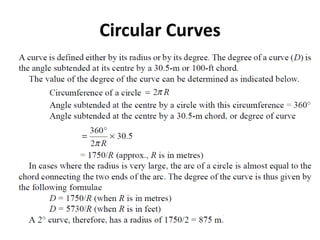
Circular Curves
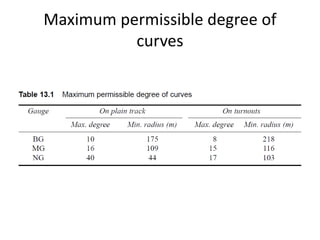
Maximum permissible degree of
curves
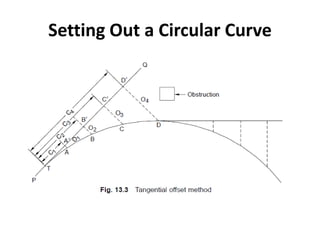
Setting Out a Circular Curve
Superelevation
• Superelevation or cant Superelevation or cant
(Ca) is the difference in height between the outer
and the inner rail on a curve.
• It is provided by gradually lifting the outer rail
above the level of the inner rail.
• The inner rail is taken as the reference rail and is
normally maintained at its original level.
• The inner rail is also known as the gradient rail.
• Actual cant for BG track limited to 165mm
The main functions of superelevation
(a) To ensure a better distribution of load on
both rails
(b) To reduce the wear and tear of the rails and
rolling stock
(c) To neutralize the effect of lateral forces
(d) To provide comfort to passengers
Equilibrium speed
• When the speed of a vehicle negotiating a curved
track is such that the resultant force of the weight
of the vehicle and of radial acceleration is
perpendicular to the plane of the rails, the vehicle
is not subjected to any unbalanced radial
acceleration and is said to be in equilibrium.
• This particular speed is called the equilibrium
speed. The equilibrium speed, as such, is the
speed at which the effect of the centrifugal force is
completely balanced by the cant provided.
Maximum permissible speed
• This is the highest speed permitted to a train
on a curve taking into consideration the radius
of curvature, actual cant, cant deficiency, cant
excess, and the length of transition.
• On cruves where the maximum permissible
speed is less than the maximum sectional
speed of the section of the line, permanent
speed restriction becomes necessary.
Cant deficiency
• Cant deficiency (Cd) occurs when a train
travels around a curve at a speed higher than
the equilibrium speed. It is the difference
between the theoretical cant required for such
high speeds and the actual cant provided.
Cant excess
• Cant excess (Ce) occurs when a train travels
around a curve at a speed lower than the
equilibrium speed. It is the difference
between the actual cant provided and the
theoretical cant required for such a low speed.
• The limiting values of cant excess have also
been prescribed. Cant excess should not be
more than 75 mm on broad gauge and 65 mm
on metre gauge for all types of rolling stock.
Cant gradient and cant deficiency
gradient
• These indicate the increase or decrease in the
cant or the deficiency of cant in a given length
of transition.
• A gradient of 1 in 1000 means that a cant or a
deficiency of cant of 1 mm is attained or lost
in every 1000 mm of transition length.
Rate of change of cant or cant
deficiency
• This is the rate at which cant deficiency
increases while passing over the transition
curve, e.g., a rate of 35 mm per second means
that a vehicle will experience a change in cant
or a cant deficiency of 35 mm in each second
of travel over the transition when travelling at
the maximum permissible speed.
Centrifugal Force on a Curved Track
• A vehicle has a tendency to travel in a straight
direction, which is tangential to the curve,
even when it moves on a circular curve. As a
result, the vehicle is subjected to a constant
radial acceleration:
Radial acceleration = g = V2/R
• where V is the velocity (metres per second)
and R is the radius of curve (metres).
• This radial acceleration produces a centrifugal
force which acts in a radial direction away from
the centre. The value of the centrifugal force is
given by the formula
• Force = mass × acceleration
F = m × (V2/R)
= (W/g) × (V2/R)
• where F is the centrifugal force (tonnes), W is the
weight of the vehicle (tonnes), V is the speed
(metre/sec), g is the acceleration due to gravity
(metre/sec2), and R is the radius of the curve
(metres).
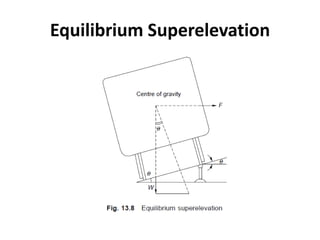
• To counteract the effect of the centrifugal force,
the outer rail of the curve is elevated with
respect to the inner rail by an amount equal to
the superelevation
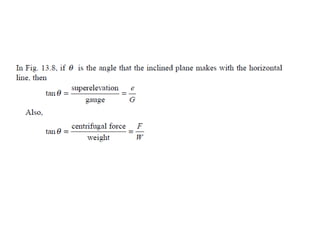
• A state of equilibrium is reached when both the
wheels exert equal pressure on the rails and the
superelevation is enough to bring the resultant
of the centrifugal force and the force exerted by
the weight of the vehicle at right angles to the
plane of the top surface of the rails. In this state
of equilibrium, the difference in the heights of
the outer and inner rails of the curve known as
equilibrium superelevation.
Equilibrium Superelevation
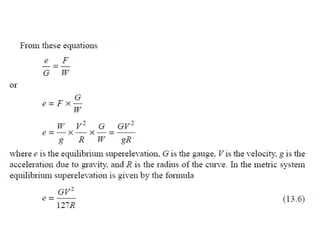
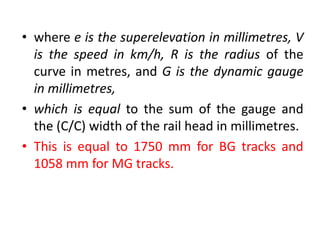
• where e is the superelevation in millimetres, V
is the speed in km/h, R is the radius of the
curve in metres, and G is the dynamic gauge
in millimetres,
• which is equal to the sum of the gauge and
the (C/C) width of the rail head in millimetres.
• This is equal to 1750 mm for BG tracks and
1058 mm for MG tracks.
Negative Superelevation
• When the main line lies on a curve and has a
turnout of contrary flexure leading to a branch
line, the superelevation necessary for the
average speed of trains running over the main
line curve cannot be provided.
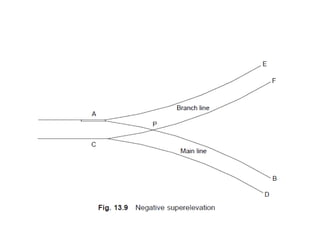
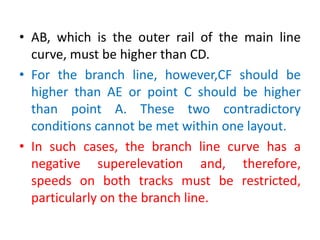
• AB, which is the outer rail of the main line
curve, must be higher than CD.
• For the branch line, however,CF should be
higher than AE or point C should be higher
than point A. These two contradictory
conditions cannot be met within one layout.
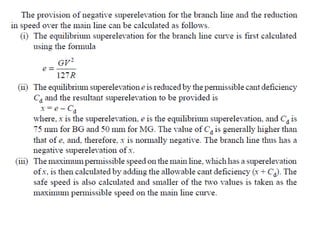
• In such cases, the branch line curve has a
negative superelevation and, therefore,
speeds on both tracks must be restricted,
particularly on the branch line.
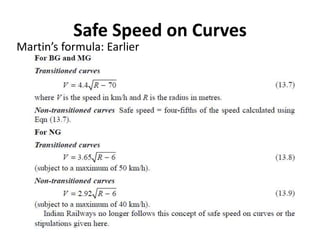
Safe Speed on Curves
Martin’s formula: Earlier
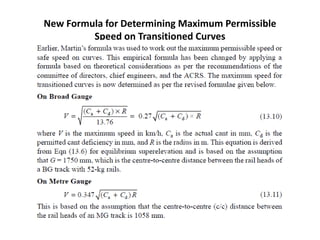
New Formula for Determining Maximum Permissible
Speed on Transitioned Curves
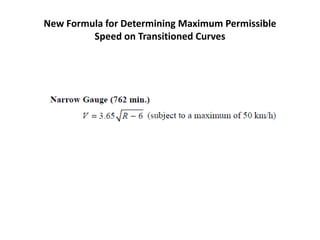
New Formula for Determining Maximum Permissible
Speed on Transitioned Curves
Maximum Permissible Speed on a
Curve
• The maximum permissible speed on a curve is the
minimum value of the speed that is calculated
after determining the four different speed limits
mentioned here.
• The first three speed limits are taken into account
for the calculation of maximum permissible
speed, particularly if the length of the transition
curve can be increased.
• For high-speed routes, however, the fourth speed
limit is also very important, as cases may arise
when the length of the transition curve cannot be
altered easily.
(i) Maximum sanctioned speed of the
section
• This is the maximum permissible speed
authorized by the commissioner of railway
safety. This is determined after an analysis of
the condition of the track, the standard of
interlocking, the type of locomotive and
rolling stock used, and other such factors.
(ii) Maximum speed of the section taking into
consideration cant deficiency
• Equilibrium speed is decided after taking
various factors into consideration and the
equilibrium superelevation (Ca) calculated.
The cant deficiency (Cd) is then added to the
equilibrium superelevation and the maximum
speed is calculated as per this increased
superelevalion (Ca + Cd).
(iii) Maximum speed taking into consideration speed of goods
train and cant
excess
• Cant (Ca) is calculated based on the speed of slow
moving traffic, i.e., goods train. This speed is
decided for each section after taking various
factors into account, but generally its value is 65
km/h for BG and 50 km/h for MG.
• The maximum value of cant excess (Ce) is added
to this cant and it should be ensured that the cant
for the maximum speed does not exceed the
value of the sum of the actual cant + and the cant
excess (Ca + Ce).
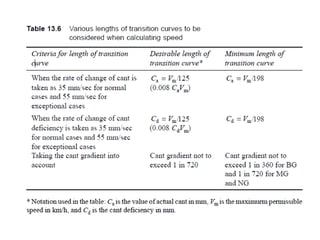
(iv) Speed corresponding to the
length of the transition curves
• This is the least value of speed calculated after
taking into consideration the various lenths of
transition curves given by the formulae listed
in Table 13.6.
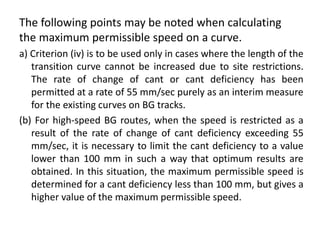
The following points may be noted when calculating
the maximum permissible speed on a curve.
a) Criterion (iv) is to be used only in cases where the length of the
transition curve cannot be increased due to site restrictions.
The rate of change of cant or cant deficiency has been
permitted at a rate of 55 mm/sec purely as an interim measure
for the existing curves on BG tracks.
(b) For high-speed BG routes, when the speed is restricted as a
result of the rate of change of cant deficiency exceeding 55
mm/sec, it is necessary to limit the cant deficiency to a value
lower than 100 mm in such a way that optimum results are
obtained. In this situation, the maximum permissible speed is
determined for a cant deficiency less than 100 mm, but gives a
higher value of the maximum permissible speed.
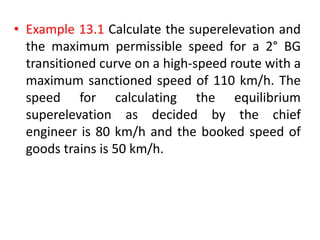
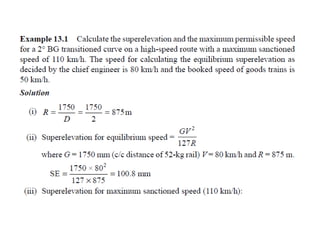
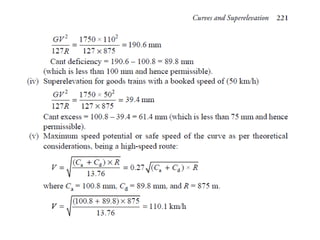
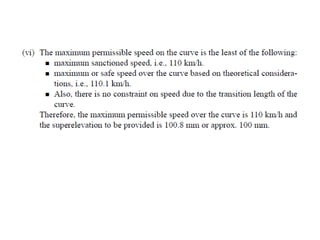
• Example 13.1 Calculate the superelevation and
the maximum permissible speed for a 2° BG
transitioned curve on a high-speed route with a
maximum sanctioned speed of 110 km/h. The
speed for calculating the equilibrium
superelevation as decided by the chief
engineer is 80 km/h and the booked speed of
goods trains is 50 km/h.
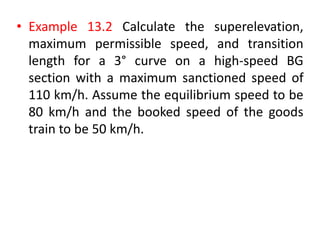
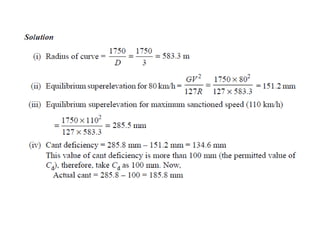
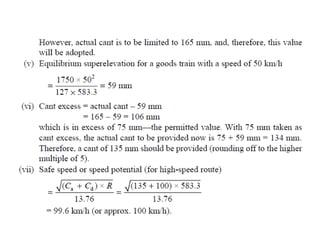
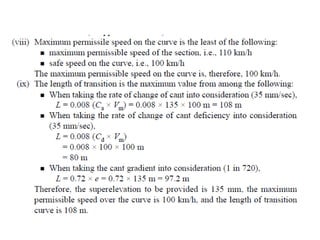
• Example 13.2 Calculate the superelevation,
maximum permissible speed, and transition
length for a 3° curve on a high-speed BG
section with a maximum sanctioned speed of
110 km/h. Assume the equilibrium speed to be
80 km/h and the booked speed of the goods
train to be 50 km/h.
Reference
• Railway Engineering book written by
SATISH CHANDRA,Professor, Department of Civil
Engineering,Indian Institute of Technology
Roorkee.

Railway Engineering-Curves and superelevation

  • 1.
    Curves and Superelevation MrManivel M Department of Civil Engineering Pandit Deendayal Petroleum University
  • 2.
    Introduction • Horizontal curvesare provided when a change in the direction of the track is required and vertical curves are provided at points where two gradients meet or where a gradient meets level ground. • To provide a comfortable ride on a horizontal curve, the level of the outer rail is raised above the level of the inner rail. This is known as superelevation.
  • 3.
  • 4.
  • 5.
    Setting Out aCircular Curve
  • 6.
    Superelevation • Superelevation orcant Superelevation or cant (Ca) is the difference in height between the outer and the inner rail on a curve. • It is provided by gradually lifting the outer rail above the level of the inner rail. • The inner rail is taken as the reference rail and is normally maintained at its original level. • The inner rail is also known as the gradient rail. • Actual cant for BG track limited to 165mm
  • 7.
    The main functionsof superelevation (a) To ensure a better distribution of load on both rails (b) To reduce the wear and tear of the rails and rolling stock (c) To neutralize the effect of lateral forces (d) To provide comfort to passengers
  • 8.
    Equilibrium speed • Whenthe speed of a vehicle negotiating a curved track is such that the resultant force of the weight of the vehicle and of radial acceleration is perpendicular to the plane of the rails, the vehicle is not subjected to any unbalanced radial acceleration and is said to be in equilibrium. • This particular speed is called the equilibrium speed. The equilibrium speed, as such, is the speed at which the effect of the centrifugal force is completely balanced by the cant provided.
  • 9.
    Maximum permissible speed •This is the highest speed permitted to a train on a curve taking into consideration the radius of curvature, actual cant, cant deficiency, cant excess, and the length of transition. • On cruves where the maximum permissible speed is less than the maximum sectional speed of the section of the line, permanent speed restriction becomes necessary.
  • 10.
    Cant deficiency • Cantdeficiency (Cd) occurs when a train travels around a curve at a speed higher than the equilibrium speed. It is the difference between the theoretical cant required for such high speeds and the actual cant provided.
  • 11.
    Cant excess • Cantexcess (Ce) occurs when a train travels around a curve at a speed lower than the equilibrium speed. It is the difference between the actual cant provided and the theoretical cant required for such a low speed. • The limiting values of cant excess have also been prescribed. Cant excess should not be more than 75 mm on broad gauge and 65 mm on metre gauge for all types of rolling stock.
  • 12.
    Cant gradient andcant deficiency gradient • These indicate the increase or decrease in the cant or the deficiency of cant in a given length of transition. • A gradient of 1 in 1000 means that a cant or a deficiency of cant of 1 mm is attained or lost in every 1000 mm of transition length.
  • 13.
    Rate of changeof cant or cant deficiency • This is the rate at which cant deficiency increases while passing over the transition curve, e.g., a rate of 35 mm per second means that a vehicle will experience a change in cant or a cant deficiency of 35 mm in each second of travel over the transition when travelling at the maximum permissible speed.
  • 14.
    Centrifugal Force ona Curved Track • A vehicle has a tendency to travel in a straight direction, which is tangential to the curve, even when it moves on a circular curve. As a result, the vehicle is subjected to a constant radial acceleration: Radial acceleration = g = V2/R • where V is the velocity (metres per second) and R is the radius of curve (metres).
  • 15.
    • This radialacceleration produces a centrifugal force which acts in a radial direction away from the centre. The value of the centrifugal force is given by the formula • Force = mass × acceleration F = m × (V2/R) = (W/g) × (V2/R) • where F is the centrifugal force (tonnes), W is the weight of the vehicle (tonnes), V is the speed (metre/sec), g is the acceleration due to gravity (metre/sec2), and R is the radius of the curve (metres).
  • 16.
    • To counteractthe effect of the centrifugal force, the outer rail of the curve is elevated with respect to the inner rail by an amount equal to the superelevation • A state of equilibrium is reached when both the wheels exert equal pressure on the rails and the superelevation is enough to bring the resultant of the centrifugal force and the force exerted by the weight of the vehicle at right angles to the plane of the top surface of the rails. In this state of equilibrium, the difference in the heights of the outer and inner rails of the curve known as equilibrium superelevation.
  • 17.
  • 20.
    • where eis the superelevation in millimetres, V is the speed in km/h, R is the radius of the curve in metres, and G is the dynamic gauge in millimetres, • which is equal to the sum of the gauge and the (C/C) width of the rail head in millimetres. • This is equal to 1750 mm for BG tracks and 1058 mm for MG tracks.
  • 21.
    Negative Superelevation • Whenthe main line lies on a curve and has a turnout of contrary flexure leading to a branch line, the superelevation necessary for the average speed of trains running over the main line curve cannot be provided.
  • 23.
    • AB, whichis the outer rail of the main line curve, must be higher than CD. • For the branch line, however,CF should be higher than AE or point C should be higher than point A. These two contradictory conditions cannot be met within one layout. • In such cases, the branch line curve has a negative superelevation and, therefore, speeds on both tracks must be restricted, particularly on the branch line.
  • 25.
    Safe Speed onCurves Martin’s formula: Earlier
  • 26.
    New Formula forDetermining Maximum Permissible Speed on Transitioned Curves
  • 27.
    New Formula forDetermining Maximum Permissible Speed on Transitioned Curves
  • 28.
    Maximum Permissible Speedon a Curve • The maximum permissible speed on a curve is the minimum value of the speed that is calculated after determining the four different speed limits mentioned here. • The first three speed limits are taken into account for the calculation of maximum permissible speed, particularly if the length of the transition curve can be increased. • For high-speed routes, however, the fourth speed limit is also very important, as cases may arise when the length of the transition curve cannot be altered easily.
  • 29.
    (i) Maximum sanctionedspeed of the section • This is the maximum permissible speed authorized by the commissioner of railway safety. This is determined after an analysis of the condition of the track, the standard of interlocking, the type of locomotive and rolling stock used, and other such factors.
  • 30.
    (ii) Maximum speedof the section taking into consideration cant deficiency • Equilibrium speed is decided after taking various factors into consideration and the equilibrium superelevation (Ca) calculated. The cant deficiency (Cd) is then added to the equilibrium superelevation and the maximum speed is calculated as per this increased superelevalion (Ca + Cd).
  • 31.
    (iii) Maximum speedtaking into consideration speed of goods train and cant excess • Cant (Ca) is calculated based on the speed of slow moving traffic, i.e., goods train. This speed is decided for each section after taking various factors into account, but generally its value is 65 km/h for BG and 50 km/h for MG. • The maximum value of cant excess (Ce) is added to this cant and it should be ensured that the cant for the maximum speed does not exceed the value of the sum of the actual cant + and the cant excess (Ca + Ce).
  • 32.
    (iv) Speed correspondingto the length of the transition curves • This is the least value of speed calculated after taking into consideration the various lenths of transition curves given by the formulae listed in Table 13.6.
  • 33.
    The following pointsmay be noted when calculating the maximum permissible speed on a curve. a) Criterion (iv) is to be used only in cases where the length of the transition curve cannot be increased due to site restrictions. The rate of change of cant or cant deficiency has been permitted at a rate of 55 mm/sec purely as an interim measure for the existing curves on BG tracks. (b) For high-speed BG routes, when the speed is restricted as a result of the rate of change of cant deficiency exceeding 55 mm/sec, it is necessary to limit the cant deficiency to a value lower than 100 mm in such a way that optimum results are obtained. In this situation, the maximum permissible speed is determined for a cant deficiency less than 100 mm, but gives a higher value of the maximum permissible speed.
  • 35.
    • Example 13.1Calculate the superelevation and the maximum permissible speed for a 2° BG transitioned curve on a high-speed route with a maximum sanctioned speed of 110 km/h. The speed for calculating the equilibrium superelevation as decided by the chief engineer is 80 km/h and the booked speed of goods trains is 50 km/h.
  • 39.
    • Example 13.2Calculate the superelevation, maximum permissible speed, and transition length for a 3° curve on a high-speed BG section with a maximum sanctioned speed of 110 km/h. Assume the equilibrium speed to be 80 km/h and the booked speed of the goods train to be 50 km/h.
  • 43.
    Reference • Railway Engineeringbook written by SATISH CHANDRA,Professor, Department of Civil Engineering,Indian Institute of Technology Roorkee.