EEG 
DR MANDAR HAVAL
• EEG is about pattern recognition 
• ECG is about precision
EEG – systematic approach 
• Minimal technical requirements 
• 16 channels 
• Atleast 3 montages 
• Longitudinal bipolar, horizontal bipolar, referential 
• Atleast 20 min recording and in neonates 1 hour
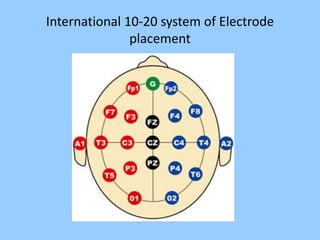
International 10-20 system of Electrode 
placement
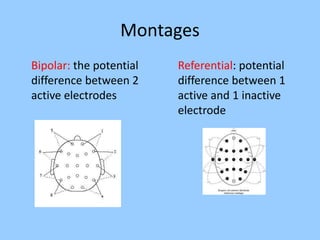
Montages 
Bipolar: the potential 
difference between 2 
active electrodes 
Referential: potential 
difference between 1 
active and 1 inactive 
electrode
EEG- what to look at? 
• Background 
• Activity – rhythmic, arhythmic, periodic 
• Evolution of the rhythm
EEG- describing the waves 
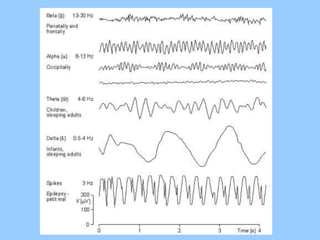
• Frequency :delta(0-4hz), theta(4-8hz), alpha(8-13hz), beta(>13 hz) 
• Amplitude: low(<25 uv), moderate(25-75uv), 
high(>75uv) 
• Location 
• Symmetry 
• Synchrony 
• Reactivity 
• Rhythmic, periodic, arhythmic 
• Morphology (spike, sharp, biphasic, triphasic)
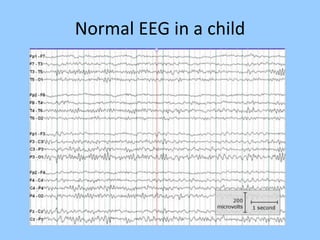
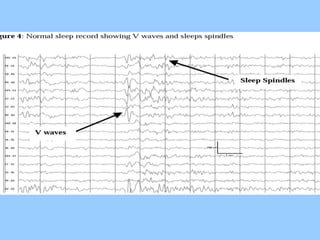
Normal EEG in a child
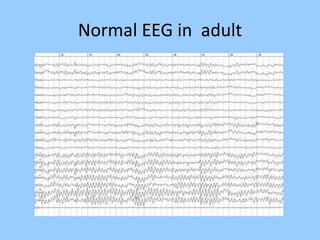
Normal EEG in adult
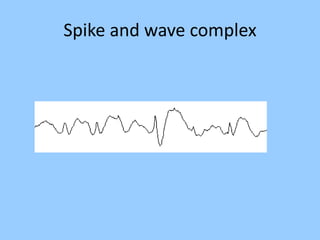
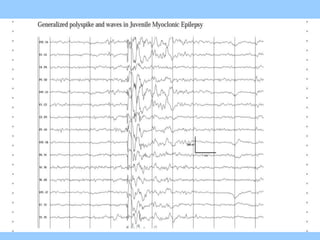
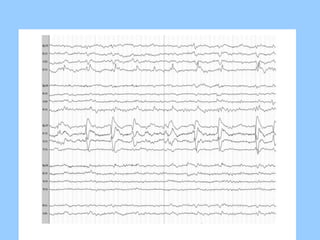
Spike and wave complex
Case 1 
• 10 year old girl 
• Developmentally normal 
• Slight deterioration in school performance last 
2 months 
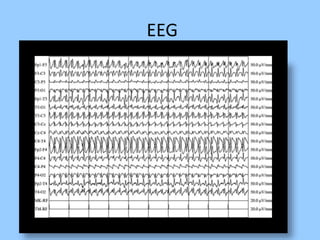
• Multiple episodes of brief staring 5 -10 sec 
• No loss of tone 
• Examination normal
EEG
Absence seizure 
• Onset 4-10 yrs 
• Hundreds per day; 4-20 secs 
• Eyes open, voluntary activity stops 
• EEG – 3per sec spike wave activity. Ppt by 
hyperventilation 
• Drug of choice – ethosuxamide/ valproate/ 
lamotrigine
Case 2 
• 5 month male 
• HIE stage 2 at birth 
• Clusters of sudden tonic flexion of entire body 
several times in a day, especially on awakening 
- 2 weeks
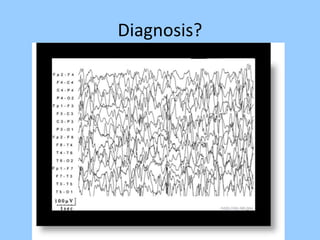
Diagnosis?
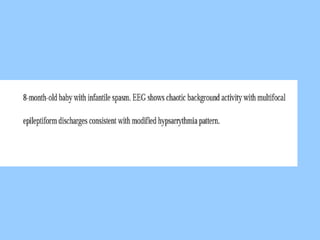
West syndrome 
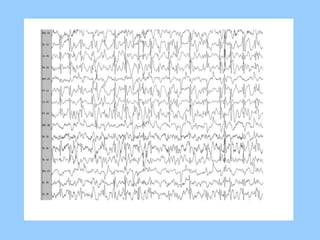
• Infantile spasms with hypsarrythmia 
• EEG – chaotic 
• High amplitude, multifocal spikes and 
polyspikes, asynchronous, arrrhythmic 
• Drugs of choice- ACTH/ steroids
Case 4 
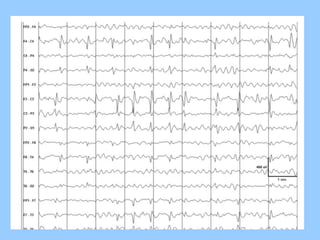
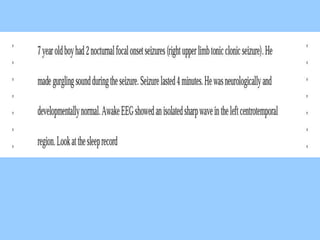
• 7 year old boy 
• Nocturnal seizure, jerky movements of the 
lips, eyes wide open, unable to sleep, 
hypersalivation
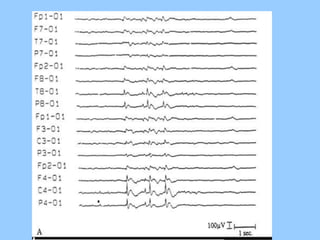
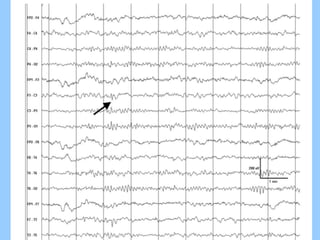
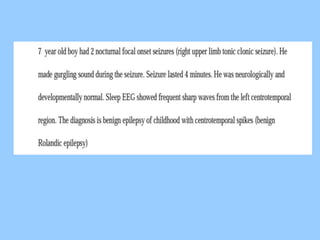
BECTS- benign childhood epilepsy with centro-temporal 
spikes (Rolandic epilepsy) 
• Onset 1-14 yrs 
• Unilateral facial sensorimotor seizures 
• Hypersalivation 
• Speech arrest 
• Oropharyngeal manifestations 
• Prognosis- most remit in 2-4 yrs 
• Treatment- nil/ CMZ/LVT
Case 4 
• 8 year old boy 
• h/o delayed milestones – walking 2 yrs, 
speech 3 years 
• Multiple types of seizures several times a day 
– 2 months 
• Tonic seizures, atonic falls, myoclonic seizures 
• Regression of milestones
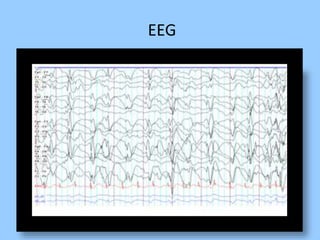
EEG
EEG of Lennox Gastaut Syndrome 
• Background – slow and disorganised 
• Slow generalized spike wave ( < 2.5 cps) 
• Multiple independent spike foci 
• Very fast ( 10-20 cps) paroxysmal activity s/o 
tonic seizures
Management of LGS 
• Multiple anti epileptic drugs 
• Poor response 
• Non AED’s- IVIG, steroids, ketogenic diet 
• Surgery – corpus callosotomy
Case 5 
• 4 year old girl 
• Fever & recurrent focal seizures – 2 days 
• Comes in status epilepticus 
• Seizures stop after lorazepam and phenytoin 
• Patient remains comatose > 24 hours after all 
motor seizures have stopped.
EEG
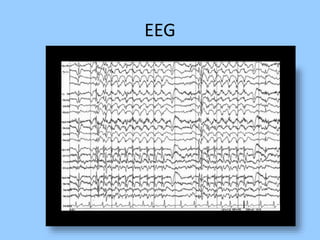
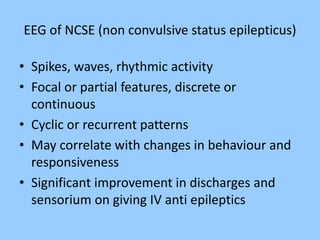
EEG of NCSE (non convulsive status epilepticus) 
• Spikes, waves, rhythmic activity 
• Focal or partial features, discrete or 
continuous 
• Cyclic or recurrent patterns 
• May correlate with changes in behaviour and 
responsiveness 
• Significant improvement in discharges and 
sensorium on giving IV anti epileptics
Case 7 
• 11 year old boy 
• Cognitive decline last 6 months 
• Repetitive extensor myoclonus last 1 month 
• Stopped walking, speaking, swallowing last 15 
days 
• Past h/o measles at 3 years
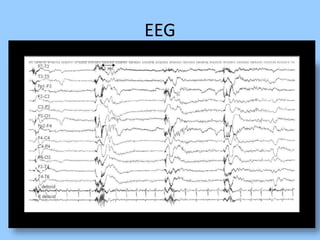
EEG
SSPE 
• EEG: stereotyped, generalized and 
synchronous high amplitude periodic 
complexes 
• Diagnosis: Elevated CSF anti measles 
antibodies 
• Prognosis: grim
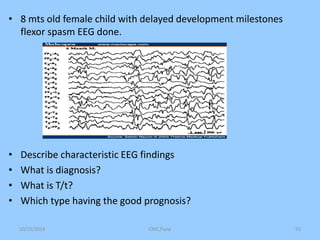
• 8 mts old female child with delayed development milestones 
flexor spasm EEG done. 
• Describe characteristic EEG findings 
• What is diagnosis? 
• What is T/t? 
• Which type having the good prognosis? 
10/15/2014 CME,Pune 55
• Hppsarrythmia 
• Infartile spasms 
• ACTH and glucocorticoids 
• Cryptogenic infantile spasms 
10/15/2014 CME,Pune 56
12.Child with fever , convulsions, altered 
sensorium 
CSF picture : protein 62, 
cells 95 P10 L90, 
sugars 45/80, 
RBCs 80/ hpf 
• Additional 2 investigations of choice 
• Treatment with dose
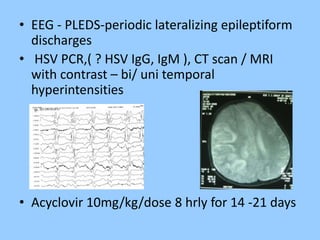
• EEG - PLEDS-periodic lateralizing epileptiform 
discharges 
• HSV PCR,( ? HSV IgG, IgM ), CT scan / MRI 
with contrast – bi/ uni temporal 
hyperintensities 
• Acyclovir 10mg/kg/dose 8 hrly for 14 -21 days
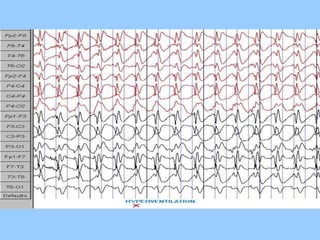
6) What does this EEG show? 
• What is the drug of choice? 
• Prognosis? 
• One OPD procedure to confirm diagnosis
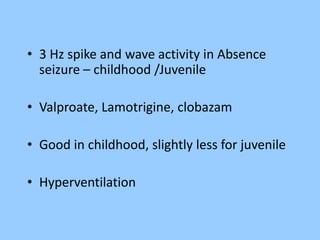
• 3 Hz spike and wave activity in Absence 
seizure – childhood /Juvenile 
• Valproate, Lamotrigine, clobazam 
• Good in childhood, slightly less for juvenile 
• Hyperventilation
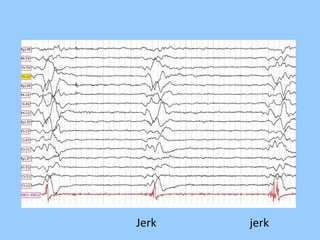
Jerk jerk
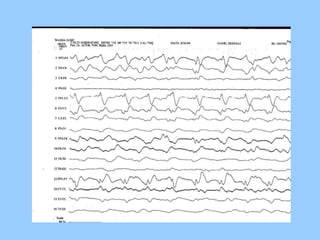
7) Diagnosis 
• Confirmatory test 
• 3 therapeutic options
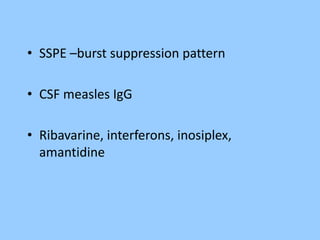
• SSPE –burst suppression pattern 
• CSF measles IgG 
• Ribavarine, interferons, inosiplex, 
amantidine
8) Diagnosis 
• Commonest etiology 
• Drug of choice
• PLEDS 
• Herpes encephalitis 
• Acyclovir
9) 6 yr old male admitted with prolonged 
generalised seizures. 
• Immediate AEDs –name 2 with dose 
• 2nd line AEDs –2 with dose 
• 3rd line – name 2
• Lorazepam [0.05mg/kg], 
• Diazepam [0.3mg/kg], 
• midazolam[ 0.2mg/kg] 
• Phenytoin[ 20mg/kg], 
• phenobarb[20/kg] 
• Midazolam drip, 
• propofol, 
• thiopentol
10) 6 months old child with h/o perinatal 
insult comes with regression of social 
milestones and clusters of startles on 
awakening . 
• Diagnosis 
• Name 2 investigations you will ask for?
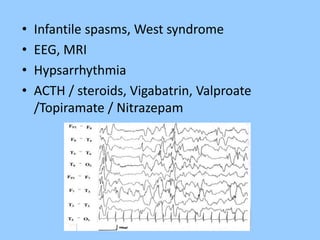
• Infantile spasms, West syndrome 
• EEG, MRI 
• Hypsarrhythmia 
• ACTH / steroids, Vigabatrin, Valproate 
/Topiramate / Nitrazepam
• Station No : A term newborn who required resuscitation at 
birth with a 5 minute APGAR of 5 is admitted in NICU. The 
neonate had seizures in first 12 hrs of life 
• Identify the findings-[1] 
• What is the significance of this finding- [1/2] 
• Name of the staging system other than Sarnat and Sarnat and 
give its component- [1]
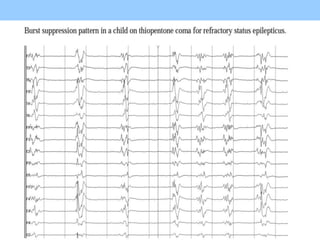
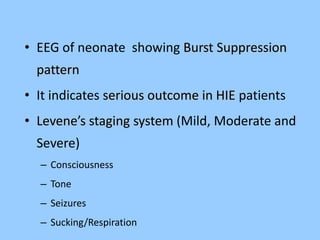
• EEG of neonate showing Burst Suppression 
pattern 
• It indicates serious outcome in HIE patients 
• Levene’s staging system (Mild, Moderate and 
Severe) 
– Consciousness 
– Tone 
– Seizures 
– Sucking/Respiration
Eeg in pediatric (DNB PEDIATRIC)

Eeg in pediatric (DNB PEDIATRIC)

  • 1.
  • 2.
    • EEG isabout pattern recognition • ECG is about precision
  • 3.
    EEG – systematicapproach • Minimal technical requirements • 16 channels • Atleast 3 montages • Longitudinal bipolar, horizontal bipolar, referential • Atleast 20 min recording and in neonates 1 hour
  • 4.
    International 10-20 systemof Electrode placement
  • 5.
    Montages Bipolar: thepotential difference between 2 active electrodes Referential: potential difference between 1 active and 1 inactive electrode
  • 6.
    EEG- what tolook at? • Background • Activity – rhythmic, arhythmic, periodic • Evolution of the rhythm
  • 7.
    EEG- describing thewaves • Frequency :delta(0-4hz), theta(4-8hz), alpha(8-13hz), beta(>13 hz) • Amplitude: low(<25 uv), moderate(25-75uv), high(>75uv) • Location • Symmetry • Synchrony • Reactivity • Rhythmic, periodic, arhythmic • Morphology (spike, sharp, biphasic, triphasic)
  • 8.
  • 9.
  • 11.
  • 12.
    Case 1 •10 year old girl • Developmentally normal • Slight deterioration in school performance last 2 months • Multiple episodes of brief staring 5 -10 sec • No loss of tone • Examination normal
  • 13.
  • 14.
    Absence seizure •Onset 4-10 yrs • Hundreds per day; 4-20 secs • Eyes open, voluntary activity stops • EEG – 3per sec spike wave activity. Ppt by hyperventilation • Drug of choice – ethosuxamide/ valproate/ lamotrigine
  • 15.
    Case 2 •5 month male • HIE stage 2 at birth • Clusters of sudden tonic flexion of entire body several times in a day, especially on awakening - 2 weeks
  • 16.
  • 17.
    West syndrome •Infantile spasms with hypsarrythmia • EEG – chaotic • High amplitude, multifocal spikes and polyspikes, asynchronous, arrrhythmic • Drugs of choice- ACTH/ steroids
  • 18.
    Case 4 •7 year old boy • Nocturnal seizure, jerky movements of the lips, eyes wide open, unable to sleep, hypersalivation
  • 20.
    BECTS- benign childhoodepilepsy with centro-temporal spikes (Rolandic epilepsy) • Onset 1-14 yrs • Unilateral facial sensorimotor seizures • Hypersalivation • Speech arrest • Oropharyngeal manifestations • Prognosis- most remit in 2-4 yrs • Treatment- nil/ CMZ/LVT
  • 21.
    Case 4 •8 year old boy • h/o delayed milestones – walking 2 yrs, speech 3 years • Multiple types of seizures several times a day – 2 months • Tonic seizures, atonic falls, myoclonic seizures • Regression of milestones
  • 22.
  • 23.
    EEG of LennoxGastaut Syndrome • Background – slow and disorganised • Slow generalized spike wave ( < 2.5 cps) • Multiple independent spike foci • Very fast ( 10-20 cps) paroxysmal activity s/o tonic seizures
  • 24.
    Management of LGS • Multiple anti epileptic drugs • Poor response • Non AED’s- IVIG, steroids, ketogenic diet • Surgery – corpus callosotomy
  • 25.
    Case 5 •4 year old girl • Fever & recurrent focal seizures – 2 days • Comes in status epilepticus • Seizures stop after lorazepam and phenytoin • Patient remains comatose > 24 hours after all motor seizures have stopped.
  • 26.
  • 27.
    EEG of NCSE(non convulsive status epilepticus) • Spikes, waves, rhythmic activity • Focal or partial features, discrete or continuous • Cyclic or recurrent patterns • May correlate with changes in behaviour and responsiveness • Significant improvement in discharges and sensorium on giving IV anti epileptics
  • 28.
    Case 7 •11 year old boy • Cognitive decline last 6 months • Repetitive extensor myoclonus last 1 month • Stopped walking, speaking, swallowing last 15 days • Past h/o measles at 3 years
  • 29.
  • 30.
    SSPE • EEG:stereotyped, generalized and synchronous high amplitude periodic complexes • Diagnosis: Elevated CSF anti measles antibodies • Prognosis: grim
  • 55.
    • 8 mtsold female child with delayed development milestones flexor spasm EEG done. • Describe characteristic EEG findings • What is diagnosis? • What is T/t? • Which type having the good prognosis? 10/15/2014 CME,Pune 55
  • 56.
    • Hppsarrythmia •Infartile spasms • ACTH and glucocorticoids • Cryptogenic infantile spasms 10/15/2014 CME,Pune 56
  • 57.
    12.Child with fever, convulsions, altered sensorium CSF picture : protein 62, cells 95 P10 L90, sugars 45/80, RBCs 80/ hpf • Additional 2 investigations of choice • Treatment with dose
  • 58.
    • EEG -PLEDS-periodic lateralizing epileptiform discharges • HSV PCR,( ? HSV IgG, IgM ), CT scan / MRI with contrast – bi/ uni temporal hyperintensities • Acyclovir 10mg/kg/dose 8 hrly for 14 -21 days
  • 60.
    6) What doesthis EEG show? • What is the drug of choice? • Prognosis? • One OPD procedure to confirm diagnosis
  • 61.
    • 3 Hzspike and wave activity in Absence seizure – childhood /Juvenile • Valproate, Lamotrigine, clobazam • Good in childhood, slightly less for juvenile • Hyperventilation
  • 62.
  • 63.
    7) Diagnosis •Confirmatory test • 3 therapeutic options
  • 64.
    • SSPE –burstsuppression pattern • CSF measles IgG • Ribavarine, interferons, inosiplex, amantidine
  • 66.
    8) Diagnosis •Commonest etiology • Drug of choice
  • 67.
    • PLEDS •Herpes encephalitis • Acyclovir
  • 68.
    9) 6 yrold male admitted with prolonged generalised seizures. • Immediate AEDs –name 2 with dose • 2nd line AEDs –2 with dose • 3rd line – name 2
  • 69.
    • Lorazepam [0.05mg/kg], • Diazepam [0.3mg/kg], • midazolam[ 0.2mg/kg] • Phenytoin[ 20mg/kg], • phenobarb[20/kg] • Midazolam drip, • propofol, • thiopentol
  • 70.
    10) 6 monthsold child with h/o perinatal insult comes with regression of social milestones and clusters of startles on awakening . • Diagnosis • Name 2 investigations you will ask for?
  • 71.
    • Infantile spasms,West syndrome • EEG, MRI • Hypsarrhythmia • ACTH / steroids, Vigabatrin, Valproate /Topiramate / Nitrazepam
  • 72.
    • Station No: A term newborn who required resuscitation at birth with a 5 minute APGAR of 5 is admitted in NICU. The neonate had seizures in first 12 hrs of life • Identify the findings-[1] • What is the significance of this finding- [1/2] • Name of the staging system other than Sarnat and Sarnat and give its component- [1]
  • 73.
    • EEG ofneonate showing Burst Suppression pattern • It indicates serious outcome in HIE patients • Levene’s staging system (Mild, Moderate and Severe) – Consciousness – Tone – Seizures – Sucking/Respiration