R E S E A R C H P A P E R 
Safety and Efficacy of Isotonic (0.9%) vs. Hypotonic (0.18%) Saline as 
Maintenance Intravenous Fluids in Children: 
A Randomized Controlled Trial 
AHMAR SHAMIM, KAMRAN AFZAL AND S MANAZIR ALI 
From Department of Pediatrics, Jawaharlal Nehru Medical College, Aligarh Muslim University, Aligarh, Uttar Pradesh, India. 
Correspondence to: Dr Ahmar Shamim, Assistant Professor, Mahatma Gandhi Mission Medical College, Navi Mumbai, 
Maharashtra, India. ahmar_shamim@yahoo.com 
Received: July 18, 2014; Initial review: September 26, 2014; Accepted: October 09, 2014. 
Objective: To compare the safety and efficacy of isotonic versus 
hypotonic maintenance fluid in children. 
Design: Randomized controlled trial. 
Setting: Tertiary-level teaching hospital. 
Participants: 60 children (age 0.5 to 12 years) who were admitted 
and anticipated to receive intravenous fluid for the next 48 hours. 
Intervention: Hypotonic fluid (Standard maintenance volume as 
0.18% NaCl in 5% dextrose) or Isotonic fluid (60% Standard 
maintenance volume as 0.9% NaCl solution in 5% dextrose). 
Outcome measures: Primary: Incidence of hyponatremia. 
Secondary: Serum sodium, serum osmolality, blood sugar, blood 
urea, serum creatinine, serum potassium, serum chloride, pH, 
urine output, change in weight, morbidity and death. Results: At 
24 hours, hyponatremia was noted in 7 (24%) patients in the 
isotonic and 16 (55%) in hypotonic group (P=0.031). At 48 hours, 
hyponatremia was noted in 4 (14%) and 13 (45%) patients in 
isotonic and hypotonic group, respectively (P=0.02). There was 
significant change in sodium levels in both isotonic (P=0.036) and 
hypotonic (P<0.001) intervention groups. The peak fall in mean 
serum sodium level was noted at 24 hours (-6.5, 95%CI: -3.5, -9.6 
mEq/L; P<0.001) in hypotonic group. In isotonic group, there was 
significant increase between 24 and 48 hours (4.3, 95% CI: 0.1, 
8.4 mEq/L; P=0.04). 
Conclusions: Reduced volume isotonic fluid results in fewer 
episodes of hyponatremia than hypotonic fluid in sick children 
during the first 48 hours of intravenous fluid therapy. 
Keywords: Hyponatremia, Intravenous fluids, Normal saline, 
Parenteral fluid therapy. 
Trial registration: CTRI/2010/091/000398. 
Recommendation for the use of a hypotonic 
saline solution (0.18% saline in 5% dextrose) 
in children is still a debated subject despite 
half a century of its practice [1]. Reports of 
symptomatic hyponatremia in hospitalized surgical and 
non-surgical pediatric patients – caused primarily by 
various non-osmotic release of vasopressin, but 
contributed by electrolyte-free water input in a 
proportion of cases – have fueled these debates [2-5]. Use 
of conventional volume maintenance isotonic saline has 
been shown to reduce the incidence of hyponatraemia [6]. 
Using indirect calorimetric measurements, energy 
expenditure in critically ill children may be as low as 50- 
60 kcal/kg/day [7]. Consequently, fluid requirement, 
which is directly proportional to the actual energy 
expenditure, is much less than previously assumed in 
critically ill children for a variety of reasons such as 
physical immobility, the use of muscle relaxants and 
sedatives, mechanical ventilation, and additional factors 
such as nonessential or facultative metabolism [8]. 
Therefore, we hypothesized that use of reduced volume 
isotonic maintenance fluid would decrease the incidence 
of hyponatremia in sick children, when compared to 
hypotonic fluid. We compared the efficacy and safety of 
isotonic fluid (0.9% NaCl in 5% dextrose) at the rate of 
60% of daily fluid requirement versus hypotonic fluid 
(0.18% NaCl in 5% dextrose) at the rate of standard 
maintenance volume in sick children. 
Accompanying Editorials: Pages 963-66. 
METHODS 
This open-label randomized controlled trial was 
conducted in the Pediatric ward of Jawahar Lal Nehru 
Medical College Hospital in Aligarh, India from 
November 2009 to October 2010. Children in the age 
group of 0.5 to 12 years, who were admitted and 
anticipated to receive intravenous fluid for the next 48 
hours, were considered for recruitment into the study. 
Written informed consent was obtained from the parent or 
guardian of all patients before enrolment. The study 
protocol was approved by the Institute Ethics Committee. 
Children with hyponatremia (serum sodium <130 
INDIAN PEDIATRICS 969 VOLUME 51__DECEMBER 15, 2014
SHAMIM, et al. ISOTONIC VS. HYPOTONIC MAINTENANCE IV FLUIDS 
mEq/L), hypernatremia (serum sodium >150 mEq/L), 
acute gastroenteritis, hemodynamic instability (shock, 
myocarditisbcongestive heart failure), acute or chronic 
kidney disease, a history/evidence of cardiac dys-function, 
uncontrolled seizures, severe developmental delay, 
diabetes mellitus or insipidus, and severe malnutrition, 
were excluded. Children with pre-existing hypertension, 
diuretic use, edema, or known adrenal dysfunction, or 
those who had received intravenous fluid within preceding 
3 hours were also excluded. 
All eligible patients were randomized to receive either 
hypotonic saline solution (0.18% NaCl in 5% dextrose), at 
the rate of standard maintenance volume or isotonic saline 
solution (0.9% NaCl solution in 5% dextrose), at the rate 
of 60% of standard maintenance volume. Maintenance 
fluid volume for administration was calculated using 
Holliday and Segar formula [1]. Both groups also received 
1 mL of potassium chloride per 100 mL of intravenous 
fluids. Randomization sequence was generated (block 
randomization, size 4) and maintained by a colleague not 
directly involved in this trial using an online computer 
program. The allocated intervention was kept in 
sequentially labeled sealed opaque envelopes to be opened 
at the time of randomization. 
Baseline demographic, anthropometric and laboratory 
characteristics were noted at enrolment. All patients were 
monitored clinically for symptoms and signs of 
dysnatremia, and signs of fluid overload or dehydration 
throughout the study period. Clinical assessment, 
including weight and urine output was done every 12 
hours. Laboratory measurements included 12-hourly 
serum sodium, serum potassium, serum chloride, pH 
(Combiline Eschweiler blood gas and electrolyte 
analyzer), blood urea, serum creatinine and blood sugar. 
Serum osmolality (by freeze point depression using 
Osmomat-30, Gonotech, Germany) was done at 0, 24 and 
48 hours. Participants who developed symptomatic 
dysnatremia (serum sodium <130 or >150mEq/L) or 
asymptomatic dysnatremia (serum sodium <125 or 
>155mEq/L), dehydration/features of hypervolemia, 
require fluid boluses for volume resuscitation, weight loss 
of >5%, increase in blood urea/serum creatinine >10% 
from baseline or urine output <1mL/kg/hr at any stage 
were excluded from the study. 
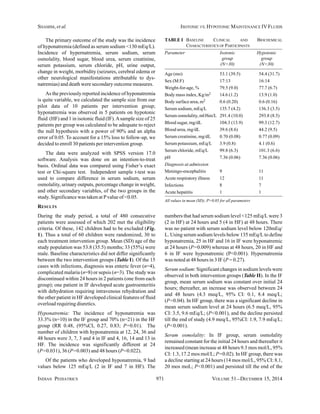
Assessed for eligibility 
202 
Excluded 142 
Hyponatremia (<130meq/L) 32 
Hemodynamic instability 56 
IV fluids in preceding 3 hours 27 
Kidney disease, cardiac dysfunction, 
chronic neuroligical illness, dehydration 19 
Hypertension, diuretic use, edema 23 
Refused consent 5 
Randomized 
60 
Isotonic group 30 
Received allocated intervention 30 
Hypotonic group 30 
Received allocated intervention 30 
Lost to follow-up 0 
Discontinued intervention (fluid overload 
that required diuretic use) 1 
Lost to follow-up 0 
Discontinued intervention (diarrhea and 
dehydration required IV rehydration) 1 
Analyzed 30 
Excluded from analysis 0 
Allocation 
Follow-up 
Analysis 
Analyzed 30 
Excluded from analysis 0 
FIG. 1 Flow of patients in the study. 
INDIAN PEDIATRICS 970 VOLUME 51__DECEMBER 15, 2014
SHAMIM, et al. ISOTONIC VS. HYPOTONIC MAINTENANCE IV FLUIDS 
The primary outcome of the study was the incidence 
of hyponatremia (defined as serum sodium <130 mEq/L). 
Incidence of hypernatremia, serum sodium, serum 
osmolality, blood sugar, blood urea, serum creatinine, 
serum potassium, serum chloride, pH, urine output, 
change in weight, morbidity (seizures, cerebral edema or 
other neurological manifestations attributable to dys-natremias) 
and death were secondary outcome measures. 
As the previously reported incidence of hyponatremia 
is quite variable, we calculated the sample size from our 
pilot data of 10 patients per intervention group; 
hyponatremia was observed in 5 patients on hypotonic 
fluid (HF) and 1 in isotonic fluid (IF). A sample size of 25 
patients per group was calculated to be adequate to reject 
the null hypothesis with a power of 90% and an alpha 
error of 0.05. To account for a 15% loss to follow-up, we 
decided to enroll 30 patients per intervention group. 
The data were analyzed with SPSS version 17.0 
software. Analysis was done on an intention-to-treat 
basis. Ordinal data was compared using Fisher’s exact 
test or Chi-square test. Independent sample t-test was 
used to compare difference in serum sodium, serum 
osmolality, urinary outputs, percentage change in weight, 
and other secondary variables, of the two groups in the 
study. Significance was taken at P value of <0.05. 
RESULTS 
During the study period, a total of 480 consecutive 
patients were assessed of which 202 met the eligibility 
criteria. Of these, 142 children had to be excluded (Fig. 
1). Thus a total of 60 children were randomized, 30 to 
each treatment intervention group. Mean (SD) age of the 
study population was 53.8 (35.5) months; 33 (55%) were 
male. Baseline characteristics did not differ significantly 
between the two intervention groups (Table I). Of the 15 
cases with infections, diagnosis was enteric fever (n=4), 
complicated malaria (n=8) or sepsis (n=3). The study was 
discontinued within 24 hours in 2 patients (one from each 
group); one patient in IF developed acute gastroenteritis 
with dehydration requiring intravenous rehydration and 
the other patient in HF developed clinical features of fluid 
overload requiring diuretics. 
Hyponatremia: The incidence of hyponatremia was 
33.3% (n=10) in the IF group and 70% (n=21) in the HF 
group (RR 0.48, (95%CI, 0.27, 0.83; P=0.01). The 
number of children with hyponatremia at 12, 24, 36 and 
48 hours were 3, 7, 3 and 4 in IF and 4, 16, 14 and 13 in 
HF. The incidence was significantly different at 24 
(P=0.031), 36 (P=0.003) and 48 hours (P=0.022). 
Of the patients who developed hyponatremia, 9 had 
values below 125 mEq/L (2 in IF and 7 in HF). The 
TABLE I BASELINE CLINICAL AND BIOCHEMICAL 
CHARACTERISTICS OF PARTICIPANTS 
Parameter Isotonic Hypotonic 
group group 
(N=30) (N=30) 
Age (mo) 53.1 (39.5) 54.4 (31.7) 
Sex (M:F) 17:13 16:14 
Weight-for-age, % 79.5 (9.0) 77.7 (6.7) 
Body mass index, Kg/m2 14.6 (1.2) 13.9 (1.0) 
Body surface area, m2 0.6 (0.20) 0.6 (0.16) 
Serum sodium, mEq/L 135.7 (4.2) 136.3 (3.5) 
Serum osmolality, mOSm/L 291.4 (10.0) 293.8 (8.5) 
Blood sugar, mg/dL 104.3 (13.9) 99.3 (12.7) 
Blood urea, mg/dL 39.6 (8.6) 44.2 (9.5) 
Serum creatinine, mg/dL 0.70 (0.08) 0.77 (0.09) 
Serum potassium, mEq/L 3.9 (0.8) 4.1 (0.6) 
Serum chloride, mEq/L 99.8 (6.3) 101.3 (6.6) 
pH 7.36 (0.06) 7.36 (0.06) 
Diagnosis at admission 
Meningo-encephalitis 9 11 
Acute respiratory illness 12 11 
Infections 8 7 
Acute hepatitis 1 1 
All values in mean (SD); P>0.05 for all parameters 
numbers that had serum sodium level <125 mEq/L were 3 
(2 in HF) at 24 hours and 5 (4 in HF) at 48 hours. There 
was no patient with serum sodium level below 120mEq/ 
L. Using serum sodium levels below 135 mEq/L to define 
hyponatremia, 25 in HF and 16 in IF were hyponatremic 
at 24 hours (P=0.009) whereas at 48 hours, 20 in HF and 
6 in IF were hyponatremic (P<0.001). Hypernatremia 
was noted at 48 hours in 3 IF (P = 0.27). 
Serum sodium: Significant changes in sodium levels were 
observed in both intervention groups (Table II). In the IF 
group, mean serum sodium was constant over initial 24 
hours; thereafter, an increase was observed between 24 
and 48 hours (4.3 meq/L, 95% CI: 0.1, 8.4 meq/L; 
(P=0.04). In HF group, there was a significant decline in 
mean serum sodium level at 24 hours (6.5 meq/L, 95% 
CI: 3.5, 9.6 mEq/L; (P<0.001), and the decline persisted 
till the end of study (4.9 meq/L, 95%CI: 1.9, 7.9 mEq/L; 
(P<0.001). 
Serum osmolality: In IF group, serum osmolality 
remained constant for the initial 24 hours and thereafter it 
increased (mean increase at 48 hours 9.3 mos mol/L, 95% 
CI: 1.3, 17.2 mos mol/L; P=0.02). In HF group, there was 
a decline starting at 24 hours (14 mos mol/L, 95% CI: 8.1, 
20 mos moL; P<0.001) and persisted till the end of the 
INDIAN PEDIATRICS 971 VOLUME 51__DECEMBER 15, 2014
SHAMIM, et al. ISOTONIC VS. HYPOTONIC MAINTENANCE IV FLUIDS 
observation period (11.7 mosmol/L, 95% CI: 5.7, 17.6 
mosmol/L; P<0.001). 
Blood urea/creatinine, serum potassium, blood sugar, 
chloride and pH: Changes in blood urea and creatinine 
were not significant, except for a significant (P<0.001) 
decline in creatinine in HF group. There were no episodes 
of hypo - or hyper-kalemia. Changes in blood sugar, 
serum chloride and pH in either group were not 
significant. 
Weight change: In IF group, there was progressive fall in 
weight, and peak fall from baseline weight (2.6%, 95% 
CI: 1.9%, 3.3%) was at 48 hours (P<0.001). In HF group, 
there was persistent rise in weight and maximum rise 
(2.8%, 95% CI: 1.0, 3.7%) was noted at 48 hours 
(P<0.001). 
Urine output: Change in urine output in IF group was not 
significant (P=0.2) whereas in HF group, it increased 
(0.15 mL/Kg/h, 95%CI: 0.06, 0.24 mL/kg/h; P<0.001). 
No episode of oligouria or anuria occurred in either 
group. 
Symptomatic dysnatremia and mortality: There were no 
symptoms attributable to dysnatremia in either 
intervention group. No mortality occurred in any of the 
group during the observation period. 
DISCUSSION 
The incidence of hyponatremia with the use of hypotonic 
intravenous fluids has ranged from 7.6% to 57% [9-13]. 
We observed unusually high incidence of 70% 
hyponatremia with the use of hypotonic ‘standard 
volume’ maintenance fluid in a selected group of non-surgical 
pediatric patients. In this study we tested the 
efficacy of reduced volume isotonic maintenance fluid, 
and confirm significant reduction in the risk of 
hyponatremia. However, in the absence of a comparative 
IF group receiving unrestricted maintenance volume in 
this study, it is difficult to assess the contribution of fluid 
TABLE II LABORATORY MEASUREMENTS IN STUDY PARTICIPANTS* 
Laboratory investigations¶ Time (hours) IF HF P value# 
Serum sodium (mEq/l) 0 135.7 (134.1,137.4) 136.3 (135.0,137.7) 0.62 
24 134.6 (132.5,136.8) 129.7 (128.3,131.1) <0.001 
48 138.9 (136.0,141.8) 131.4 (129.2,133.5) <0.001 
Serum osmolality(mOsm/l) 0 291.4 (287.7,295.4) 293.8 (290.8,297.3) 0.32 
24 290.9 (286.1,295.7) 279.8 (276.6,283.0) <0.001 
48 300.7 (294.8,306.6) 282.2 (277.8,286.6) <0.001 
Blood urea(mg/dL) 0 39.6 (36.4,43.0) 44.2 (40.8,48.1) 0.06 
24 41.8 (38.2,45.4) 42.0 (38.9,45.2) 0.92 
48 43.5 (39.6,47.5) 40.0 (37.1,43.0) 0.15 
Serum creatinine (mg/dL) 0 0.70 (0.67,0.73) 0.77 (0.73,0.80) 0.06 
24 0.71 (0.69,0.73) 0.72 (0.69,0.75) 0.66 
48 0.71 (0.68,0.74) 0.69 (0.66,0.71) 0.19 
Serum potassium(mEq/L) 0 3.95 (3.64, 4.26) 4.12 (3.91, 4.34) 0.34 
24 4.18 (3.89, 4.47) 3.87 (3.63, 4.11) 0.09 
48 4.45 (4.09, 4.80) 3.63 (3.27, 3.99) 0.01 
Serum chloride(mEq/L) 0 99.8 (97.4, 102.1) 101.3 (98.9, 103.8) 0.35 
24 101.4 (98.9, 104.0) 99.9 (97.5, 102.3) 0.31 
48 102.8 (99.7, 106.0) 99.3 (96.6, 102.0) 0.17 
pH 0 7.36 (7.34, 7.39) 7.36 (7.34, 7.38) 0.99 
24 7.35 (7.32, 7.37) 7.36 (7.34, 7.39) 0.28 
48 7.32 (7.30, 7.36) 7.38 (7.35, 7.40) 0.01 
Blood sugar(mg/dL) 0 104.3 (99.7, 110.1) 99.3 (94.2, 103.9) 0.17 
24 108.8 (104.9, 112.8) 99.6 (96.4, 102.8) <0.001 
48 110.3 (107.3, 113.4) 101.5 (98.1, 104.9) <0.001 
¶ Mean (95% confidence interval), IF =Isotonic group, HF= Hypotonic group; *N=30 at 0 hr and N=29 in both groups at 24 and 48 hr; 
# Independent Sample t-test for IF versus HF. 
INDIAN PEDIATRICS 972 VOLUME 51__DECEMBER 15, 2014
SHAMIM, et al. ISOTONIC VS. HYPOTONIC MAINTENANCE IV FLUIDS 
WHAT IS ALREADY KNOWN? 
• Standard volume maintenance isotonic fluids reduce the incidence of hyponatremia in comparison to hypotonic 
maintenance fluids in children. 
WHAT THIS STUDY ADDS? 
• Reduced volume isotonic maintenance fluids results in fewer episodes of hyponatremia in comparison to hypotonic 
maintenance fluids in non-surgical pediatric patients. 
• The risk of hyponatremia is highest at 24 hours of intravenous fluid administration, and requires close monitoring. 
restriction versus higher fluid sodium, to the improved 
sodium levels in the IF group. 
Isotonic maintenance fluids have consistently been 
shown to lower the incidence of hyponatremia [6,12-16]. 
Reducing the volume of administered fluid has also been 
shown to decrease the risk of hyponatremia in children 
with free-water excess [13]. Kannan, et al. [13] have 
previously shown that hyponatremia is less common with 
the use of isotonic saline in standard volume (1.72%) as 
well as with reduced volume hypotonic saline solution 
(3.8%) when compared to standard volume hypotonic 
fluid (14.3%). Young and Keeley [14], however, reported 
that fluid type but not rate was significantly associated 
with hyponatremia in surgical pediatric patients. 
Similar to findings from our study, Saba, et al. [16] also 
did not find a change in serum sodium in the first 12 hours 
in both intervention groups (isotonic or 0.45% NaCl). Thus 
maximum risk of hyponatremia with use of either fluid is at 
24 hours, and warrants close clinical and laboratory 
monitoring. Similar to our observations, Neville, et al. [12] 
observed that serum osmolality remained constant in 
patients receiving isotonic fluids (0.9% NS), whereas there 
was significant fall after 4 hours of fluid therapy in those 
receiving 0.45% saline. Thus, continued administration of 
restricted volume isotonic fluids beyond 24 hours may 
impose risk of dehydration and hypernatremia. 
Our study had certain limitations. First, the study 
excluded all surgical patients as well as serious medical 
conditions because of variability in their fluid 
requirements. In usual clinical settings, these patients 
commonly require parenteral maintenance fluid 
administration and are more prone to develop dysnatremia. 
Second, a comparative IF arm, receiving full maintenance 
fluid would have been useful to ascertain the influence of 
fluid restriction over and above isotonic saline 
administration. Third, we did not measure urinary 
electrolytes/osmolality and serum anti-diuretic hormone 
levels. These would have been important for assessing 
volume status and free water clearance. Lastly, since none 
of the patients in either group received other fluids, it is 
difficult to extrapolate the results of this trial to usual 
clinical scenario wherein patients often require deficit 
replacements, partial maintenance fluid and sodium from 
other sources. Further studies with a larger sample size and 
an additional control arm using standard volume isotonic 
fluids may determine the overall benefit and safety of 
volume reduction. 
To conclude, intravenous isotonic fluid at the rate of 
60% of daily maintenance fluid requirement results in 
fewer episodes of hyponatremia than standard volume 
maintenance hypotonic fluid during 48 hours of treatment 
without significant increase in the incidence of 
hypernatremia. Continued administration of isotonic fluids 
beyond 24 hours, deserve close monitoring and 
modification of fluid therapy. 
Contributors: AS: concept of study, data collection, analysis, 
drafting and revision of manuscript; KA: concept, design and 
supervision of the work; analysis of data; and drafting and 
revision of manuscript for important intellectual content; SMA: 
supervision of the work, data analysis and revision of 
manuscript. KA will act as the guarantor. 
Funding: None; Competing Interests: None stated. 
REFERENCES 
1. Holliday MA, Segar ME. Maintenance need for water in 
parenteral fluid therapy. Pediatrics. 1957;19:823-32. 
2. Anderson RJ. Hospital associated hyponatremia. Kidney 
lnt. 1986;29:1237-47. 
3. Arieff AI, Ayus JC, Fraser CL, Hyponatraemia and death or 
permanent brain damage in healthy children. BMJ. 
1992;304:1218-22. 
4. Halberthal M, Halperin ML, Bohn D. Acute hyponatremia 
in children admitted in hospital. BMJ. 2001;322:780-2. 
5. Holliday MA, Friedman A, Segar ME, Chesney R, Finberg 
L. Acute hospital induced hyponatremia in children: A 
physiological approach. J Pediatr. 2004;145:584-7. 
6. Montañana PA, Modesto i Alapont V, Ocón AP, López 
PO, López Prats JL, et al. The use of isotonic fluid as 
maintenance therapy prevents iatrogenic hyponatremia in 
pediatrics: A randomized, controlled open study. Pediatr 
Crit Care Med. 2008;9:658-9. 
7. Briassoulis G, Venkataraman S, Thompson AE. Energy 
expenditure in critically ill children. Pediatr Crit Care Med. 
INDIAN PEDIATRICS 973 VOLUME 51__DECEMBER 15, 2014
SHAMIM, et al. ISOTONIC VS. HYPOTONIC MAINTENANCE IV FLUIDS 
2000;28:1166-72. 
8. Choong K, Bohn D. Maintenance parenteral fluids in the 
critically ill child. J Pediatr (Rio J). 2007; 83:S3-10. 
9. Duke T, Mokela D, Frank D, Michael A, Paulo T, Mgone 
J, et al. Management of meningitis in children with oral 
fluid restriction or intravenous fluid at maintenance 
volumes: a randomized trial. Ann Trop Pediatr. 
2002;22:145-57. 
10. Hoorn EJ, Geary D, Robb M, Halperin ML, Bohn D. Acute 
hyponatremia related to intravenous fluid administration in 
hospitalized children: An observational study. Pediatrics. 
2004;113:1279-84. 
11. Brazel P, McPhee IP. Inappropriate secretion of 
antidiuretic hormone in postoperative scoliosis patients: 
The role of fluid management. Spine. 1996;21:727. 
12. Neville K, Verge C, Rosenberg A, O’Meara M, Walker J. 
Isotonic is better than hypotonic saline for intravenous 
rehydration of children with gastroenteritis: A prospective 
randomized study. Arch Dis Child. 2006;91:226-32. 
13. Kannan L, Lodha R, Vivekanandhan S, Bagga A, Kabra 
SK, Kabra M. Intravenous fluid regimen and 
hyponatraemia among children: A randomized controlled 
trial. Pediatr Nephrol. 2010;25:2303-9. 
14. Yung M, Keeley S. Randomised controlled trial of 
intravenous maintenance fluids. J Paediatr Child Health. 
2009;45:9-14. 
15. Choong K, Arora S, Cheng J, Farrokhyar F, Reddy D, 
Thabane L, et al. Hypotonic versus isotonic maintenance 
fluids after surgery in children: A randomized controlled 
trial. Pediatrics. 2011;128:857-66. 
16. Saba TG, Fairbairn J, Houghton F, Laforte D, Foster BJ. A 
randomized controlled trial of isotonic versus hypotonic 
maintenance intravenous fluids in hospitalized children. 
BMC Pediatr. 2011;11:82. 
Opt – out of Hard Copies of Indian Pediatrics 
Join us to save paper, and reduce carbon footprint and cost 
ADVERTISEMENT 
Indian Pediatrics is freely available online — a rarity for such an indexed journal (indexed with Science 
citation index) in the world. The new issue is uploaded in the first week of every month at our 
website www.indianpediatrics.net. The ‘Table of Contents’ alert, with links to full text articles, is now 
being mailed to all IAP members. The articles are easily readable in PDF format on mobile and tablet 
device. Soon, we will also be launching an ‘App’ of Indian Pediatrics for more reader-friendly access to 
our online edition. We have received several mails from senior members to discontinue with the practice 
of sending print version of the journal. However, we are continuing with it as a social service to the 
academicians, and on popular demand at the General Body Meetings of IAP. Printing and posting 
22,000 copies every month involves huge expense and labour, besides not being environment friendly. 
With this background, we request IAP members to intimate us (by email to jiap@nic.in) whether they 
want to continue to receive the hard copy of the journal or if they want to opt out of hard copies. Those 
willing to opt out will also have the option of the electronic copy of the journal mailed to their account 
regularly. Members may mail their option in the following format: 
Name IAP Do you want to If you opt out of Remarks 
Membership continue receiving hard copy, do you 
No. hard copy want an electronic copy? 
(Yes/No) (Yes/No) 
INDIAN PEDIATRICS 974 VOLUME 51__DECEMBER 15, 2014

Safety and Efficacy of Isotonic (0.9%) vs. Hypotonic (0.18%) Saline as Maintenance Intravenous Fluids in Children:

  • 1.
    R E SE A R C H P A P E R Safety and Efficacy of Isotonic (0.9%) vs. Hypotonic (0.18%) Saline as Maintenance Intravenous Fluids in Children: A Randomized Controlled Trial AHMAR SHAMIM, KAMRAN AFZAL AND S MANAZIR ALI From Department of Pediatrics, Jawaharlal Nehru Medical College, Aligarh Muslim University, Aligarh, Uttar Pradesh, India. Correspondence to: Dr Ahmar Shamim, Assistant Professor, Mahatma Gandhi Mission Medical College, Navi Mumbai, Maharashtra, India. ahmar_shamim@yahoo.com Received: July 18, 2014; Initial review: September 26, 2014; Accepted: October 09, 2014. Objective: To compare the safety and efficacy of isotonic versus hypotonic maintenance fluid in children. Design: Randomized controlled trial. Setting: Tertiary-level teaching hospital. Participants: 60 children (age 0.5 to 12 years) who were admitted and anticipated to receive intravenous fluid for the next 48 hours. Intervention: Hypotonic fluid (Standard maintenance volume as 0.18% NaCl in 5% dextrose) or Isotonic fluid (60% Standard maintenance volume as 0.9% NaCl solution in 5% dextrose). Outcome measures: Primary: Incidence of hyponatremia. Secondary: Serum sodium, serum osmolality, blood sugar, blood urea, serum creatinine, serum potassium, serum chloride, pH, urine output, change in weight, morbidity and death. Results: At 24 hours, hyponatremia was noted in 7 (24%) patients in the isotonic and 16 (55%) in hypotonic group (P=0.031). At 48 hours, hyponatremia was noted in 4 (14%) and 13 (45%) patients in isotonic and hypotonic group, respectively (P=0.02). There was significant change in sodium levels in both isotonic (P=0.036) and hypotonic (P<0.001) intervention groups. The peak fall in mean serum sodium level was noted at 24 hours (-6.5, 95%CI: -3.5, -9.6 mEq/L; P<0.001) in hypotonic group. In isotonic group, there was significant increase between 24 and 48 hours (4.3, 95% CI: 0.1, 8.4 mEq/L; P=0.04). Conclusions: Reduced volume isotonic fluid results in fewer episodes of hyponatremia than hypotonic fluid in sick children during the first 48 hours of intravenous fluid therapy. Keywords: Hyponatremia, Intravenous fluids, Normal saline, Parenteral fluid therapy. Trial registration: CTRI/2010/091/000398. Recommendation for the use of a hypotonic saline solution (0.18% saline in 5% dextrose) in children is still a debated subject despite half a century of its practice [1]. Reports of symptomatic hyponatremia in hospitalized surgical and non-surgical pediatric patients – caused primarily by various non-osmotic release of vasopressin, but contributed by electrolyte-free water input in a proportion of cases – have fueled these debates [2-5]. Use of conventional volume maintenance isotonic saline has been shown to reduce the incidence of hyponatraemia [6]. Using indirect calorimetric measurements, energy expenditure in critically ill children may be as low as 50- 60 kcal/kg/day [7]. Consequently, fluid requirement, which is directly proportional to the actual energy expenditure, is much less than previously assumed in critically ill children for a variety of reasons such as physical immobility, the use of muscle relaxants and sedatives, mechanical ventilation, and additional factors such as nonessential or facultative metabolism [8]. Therefore, we hypothesized that use of reduced volume isotonic maintenance fluid would decrease the incidence of hyponatremia in sick children, when compared to hypotonic fluid. We compared the efficacy and safety of isotonic fluid (0.9% NaCl in 5% dextrose) at the rate of 60% of daily fluid requirement versus hypotonic fluid (0.18% NaCl in 5% dextrose) at the rate of standard maintenance volume in sick children. Accompanying Editorials: Pages 963-66. METHODS This open-label randomized controlled trial was conducted in the Pediatric ward of Jawahar Lal Nehru Medical College Hospital in Aligarh, India from November 2009 to October 2010. Children in the age group of 0.5 to 12 years, who were admitted and anticipated to receive intravenous fluid for the next 48 hours, were considered for recruitment into the study. Written informed consent was obtained from the parent or guardian of all patients before enrolment. The study protocol was approved by the Institute Ethics Committee. Children with hyponatremia (serum sodium <130 INDIAN PEDIATRICS 969 VOLUME 51__DECEMBER 15, 2014
  • 2.
    SHAMIM, et al.ISOTONIC VS. HYPOTONIC MAINTENANCE IV FLUIDS mEq/L), hypernatremia (serum sodium >150 mEq/L), acute gastroenteritis, hemodynamic instability (shock, myocarditisbcongestive heart failure), acute or chronic kidney disease, a history/evidence of cardiac dys-function, uncontrolled seizures, severe developmental delay, diabetes mellitus or insipidus, and severe malnutrition, were excluded. Children with pre-existing hypertension, diuretic use, edema, or known adrenal dysfunction, or those who had received intravenous fluid within preceding 3 hours were also excluded. All eligible patients were randomized to receive either hypotonic saline solution (0.18% NaCl in 5% dextrose), at the rate of standard maintenance volume or isotonic saline solution (0.9% NaCl solution in 5% dextrose), at the rate of 60% of standard maintenance volume. Maintenance fluid volume for administration was calculated using Holliday and Segar formula [1]. Both groups also received 1 mL of potassium chloride per 100 mL of intravenous fluids. Randomization sequence was generated (block randomization, size 4) and maintained by a colleague not directly involved in this trial using an online computer program. The allocated intervention was kept in sequentially labeled sealed opaque envelopes to be opened at the time of randomization. Baseline demographic, anthropometric and laboratory characteristics were noted at enrolment. All patients were monitored clinically for symptoms and signs of dysnatremia, and signs of fluid overload or dehydration throughout the study period. Clinical assessment, including weight and urine output was done every 12 hours. Laboratory measurements included 12-hourly serum sodium, serum potassium, serum chloride, pH (Combiline Eschweiler blood gas and electrolyte analyzer), blood urea, serum creatinine and blood sugar. Serum osmolality (by freeze point depression using Osmomat-30, Gonotech, Germany) was done at 0, 24 and 48 hours. Participants who developed symptomatic dysnatremia (serum sodium <130 or >150mEq/L) or asymptomatic dysnatremia (serum sodium <125 or >155mEq/L), dehydration/features of hypervolemia, require fluid boluses for volume resuscitation, weight loss of >5%, increase in blood urea/serum creatinine >10% from baseline or urine output <1mL/kg/hr at any stage were excluded from the study. Assessed for eligibility 202 Excluded 142 Hyponatremia (<130meq/L) 32 Hemodynamic instability 56 IV fluids in preceding 3 hours 27 Kidney disease, cardiac dysfunction, chronic neuroligical illness, dehydration 19 Hypertension, diuretic use, edema 23 Refused consent 5 Randomized 60 Isotonic group 30 Received allocated intervention 30 Hypotonic group 30 Received allocated intervention 30 Lost to follow-up 0 Discontinued intervention (fluid overload that required diuretic use) 1 Lost to follow-up 0 Discontinued intervention (diarrhea and dehydration required IV rehydration) 1 Analyzed 30 Excluded from analysis 0 Allocation Follow-up Analysis Analyzed 30 Excluded from analysis 0 FIG. 1 Flow of patients in the study. INDIAN PEDIATRICS 970 VOLUME 51__DECEMBER 15, 2014
  • 3.
    SHAMIM, et al.ISOTONIC VS. HYPOTONIC MAINTENANCE IV FLUIDS The primary outcome of the study was the incidence of hyponatremia (defined as serum sodium <130 mEq/L). Incidence of hypernatremia, serum sodium, serum osmolality, blood sugar, blood urea, serum creatinine, serum potassium, serum chloride, pH, urine output, change in weight, morbidity (seizures, cerebral edema or other neurological manifestations attributable to dys-natremias) and death were secondary outcome measures. As the previously reported incidence of hyponatremia is quite variable, we calculated the sample size from our pilot data of 10 patients per intervention group; hyponatremia was observed in 5 patients on hypotonic fluid (HF) and 1 in isotonic fluid (IF). A sample size of 25 patients per group was calculated to be adequate to reject the null hypothesis with a power of 90% and an alpha error of 0.05. To account for a 15% loss to follow-up, we decided to enroll 30 patients per intervention group. The data were analyzed with SPSS version 17.0 software. Analysis was done on an intention-to-treat basis. Ordinal data was compared using Fisher’s exact test or Chi-square test. Independent sample t-test was used to compare difference in serum sodium, serum osmolality, urinary outputs, percentage change in weight, and other secondary variables, of the two groups in the study. Significance was taken at P value of <0.05. RESULTS During the study period, a total of 480 consecutive patients were assessed of which 202 met the eligibility criteria. Of these, 142 children had to be excluded (Fig. 1). Thus a total of 60 children were randomized, 30 to each treatment intervention group. Mean (SD) age of the study population was 53.8 (35.5) months; 33 (55%) were male. Baseline characteristics did not differ significantly between the two intervention groups (Table I). Of the 15 cases with infections, diagnosis was enteric fever (n=4), complicated malaria (n=8) or sepsis (n=3). The study was discontinued within 24 hours in 2 patients (one from each group); one patient in IF developed acute gastroenteritis with dehydration requiring intravenous rehydration and the other patient in HF developed clinical features of fluid overload requiring diuretics. Hyponatremia: The incidence of hyponatremia was 33.3% (n=10) in the IF group and 70% (n=21) in the HF group (RR 0.48, (95%CI, 0.27, 0.83; P=0.01). The number of children with hyponatremia at 12, 24, 36 and 48 hours were 3, 7, 3 and 4 in IF and 4, 16, 14 and 13 in HF. The incidence was significantly different at 24 (P=0.031), 36 (P=0.003) and 48 hours (P=0.022). Of the patients who developed hyponatremia, 9 had values below 125 mEq/L (2 in IF and 7 in HF). The TABLE I BASELINE CLINICAL AND BIOCHEMICAL CHARACTERISTICS OF PARTICIPANTS Parameter Isotonic Hypotonic group group (N=30) (N=30) Age (mo) 53.1 (39.5) 54.4 (31.7) Sex (M:F) 17:13 16:14 Weight-for-age, % 79.5 (9.0) 77.7 (6.7) Body mass index, Kg/m2 14.6 (1.2) 13.9 (1.0) Body surface area, m2 0.6 (0.20) 0.6 (0.16) Serum sodium, mEq/L 135.7 (4.2) 136.3 (3.5) Serum osmolality, mOSm/L 291.4 (10.0) 293.8 (8.5) Blood sugar, mg/dL 104.3 (13.9) 99.3 (12.7) Blood urea, mg/dL 39.6 (8.6) 44.2 (9.5) Serum creatinine, mg/dL 0.70 (0.08) 0.77 (0.09) Serum potassium, mEq/L 3.9 (0.8) 4.1 (0.6) Serum chloride, mEq/L 99.8 (6.3) 101.3 (6.6) pH 7.36 (0.06) 7.36 (0.06) Diagnosis at admission Meningo-encephalitis 9 11 Acute respiratory illness 12 11 Infections 8 7 Acute hepatitis 1 1 All values in mean (SD); P>0.05 for all parameters numbers that had serum sodium level <125 mEq/L were 3 (2 in HF) at 24 hours and 5 (4 in HF) at 48 hours. There was no patient with serum sodium level below 120mEq/ L. Using serum sodium levels below 135 mEq/L to define hyponatremia, 25 in HF and 16 in IF were hyponatremic at 24 hours (P=0.009) whereas at 48 hours, 20 in HF and 6 in IF were hyponatremic (P<0.001). Hypernatremia was noted at 48 hours in 3 IF (P = 0.27). Serum sodium: Significant changes in sodium levels were observed in both intervention groups (Table II). In the IF group, mean serum sodium was constant over initial 24 hours; thereafter, an increase was observed between 24 and 48 hours (4.3 meq/L, 95% CI: 0.1, 8.4 meq/L; (P=0.04). In HF group, there was a significant decline in mean serum sodium level at 24 hours (6.5 meq/L, 95% CI: 3.5, 9.6 mEq/L; (P<0.001), and the decline persisted till the end of study (4.9 meq/L, 95%CI: 1.9, 7.9 mEq/L; (P<0.001). Serum osmolality: In IF group, serum osmolality remained constant for the initial 24 hours and thereafter it increased (mean increase at 48 hours 9.3 mos mol/L, 95% CI: 1.3, 17.2 mos mol/L; P=0.02). In HF group, there was a decline starting at 24 hours (14 mos mol/L, 95% CI: 8.1, 20 mos moL; P<0.001) and persisted till the end of the INDIAN PEDIATRICS 971 VOLUME 51__DECEMBER 15, 2014
  • 4.
    SHAMIM, et al.ISOTONIC VS. HYPOTONIC MAINTENANCE IV FLUIDS observation period (11.7 mosmol/L, 95% CI: 5.7, 17.6 mosmol/L; P<0.001). Blood urea/creatinine, serum potassium, blood sugar, chloride and pH: Changes in blood urea and creatinine were not significant, except for a significant (P<0.001) decline in creatinine in HF group. There were no episodes of hypo - or hyper-kalemia. Changes in blood sugar, serum chloride and pH in either group were not significant. Weight change: In IF group, there was progressive fall in weight, and peak fall from baseline weight (2.6%, 95% CI: 1.9%, 3.3%) was at 48 hours (P<0.001). In HF group, there was persistent rise in weight and maximum rise (2.8%, 95% CI: 1.0, 3.7%) was noted at 48 hours (P<0.001). Urine output: Change in urine output in IF group was not significant (P=0.2) whereas in HF group, it increased (0.15 mL/Kg/h, 95%CI: 0.06, 0.24 mL/kg/h; P<0.001). No episode of oligouria or anuria occurred in either group. Symptomatic dysnatremia and mortality: There were no symptoms attributable to dysnatremia in either intervention group. No mortality occurred in any of the group during the observation period. DISCUSSION The incidence of hyponatremia with the use of hypotonic intravenous fluids has ranged from 7.6% to 57% [9-13]. We observed unusually high incidence of 70% hyponatremia with the use of hypotonic ‘standard volume’ maintenance fluid in a selected group of non-surgical pediatric patients. In this study we tested the efficacy of reduced volume isotonic maintenance fluid, and confirm significant reduction in the risk of hyponatremia. However, in the absence of a comparative IF group receiving unrestricted maintenance volume in this study, it is difficult to assess the contribution of fluid TABLE II LABORATORY MEASUREMENTS IN STUDY PARTICIPANTS* Laboratory investigations¶ Time (hours) IF HF P value# Serum sodium (mEq/l) 0 135.7 (134.1,137.4) 136.3 (135.0,137.7) 0.62 24 134.6 (132.5,136.8) 129.7 (128.3,131.1) <0.001 48 138.9 (136.0,141.8) 131.4 (129.2,133.5) <0.001 Serum osmolality(mOsm/l) 0 291.4 (287.7,295.4) 293.8 (290.8,297.3) 0.32 24 290.9 (286.1,295.7) 279.8 (276.6,283.0) <0.001 48 300.7 (294.8,306.6) 282.2 (277.8,286.6) <0.001 Blood urea(mg/dL) 0 39.6 (36.4,43.0) 44.2 (40.8,48.1) 0.06 24 41.8 (38.2,45.4) 42.0 (38.9,45.2) 0.92 48 43.5 (39.6,47.5) 40.0 (37.1,43.0) 0.15 Serum creatinine (mg/dL) 0 0.70 (0.67,0.73) 0.77 (0.73,0.80) 0.06 24 0.71 (0.69,0.73) 0.72 (0.69,0.75) 0.66 48 0.71 (0.68,0.74) 0.69 (0.66,0.71) 0.19 Serum potassium(mEq/L) 0 3.95 (3.64, 4.26) 4.12 (3.91, 4.34) 0.34 24 4.18 (3.89, 4.47) 3.87 (3.63, 4.11) 0.09 48 4.45 (4.09, 4.80) 3.63 (3.27, 3.99) 0.01 Serum chloride(mEq/L) 0 99.8 (97.4, 102.1) 101.3 (98.9, 103.8) 0.35 24 101.4 (98.9, 104.0) 99.9 (97.5, 102.3) 0.31 48 102.8 (99.7, 106.0) 99.3 (96.6, 102.0) 0.17 pH 0 7.36 (7.34, 7.39) 7.36 (7.34, 7.38) 0.99 24 7.35 (7.32, 7.37) 7.36 (7.34, 7.39) 0.28 48 7.32 (7.30, 7.36) 7.38 (7.35, 7.40) 0.01 Blood sugar(mg/dL) 0 104.3 (99.7, 110.1) 99.3 (94.2, 103.9) 0.17 24 108.8 (104.9, 112.8) 99.6 (96.4, 102.8) <0.001 48 110.3 (107.3, 113.4) 101.5 (98.1, 104.9) <0.001 ¶ Mean (95% confidence interval), IF =Isotonic group, HF= Hypotonic group; *N=30 at 0 hr and N=29 in both groups at 24 and 48 hr; # Independent Sample t-test for IF versus HF. INDIAN PEDIATRICS 972 VOLUME 51__DECEMBER 15, 2014
  • 5.
    SHAMIM, et al.ISOTONIC VS. HYPOTONIC MAINTENANCE IV FLUIDS WHAT IS ALREADY KNOWN? • Standard volume maintenance isotonic fluids reduce the incidence of hyponatremia in comparison to hypotonic maintenance fluids in children. WHAT THIS STUDY ADDS? • Reduced volume isotonic maintenance fluids results in fewer episodes of hyponatremia in comparison to hypotonic maintenance fluids in non-surgical pediatric patients. • The risk of hyponatremia is highest at 24 hours of intravenous fluid administration, and requires close monitoring. restriction versus higher fluid sodium, to the improved sodium levels in the IF group. Isotonic maintenance fluids have consistently been shown to lower the incidence of hyponatremia [6,12-16]. Reducing the volume of administered fluid has also been shown to decrease the risk of hyponatremia in children with free-water excess [13]. Kannan, et al. [13] have previously shown that hyponatremia is less common with the use of isotonic saline in standard volume (1.72%) as well as with reduced volume hypotonic saline solution (3.8%) when compared to standard volume hypotonic fluid (14.3%). Young and Keeley [14], however, reported that fluid type but not rate was significantly associated with hyponatremia in surgical pediatric patients. Similar to findings from our study, Saba, et al. [16] also did not find a change in serum sodium in the first 12 hours in both intervention groups (isotonic or 0.45% NaCl). Thus maximum risk of hyponatremia with use of either fluid is at 24 hours, and warrants close clinical and laboratory monitoring. Similar to our observations, Neville, et al. [12] observed that serum osmolality remained constant in patients receiving isotonic fluids (0.9% NS), whereas there was significant fall after 4 hours of fluid therapy in those receiving 0.45% saline. Thus, continued administration of restricted volume isotonic fluids beyond 24 hours may impose risk of dehydration and hypernatremia. Our study had certain limitations. First, the study excluded all surgical patients as well as serious medical conditions because of variability in their fluid requirements. In usual clinical settings, these patients commonly require parenteral maintenance fluid administration and are more prone to develop dysnatremia. Second, a comparative IF arm, receiving full maintenance fluid would have been useful to ascertain the influence of fluid restriction over and above isotonic saline administration. Third, we did not measure urinary electrolytes/osmolality and serum anti-diuretic hormone levels. These would have been important for assessing volume status and free water clearance. Lastly, since none of the patients in either group received other fluids, it is difficult to extrapolate the results of this trial to usual clinical scenario wherein patients often require deficit replacements, partial maintenance fluid and sodium from other sources. Further studies with a larger sample size and an additional control arm using standard volume isotonic fluids may determine the overall benefit and safety of volume reduction. To conclude, intravenous isotonic fluid at the rate of 60% of daily maintenance fluid requirement results in fewer episodes of hyponatremia than standard volume maintenance hypotonic fluid during 48 hours of treatment without significant increase in the incidence of hypernatremia. Continued administration of isotonic fluids beyond 24 hours, deserve close monitoring and modification of fluid therapy. Contributors: AS: concept of study, data collection, analysis, drafting and revision of manuscript; KA: concept, design and supervision of the work; analysis of data; and drafting and revision of manuscript for important intellectual content; SMA: supervision of the work, data analysis and revision of manuscript. KA will act as the guarantor. Funding: None; Competing Interests: None stated. REFERENCES 1. Holliday MA, Segar ME. Maintenance need for water in parenteral fluid therapy. Pediatrics. 1957;19:823-32. 2. Anderson RJ. Hospital associated hyponatremia. Kidney lnt. 1986;29:1237-47. 3. Arieff AI, Ayus JC, Fraser CL, Hyponatraemia and death or permanent brain damage in healthy children. BMJ. 1992;304:1218-22. 4. Halberthal M, Halperin ML, Bohn D. Acute hyponatremia in children admitted in hospital. BMJ. 2001;322:780-2. 5. Holliday MA, Friedman A, Segar ME, Chesney R, Finberg L. Acute hospital induced hyponatremia in children: A physiological approach. J Pediatr. 2004;145:584-7. 6. Montañana PA, Modesto i Alapont V, Ocón AP, López PO, López Prats JL, et al. The use of isotonic fluid as maintenance therapy prevents iatrogenic hyponatremia in pediatrics: A randomized, controlled open study. Pediatr Crit Care Med. 2008;9:658-9. 7. Briassoulis G, Venkataraman S, Thompson AE. Energy expenditure in critically ill children. Pediatr Crit Care Med. INDIAN PEDIATRICS 973 VOLUME 51__DECEMBER 15, 2014
  • 6.
    SHAMIM, et al.ISOTONIC VS. HYPOTONIC MAINTENANCE IV FLUIDS 2000;28:1166-72. 8. Choong K, Bohn D. Maintenance parenteral fluids in the critically ill child. J Pediatr (Rio J). 2007; 83:S3-10. 9. Duke T, Mokela D, Frank D, Michael A, Paulo T, Mgone J, et al. Management of meningitis in children with oral fluid restriction or intravenous fluid at maintenance volumes: a randomized trial. Ann Trop Pediatr. 2002;22:145-57. 10. Hoorn EJ, Geary D, Robb M, Halperin ML, Bohn D. Acute hyponatremia related to intravenous fluid administration in hospitalized children: An observational study. Pediatrics. 2004;113:1279-84. 11. Brazel P, McPhee IP. Inappropriate secretion of antidiuretic hormone in postoperative scoliosis patients: The role of fluid management. Spine. 1996;21:727. 12. Neville K, Verge C, Rosenberg A, O’Meara M, Walker J. Isotonic is better than hypotonic saline for intravenous rehydration of children with gastroenteritis: A prospective randomized study. Arch Dis Child. 2006;91:226-32. 13. Kannan L, Lodha R, Vivekanandhan S, Bagga A, Kabra SK, Kabra M. Intravenous fluid regimen and hyponatraemia among children: A randomized controlled trial. Pediatr Nephrol. 2010;25:2303-9. 14. Yung M, Keeley S. Randomised controlled trial of intravenous maintenance fluids. J Paediatr Child Health. 2009;45:9-14. 15. Choong K, Arora S, Cheng J, Farrokhyar F, Reddy D, Thabane L, et al. Hypotonic versus isotonic maintenance fluids after surgery in children: A randomized controlled trial. Pediatrics. 2011;128:857-66. 16. Saba TG, Fairbairn J, Houghton F, Laforte D, Foster BJ. A randomized controlled trial of isotonic versus hypotonic maintenance intravenous fluids in hospitalized children. BMC Pediatr. 2011;11:82. Opt – out of Hard Copies of Indian Pediatrics Join us to save paper, and reduce carbon footprint and cost ADVERTISEMENT Indian Pediatrics is freely available online — a rarity for such an indexed journal (indexed with Science citation index) in the world. The new issue is uploaded in the first week of every month at our website www.indianpediatrics.net. The ‘Table of Contents’ alert, with links to full text articles, is now being mailed to all IAP members. The articles are easily readable in PDF format on mobile and tablet device. Soon, we will also be launching an ‘App’ of Indian Pediatrics for more reader-friendly access to our online edition. We have received several mails from senior members to discontinue with the practice of sending print version of the journal. However, we are continuing with it as a social service to the academicians, and on popular demand at the General Body Meetings of IAP. Printing and posting 22,000 copies every month involves huge expense and labour, besides not being environment friendly. With this background, we request IAP members to intimate us (by email to jiap@nic.in) whether they want to continue to receive the hard copy of the journal or if they want to opt out of hard copies. Those willing to opt out will also have the option of the electronic copy of the journal mailed to their account regularly. Members may mail their option in the following format: Name IAP Do you want to If you opt out of Remarks Membership continue receiving hard copy, do you No. hard copy want an electronic copy? (Yes/No) (Yes/No) INDIAN PEDIATRICS 974 VOLUME 51__DECEMBER 15, 2014