Definitions
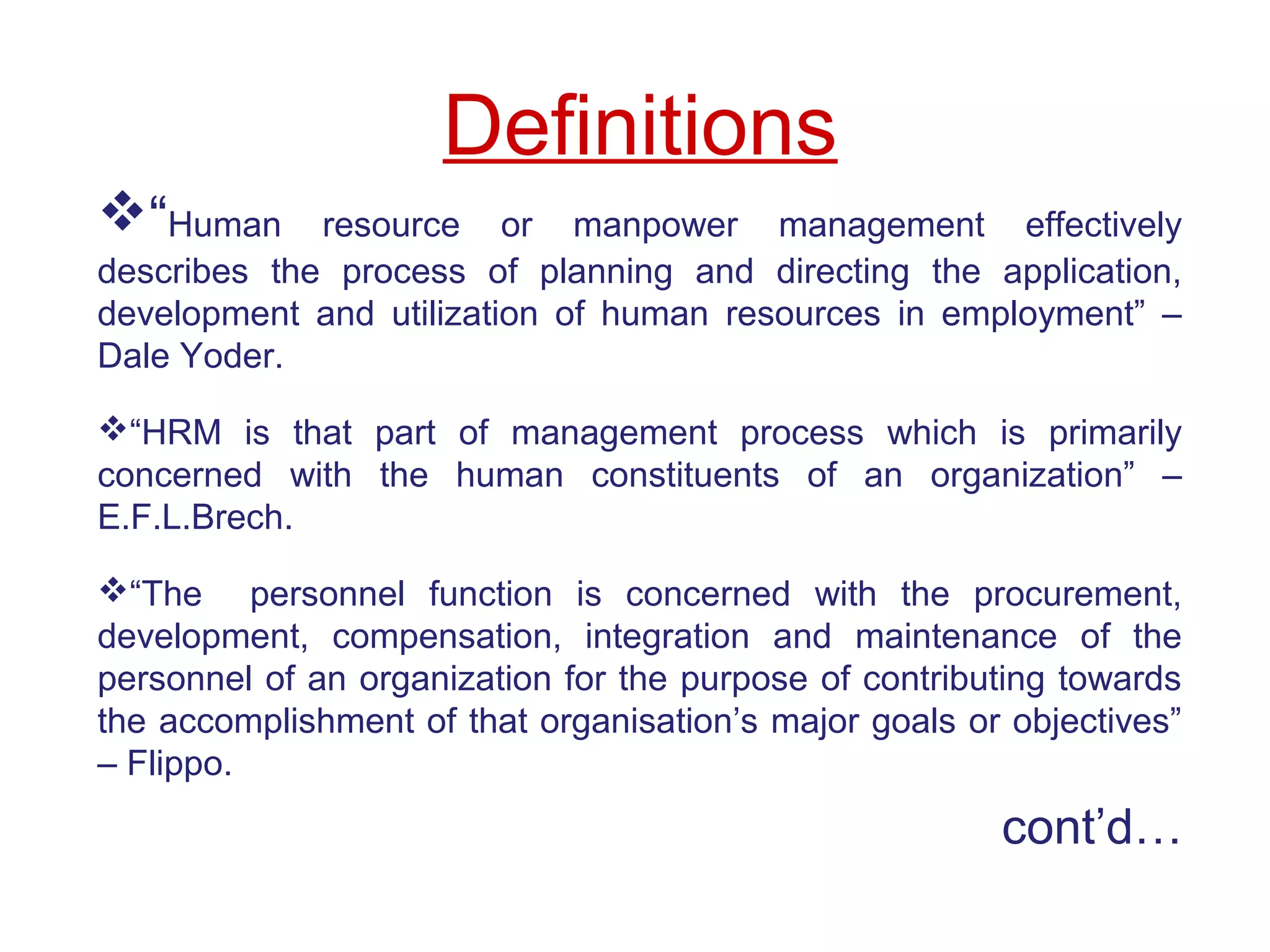
“Human resource or manpower management effectively
describes the process of planning and directing the application,
development and utilization of human resources in employment” –
Dale Yoder.
“HRM is that part of management process which is primarily
concerned with the human constituents of an organization” –
E.F.L.Brech.
“The personnel function is concerned with the procurement,
development, compensation, integration and maintenance of the
personnel of an organization for the purpose of contributing towards
the accomplishment of that organisation’s major goals or objectives”
– Flippo.
cont’d…
 “It is the field of management which has to do with
planning, organizing, directing and controlling the various
operative functions of procuring, developing ,
maintaining and utilizing a labour force for the attainment
of the company’s objectives” – Prof. Jucius.
 “It is that part of the management function which is
concerned with people at work and with their relationship
within an enterprise. Its aim is to bring together and
develop into an effective organization the men and
women who make up an enterprise and having regard to
the well-being of an individual and of working groups, to
enable to make their best contribution to its success” –
The British Institute of Personnel Management.
Function
Managerial functions
Operative function
Managerial Functions
 Planning
 Organising
 Directing
 Controlling
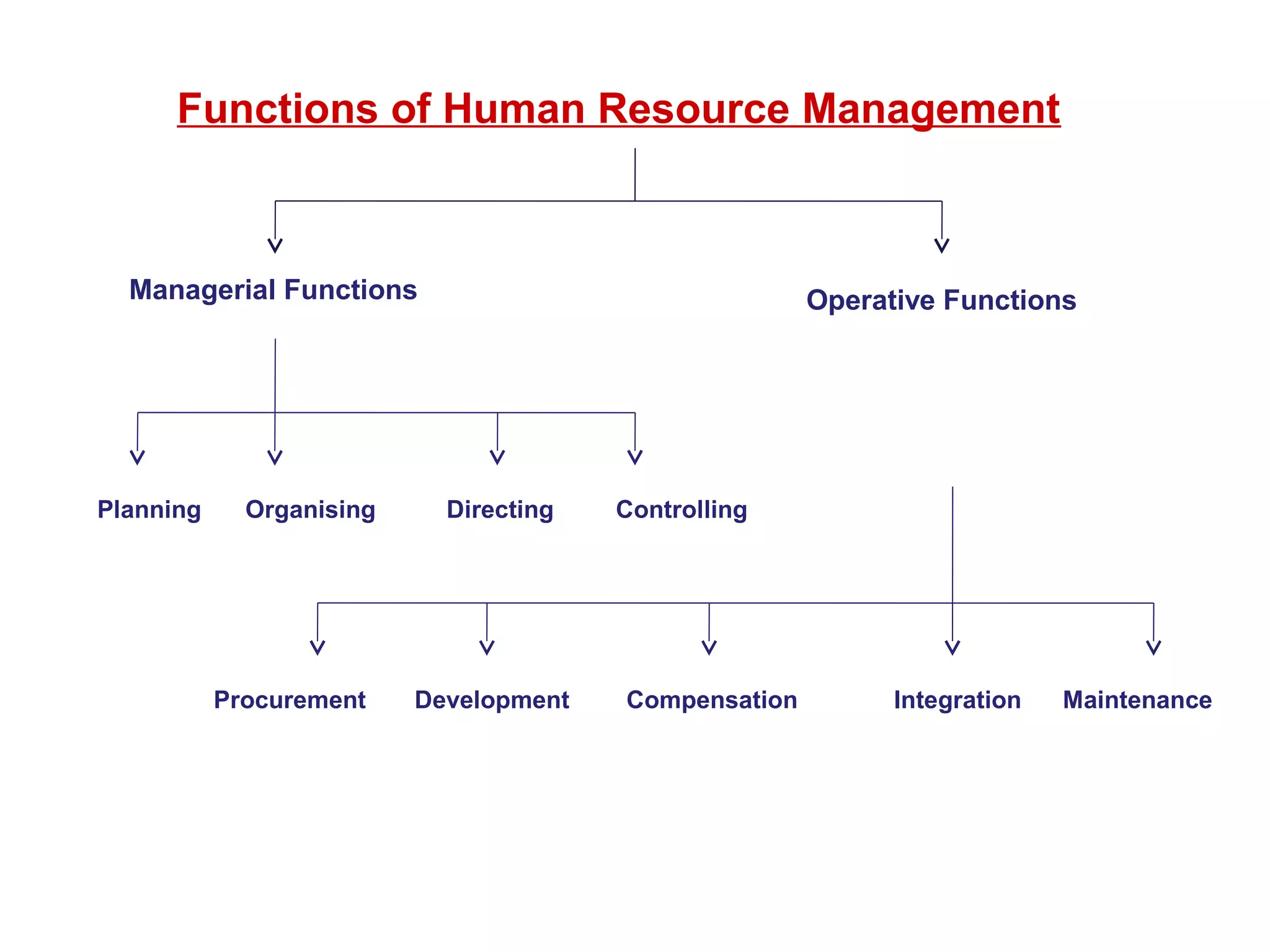
Functions of Human Resource Management
Managerial Functions Operative Functions
Planning Organising Directing Controlling
Procurement Development Compensation Integration Maintenance
Operative Function
• Procurement
• Development
• Compensation
• Integration
• Maintenance
Human Resource
• Peculiar Characteristics
• Exist
• Lives
• Created the other resources
• Commitment, devotion, enthusiasm,
energy, interest, intelligence,
• Creative
Nature of Human Resource Management
 It is universally relevant
 It is goal-oriented
 It adopts a systematic approach in handling the
manpower resource
 It is pervasive in nature
 It is an on-going activity
 It is a dynamic field of activity
 It focuses on the development of manpower
resource
 It is a Science as well as an Art
 It is inter disciplinary
 It is relatively new
Importance/role of Human Resource Management
(HRM)
 Identify correctly its manpower needs
 Right man for the right job
 Development of the skill of every individual
 Appraisal
 Incentives
 Employee attitude
 Good human relations
 Collective bargaining
The Role of a Human Resource Manager
Counselling
Act as a link
Employees get what is due to them
Spokesman
Introduce any change
Advise the line Managers
Qualities of a Human Resource Manager
 Good Communication Skills
 Creative
 Analyse any problem objectively
 Inspire, induce and motivate
 Leadership qualities
 Friendly and approachable
 Fair and honest
 Make decisions independently
 Curious always.
 Dynamic Person
 Good Memory
Objectives of Human Resource Management
• To make an optimum utilisation of the human
resource of the organisation
• To ensure that the organisation has the required
number staff
• To establish and maintain a sound organisation
structure
• To reconcile personal and organisational goals
• To provide scope for the development of personnel
• To ensure that the employees have higher job
satisfaction
• To provide scope for participation in decision-
making
Human Resource Audit
Meaning
Human Resource Audit (HR Audit) is
concerned with the examination and
evaluation of the policies, procedures
and practices with reference to the
human resource of the organisation. It
is a periodic review to measure the
efficiency and effectiveness of human
resource management.
Objectives of HR Audit
o To review the entire system of procuring,
developing, allocating and utilising the human
resources in an organisation
o To seek explanation on any matter pertaining to the
human resource of the organisation.
o To evaluate the extent of implementation of the
human resource policies and programmes
o To evaluate the performance of the staff looking
after the HRM function.
IMPORTANCE OF HR AUDIT
Due to the
Importance of
the human
resource itself
To face any
future
enquiry
To meet the
challenges of
trade unions
To have
control over
cost of labour
To improve the
performance of
human resource
Human Resource
Management Function
Qualitative Indicators
1. Procurement
2. Development
3. Compensation
4. Integration
5. Maintenance
Quality of HR planning, Job Specification, Source of
Recruitment, Selection Procedure.
Type of Training, Management Development
Programme, performance Appraisal Methods,
promotion Criteria, Career Planning.
Method of Job Evaluation, Methods of Wage Payment,
Type of Incentives, Fringe Benefits, Union Demands.
Handling of Grievances and Conflicts, Measures taken
to ensure Discipline and a high level of Morale,
Employees’ participation in decisions.
Steps taken to provide Job Satisfaction, Measures
adopted to control labour turnover.
Qualitative Indicators for HR Audit
Human Resource
Management Function
Quantitative Indicators
1. Procurement
2. Development
3. Compensation
4. Integration
5. Maintenance
Time taken to fill up vacancies, Ratio of Vacancies to
Number of Posts, Number of Employees recruited
during the year.
Duration of each Training Programme, Number of
Trainees in every Programme. Productivity Increase.
Pay differentials, Number of employees earning bonus
and other incentives.
Level of Morale, Grievances and Conflicts, Rate of
Absenteeism.
Level of Job Satisfaction, Rate of Labour Turnover.
Quantitative Indicators

Human resource management

  • 1.
    Definitions “Human resource ormanpower management effectively describes the process of planning and directing the application, development and utilization of human resources in employment” – Dale Yoder. “HRM is that part of management process which is primarily concerned with the human constituents of an organization” – E.F.L.Brech. “The personnel function is concerned with the procurement, development, compensation, integration and maintenance of the personnel of an organization for the purpose of contributing towards the accomplishment of that organisation’s major goals or objectives” – Flippo. cont’d…
  • 2.
     “It isthe field of management which has to do with planning, organizing, directing and controlling the various operative functions of procuring, developing , maintaining and utilizing a labour force for the attainment of the company’s objectives” – Prof. Jucius.  “It is that part of the management function which is concerned with people at work and with their relationship within an enterprise. Its aim is to bring together and develop into an effective organization the men and women who make up an enterprise and having regard to the well-being of an individual and of working groups, to enable to make their best contribution to its success” – The British Institute of Personnel Management.
  • 3.
  • 4.
    Managerial Functions  Planning Organising  Directing  Controlling
  • 5.
    Functions of HumanResource Management Managerial Functions Operative Functions Planning Organising Directing Controlling Procurement Development Compensation Integration Maintenance
  • 6.
    Operative Function • Procurement •Development • Compensation • Integration • Maintenance
  • 7.
    Human Resource • PeculiarCharacteristics • Exist • Lives • Created the other resources • Commitment, devotion, enthusiasm, energy, interest, intelligence, • Creative
  • 8.
    Nature of HumanResource Management  It is universally relevant  It is goal-oriented  It adopts a systematic approach in handling the manpower resource  It is pervasive in nature  It is an on-going activity  It is a dynamic field of activity  It focuses on the development of manpower resource  It is a Science as well as an Art  It is inter disciplinary  It is relatively new
  • 9.
    Importance/role of HumanResource Management (HRM)  Identify correctly its manpower needs  Right man for the right job  Development of the skill of every individual  Appraisal  Incentives  Employee attitude  Good human relations  Collective bargaining
  • 10.
    The Role ofa Human Resource Manager Counselling Act as a link Employees get what is due to them Spokesman Introduce any change Advise the line Managers
  • 11.
    Qualities of aHuman Resource Manager  Good Communication Skills  Creative  Analyse any problem objectively  Inspire, induce and motivate  Leadership qualities  Friendly and approachable  Fair and honest  Make decisions independently  Curious always.  Dynamic Person  Good Memory
  • 12.
    Objectives of HumanResource Management • To make an optimum utilisation of the human resource of the organisation • To ensure that the organisation has the required number staff • To establish and maintain a sound organisation structure • To reconcile personal and organisational goals • To provide scope for the development of personnel • To ensure that the employees have higher job satisfaction • To provide scope for participation in decision- making
  • 13.
    Human Resource Audit Meaning HumanResource Audit (HR Audit) is concerned with the examination and evaluation of the policies, procedures and practices with reference to the human resource of the organisation. It is a periodic review to measure the efficiency and effectiveness of human resource management.
  • 14.
    Objectives of HRAudit o To review the entire system of procuring, developing, allocating and utilising the human resources in an organisation o To seek explanation on any matter pertaining to the human resource of the organisation. o To evaluate the extent of implementation of the human resource policies and programmes o To evaluate the performance of the staff looking after the HRM function.
  • 15.
    IMPORTANCE OF HRAUDIT Due to the Importance of the human resource itself To face any future enquiry To meet the challenges of trade unions To have control over cost of labour To improve the performance of human resource
  • 16.
    Human Resource Management Function QualitativeIndicators 1. Procurement 2. Development 3. Compensation 4. Integration 5. Maintenance Quality of HR planning, Job Specification, Source of Recruitment, Selection Procedure. Type of Training, Management Development Programme, performance Appraisal Methods, promotion Criteria, Career Planning. Method of Job Evaluation, Methods of Wage Payment, Type of Incentives, Fringe Benefits, Union Demands. Handling of Grievances and Conflicts, Measures taken to ensure Discipline and a high level of Morale, Employees’ participation in decisions. Steps taken to provide Job Satisfaction, Measures adopted to control labour turnover. Qualitative Indicators for HR Audit
  • 17.
    Human Resource Management Function QuantitativeIndicators 1. Procurement 2. Development 3. Compensation 4. Integration 5. Maintenance Time taken to fill up vacancies, Ratio of Vacancies to Number of Posts, Number of Employees recruited during the year. Duration of each Training Programme, Number of Trainees in every Programme. Productivity Increase. Pay differentials, Number of employees earning bonus and other incentives. Level of Morale, Grievances and Conflicts, Rate of Absenteeism. Level of Job Satisfaction, Rate of Labour Turnover. Quantitative Indicators