1
Presented by
M.Nageswara Rao
Sr.SO(A)/S.C.Rly
Indian Rly. Administration & Finance Code- Para 510
(Financial Ratios)
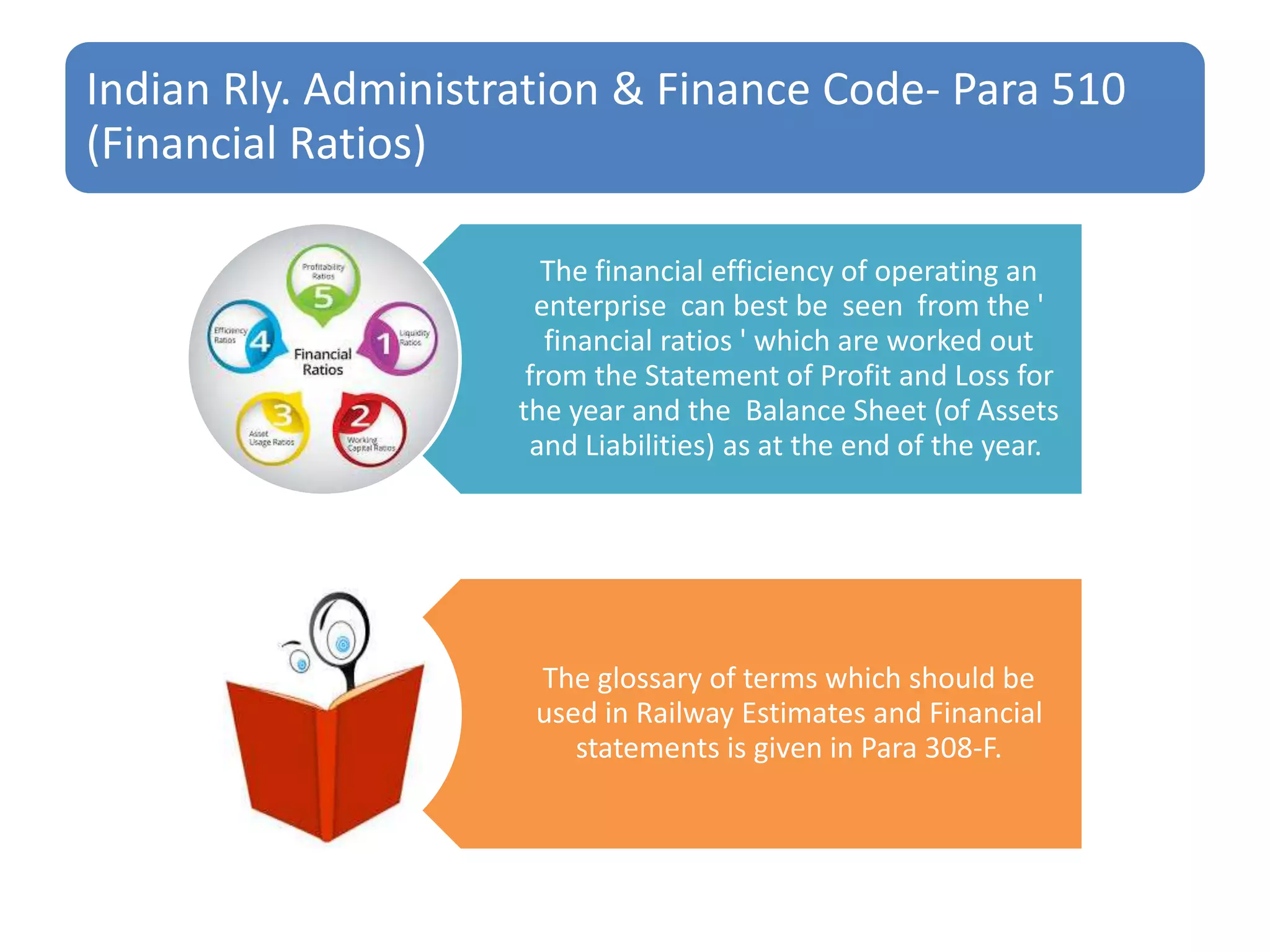
The financial efficiency of operating an
enterprise can best be seen from the '
financial ratios ' which are worked out
from the Statement of Profit and Loss for
the year and the Balance Sheet (of Assets
and Liabilities) as at the end of the year.
The glossary of terms which should be
used in Railway Estimates and Financial
statements is given in Para 308-F.
Indian Rly. Administration & Finance
Code- Para 511 (Financial Ratios)
(a) Operating Ratio, i.e., percentage of gross working
expenses (item (xiii) of Para 308-F.) to gross earnings (item
(v) of Para 308-F).
b) Return on Capital
(i) percentage of (revenue) surplus (item xxi of para 308-F)
to Capital-at-charge (item xxii of para 308-F).
(ii) percentage of net receipts (item xix of para 308-F) to
Capital-at-charge.
c) Current Assets/Liabilities - (j) Stores in stock in terms of month's consumption,
(ii) work-in-process (workshops) as a percentage of the value of workshop
outturn.
(iii) stores inventory (stores, ' purchases', 'sales', and miscellaneous advance-
capital, etc.,) as percentage of the total issue of stores.
(iv) Unrealised earnings at the year-end in terms of number of days, earnings.
Operating Ratio
It is regarded as one of the Most Important
financial statistics/ratios.
frequently been used as
an Index of the operating
efficiency of the Railways.
Operating Ratio – Definition
(Para 434 of Finance code vol.I)
Percentage of Gross Working Expenses to Gross
Earnings of any accounting year.
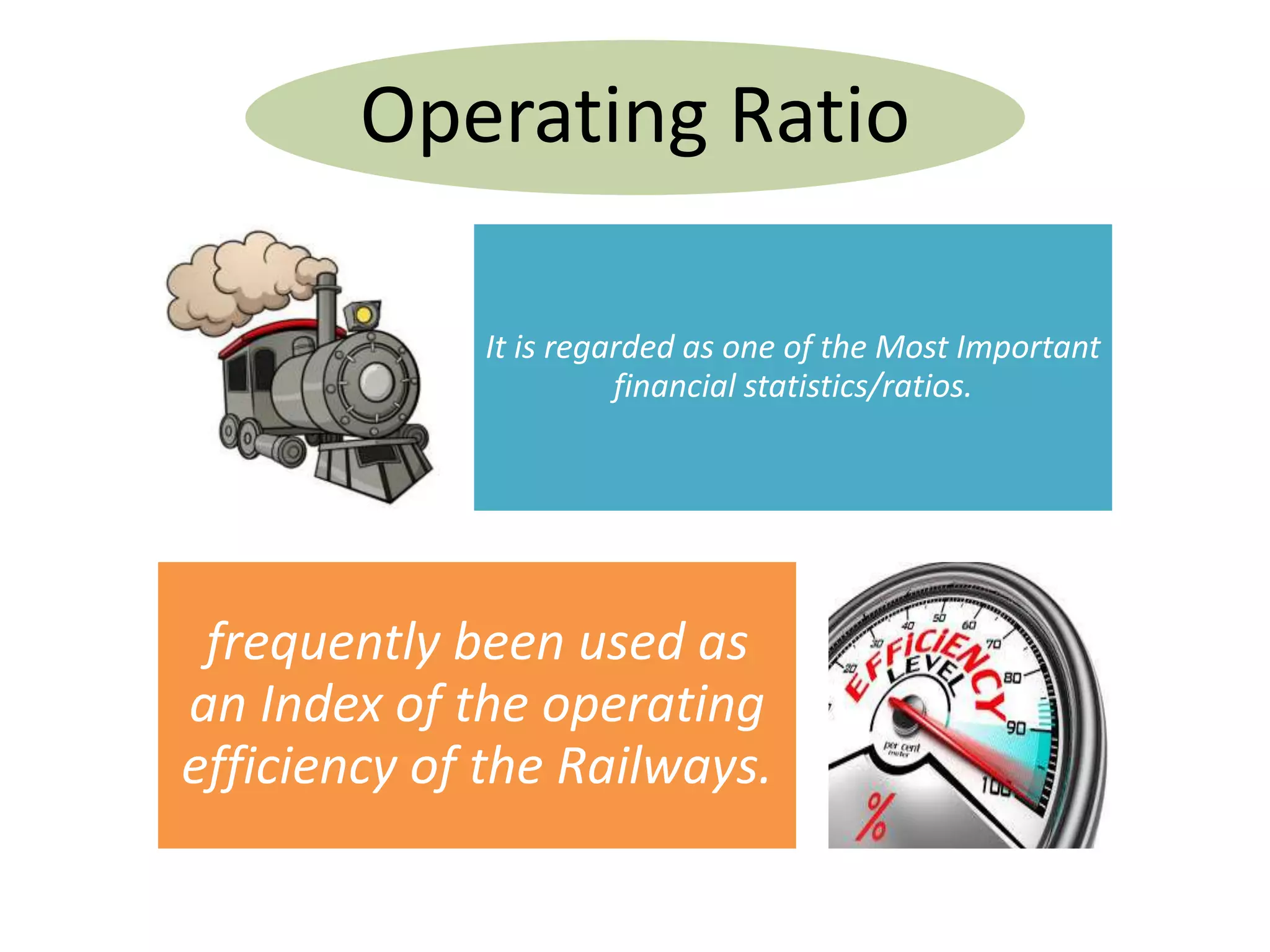
There is no ideal Operating Ratio for Indian
Railways. In rail road sector, an operating ratio
of 80 % or lower is considered desirable
Advantage of better O.R
However lower O.R. helps in generating internal
resources for meeting requirement of Plan
Expenditure on Safety (RSF), Amenities to
Passengers & Staff (D.F) and other Capital
investments such as laying of new lines,
acquisition of Rolling Stock etc (Capital Fund).
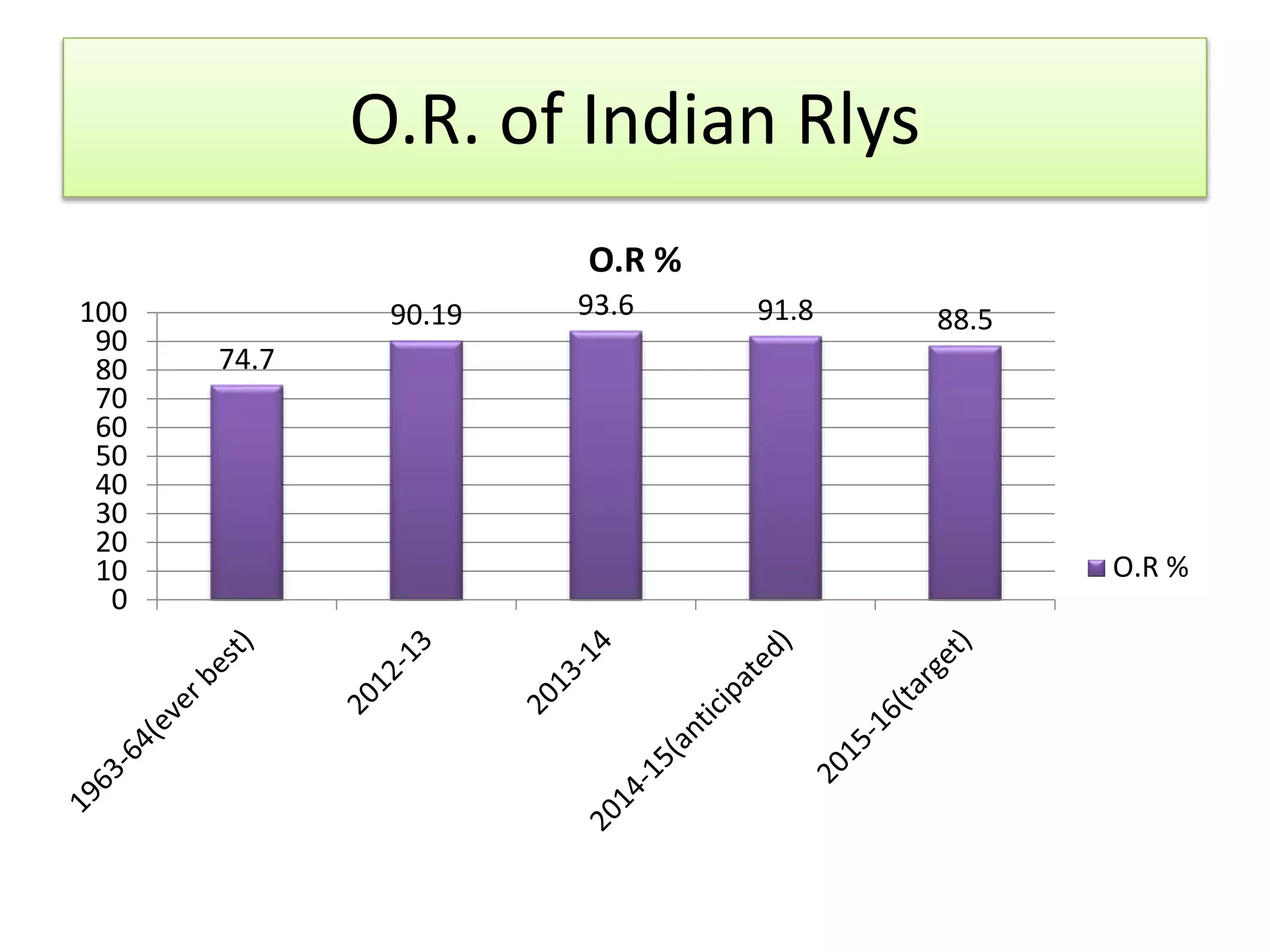
The Best ever O.R of
Indian Railways was
74.7 % in 1963-64.
O.R. of Indian Rlys
74.7
90.19 93.6 91.8 88.5
0
10
20
30
40
50
60
70
80
90
100
O.R %
O.R %
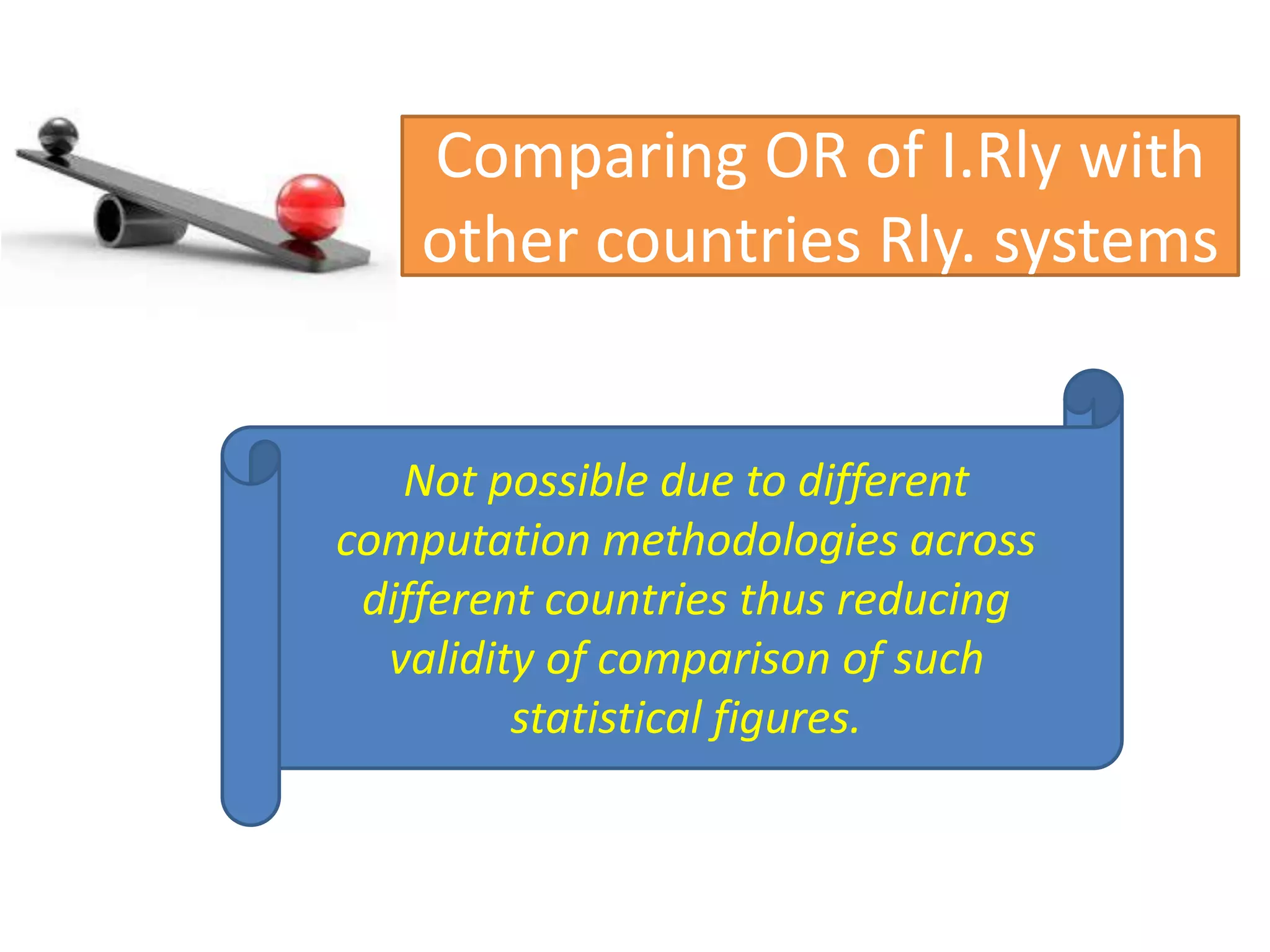
Comparing OR of I.Rly with
other countries Rly. systems
Not possible due to different
computation methodologies across
different countries thus reducing
validity of comparison of such
statistical figures.
In the year 2005, Indian
Railways, changed its
accounting policy for the
lease charges paid to IRFC.
The lease charges have
been broken into two parts
– Principal part(capital) and
Interest part (revenue).
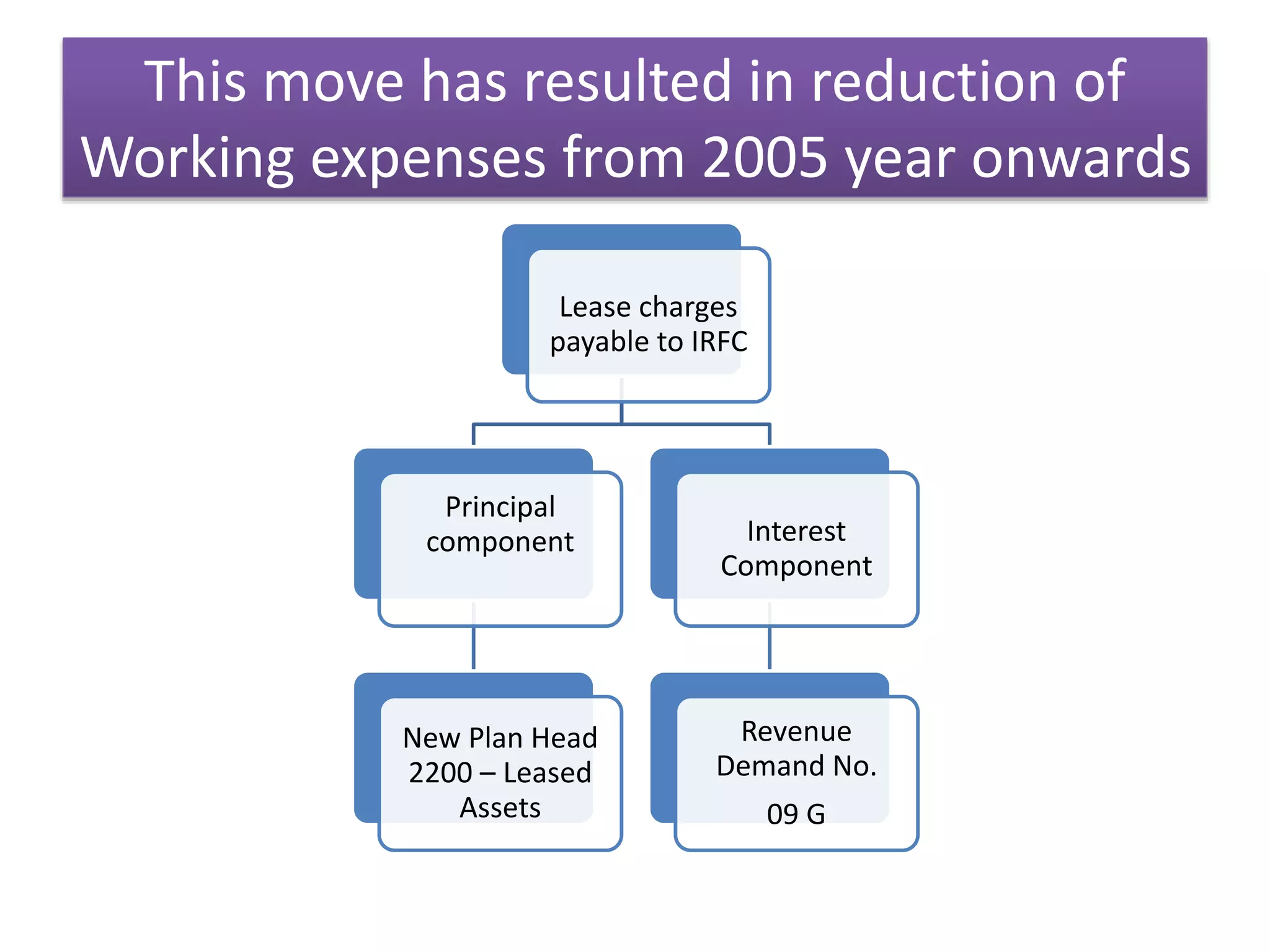
This move has resulted in reduction of
Working expenses from 2005 year onwards
Lease charges
payable to IRFC
Principal
component
New Plan Head
2200 – Leased
Assets
Interest
Component
Revenue
Demand No.
09 G
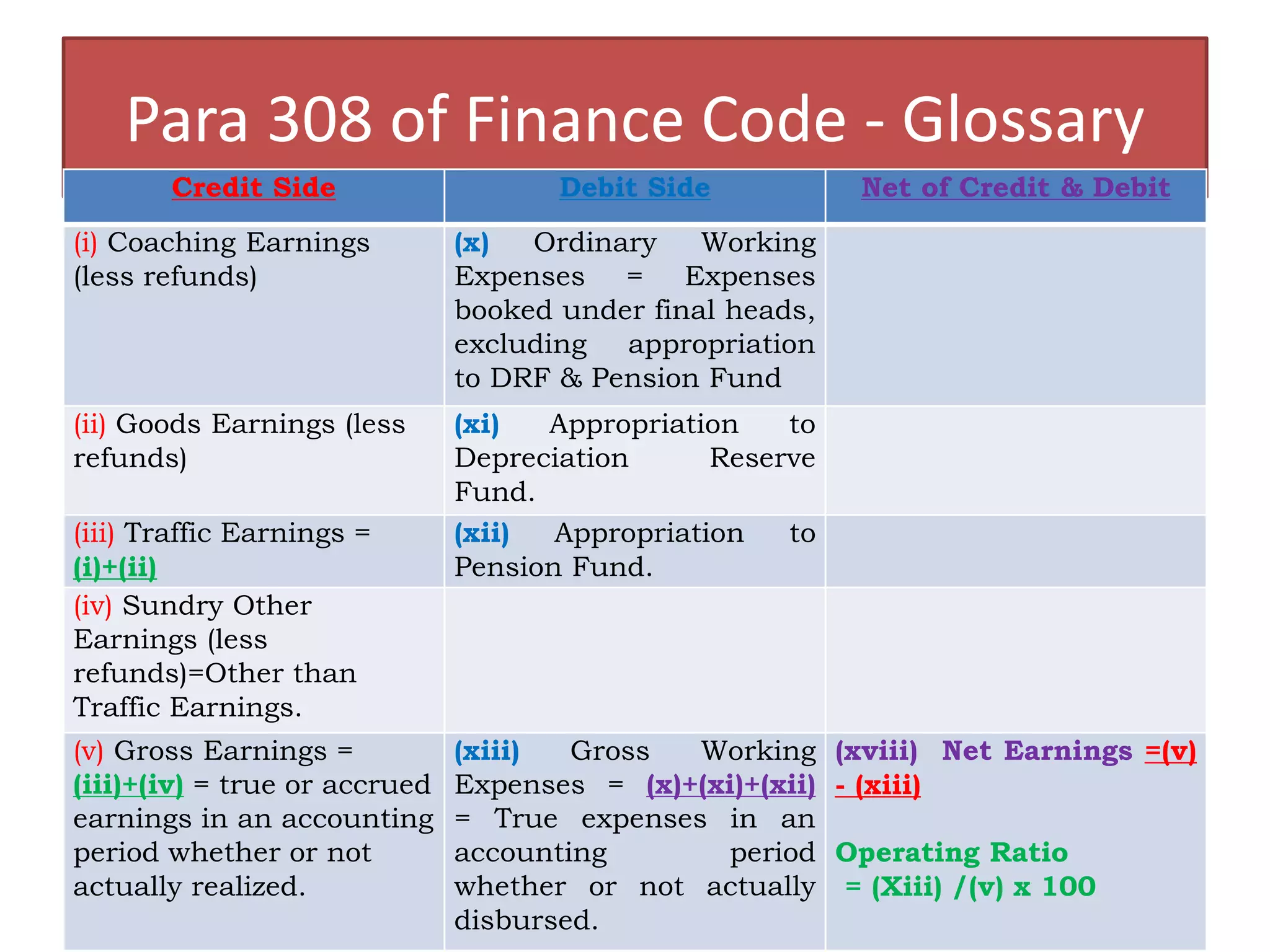
Para 308 of Finance Code - Glossary
Credit Side Debit Side Net of Credit & Debit
(i) Coaching Earnings
(less refunds)
(x) Ordinary Working
Expenses = Expenses
booked under final heads,
excluding appropriation
to DRF & Pension Fund
(ii) Goods Earnings (less
refunds)
(xi) Appropriation to
Depreciation Reserve
Fund.
(iii) Traffic Earnings =
(i)+(ii)
(xii) Appropriation to
Pension Fund.
(iv) Sundry Other
Earnings (less
refunds)=Other than
Traffic Earnings.
(v) Gross Earnings =
(iii)+(iv) = true or accrued
earnings in an accounting
period whether or not
actually realized.
(xiii) Gross Working
Expenses = (x)+(xi)+(xii)
= True expenses in an
accounting period
whether or not actually
disbursed.
(xviii) Net Earnings =(v)
- (xiii)
Operating Ratio
= (Xiii) /(v) x 100
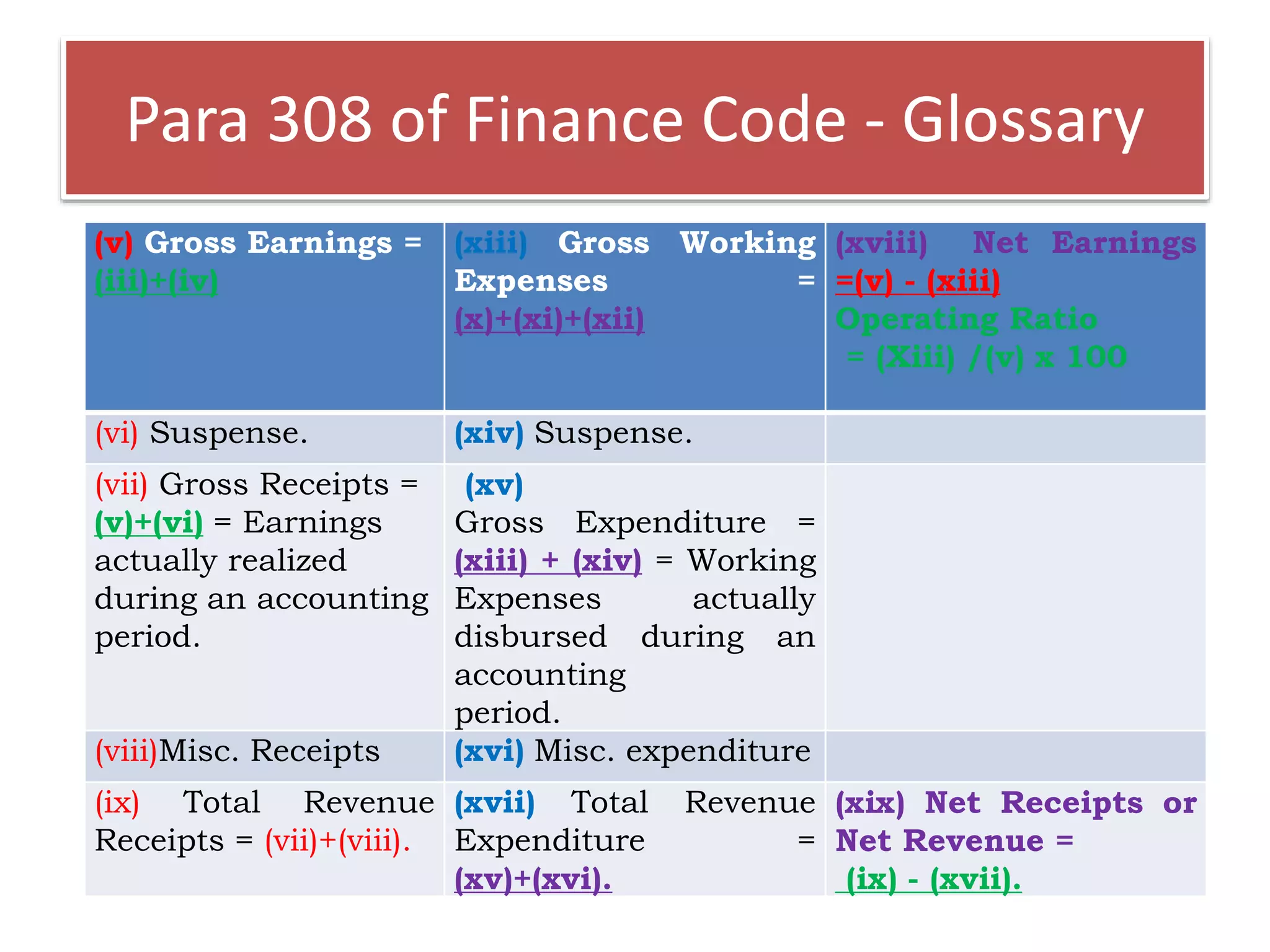
Para 308 of Finance Code - Glossary
(v) Gross Earnings =
(iii)+(iv)
(xiii) Gross Working
Expenses =
(x)+(xi)+(xii)
(xviii) Net Earnings
=(v) - (xiii)
Operating Ratio
= (Xiii) /(v) x 100
(vi) Suspense. (xiv) Suspense.
(vii) Gross Receipts =
(v)+(vi) = Earnings
actually realized
during an accounting
period.
(xv)
Gross Expenditure =
(xiii) + (xiv) = Working
Expenses actually
disbursed during an
accounting
period.
(viii)Misc. Receipts (xvi) Misc. expenditure
(ix) Total Revenue
Receipts = (vii)+(viii).
(xvii) Total Revenue
Expenditure =
(xv)+(xvi).
(xix) Net Receipts or
Net Revenue =
(ix) - (xvii).
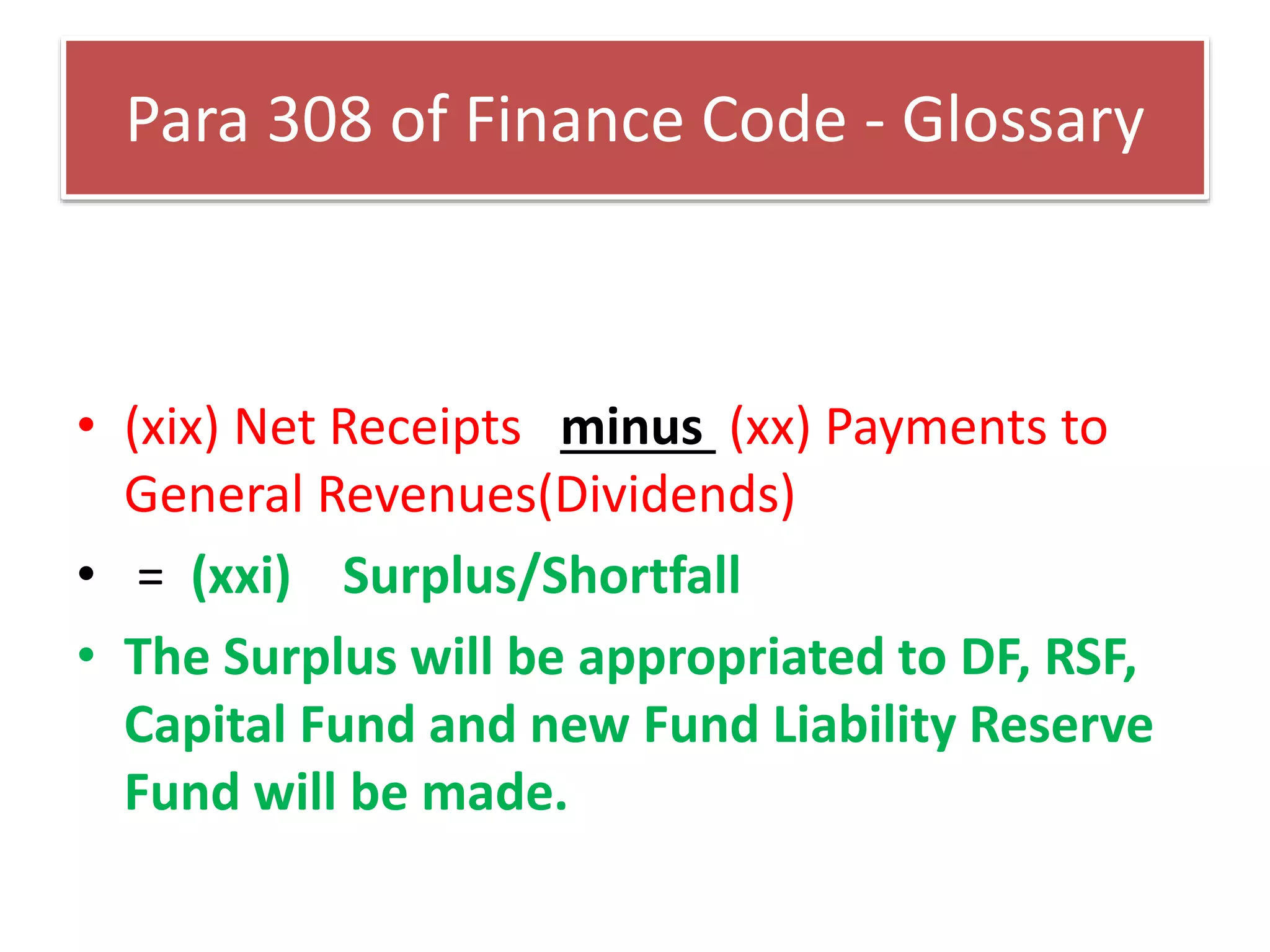
Para 308 of Finance Code - Glossary
• (xix) Net Receipts minus (xx) Payments to
General Revenues(Dividends)
• = (xxi) Surplus/Shortfall
• The Surplus will be appropriated to DF, RSF,
Capital Fund and new Fund Liability Reserve
Fund will be made.
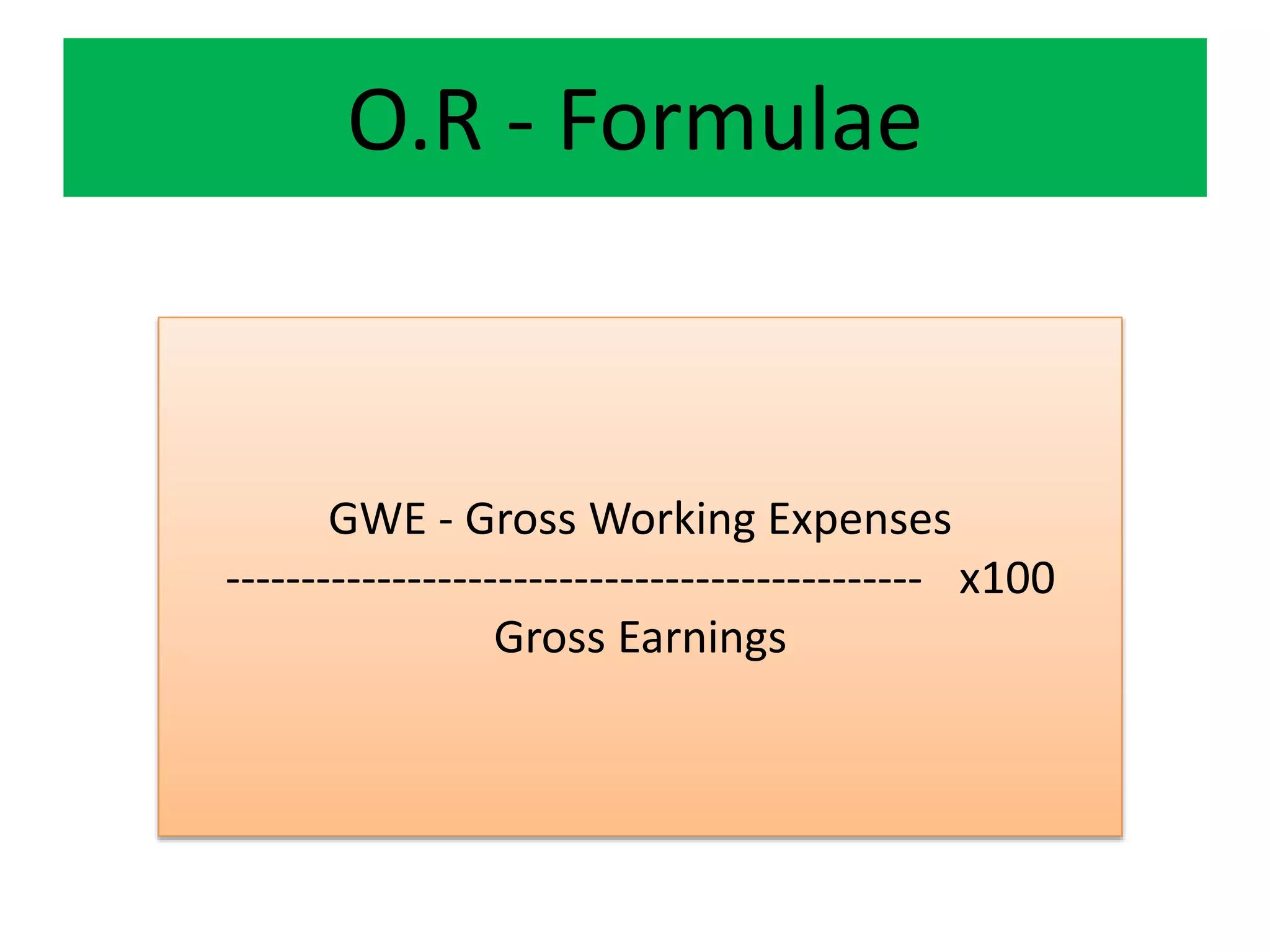
O.R - Formulae
GWE - Gross Working Expenses
---------------------------------------------- x100
Gross Earnings
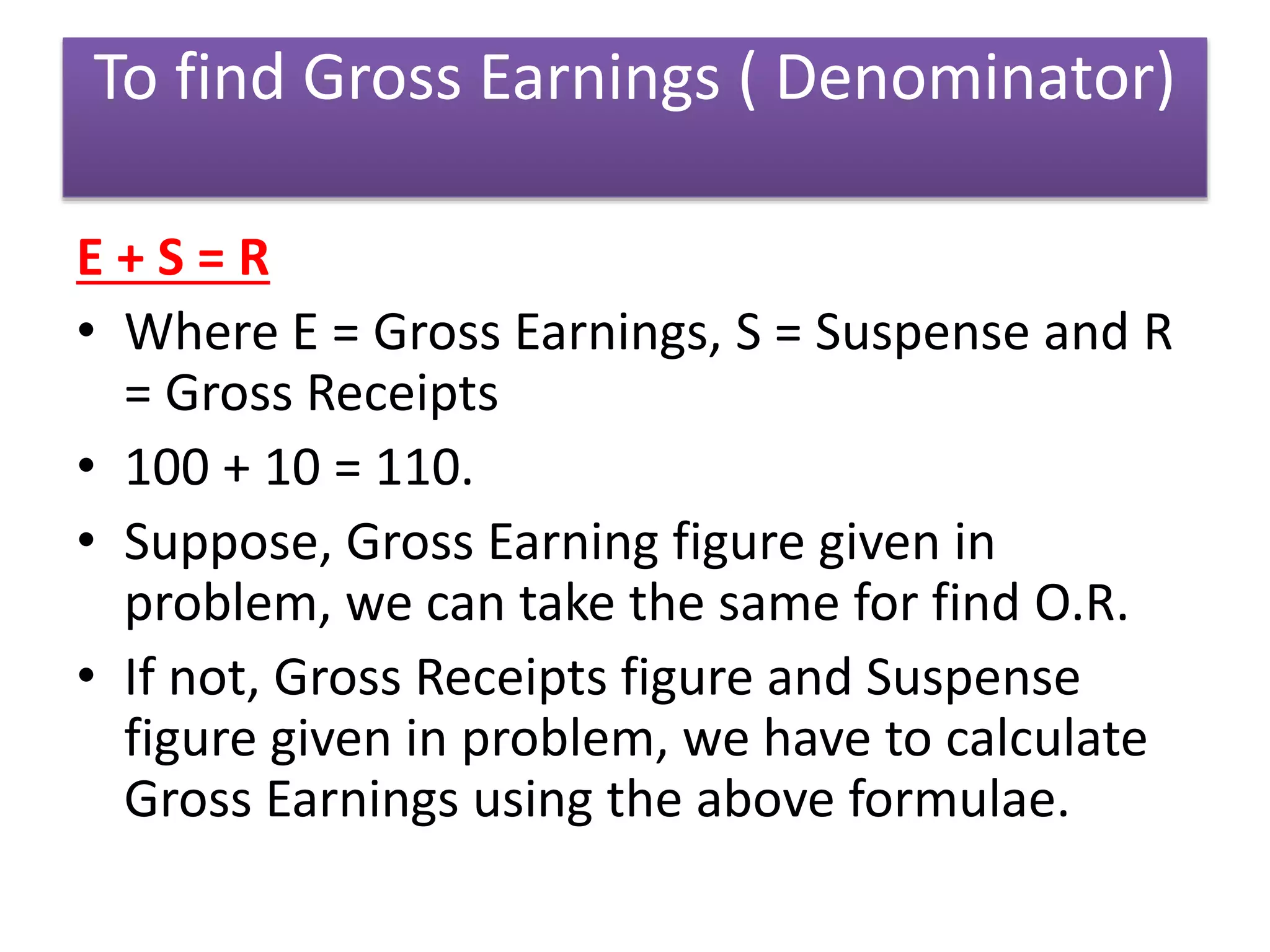
To find Gross Earnings ( Denominator)
E + S = R
• Where E = Gross Earnings, S = Suspense and R
= Gross Receipts
• 100 + 10 = 110.
• Suppose, Gross Earning figure given in
problem, we can take the same for find O.R.
• If not, Gross Receipts figure and Suspense
figure given in problem, we have to calculate
Gross Earnings using the above formulae.
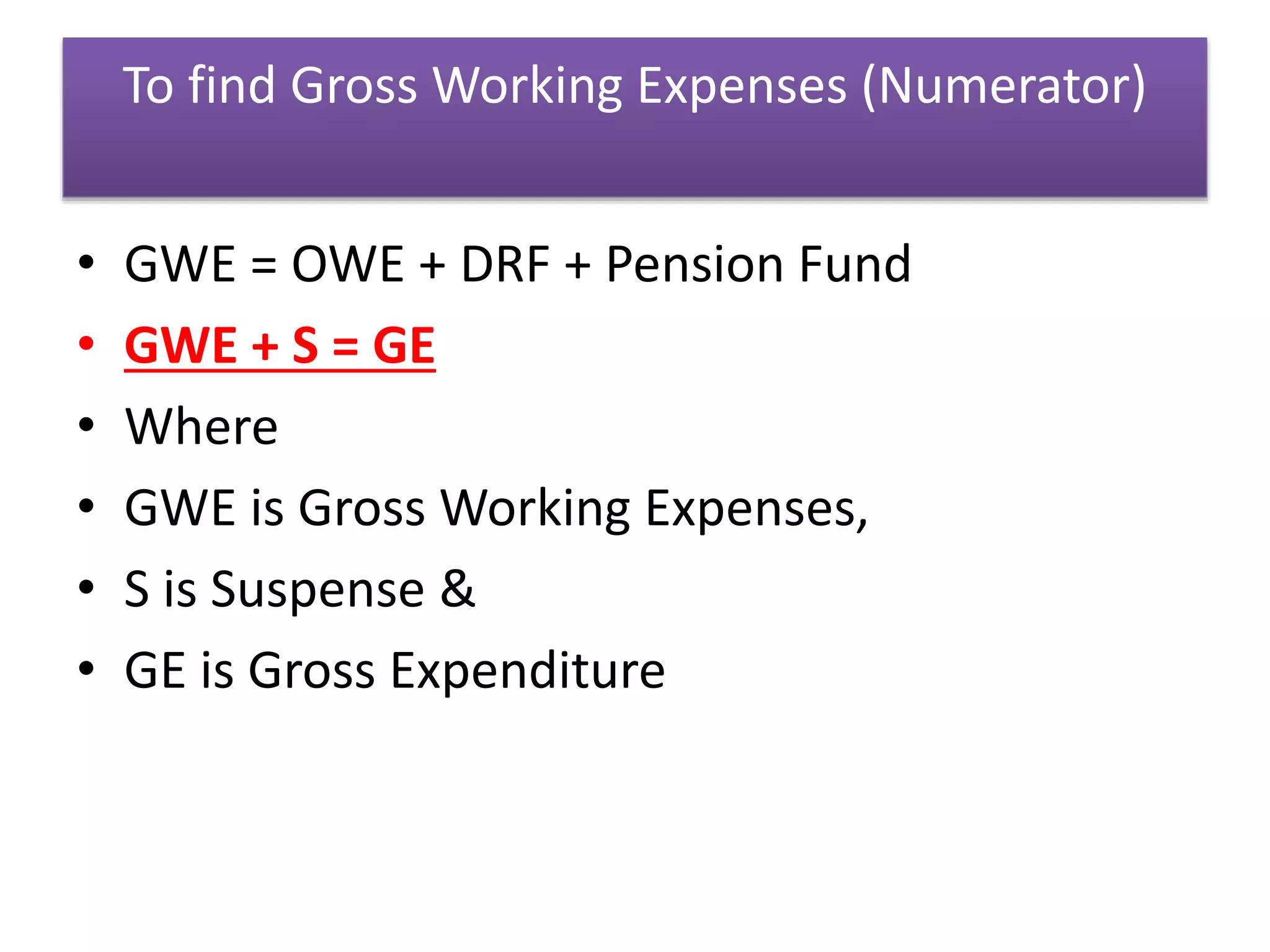
To find Gross Working Expenses (Numerator)
• GWE = OWE + DRF + Pension Fund
• GWE + S = GE
• Where
• GWE is Gross Working Expenses,
• S is Suspense &
• GE is Gross Expenditure
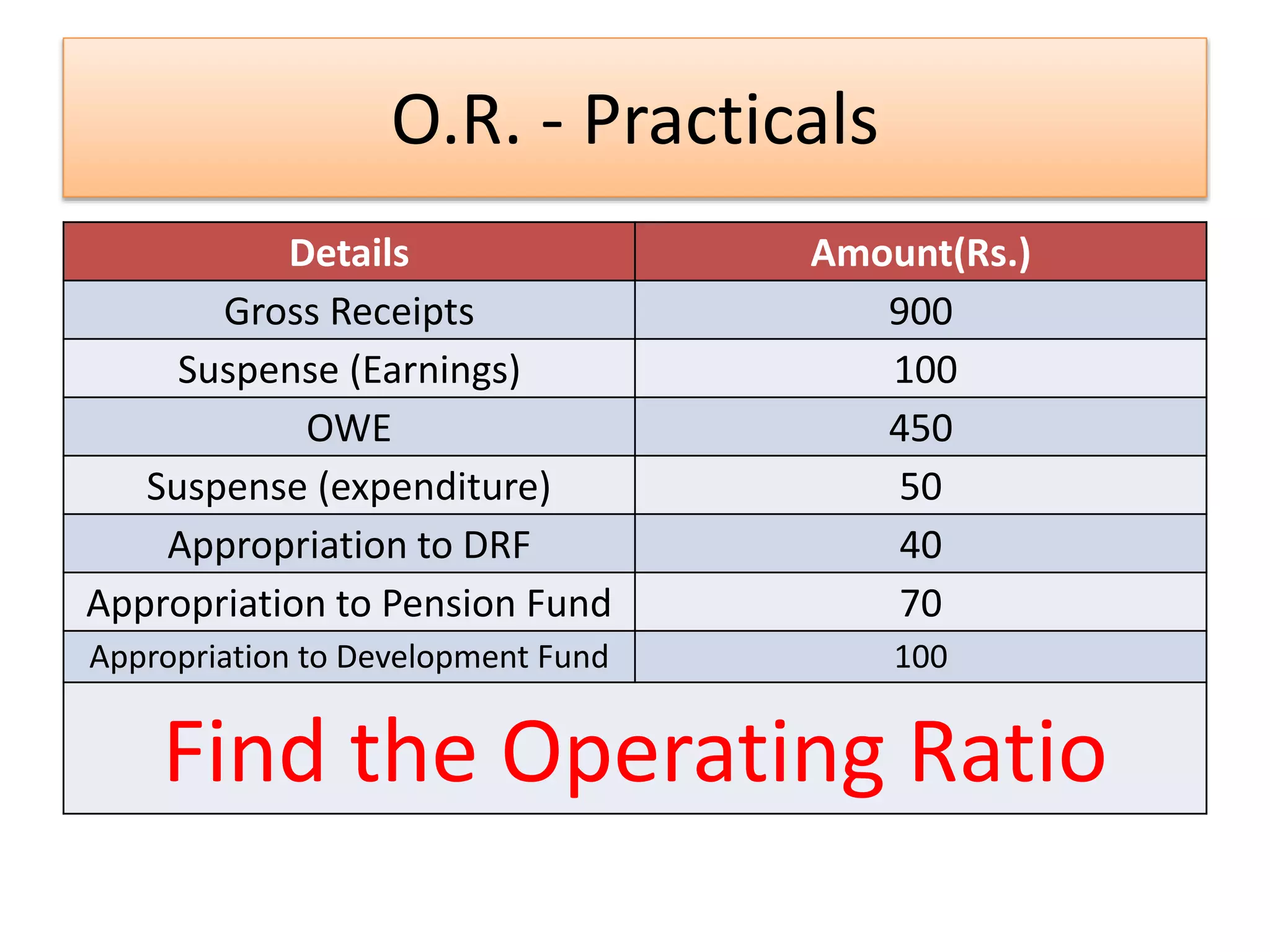
O.R. - Practicals
Details Amount(Rs.)
Gross Receipts 900
Suspense (Earnings) 100
OWE 450
Suspense (expenditure) 50
Appropriation to DRF 40
Appropriation to Pension Fund 70
Appropriation to Development Fund 100
Find the Operating Ratio
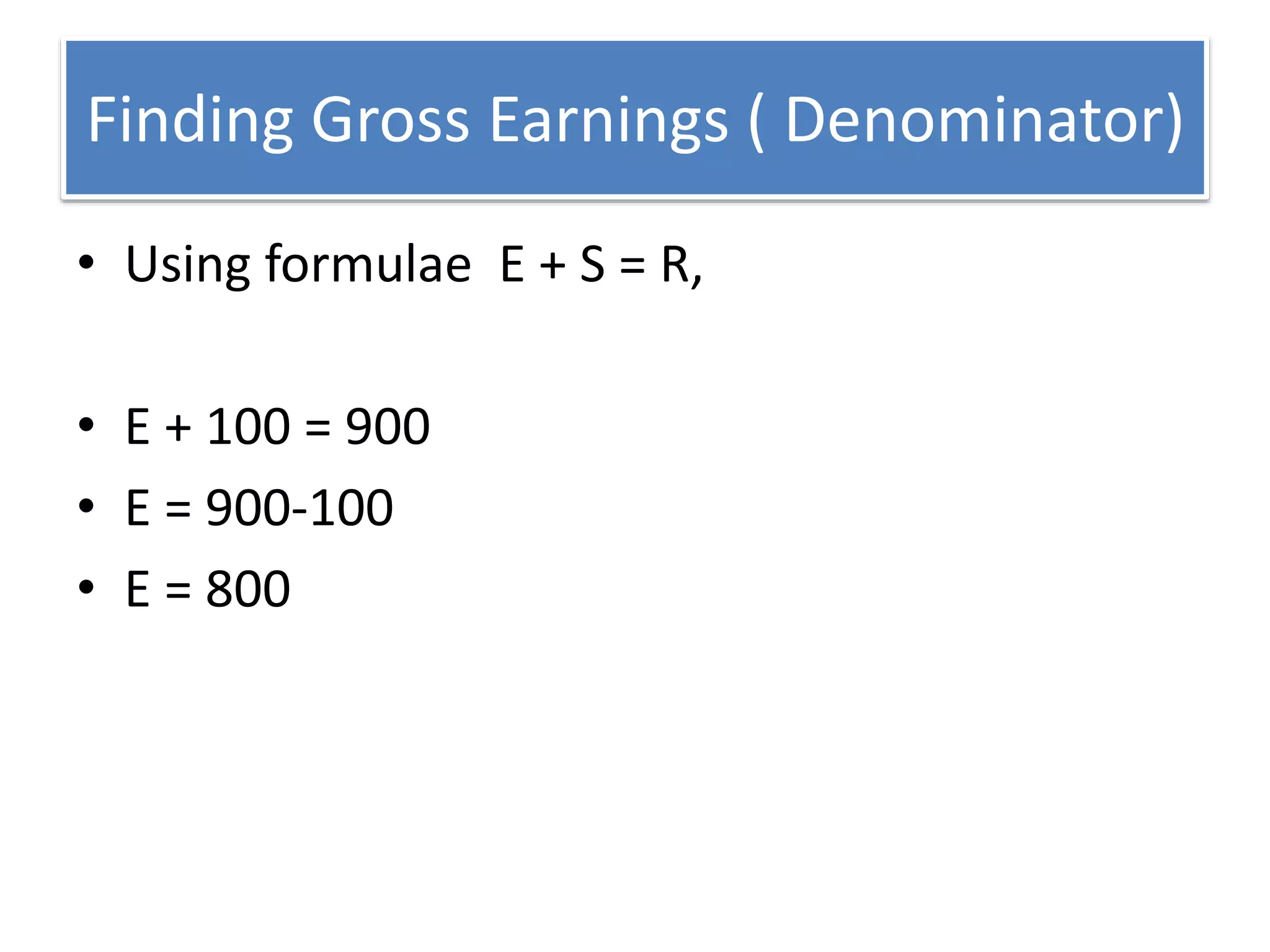
Finding Gross Earnings ( Denominator)
• Using formulae E + S = R,
• E + 100 = 900
• E = 900-100
• E = 800
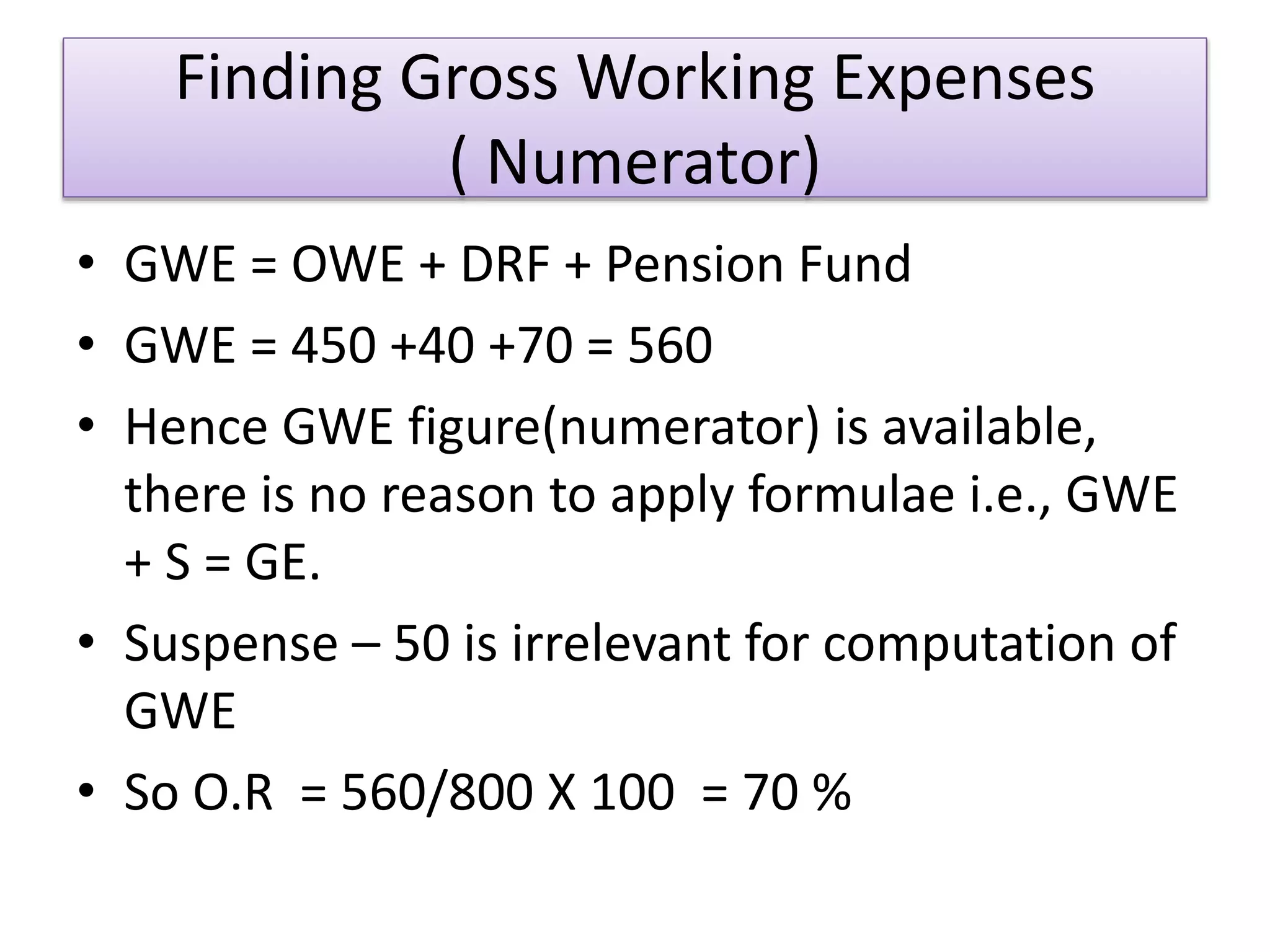
Finding Gross Working Expenses
( Numerator)
• GWE = OWE + DRF + Pension Fund
• GWE = 450 +40 +70 = 560
• Hence GWE figure(numerator) is available,
there is no reason to apply formulae i.e., GWE
+ S = GE.
• Suspense – 50 is irrelevant for computation of
GWE
• So O.R = 560/800 X 100 = 70 %
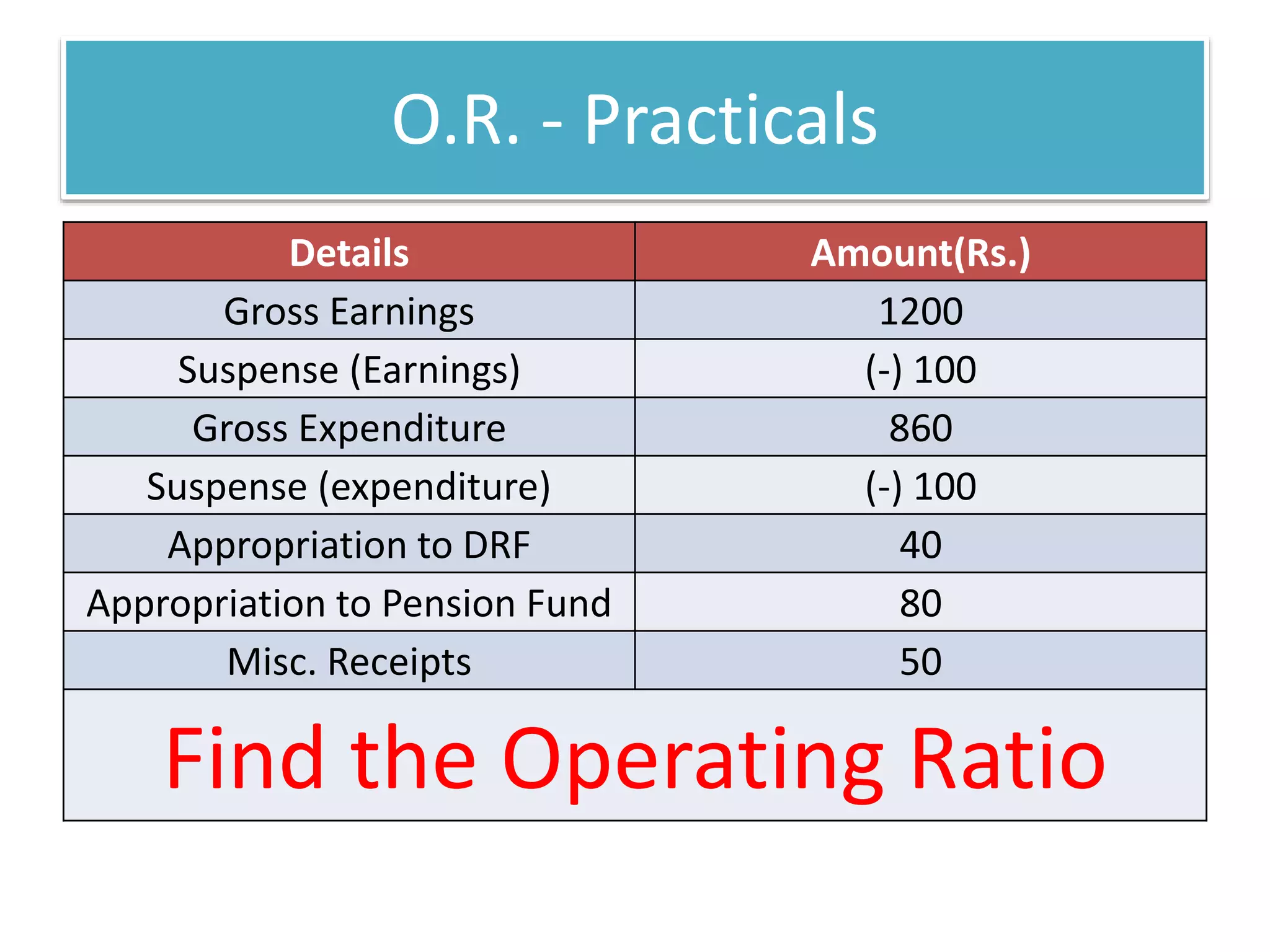
O.R. - Practicals
Details Amount(Rs.)
Gross Earnings 1200
Suspense (Earnings) (-) 100
Gross Expenditure 860
Suspense (expenditure) (-) 100
Appropriation to DRF 40
Appropriation to Pension Fund 80
Misc. Receipts 50
Find the Operating Ratio
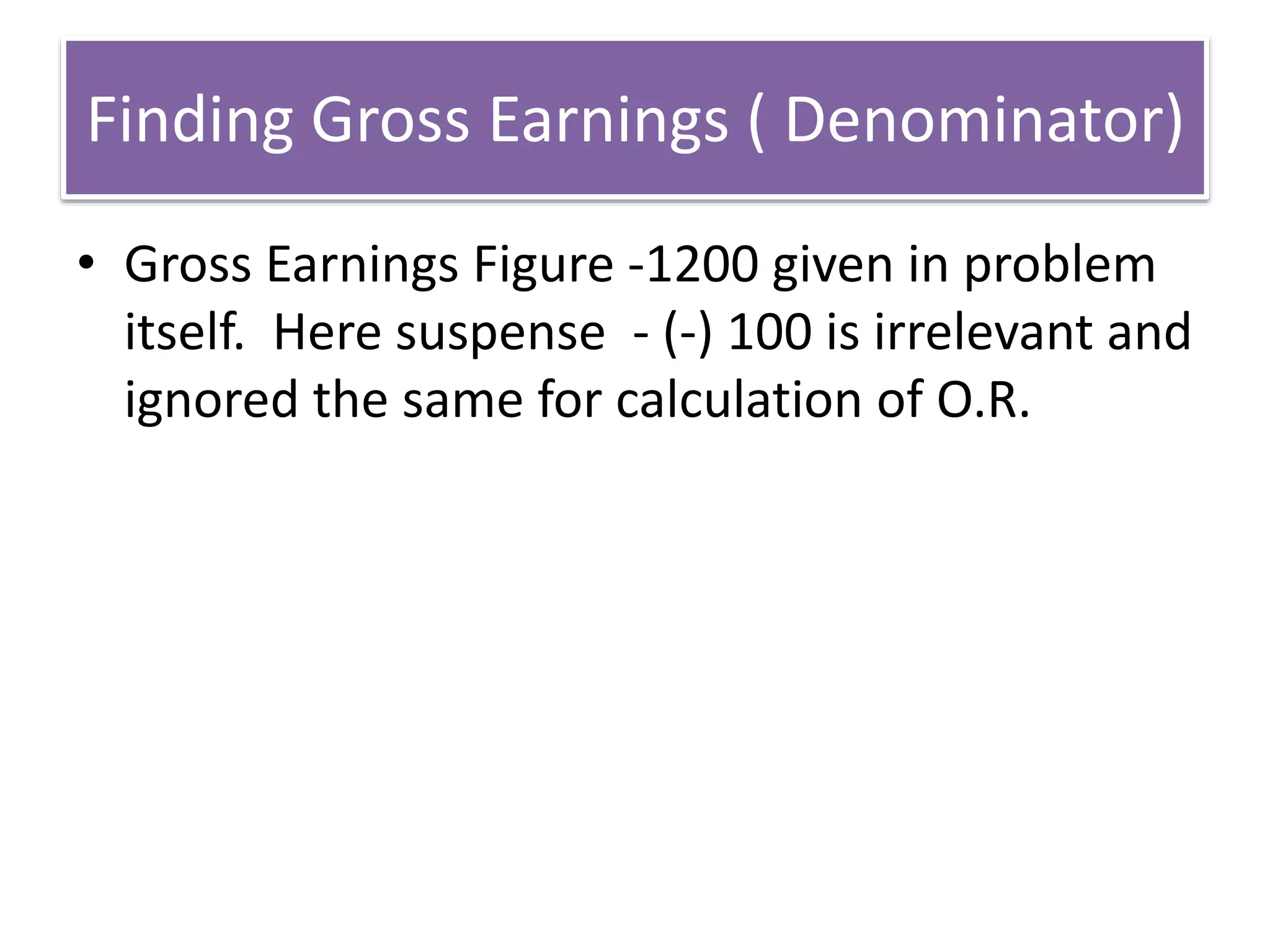
Finding Gross Earnings ( Denominator)
• Gross Earnings Figure -1200 given in problem
itself. Here suspense - (-) 100 is irrelevant and
ignored the same for calculation of O.R.
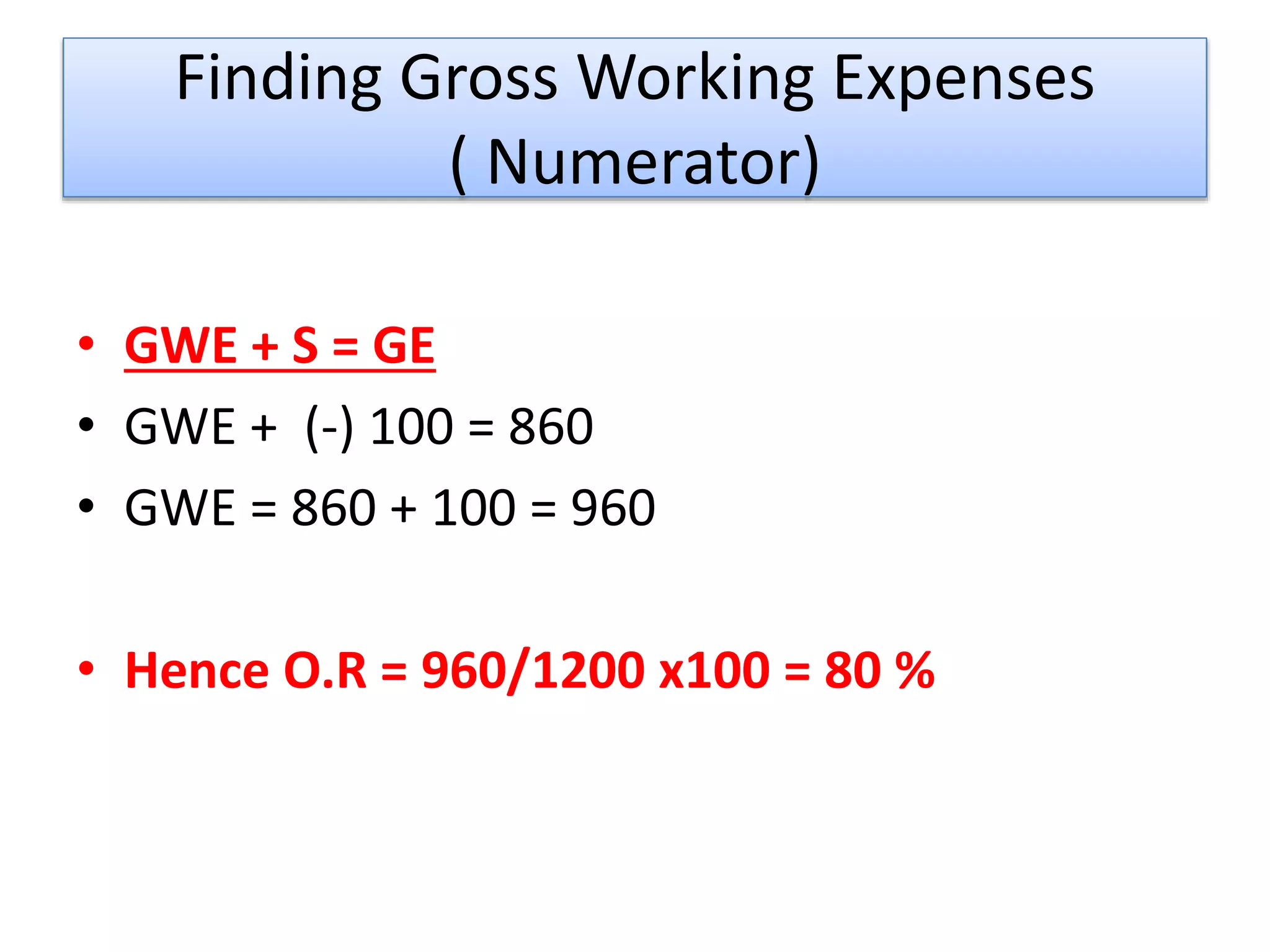
Finding Gross Working Expenses
( Numerator)
• GWE + S = GE
• GWE + (-) 100 = 860
• GWE = 860 + 100 = 960
• Hence O.R = 960/1200 x100 = 80 %
Tuesday, July 7, 2015 25

Operating ratio ppt

  • 1.
  • 2.
    Indian Rly. Administration& Finance Code- Para 510 (Financial Ratios) The financial efficiency of operating an enterprise can best be seen from the ' financial ratios ' which are worked out from the Statement of Profit and Loss for the year and the Balance Sheet (of Assets and Liabilities) as at the end of the year. The glossary of terms which should be used in Railway Estimates and Financial statements is given in Para 308-F.
  • 3.
    Indian Rly. Administration& Finance Code- Para 511 (Financial Ratios) (a) Operating Ratio, i.e., percentage of gross working expenses (item (xiii) of Para 308-F.) to gross earnings (item (v) of Para 308-F). b) Return on Capital (i) percentage of (revenue) surplus (item xxi of para 308-F) to Capital-at-charge (item xxii of para 308-F). (ii) percentage of net receipts (item xix of para 308-F) to Capital-at-charge. c) Current Assets/Liabilities - (j) Stores in stock in terms of month's consumption, (ii) work-in-process (workshops) as a percentage of the value of workshop outturn. (iii) stores inventory (stores, ' purchases', 'sales', and miscellaneous advance- capital, etc.,) as percentage of the total issue of stores. (iv) Unrealised earnings at the year-end in terms of number of days, earnings.
  • 4.
    Operating Ratio It isregarded as one of the Most Important financial statistics/ratios. frequently been used as an Index of the operating efficiency of the Railways.
  • 5.
    Operating Ratio –Definition (Para 434 of Finance code vol.I) Percentage of Gross Working Expenses to Gross Earnings of any accounting year.
  • 6.
    There is noideal Operating Ratio for Indian Railways. In rail road sector, an operating ratio of 80 % or lower is considered desirable
  • 7.
    Advantage of betterO.R However lower O.R. helps in generating internal resources for meeting requirement of Plan Expenditure on Safety (RSF), Amenities to Passengers & Staff (D.F) and other Capital investments such as laying of new lines, acquisition of Rolling Stock etc (Capital Fund).
  • 8.
    The Best everO.R of Indian Railways was 74.7 % in 1963-64.
  • 9.
    O.R. of IndianRlys 74.7 90.19 93.6 91.8 88.5 0 10 20 30 40 50 60 70 80 90 100 O.R % O.R %
  • 10.
    Comparing OR ofI.Rly with other countries Rly. systems Not possible due to different computation methodologies across different countries thus reducing validity of comparison of such statistical figures.
  • 11.
    In the year2005, Indian Railways, changed its accounting policy for the lease charges paid to IRFC. The lease charges have been broken into two parts – Principal part(capital) and Interest part (revenue).
  • 12.
    This move hasresulted in reduction of Working expenses from 2005 year onwards Lease charges payable to IRFC Principal component New Plan Head 2200 – Leased Assets Interest Component Revenue Demand No. 09 G
  • 13.
    Para 308 ofFinance Code - Glossary Credit Side Debit Side Net of Credit & Debit (i) Coaching Earnings (less refunds) (x) Ordinary Working Expenses = Expenses booked under final heads, excluding appropriation to DRF & Pension Fund (ii) Goods Earnings (less refunds) (xi) Appropriation to Depreciation Reserve Fund. (iii) Traffic Earnings = (i)+(ii) (xii) Appropriation to Pension Fund. (iv) Sundry Other Earnings (less refunds)=Other than Traffic Earnings. (v) Gross Earnings = (iii)+(iv) = true or accrued earnings in an accounting period whether or not actually realized. (xiii) Gross Working Expenses = (x)+(xi)+(xii) = True expenses in an accounting period whether or not actually disbursed. (xviii) Net Earnings =(v) - (xiii) Operating Ratio = (Xiii) /(v) x 100
  • 14.
    Para 308 ofFinance Code - Glossary (v) Gross Earnings = (iii)+(iv) (xiii) Gross Working Expenses = (x)+(xi)+(xii) (xviii) Net Earnings =(v) - (xiii) Operating Ratio = (Xiii) /(v) x 100 (vi) Suspense. (xiv) Suspense. (vii) Gross Receipts = (v)+(vi) = Earnings actually realized during an accounting period. (xv) Gross Expenditure = (xiii) + (xiv) = Working Expenses actually disbursed during an accounting period. (viii)Misc. Receipts (xvi) Misc. expenditure (ix) Total Revenue Receipts = (vii)+(viii). (xvii) Total Revenue Expenditure = (xv)+(xvi). (xix) Net Receipts or Net Revenue = (ix) - (xvii).
  • 15.
    Para 308 ofFinance Code - Glossary • (xix) Net Receipts minus (xx) Payments to General Revenues(Dividends) • = (xxi) Surplus/Shortfall • The Surplus will be appropriated to DF, RSF, Capital Fund and new Fund Liability Reserve Fund will be made.
  • 16.
    O.R - Formulae GWE- Gross Working Expenses ---------------------------------------------- x100 Gross Earnings
  • 17.
    To find GrossEarnings ( Denominator) E + S = R • Where E = Gross Earnings, S = Suspense and R = Gross Receipts • 100 + 10 = 110. • Suppose, Gross Earning figure given in problem, we can take the same for find O.R. • If not, Gross Receipts figure and Suspense figure given in problem, we have to calculate Gross Earnings using the above formulae.
  • 18.
    To find GrossWorking Expenses (Numerator) • GWE = OWE + DRF + Pension Fund • GWE + S = GE • Where • GWE is Gross Working Expenses, • S is Suspense & • GE is Gross Expenditure
  • 19.
    O.R. - Practicals DetailsAmount(Rs.) Gross Receipts 900 Suspense (Earnings) 100 OWE 450 Suspense (expenditure) 50 Appropriation to DRF 40 Appropriation to Pension Fund 70 Appropriation to Development Fund 100 Find the Operating Ratio
  • 20.
    Finding Gross Earnings( Denominator) • Using formulae E + S = R, • E + 100 = 900 • E = 900-100 • E = 800
  • 21.
    Finding Gross WorkingExpenses ( Numerator) • GWE = OWE + DRF + Pension Fund • GWE = 450 +40 +70 = 560 • Hence GWE figure(numerator) is available, there is no reason to apply formulae i.e., GWE + S = GE. • Suspense – 50 is irrelevant for computation of GWE • So O.R = 560/800 X 100 = 70 %
  • 22.
    O.R. - Practicals DetailsAmount(Rs.) Gross Earnings 1200 Suspense (Earnings) (-) 100 Gross Expenditure 860 Suspense (expenditure) (-) 100 Appropriation to DRF 40 Appropriation to Pension Fund 80 Misc. Receipts 50 Find the Operating Ratio
  • 23.
    Finding Gross Earnings( Denominator) • Gross Earnings Figure -1200 given in problem itself. Here suspense - (-) 100 is irrelevant and ignored the same for calculation of O.R.
  • 24.
    Finding Gross WorkingExpenses ( Numerator) • GWE + S = GE • GWE + (-) 100 = 860 • GWE = 860 + 100 = 960 • Hence O.R = 960/1200 x100 = 80 %
  • 25.