Audit:
Role of Audit, Audit Objections,
Draft Paras
Damodara Prasad K, Sr.AFA (Retd.)
9491043283
damodara@gmail.com
C&AGI
• The Comptroller and Auditor General of India is the final or
supreme audit authority in India and created sui generis by
the Constitution of India (Art 148) for audit of the accounts of
the Union, the States and UTs. Thus, it is a Constitutional
body.
• His functions and powers are derived from articles 149 to 151
of the Constitution of India and duties are defined by an Act-
(DPC)1971, amended in 1976.
Constitutional provisions: Art 149-151
• C&AG shall perform such duties and exercise such powers as
prescribed under any law made by Parliament.
• The Accounts of the Government should be kept in such form
as prescribed by C&AG with the approval the President
• The Reports of Union (UTs)/States shall be submitted to the
President/Governor and laid in Parliament/State Legislature.
C&AG: Duties
(a) To audit all expenditure from the Consolidated Fund of India
and to ascertain, whether the moneys shown in the accounts
as having been disbursed were legally available for, and
applicable to the service or purpose to which they have been
applied or charged and whether the expenditure conforms to
the authority which governs it;
(b) To audit all transactions relating to Contingency Fund and
Public Account
(c) To audit all trading, manufacturing, profit and loss accounts
and balance sheets and other subsidiary accounts kept and
submit a Report.
• Assists PAC in scrutiny of Appropriation Accounts
• The scope and extent of audit are determined by the C&AG
Purpose & Objects of Audit- 3 fold
• Firstly, accountancy audit : i. to check arithmetical
calculations, payments are supported by receipted vouchers
etc., with an object to detection of frauds, technical errors,
principle errors etc.; ii. to asses the adequacy of accounting
system and the system of IC .
• Secondly, appropriation audit: to check classification of
expenditure and receipts with an object to ensure that the
exp and earnings are allocated to the proper heads ; to check
that the expenditure is not exceeded funds allotted as part of
parliamentary control. This is full and complete.
• Thirdly, administrative audit: to check sanctions with an
object to check that the exp is incurred wrt the SoP. A
percentage check is applied here on the connected vouchers
and records
Safeguards available for independence
and freedom of C&AG
• His oath of office requires him to uphold the Constitution and
the laws and to discharge his duties without fear or favour,
affection or ill-will.
• Article 148 of the Constitution provides that the Comptroller
and Auditor General shall be appointed by the President
under his hand seal and shall only be removed from office in
like manner and on the like ground as a Judge of the Supreme
Court.
• It also provides that he would not be eligible for appointment
any other office of profit either under the Government of
India or the Government of any State
Safeguards….
• The salary and other conditions of service of C&AG shall be
determined by the Parliament under Law; and his salary,
leave, pension , age of retirement shall not be varied to his
disadvantage after his appointment.
• The administrative expenses of his office, including all
salaries, allowances and pensions payable to or in respect of
persons serving in that office, shall be charged, upon the
Consolidated Fund of India ie treated as Charged expenditure
C&AGI and Rlys
• C&AG is responsible for the audit of the accounts of Indian
Railways, but has no responsibility for compilation of the
same. C&AG is relieved of the responsibility for compiling the
accounts of Railway department from 1929 onwards.
• The from in which accounts of the Indian Railways should be
kept and changes in the accounting classification affecting the
recording of expenditure in finance and revenue accounts of
the Government of India are subject to his approval.
• Addl. Dy.C&AGI/Rlys (DAI) is responsible for scrutinising the
Railway portion of the Finance Accounts including Annual
Review of Balances and examining the Appropriation
Accounts prepared by the Railway Board for certifying their
accuracy and preparing the Audit Report.
Rly Audit organisation
• In Railways, C&AG is assisted by Addl. Dy.C&AGI. Subordinate
to him are DG/Railways, Principle Directors of Audit/DGA, Dy.
Directors, Senior/Divl Audit Officers etc., who are responsible
for conducting audit of the accounts of Indian Railways-
expenditure and receipt transactions, including stores and
stock accounts.
• The cost of Railway audit is borne by the Railway revenues-
Misc Exp.
• Audit duty is ex-Post facto and constitutional, while Accounts
job is concurrent and as of participative management.
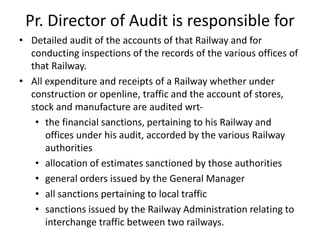
Pr. Director of Audit is responsible for
• Detailed audit of the accounts of that Railway and for
conducting inspections of the records of the various offices of
that Railway.
• All expenditure and receipts of a Railway whether under
construction or openline, traffic and the account of stores,
stock and manufacture are audited wrt-
• the financial sanctions, pertaining to his Railway and
offices under his audit, accorded by the various Railway
authorities
• allocation of estimates sanctioned by those authorities
• general orders issued by the General Manager
• all sanctions pertaining to local traffic
• sanctions issued by the Railway Administration relating to
interchange traffic between two railways.
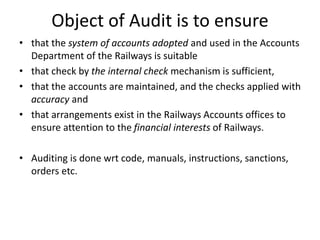
Object of Audit is to ensure
• that the system of accounts adopted and used in the Accounts
Department of the Railways is suitable
• that check by the internal check mechanism is sufficient,
• that the accounts are maintained, and the checks applied with
accuracy and
• that arrangements exist in the Railways Accounts offices to
ensure attention to the financial interests of Railways.
• Auditing is done wrt code, manuals, instructions, sanctions,
orders etc.
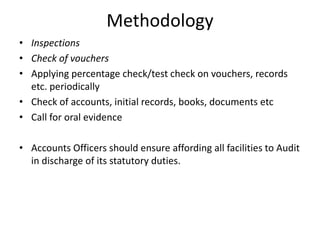
Methodology
• Inspections
• Check of vouchers
• Applying percentage check/test check on vouchers, records
etc. periodically
• Check of accounts, initial records, books, documents etc
• Call for oral evidence
• Accounts Officers should ensure affording all facilities to Audit
in discharge of its statutory duties.
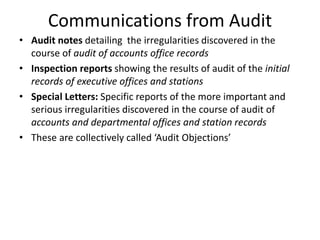
Communications from Audit
• Audit notes detailing the irregularities discovered in the
course of audit of accounts office records
• Inspection reports showing the results of audit of the initial
records of executive offices and stations
• Special Letters: Specific reports of the more important and
serious irregularities discovered in the course of audit of
accounts and departmental offices and station records
• These are collectively called ‘Audit Objections’
Replies to Audit objections
• Audit Notes: are to be replied by the Accounts immediately.
• Audit Inspection Reports: initial remarks shall be obtained
within a 30days time of receipt. Audit rejoinder is further
observations of audit on the reply furnished by railways,
which shall be replied within a week’s time.
• All the replies/correspondence from the executives to Audit
should be routed through Accounts.
• Accounts and Other departments shall comply with the Audit
requisitions promptly. Otherwise, Audit will calculate the lost
man-hours on that account.
• Accounts officer is required to certify ‘recoveries made at the
instance of Audit’, as a result of audit check.
Closure of Audit objections
• Replies to Audit Inspection Reports and Audit Notes and Special
Letters/Reports should be scrutinised in the Accounts office and
sent to the Audit for closure.
• Accounts will maintain record of audit objection received, closed
and pending, department-wise and year-wise and submit report
to Hqrs/Board
• If objections are piling up, Bi-partite or Tri-partite meetings are
held at appropriate levels for expeditious clearance of audit
objections.
• The connected records on which objections have been raised
should not be destroyed till the objections are settled.
Audit Objections and Provisional Payments
• If Audit objects to any payments of a recurring nature and it is
considered necessary to continue them pending settlement of the
objection, the claims may be admitted provisionally.
Audit Report - Railways
Audit Report: Significance
• Addl. Dy.C&AGI/Rlys is responsible for scrutinising the Railway
portion of the Finance Accounts including Annual Review of
Balances and examining the Appropriation Accounts prepared
by the Railway Board for certifying their accuracy and
prepares the Audit Report.
Significance of Audit Reports
• Audit reports provide useful hints for future guidance
• Audit Report are submitted to Parliament and the
recommendations of the Public Accounts Committee (PAC)
are considered by the Ministry concerned.
Audit Reports
• The reports of the C&AG in relation to the accounts of a
Government will be submitted to the Government
concerned. The Government shall cause every report so
received to be laid before each House of Parliament/State
legislature. Thereafter the report is deemed to have been
kept in public domain. Till such time the correspondence
shall be kept confidential
• The audit done by C&AG is broadly classified into Finance
Audit, Regularity/Compliance Audit, Performance Audit and
IT audit. Audit objections which are picked up for
incorporation in the Audit report, will generally be first
processed as Draft Paras
Audit Report: Stages
• Draft Paragraph (DP): All important cases noticed in audit,
which merit inclusion in the Report of the C&AGI are brought
to the notice of the Railway Administrations through special
letters, notes of objection etc., issued to the PHoD and PFA
by the PDA of the Railways.
Draft Paragraph is the first stage of presenting audit view
point for inclusion in the Audit Report as Audit para. Railway
should avail full opportunity to present its case.
• Provisional Para (PP)
In these stages, if railway replies are convincing, the Paras
are dropped and if not convinced, the same will be escalated
to next stage.
• Audit Para (AP): Final stage, Audit Para finding place in the
Audit Report for Railways under relevant chapters
Draft Para
• The PDA sends the draft paragraphs to the General Manager.
• He shall also send simultaneously copies of the draft paragraphs
with connected correspondence, to the PFA, the Head of the
Department concerned, to facilitate prompt action and detailed
examination of the points brought out in the draft paragraph.
• The General Manager should send the reply to the Draft paragraph
within six weeks.
Draft Para
Accounts scrutiny
• The Railway Administration (PFA, on behalf of GM), should furnish
reply to the PDA, simultaneously giving copy to the Railway Board.
The reply should have the personal approval of the GM.
• Needless to say that the reply from executive should have the
approval of PHoD.
• Accounts should verify the facts and the line of reply is to the
point. It should be a statement of authoritative facts.
• Calculations furnished in the key documents to the Draft Para and
the conclusions arrived at are correct. If not correct, clear reasons
should be furnished.
• The reply should be total and comprehensive, leaving no point left
uncovered.
Annexures to the DP reply
• The reply should be sentence-wise in juxtaposition to the
Draft para contents.
• It should be accompanied by the following-
– A brief history of the case together with the Audit
contention
– Railway defense
– A chronological summary of the case where there has
been unusual delay in dealing with the subject matter.
– Remedial action called for or taken to avoid similar cases in
future.
– Disciplinary aspects, if any where individual lapses have
been brought to light.
Audit Report: Provisional Paras
• DPs for which railways not furnished remarks, or had
furnished remarks but Audit not convinced and decided to
include in Audit report are sent to RB as Provisional Paras
(PPs)
• Railways are given only 2 weeks time to furnish reply
(Sentense-wise) to Provisional Paras with the approval of
GM to Rly Board.
• The replies furnished by respective Directorates to PPs will
be considered by Audit at RB and the PPs for which replies
either not received or are found not convincing will be
incorporated in Audit Report- Railways as Audit Paras.
AR: Audit Paras and ATNs
• On receipt of Audit Report, Draft Action Taken Note (ATN)
in the prescribed proforma along with Para-wise remarks
are sent to Railway Board.
• PAC will select a few Audit Paras for discussion with the
GM and PHODs and submit its recommendations to
Government for its consideration.
• Railway Board sends ATN to Audit; accepted ATN and
comments of Audit thereon, if any, will be communicated
back to Zonal Railways.
For further reading
• Chapter IX of Finance Code
• Para 113 to 116 of Accounts Code
• Appendix I to Accounts Code
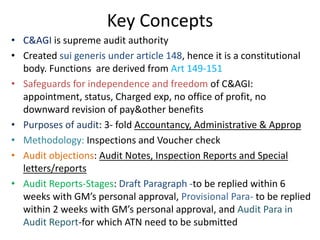
Key Concepts
• C&AGI is supreme audit authority
• Created sui generis under article 148, hence it is a constitutional
body. Functions are derived from Art 149-151
• Safeguards for independence and freedom of C&AGI:
appointment, status, Charged exp, no office of profit, no
downward revision of pay&other benefits
• Purposes of audit: 3- fold Accountancy, Administrative & Approp
• Methodology: Inspections and Voucher check
• Audit objections: Audit Notes, Inspection Reports and Special
letters/reports
• Audit Reports-Stages: Draft Paragraph -to be replied within 6
weeks with GM’s personal approval, Provisional Para- to be replied
within 2 weeks with GM’s personal approval, and Audit Para in
Audit Report-for which ATN need to be submitted
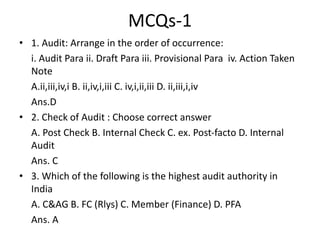
MCQs-1
• 1. Audit: Arrange in the order of occurrence:
i. Audit Para ii. Draft Para iii. Provisional Para iv. Action Taken
Note
A.ii,iii,iv,i B. ii,iv,i,iii C. iv,i,ii,iii D. ii,iii,i,iv
Ans.D
• 2. Check of Audit : Choose correct answer
A. Post Check B. Internal Check C. ex. Post-facto D. Internal
Audit
Ans. C
• 3. Which of the following is the highest audit authority in
India
A. C&AG B. FC (Rlys) C. Member (Finance) D. PFA
Ans. A
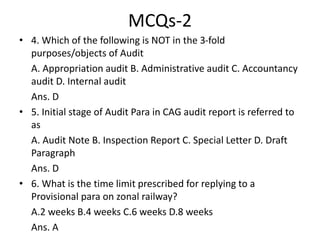
MCQs-2
• 4. Which of the following is NOT in the 3-fold
purposes/objects of Audit
A. Appropriation audit B. Administrative audit C. Accountancy
audit D. Internal audit
Ans. D
• 5. Initial stage of Audit Para in CAG audit report is referred to
as
A. Audit Note B. Inspection Report C. Special Letter D. Draft
Paragraph
Ans. D
• 6. What is the time limit prescribed for replying to a
Provisional para on zonal railway?
A.2 weeks B.4 weeks C.6 weeks D.8 weeks
Ans. A
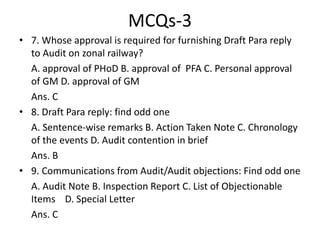
MCQs-3
• 7. Whose approval is required for furnishing Draft Para reply
to Audit on zonal railway?
A. approval of PHoD B. approval of PFA C. Personal approval
of GM D. approval of GM
Ans. C
• 8. Draft Para reply: find odd one
A. Sentence-wise remarks B. Action Taken Note C. Chronology
of the events D. Audit contention in brief
Ans. B
• 9. Communications from Audit/Audit objections: Find odd one
A. Audit Note B. Inspection Report C. List of Objectionable
Items D. Special Letter
Ans. C
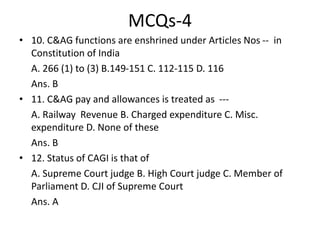
MCQs-4
• 10. C&AG functions are enshrined under Articles Nos -- in
Constitution of India
A. 266 (1) to (3) B.149-151 C. 112-115 D. 116
Ans. B
• 11. C&AG pay and allowances is treated as ---
A. Railway Revenue B. Charged expenditure C. Misc.
expenditure D. None of these
Ans. B
• 12. Status of CAGI is that of
A. Supreme Court judge B. High Court judge C. Member of
Parliament D. CJI of Supreme Court
Ans. A
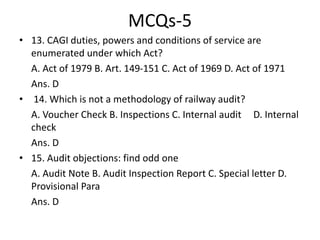
MCQs-5
• 13. CAGI duties, powers and conditions of service are
enumerated under which Act?
A. Act of 1979 B. Art. 149-151 C. Act of 1969 D. Act of 1971
Ans. D
• 14. Which is not a methodology of railway audit?
A. Voucher Check B. Inspections C. Internal audit D. Internal
check
Ans. D
• 15. Audit objections: find odd one
A. Audit Note B. Audit Inspection Report C. Special letter D.
Provisional Para
Ans. D
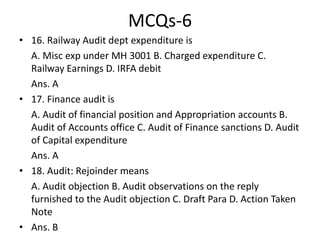
MCQs-6
• 16. Railway Audit dept expenditure is
A. Misc exp under MH 3001 B. Charged expenditure C.
Railway Earnings D. IRFA debit
Ans. A
• 17. Finance audit is
A. Audit of financial position and Appropriation accounts B.
Audit of Accounts office C. Audit of Finance sanctions D. Audit
of Capital expenditure
Ans. A
• 18. Audit: Rejoinder means
A. Audit objection B. Audit observations on the reply
furnished to the Audit objection C. Draft Para D. Action Taken
Note
• Ans. B

Railway Audit.ppt

  • 1.
    Audit: Role of Audit,Audit Objections, Draft Paras Damodara Prasad K, Sr.AFA (Retd.) 9491043283 damodara@gmail.com
  • 2.
    C&AGI • The Comptrollerand Auditor General of India is the final or supreme audit authority in India and created sui generis by the Constitution of India (Art 148) for audit of the accounts of the Union, the States and UTs. Thus, it is a Constitutional body. • His functions and powers are derived from articles 149 to 151 of the Constitution of India and duties are defined by an Act- (DPC)1971, amended in 1976. Constitutional provisions: Art 149-151 • C&AG shall perform such duties and exercise such powers as prescribed under any law made by Parliament. • The Accounts of the Government should be kept in such form as prescribed by C&AG with the approval the President • The Reports of Union (UTs)/States shall be submitted to the President/Governor and laid in Parliament/State Legislature.
  • 3.
    C&AG: Duties (a) Toaudit all expenditure from the Consolidated Fund of India and to ascertain, whether the moneys shown in the accounts as having been disbursed were legally available for, and applicable to the service or purpose to which they have been applied or charged and whether the expenditure conforms to the authority which governs it; (b) To audit all transactions relating to Contingency Fund and Public Account (c) To audit all trading, manufacturing, profit and loss accounts and balance sheets and other subsidiary accounts kept and submit a Report. • Assists PAC in scrutiny of Appropriation Accounts • The scope and extent of audit are determined by the C&AG
  • 4.
    Purpose & Objectsof Audit- 3 fold • Firstly, accountancy audit : i. to check arithmetical calculations, payments are supported by receipted vouchers etc., with an object to detection of frauds, technical errors, principle errors etc.; ii. to asses the adequacy of accounting system and the system of IC . • Secondly, appropriation audit: to check classification of expenditure and receipts with an object to ensure that the exp and earnings are allocated to the proper heads ; to check that the expenditure is not exceeded funds allotted as part of parliamentary control. This is full and complete. • Thirdly, administrative audit: to check sanctions with an object to check that the exp is incurred wrt the SoP. A percentage check is applied here on the connected vouchers and records
  • 5.
    Safeguards available forindependence and freedom of C&AG • His oath of office requires him to uphold the Constitution and the laws and to discharge his duties without fear or favour, affection or ill-will. • Article 148 of the Constitution provides that the Comptroller and Auditor General shall be appointed by the President under his hand seal and shall only be removed from office in like manner and on the like ground as a Judge of the Supreme Court. • It also provides that he would not be eligible for appointment any other office of profit either under the Government of India or the Government of any State
  • 6.
    Safeguards…. • The salaryand other conditions of service of C&AG shall be determined by the Parliament under Law; and his salary, leave, pension , age of retirement shall not be varied to his disadvantage after his appointment. • The administrative expenses of his office, including all salaries, allowances and pensions payable to or in respect of persons serving in that office, shall be charged, upon the Consolidated Fund of India ie treated as Charged expenditure
  • 7.
    C&AGI and Rlys •C&AG is responsible for the audit of the accounts of Indian Railways, but has no responsibility for compilation of the same. C&AG is relieved of the responsibility for compiling the accounts of Railway department from 1929 onwards. • The from in which accounts of the Indian Railways should be kept and changes in the accounting classification affecting the recording of expenditure in finance and revenue accounts of the Government of India are subject to his approval. • Addl. Dy.C&AGI/Rlys (DAI) is responsible for scrutinising the Railway portion of the Finance Accounts including Annual Review of Balances and examining the Appropriation Accounts prepared by the Railway Board for certifying their accuracy and preparing the Audit Report.
  • 8.
    Rly Audit organisation •In Railways, C&AG is assisted by Addl. Dy.C&AGI. Subordinate to him are DG/Railways, Principle Directors of Audit/DGA, Dy. Directors, Senior/Divl Audit Officers etc., who are responsible for conducting audit of the accounts of Indian Railways- expenditure and receipt transactions, including stores and stock accounts. • The cost of Railway audit is borne by the Railway revenues- Misc Exp. • Audit duty is ex-Post facto and constitutional, while Accounts job is concurrent and as of participative management.
  • 9.
    Pr. Director ofAudit is responsible for • Detailed audit of the accounts of that Railway and for conducting inspections of the records of the various offices of that Railway. • All expenditure and receipts of a Railway whether under construction or openline, traffic and the account of stores, stock and manufacture are audited wrt- • the financial sanctions, pertaining to his Railway and offices under his audit, accorded by the various Railway authorities • allocation of estimates sanctioned by those authorities • general orders issued by the General Manager • all sanctions pertaining to local traffic • sanctions issued by the Railway Administration relating to interchange traffic between two railways.
  • 10.
    Object of Auditis to ensure • that the system of accounts adopted and used in the Accounts Department of the Railways is suitable • that check by the internal check mechanism is sufficient, • that the accounts are maintained, and the checks applied with accuracy and • that arrangements exist in the Railways Accounts offices to ensure attention to the financial interests of Railways. • Auditing is done wrt code, manuals, instructions, sanctions, orders etc.
  • 11.
    Methodology • Inspections • Checkof vouchers • Applying percentage check/test check on vouchers, records etc. periodically • Check of accounts, initial records, books, documents etc • Call for oral evidence • Accounts Officers should ensure affording all facilities to Audit in discharge of its statutory duties.
  • 12.
    Communications from Audit •Audit notes detailing the irregularities discovered in the course of audit of accounts office records • Inspection reports showing the results of audit of the initial records of executive offices and stations • Special Letters: Specific reports of the more important and serious irregularities discovered in the course of audit of accounts and departmental offices and station records • These are collectively called ‘Audit Objections’
  • 13.
    Replies to Auditobjections • Audit Notes: are to be replied by the Accounts immediately. • Audit Inspection Reports: initial remarks shall be obtained within a 30days time of receipt. Audit rejoinder is further observations of audit on the reply furnished by railways, which shall be replied within a week’s time. • All the replies/correspondence from the executives to Audit should be routed through Accounts. • Accounts and Other departments shall comply with the Audit requisitions promptly. Otherwise, Audit will calculate the lost man-hours on that account. • Accounts officer is required to certify ‘recoveries made at the instance of Audit’, as a result of audit check.
  • 14.
    Closure of Auditobjections • Replies to Audit Inspection Reports and Audit Notes and Special Letters/Reports should be scrutinised in the Accounts office and sent to the Audit for closure. • Accounts will maintain record of audit objection received, closed and pending, department-wise and year-wise and submit report to Hqrs/Board • If objections are piling up, Bi-partite or Tri-partite meetings are held at appropriate levels for expeditious clearance of audit objections. • The connected records on which objections have been raised should not be destroyed till the objections are settled. Audit Objections and Provisional Payments • If Audit objects to any payments of a recurring nature and it is considered necessary to continue them pending settlement of the objection, the claims may be admitted provisionally.
  • 15.
  • 16.
    Audit Report: Significance •Addl. Dy.C&AGI/Rlys is responsible for scrutinising the Railway portion of the Finance Accounts including Annual Review of Balances and examining the Appropriation Accounts prepared by the Railway Board for certifying their accuracy and prepares the Audit Report. Significance of Audit Reports • Audit reports provide useful hints for future guidance • Audit Report are submitted to Parliament and the recommendations of the Public Accounts Committee (PAC) are considered by the Ministry concerned.
  • 17.
    Audit Reports • Thereports of the C&AG in relation to the accounts of a Government will be submitted to the Government concerned. The Government shall cause every report so received to be laid before each House of Parliament/State legislature. Thereafter the report is deemed to have been kept in public domain. Till such time the correspondence shall be kept confidential • The audit done by C&AG is broadly classified into Finance Audit, Regularity/Compliance Audit, Performance Audit and IT audit. Audit objections which are picked up for incorporation in the Audit report, will generally be first processed as Draft Paras
  • 18.
    Audit Report: Stages •Draft Paragraph (DP): All important cases noticed in audit, which merit inclusion in the Report of the C&AGI are brought to the notice of the Railway Administrations through special letters, notes of objection etc., issued to the PHoD and PFA by the PDA of the Railways. Draft Paragraph is the first stage of presenting audit view point for inclusion in the Audit Report as Audit para. Railway should avail full opportunity to present its case. • Provisional Para (PP) In these stages, if railway replies are convincing, the Paras are dropped and if not convinced, the same will be escalated to next stage. • Audit Para (AP): Final stage, Audit Para finding place in the Audit Report for Railways under relevant chapters
  • 19.
    Draft Para • ThePDA sends the draft paragraphs to the General Manager. • He shall also send simultaneously copies of the draft paragraphs with connected correspondence, to the PFA, the Head of the Department concerned, to facilitate prompt action and detailed examination of the points brought out in the draft paragraph. • The General Manager should send the reply to the Draft paragraph within six weeks.
  • 20.
    Draft Para Accounts scrutiny •The Railway Administration (PFA, on behalf of GM), should furnish reply to the PDA, simultaneously giving copy to the Railway Board. The reply should have the personal approval of the GM. • Needless to say that the reply from executive should have the approval of PHoD. • Accounts should verify the facts and the line of reply is to the point. It should be a statement of authoritative facts. • Calculations furnished in the key documents to the Draft Para and the conclusions arrived at are correct. If not correct, clear reasons should be furnished. • The reply should be total and comprehensive, leaving no point left uncovered.
  • 21.
    Annexures to theDP reply • The reply should be sentence-wise in juxtaposition to the Draft para contents. • It should be accompanied by the following- – A brief history of the case together with the Audit contention – Railway defense – A chronological summary of the case where there has been unusual delay in dealing with the subject matter. – Remedial action called for or taken to avoid similar cases in future. – Disciplinary aspects, if any where individual lapses have been brought to light.
  • 22.
    Audit Report: ProvisionalParas • DPs for which railways not furnished remarks, or had furnished remarks but Audit not convinced and decided to include in Audit report are sent to RB as Provisional Paras (PPs) • Railways are given only 2 weeks time to furnish reply (Sentense-wise) to Provisional Paras with the approval of GM to Rly Board. • The replies furnished by respective Directorates to PPs will be considered by Audit at RB and the PPs for which replies either not received or are found not convincing will be incorporated in Audit Report- Railways as Audit Paras.
  • 23.
    AR: Audit Parasand ATNs • On receipt of Audit Report, Draft Action Taken Note (ATN) in the prescribed proforma along with Para-wise remarks are sent to Railway Board. • PAC will select a few Audit Paras for discussion with the GM and PHODs and submit its recommendations to Government for its consideration. • Railway Board sends ATN to Audit; accepted ATN and comments of Audit thereon, if any, will be communicated back to Zonal Railways.
  • 24.
    For further reading •Chapter IX of Finance Code • Para 113 to 116 of Accounts Code • Appendix I to Accounts Code
  • 25.
    Key Concepts • C&AGIis supreme audit authority • Created sui generis under article 148, hence it is a constitutional body. Functions are derived from Art 149-151 • Safeguards for independence and freedom of C&AGI: appointment, status, Charged exp, no office of profit, no downward revision of pay&other benefits • Purposes of audit: 3- fold Accountancy, Administrative & Approp • Methodology: Inspections and Voucher check • Audit objections: Audit Notes, Inspection Reports and Special letters/reports • Audit Reports-Stages: Draft Paragraph -to be replied within 6 weeks with GM’s personal approval, Provisional Para- to be replied within 2 weeks with GM’s personal approval, and Audit Para in Audit Report-for which ATN need to be submitted
  • 26.
    MCQs-1 • 1. Audit:Arrange in the order of occurrence: i. Audit Para ii. Draft Para iii. Provisional Para iv. Action Taken Note A.ii,iii,iv,i B. ii,iv,i,iii C. iv,i,ii,iii D. ii,iii,i,iv Ans.D • 2. Check of Audit : Choose correct answer A. Post Check B. Internal Check C. ex. Post-facto D. Internal Audit Ans. C • 3. Which of the following is the highest audit authority in India A. C&AG B. FC (Rlys) C. Member (Finance) D. PFA Ans. A
  • 27.
    MCQs-2 • 4. Whichof the following is NOT in the 3-fold purposes/objects of Audit A. Appropriation audit B. Administrative audit C. Accountancy audit D. Internal audit Ans. D • 5. Initial stage of Audit Para in CAG audit report is referred to as A. Audit Note B. Inspection Report C. Special Letter D. Draft Paragraph Ans. D • 6. What is the time limit prescribed for replying to a Provisional para on zonal railway? A.2 weeks B.4 weeks C.6 weeks D.8 weeks Ans. A
  • 28.
    MCQs-3 • 7. Whoseapproval is required for furnishing Draft Para reply to Audit on zonal railway? A. approval of PHoD B. approval of PFA C. Personal approval of GM D. approval of GM Ans. C • 8. Draft Para reply: find odd one A. Sentence-wise remarks B. Action Taken Note C. Chronology of the events D. Audit contention in brief Ans. B • 9. Communications from Audit/Audit objections: Find odd one A. Audit Note B. Inspection Report C. List of Objectionable Items D. Special Letter Ans. C
  • 29.
    MCQs-4 • 10. C&AGfunctions are enshrined under Articles Nos -- in Constitution of India A. 266 (1) to (3) B.149-151 C. 112-115 D. 116 Ans. B • 11. C&AG pay and allowances is treated as --- A. Railway Revenue B. Charged expenditure C. Misc. expenditure D. None of these Ans. B • 12. Status of CAGI is that of A. Supreme Court judge B. High Court judge C. Member of Parliament D. CJI of Supreme Court Ans. A
  • 30.
    MCQs-5 • 13. CAGIduties, powers and conditions of service are enumerated under which Act? A. Act of 1979 B. Art. 149-151 C. Act of 1969 D. Act of 1971 Ans. D • 14. Which is not a methodology of railway audit? A. Voucher Check B. Inspections C. Internal audit D. Internal check Ans. D • 15. Audit objections: find odd one A. Audit Note B. Audit Inspection Report C. Special letter D. Provisional Para Ans. D
  • 31.
    MCQs-6 • 16. RailwayAudit dept expenditure is A. Misc exp under MH 3001 B. Charged expenditure C. Railway Earnings D. IRFA debit Ans. A • 17. Finance audit is A. Audit of financial position and Appropriation accounts B. Audit of Accounts office C. Audit of Finance sanctions D. Audit of Capital expenditure Ans. A • 18. Audit: Rejoinder means A. Audit objection B. Audit observations on the reply furnished to the Audit objection C. Draft Para D. Action Taken Note • Ans. B