Beyond User Research
Lou Rosenfeld •  lou@rosenfeldmedia.com
#EuroIA17 • 30 September 2017
(a talk has no name)
Lou Rosenfeld •  lou@rosenfeldmedia.com
EuroIA 2017 • 30 September 2017
What might
we become?
What does victory look like?
User research in
today’s organization
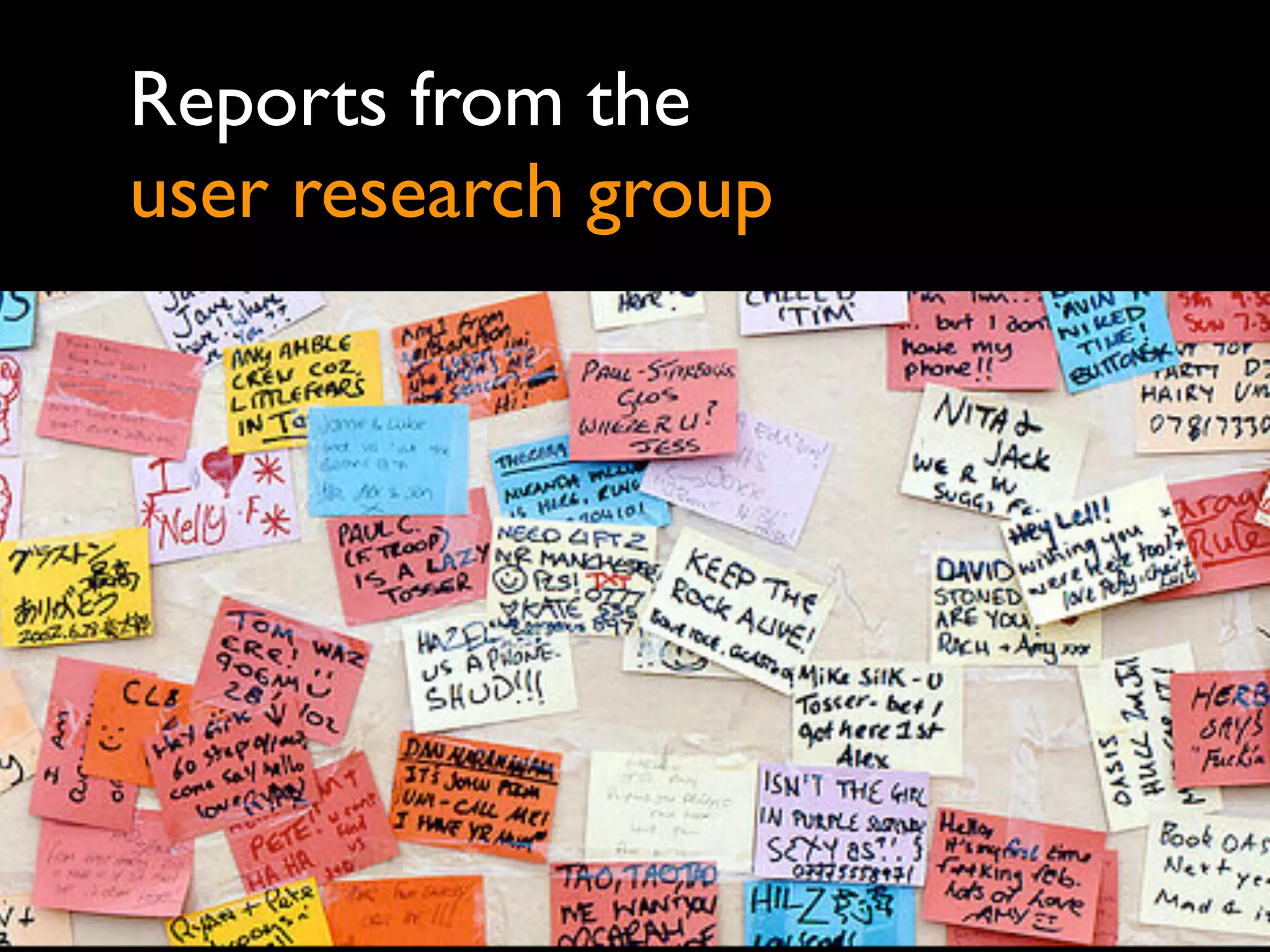
Reports from the
user research group
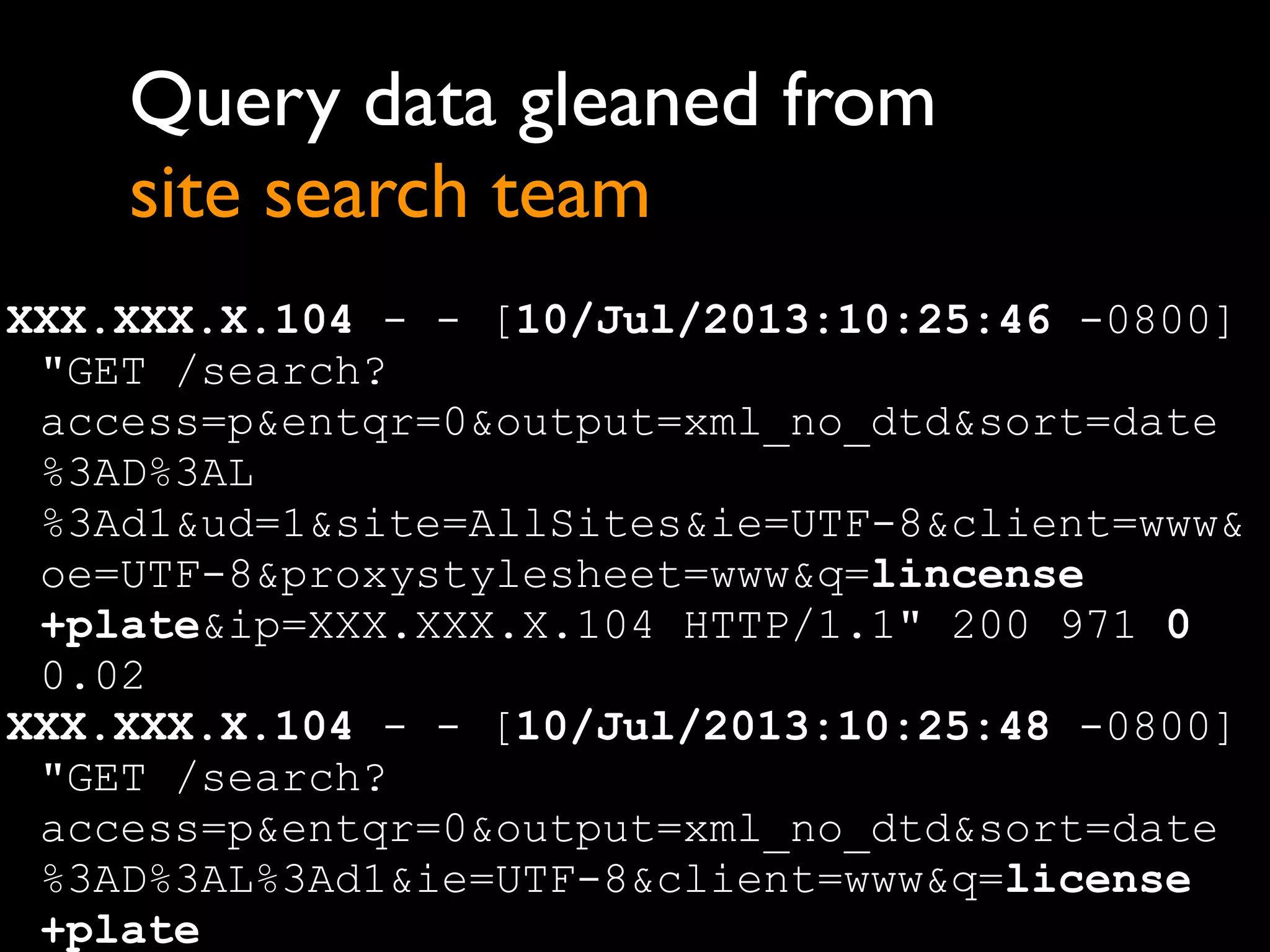
Query data from the
search team
XXX.XXX.X.104 - - [10/Jul/2013:10:25:46 -0800]
"GET /search?
access=p&entqr=0&output=xml_no_dtd&sort=date%
3AD%3AL%3Ad1&ud=1&site=AllSites&ie=UTF-8&clie
nt=www&oe=UTF-8&proxystylesheet=www&q=lincens
e+plate&ip=XXX.XXX.X.104 HTTP/1.1" 200 971 0
0.02
XXX.XXX.X.104 - - [10/Jul/2013:10:25:48 -0800]
"GET /search?
access=p&entqr=0&output=xml_no_dtd&sort=date%
3AD%3AL%3Ad1&ie=UTF-8&client=www&q=license+pl
Logs from the
call center
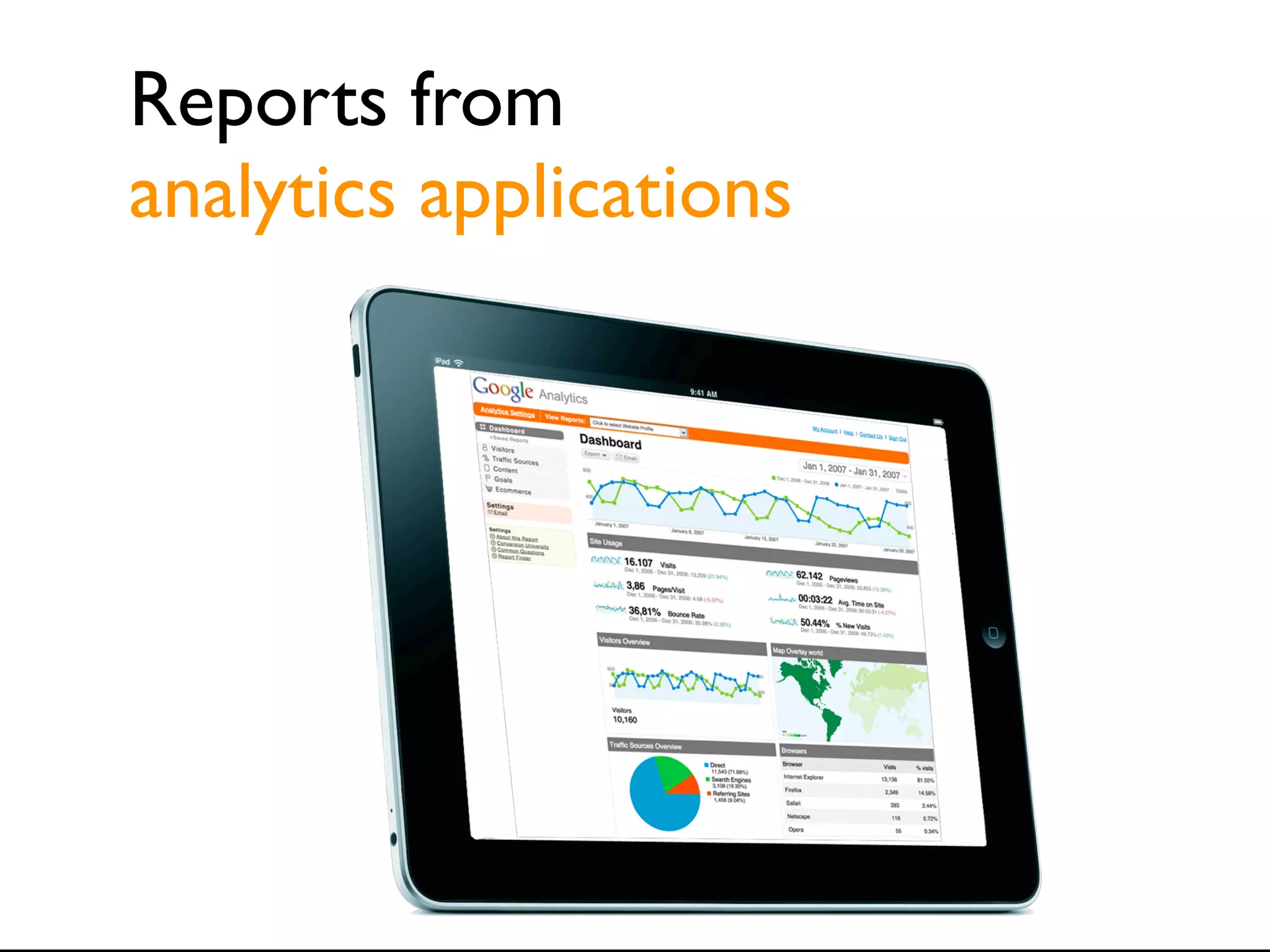
Reports from
analytics applications
“Learnings” from
Voice of the Customer research
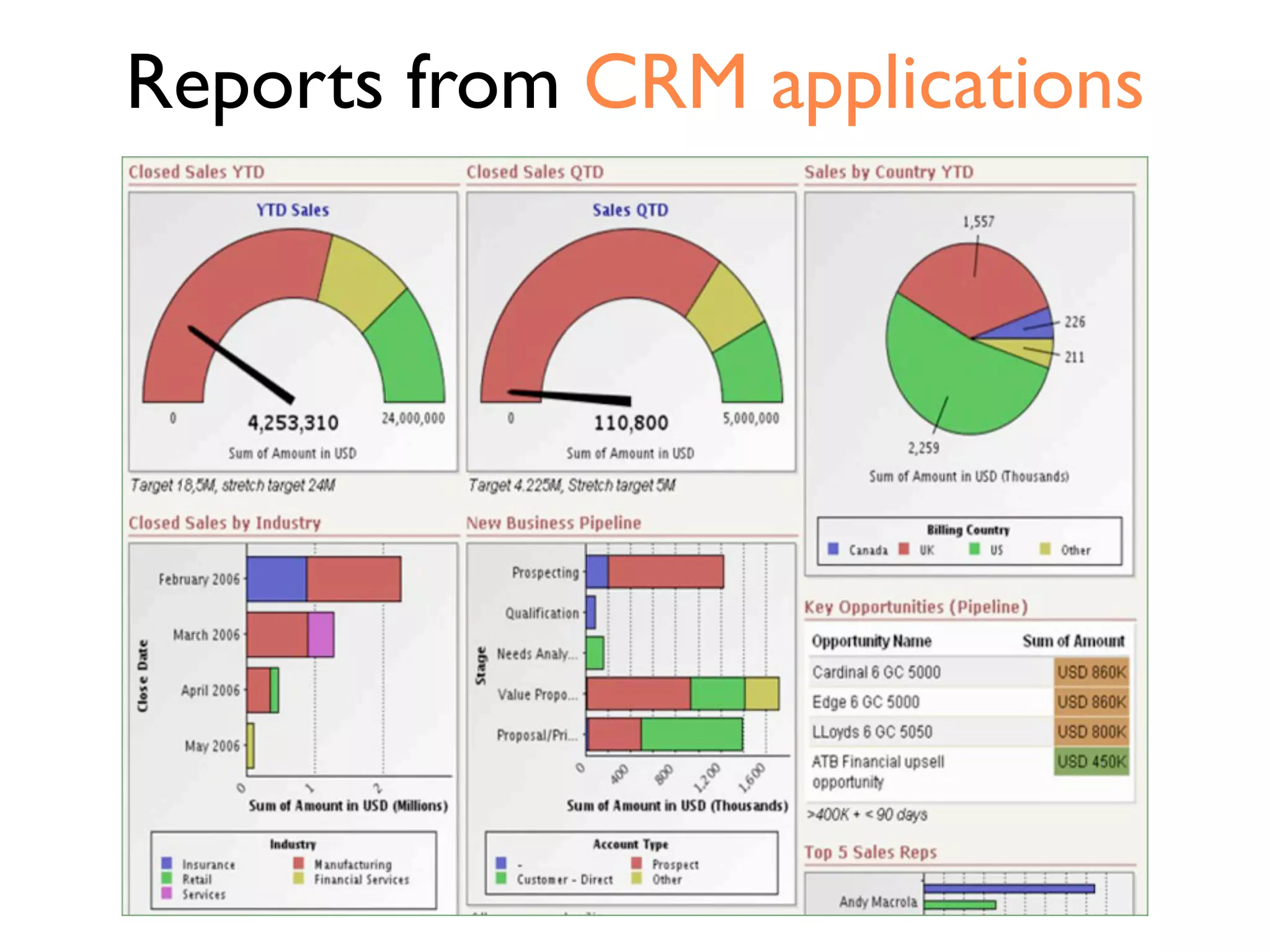
Reports from CRM applications
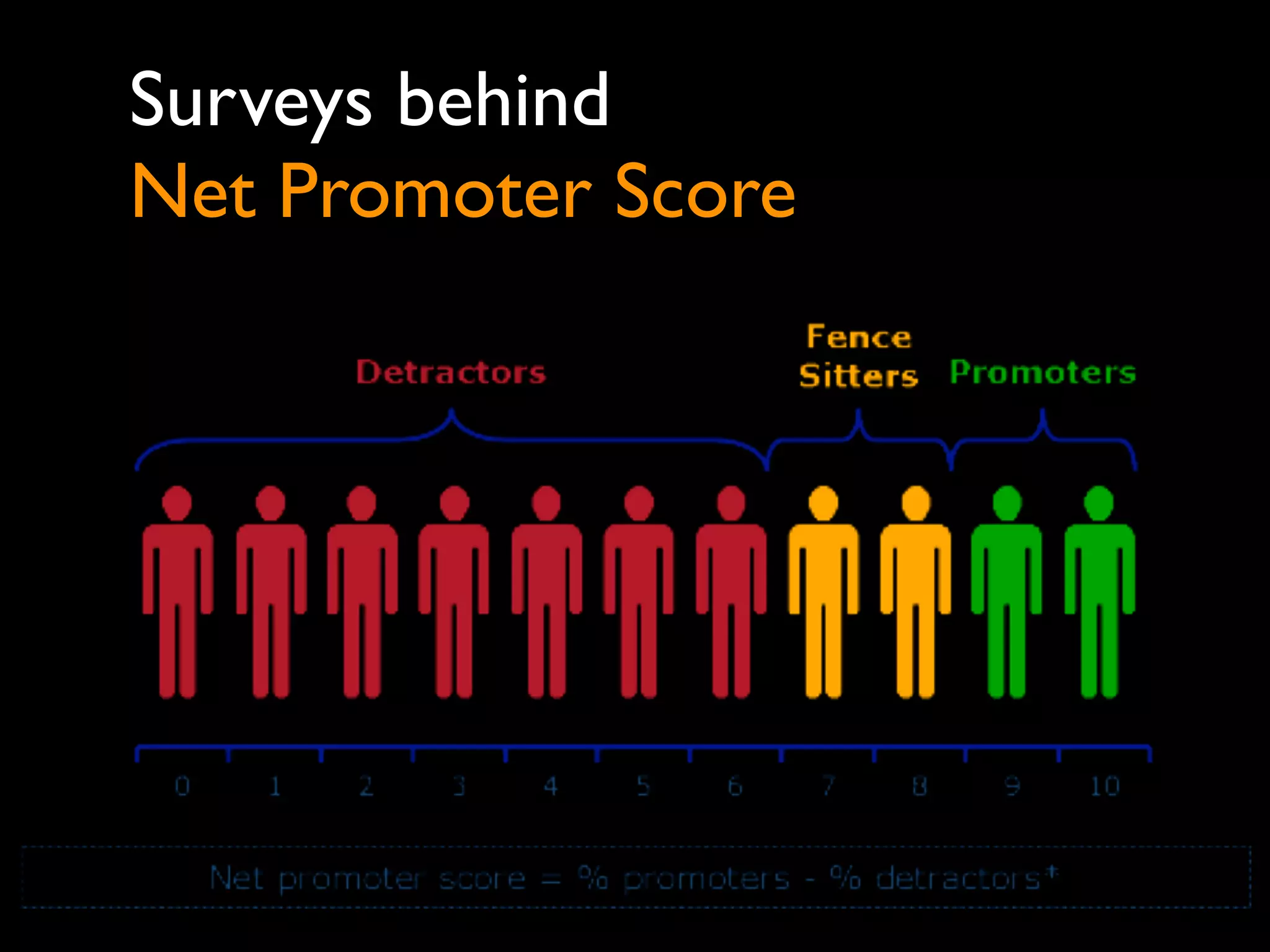
Surveys behind
Net Promoter Score
Studies from the
research center
Analysis of
social media
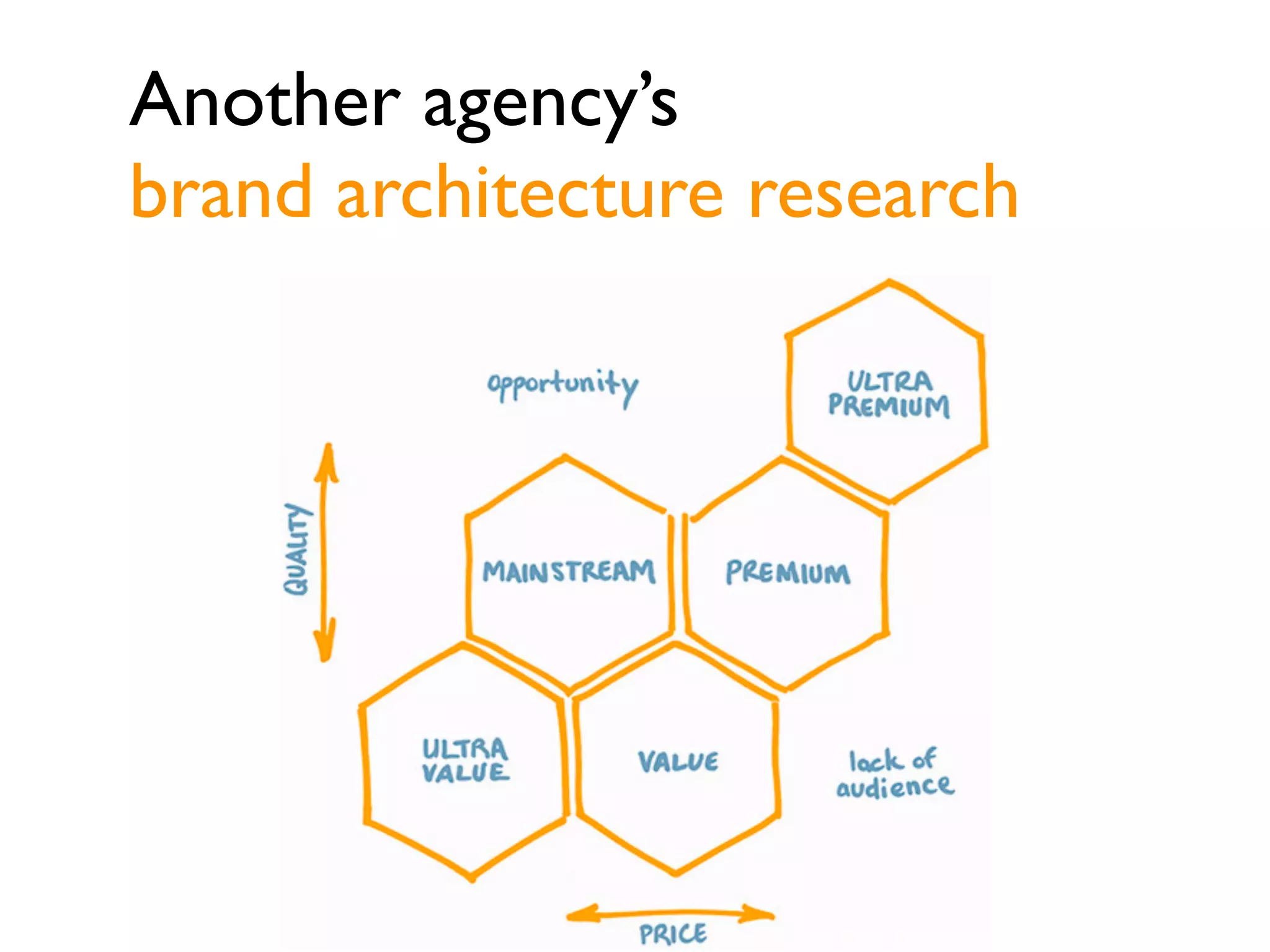
Research on
brand architecture
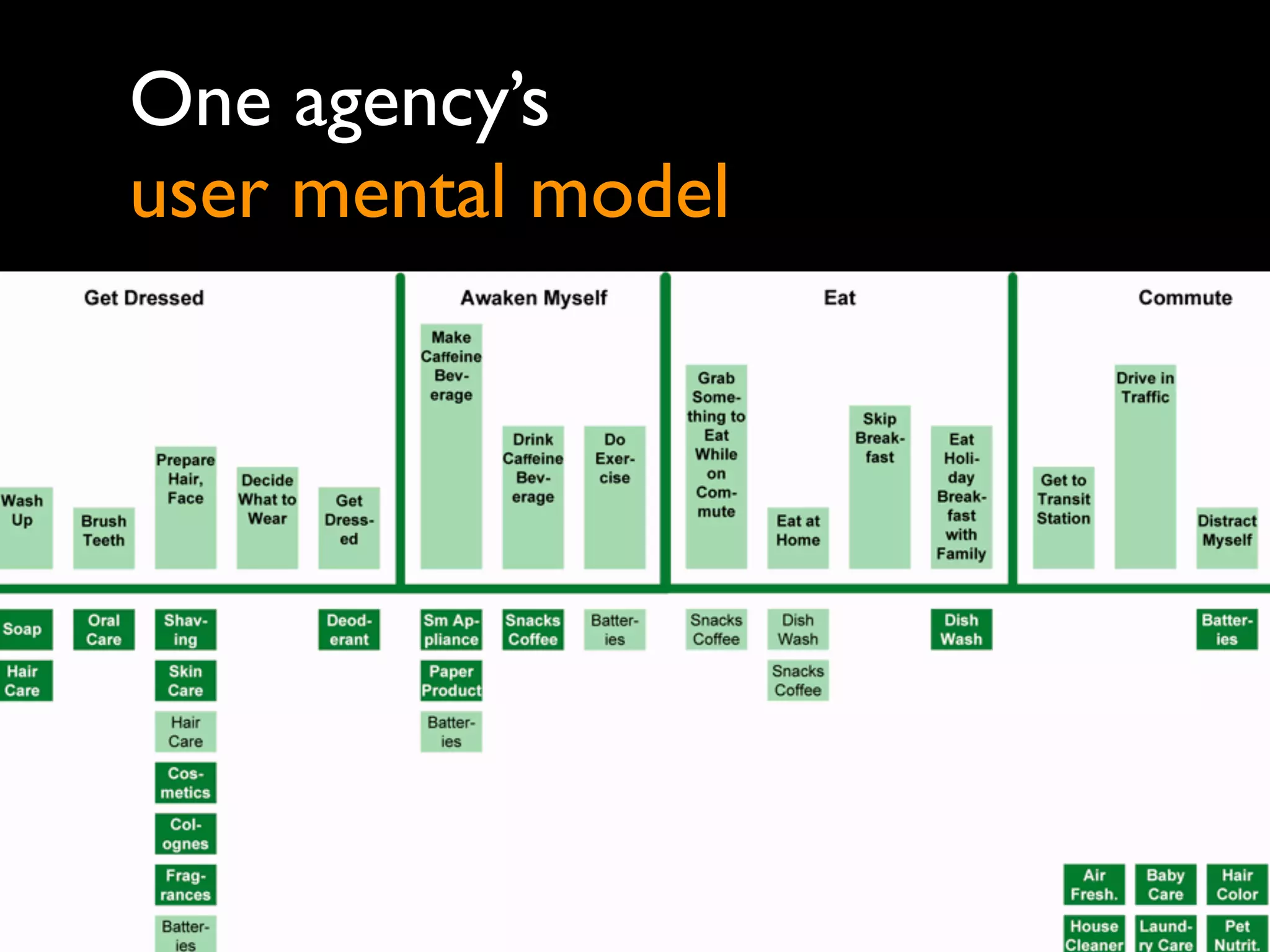
Even users’
mental models
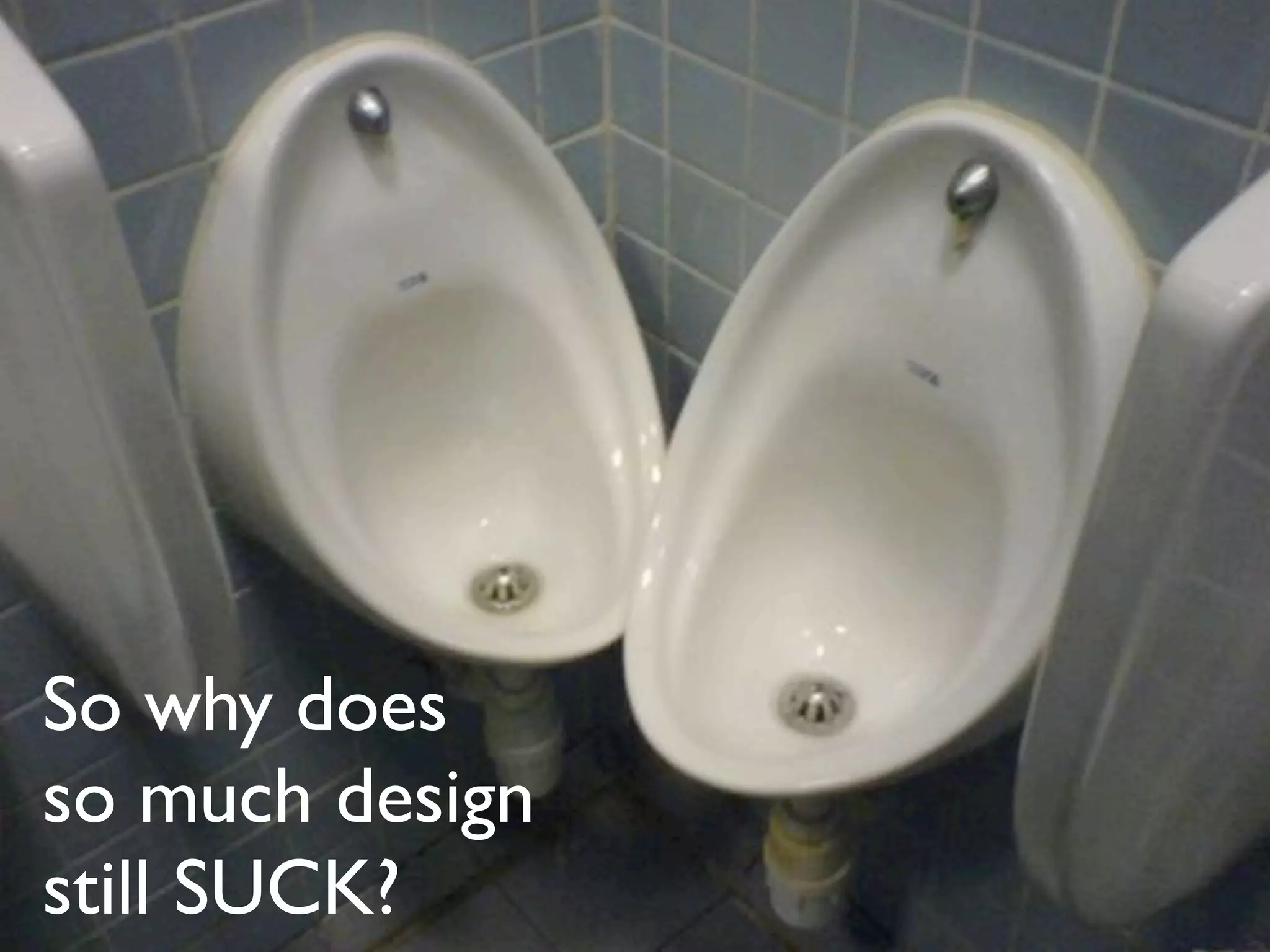
Yet why does
so much design
still SUCK?
Yet why does
so much design
still SUCK?
Problem
It’s only going
to get worse
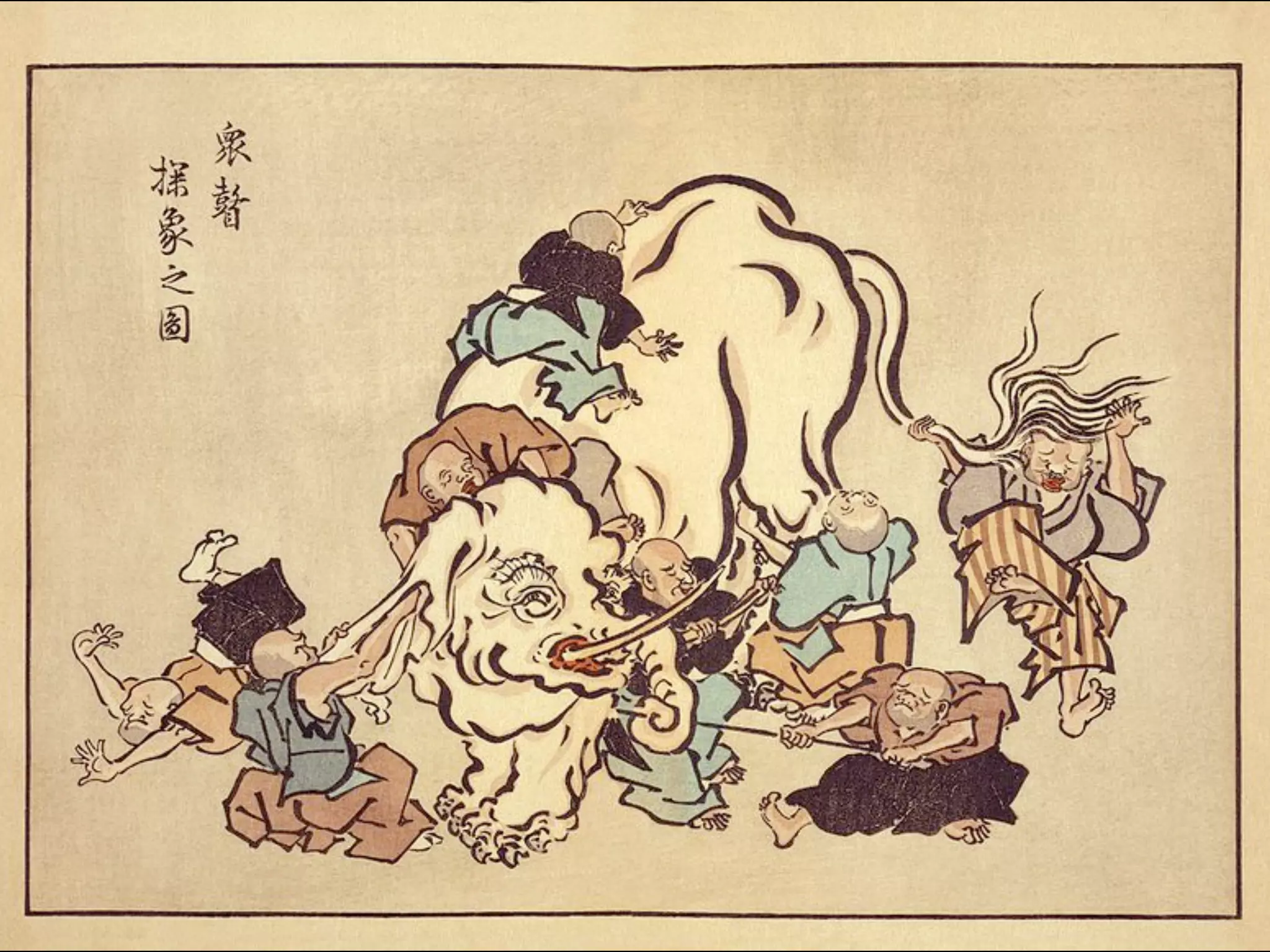
The blind men and the
elephant
Problem
It’s only going
to get worse
Opportunity
How might we support 

synthesis and insight?
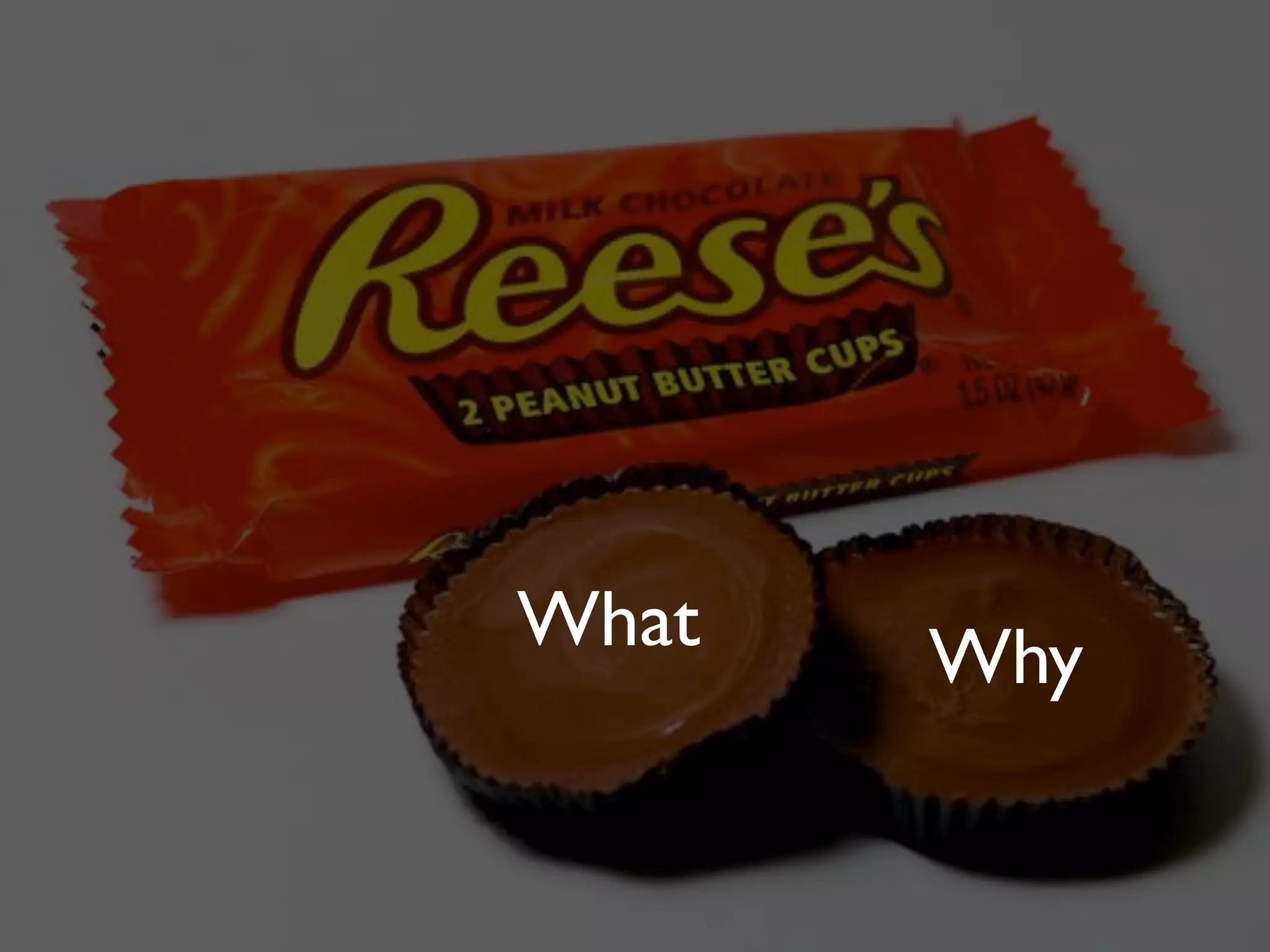
What Why
Methods employed:
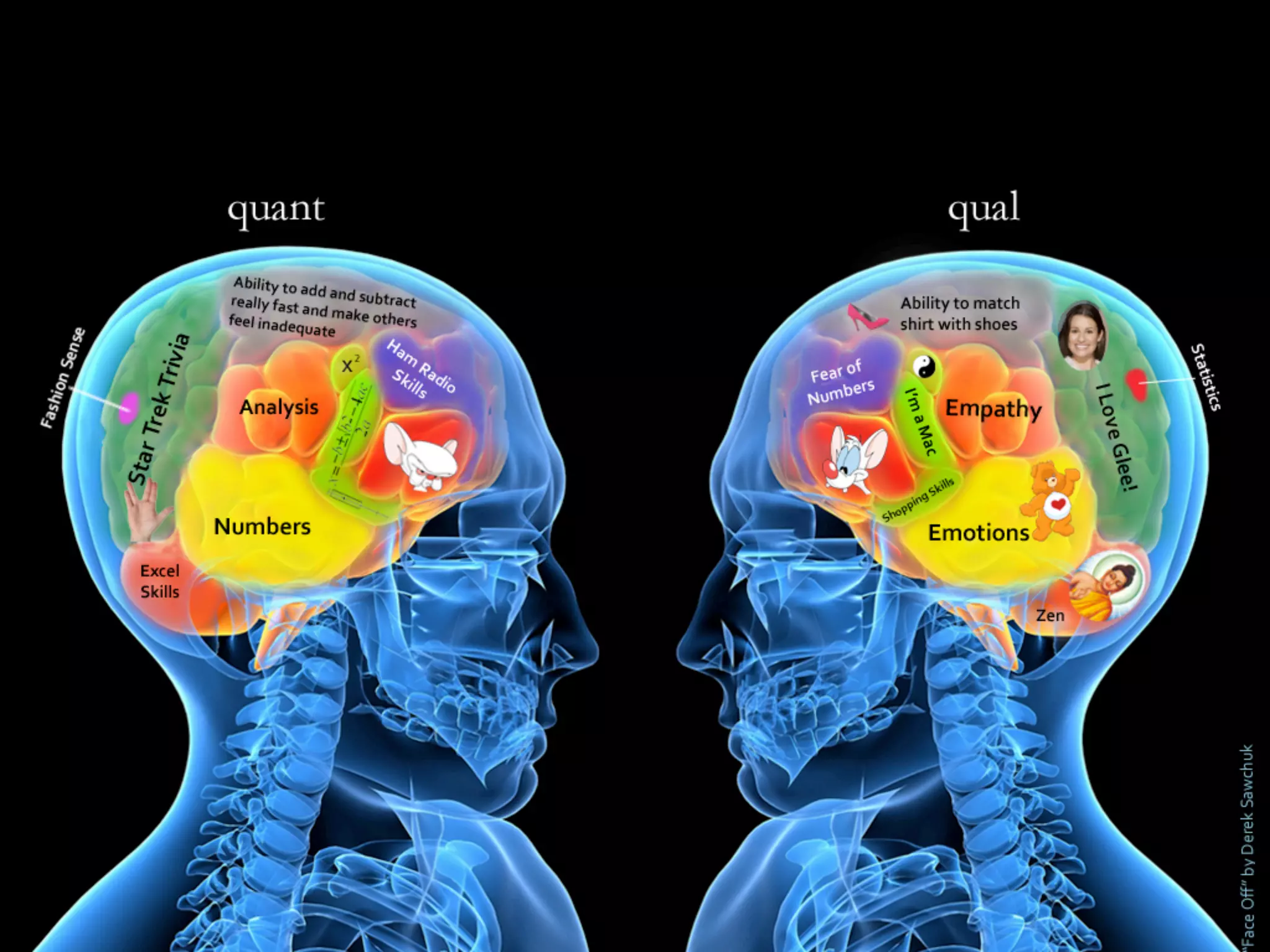
quantitative versus qualitative
Goals: help org or users
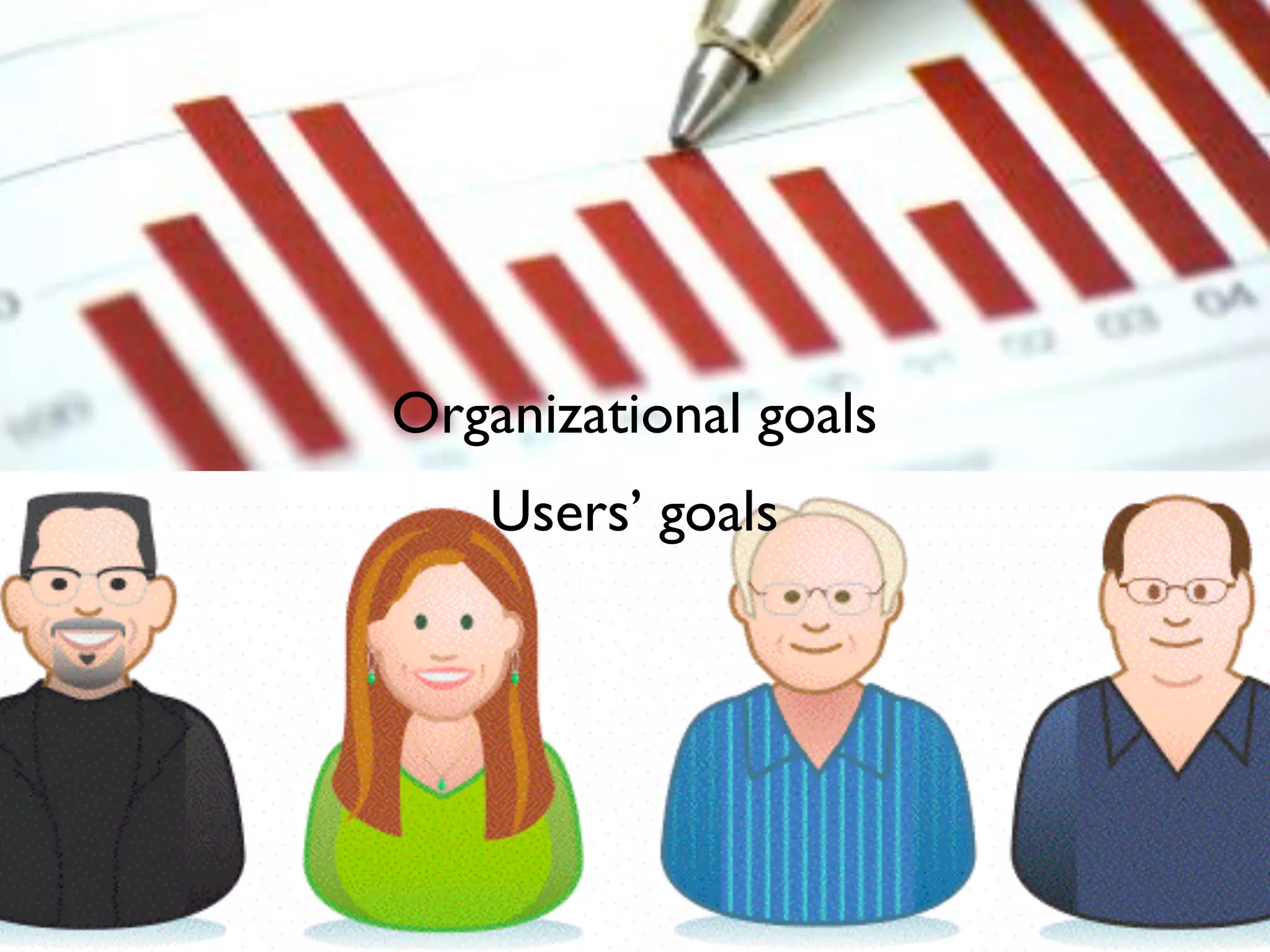
Organizational goals
Users’ goals
How they use data: measur
world we know versus wo
we don’t
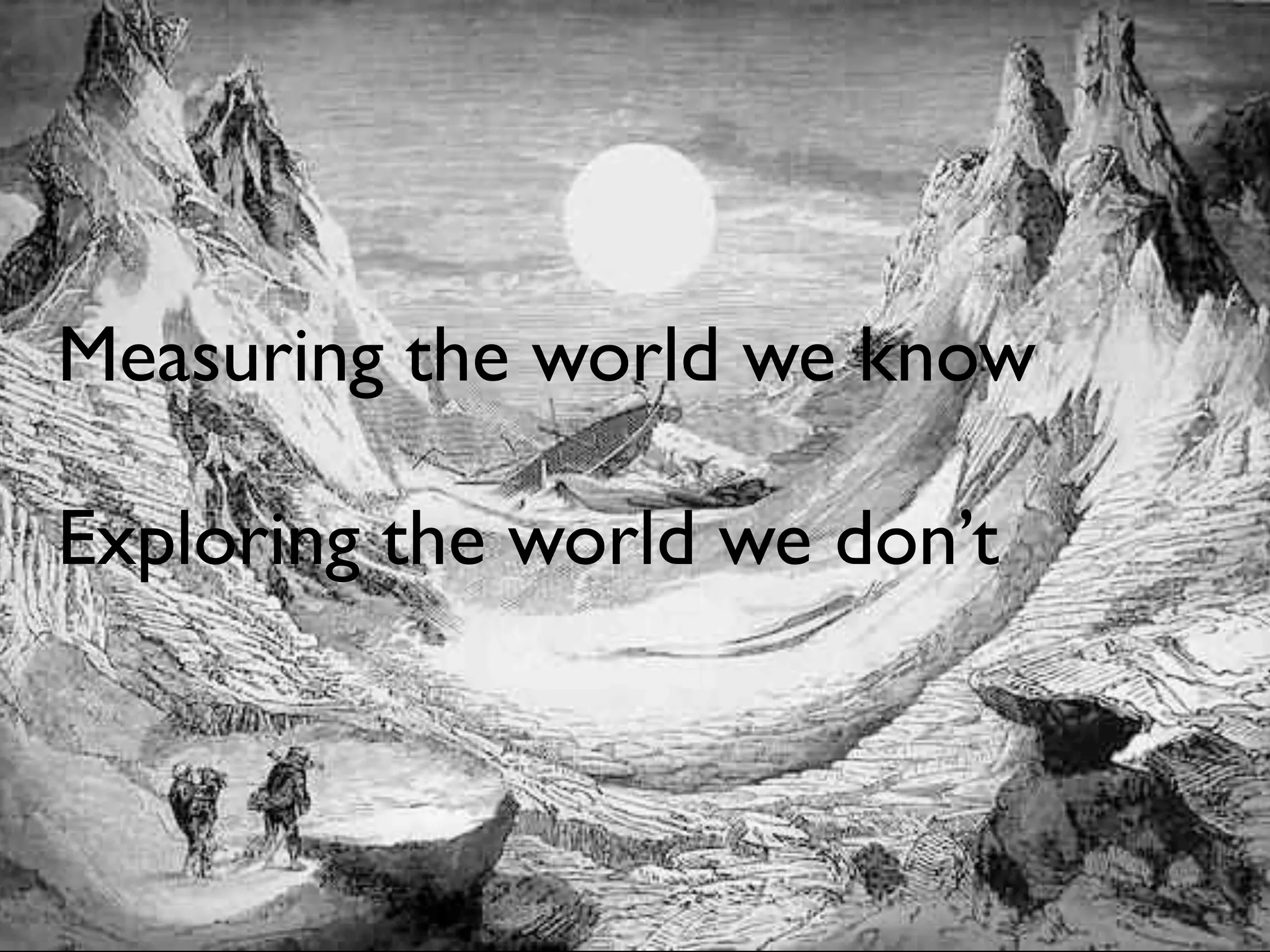
Measuring the world we know


Exploring the world we don’t
...I
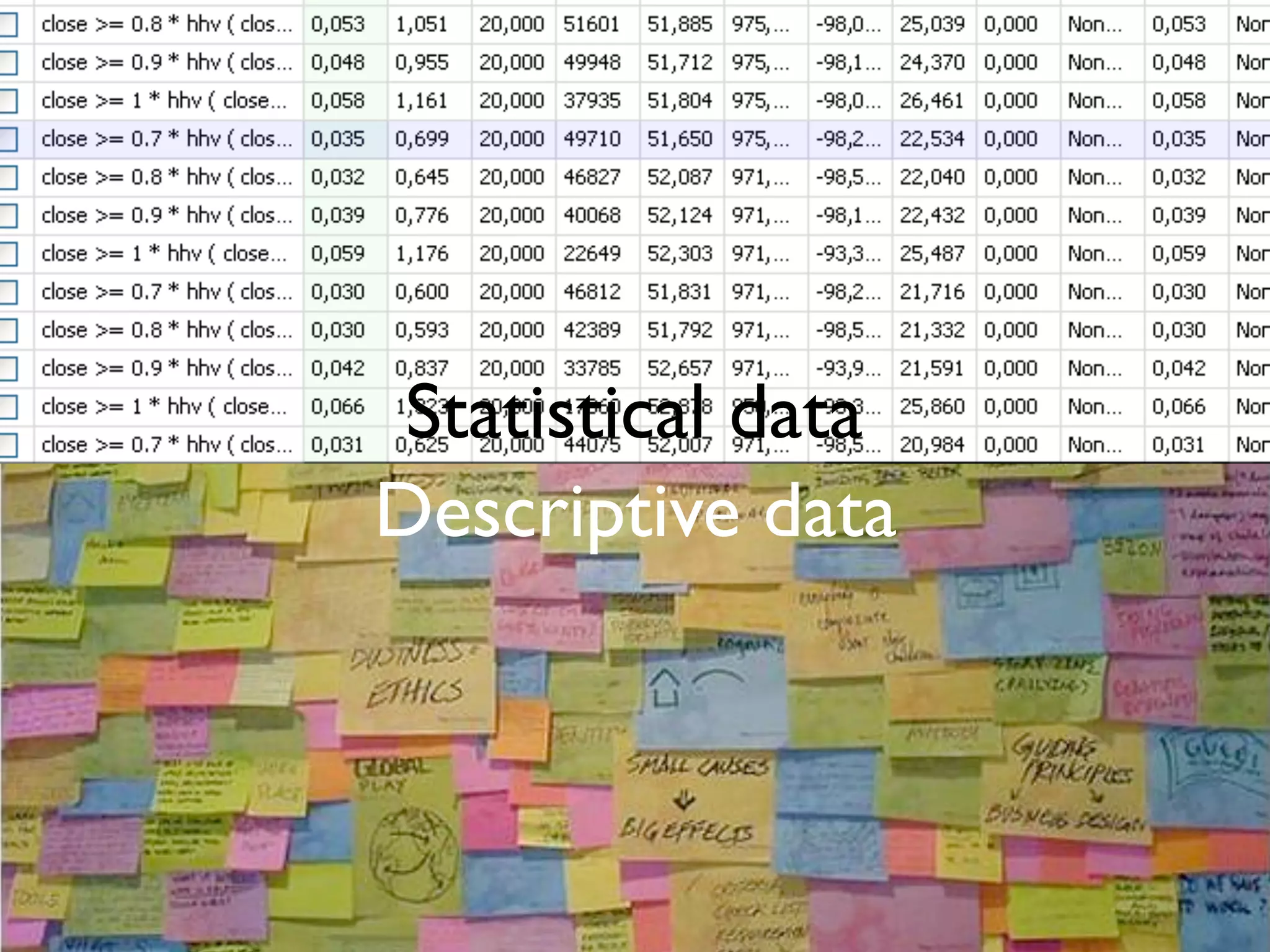
Descriptive data
Statistical data
This is true.
And so is this.
This is true.
And so is this.
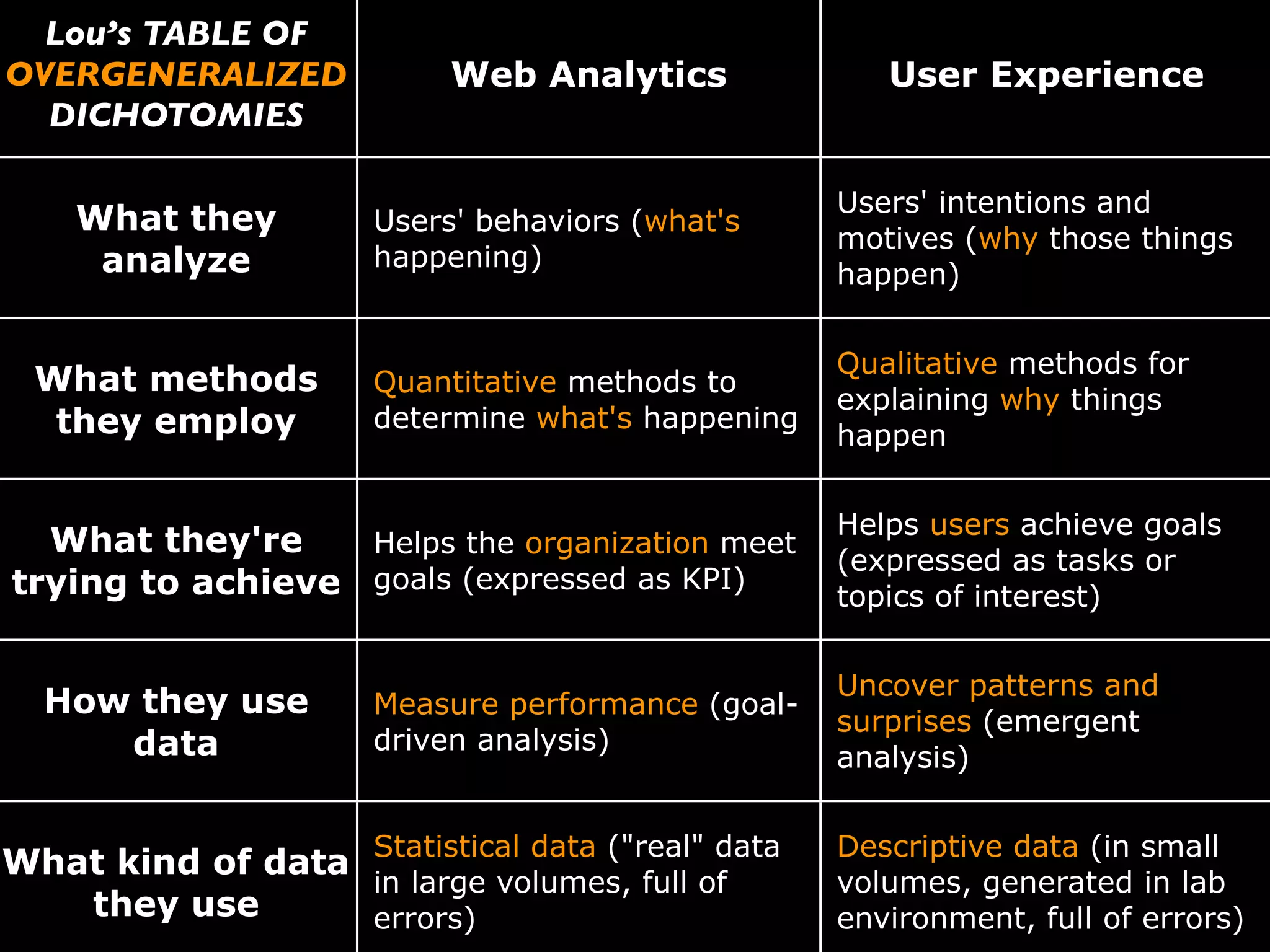
Lou’s TABLE OF
OVERGENERALIZED
DICHOTOMIES
Web Analytics User Experience
What they
analyze
Users' behaviors (what's
happening)
Users' intentions and
motives (why those things
happen)
What methods
they employ
Quantitative methods to
determine what's happening
Qualitative methods for
explaining why things
happen
What they're
trying to achieve
Helps the organization meet
goals (expressed as KPI)
Helps users achieve goals
(expressed as tasks or
topics of interest)
How they use
data
Measure performance (goal-
driven analysis)
Uncover patterns and
surprises (emergent
analysis)
What kind of data
they use
Statistical data ("real" data
in large volumes, full of
errors)
Descriptive data (in small
volumes, generated in lab
environment, full of errors)
Five themes for getting to
synthesis and insight
1. Balance
2. Cadence
3. Conversation
4. Perspective
5. Operations
1. Balance
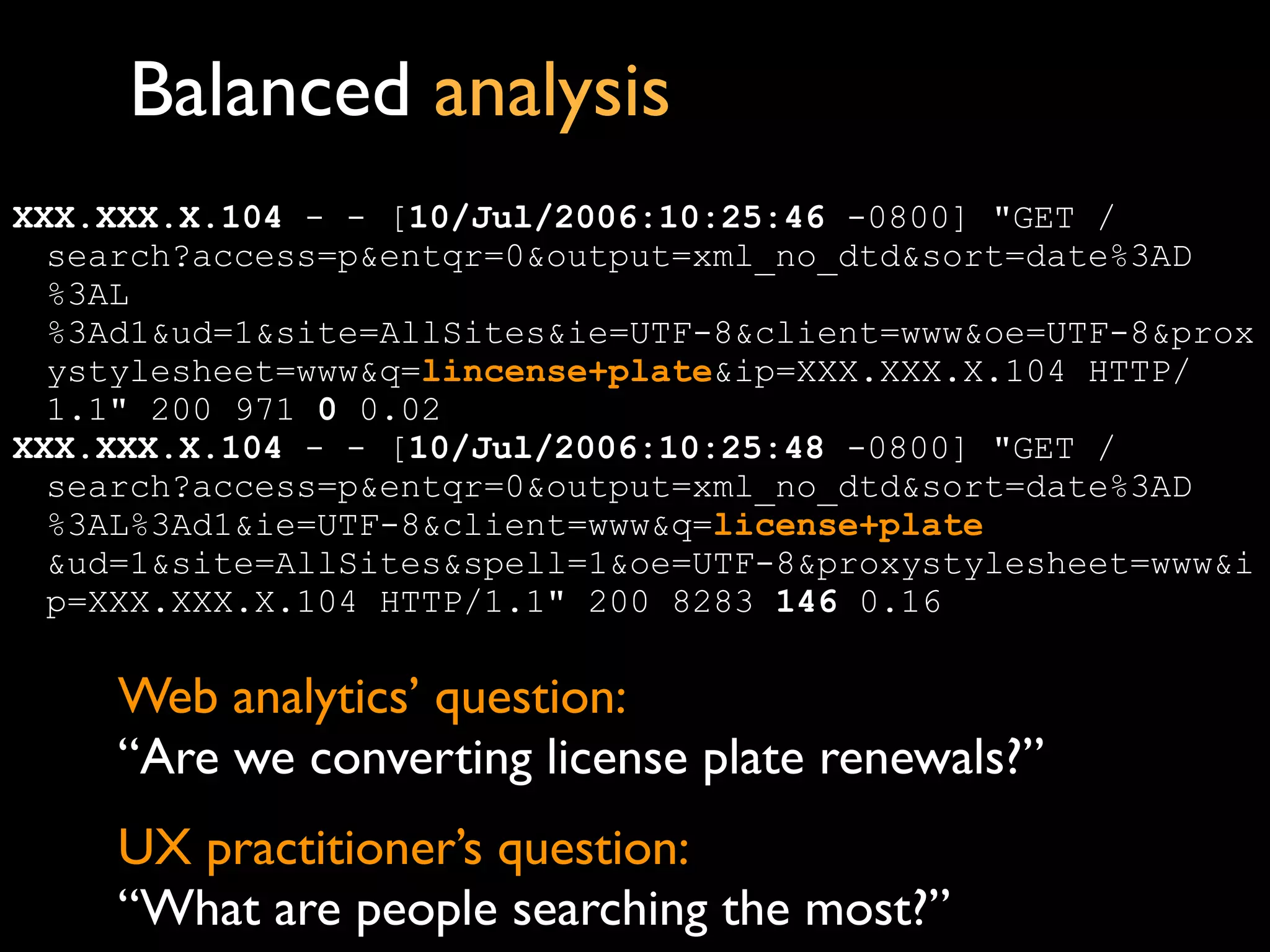
XXX.XXX.X.104 - - [10/Jul/2006:10:25:46 -0800] "GET /
search?
access=p&entqr=0&output=xml_no_dtd&sort=date%3AD%3AL%3Ad1&
ud=1&site=AllSites&ie=UTF-8&client=www&oe=UTF-8&proxystyle
sheet=www&q=lincense+plate&ip=XXX.XXX.X.104 HTTP/1.1" 200
971 0 0.02
XXX.XXX.X.104 - - [10/Jul/2006:10:25:48 -0800] "GET /
search?
access=p&entqr=0&output=xml_no_dtd&sort=date%3AD%3AL%3Ad1&
ie=UTF-8&client=www&q=license+plate

&ud=1&site=AllSites&spell=1&oe=UTF-8&proxystylesheet=www&i
p=XXX.XXX.X.104 HTTP/1.1" 200 8283 146 0.16
Web analytics asks:

“Are we converting license plate renewals?”
User researcher asks:

“What are people searching the most?”
Balanced analysis
Thanks
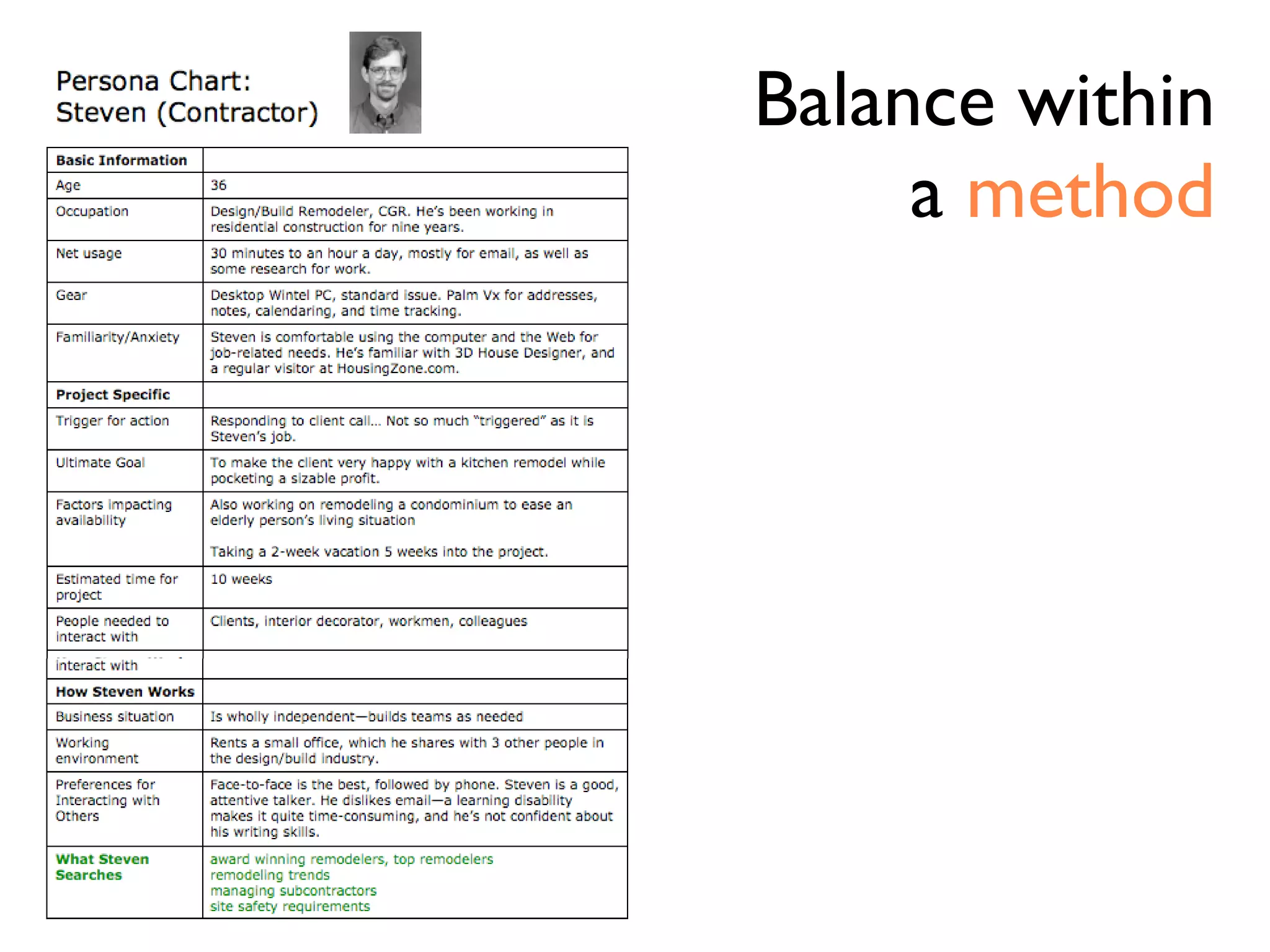
Balance within methods
example courtesy to Angel Brown, Ogilvy DigitalHealth
Thanks
Balance within methods
example courtesy to Angel Brown, Ogilvy DigitalHealth
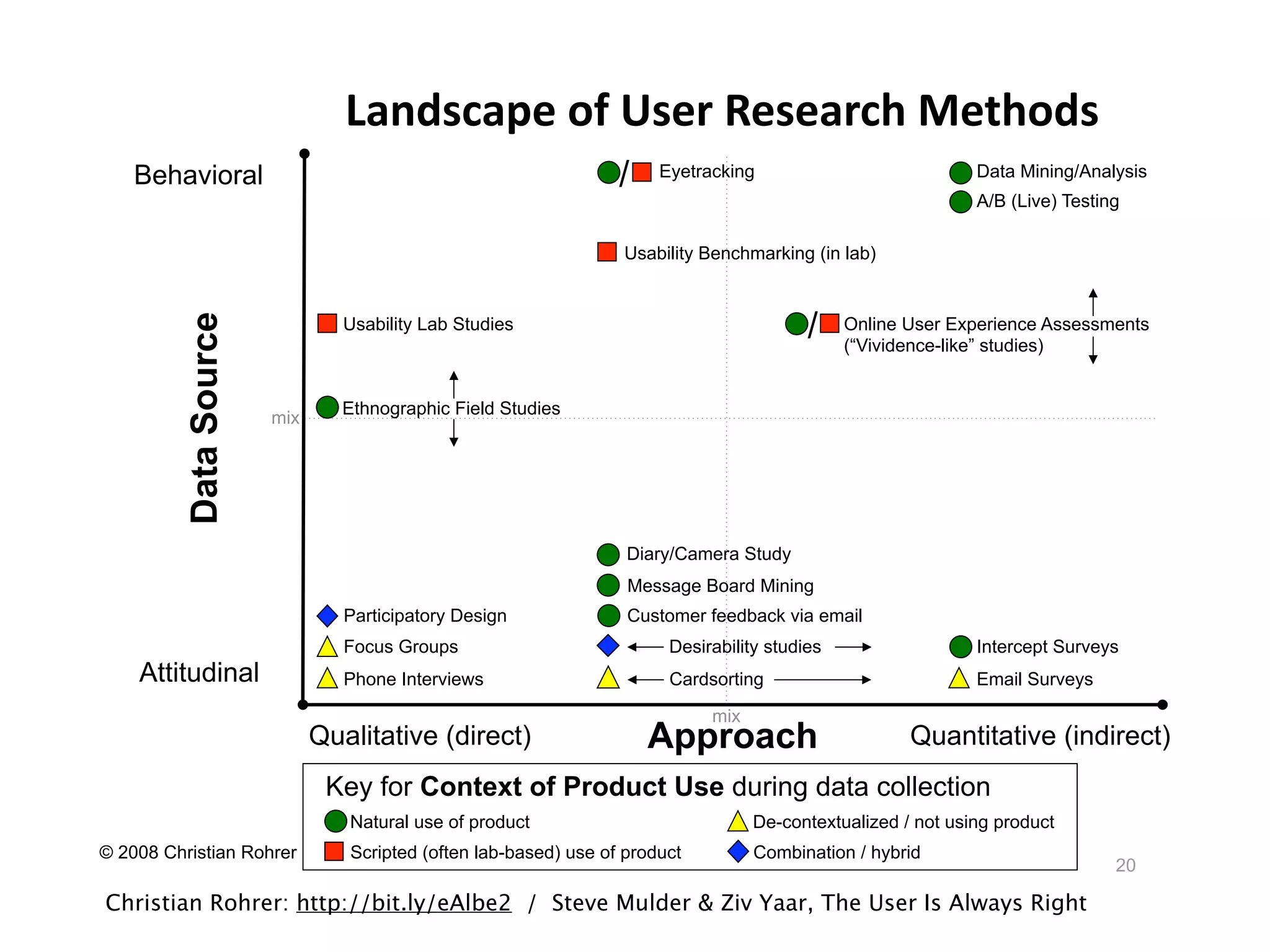
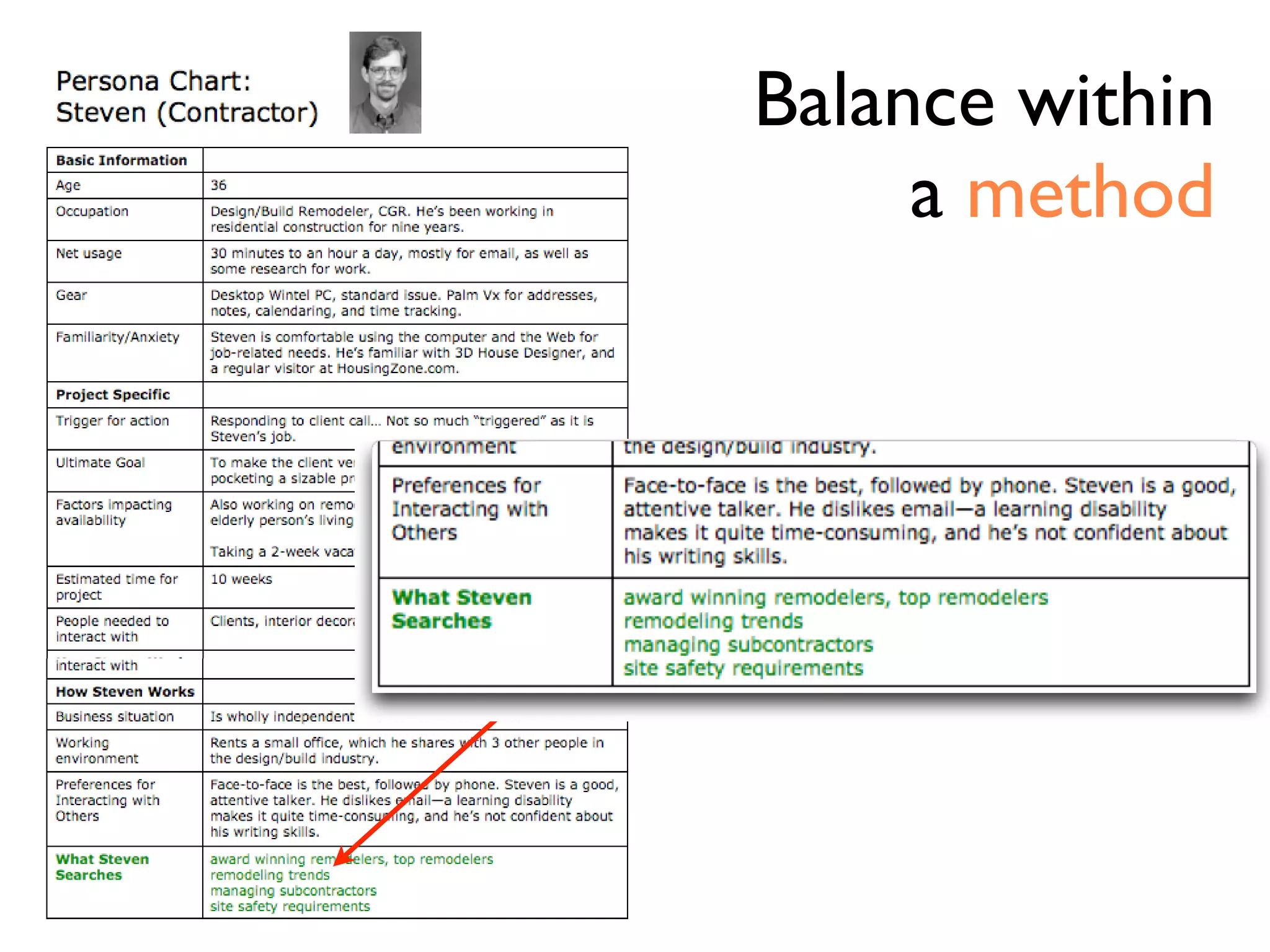
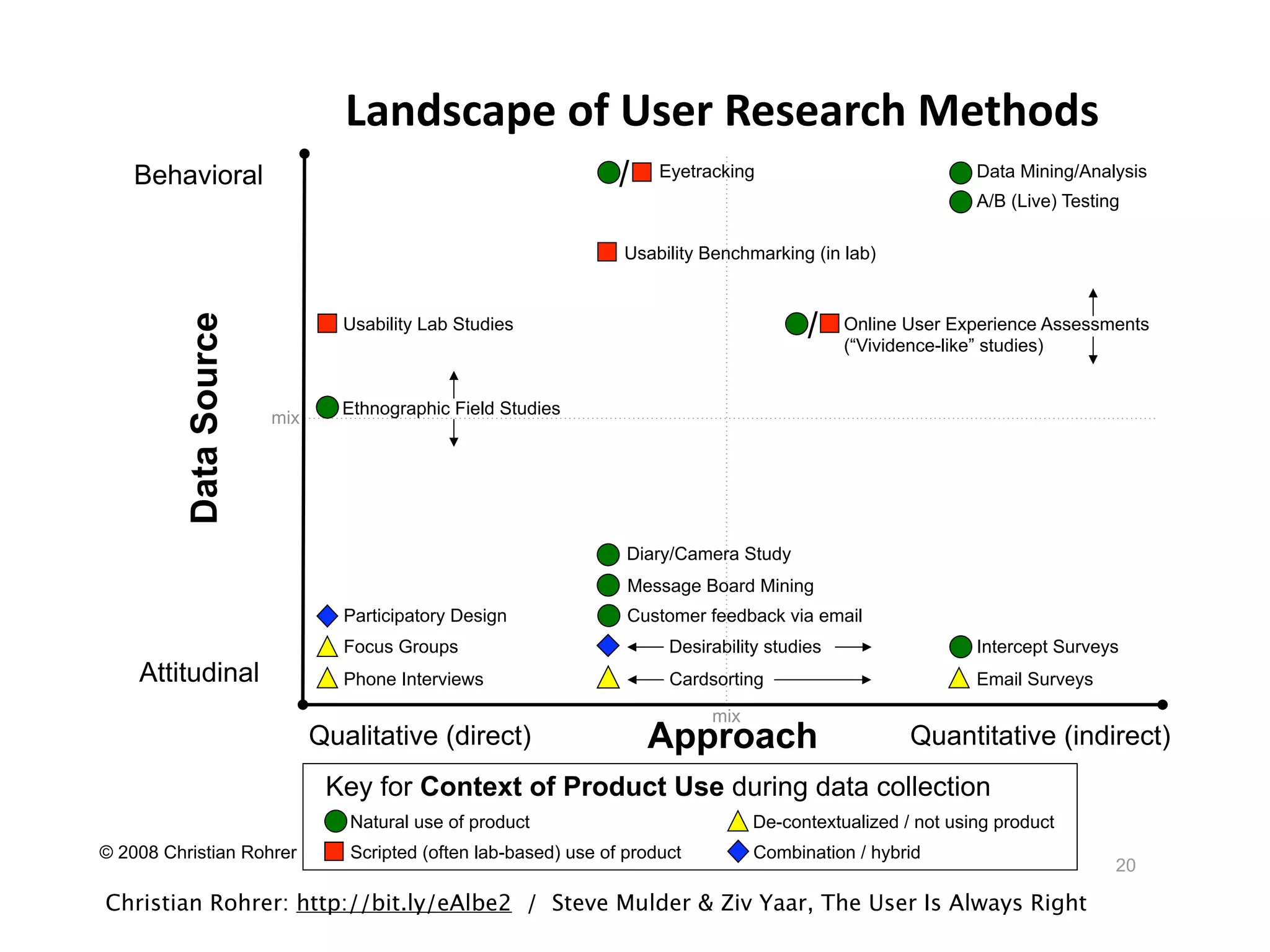
Rohrer’s user research
landscape
Text
Christian Rohrer: http://www.nngroup.com/articles/which-ux-research-methods/
Balance within practice
Rohrer’s user research
landscape
Text
2. Cadence
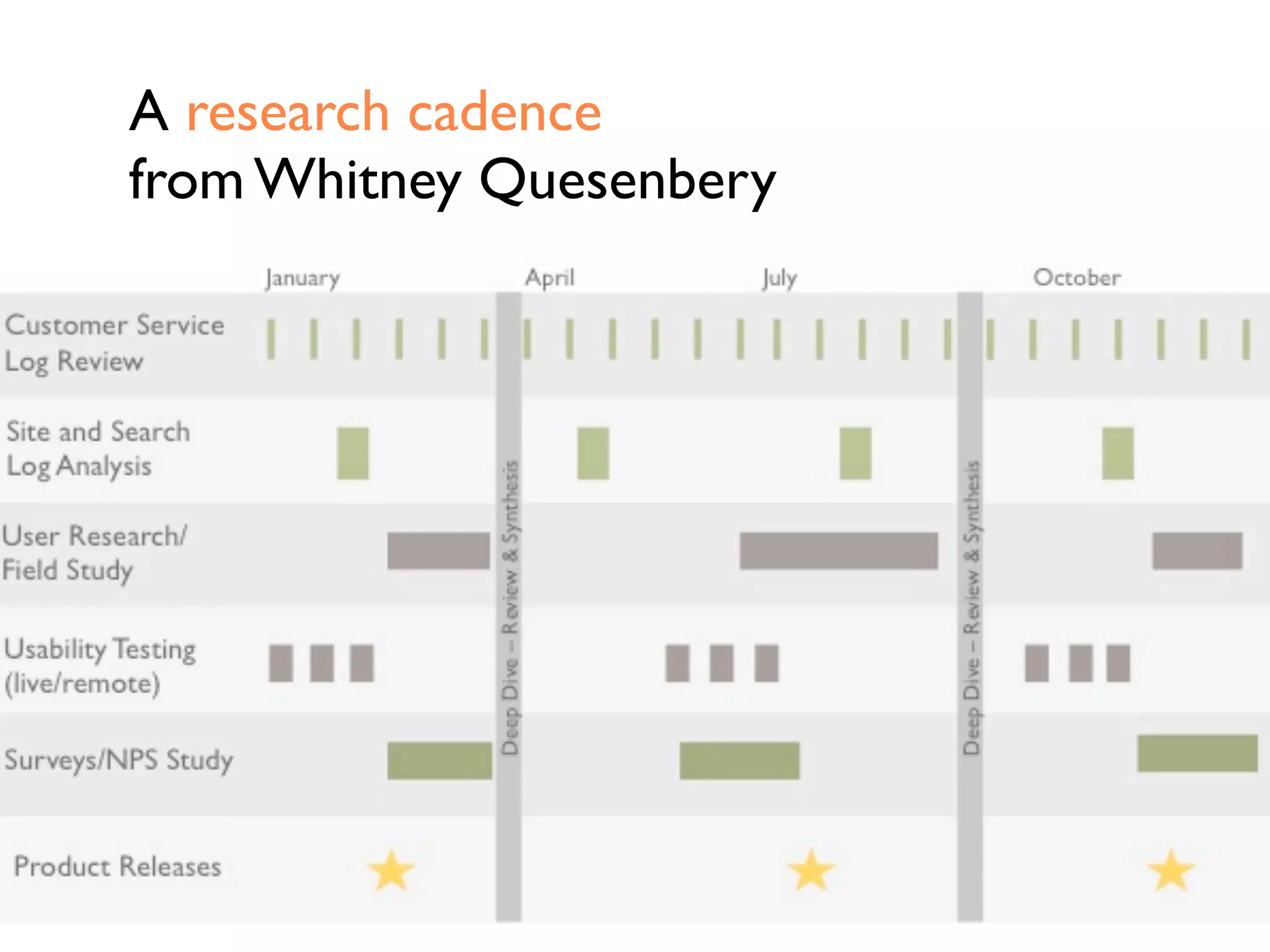
A research cadence
from Whitney Quesenbery
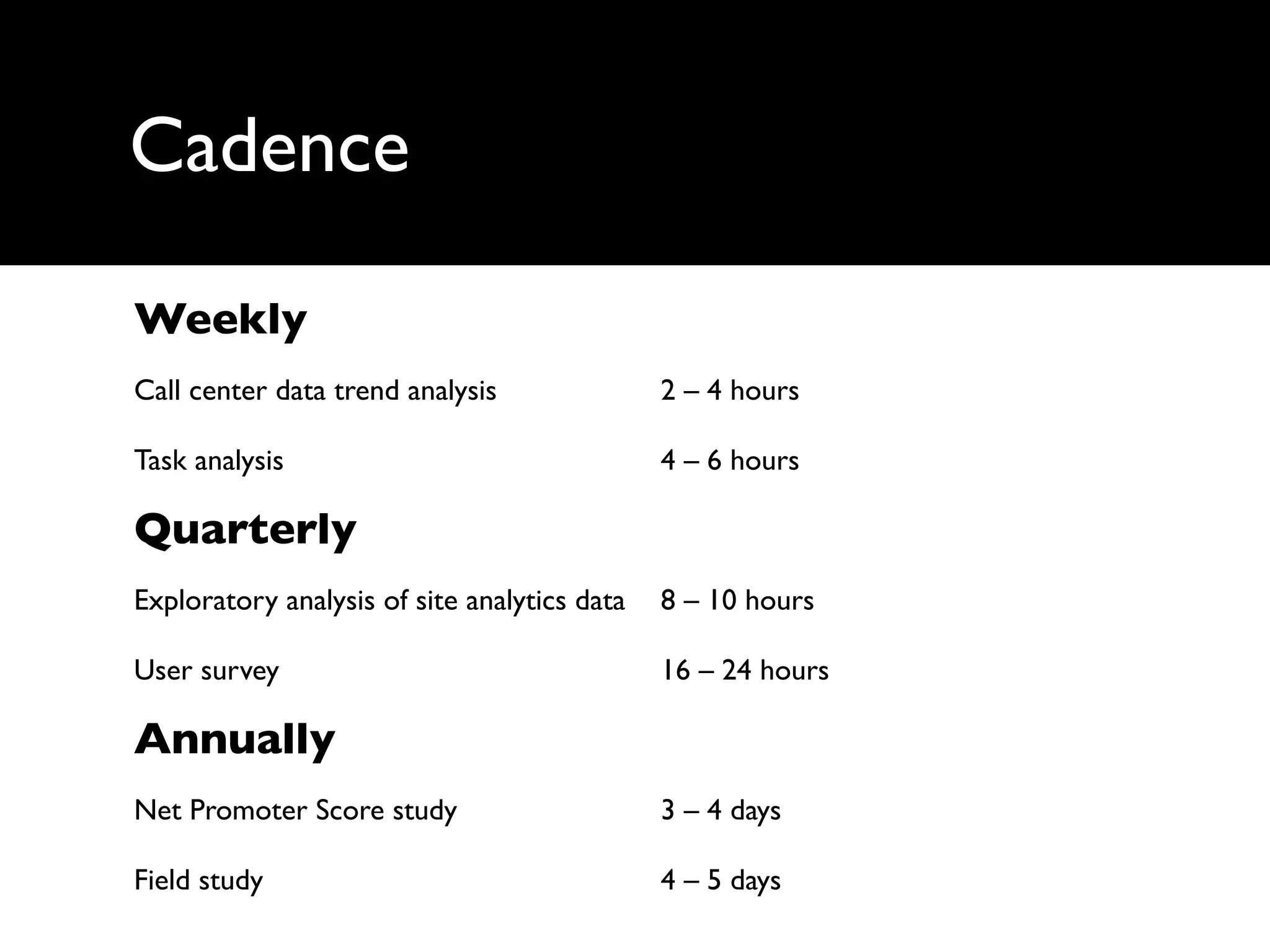
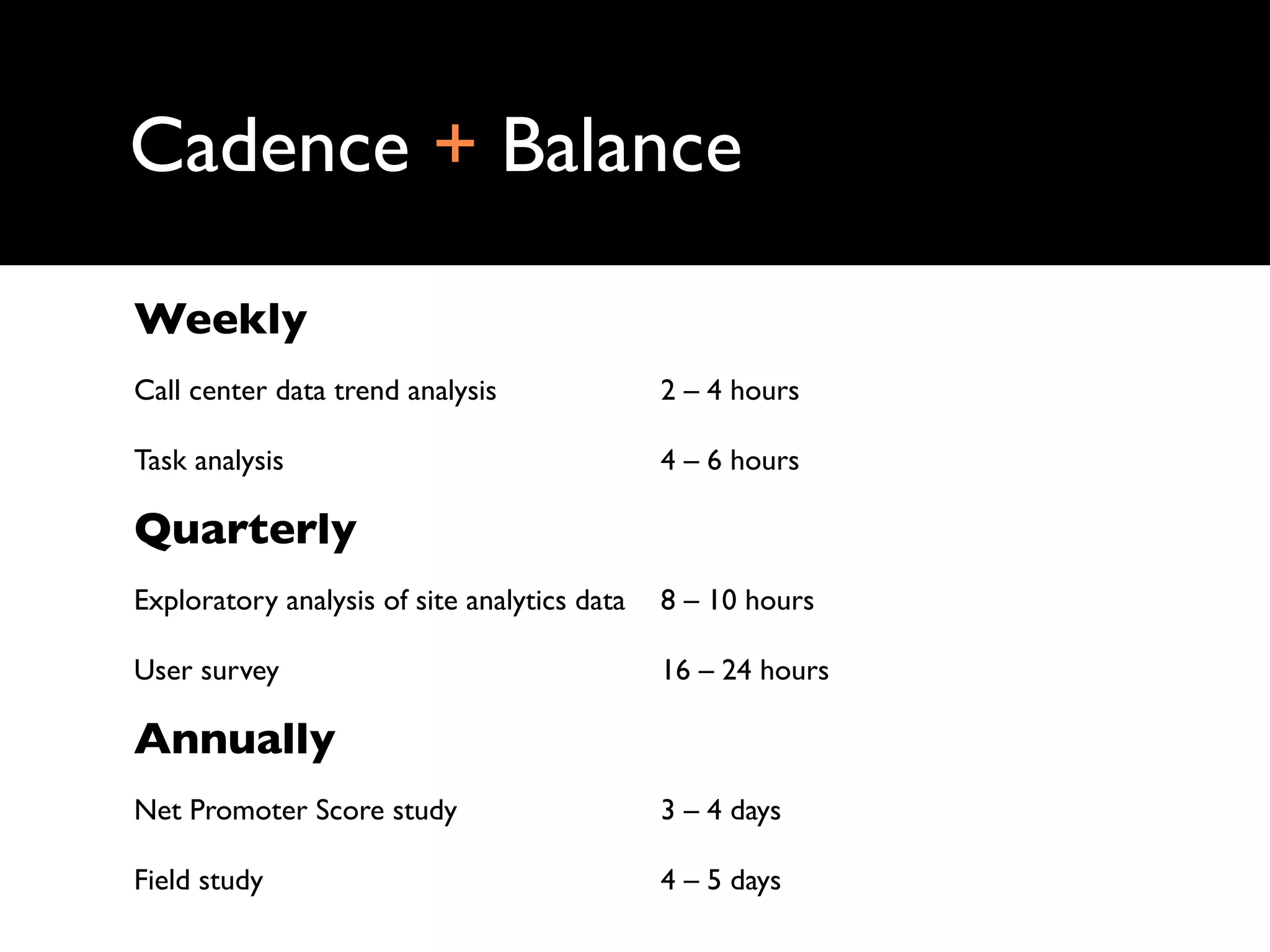
Cadence
Weekly
Call center data trend analysis 2 – 4 hours behavioral + quantitative
Task analysis 4 – 6 hours behavioral + quantitative
Quarterly
Exploratory analysis of site analytics data 8 – 10 hours behavioral + qualitative
User survey 16 – 24 hours attitudinal + quantitative
Annually
Net Promoter Score study 3 – 4 days attitudinal + quantitative
Field study 4 – 5 days behavioral + qualitative
Cadence
Weekly
Call center data trend analysis 2 – 4 hours behavioral + quantitative
Task analysis 4 – 6 hours behavioral + quantitative
Quarterly
Exploratory analysis of site analytics data 8 – 10 hours behavioral + qualitative
User survey 16 – 24 hours attitudinal + quantitative
Annually
Net Promoter Score study 3 – 4 days attitudinal + quantitative
Field study 4 – 5 days behavioral + qualitative
Cadence + Balance
Cadence
Weekly
Call center data trend analysis 2 – 4 hours behavioral + quantitative
Task analysis 4 – 6 hours behavioral + quantitative
Quarterly
Exploratory analysis of site analytics data 8 – 10 hours behavioral + qualitative
User survey 16 – 24 hours attitudinal + quantitative
Annually
Net Promoter Score study 3 – 4 days attitudinal + quantitative
Field study 4 – 5 days behavioral + qualitative
Cadence + Balance
3. Conversation
Buy Candy
for Strangers
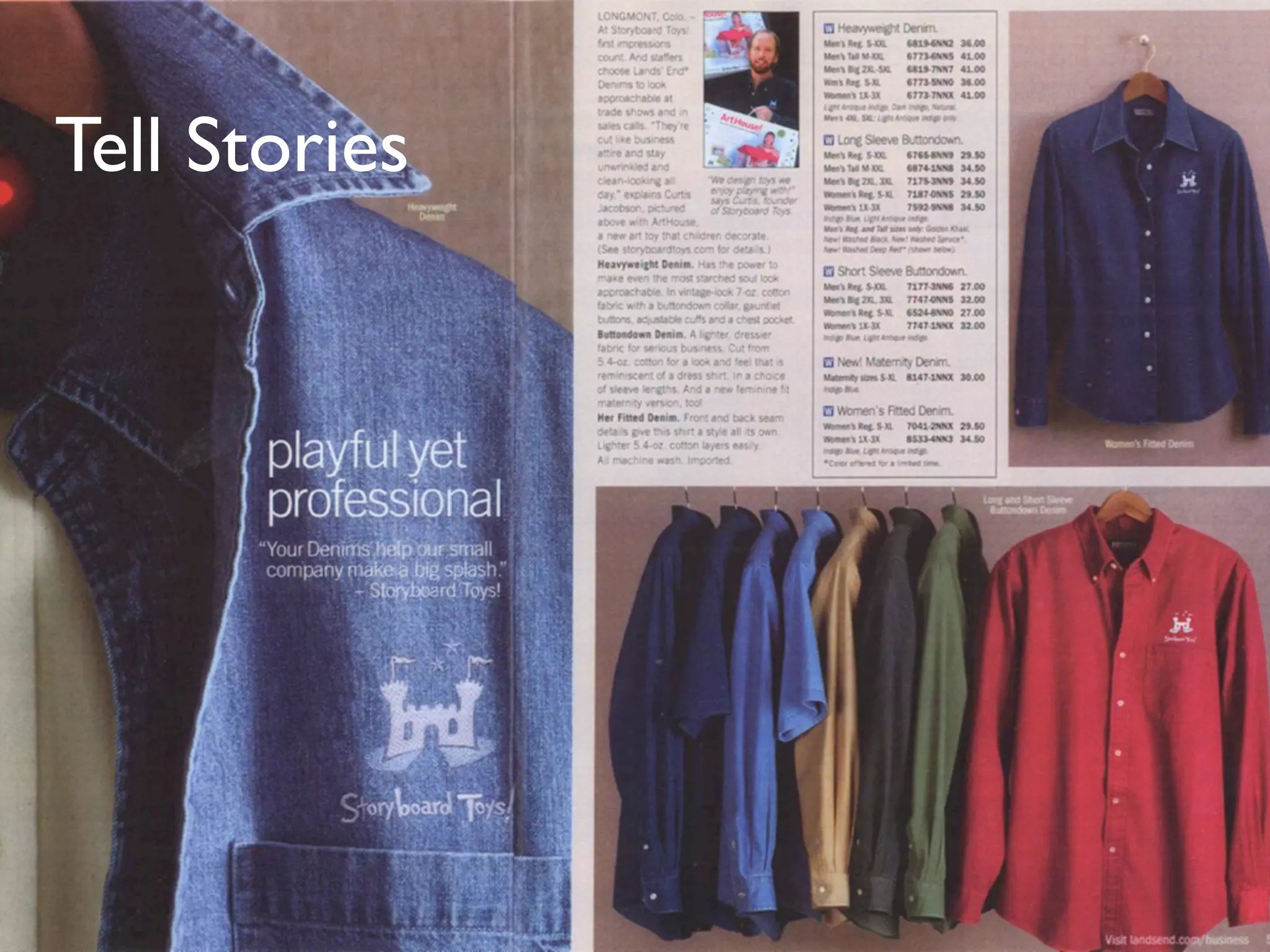
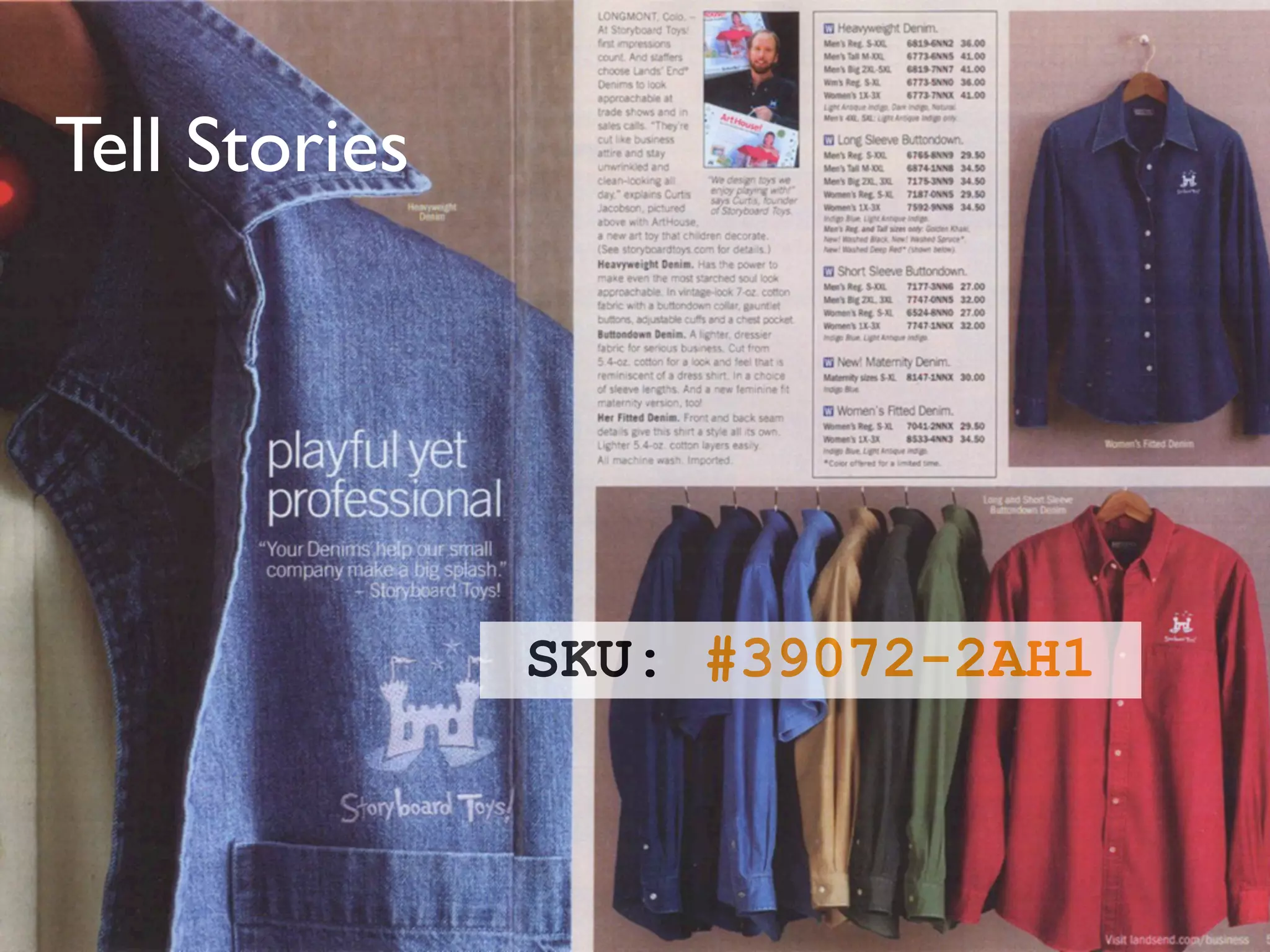
Tell
Stories
Tell
Stories
SKU: #39072-2AH1
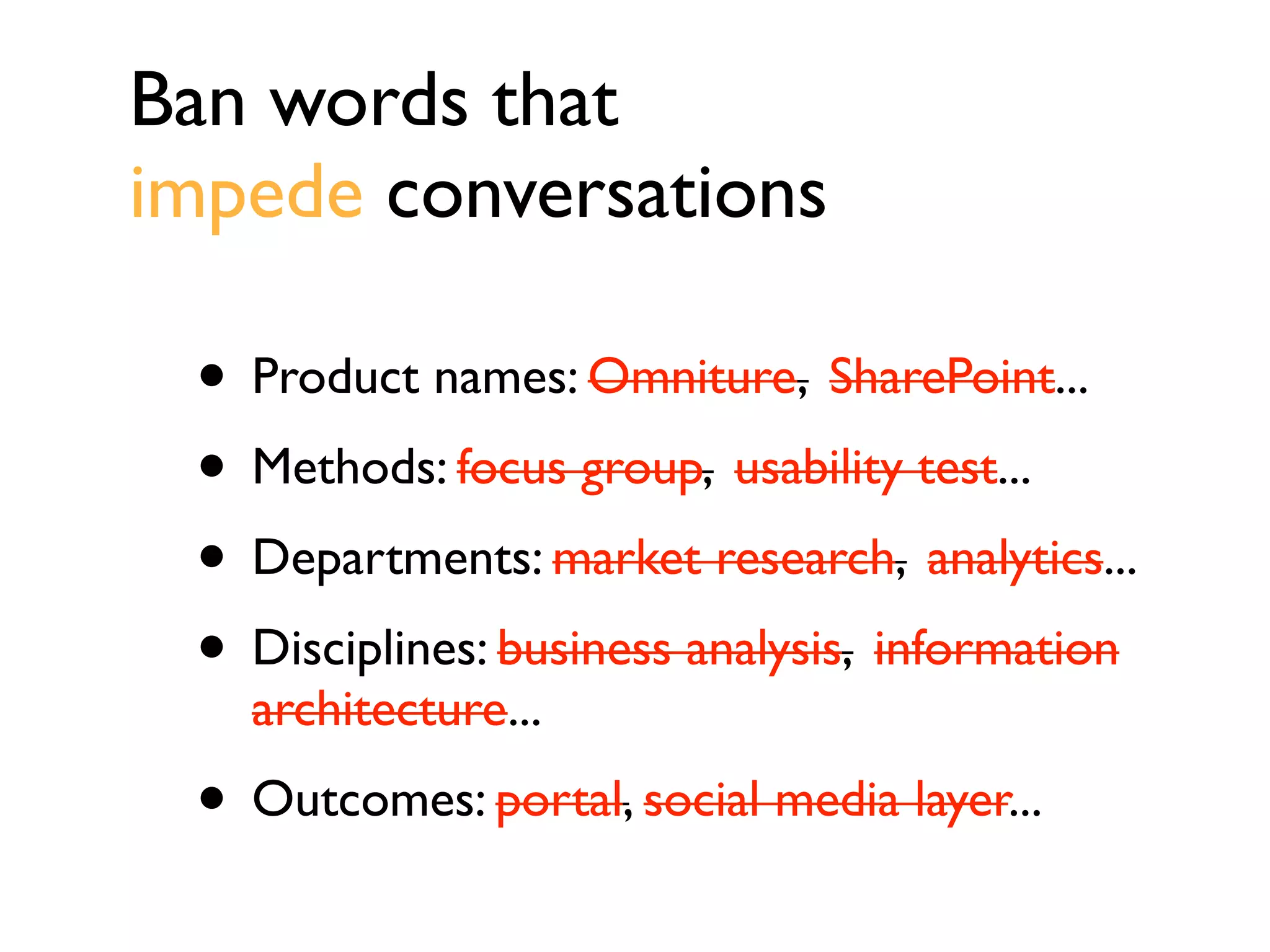
Ban words that
impede conversations
• Product names: Omniture,, SharePoint...
• Methods: focus group,, usability test...
• Departments: market research,, analytics...
• Disciplines: business analysis,, information
architecture...
• Outcomes: portal, social media layer...
Consider
framing
Consider
framing
Big Data
Consider
framing
Big Data THICk Data
Consider
framing
Big Data THICk Data
SeeTriciaWang’s
“Why Big Data 

NeedsThick Data”:
http://bit.ly/23E9qlv
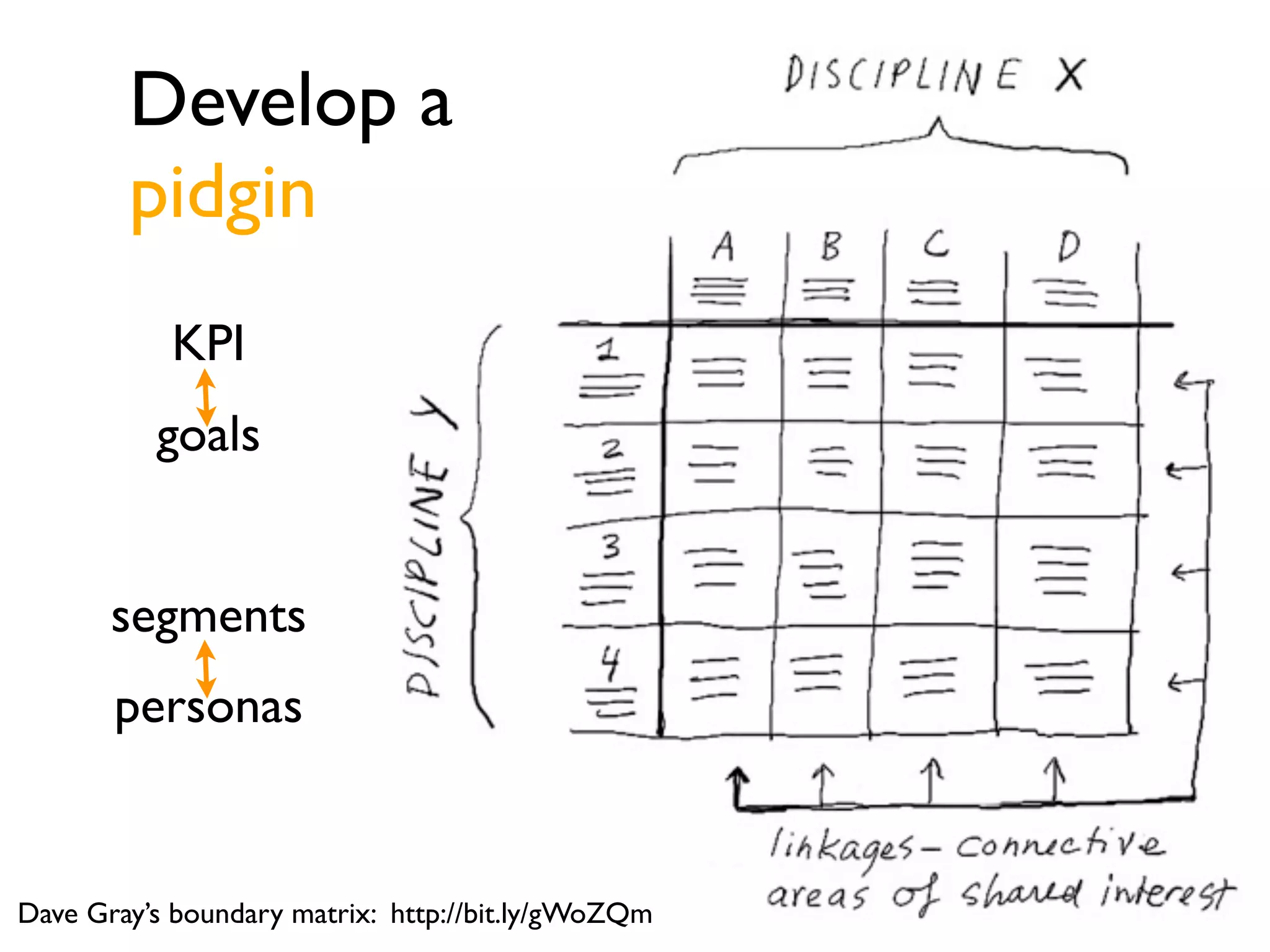
Develop a
pidgin
Dave Gray’s boundary matrix: http://bit.ly/gWoZQm
KPI
goals
segments
personas
4. Perspective
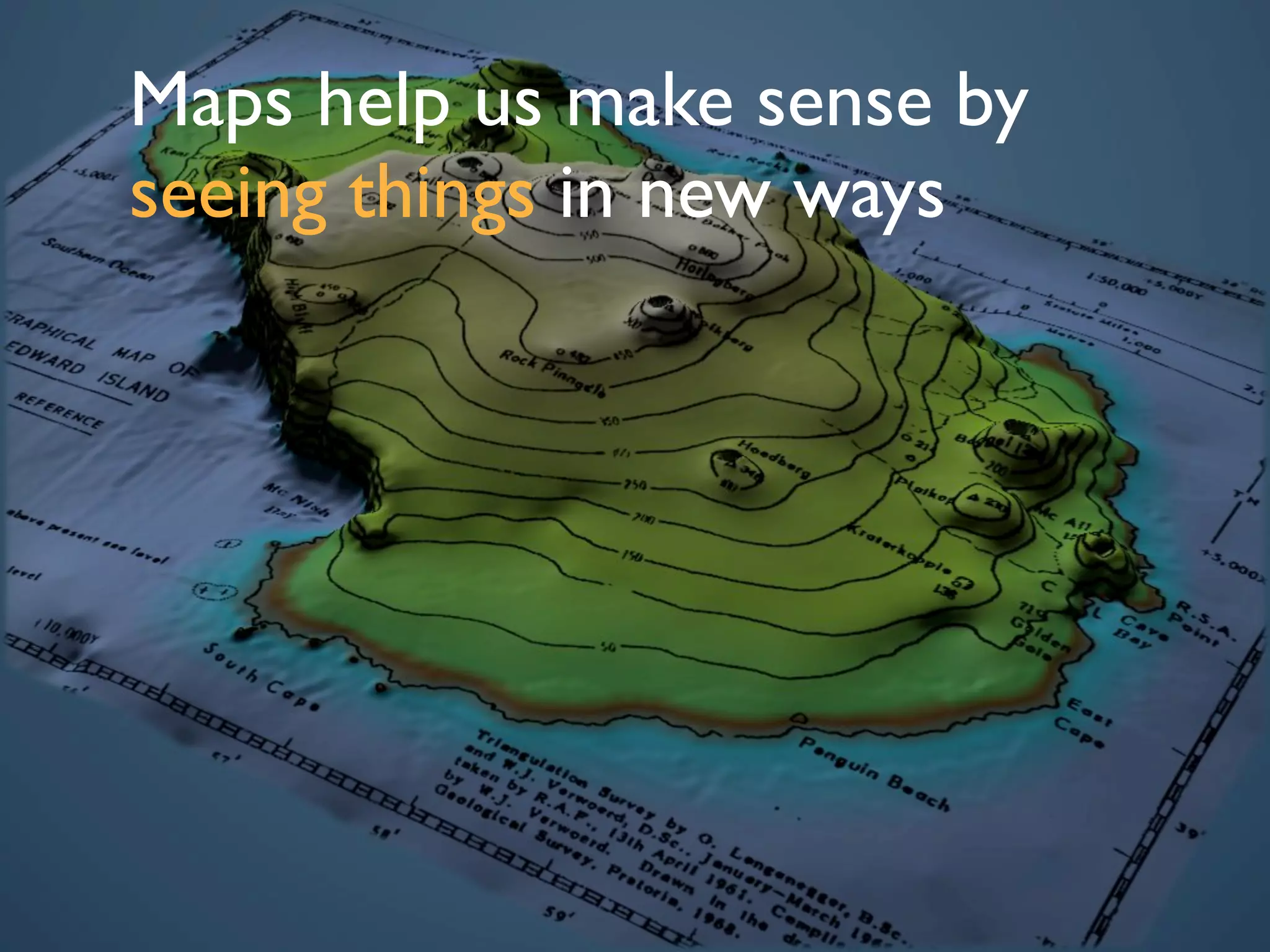
Maps help us make sense by
seeing things in new ways
Rohrer’s user research
landscape
Text
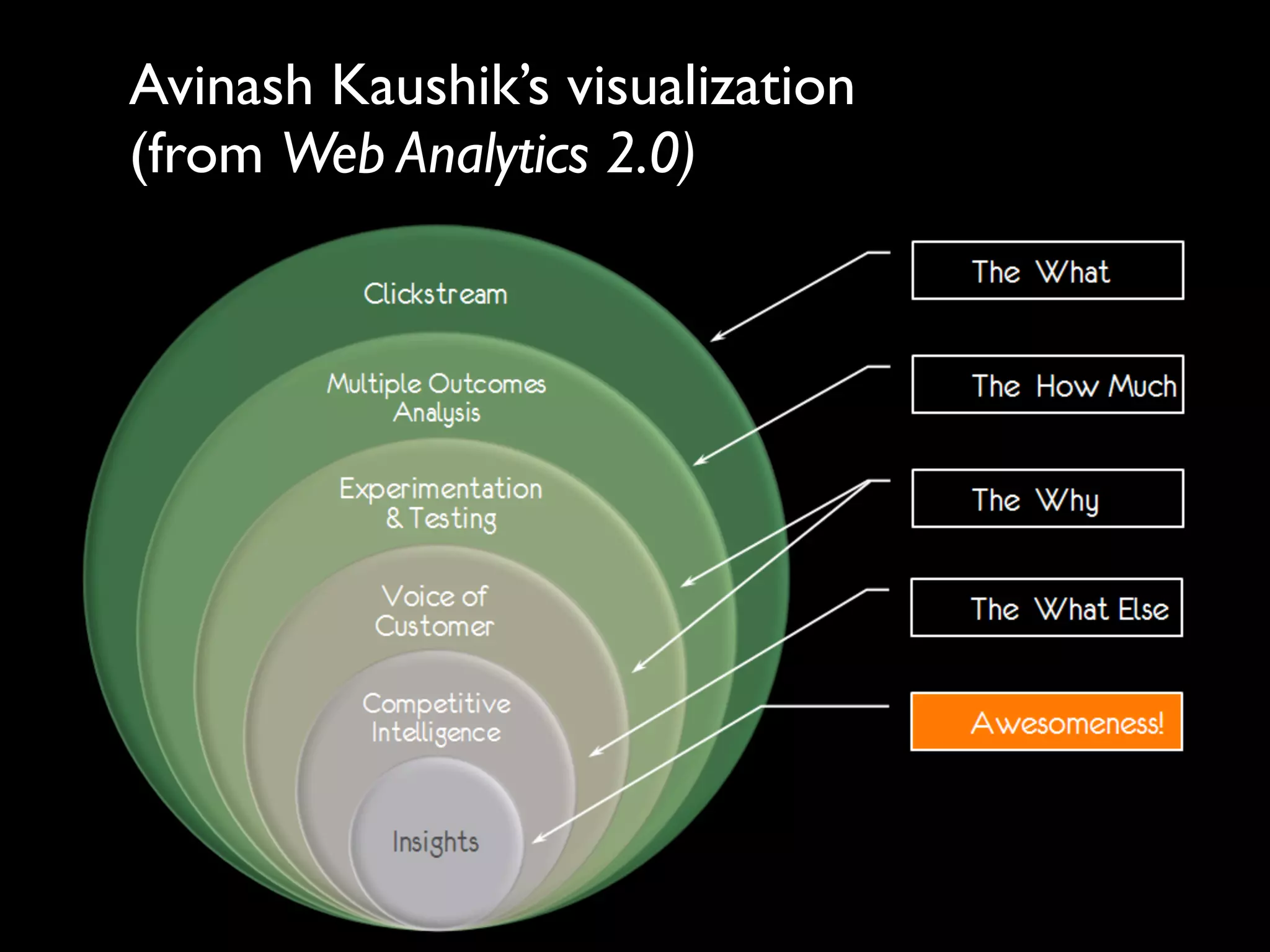
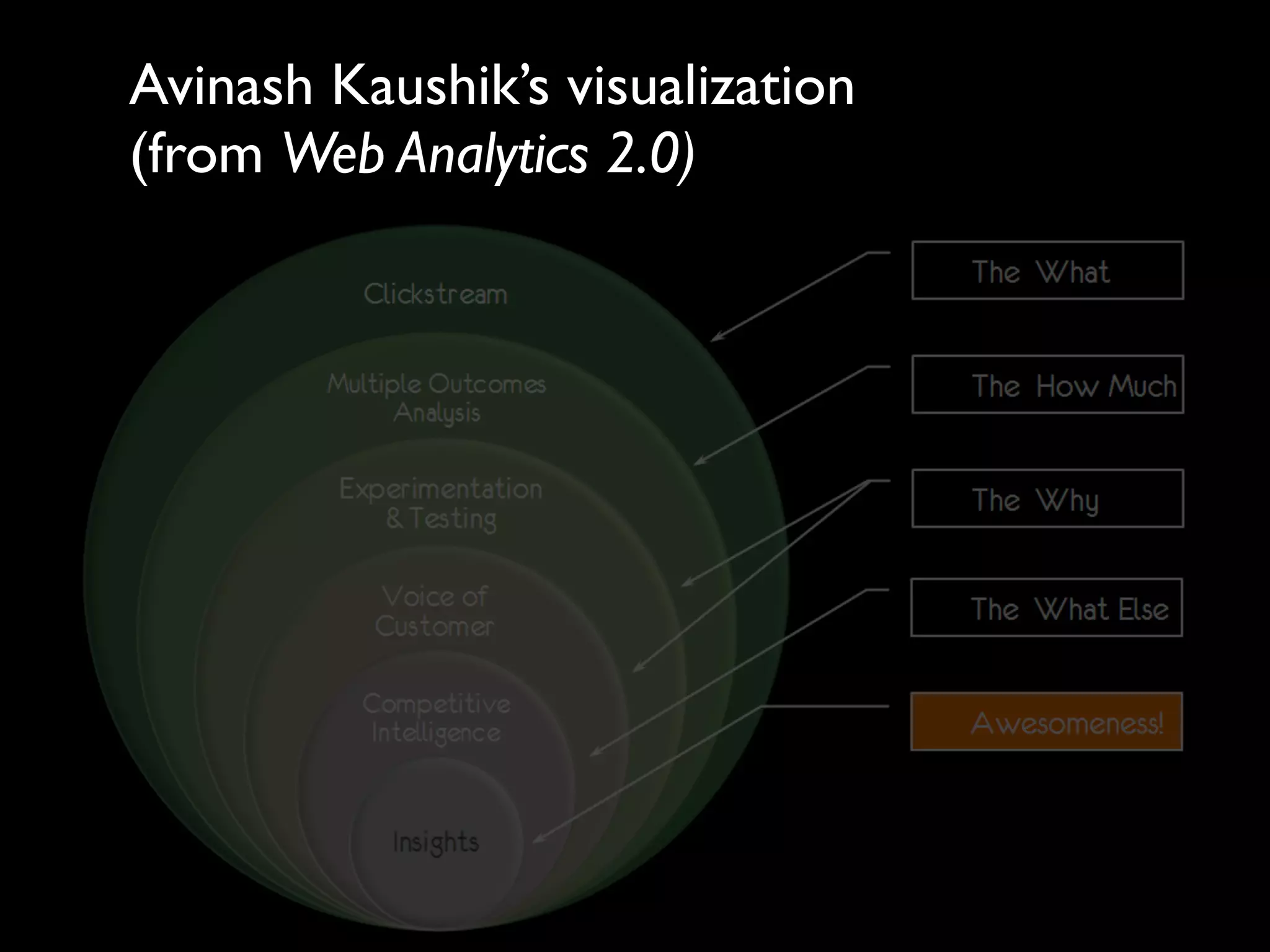
Kaushik’s Trinity Strategy
Avinash Kaushik’s “Trinity:A Mindset & Strategic Approach“: http://bit.ly/2yKA9CC
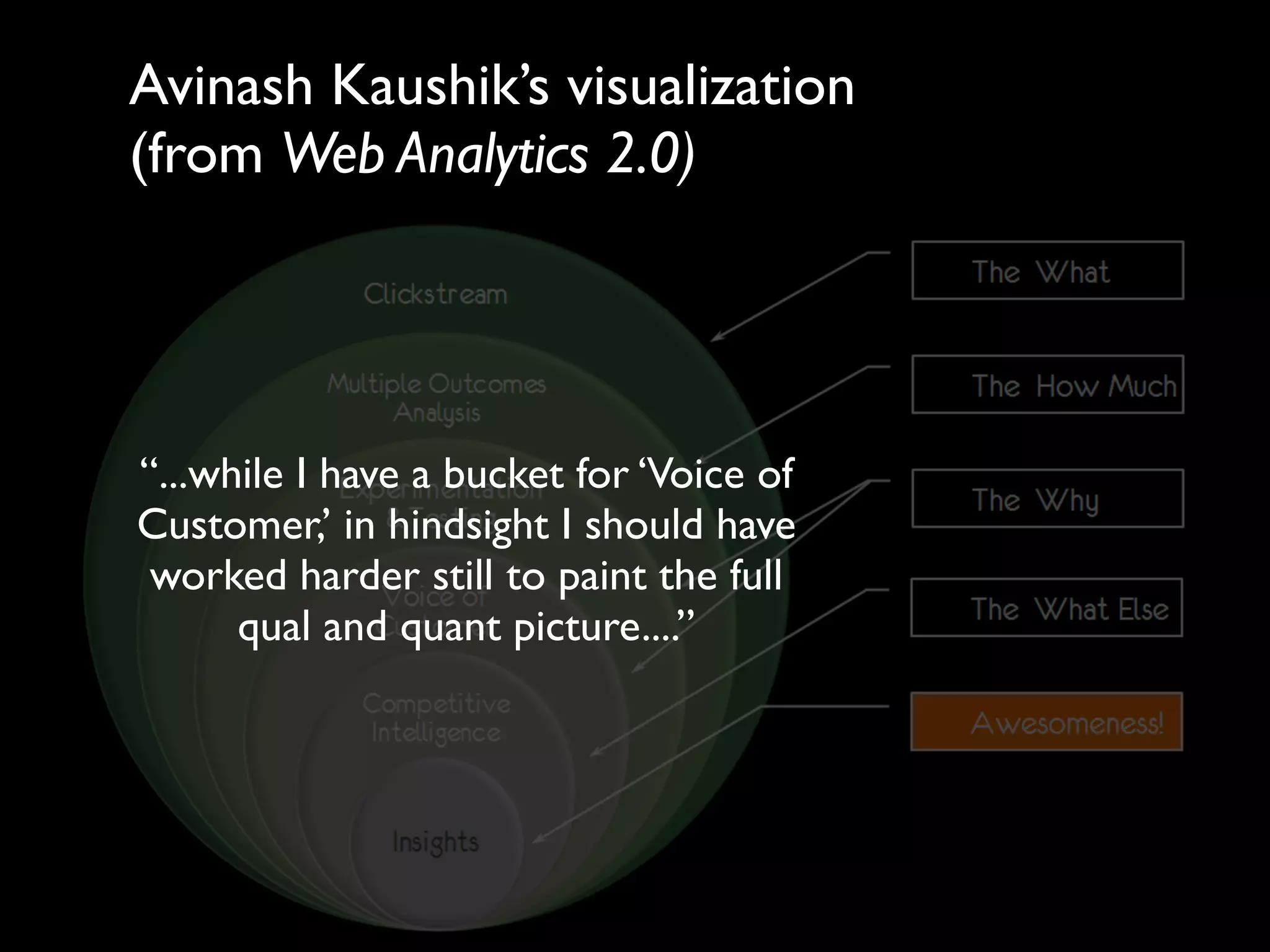
“...while I have a bucket for ‘Voice of
Customer,’ in hindsight I should have
worked harder still to paint the full qual
and quant picture….”
—Kaushik (in private email)
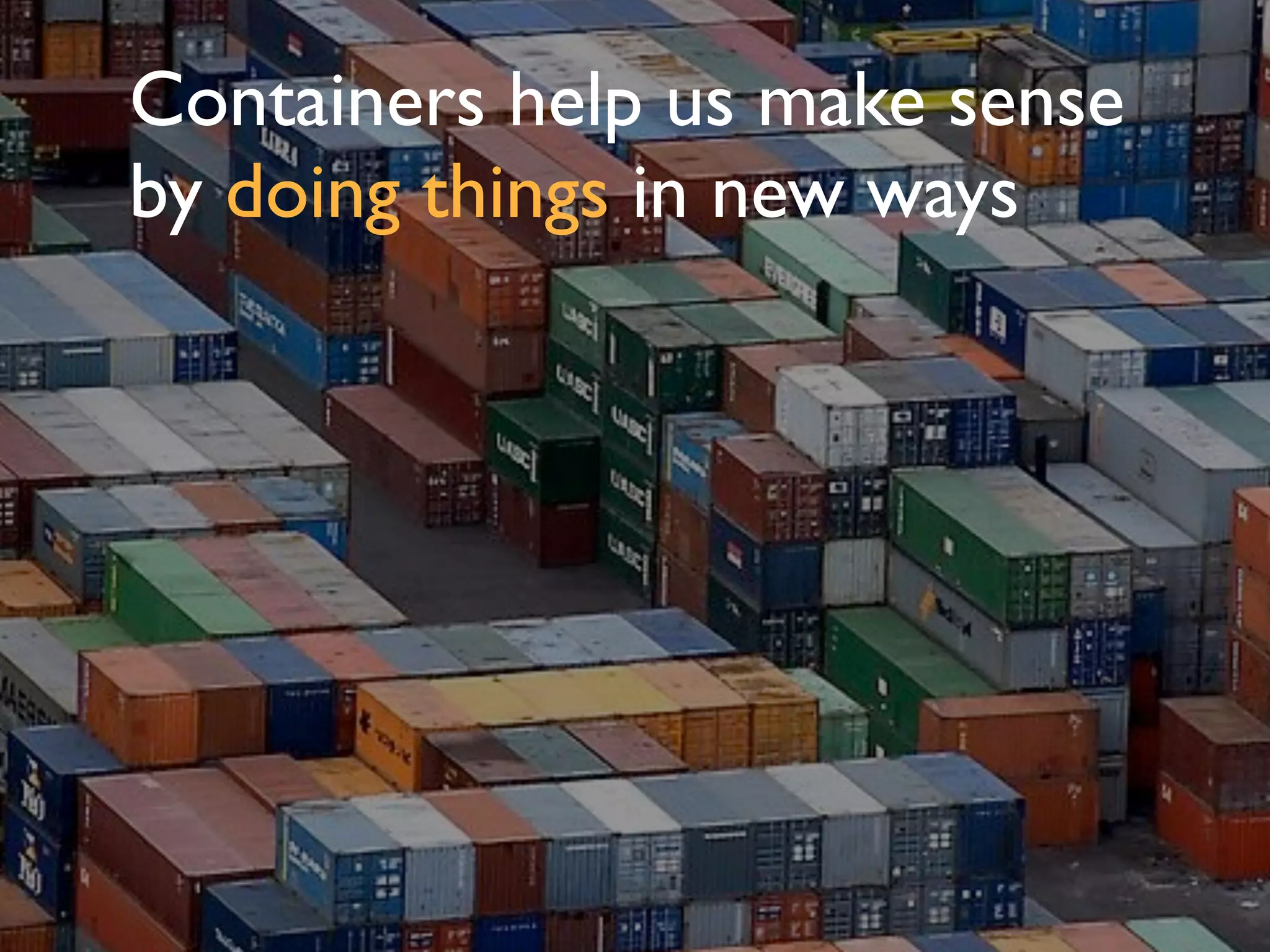
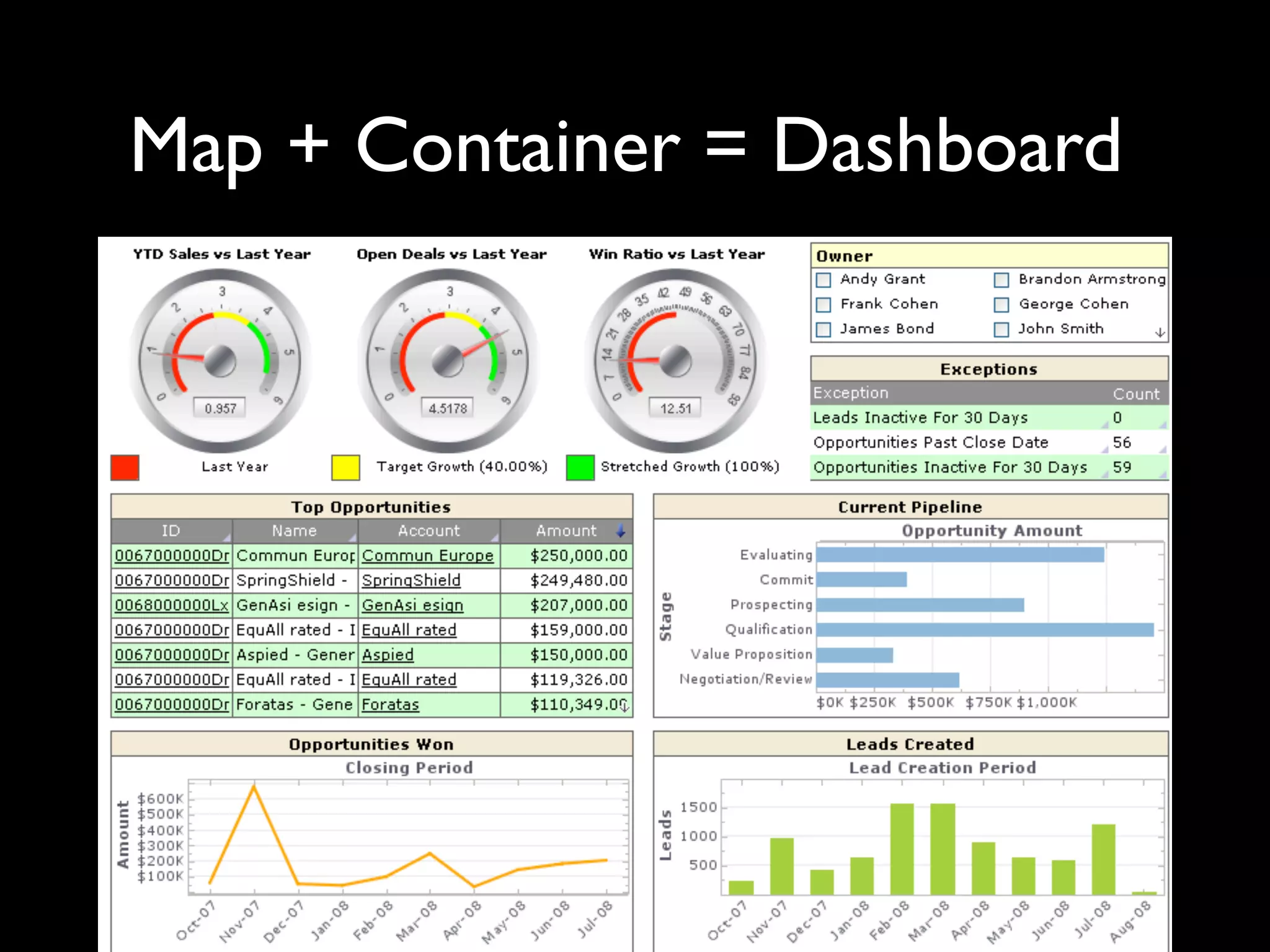
Containers help us make sense
by putting things together
in new ways
MailChimp’s UX team:
drowning in data
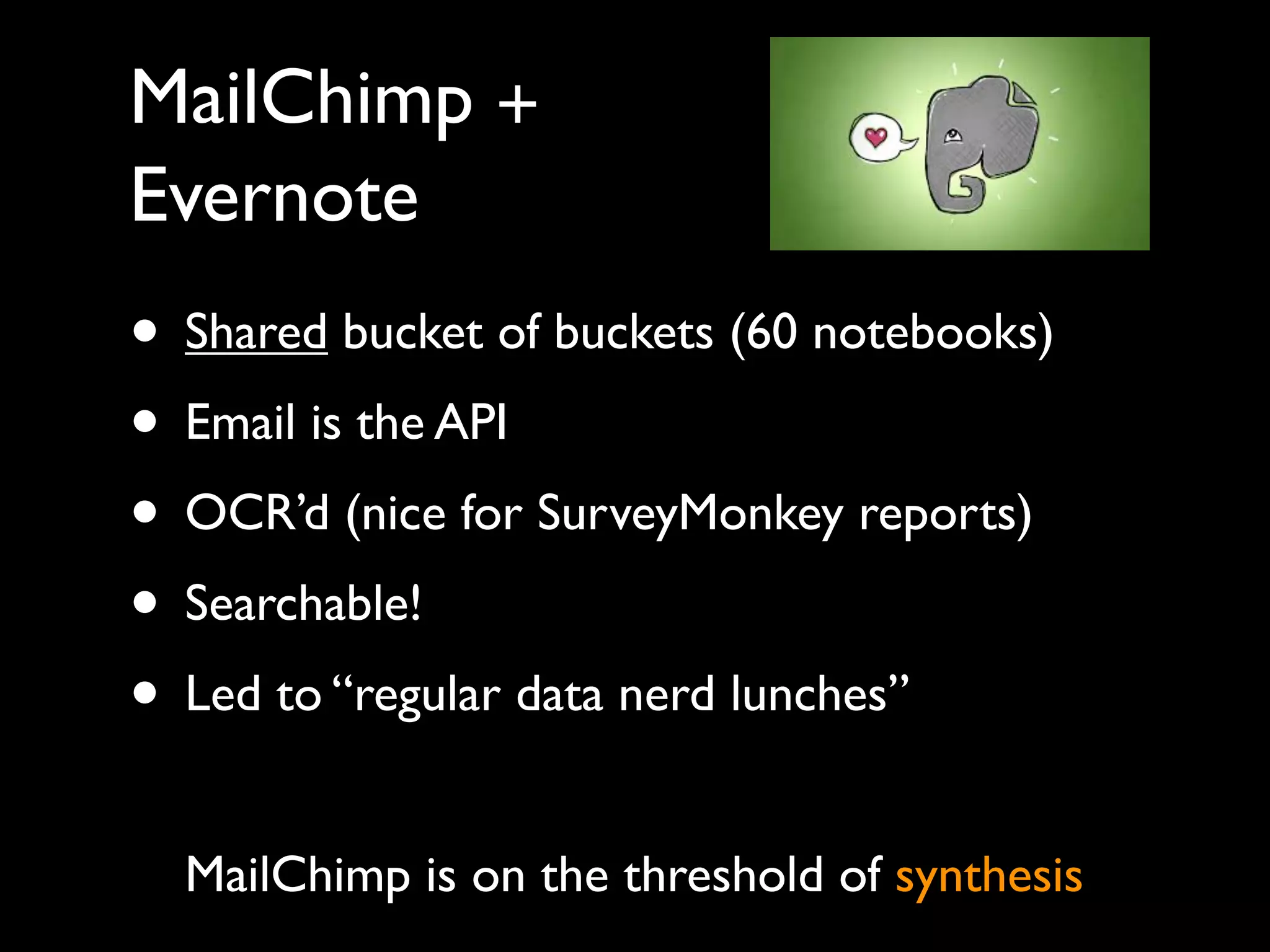
MailChimp + Evernote
• Shared bucket of buckets (60 notebooks)
• Email is the API
• OCR’d (nice for SurveyMonkey reports)
• Searchable!
• Led to “regular data nerd lunches”
MailChimp: on the threshold of
synthesis
MailChimp + Evernote
• Shared bucket of buckets (60 notebooks)
• Email is the API
• OCR’d (nice for SurveyMonkey reports)
• Searchable!
• Led to “regular data nerd lunches”
MailChimp: on the threshold of
synthesis was getting closer to
5. Operations
WeWork’s Polaris: 

working with a blank slate
Research challenges
at WeWork
1. Siloed research
2. Gaps in research memory
3. Reports instead of insight
WeWork: "nuggetization" +
metadata
WeWork: "nuggetization" +
metadata
nuggets
metadata
WeWork: "nuggetization" +
metadata
WeWork: "nuggetization" +
metadata
WeWork: filter/search this stuff
•
WeWork: an insight(nuggets)
WeWork: "nuggetization" +
metadata
nuggets
metadata
WeWork’s approach
• Atomic units smaller than reports—nuggets
(350 interviews yield @3400 nuggets)
• LOTS of metadata
• Findability improves organizational research
memory
• Researcher:curator ratio is 3:1
WeWork’s approach
• Atomic units smaller than reports—nuggets
(350 interviews yield @3400 nuggets)
• LOTS of metadata
• Findability improves organizational research
memory
• Researcher:curator ratio is 3:1
…is an IA approach…
WeWork’s approach
• Atomic units smaller than reports—nuggets
(350 interviews yield @3400 nuggets)
• LOTS of metadata
• Findability improves organizational research
memory
• Researcher:curator ratio is 3:1
…is an IA approach…
…and an Ops approach
Early efforts to operationalize insight
information architects in Wellington interaction designers in London
industrial designers in Seattle
market researchers in London
from DevOps: https://devops.com/2014/04/07/evolve-devops/
DevOps => DecisionOps
DevOps
from DevOps: https://devops.com/2014/04/07/evolve-devops/
DevOps => DecisionOps
DevOps DesignOps
from DevOps: https://devops.com/2014/04/07/evolve-devops/
DevOps => DecisionOps
DevOps DesignOps ResearchOps
from DevOps: https://devops.com/2014/04/07/evolve-devops/
DevOps => DecisionOps
DevOps DesignOps ResearchOps InsightOps
from DevOps: https://devops.com/2014/04/07/evolve-devops/
DevOps => DecisionOps
DevOps DesignOps ResearchOps InsightOps
Operations is nascent
CreativeOps, Social Media Ops, DataOps…
Operations is…
Operations is…
a platform

(systems • infrastructure • processes • tooling • principles)
Operations is…
a platform

(systems • infrastructure • processes • tooling • principles)
that enables and amplifies the “talent”
Operations is…
a platform

(systems • infrastructure • processes • tooling • principles)
that enables and amplifies the “talent”
maximizes efficiency
Operations is…
a platform

(systems • infrastructure • processes • tooling • principles)
that enables and amplifies the “talent”
maximizes efficiency
and makes sense of the unknown
Operations is…
a platform

(systems • infrastructure • processes • tooling • principles)
that enables and amplifies the “talent”
maximizes efficiency
and makes sense of the unknown
Operations requires IA
to enable
Operations requires IA
to enable
balance
Operations requires IA
to enable
balance
cadence
Operations requires IA
to enable
balance
cadence
conversation
Operations requires IA
to enable
balance
cadence
conversation
perspective
Operations requires IA
to enable
balance
cadence
conversation
perspective
What might
we become?
Is Information Architecture
more Operations
than anything else?
Architecting for insight
Lou Rosenfeld •  lou@rosenfeldmedia.com
#EuroIA17 • 30 September 2017
Thanks!
slides: 

http://rfld.me/11FrI3o
related article:

http://rfld.me/145ZccP
Lou Rosenfeld
@louisrosenfeld

www.rosenfeldmedia.com • @rosenfeldmedia

Beyond User Research

Editor's Notes

  • #2 Image from http://assets.mytopfbcover.com/2012/11/08/3814/128730/funny-face-of-the-elephant_facebook_timeline_cover.jpg
  • #3 http://www.youtube.com/watch?v=XRs7BJP6Ky4&feature=youtu.be
  • #5 http://www.city-data.com/forum/members/johndbaumgardner-637750-albums-beautiful-cleveland-ohio-pic38486-standing-base-beautiful-rather-imposing-keycorp.jpg
  • #7 http://dell.com
  • #8 http://lukewalsh.co.uk/blog/uploaded_images/call-center-738087.jpg
  • #9 http://www.cpasitesolutions.com/youget/cpa-website-marketing/google-analytics-for-accountants.php
  • #10 http://community.acstechnologies.com/wp-content/uploads/2010/08/megaphone-stickman.jpg
  • #11 http://www.crm-reviews.com/vendor-review/salesforce-com-crm-review/
  • #12 http://www.research.ibm.com/images/about/labs/wat_outside.jpg
  • #13 http://www.boxesandarrows.com/files/banda/where-is-your-mental/indiyoung.mentalmodel.large.png
  • #14 http://www.blackcoffee.com/blog/wp-content/uploads/2009/10/brand-architecture.jpg
  • #15 http://www.renps.com/images/NPSpic.png
  • #16 http://pisspoordesign.wordpress.com/page/2/ “Piss poor design”
  • #17 http://1.bp.blogspot.com/-3buwQCBdO8E/Tkis7YLgTBI/AAAAAAAAAUg/qV_44w9gKUw/s1600/Blind+men+and+elephant.jpg Vive l’difference! (differences are a source of strength--if recognized/exploited)
  • #19 http://blog.ideaworks.com/wp-content/uploads/2010/06/Quantitative-vs.-Qualitative1.jpg
  • #20 http://www.writeforhr.com/wp-content/uploads/2010/04/Key-Performance-Indicators.jpg http://graffletopia.com/stencils/644
  • #21 http://www.planetperplex.com/en/item/the-mysterious-island/ TWISTY COURSE OF STARTUPS (AND THEIR ABILITY TO PIVOT ON DATA) SHOWS THE WORLD WE DON’T KNOW
  • #22 http://www.quantshare.com/Images/tutorials/tutorial_statistical_data_analysis_1.gif http://www.thetechherald.com/media/images/200819/PostIt_16.jpg
  • #25 http://www.pentagonpost.com/wp-content/uploads/2013/10/balanced_diet.jpg largely a diagnostic process to help us determine:* we don’t know what we don’t know (helps w/diagnostics)* we don’t know when to use what
  • #26 http://www.xdstrategy.com/blog/
  • #28 Can a persona• Be data-enriched?• Borrow from analytics segments?• ...and vice versa? Adapted from an Adaptive Path persona
  • #29 http://2.bp.blogspot.com/-6jg9sv4lX8o/T05IsomD01I/AAAAAAAAB1g/UrdljvHNS5Y/s1600/music-clipart4.jpg understand/make sense of research in time (as opposed to balance, which maps it in space)
  • #32 http://3.bp.blogspot.com/-pdziO1-SUQ0/TiylnsXmwcI/AAAAAAAAAnU/z_4Ctf9YK-4/s1600/128787933020784313.jpg
  • #33 Dave Gray’s article/diagram: http://www.gogamestorm.com/?p=58
  • #34 http://www.politicususa.com/wp-content/uploads/Angry-Palin1-300x225.jpg
  • #36 http://atomic-candy.com/wp-content/uploads/2012/11/candy.jpg
  • #37 moving from maps to containers--from seeing to doing http://julieanimation.blogspot.ca/2010/12/3-point-perspective-4-point-perspective.html
  • #38 http://marion.sanap.org.za/MapPrinceEdward3d.jpg
  • #39 http://www.xdstrategy.com/blog/
  • #41 http://www.gatekeeperusainc.com/
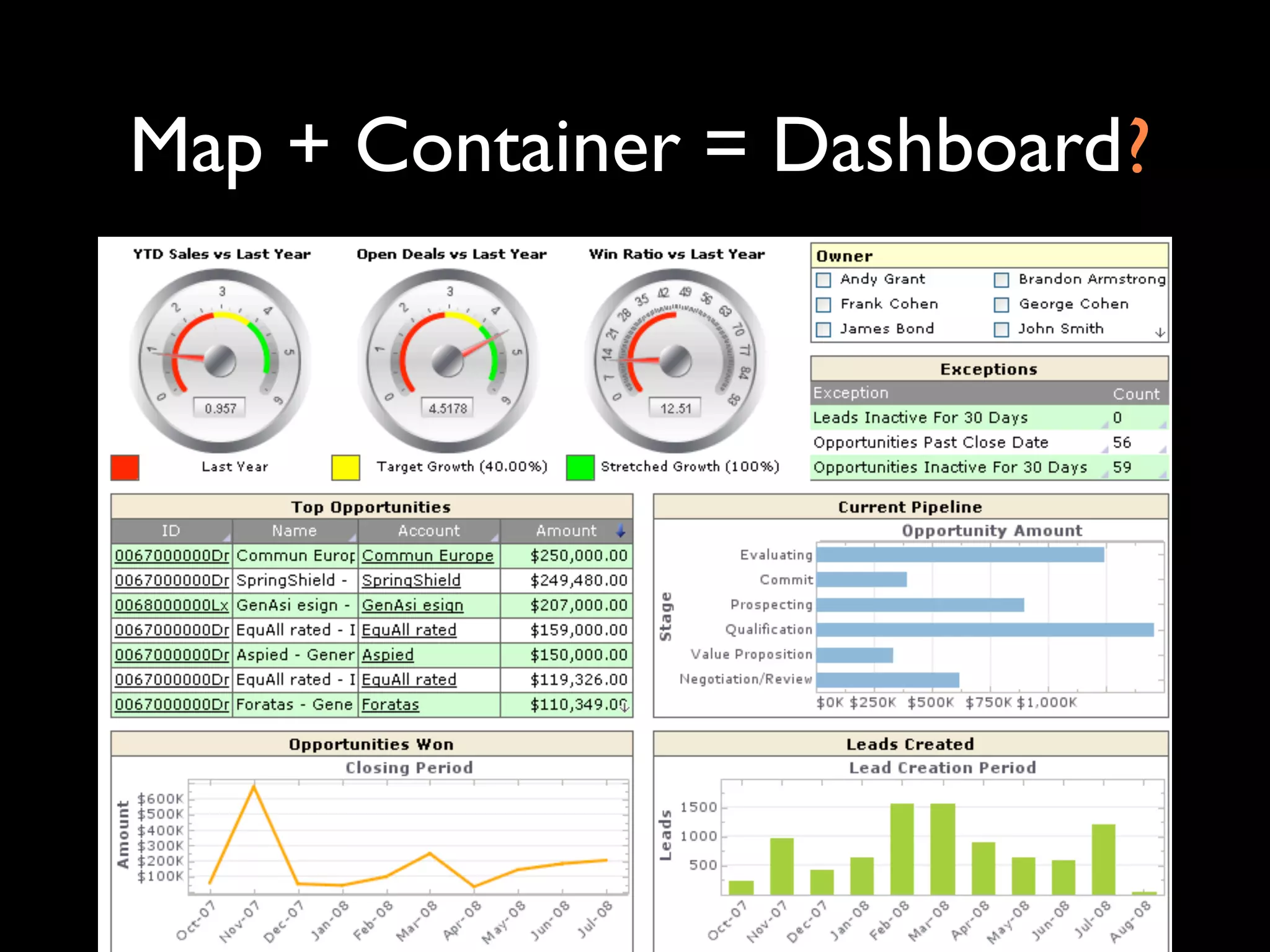
  • #44 http://www.inetsoft.com/images/screenshots/an_executive_dashboard.png ...but beware dashboards; the metaphor will only take you so far.
  • #45 Wikipedia image from http://en.wikipedia.org/wiki/File:Viegas-UserActivityonWikipedia.gif
  • #46 http://2.bp.blogspot.com/_wb8bAl1P-N0/TOFKkD6iQII/AAAAAAAARyQ/mmGzMbjvVrk/s1600/blue-sky.jpeg IT’S NO ONE’S FAULT THAT IT ENDED UP THIS WAY...
  • #47 http://4.bp.blogspot.com/_cAFRZohUKig/TJd3XS2t-pI/AAAAAAAAAMQ/kWwHpDic1K4/s1600/600px-ConferenceBike.jpg