






8 better practices from information architecture


                  Lou Rosenfeld
Hello, my name is Lou


www.louisrosenfeld.com | www.rosenfeldmedia.com

                                                  2
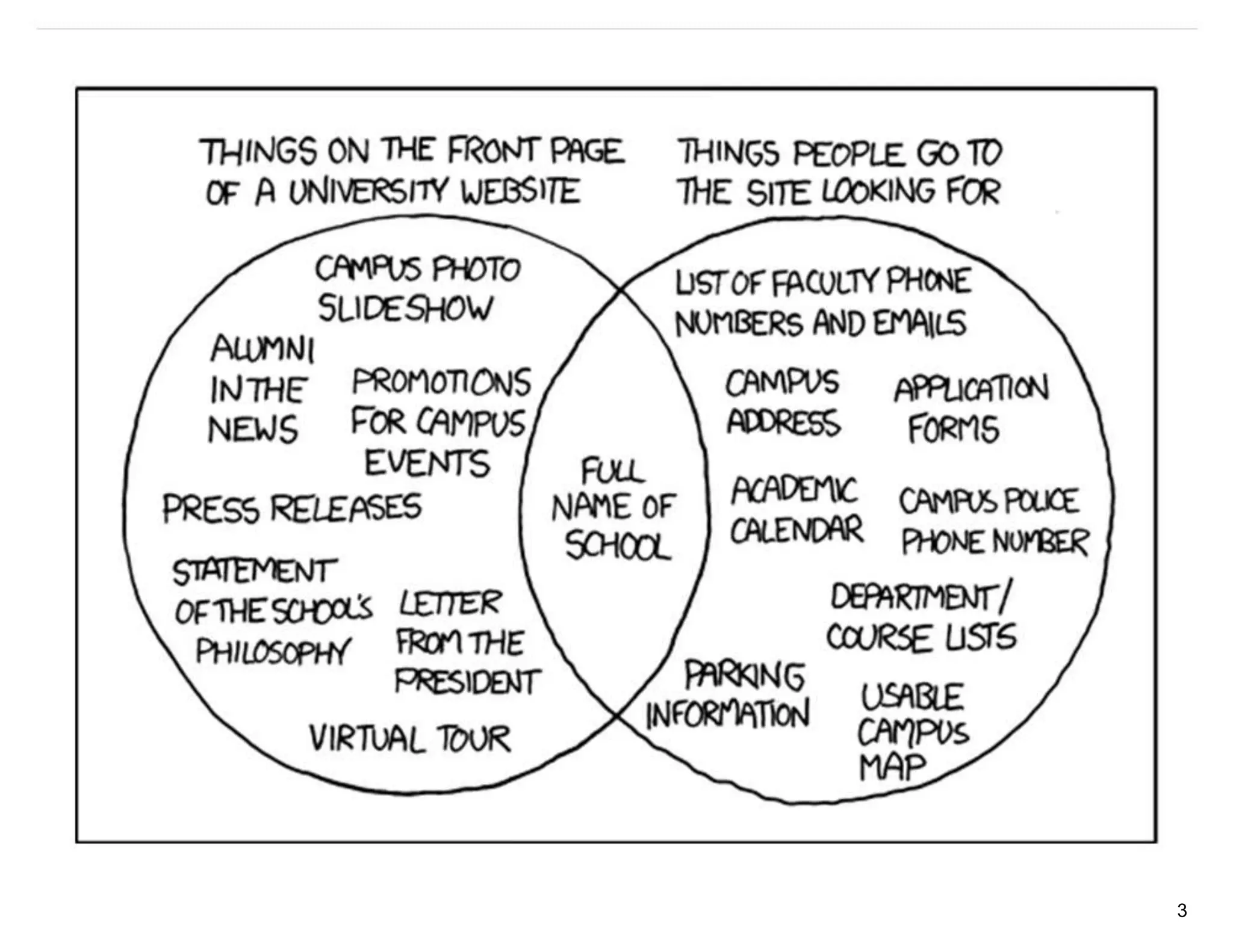
3
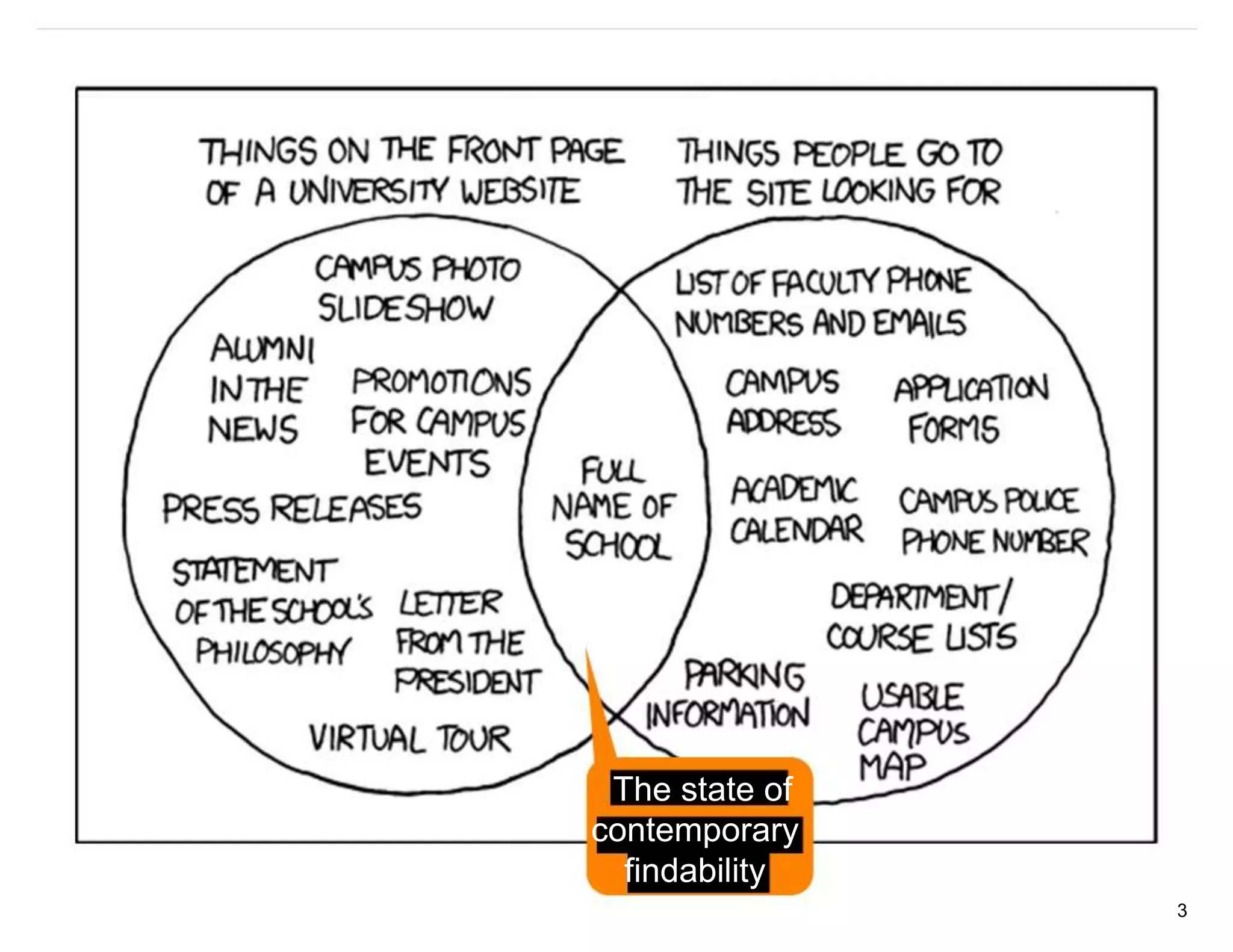
The state of
contemporary
  findability
                3
Some questions that you
probably can’t answer
• Who are your content’s primary audiences?
• What are the five major tasks and needs
  each has?
• Are you satisfying those tasks and needs?
• What data support your thinking?
• How do you measure success?

                                              4
Why can’t we get
findability right?
Why can’t we get
findability right?
• We don’t know how to diagnose
Why can’t we get
findability right?
• We don’t know how to diagnose
• We don’t know how to measure
Why can’t we get
findability right?
• We don’t know how to diagnose
• We don’t know how to measure
• Siloed organizations
Why can’t we get
findability right?
• We don’t know how to diagnose
• We don’t know how to measure
• Siloed organizations
• Ill-equipped decision-makers
Why can’t we get
findability right?
• We don’t know how to diagnose
• We don’t know how to measure
• Siloed organizations
• Ill-equipped decision-makers
• Short-term thinking
Why can’t we get
findability right?
• We don’t know how to diagnose
• We don’t know how to measure
• Siloed organizations
• Ill-equipped decision-makers
• Short-term thinking
• Semantic illiteracy
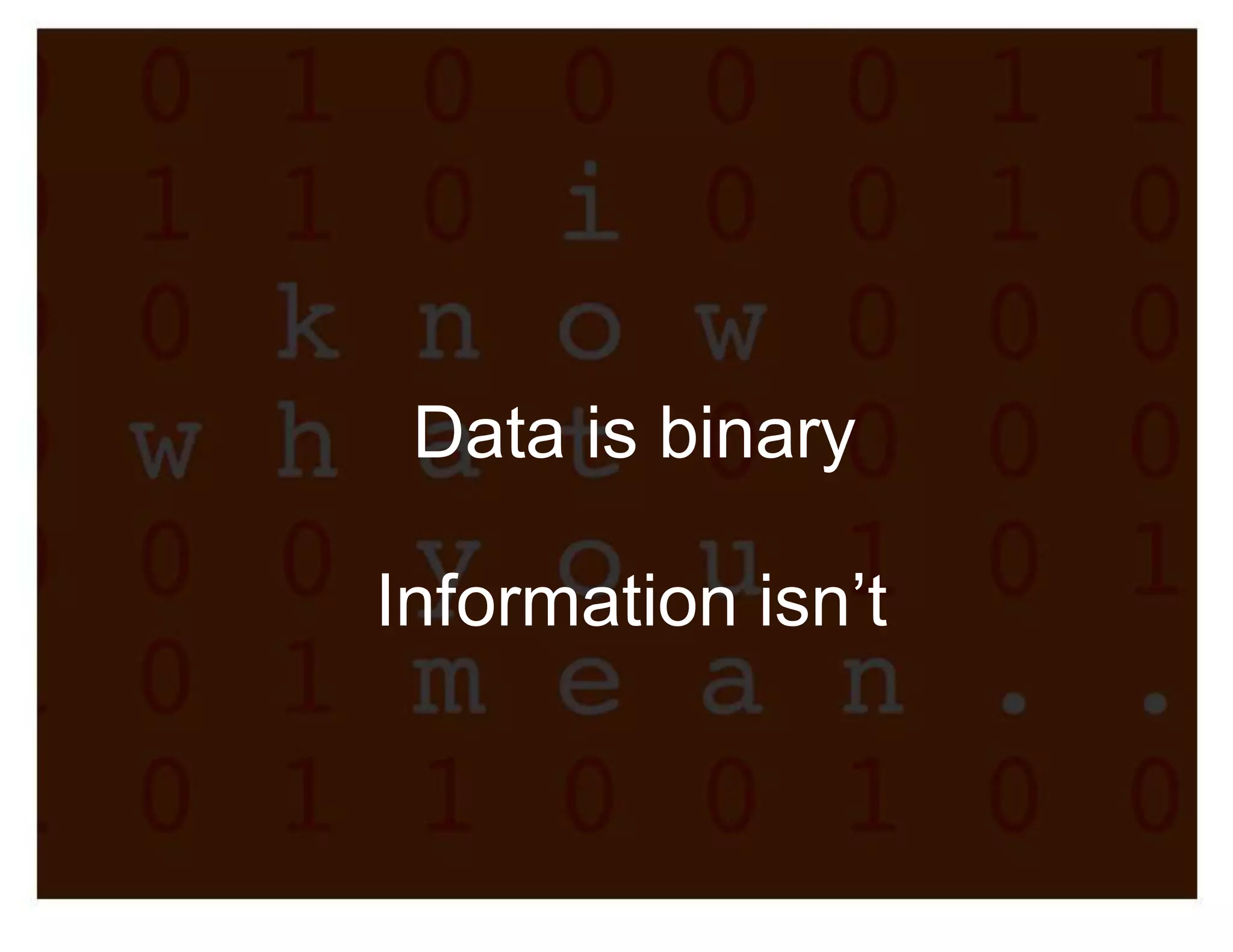
Data is binary

Information isn’t
Information architecture:
8 better practices for findability
1. Diagnose the important problems
2. Balance your evidence
3. Advocate for the long term
4. Measure engagement
5. Support contextual navigation
6. Improve search across silos
7. Combine design approaches effectively
8. Tune your design over time


                                           7
#1
Diagnose the
important problems


                     8
A


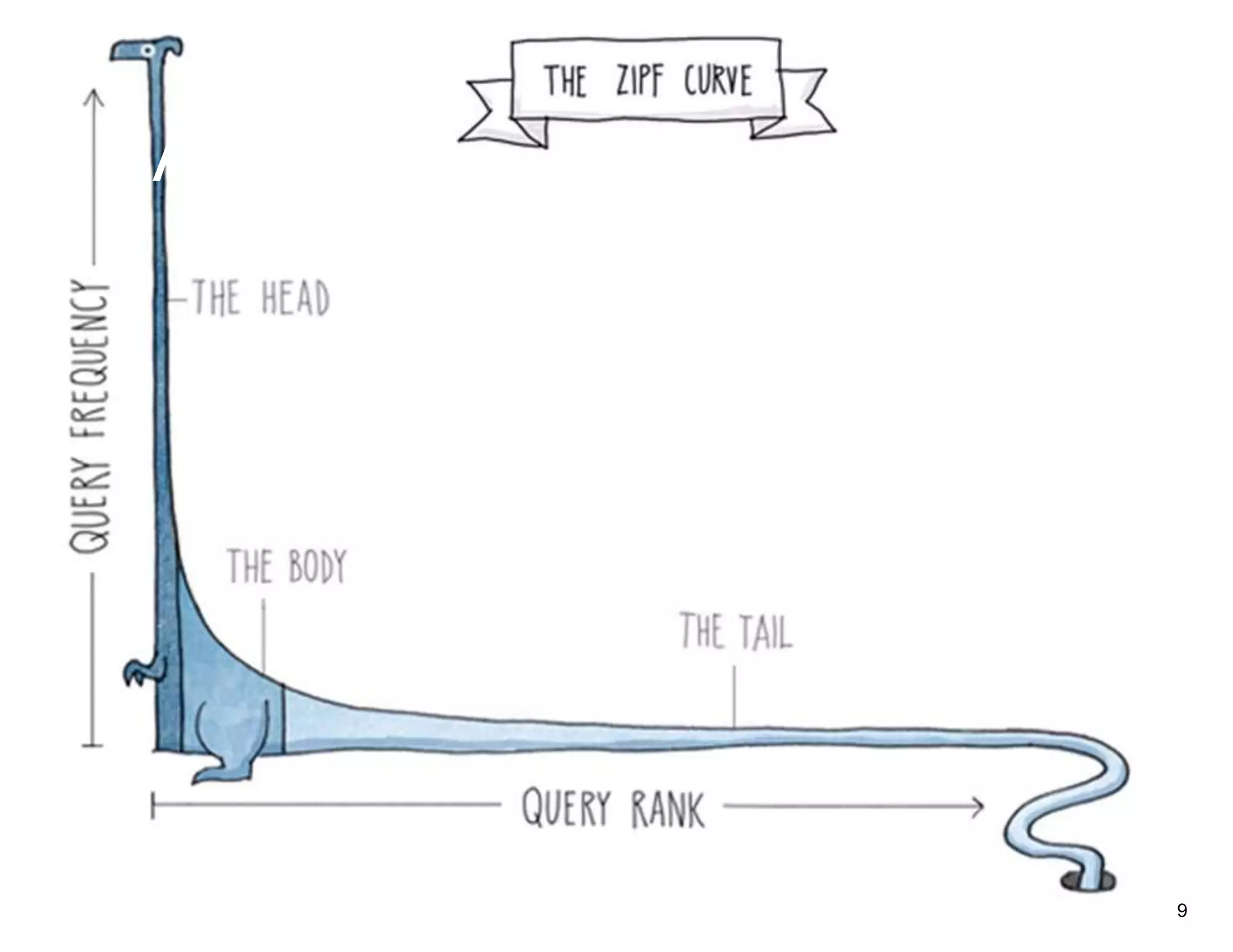
    9
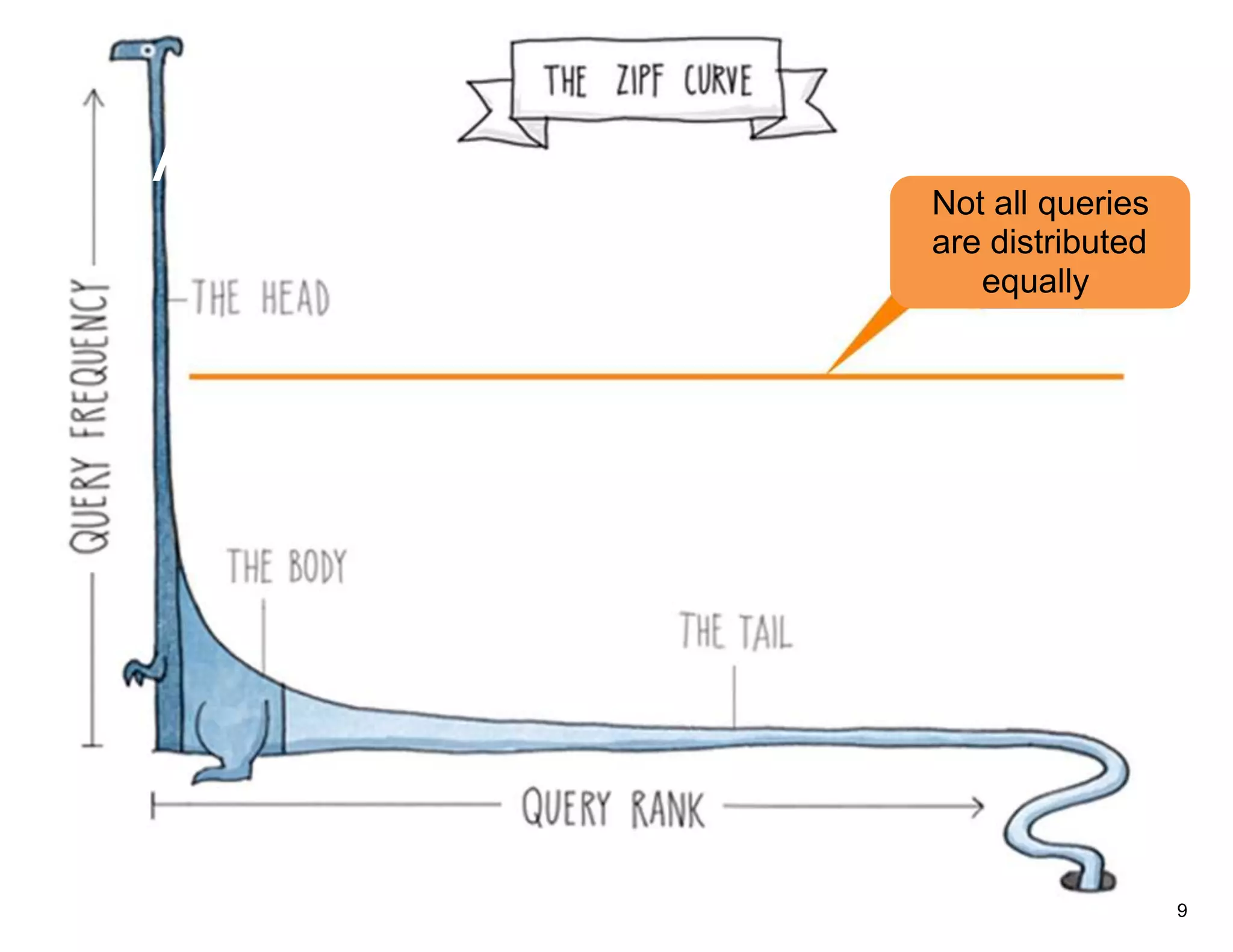
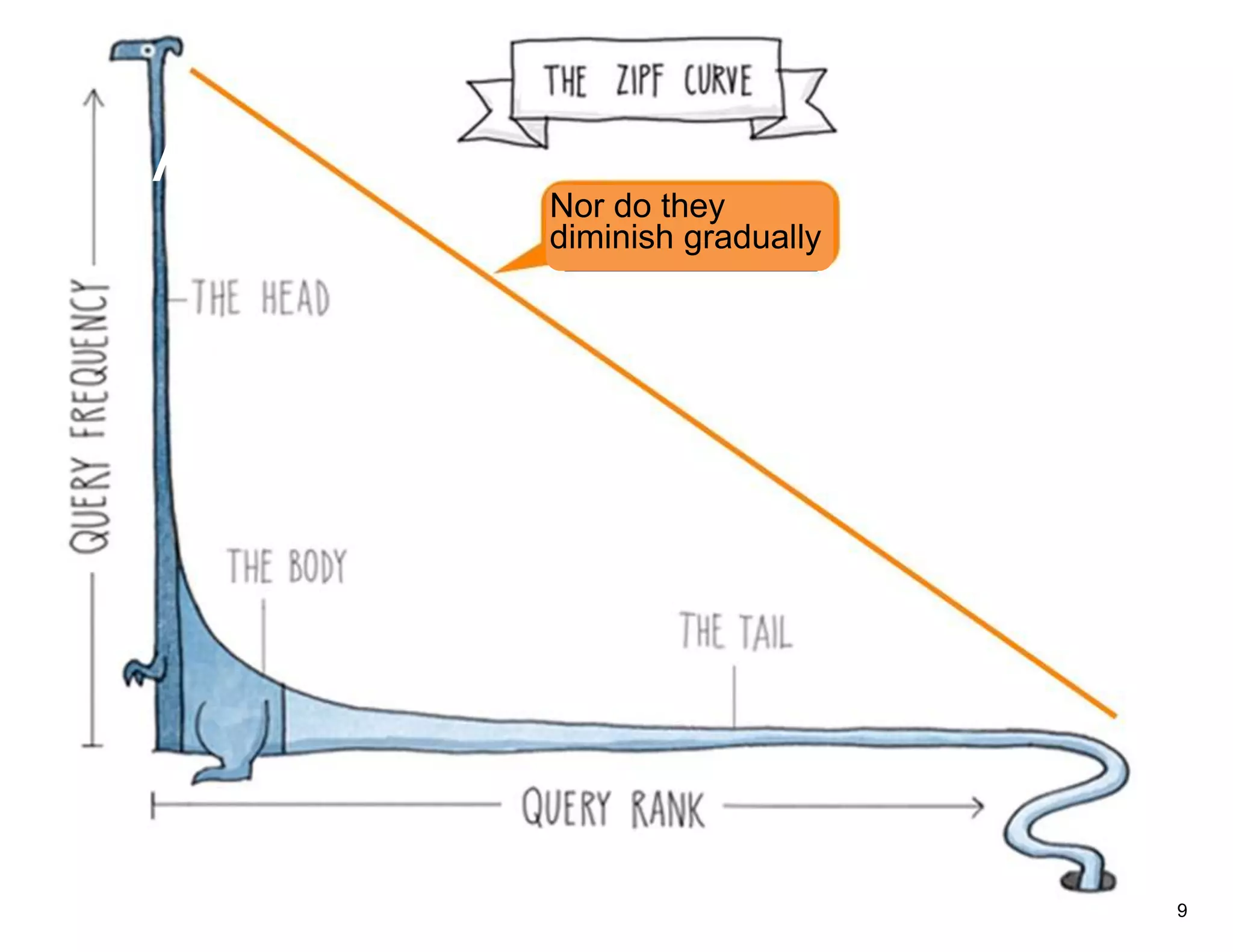
A   Not all queries
    are distributed
       equally


                      9
A   Nor do they
    diminish gradually


                         9
A


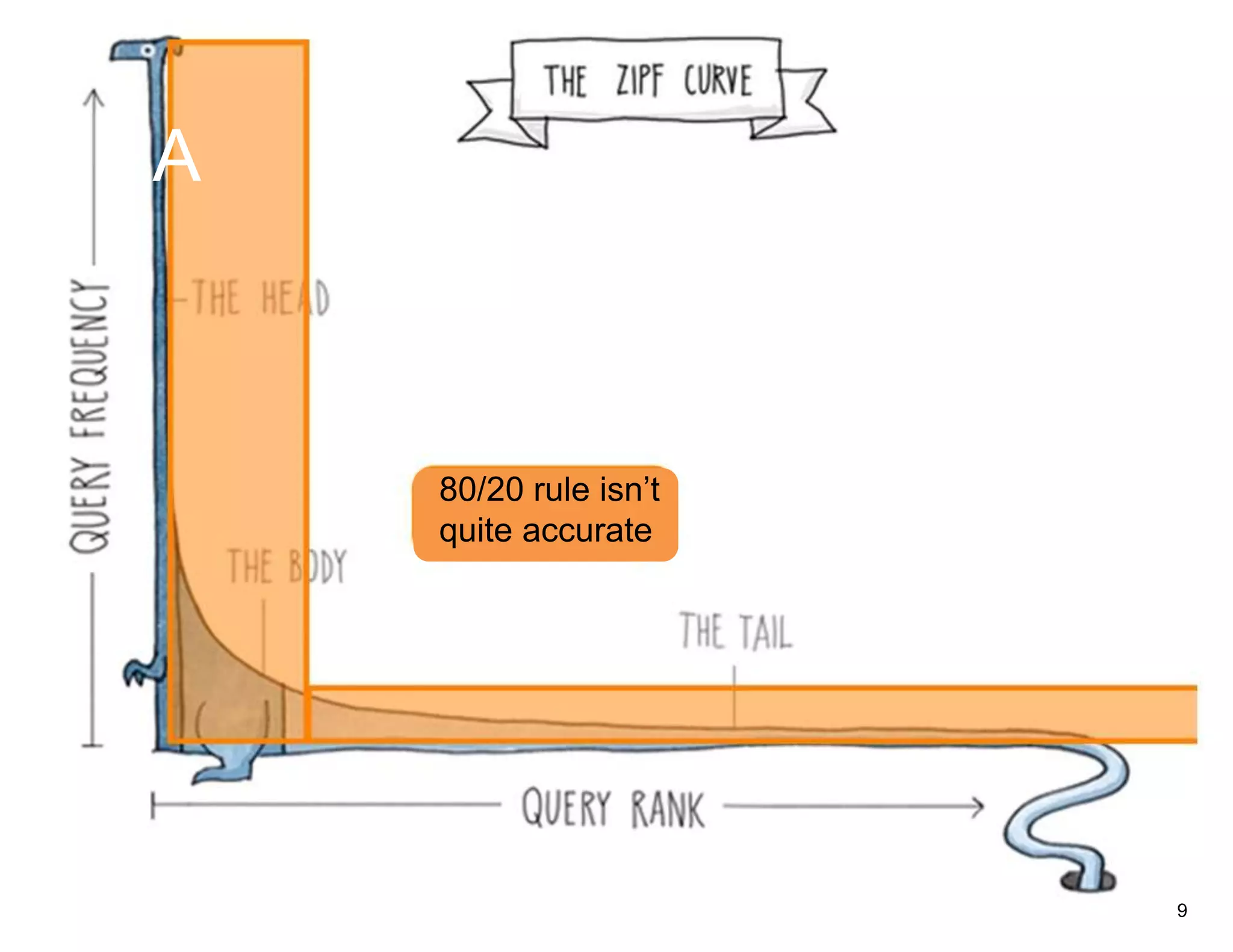
    80/20 rule isn’t
    quite accurate


                       9
(


    10
(


    10
(


    10
(


    10
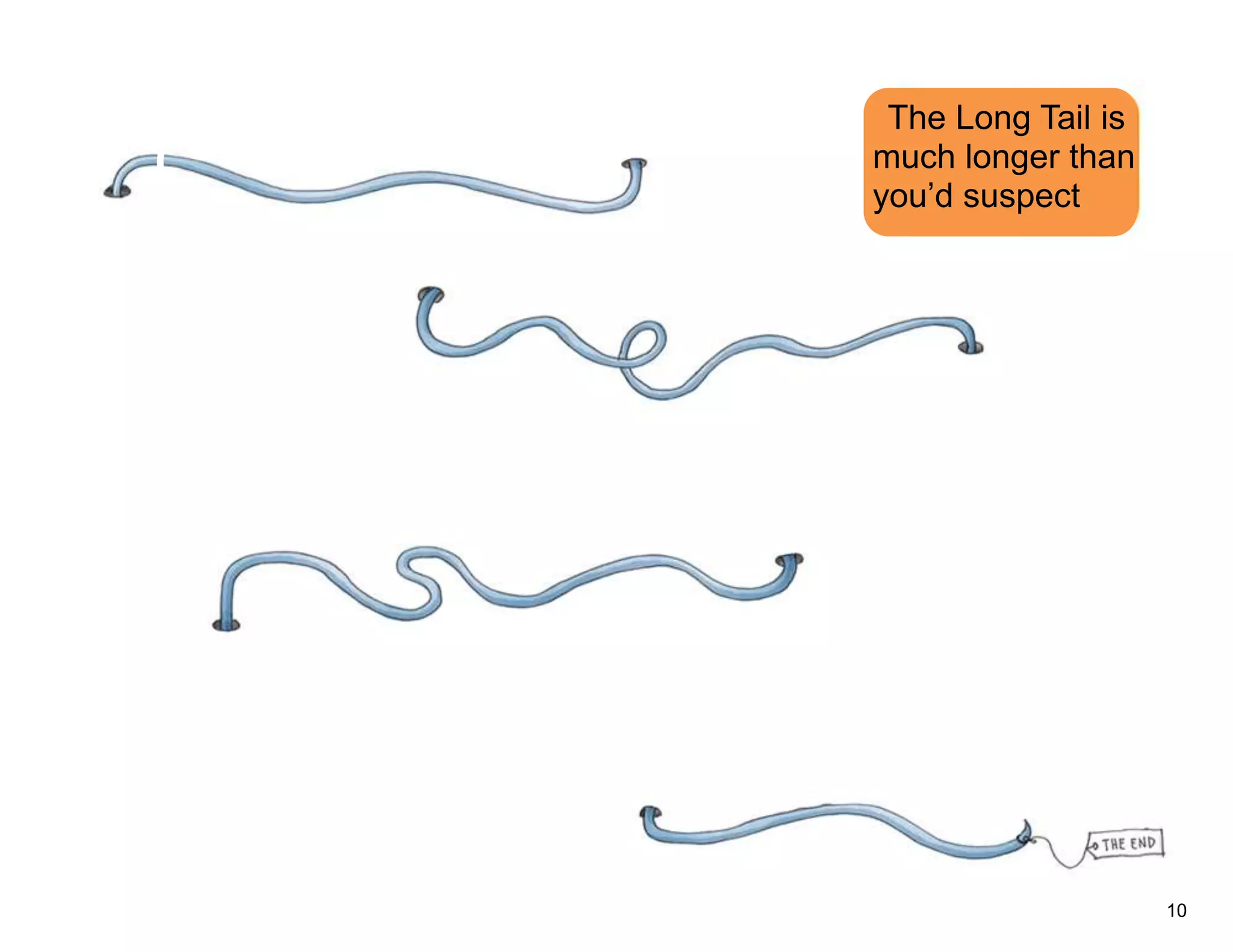
The Long Tail is
(   much longer than
    you’d suspect


                        10
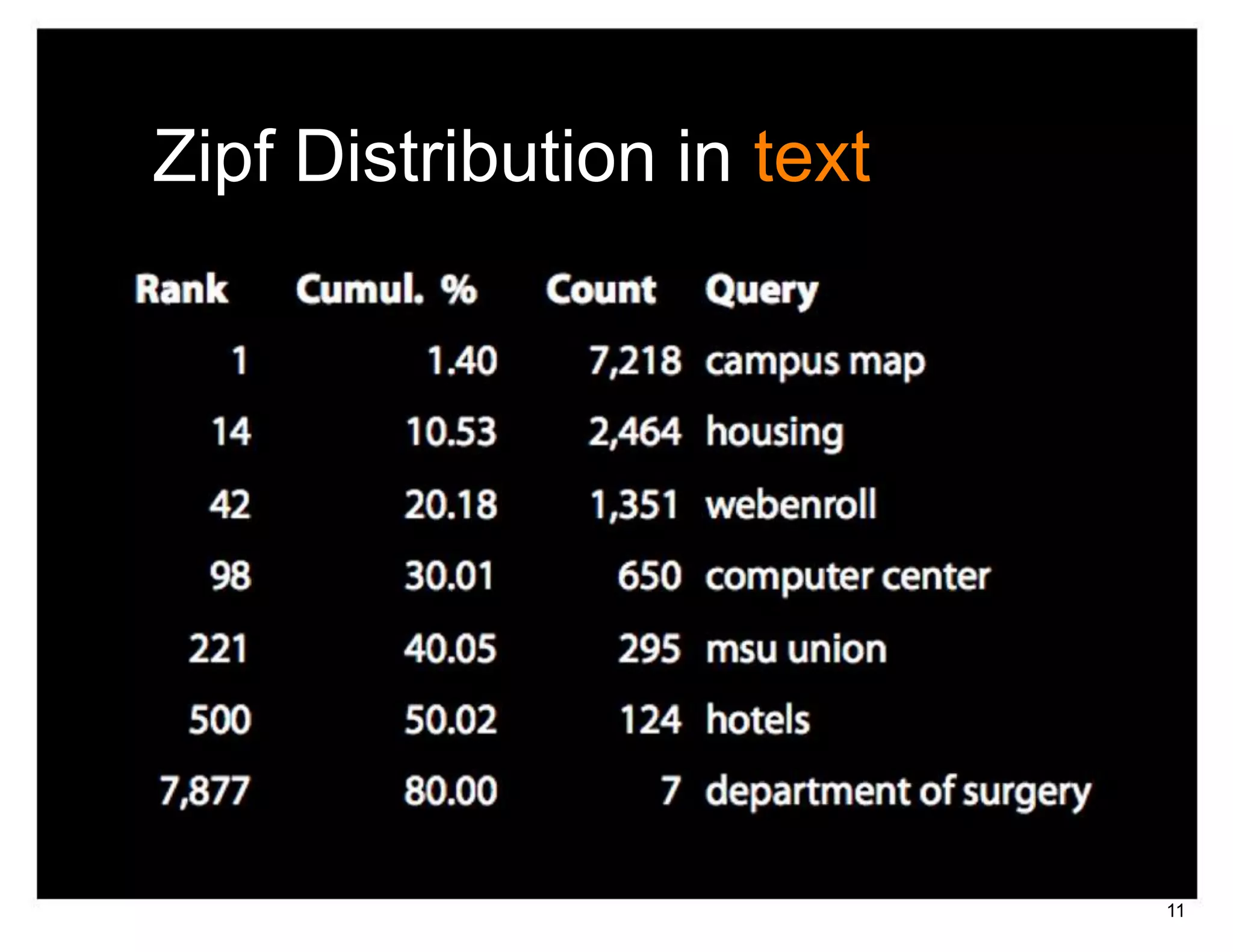
Zipf Distribution in text


                            11
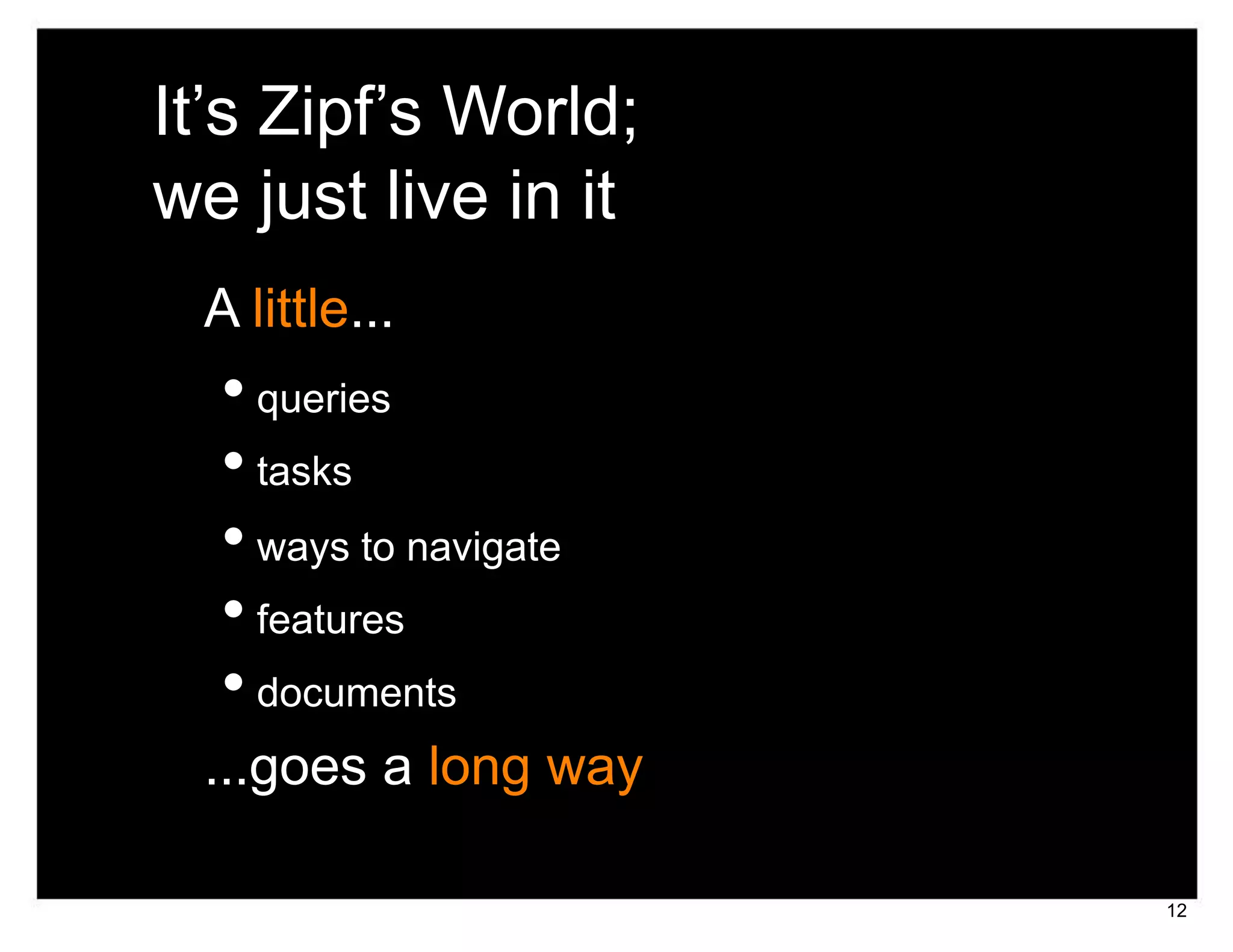
It’s Zipf’s World;
we just live in it
 A little...
  • queries
  • tasks
  • ways to navigate
  • features
  • documents
 ...goes a long way

                       12
UNVERIFIED RUMOR:
         90% of
 Microsoft.com content
has never been accessed...
     not even once

      TAKEAWAY:
     FOCUS ON
    THE STUFF
THAT MATTERS!
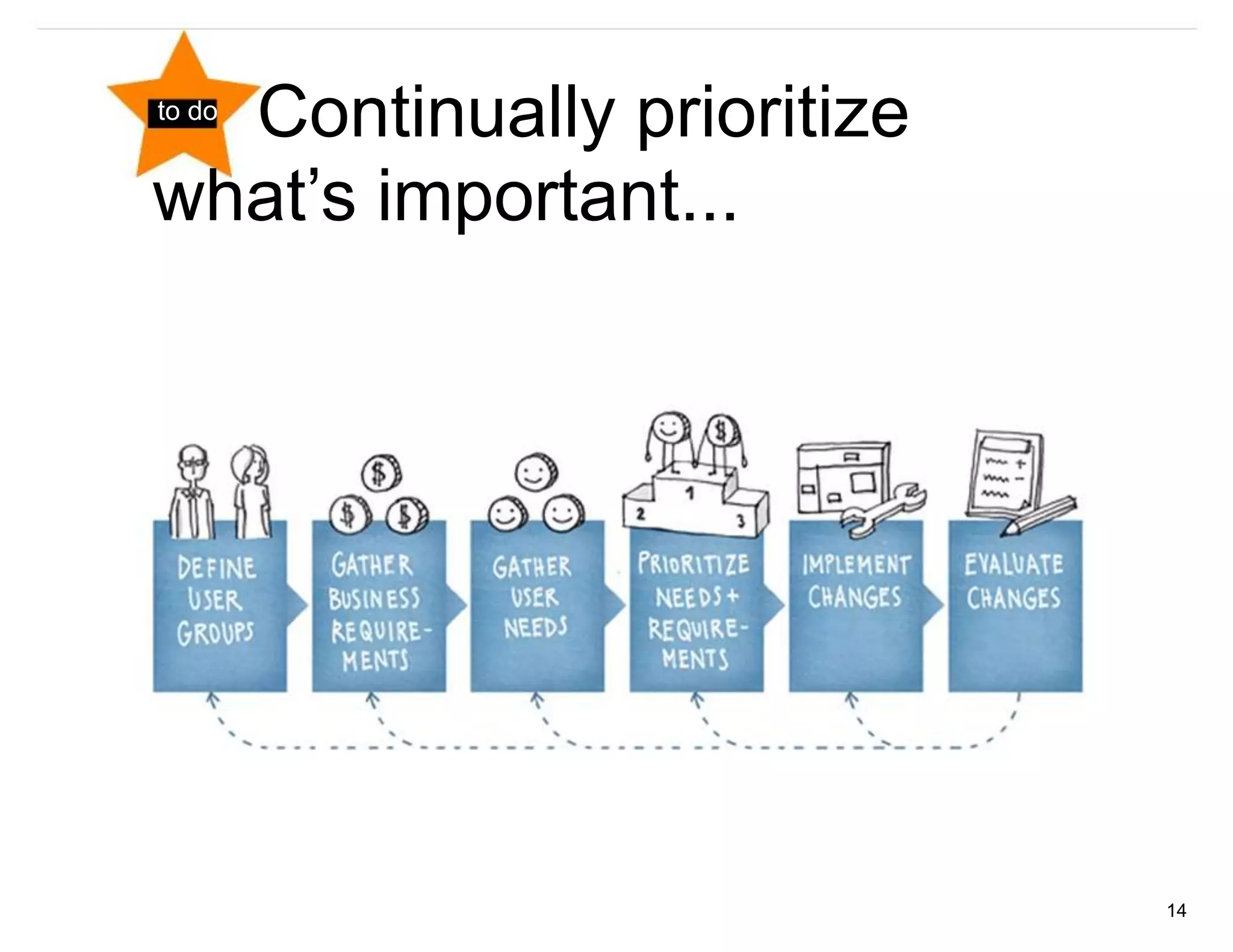
Continually prioritize
to do


what’s important...


                           14
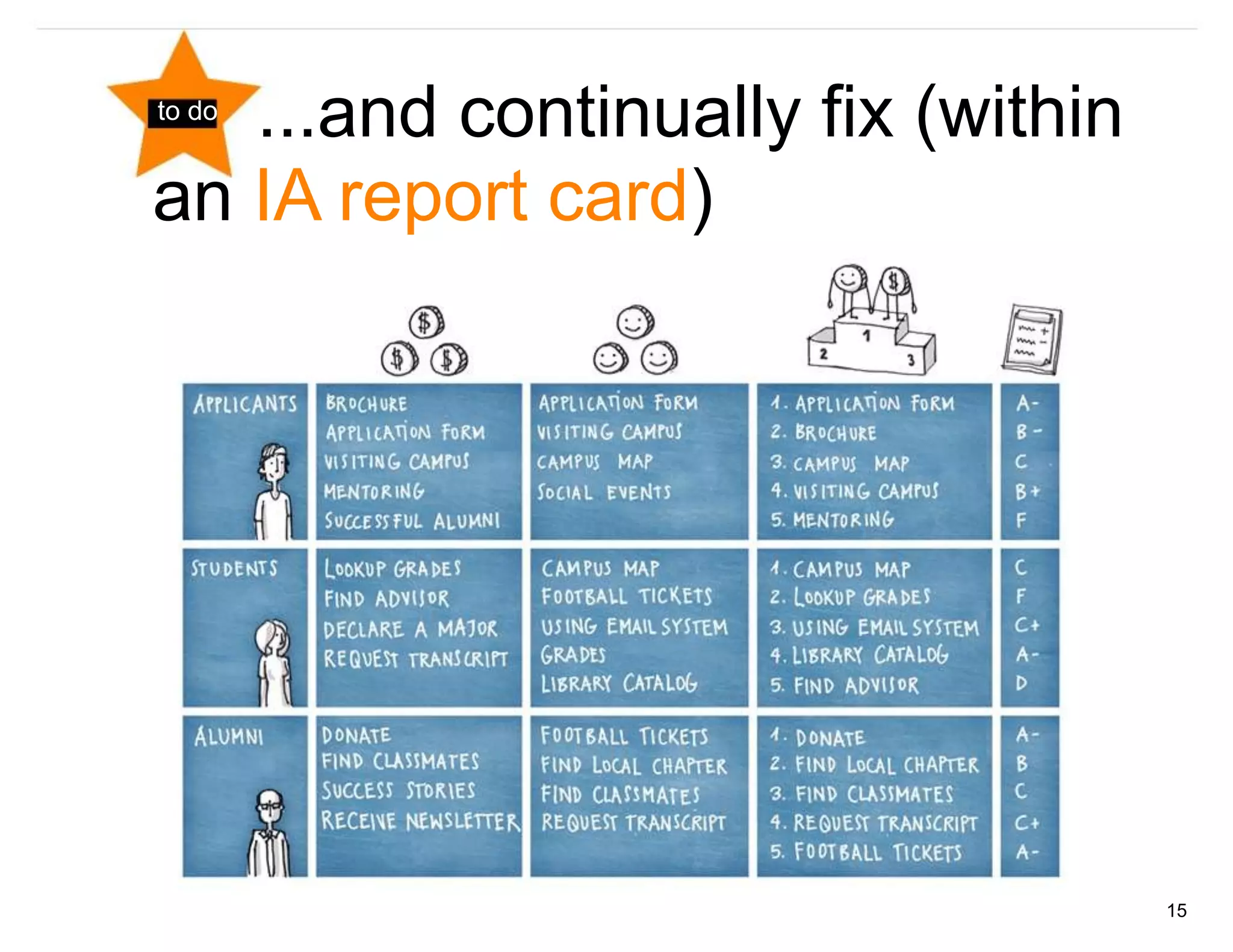
...and continually fix (within
to do


an IA report card)


                                    15
#2
Balance your evidence


                        16
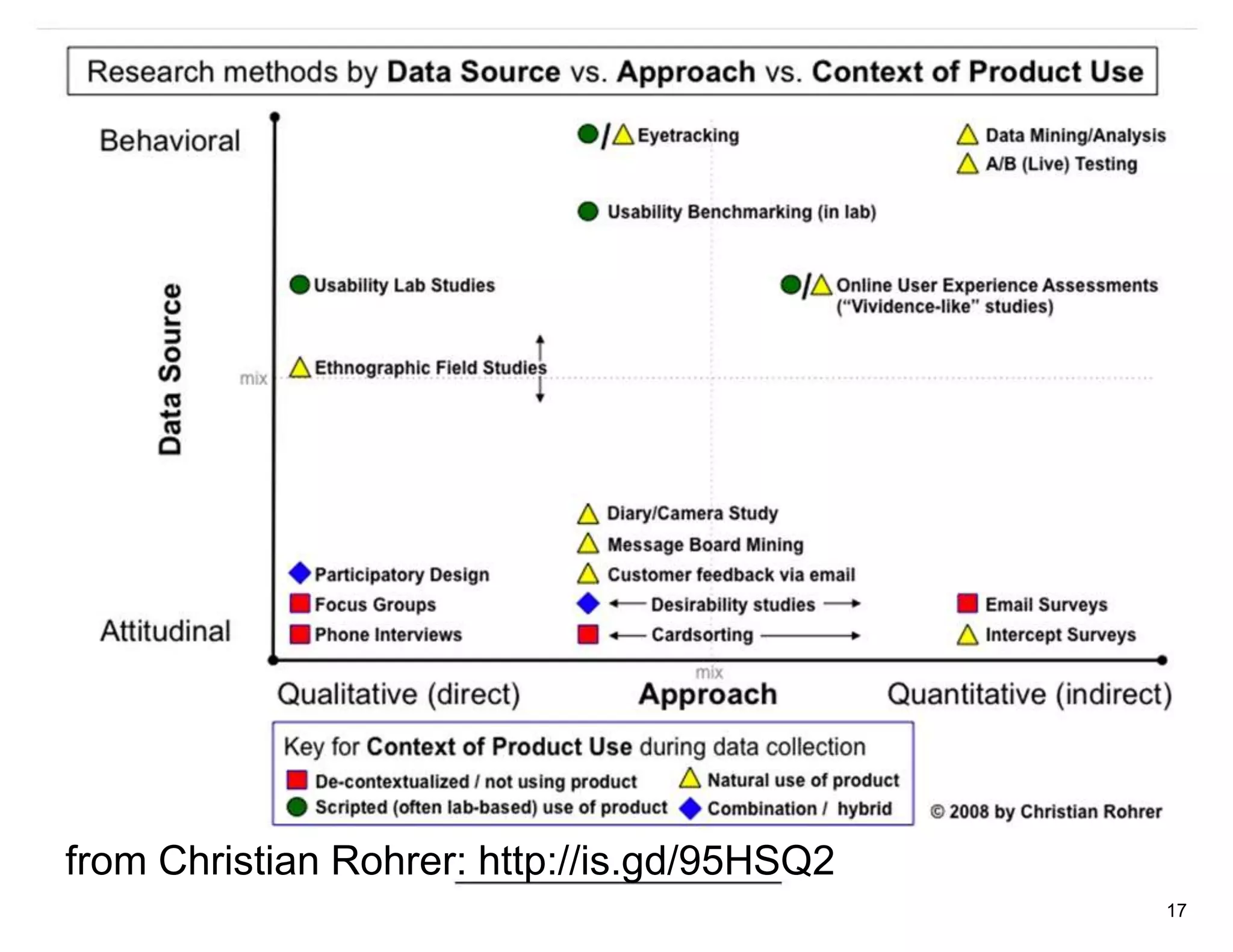
from Christian Rohrer: http://is.gd/95HSQ2
                                             17
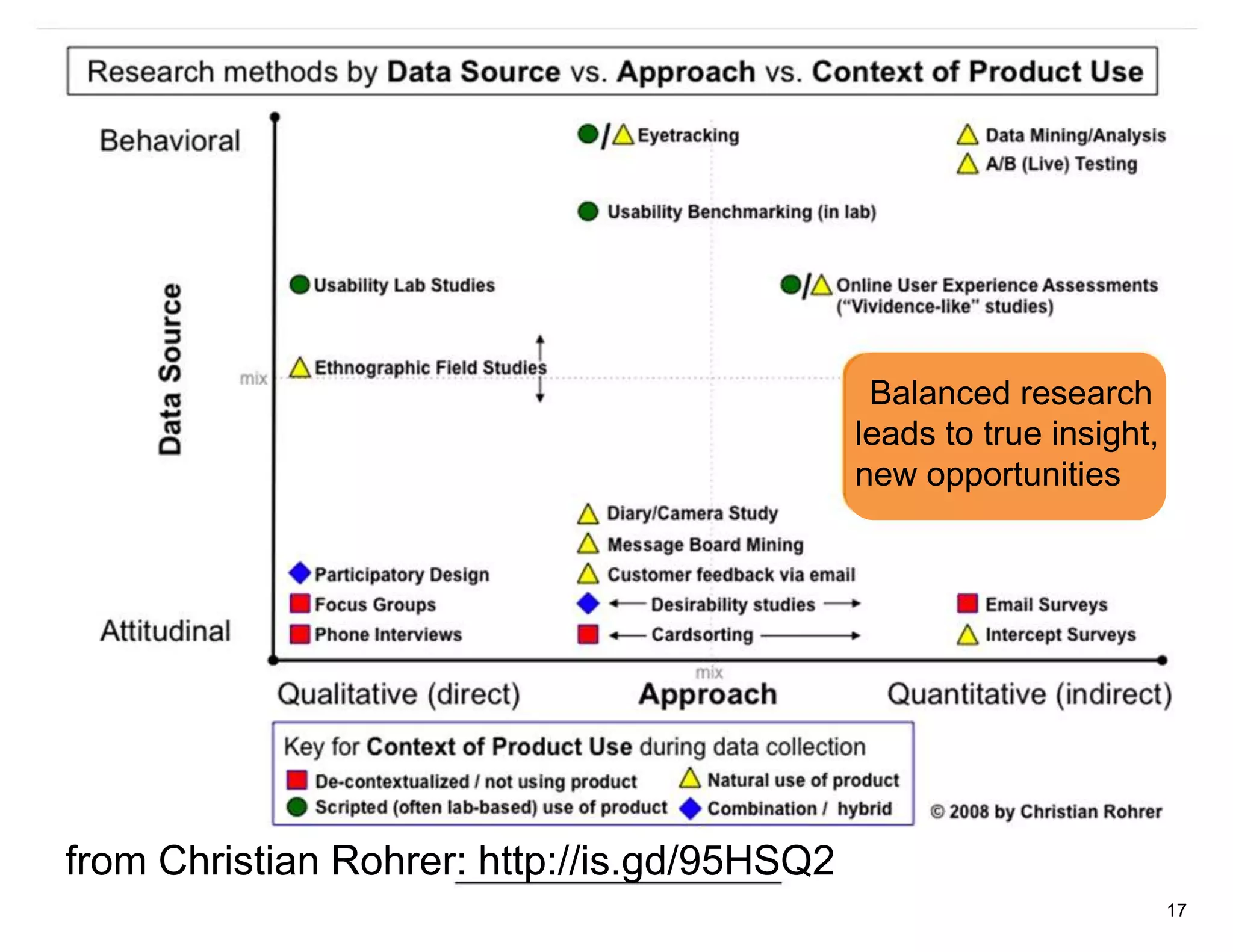
Balanced research
                                             leads to true insight,
                                             new opportunities


from Christian Rohrer: http://is.gd/95HSQ2
                                                                      17
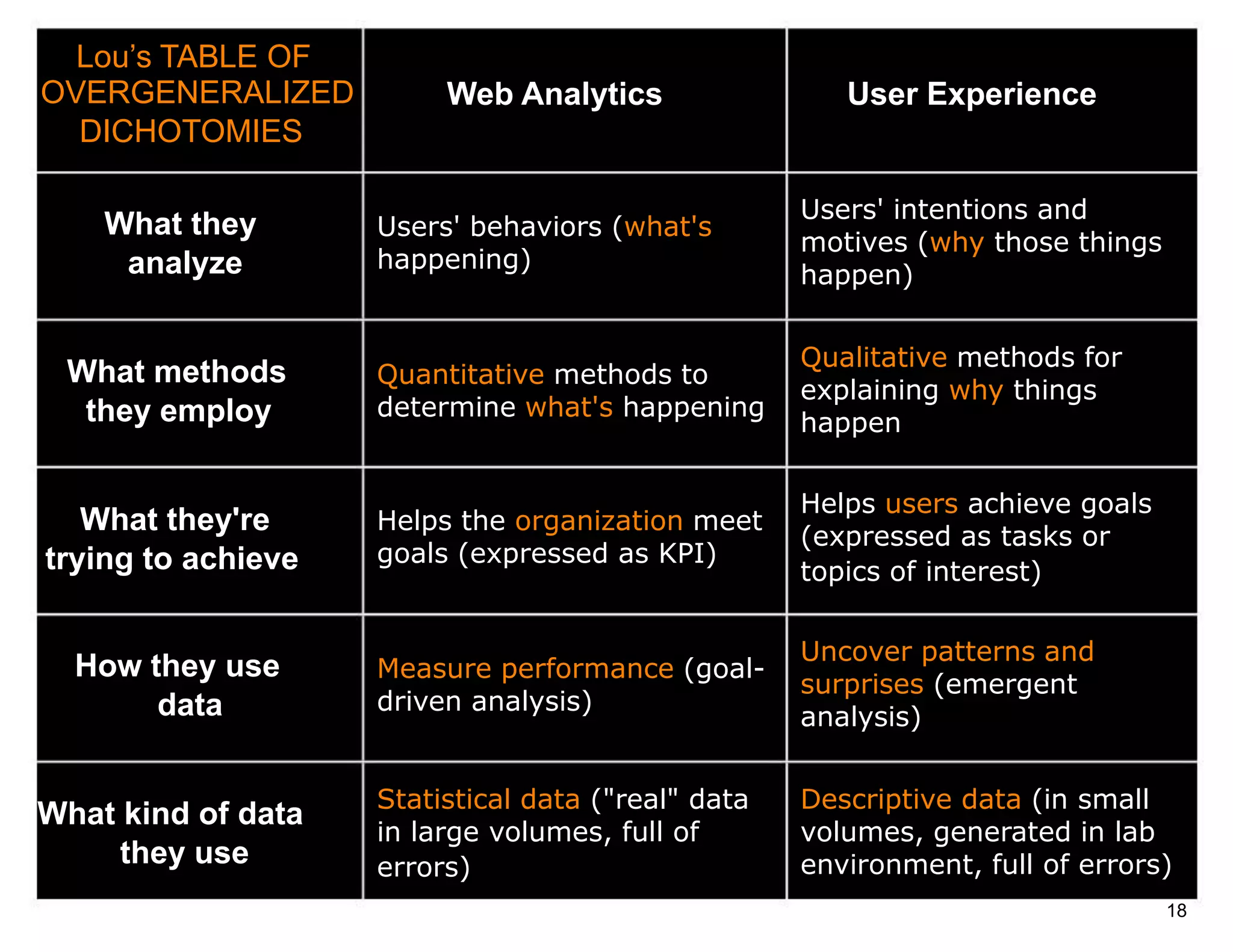
Lou’s TABLE OF
OVERGENERALIZED          Web Analytics                 User Experience
  DICHOTOMIES

                                                    Users' intentions and
    What they       Users' behaviors (what's
                                                    motives (why those things
     analyze        happening)
                                                    happen)


                                                    Qualitative methods for
 What methods       Quantitative methods to
                                                    explaining why things
  they employ       determine what's happening
                                                    happen

                                                    Helps users achieve goals
   What they're     Helps the organization meet
                                                    (expressed as tasks or
trying to achieve   goals (expressed as KPI)
                                                    topics of interest)

                                                    Uncover patterns and
  How they use      Measure performance (goal-
                                                    surprises (emergent
       data         driven analysis)
                                                    analysis)


                    Statistical data ("real" data   Descriptive data (in small
What kind of data
                    in large volumes, full of       volumes, generated in lab
     they use       errors)                         environment, full of errors)
                                                                                18
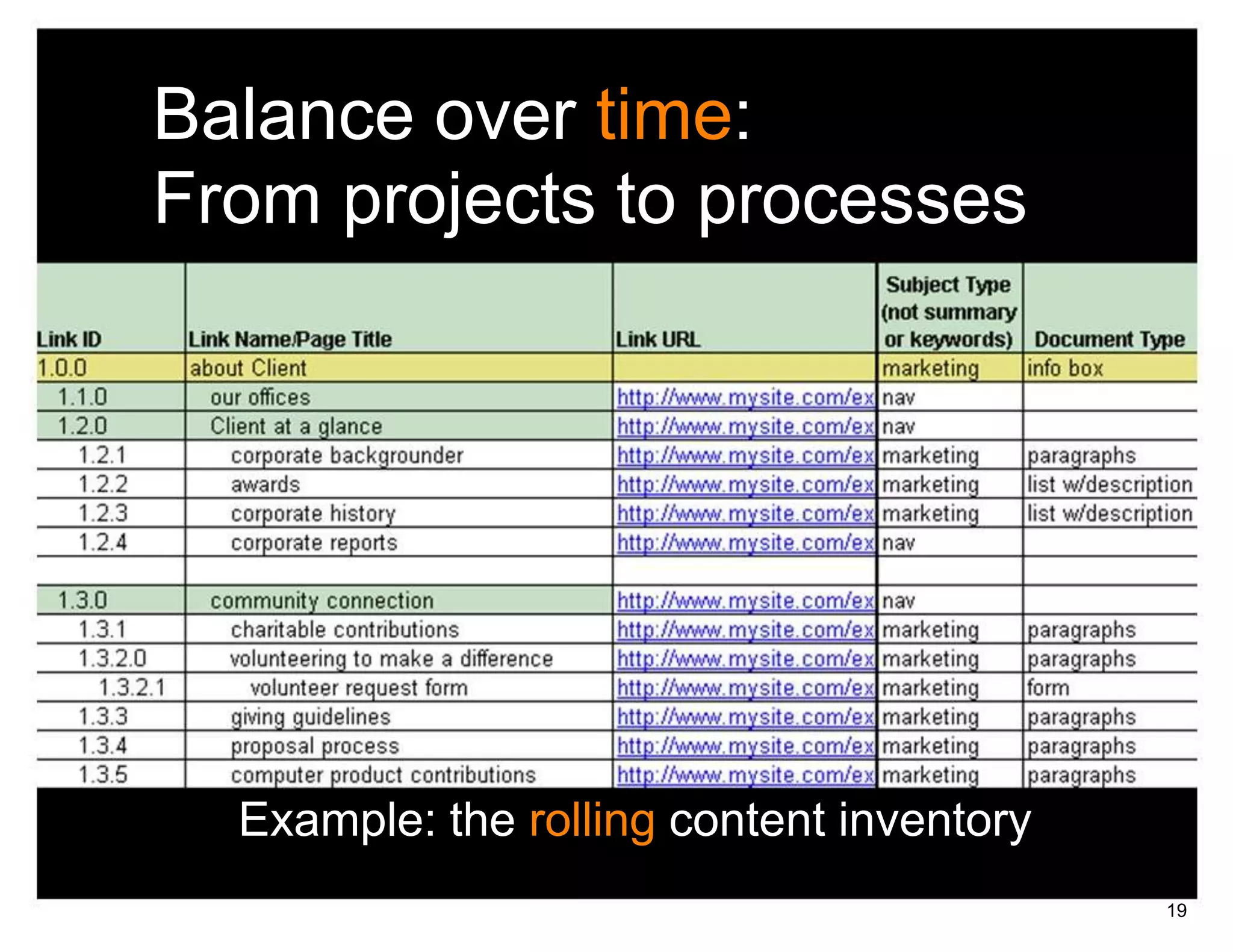
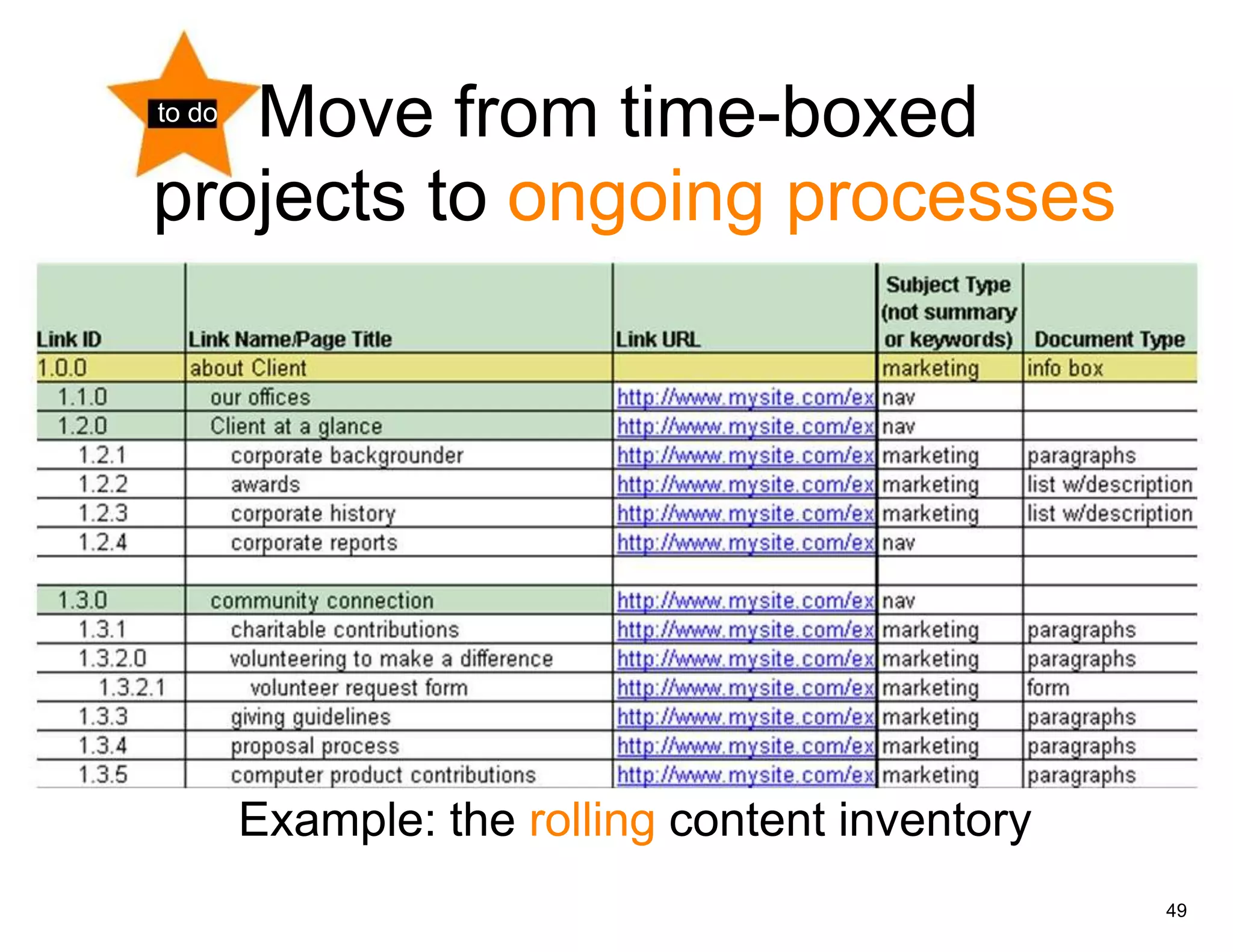
Balance over time:
From projects to processes


  Example: the rolling content inventory
                                           19
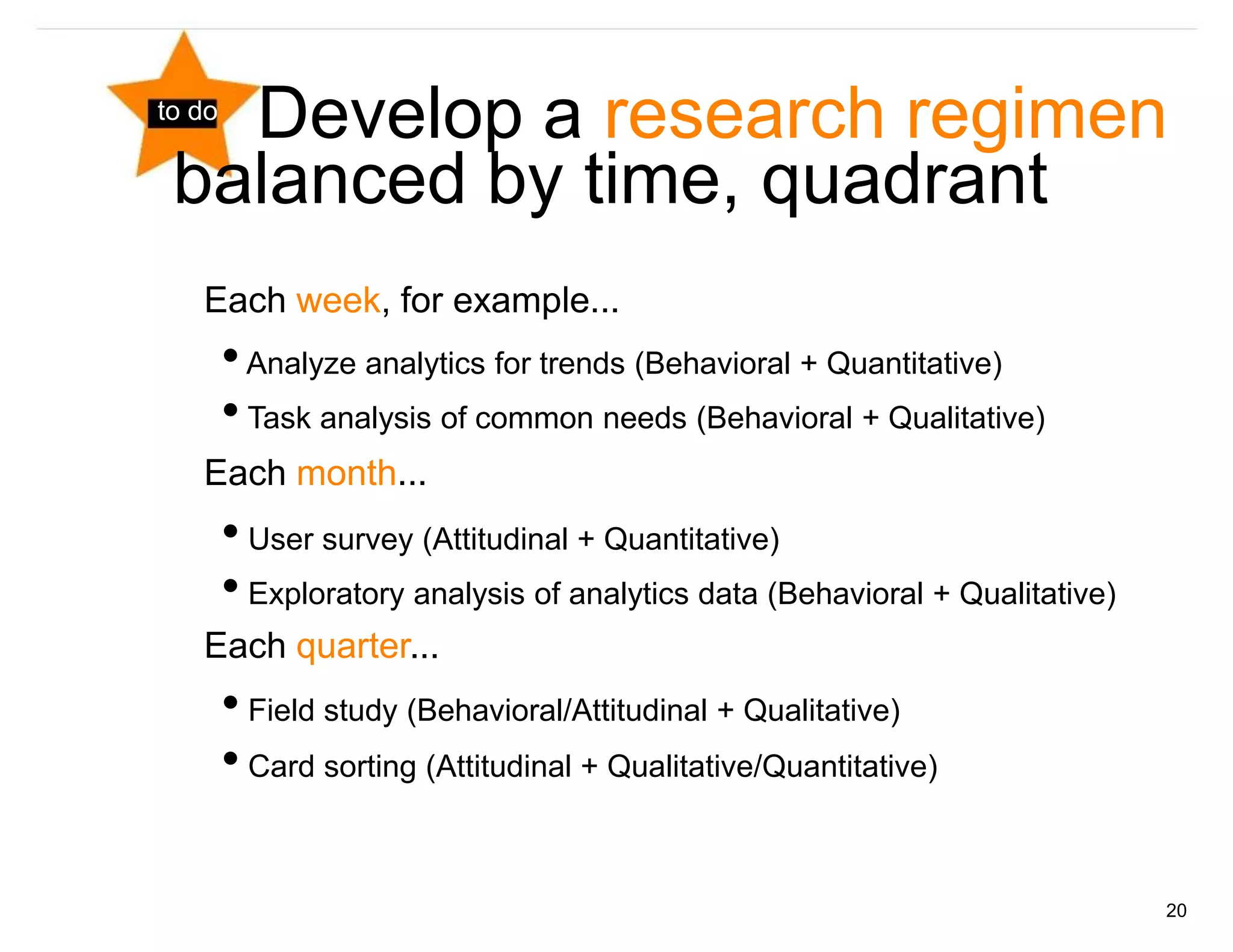
Develop a research regimen
to do


 balanced by time, quadrant
   Each week, for example...
        • Analyze analytics for trends (Behavioral + Quantitative)
        • Task analysis of common needs (Behavioral + Qualitative)
   Each month...
        • User survey (Attitudinal + Quantitative)
        • Exploratory analysis of analytics data (Behavioral + Qualitative)
   Each quarter...
        • Field study (Behavioral/Attitudinal + Qualitative)
        • Card sorting (Attitudinal + Qualitative/Quantitative)

                                                                              20
#3
Advocate for the long-term


                             21
S
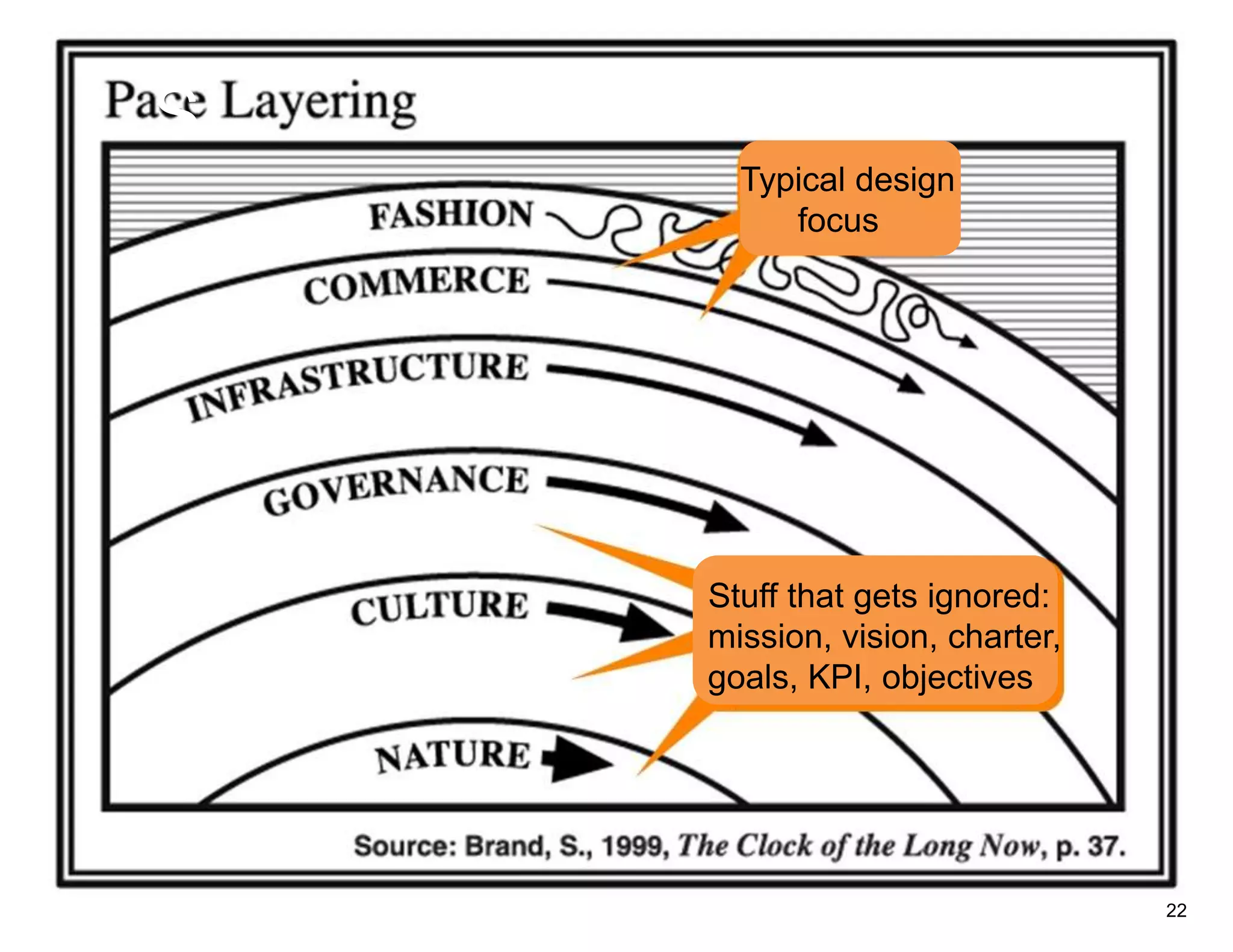
      Typical design
         focus


    Stuff that gets ignored:
    mission, vision, charter,
    goals, KPI, objectives


                                22
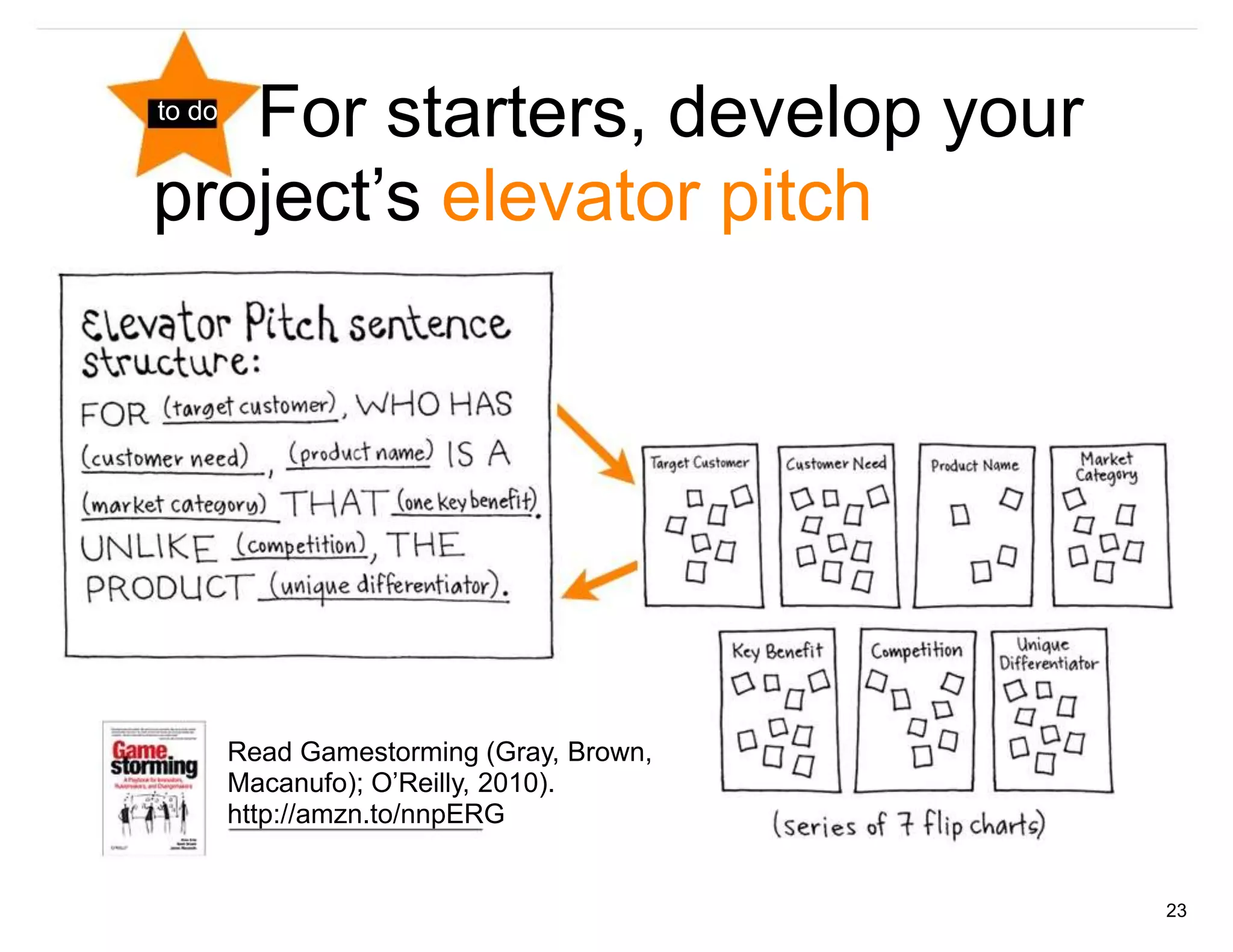
For starters, develop your
to do


project’s elevator pitch


        Read Gamestorming (Gray, Brown,
        Macanufo); O’Reilly, 2010).
        http://amzn.to/nnpERG


                                          23
#4
Measure engagement


                     24
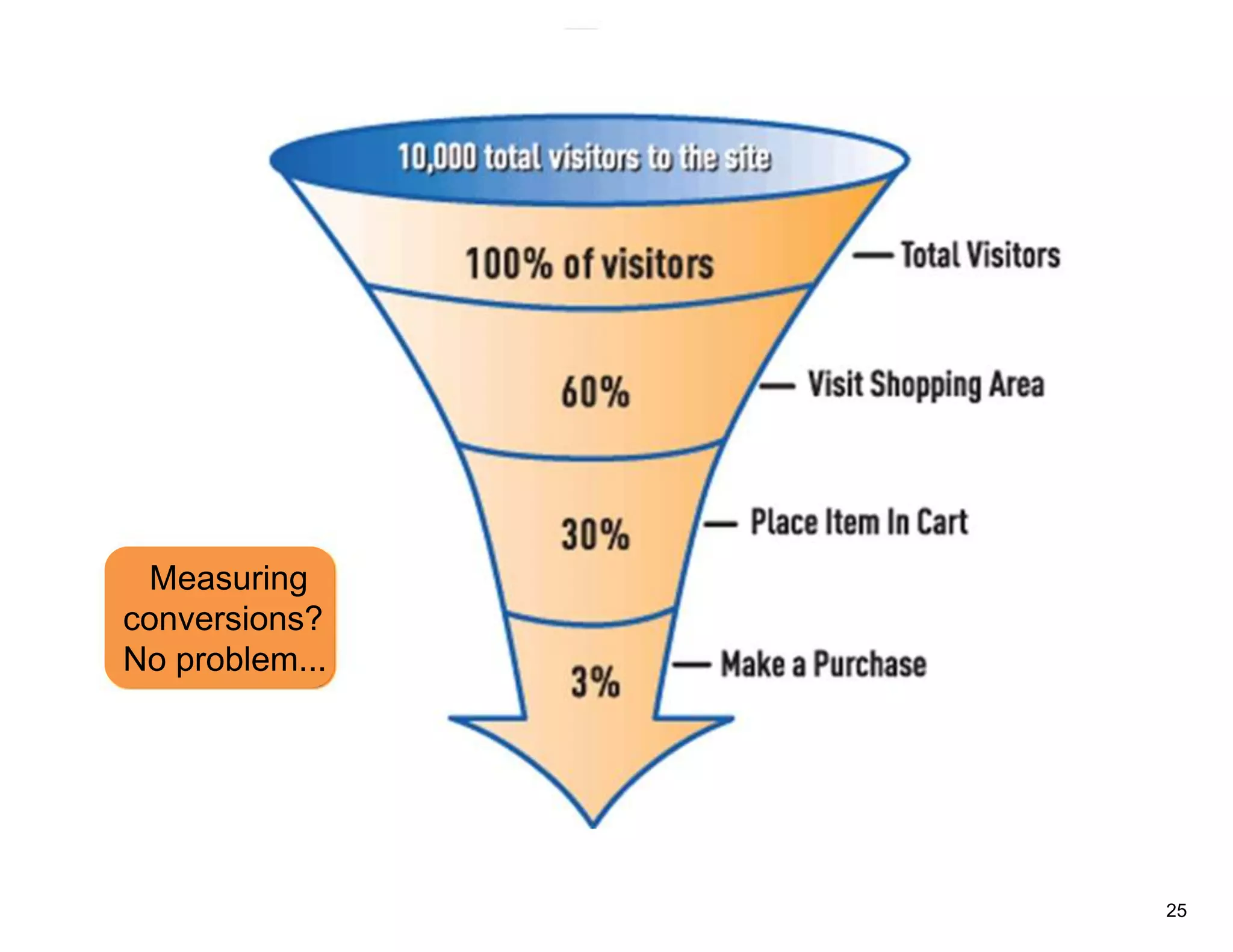
Measuring
conversions?
No problem...


                25
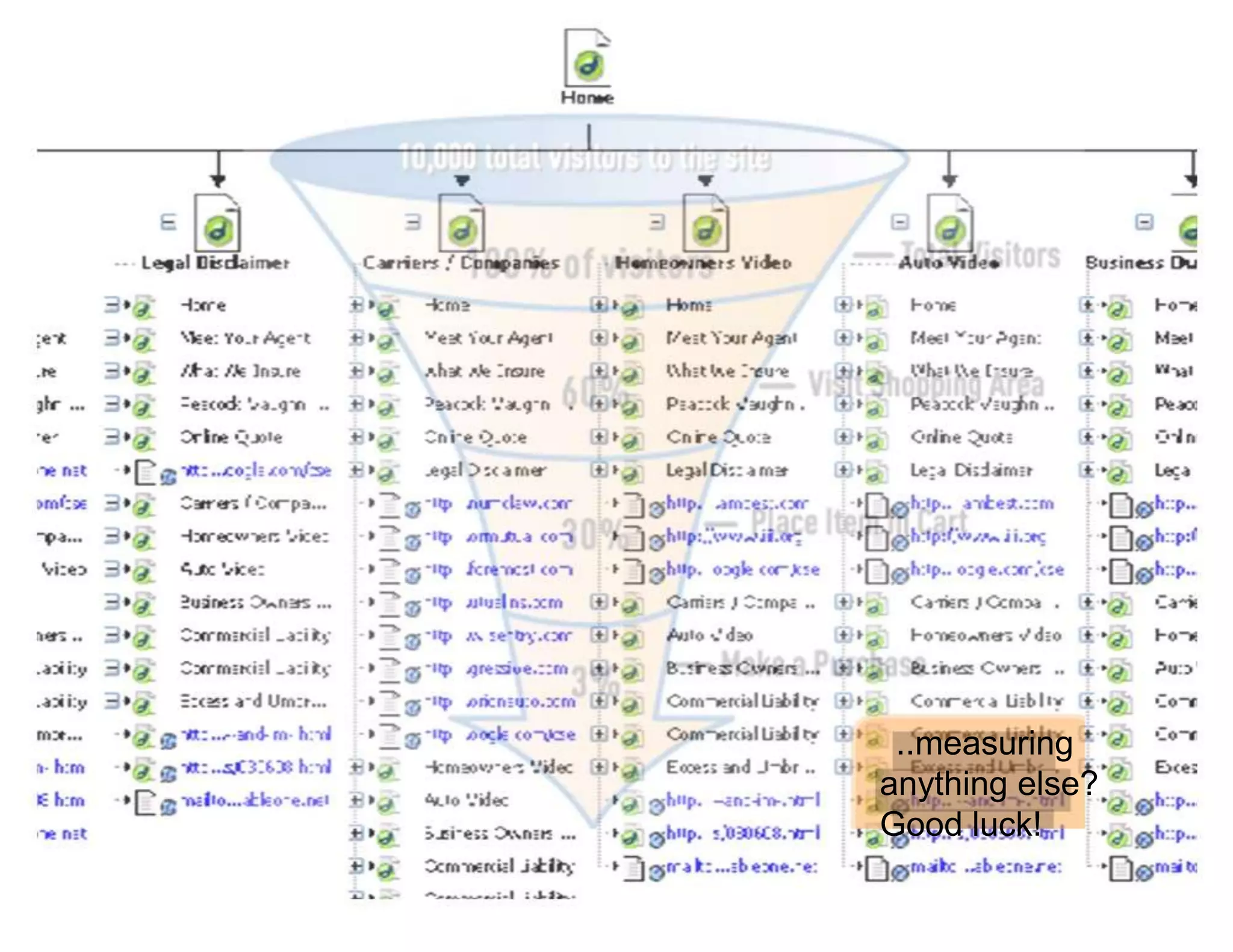
..measuring
anything else?
Good luck!
The missing metrics
of in-betweenness
• Orientation (“What can I do here?”)
• Engagement (“I like this; do you?”)
• Connection/cross-promotion (“What goes
  with this?”)
• Authority (“I trust this”)
• and many more...

                                           26
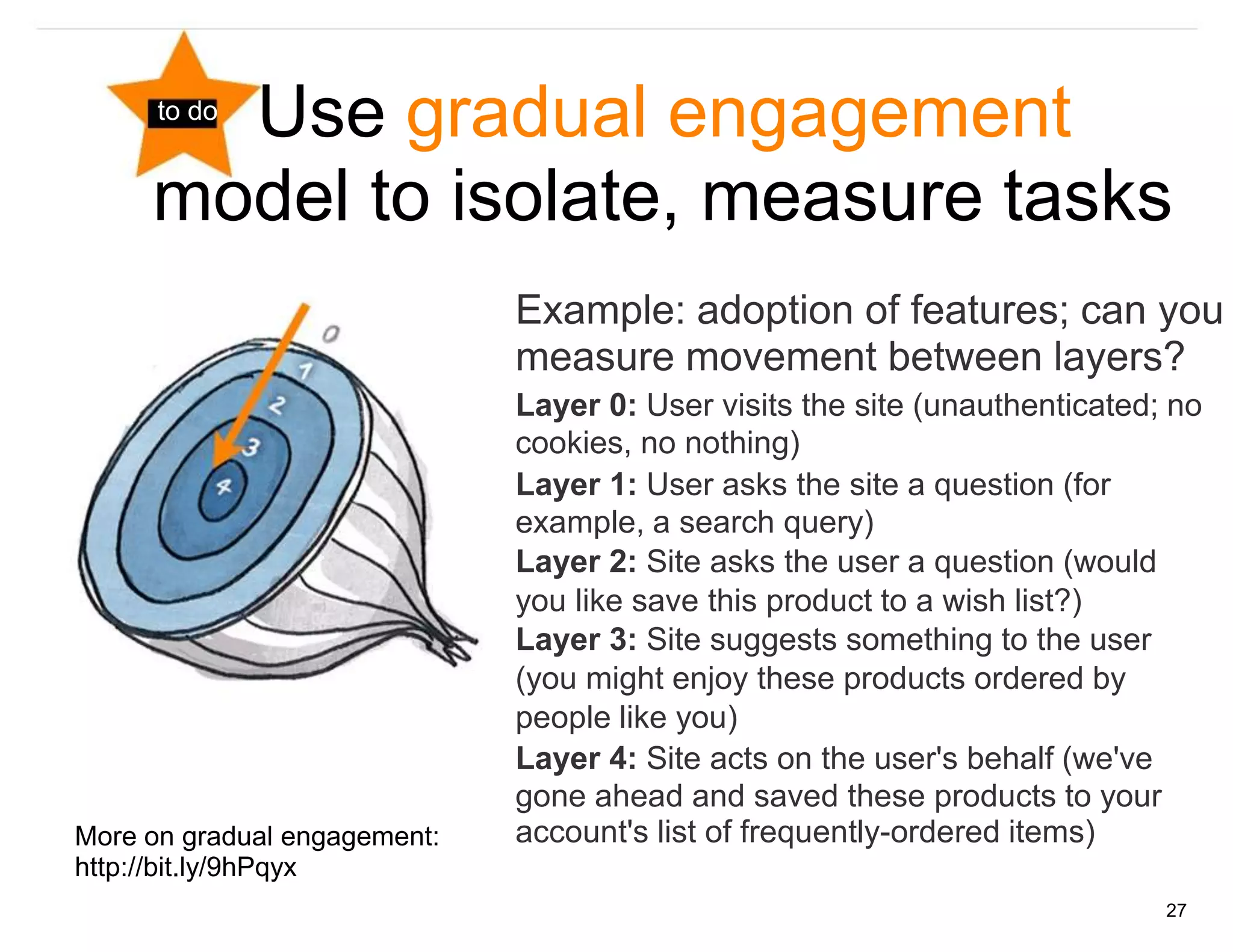
Use gradual engagement
      to do


     model to isolate, measure tasks
                              Example: adoption of features; can you
                              measure movement between layers?
                              Layer 0: User visits the site (unauthenticated; no
                              cookies, no nothing)
                              Layer 1: User asks the site a question (for
                              example, a search query)
                              Layer 2: Site asks the user a question (would
                              you like save this product to a wish list?)
                              Layer 3: Site suggests something to the user
                              (you might enjoy these products ordered by
                              people like you)
                              Layer 4: Site acts on the user's behalf (we've
                              gone ahead and saved these products to your
More on gradual engagement:   account's list of frequently-ordered items)
http://bit.ly/9hPqyx
                                                                             27
#5
Support contextual navigation


                                28
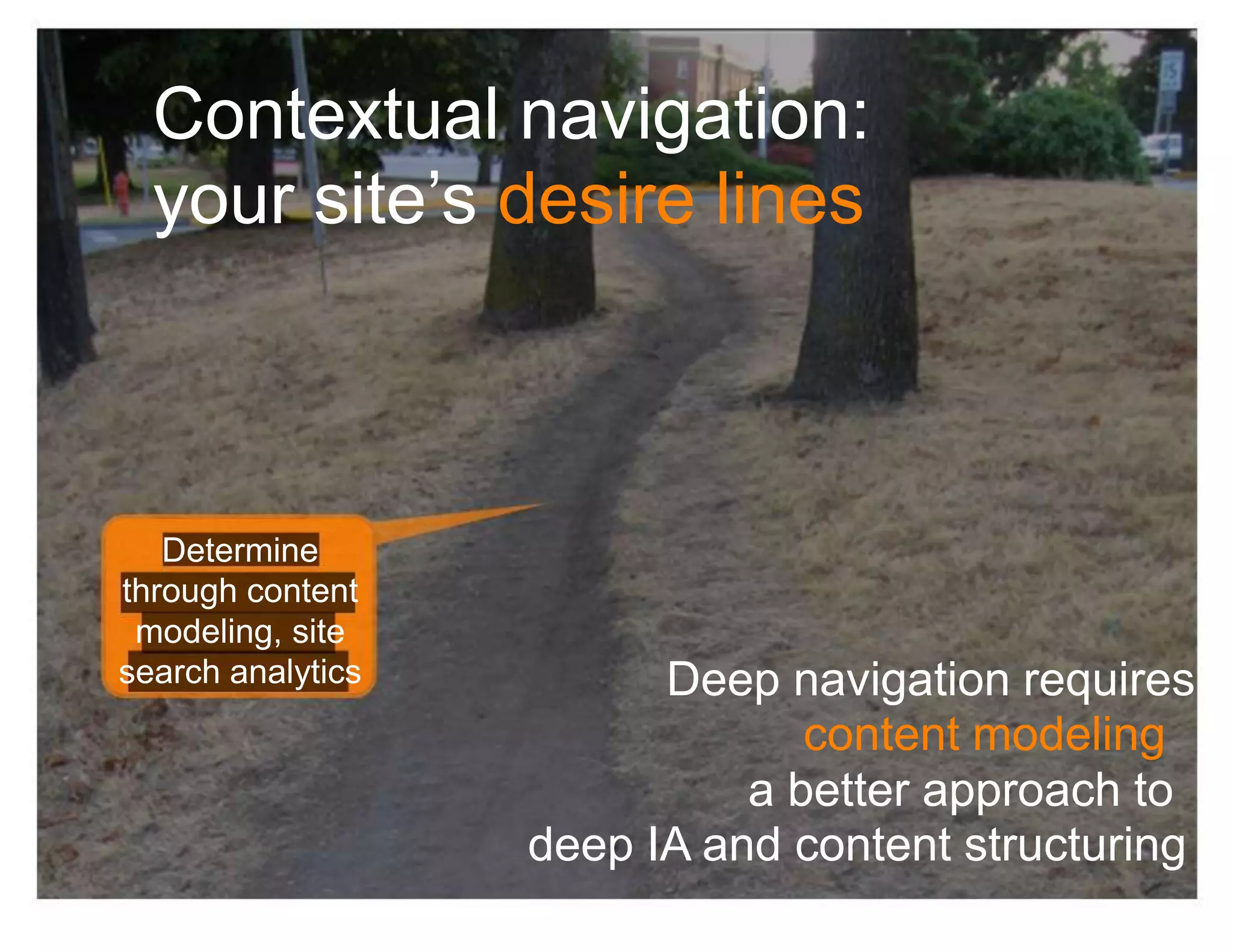
Contextual navigation:
  your site’s desire lines


   Determine
through content
 modeling, site
search analytics         Deep navigation requires
                                content modeling :
                             a better approach to
                   deep IA and content structuring
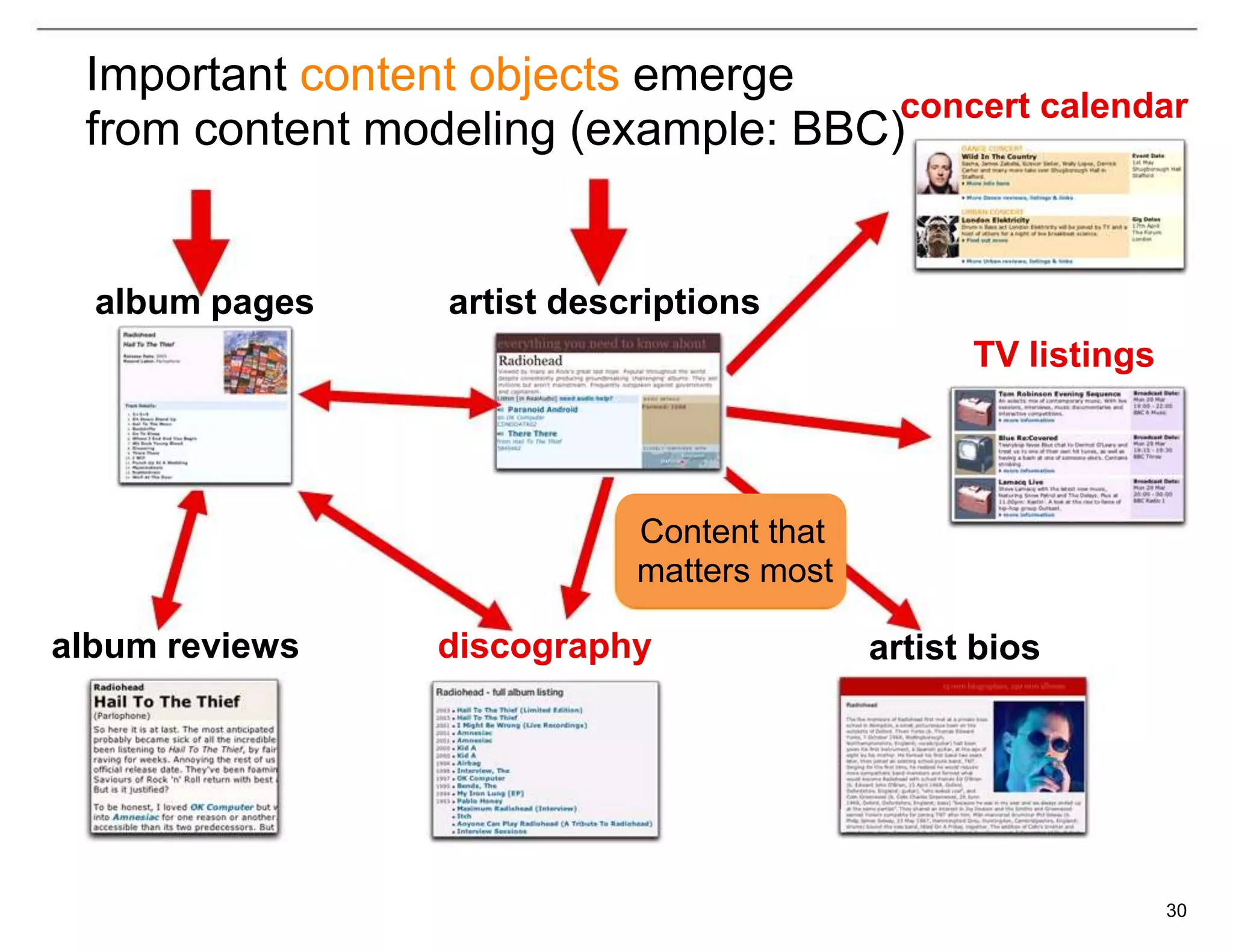
Important content objects emerge
                                     concert calendar
 from content modeling (example: BBC)


  album pages     artist descriptions
                                                  TV listings


                             Content that
                             matters most

album reviews    discography                artist bios


                                                                30
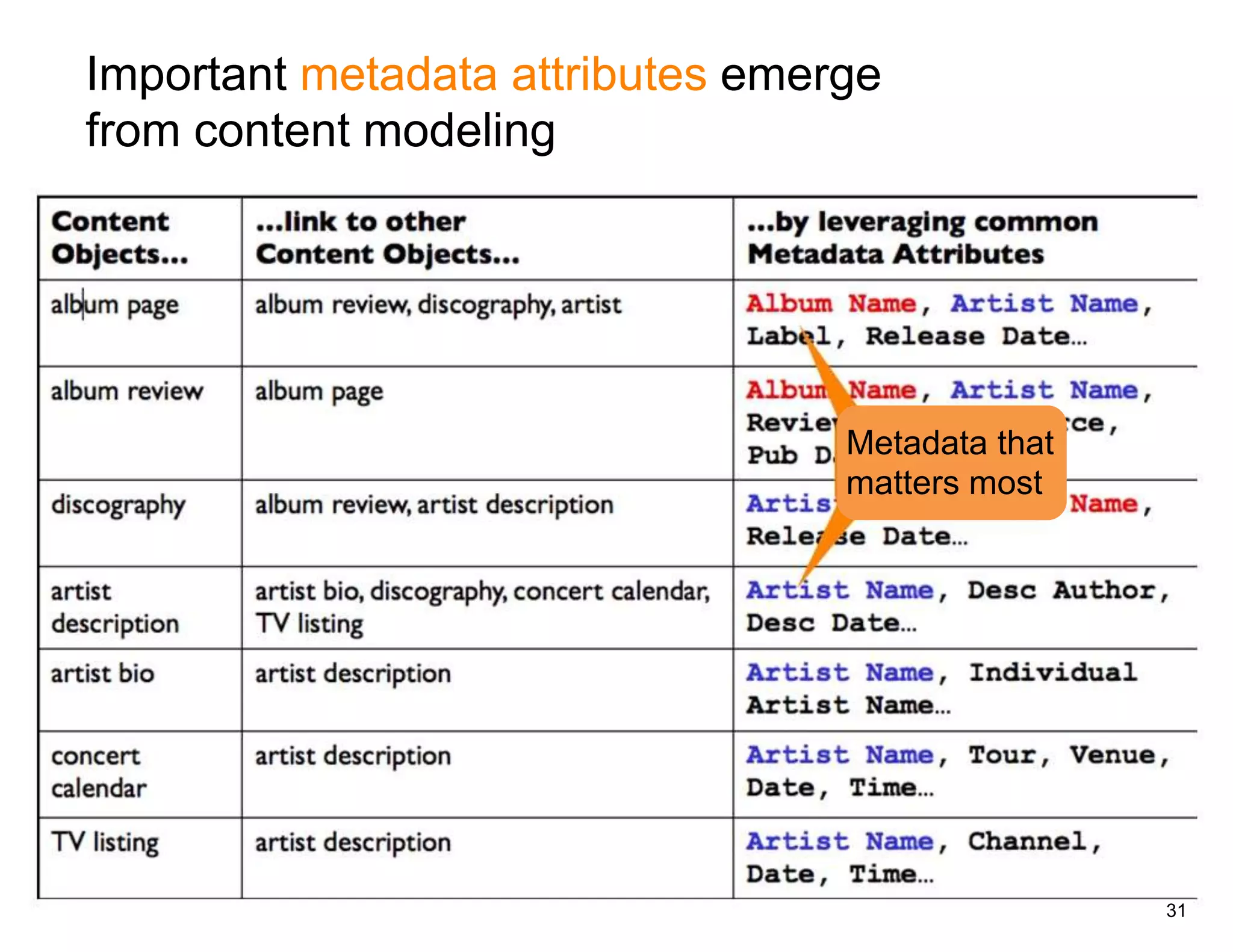
Important metadata attributes emerge
from content modeling


                                  Metadata that
                                  matters most


                                                  31
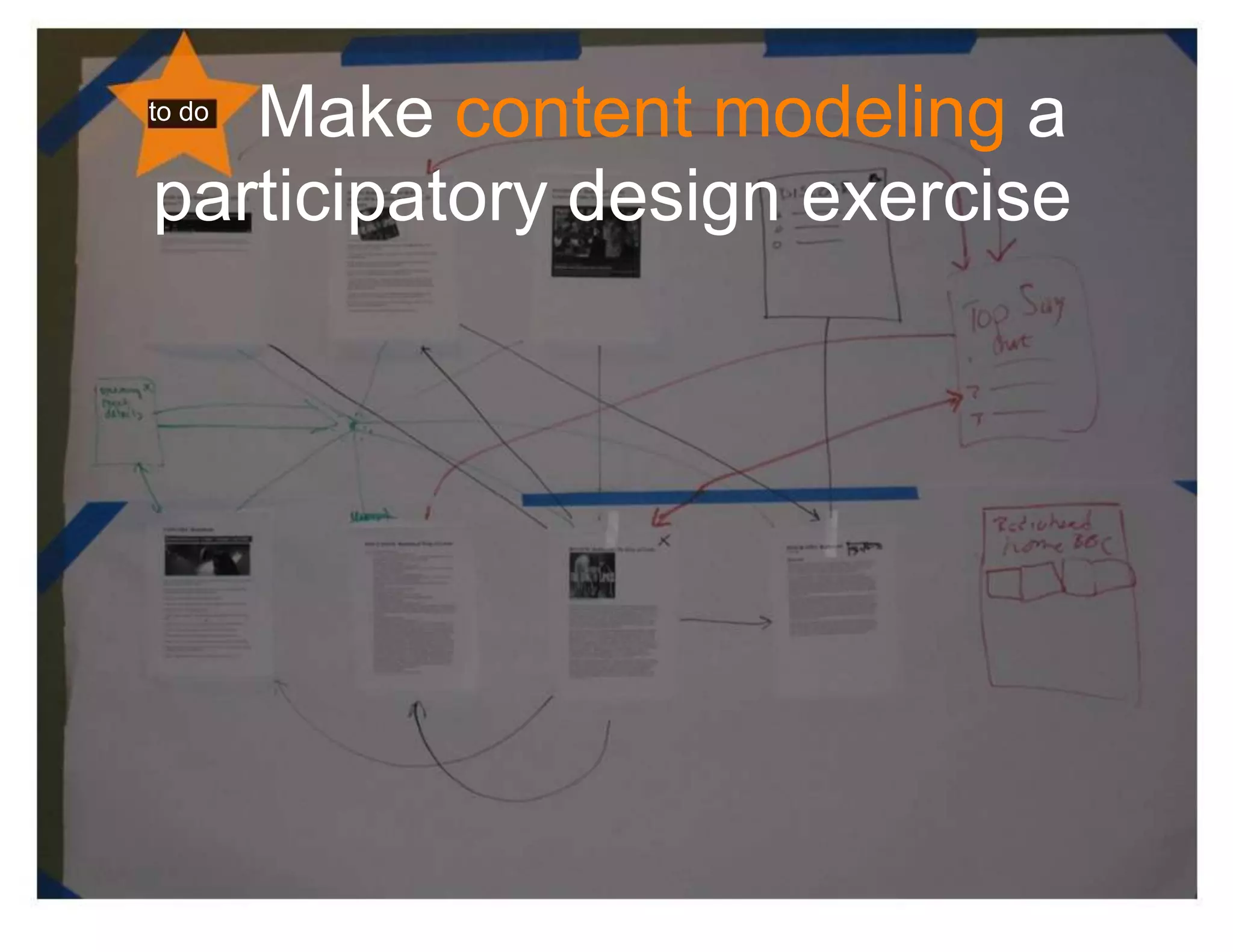
Make content modeling a
to do


participatory design exercise
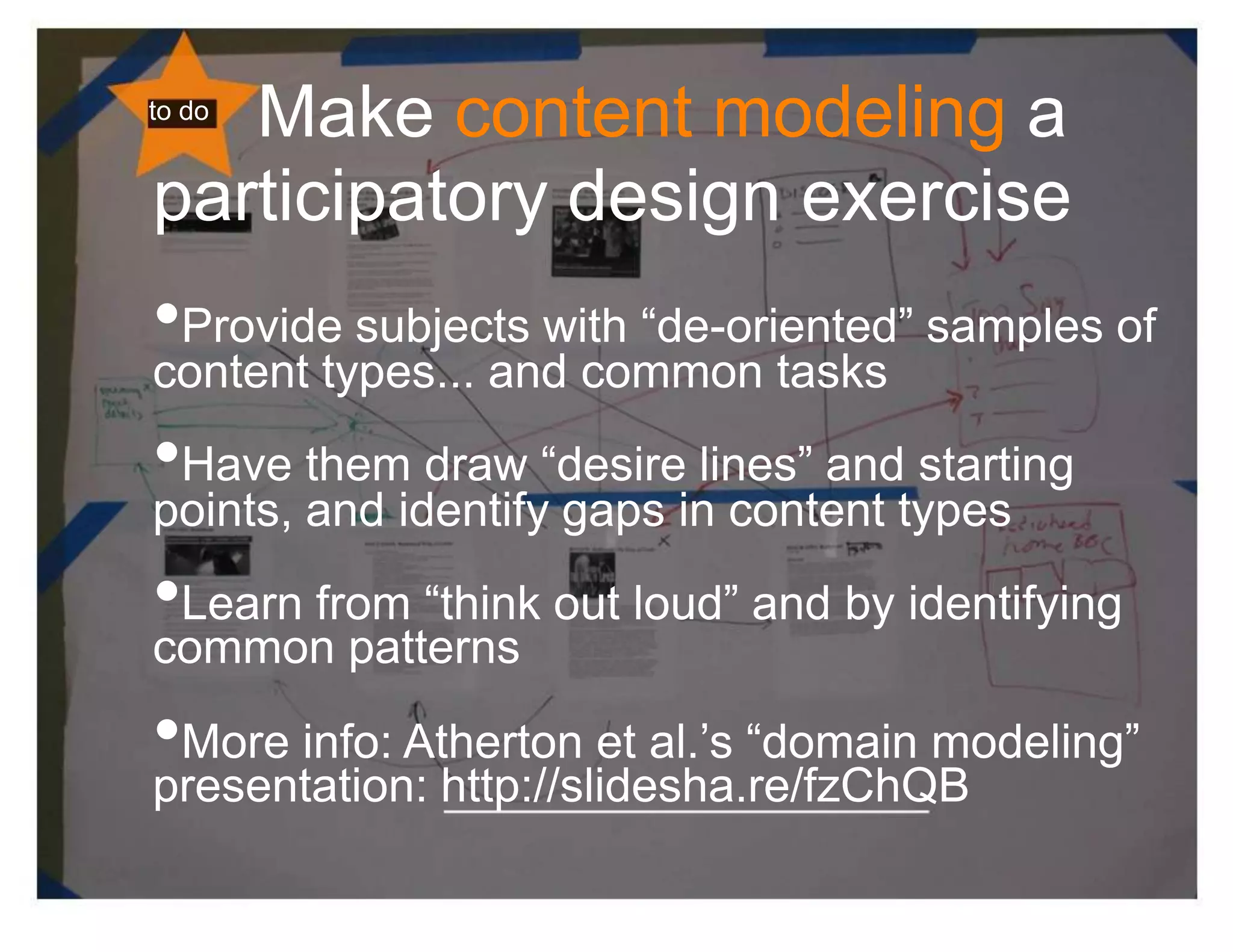
Make content modeling a
to do


participatory design exercise
•Provide subjects with “de-oriented” samples of
content types... and common tasks
•Have them draw “desire lines” and starting
points, and identify gaps in content types
•Learn from “think out loud” and by identifying
common patterns
•More info: Atherton et al.’s “domain modeling”
presentation: http://slidesha.re/fzChQB
#6
Improve search across silos


                              33
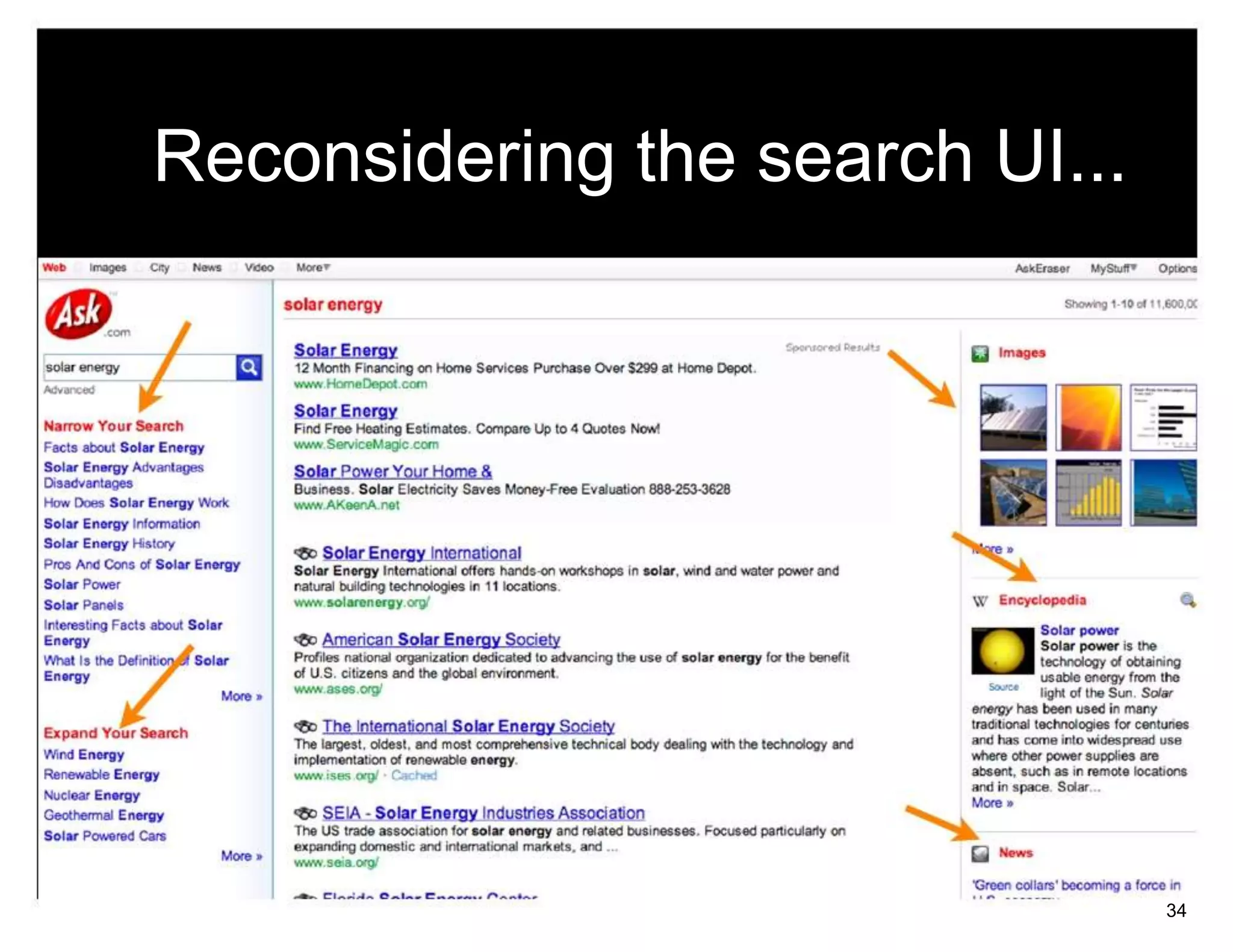
Reconsidering the search UI...


                                 34
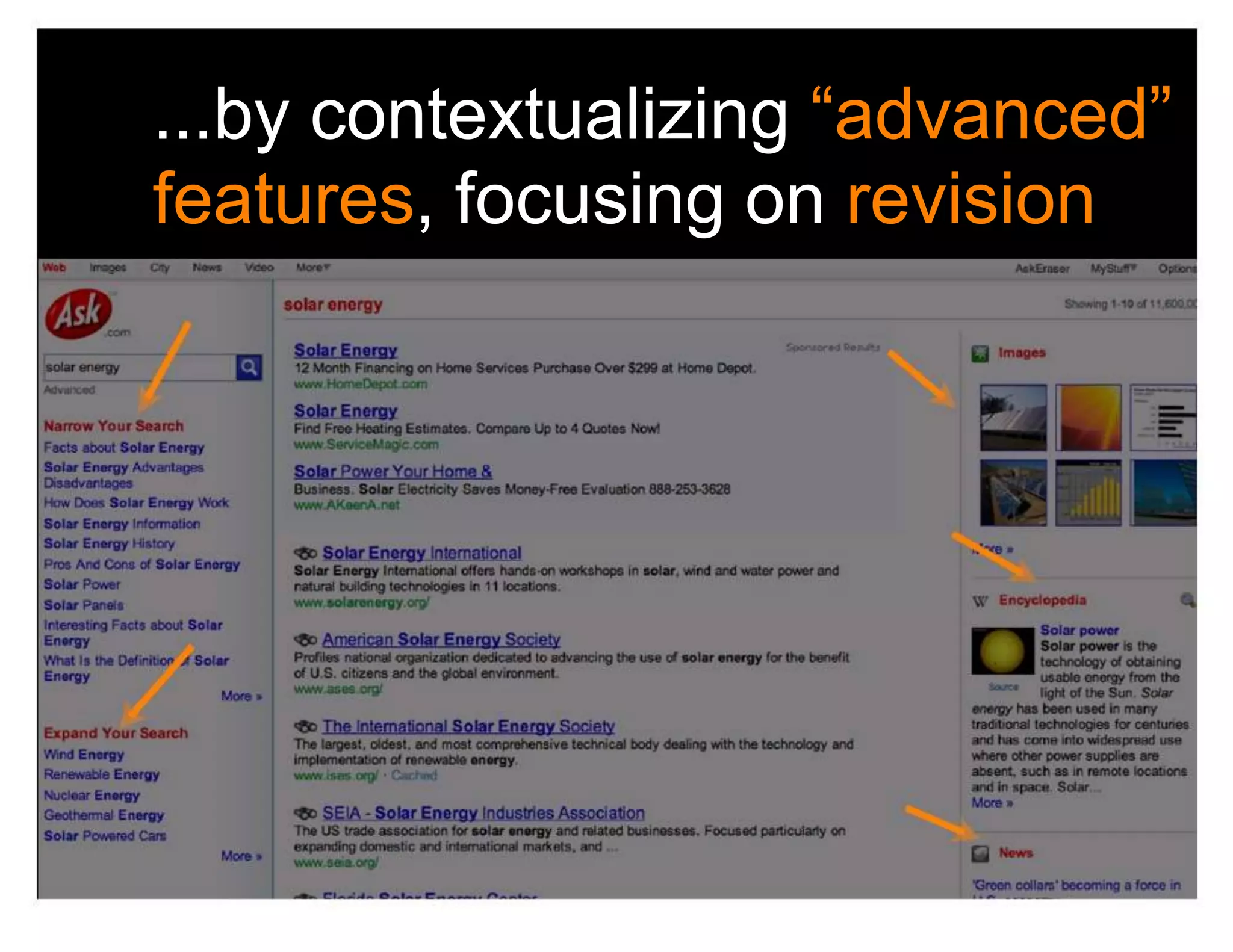
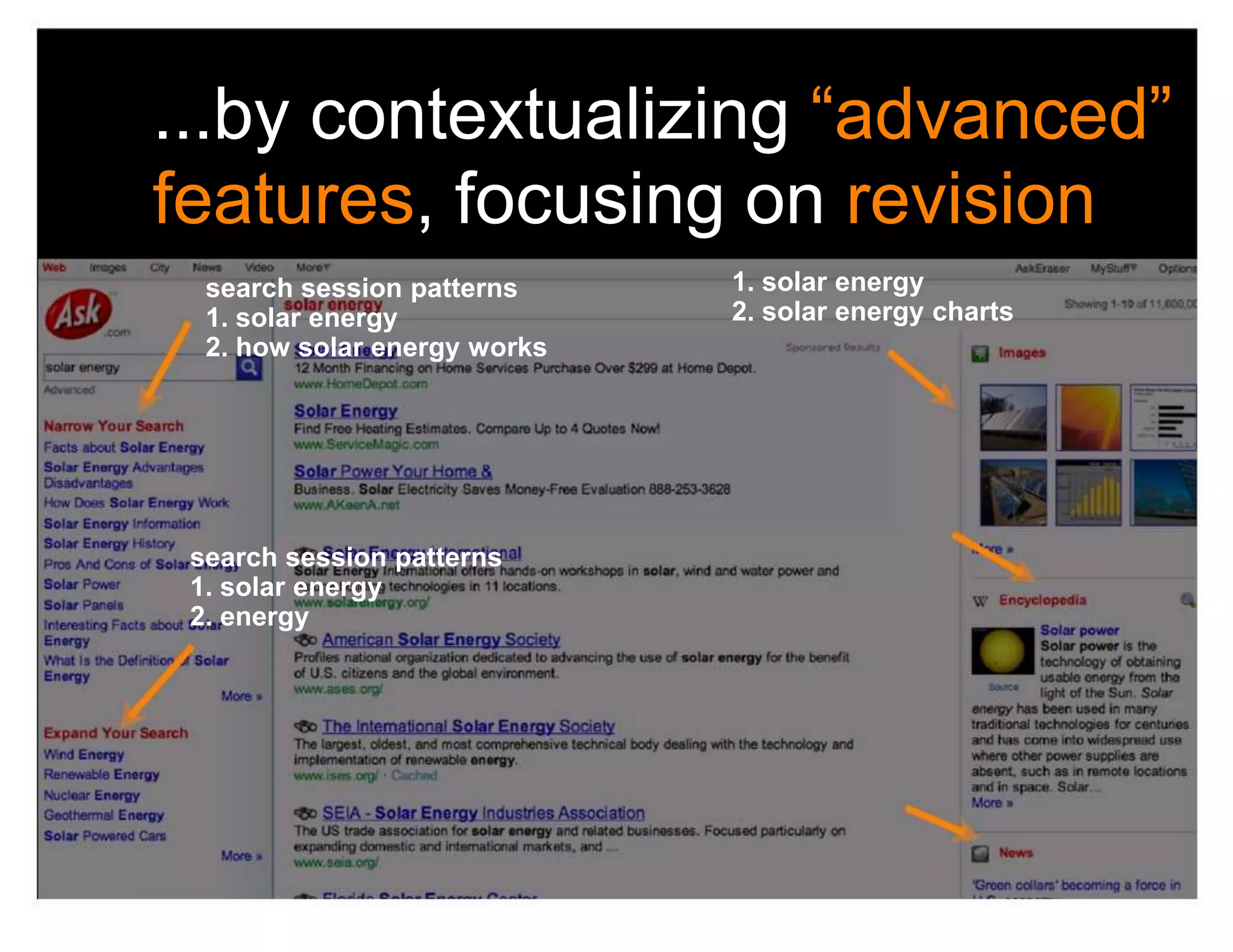
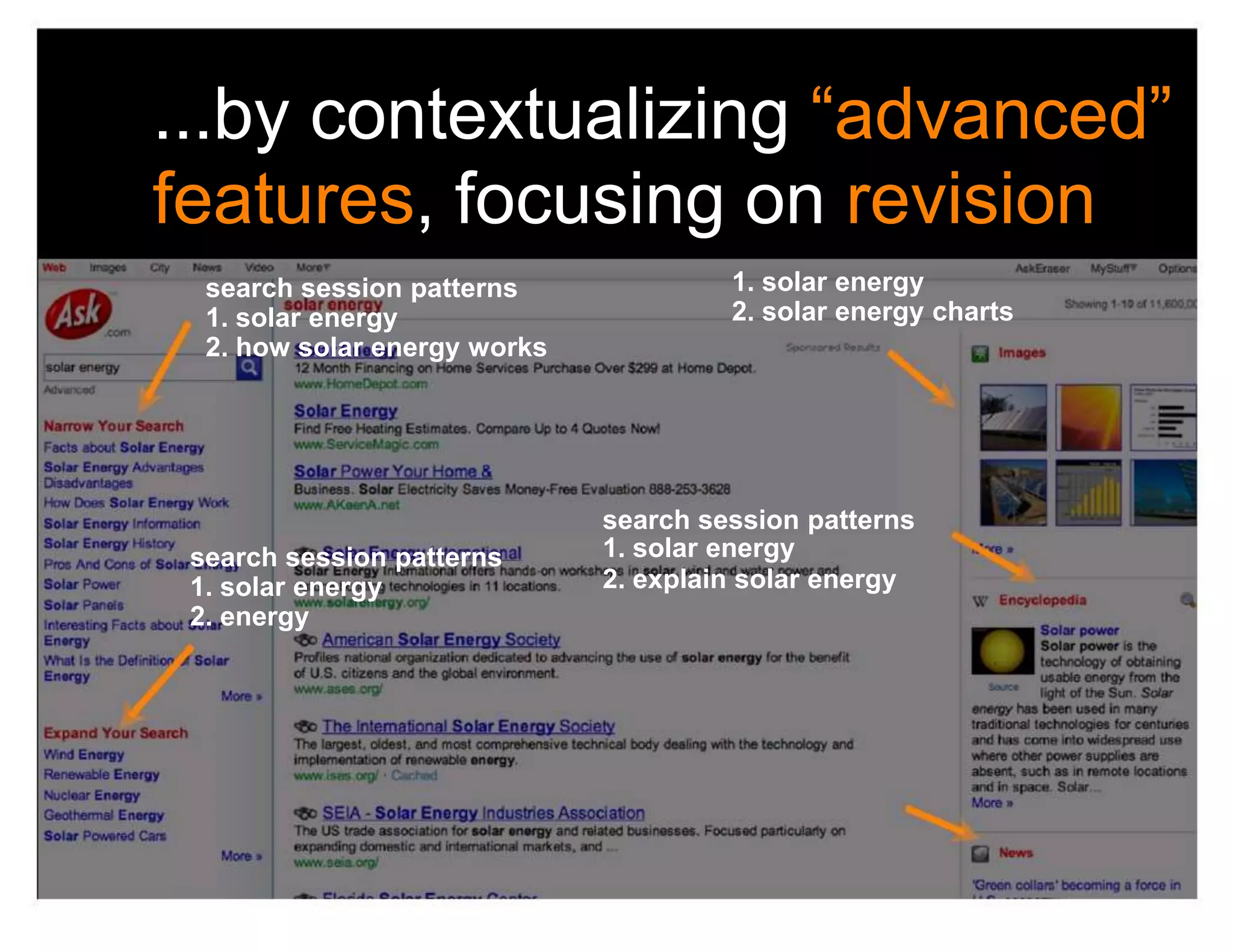
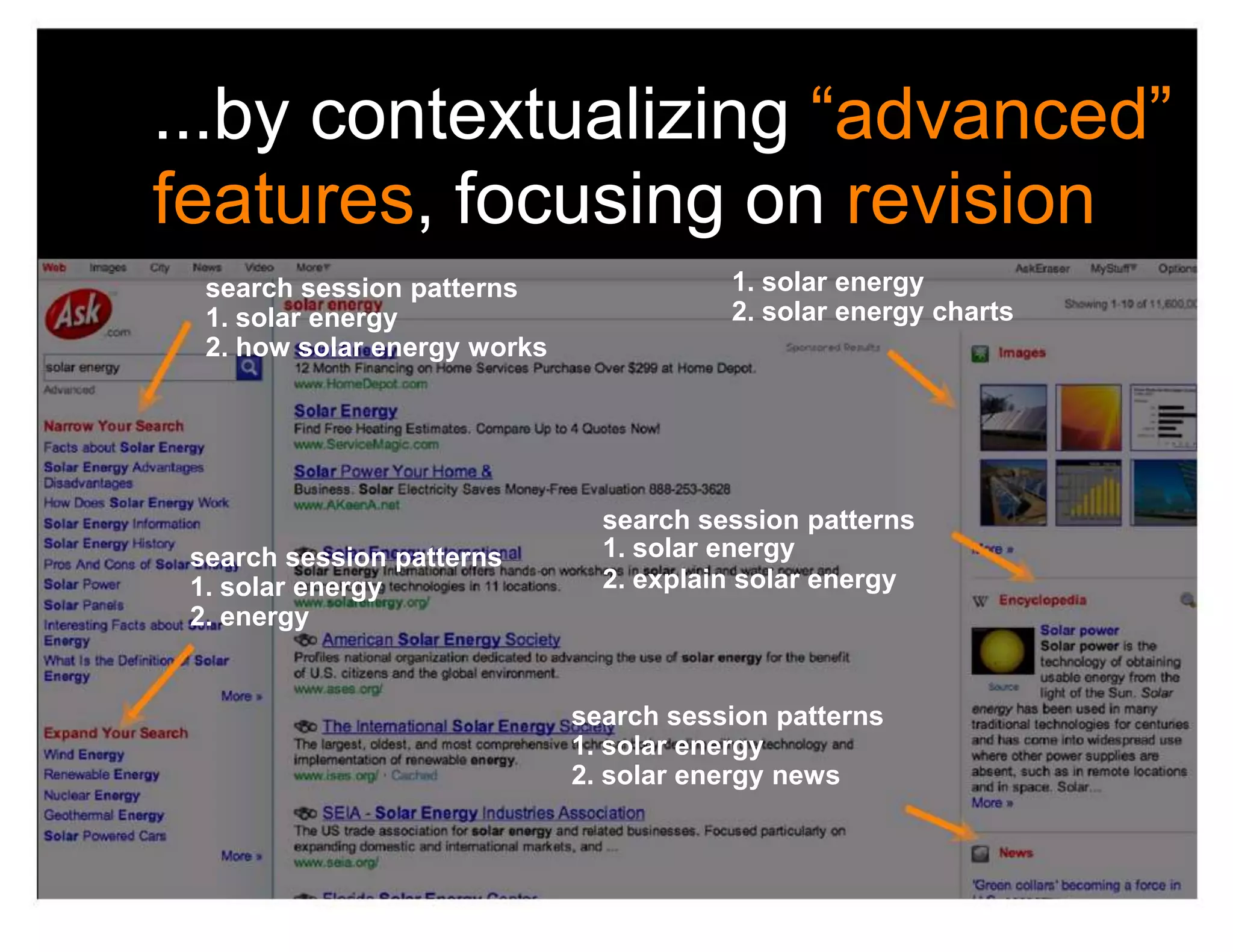
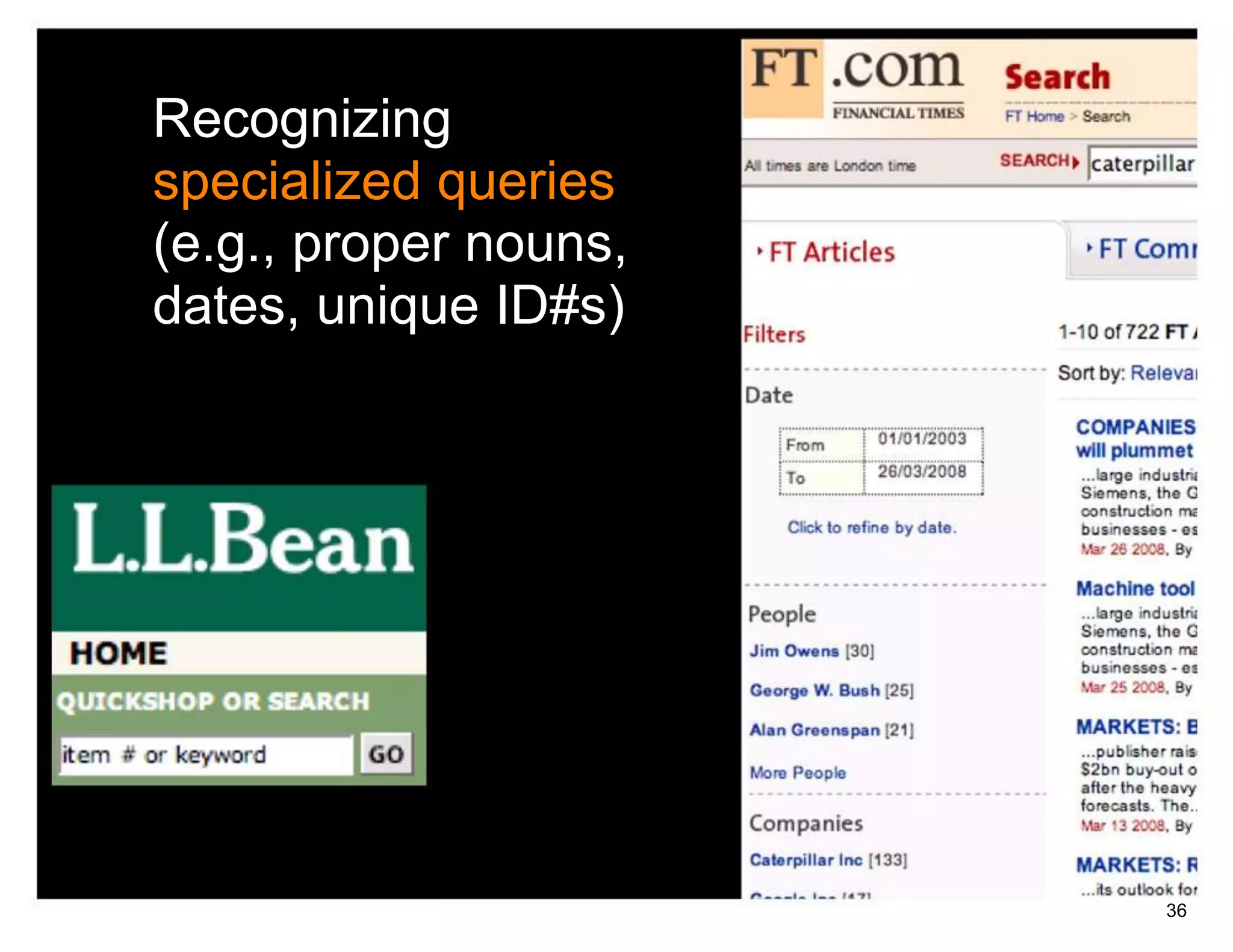
...by contextualizing “advanced”
features, focusing on revision
...by contextualizing “advanced”
features, focusing on revision
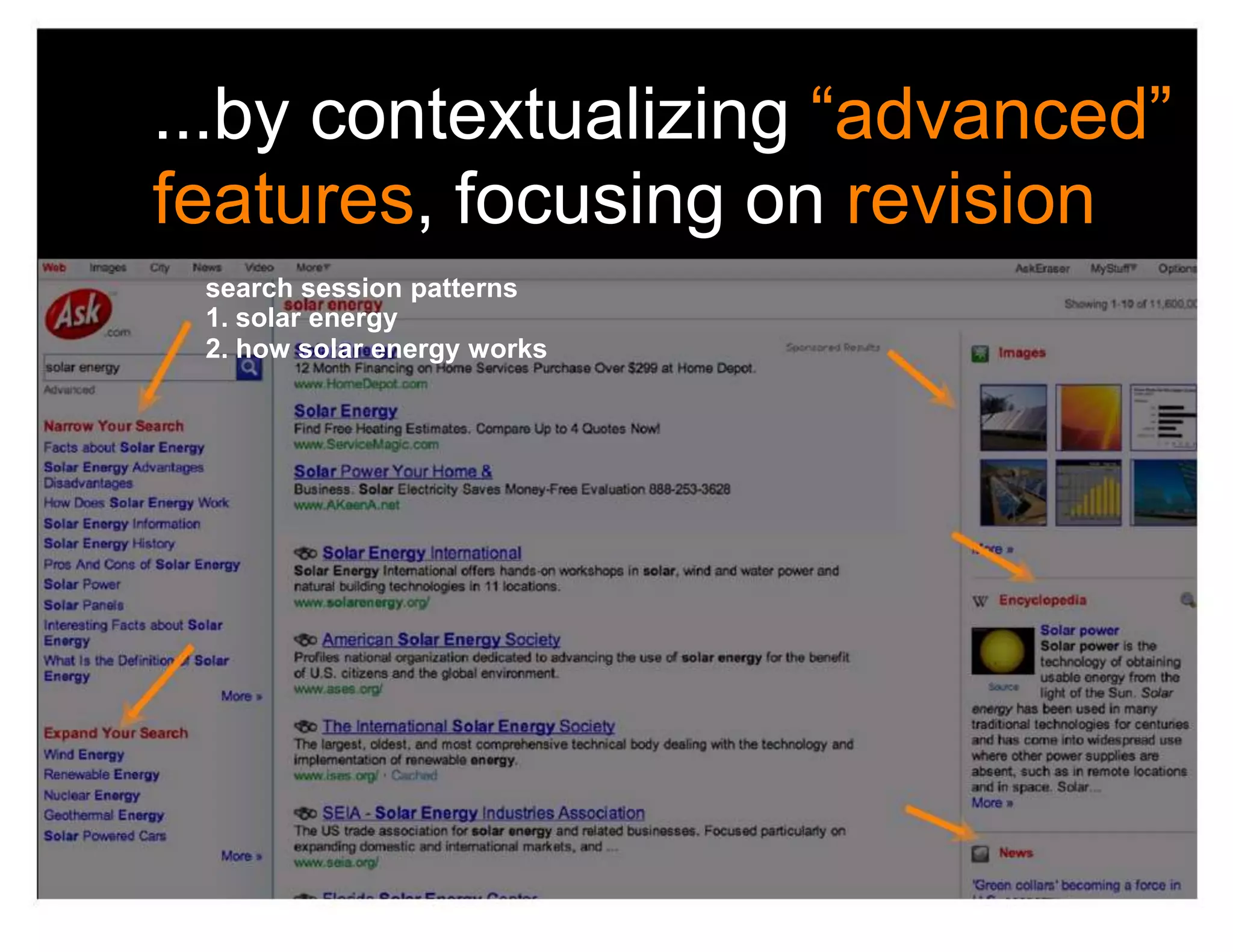
 search session patterns
 1. solar energy
 2. how solar energy works
...by contextualizing “advanced”
features, focusing on revision
  search session patterns
  1. solar energy
  2. how solar energy works


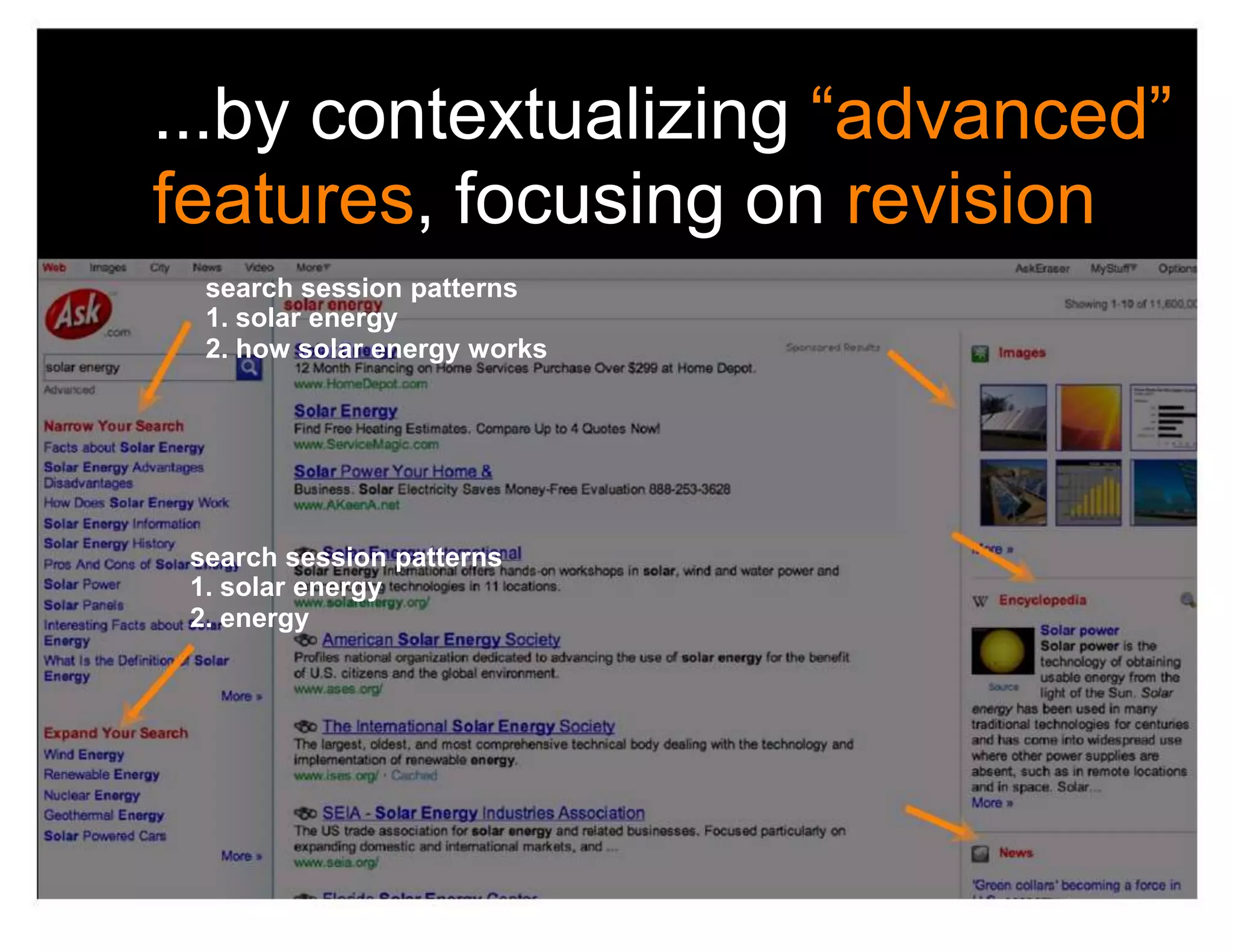
 search session patterns
 1. solar energy
 2. energy
...by contextualizing “advanced”
features, focusing on revision
  search session patterns     1. solar energy
  1. solar energy             2. solar energy charts
  2. how solar energy works


 search session patterns
 1. solar energy
 2. energy
...by contextualizing “advanced”
features, focusing on revision
  search session patterns              1. solar energy
  1. solar energy                      2. solar energy charts
  2. how solar energy works


                              search session patterns
 search session patterns      1. solar energy
 1. solar energy              2. explain solar energy
 2. energy
...by contextualizing “advanced”
features, focusing on revision
  search session patterns                1. solar energy
  1. solar energy                        2. solar energy charts
  2. how solar energy works


                                search session patterns
 search session patterns        1. solar energy
 1. solar energy                2. explain solar energy
 2. energy


                              search session patterns
                              1. solar energy
                              2. solar energy news
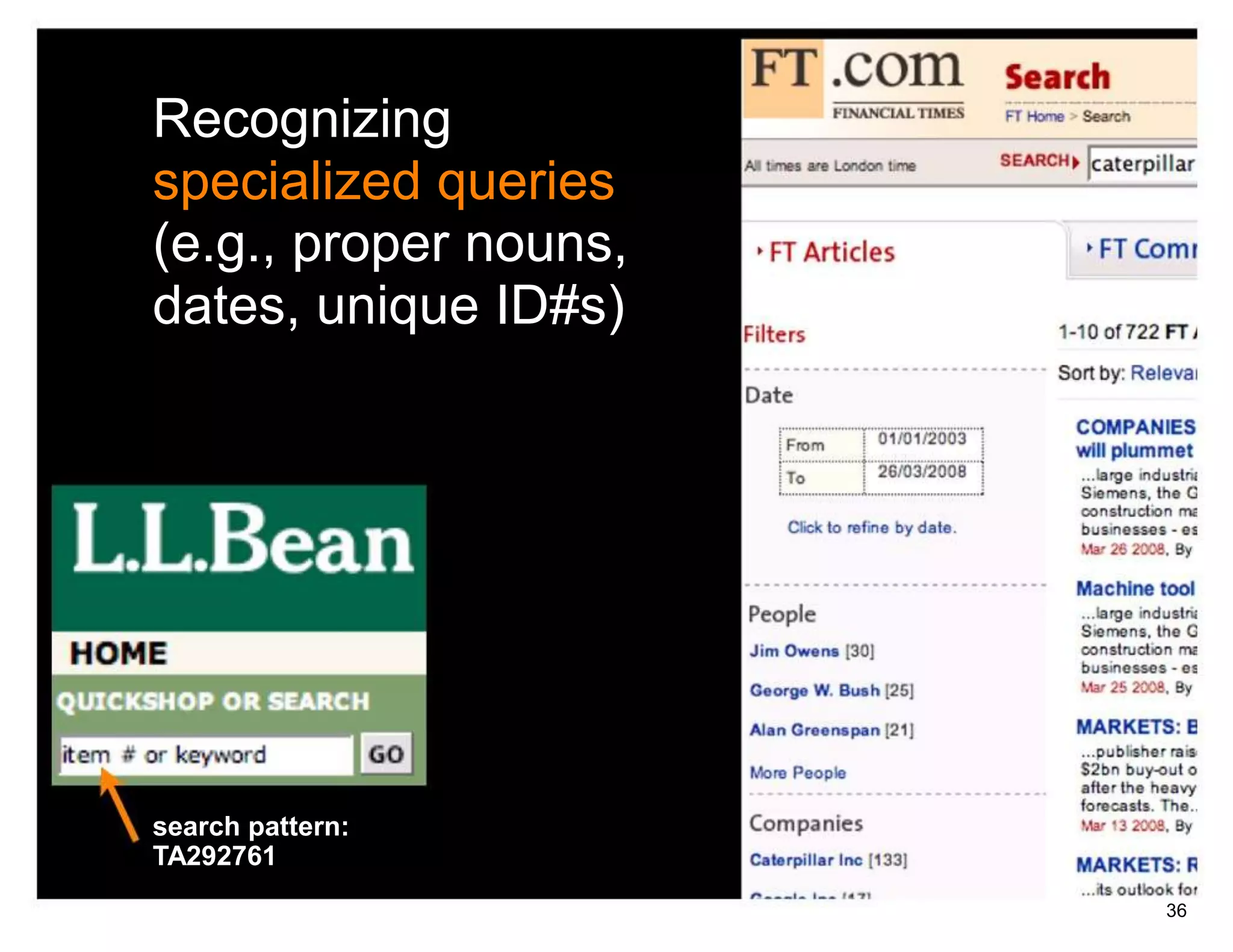
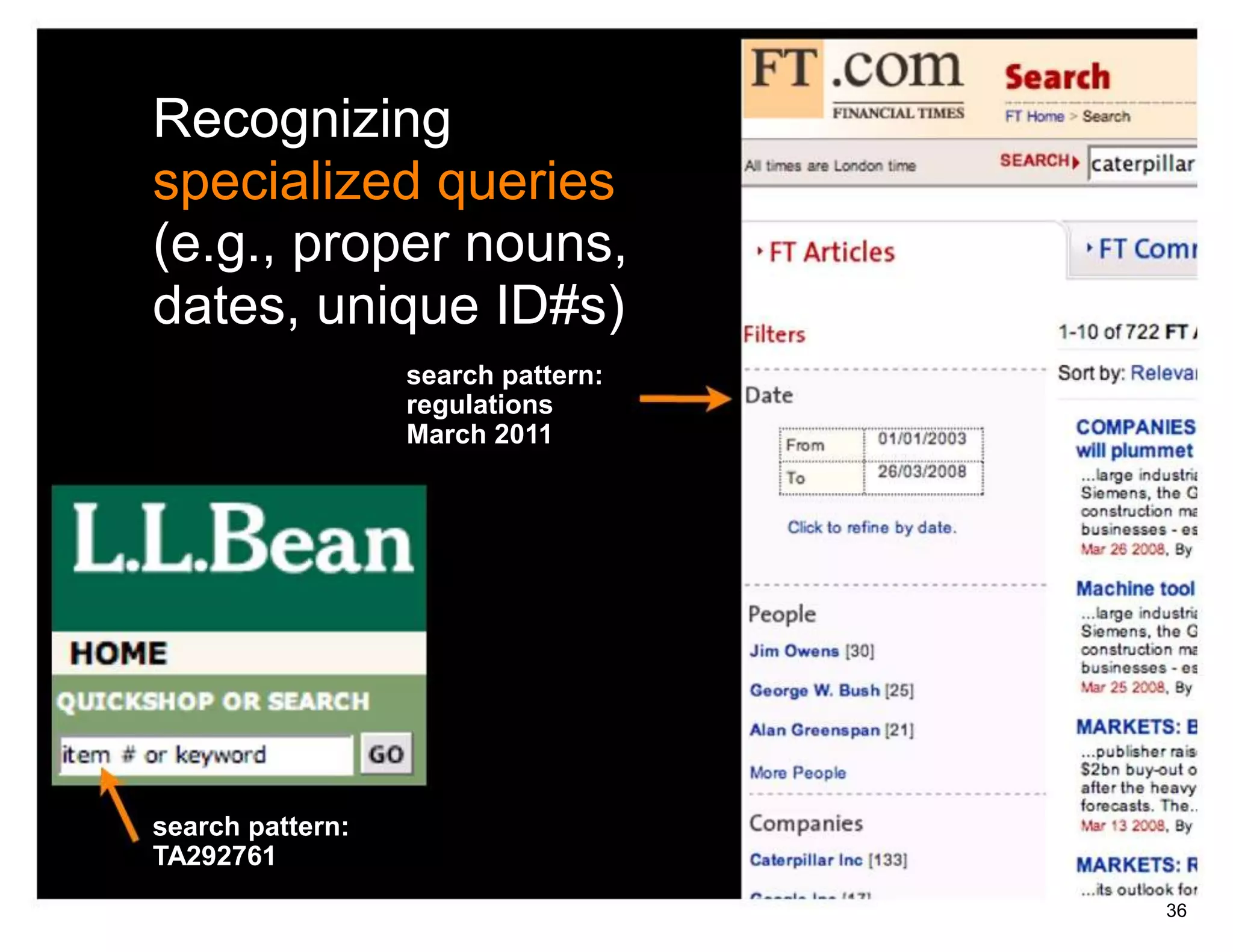
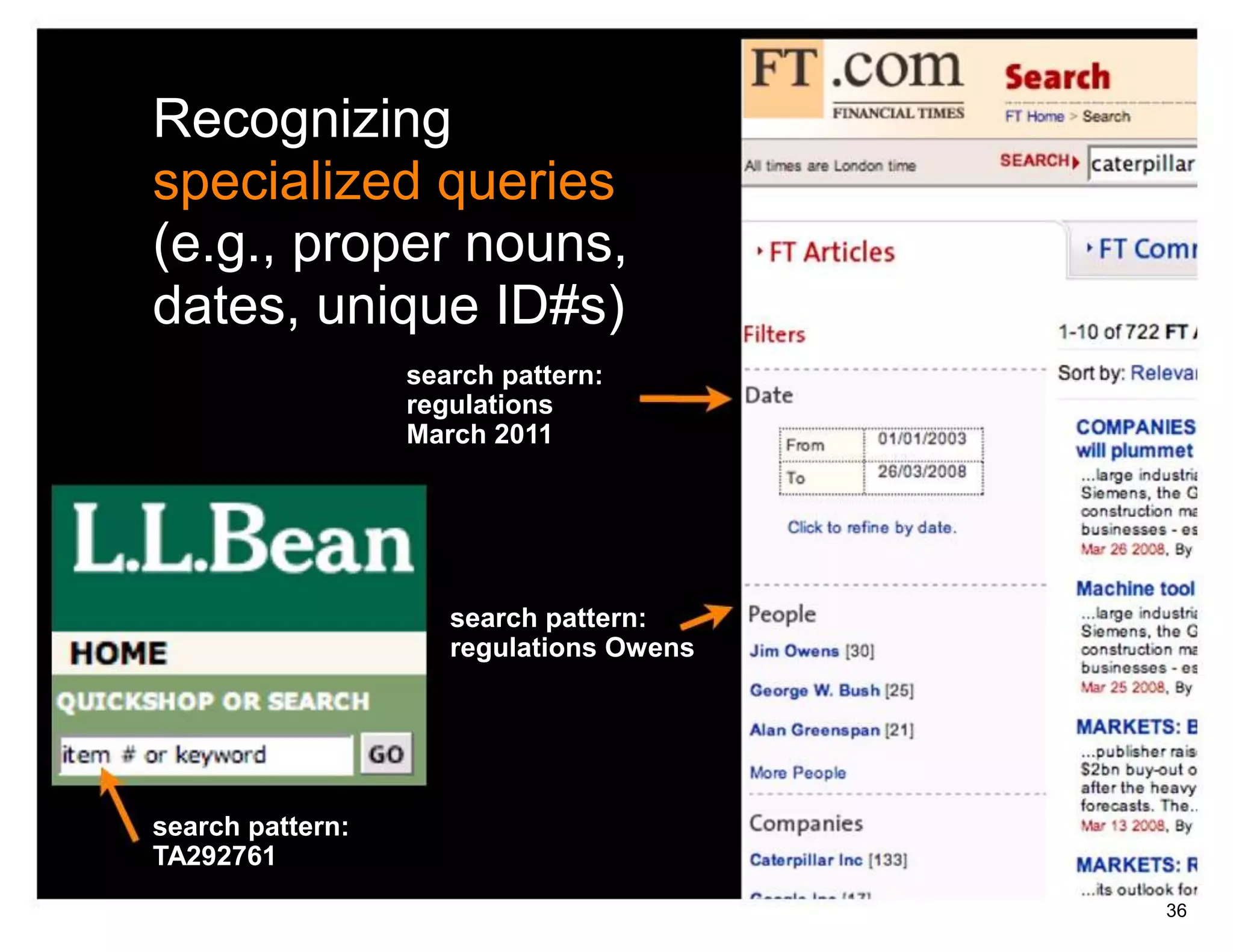
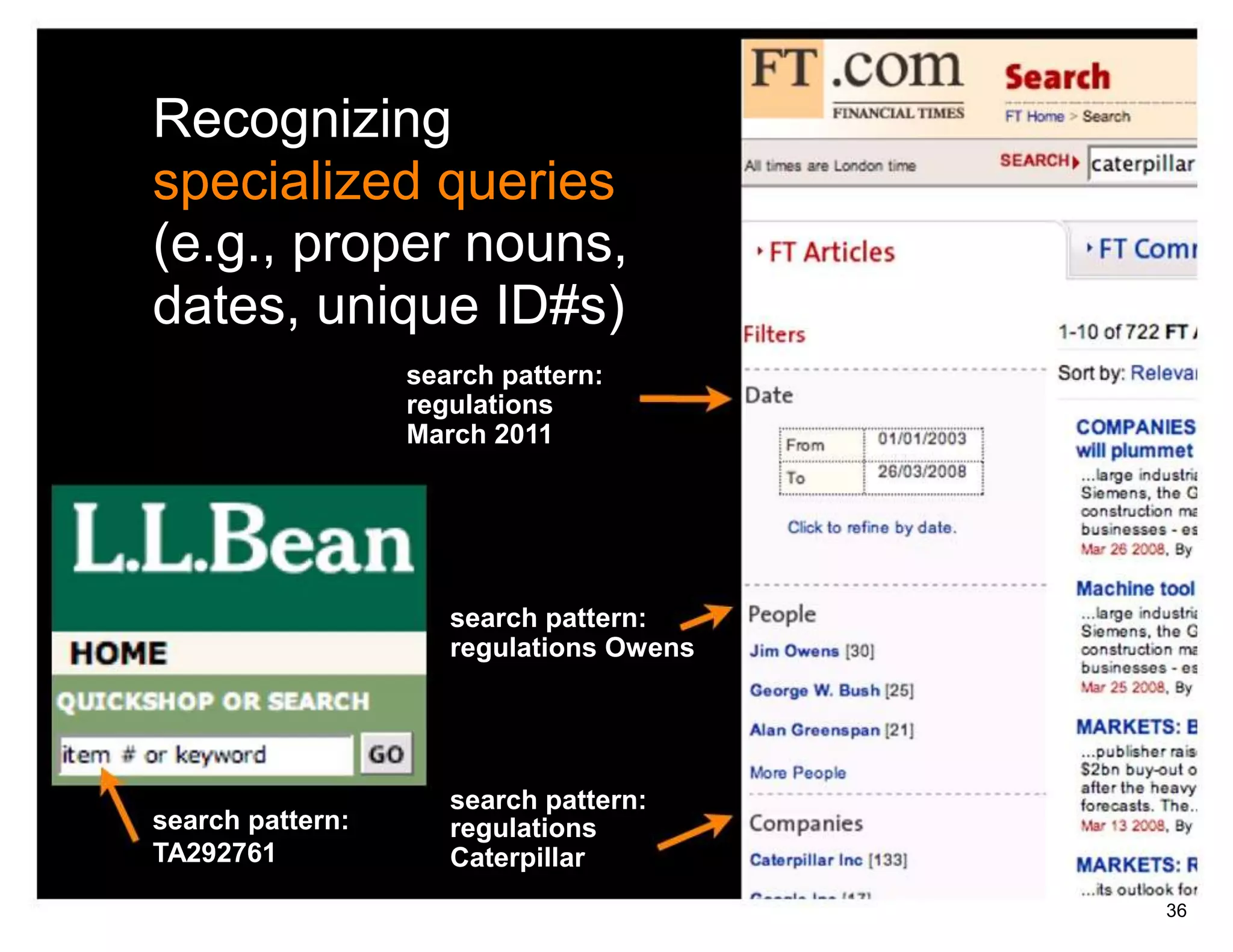
Recognizing
specialized queries
(e.g., proper nouns,
dates, unique ID#s)


                       36
Recognizing
specialized queries
(e.g., proper nouns,
dates, unique ID#s)


search pattern:
TA292761
                       36
Recognizing
specialized queries
(e.g., proper nouns,
dates, unique ID#s)
                  search pattern:
                  regulations
                  March 2011


search pattern:
TA292761
                                    36
Recognizing
specialized queries
(e.g., proper nouns,
dates, unique ID#s)
                  search pattern:
                  regulations
                  March 2011


                     search pattern:
                     regulations Owens


search pattern:
TA292761
                                         36
Recognizing
specialized queries
(e.g., proper nouns,
dates, unique ID#s)
                  search pattern:
                  regulations
                  March 2011


                     search pattern:
                     regulations Owens


                     search pattern:
search pattern:      regulations
TA292761             Caterpillar
                                         36
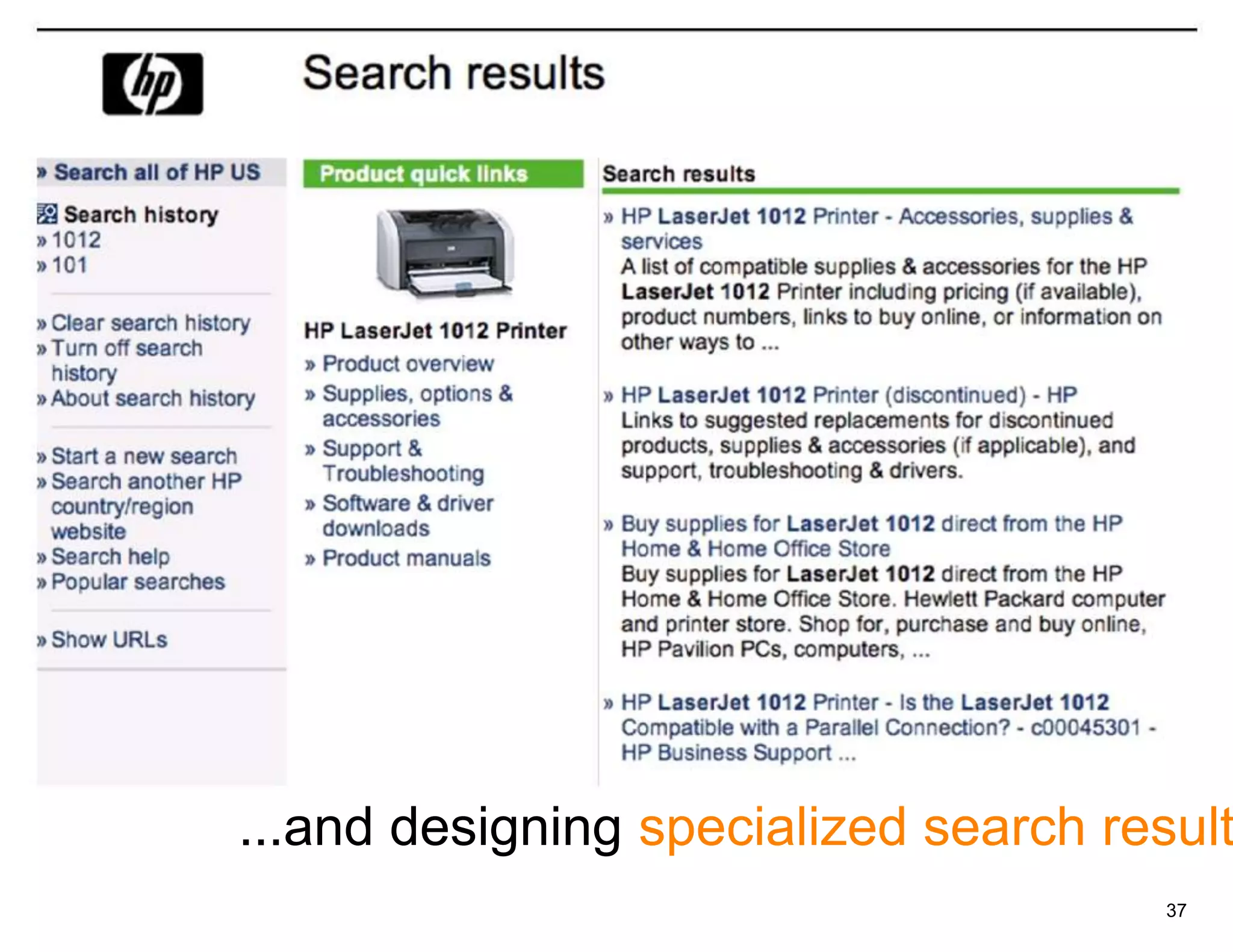
...and designing specialized search result
                                       37
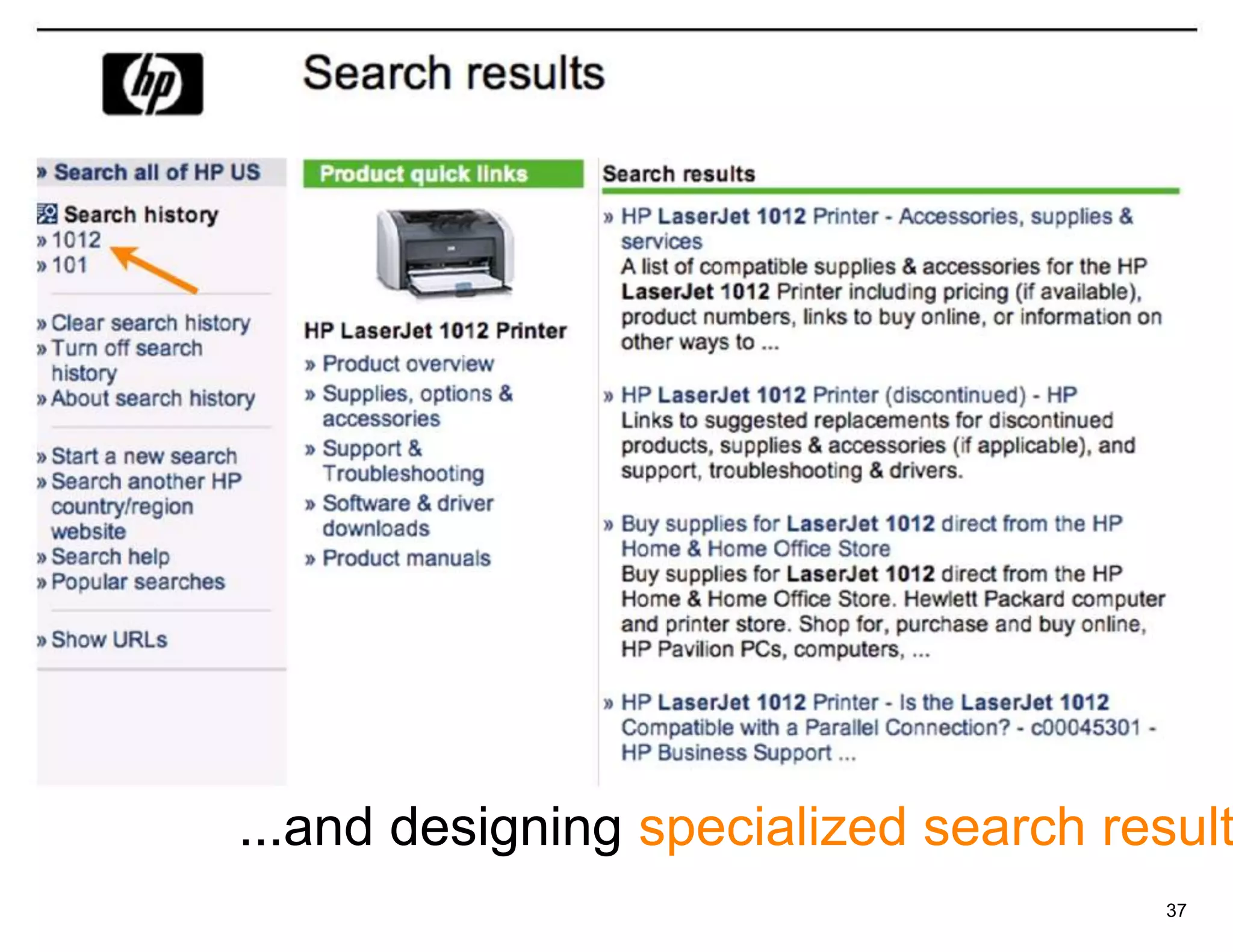
...and designing specialized search result
                                       37
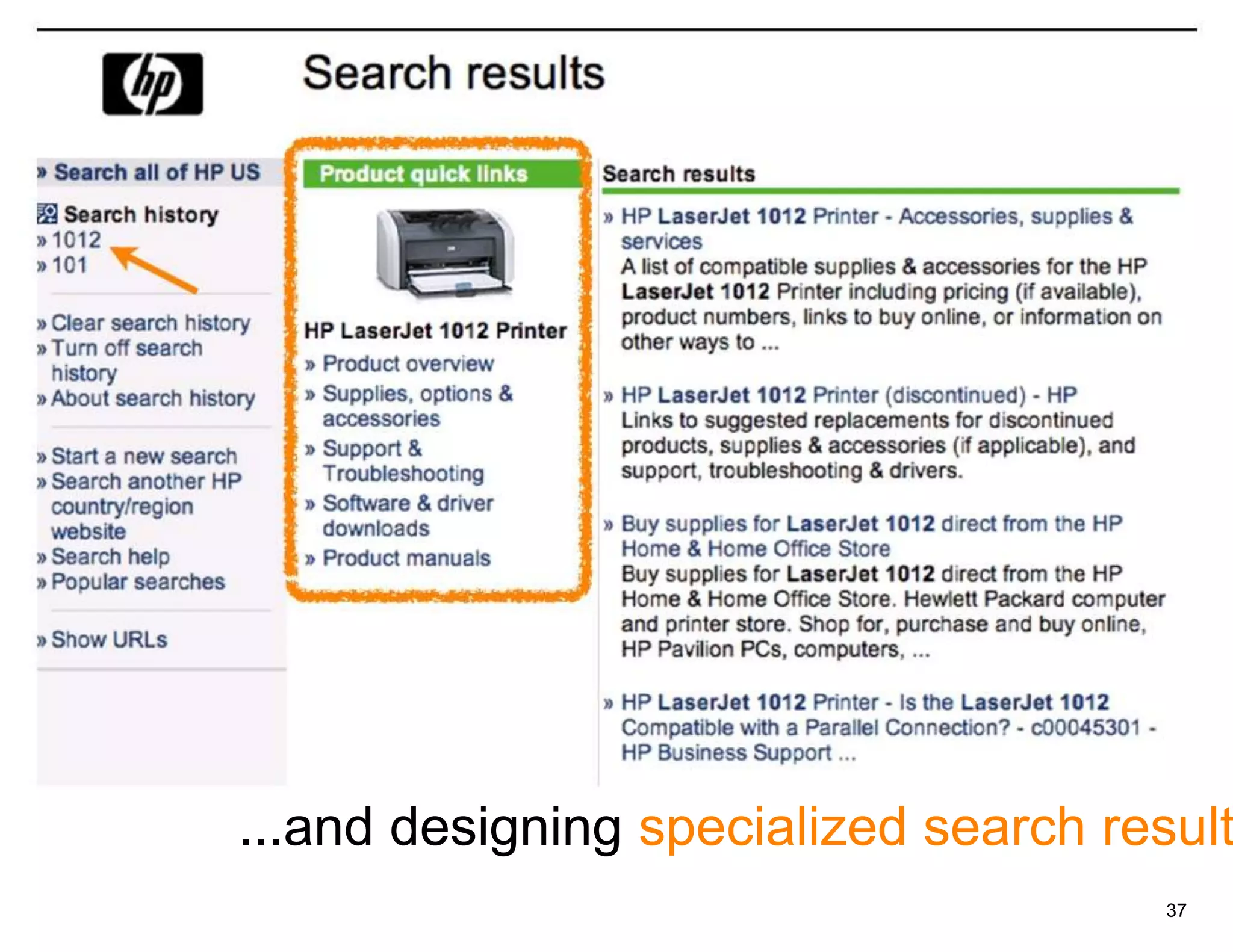
...and designing specialized search result
                                       37
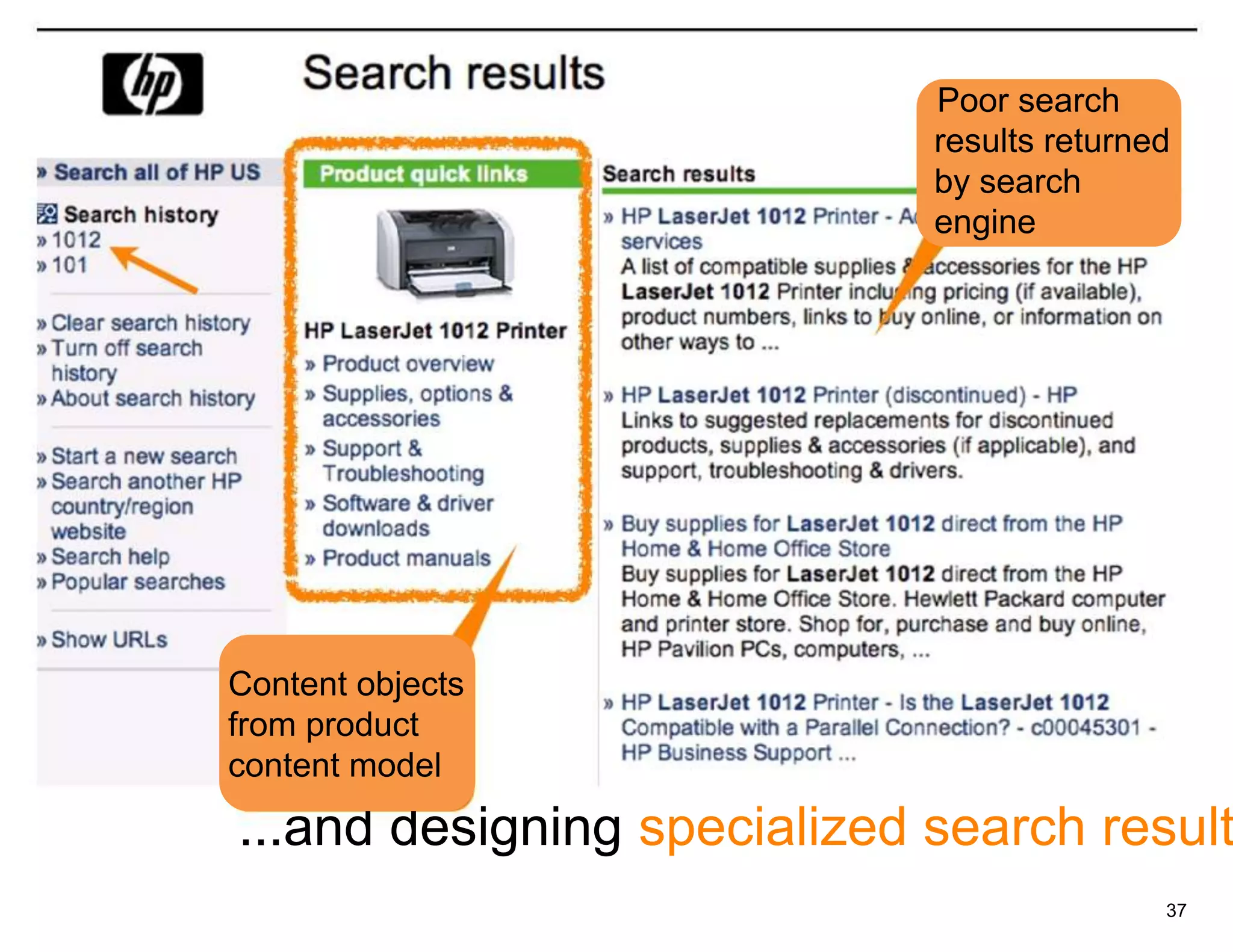
Poor search
                             results returned
                             by search
                             engine


Content objects
from product
content model

...and designing specialized search result
                                            37
Read a book chapter on
to do


session analysis

You’ll find one in my book
Search Analytics for Your Site
http://bit.ly/quFxdz


                                 38
#7
Combine design approaches
effectively


                            39
Y


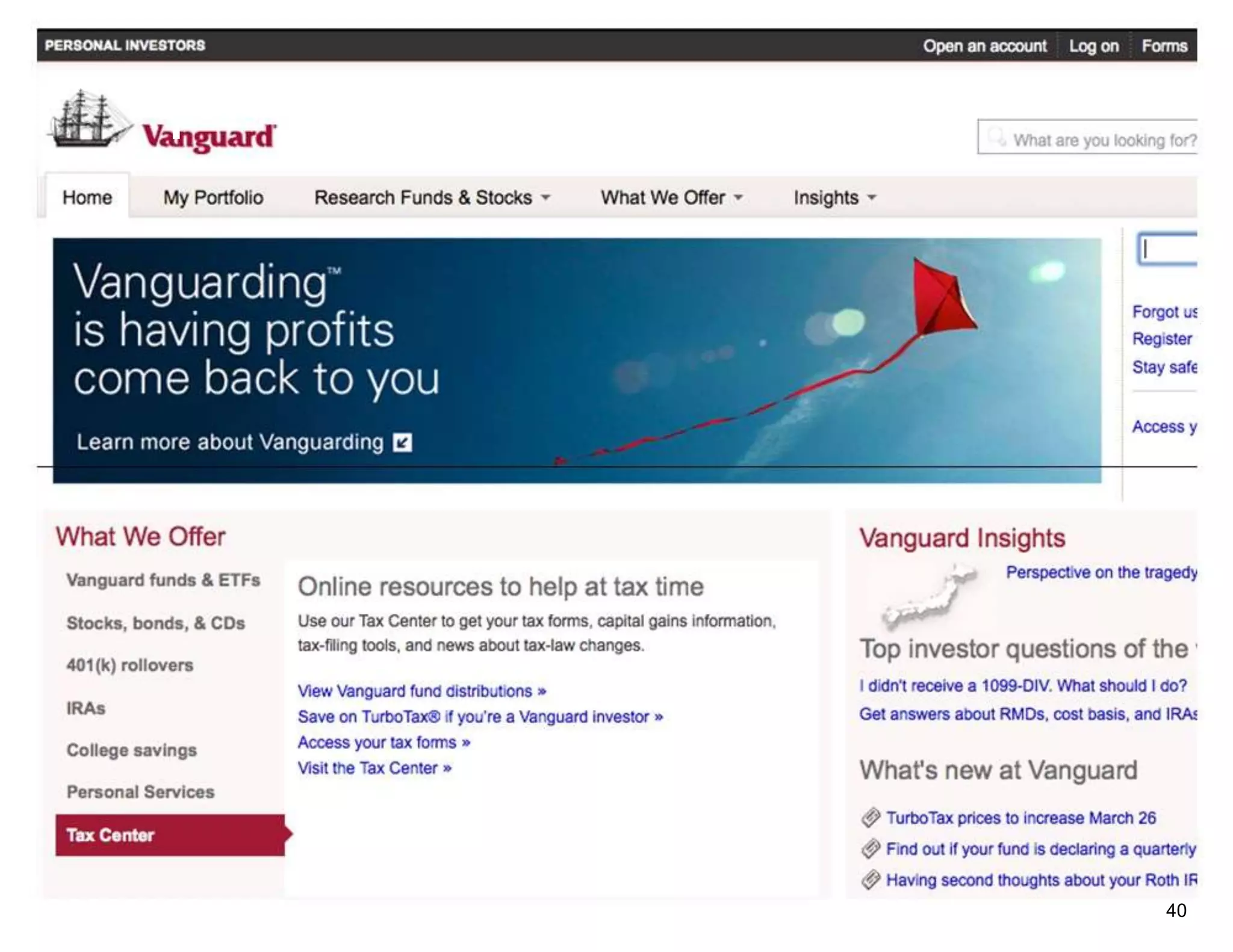
    40
Y


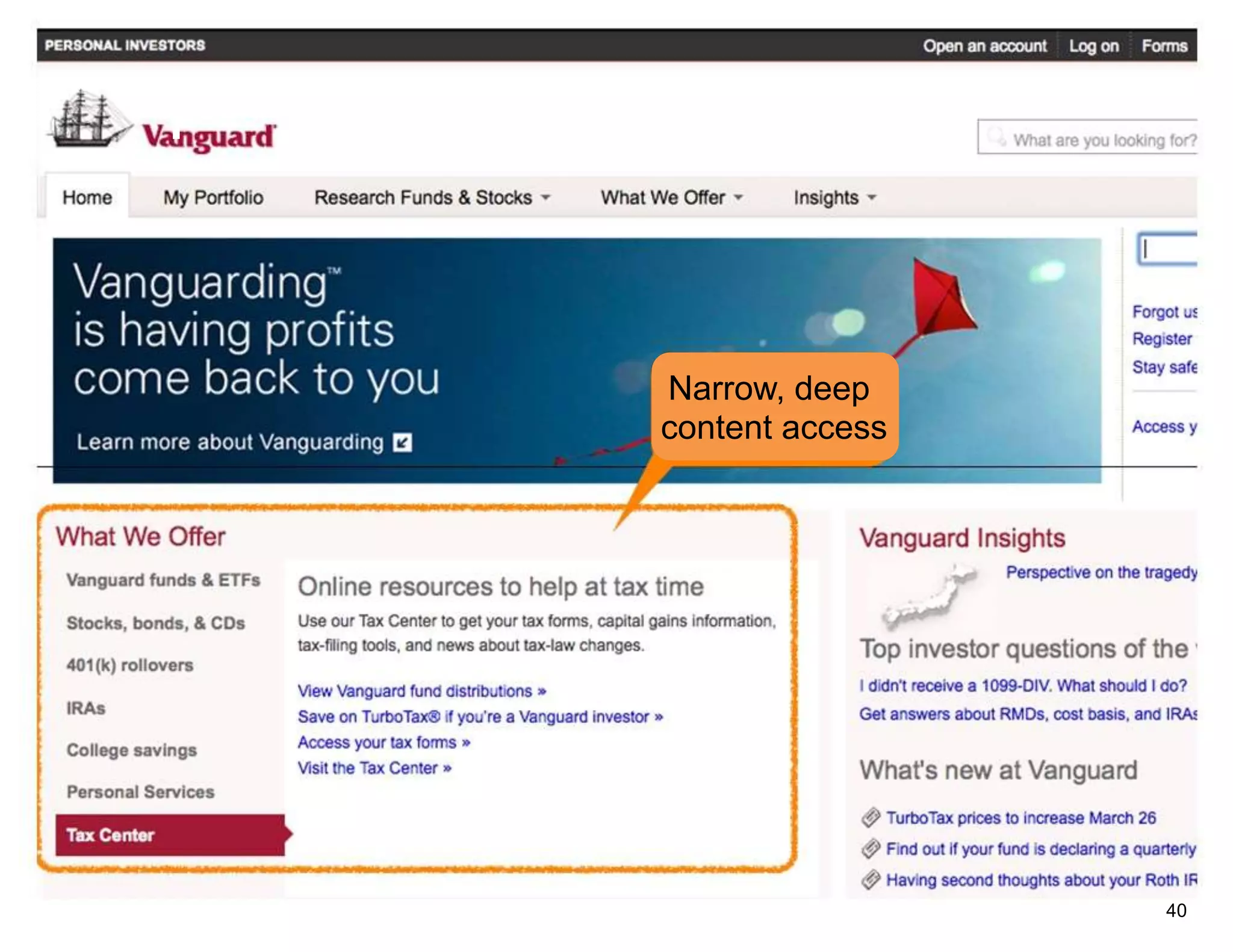
    Narrow, deep
    content access


                     40
V


    41
V


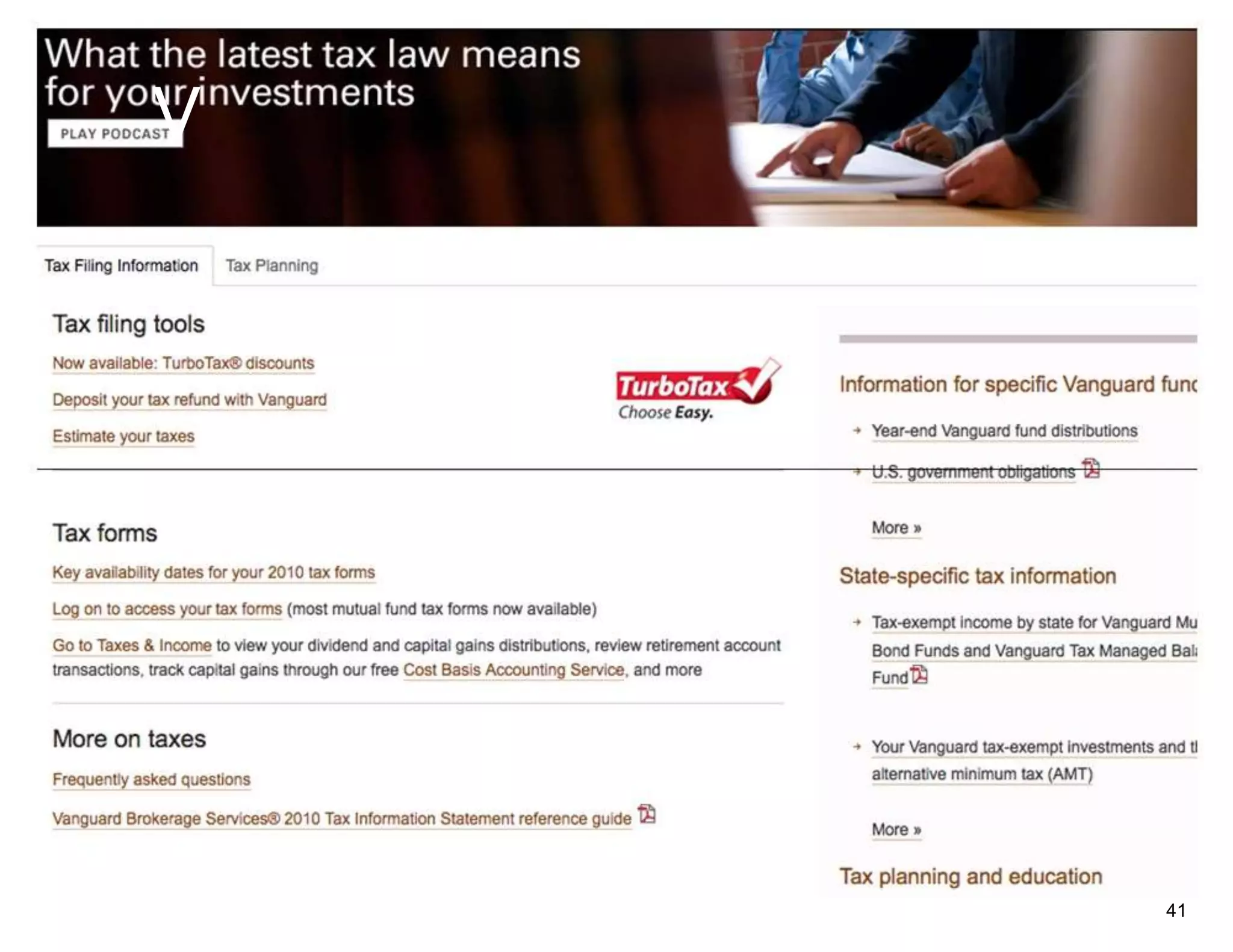
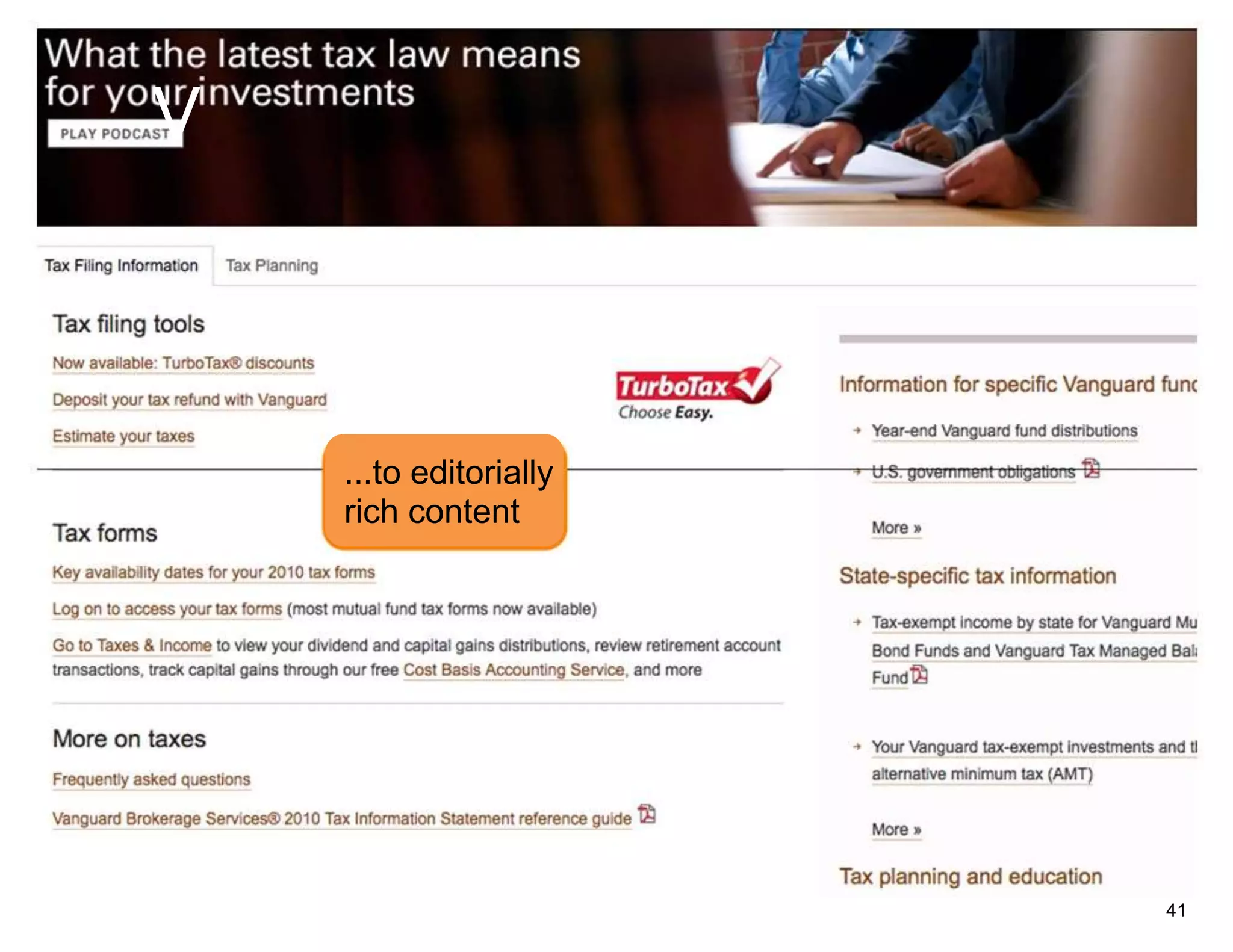
    ...to editorially
    rich content


                        41
42
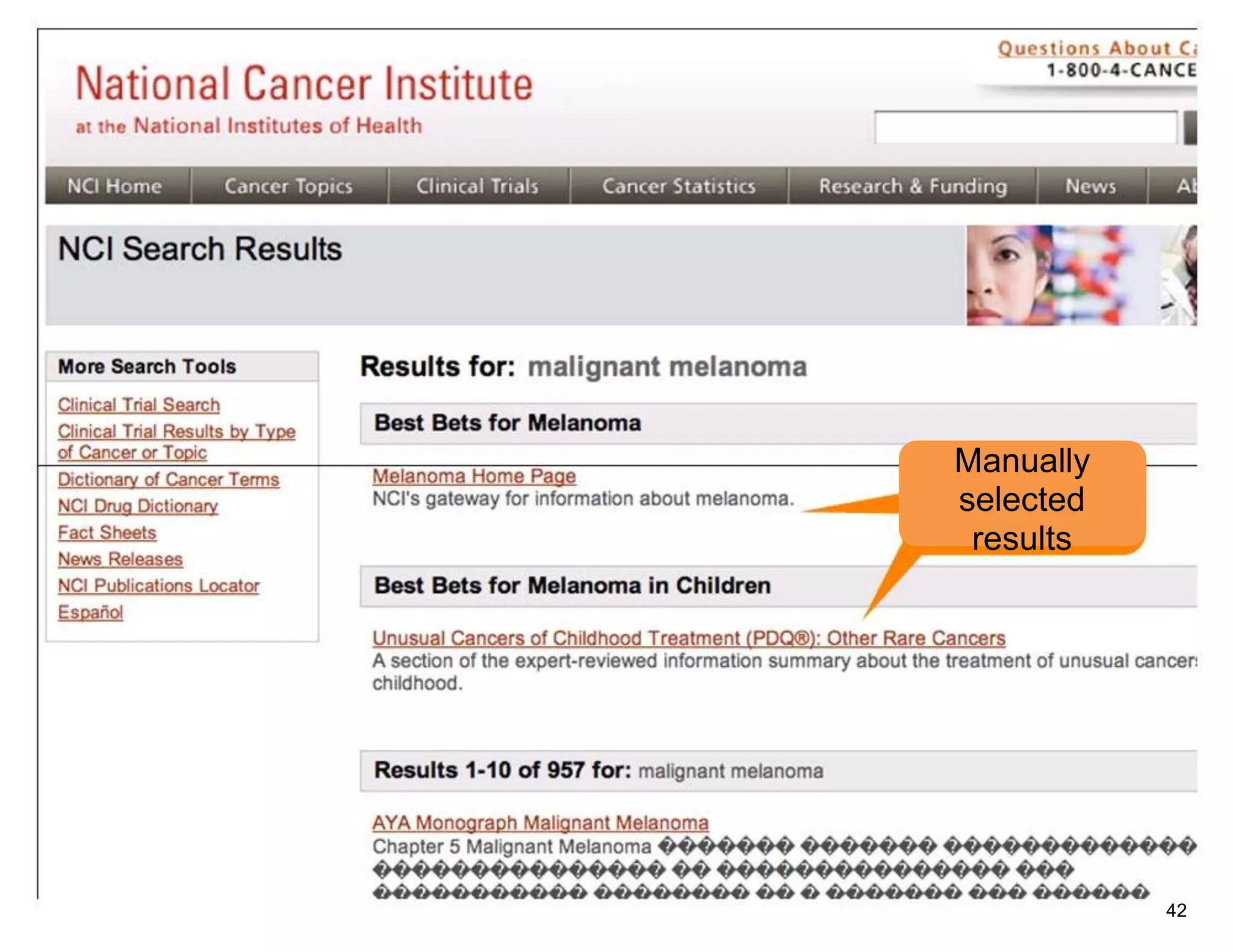
Manually
selected
 results


           42
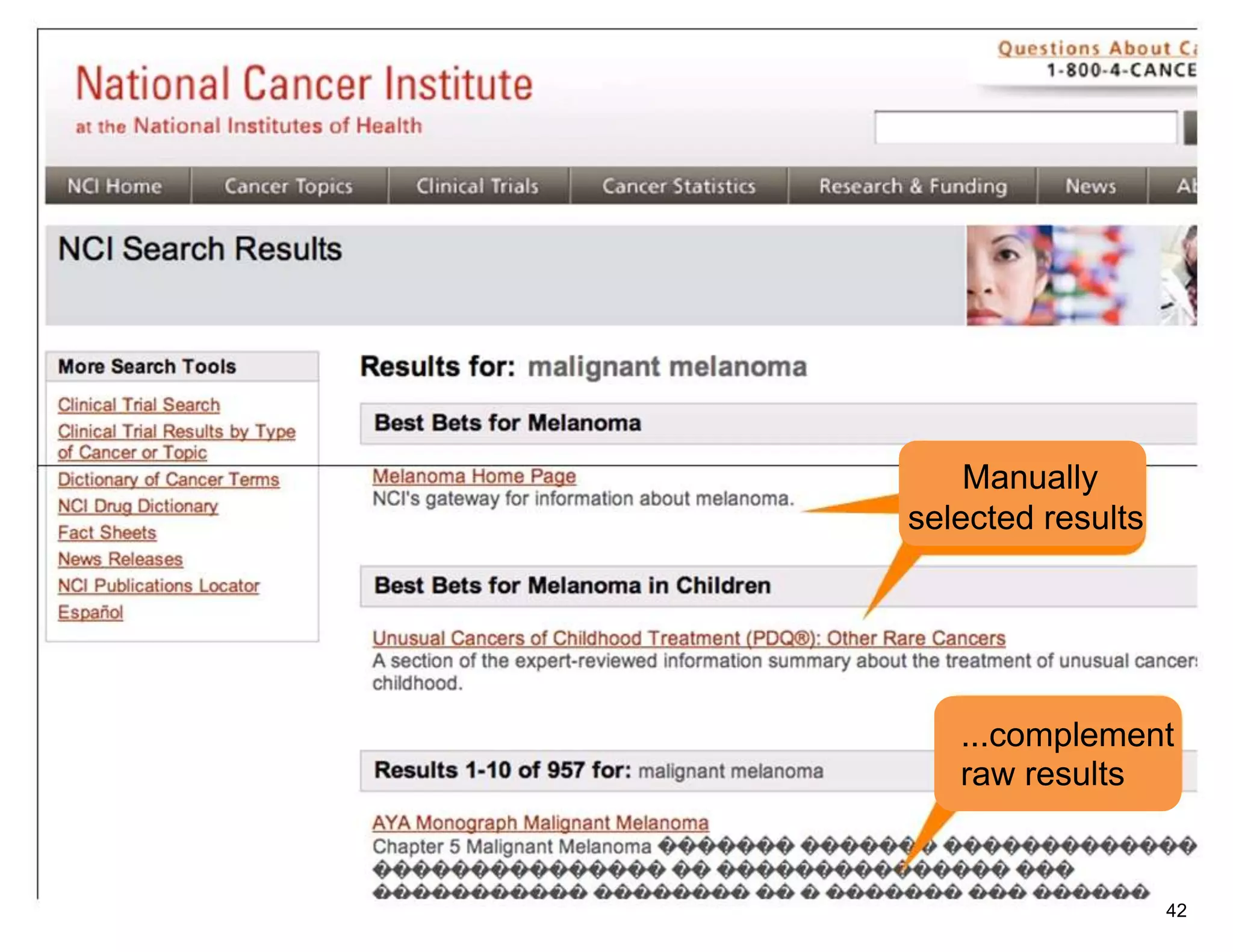
Manually
selected results


   ...complement
   raw results


                   42
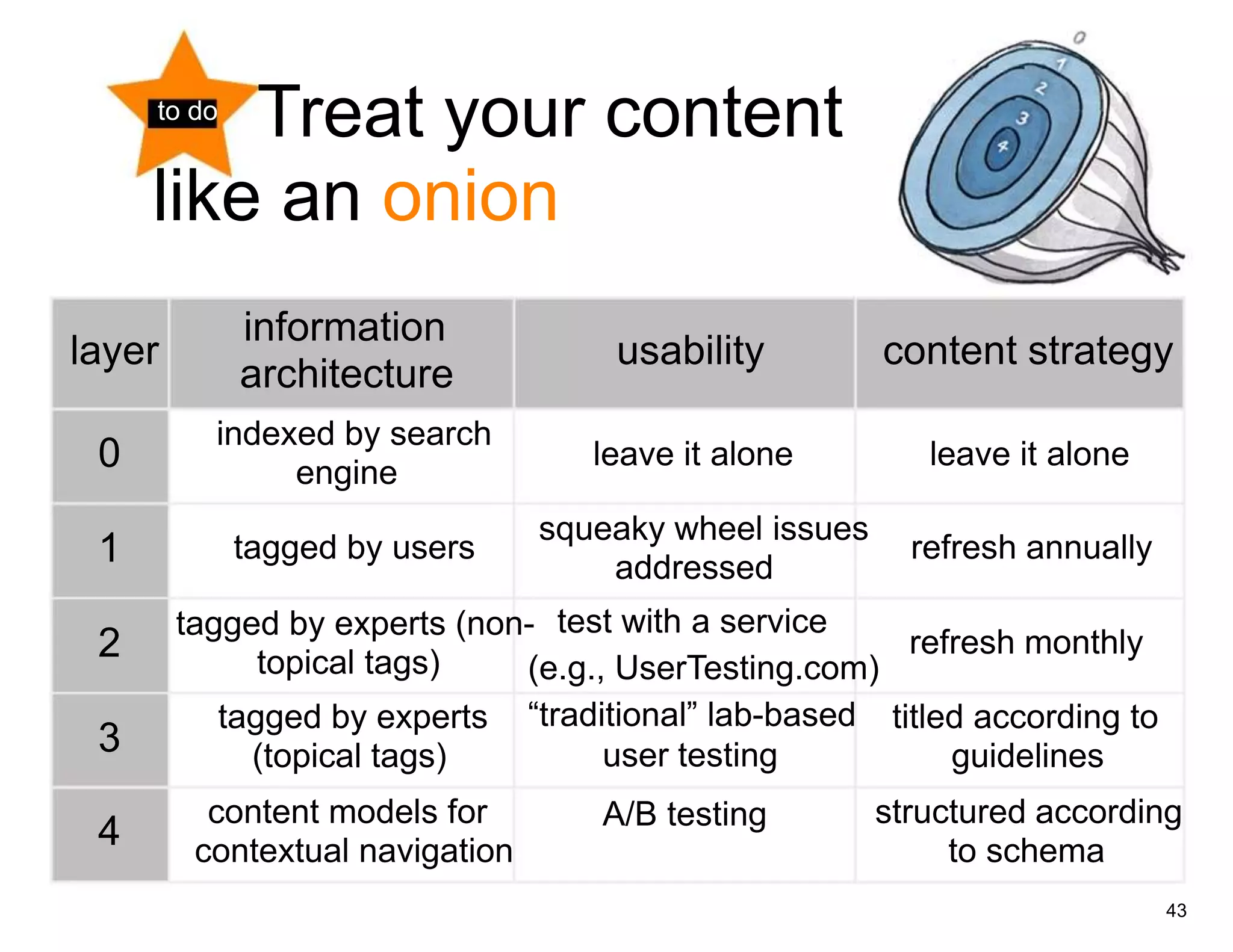
Treat your content
     to do


     like an onion
              information
layer                                  usability           content strategy
              architecture
          indexed by search
 0             engine
                                     leave it alone           leave it alone

                                 squeaky wheel issues
 1           tagged by users
                                     addressed
                                                             refresh annually

        tagged by experts (non- test with a service
 2           topical tags)
                                                      refresh monthly
                              (e.g., UserTesting.com)
             tagged by experts   “traditional” lab-based    titled according to
 3             (topical tags)          user testing              guidelines
          content models for          A/B testing          structured according
 4       contextual navigation                                  to schema
                                                                                  43
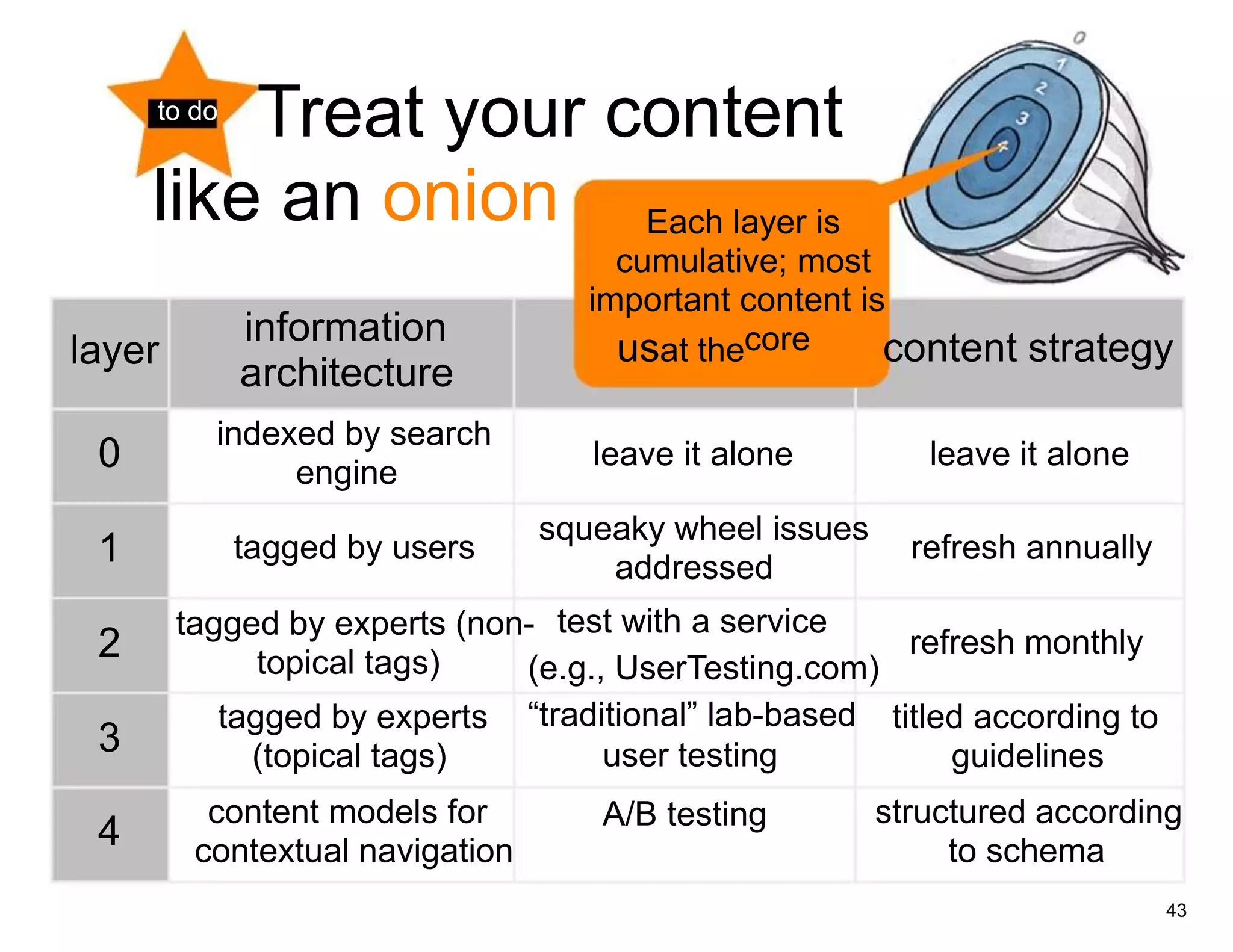
Treat your content
     to do


     like an onion Each layer is
                                       cumulative; most
                                     important content is
              information
layer                                  usat thecore      content     strategy
              architecture
          indexed by search
 0             engine
                                     leave it alone           leave it alone

                                 squeaky wheel issues
 1           tagged by users
                                     addressed
                                                             refresh annually

        tagged by experts (non- test with a service
 2           topical tags)
                                                      refresh monthly
                              (e.g., UserTesting.com)
             tagged by experts   “traditional” lab-based    titled according to
 3             (topical tags)          user testing              guidelines
          content models for          A/B testing          structured according
 4       contextual navigation                                  to schema
                                                                                  43
#8
Tune your design over time


                             44
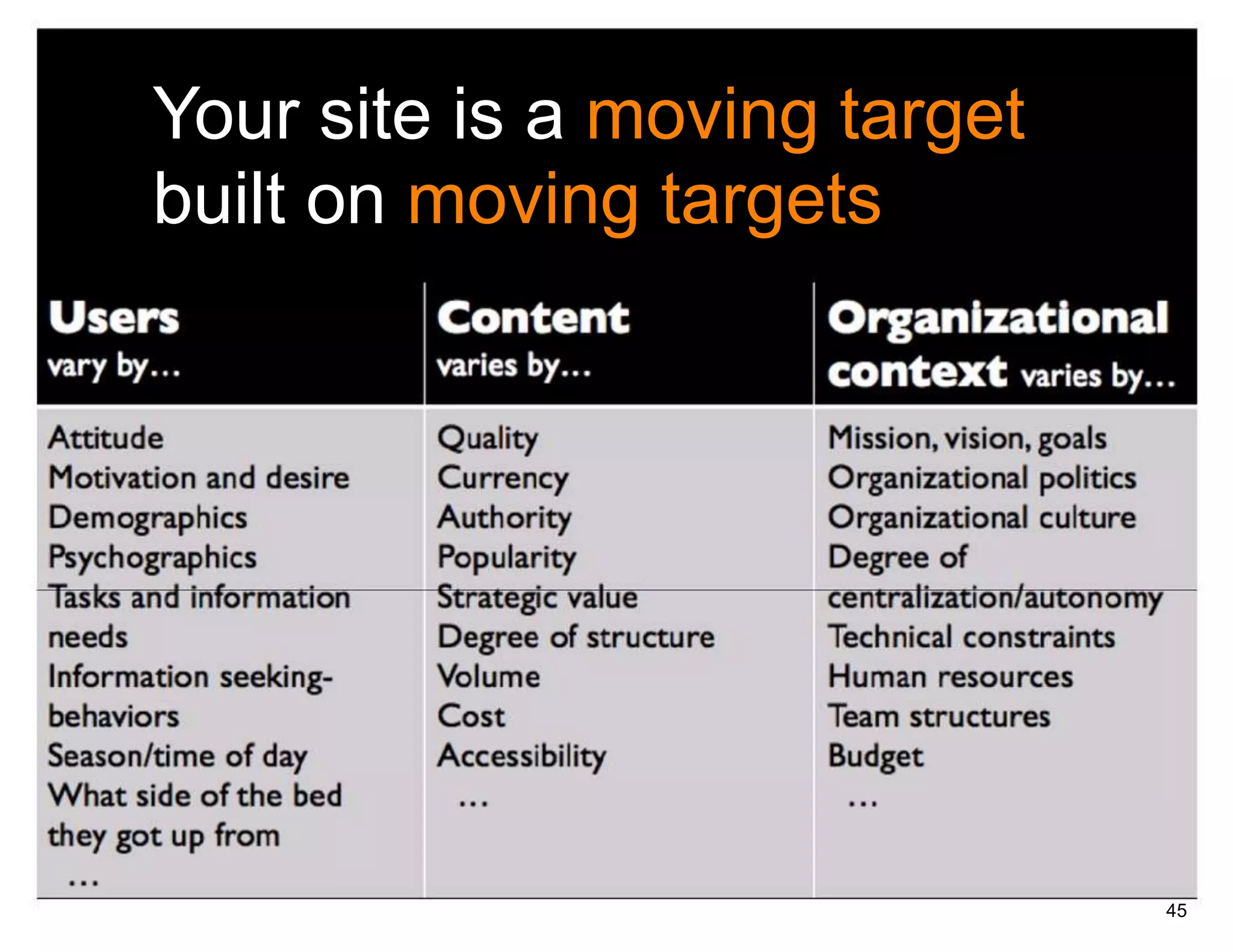
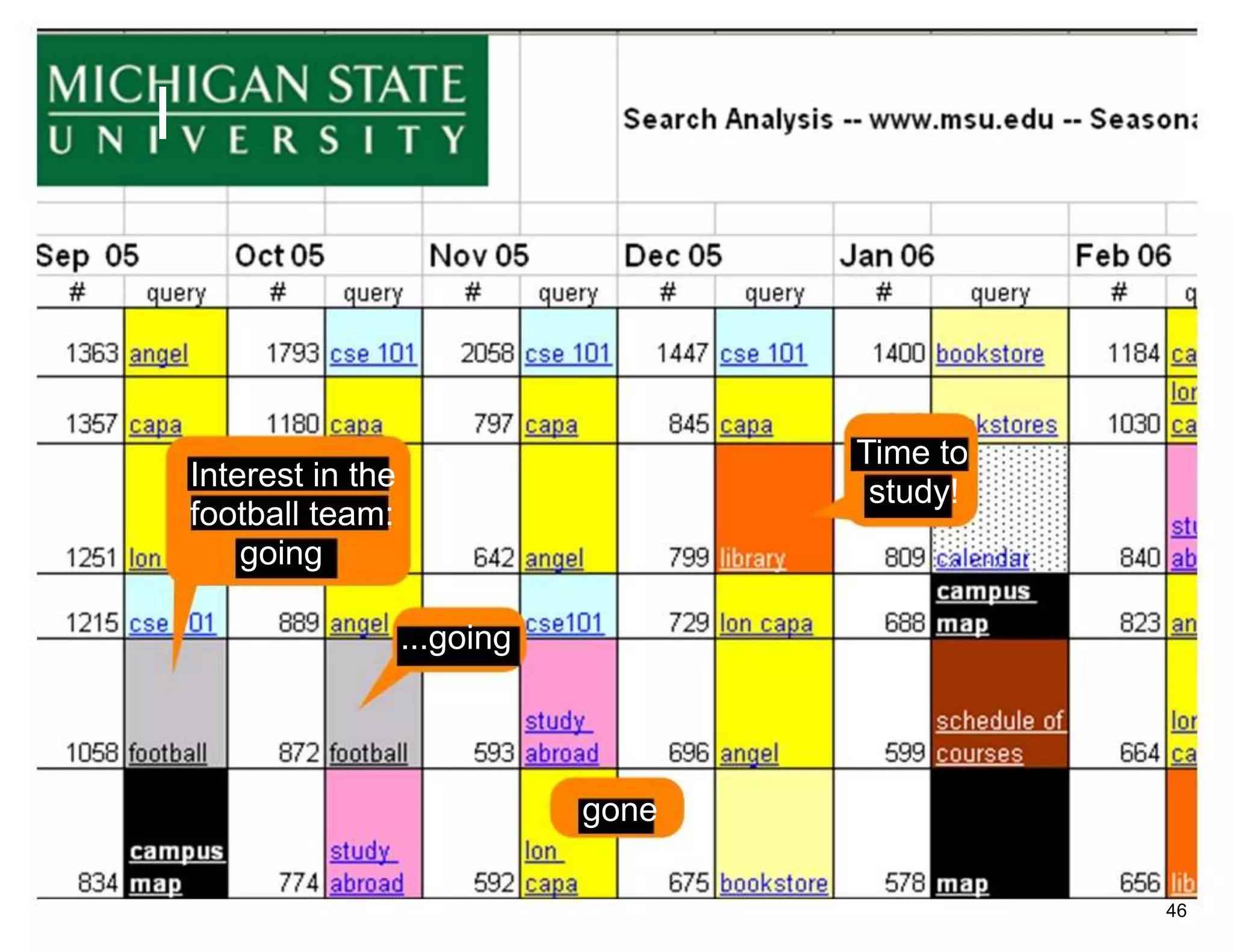
Your site is a moving target
built on moving targets


                               45
I


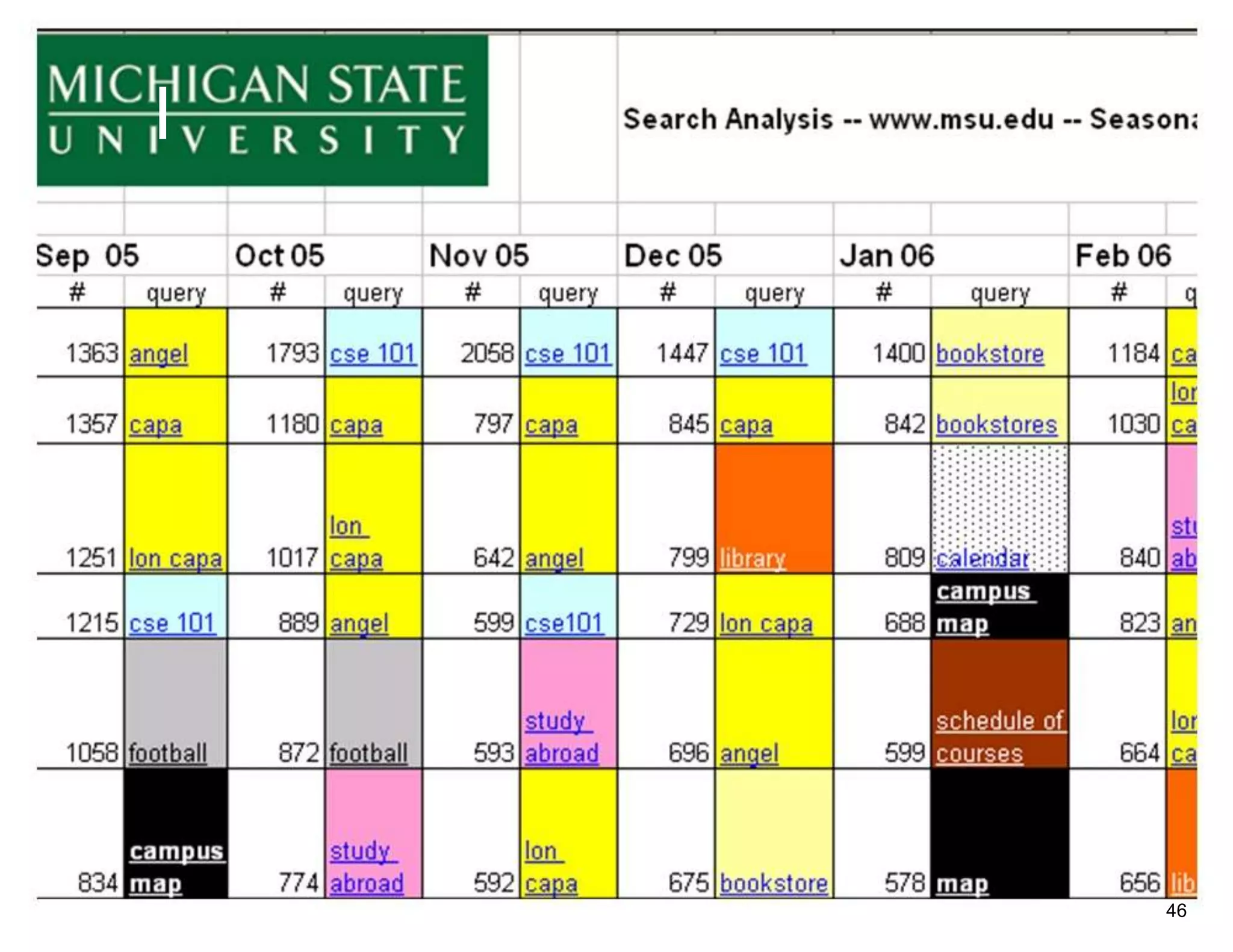
    46
I


                                        Time to
    Interest in the                      study!
    football team:
        going

                      ...going


                                 gone

                                                  46
I


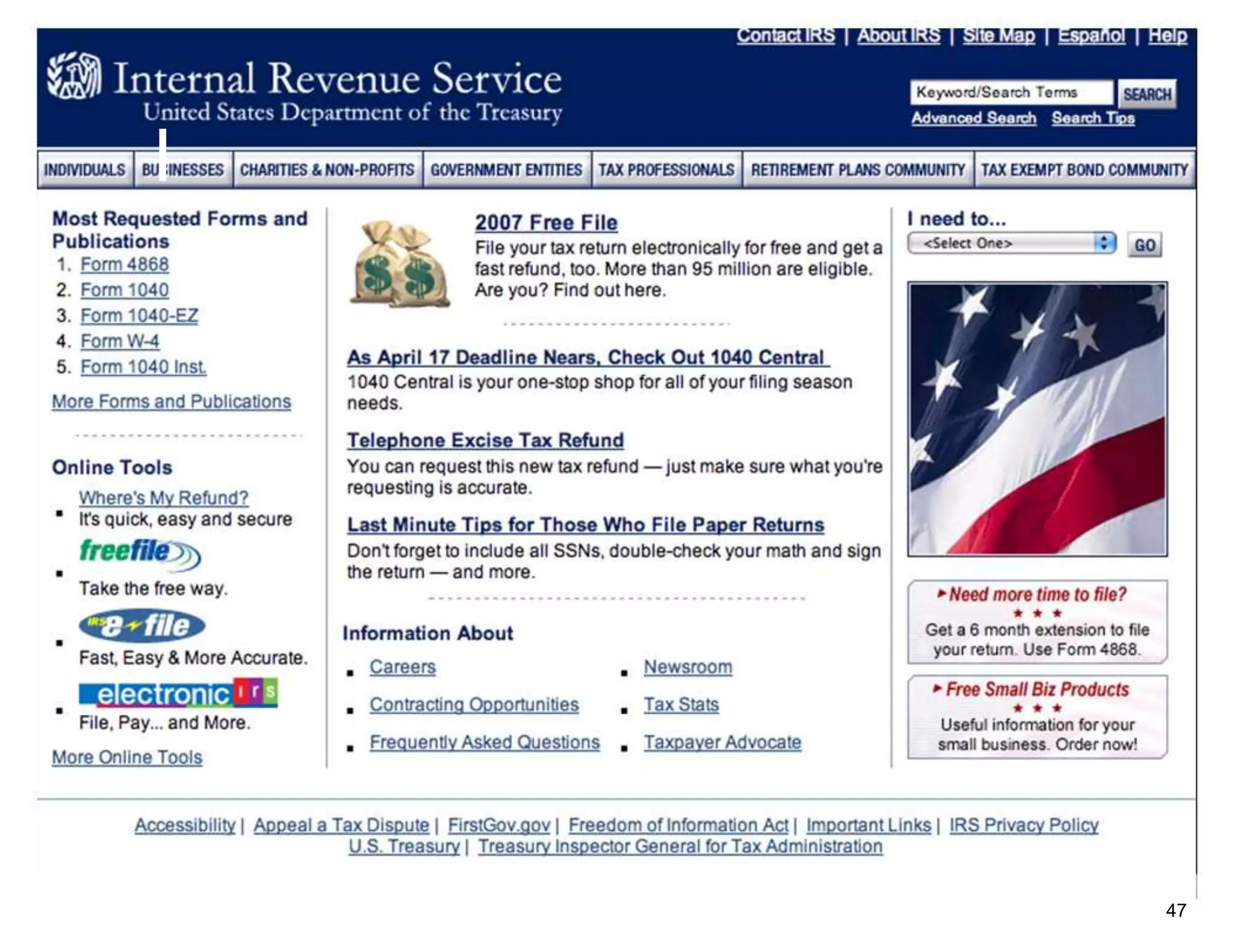
    47
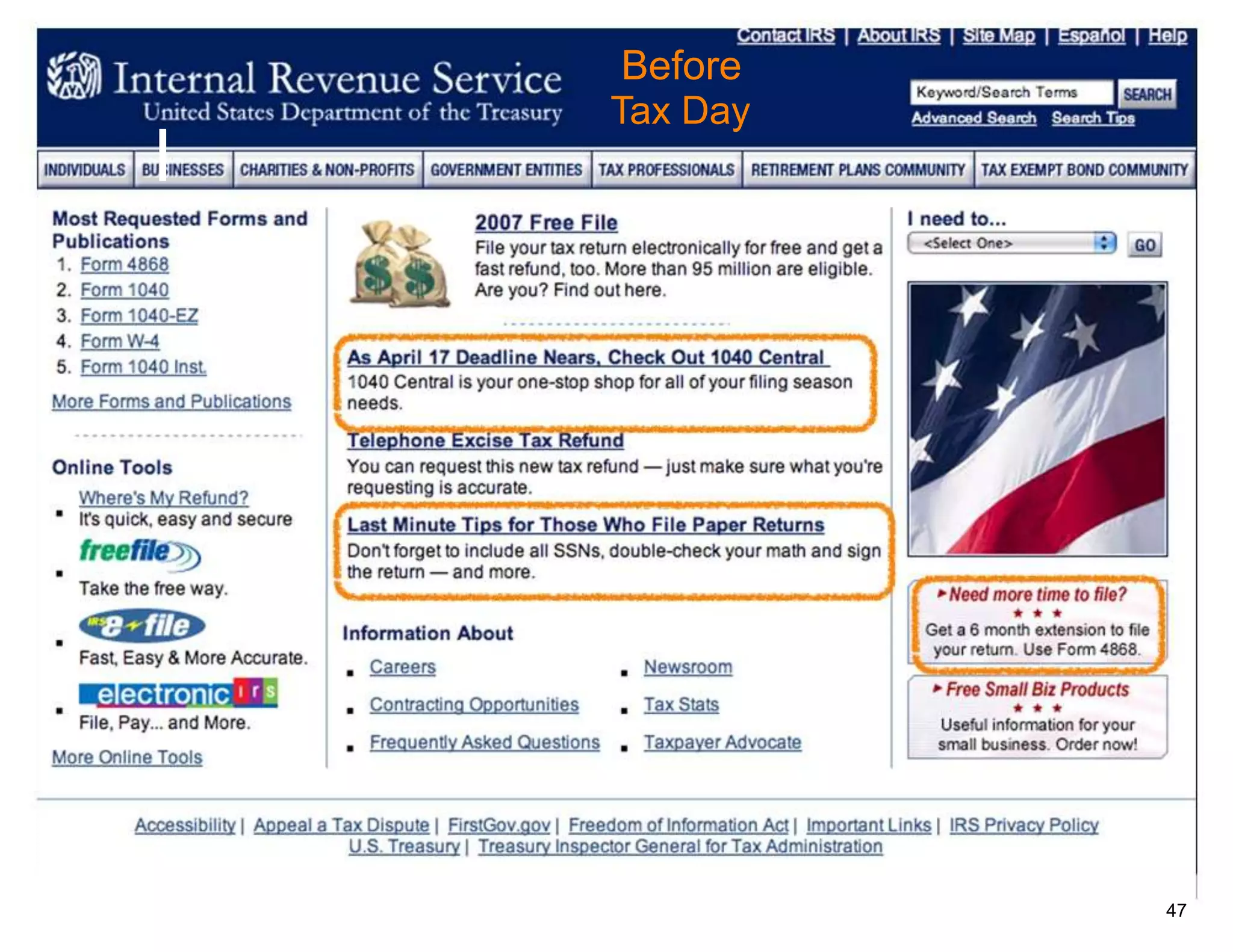
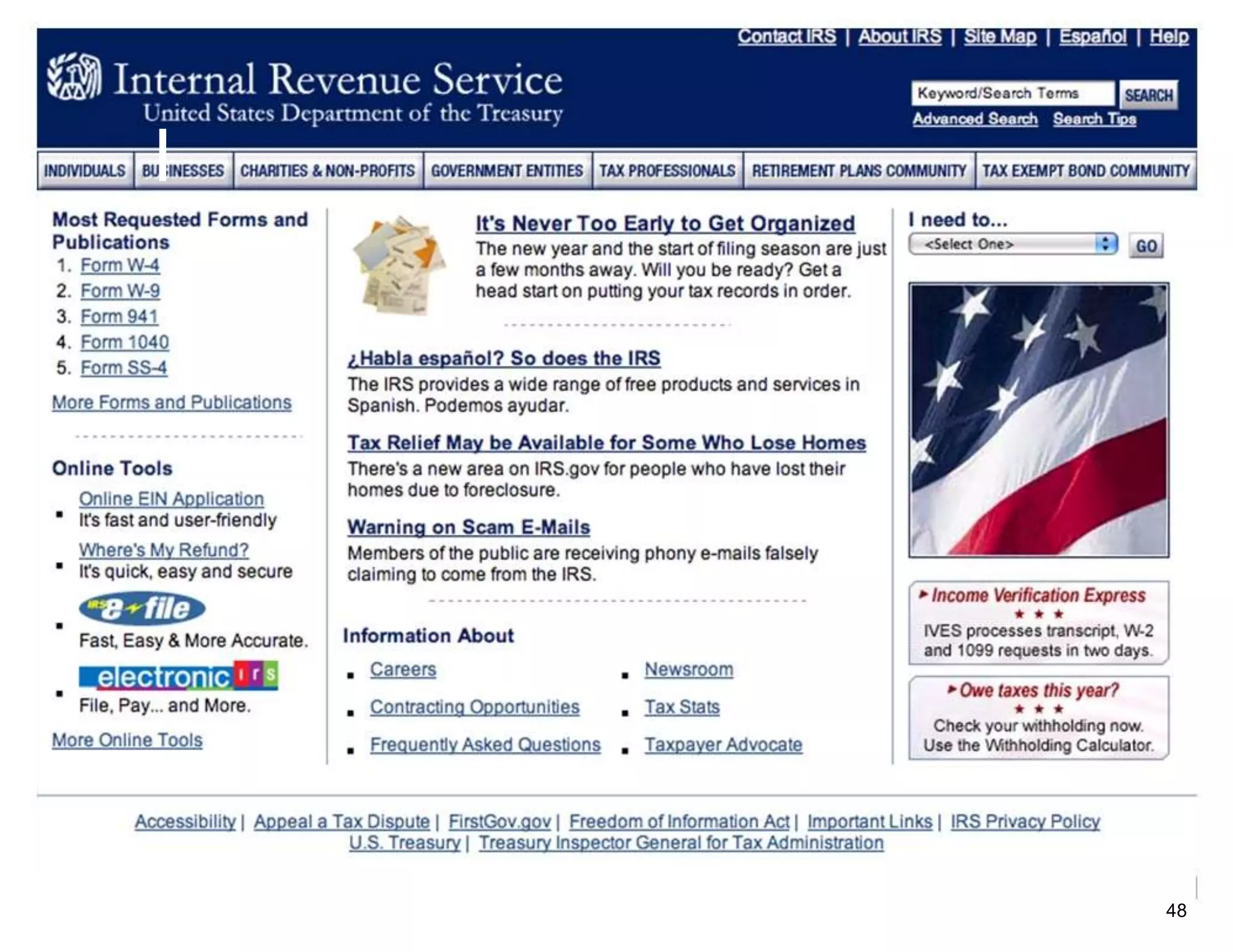
Before
    Tax Day
I


              47
I


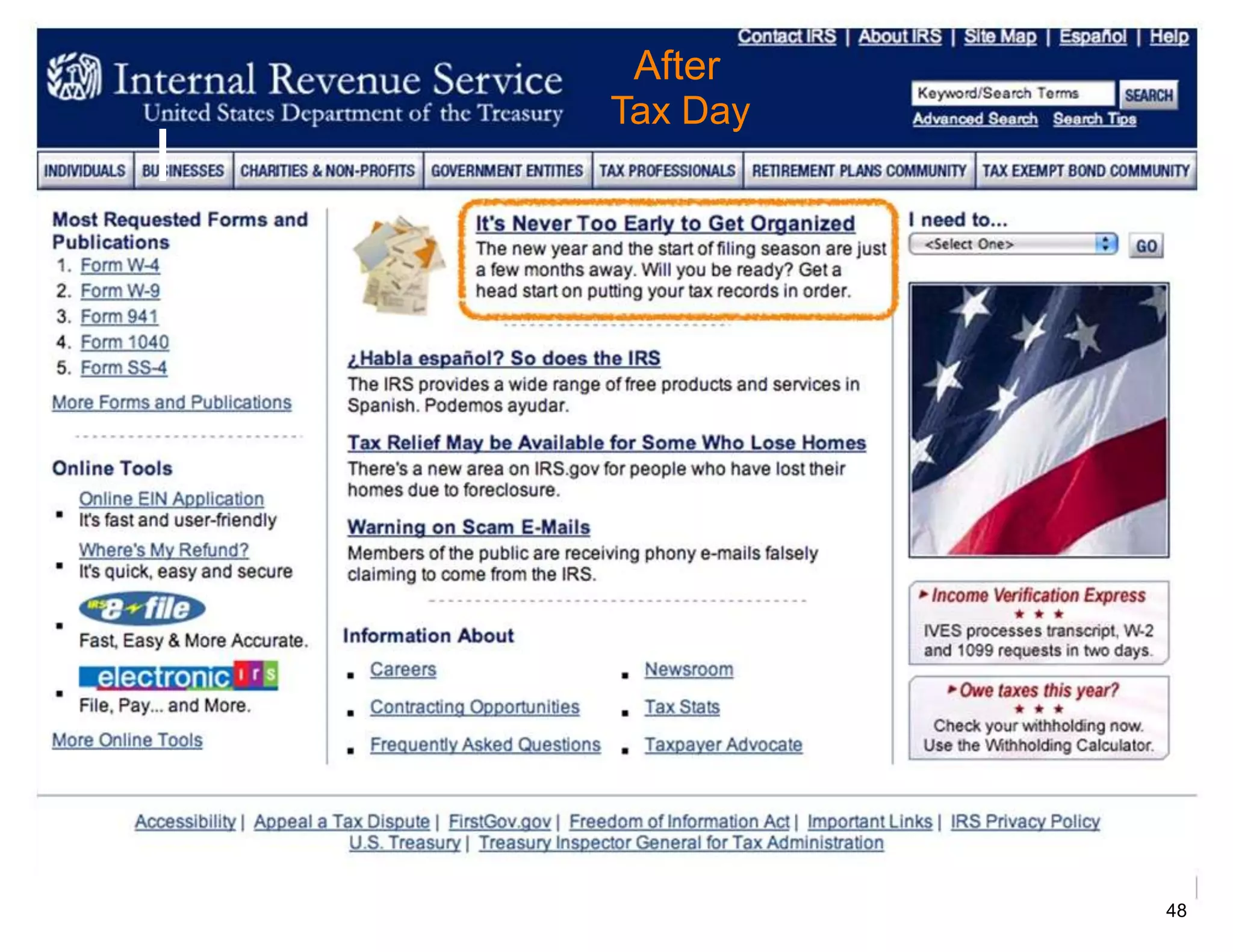
    48
After
    Tax Day
I


              48
Move from time-boxed
to do


projects to ongoing processes


        Example: the rolling content inventory
                                                 49
Summary:
8 IA better practices
1. Diagnose the important problems
2. Balance your evidence
3. Advocate for the long term
4. Measure engagement
5. Support contextual navigation
6. Improve search across silos
7. Combine design approaches effectively
8. Tune your design over time


                                           50
S


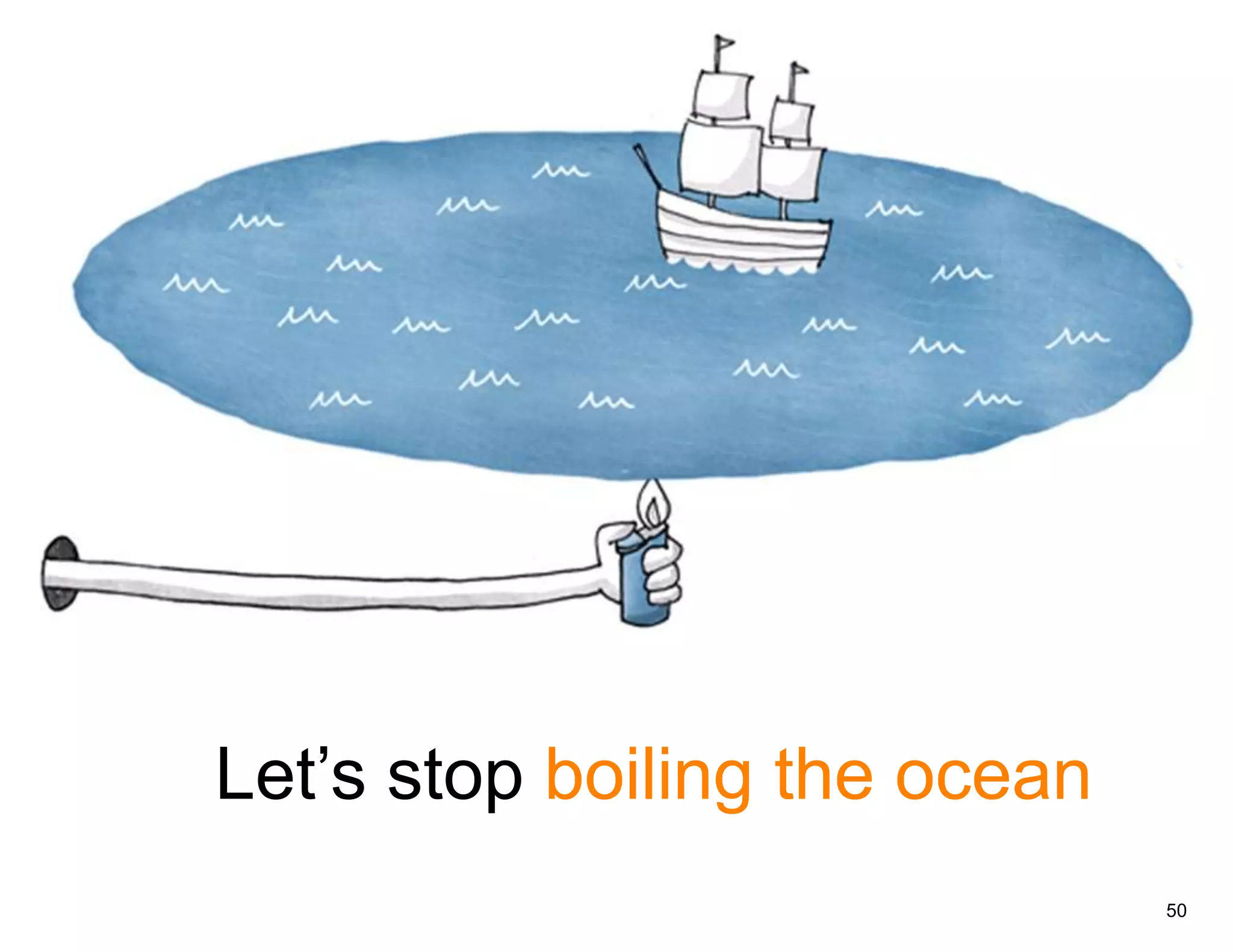
    Let’s stop boiling the ocean
                                   50
Say hello


 Lou Rosenfeld
 lou@louisrosenfeld.com
 Rosenfeld Media
 www.louisrosenfeld.com | @louisrosenfeld
 www.rosenfeldmedia.com | @rosenfeldmedia


                                            51

8 better practices from information architecture By: Lou Rosenfeld

  • 1.
    8 better practicesfrom information architecture Lou Rosenfeld
  • 2.
    Hello, my nameis Lou www.louisrosenfeld.com | www.rosenfeldmedia.com 2
  • 3.
  • 4.
  • 5.
    Some questions thatyou probably can’t answer • Who are your content’s primary audiences? • What are the five major tasks and needs each has? • Are you satisfying those tasks and needs? • What data support your thinking? • How do you measure success? 4
  • 6.
    Why can’t weget findability right?
  • 7.
    Why can’t weget findability right? • We don’t know how to diagnose
  • 8.
    Why can’t weget findability right? • We don’t know how to diagnose • We don’t know how to measure
  • 9.
    Why can’t weget findability right? • We don’t know how to diagnose • We don’t know how to measure • Siloed organizations
  • 10.
    Why can’t weget findability right? • We don’t know how to diagnose • We don’t know how to measure • Siloed organizations • Ill-equipped decision-makers
  • 11.
    Why can’t weget findability right? • We don’t know how to diagnose • We don’t know how to measure • Siloed organizations • Ill-equipped decision-makers • Short-term thinking
  • 12.
    Why can’t weget findability right? • We don’t know how to diagnose • We don’t know how to measure • Siloed organizations • Ill-equipped decision-makers • Short-term thinking • Semantic illiteracy
  • 13.
  • 14.
    Information architecture: 8 betterpractices for findability 1. Diagnose the important problems 2. Balance your evidence 3. Advocate for the long term 4. Measure engagement 5. Support contextual navigation 6. Improve search across silos 7. Combine design approaches effectively 8. Tune your design over time 7
  • 15.
  • 16.
    A 9
  • 17.
    A Not all queries are distributed equally 9
  • 18.
    A Nor do they diminish gradually 9
  • 19.
    A 80/20 rule isn’t quite accurate 9
  • 20.
    ( 10
  • 21.
    ( 10
  • 22.
    ( 10
  • 23.
    ( 10
  • 24.
    The Long Tailis ( much longer than you’d suspect 10
  • 25.
  • 26.
    It’s Zipf’s World; wejust live in it A little... • queries • tasks • ways to navigate • features • documents ...goes a long way 12
  • 27.
    UNVERIFIED RUMOR: 90% of Microsoft.com content has never been accessed... not even once TAKEAWAY: FOCUS ON THE STUFF THAT MATTERS!
  • 28.
  • 29.
    ...and continually fix(within to do an IA report card) 15
  • 30.
  • 31.
    from Christian Rohrer:http://is.gd/95HSQ2 17
  • 32.
    Balanced research leads to true insight, new opportunities from Christian Rohrer: http://is.gd/95HSQ2 17
  • 33.
    Lou’s TABLE OF OVERGENERALIZED Web Analytics User Experience DICHOTOMIES Users' intentions and What they Users' behaviors (what's motives (why those things analyze happening) happen) Qualitative methods for What methods Quantitative methods to explaining why things they employ determine what's happening happen Helps users achieve goals What they're Helps the organization meet (expressed as tasks or trying to achieve goals (expressed as KPI) topics of interest) Uncover patterns and How they use Measure performance (goal- surprises (emergent data driven analysis) analysis) Statistical data ("real" data Descriptive data (in small What kind of data in large volumes, full of volumes, generated in lab they use errors) environment, full of errors) 18
  • 34.
    Balance over time: Fromprojects to processes Example: the rolling content inventory 19
  • 35.
    Develop a researchregimen to do balanced by time, quadrant Each week, for example... • Analyze analytics for trends (Behavioral + Quantitative) • Task analysis of common needs (Behavioral + Qualitative) Each month... • User survey (Attitudinal + Quantitative) • Exploratory analysis of analytics data (Behavioral + Qualitative) Each quarter... • Field study (Behavioral/Attitudinal + Qualitative) • Card sorting (Attitudinal + Qualitative/Quantitative) 20
  • 36.
    #3 Advocate for thelong-term 21
  • 37.
    S Typical design focus Stuff that gets ignored: mission, vision, charter, goals, KPI, objectives 22
  • 38.
    For starters, developyour to do project’s elevator pitch Read Gamestorming (Gray, Brown, Macanufo); O’Reilly, 2010). http://amzn.to/nnpERG 23
  • 39.
  • 40.
  • 41.
  • 42.
    The missing metrics ofin-betweenness • Orientation (“What can I do here?”) • Engagement (“I like this; do you?”) • Connection/cross-promotion (“What goes with this?”) • Authority (“I trust this”) • and many more... 26
  • 43.
    Use gradual engagement to do model to isolate, measure tasks Example: adoption of features; can you measure movement between layers? Layer 0: User visits the site (unauthenticated; no cookies, no nothing) Layer 1: User asks the site a question (for example, a search query) Layer 2: Site asks the user a question (would you like save this product to a wish list?) Layer 3: Site suggests something to the user (you might enjoy these products ordered by people like you) Layer 4: Site acts on the user's behalf (we've gone ahead and saved these products to your More on gradual engagement: account's list of frequently-ordered items) http://bit.ly/9hPqyx 27
  • 44.
  • 45.
    Contextual navigation: your site’s desire lines Determine through content modeling, site search analytics Deep navigation requires content modeling : a better approach to deep IA and content structuring
  • 46.
    Important content objectsemerge concert calendar from content modeling (example: BBC) album pages artist descriptions TV listings Content that matters most album reviews discography artist bios 30
  • 47.
    Important metadata attributesemerge from content modeling Metadata that matters most 31
  • 48.
    Make content modelinga to do participatory design exercise
  • 49.
    Make content modelinga to do participatory design exercise •Provide subjects with “de-oriented” samples of content types... and common tasks •Have them draw “desire lines” and starting points, and identify gaps in content types •Learn from “think out loud” and by identifying common patterns •More info: Atherton et al.’s “domain modeling” presentation: http://slidesha.re/fzChQB
  • 50.
  • 51.
  • 52.
  • 53.
    ...by contextualizing “advanced” features,focusing on revision search session patterns 1. solar energy 2. how solar energy works
  • 54.
    ...by contextualizing “advanced” features,focusing on revision search session patterns 1. solar energy 2. how solar energy works search session patterns 1. solar energy 2. energy
  • 55.
    ...by contextualizing “advanced” features,focusing on revision search session patterns 1. solar energy 1. solar energy 2. solar energy charts 2. how solar energy works search session patterns 1. solar energy 2. energy
  • 56.
    ...by contextualizing “advanced” features,focusing on revision search session patterns 1. solar energy 1. solar energy 2. solar energy charts 2. how solar energy works search session patterns search session patterns 1. solar energy 1. solar energy 2. explain solar energy 2. energy
  • 57.
    ...by contextualizing “advanced” features,focusing on revision search session patterns 1. solar energy 1. solar energy 2. solar energy charts 2. how solar energy works search session patterns search session patterns 1. solar energy 1. solar energy 2. explain solar energy 2. energy search session patterns 1. solar energy 2. solar energy news
  • 58.
    Recognizing specialized queries (e.g., propernouns, dates, unique ID#s) 36
  • 59.
    Recognizing specialized queries (e.g., propernouns, dates, unique ID#s) search pattern: TA292761 36
  • 60.
    Recognizing specialized queries (e.g., propernouns, dates, unique ID#s) search pattern: regulations March 2011 search pattern: TA292761 36
  • 61.
    Recognizing specialized queries (e.g., propernouns, dates, unique ID#s) search pattern: regulations March 2011 search pattern: regulations Owens search pattern: TA292761 36
  • 62.
    Recognizing specialized queries (e.g., propernouns, dates, unique ID#s) search pattern: regulations March 2011 search pattern: regulations Owens search pattern: search pattern: regulations TA292761 Caterpillar 36
  • 63.
  • 64.
  • 65.
  • 66.
    Poor search results returned by search engine Content objects from product content model ...and designing specialized search result 37
  • 67.
    Read a bookchapter on to do session analysis You’ll find one in my book Search Analytics for Your Site http://bit.ly/quFxdz 38
  • 68.
  • 69.
    Y 40
  • 70.
    Y Narrow, deep content access 40
  • 71.
    V 41
  • 72.
    V ...to editorially rich content 41
  • 73.
  • 74.
  • 75.
    Manually selected results ...complement raw results 42
  • 76.
    Treat your content to do like an onion information layer usability content strategy architecture indexed by search 0 engine leave it alone leave it alone squeaky wheel issues 1 tagged by users addressed refresh annually tagged by experts (non- test with a service 2 topical tags) refresh monthly (e.g., UserTesting.com) tagged by experts “traditional” lab-based titled according to 3 (topical tags) user testing guidelines content models for A/B testing structured according 4 contextual navigation to schema 43
  • 77.
    Treat your content to do like an onion Each layer is cumulative; most important content is information layer usat thecore content strategy architecture indexed by search 0 engine leave it alone leave it alone squeaky wheel issues 1 tagged by users addressed refresh annually tagged by experts (non- test with a service 2 topical tags) refresh monthly (e.g., UserTesting.com) tagged by experts “traditional” lab-based titled according to 3 (topical tags) user testing guidelines content models for A/B testing structured according 4 contextual navigation to schema 43
  • 78.
    #8 Tune your designover time 44
  • 79.
    Your site isa moving target built on moving targets 45
  • 80.
    I 46
  • 81.
    I Time to Interest in the study! football team: going ...going gone 46
  • 82.
    I 47
  • 83.
    Before Tax Day I 47
  • 84.
    I 48
  • 85.
    After Tax Day I 48
  • 86.
    Move from time-boxed todo projects to ongoing processes Example: the rolling content inventory 49
  • 87.
    Summary: 8 IA betterpractices 1. Diagnose the important problems 2. Balance your evidence 3. Advocate for the long term 4. Measure engagement 5. Support contextual navigation 6. Improve search across silos 7. Combine design approaches effectively 8. Tune your design over time 50
  • 88.
    S Let’s stop boiling the ocean 50
  • 89.
    Say hello LouRosenfeld lou@louisrosenfeld.com Rosenfeld Media www.louisrosenfeld.com | @louisrosenfeld www.rosenfeldmedia.com | @rosenfeldmedia 51

Editor's Notes

  • #5 http://xkcd.com/773/
  • #8 http://www.semanticreview.com/images/semantic-data.jpg
  • #11 Amazing drawing by Eva-Lotta Lamm: www.evalotta.net
  • #12 Amazing drawing by Eva-Lotta Lamm: www.evalotta.net
  • #22 Funnel: http://www.orionweb.net/wp-content/uploads/conversion-funnel.png Sitemap: http://www.peacockvaughninsurance.com/images/SiteMap.bmp
  • #37 Onion courtesy Eva-Lotta Lamm