Literary Analysis Outline:

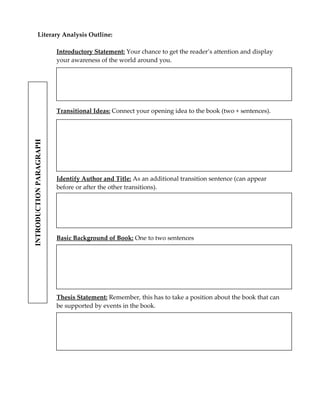
                         Introductory Statement: Your chance to get the reader’s attention and display
                         your awareness of the world around you.


                         Transitional Ideas: Connect your opening idea to the book (two + sentences).
INTRODUCTION PARAGRAPH


                         Identify Author and Title: As an additional transition sentence (can appear
                         before or after the other transitions).


                         Basic Background of Book: One to two sentences


                         Thesis Statement: Remember, this has to take a position about the book that can
                         be supported by events in the book.
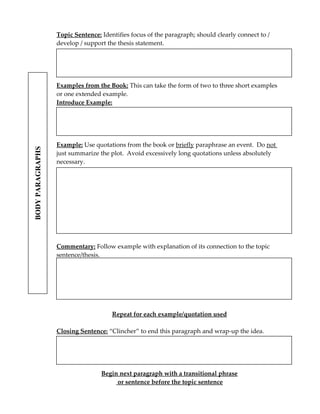
Topic Sentence: Identifies focus of the paragraph; should clearly connect to /
                  develop / support the thesis statement.


                  Examples from the Book: This can take the form of two to three short examples
                  or one extended example.
                  Introduce Example:


                  Example: Use quotations from the book or briefly paraphrase an event. Do not
BODY PARAGRAPHS


                  just summarize the plot. Avoid excessively long quotations unless absolutely
                  necessary.


                  Commentary: Follow example with explanation of its connection to the topic
                  sentence/thesis.


                                      Repeat for each example/quotation used

                  Closing Sentence: “Clincher” to end this paragraph and wrap-up the idea.


                                  Begin next paragraph with a transitional phrase
                                       or sentence before the topic sentence
Topic Sentence: Establish that you have reached the end of the essay, perhaps by
                       echoing the idea of the thesis statement. Do not use trite expressions like “in
                       conclusion” or “to sum up.”


                       Reflect on Your Ideas: Make it clear to the reader why your paper was
                       important. Stress what was unique about your interpretation. Give the reader
                       something to think about that connects to the world around.
CONCLUSION PARAGRAPH


                       Closing Statement: Wrap-up this discussion of your topic. Let the reader know
                       the essay is at an end, and leave him or her with something to think about.

Literary analysis outline

  • 1.
    Literary Analysis Outline: Introductory Statement: Your chance to get the reader’s attention and display your awareness of the world around you. Transitional Ideas: Connect your opening idea to the book (two + sentences). INTRODUCTION PARAGRAPH Identify Author and Title: As an additional transition sentence (can appear before or after the other transitions). Basic Background of Book: One to two sentences Thesis Statement: Remember, this has to take a position about the book that can be supported by events in the book.
  • 2.
    Topic Sentence: Identifiesfocus of the paragraph; should clearly connect to / develop / support the thesis statement. Examples from the Book: This can take the form of two to three short examples or one extended example. Introduce Example: Example: Use quotations from the book or briefly paraphrase an event. Do not BODY PARAGRAPHS just summarize the plot. Avoid excessively long quotations unless absolutely necessary. Commentary: Follow example with explanation of its connection to the topic sentence/thesis. Repeat for each example/quotation used Closing Sentence: “Clincher” to end this paragraph and wrap-up the idea. Begin next paragraph with a transitional phrase or sentence before the topic sentence
  • 3.
    Topic Sentence: Establishthat you have reached the end of the essay, perhaps by echoing the idea of the thesis statement. Do not use trite expressions like “in conclusion” or “to sum up.” Reflect on Your Ideas: Make it clear to the reader why your paper was important. Stress what was unique about your interpretation. Give the reader something to think about that connects to the world around. CONCLUSION PARAGRAPH Closing Statement: Wrap-up this discussion of your topic. Let the reader know the essay is at an end, and leave him or her with something to think about.