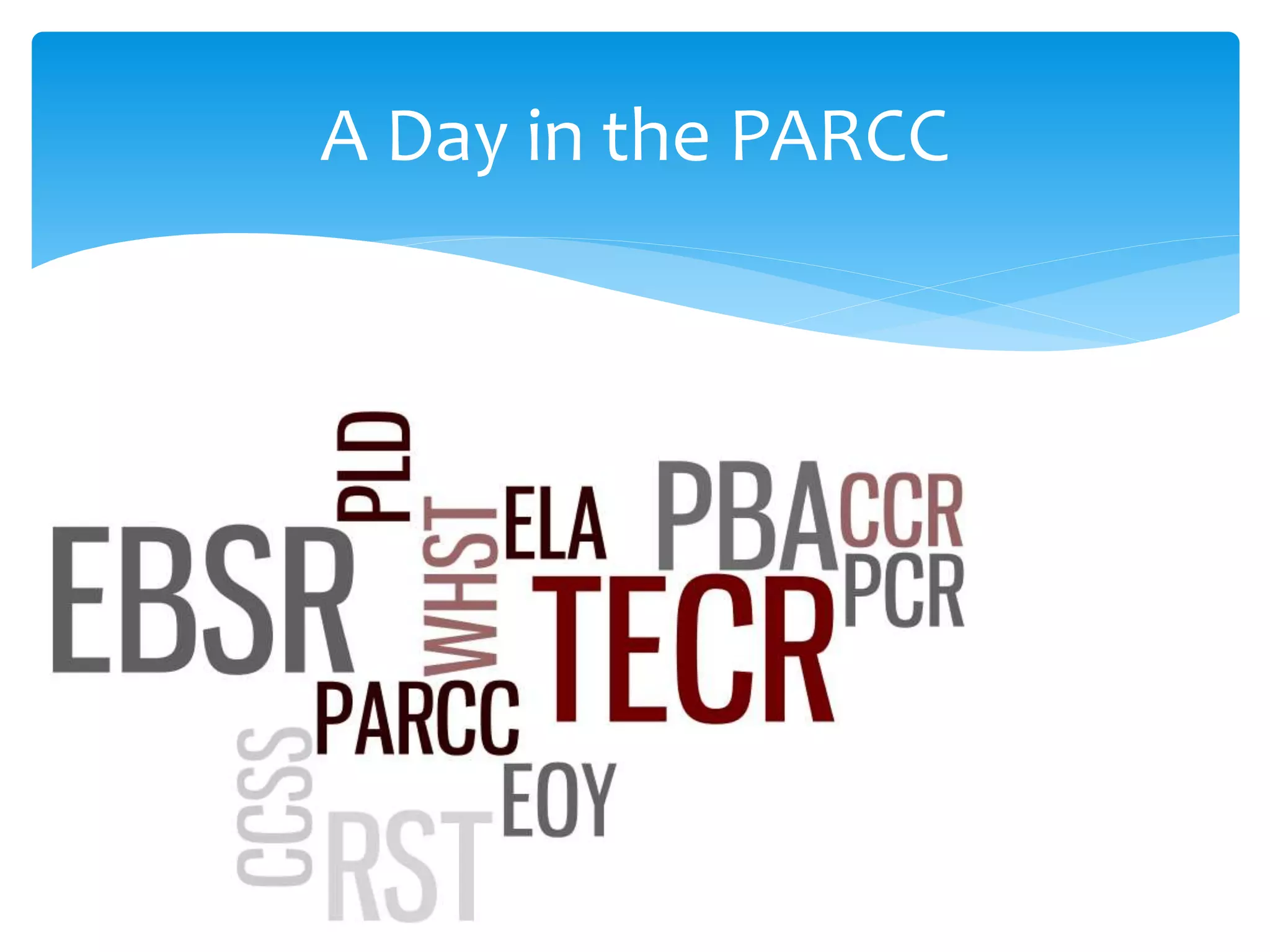
A Day in the PARCC
Get Yer’ Program, Here! 
Can’t tell one acronym from 
the next without yer program.
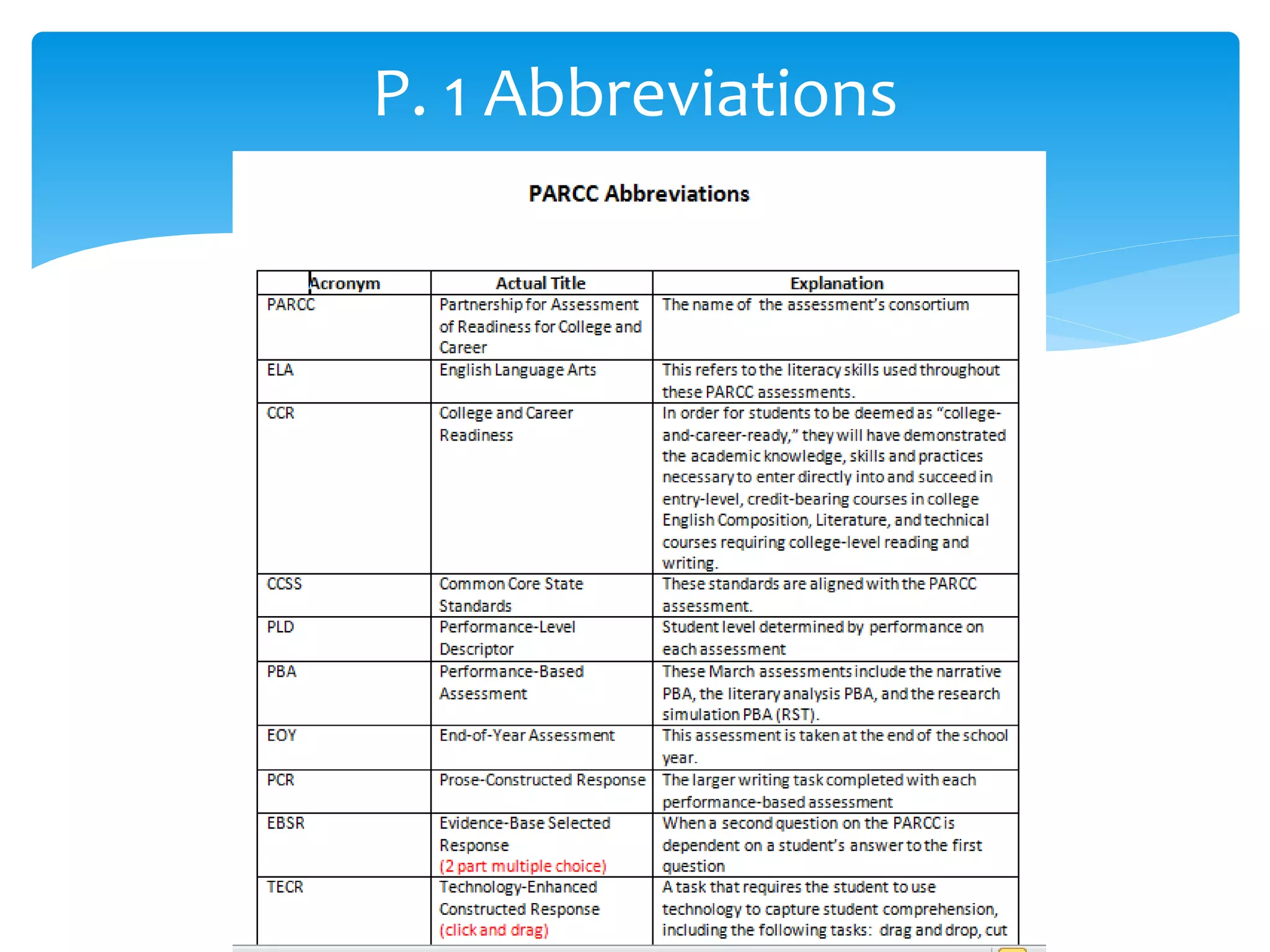
P. 1 Abbreviations
P. 2 Blueprints 
PARCC Test Blueprints
Section I – The Literary Analysis Task 
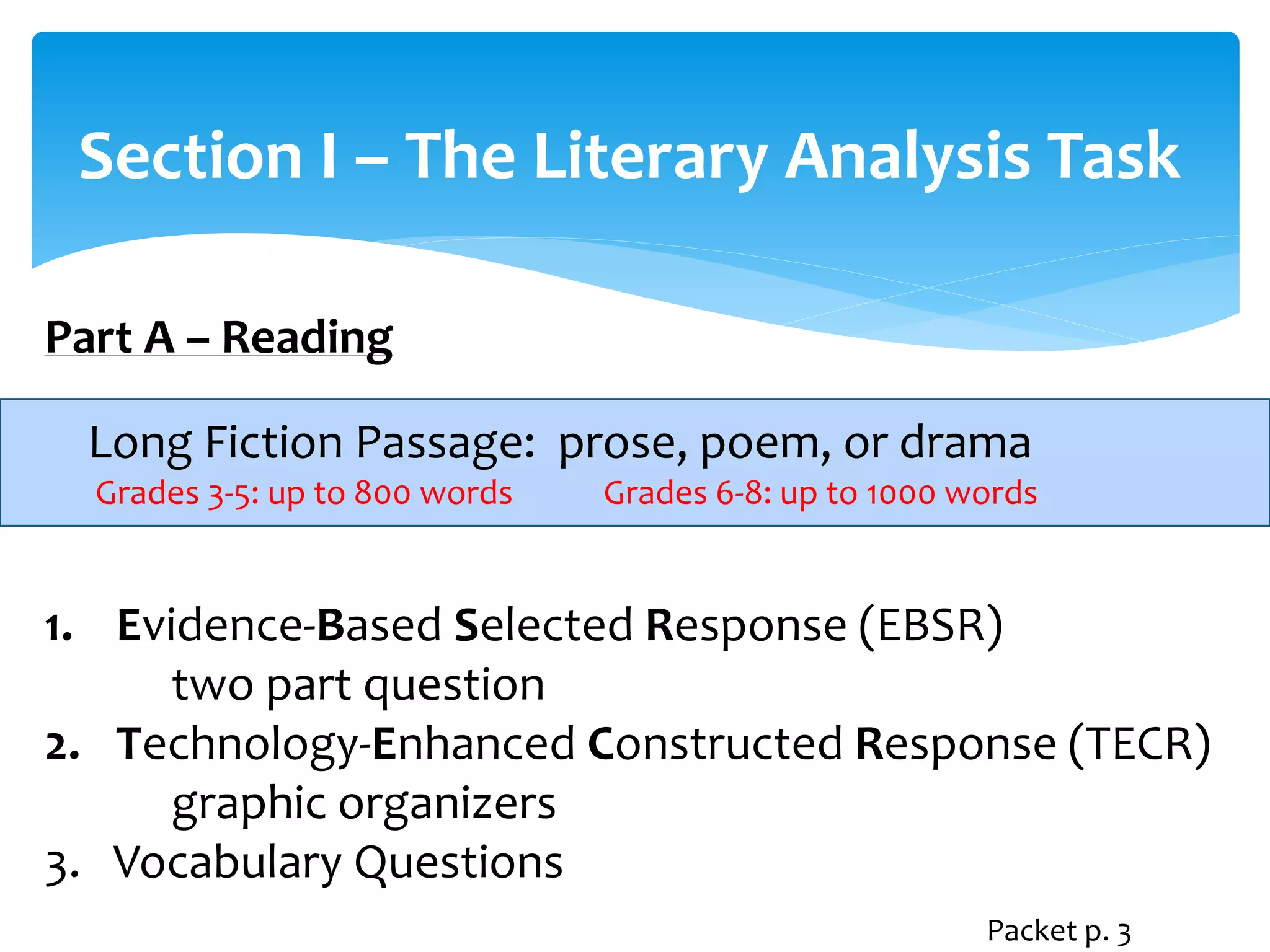
Part A – Reading 
Long Fiction Passage: prose, poem, or drama 
Grades 3-5: up to 800 words Grades 6-8: up to 1000 words 
1. Evidence-Based Selected Response (EBSR) 
two part question 
2. Technology-Enhanced Constructed Response (TECR) 
graphic organizers 
3. Vocabulary Questions 
Packet p. 3
Section I – The Literary Analysis Task 
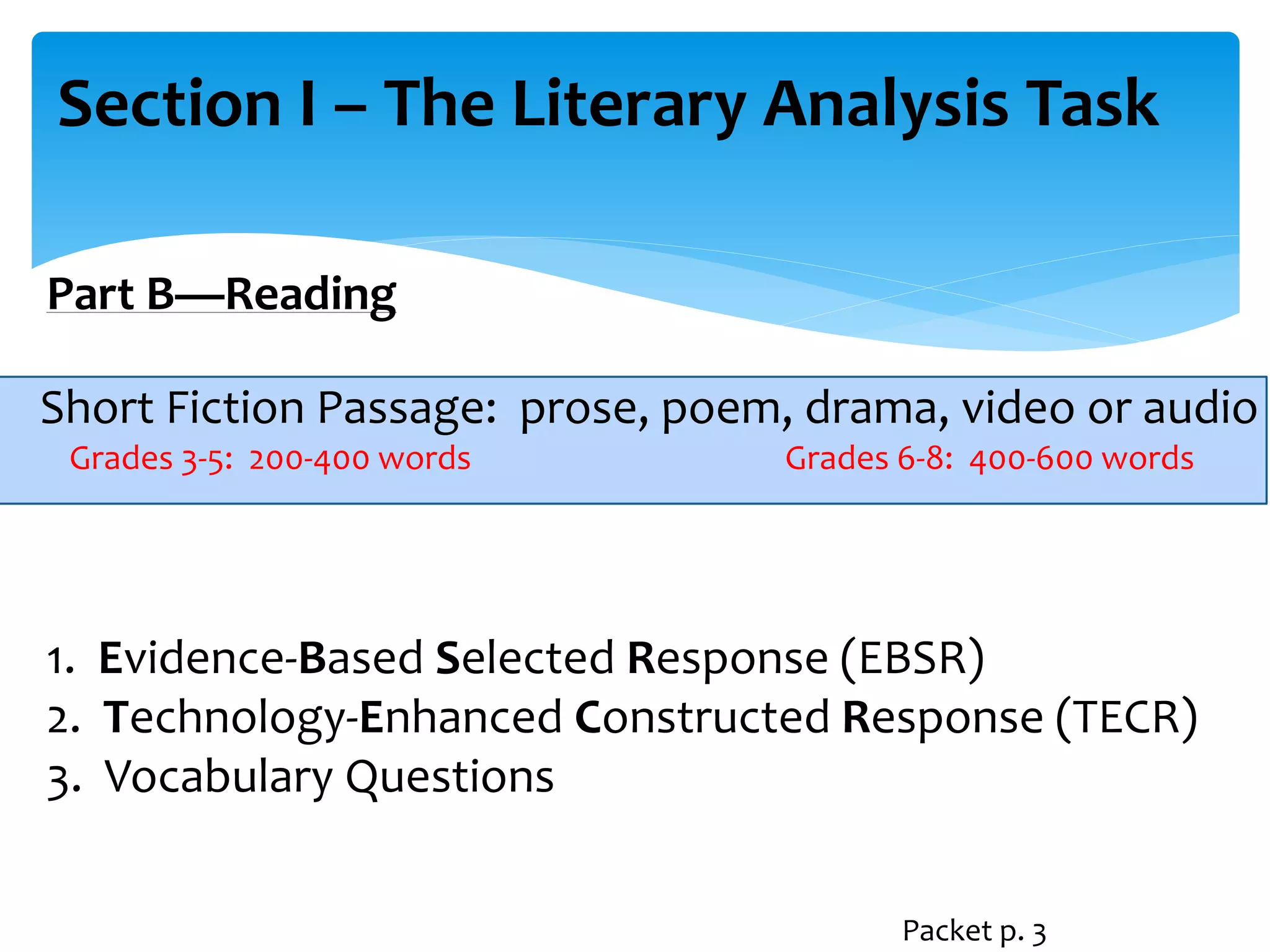
Part B—Reading 
Short Fiction Passage: prose, poem, drama, video or audio 
Grades 3-5: 200-400 words Grades 6-8: 400-600 words 
1. Evidence-Based Selected Response (EBSR) 
2. Technology-Enhanced Constructed Response (TECR) 
3. Vocabulary Questions 
Packet p. 3
Section I – The Literary Analysis Task 
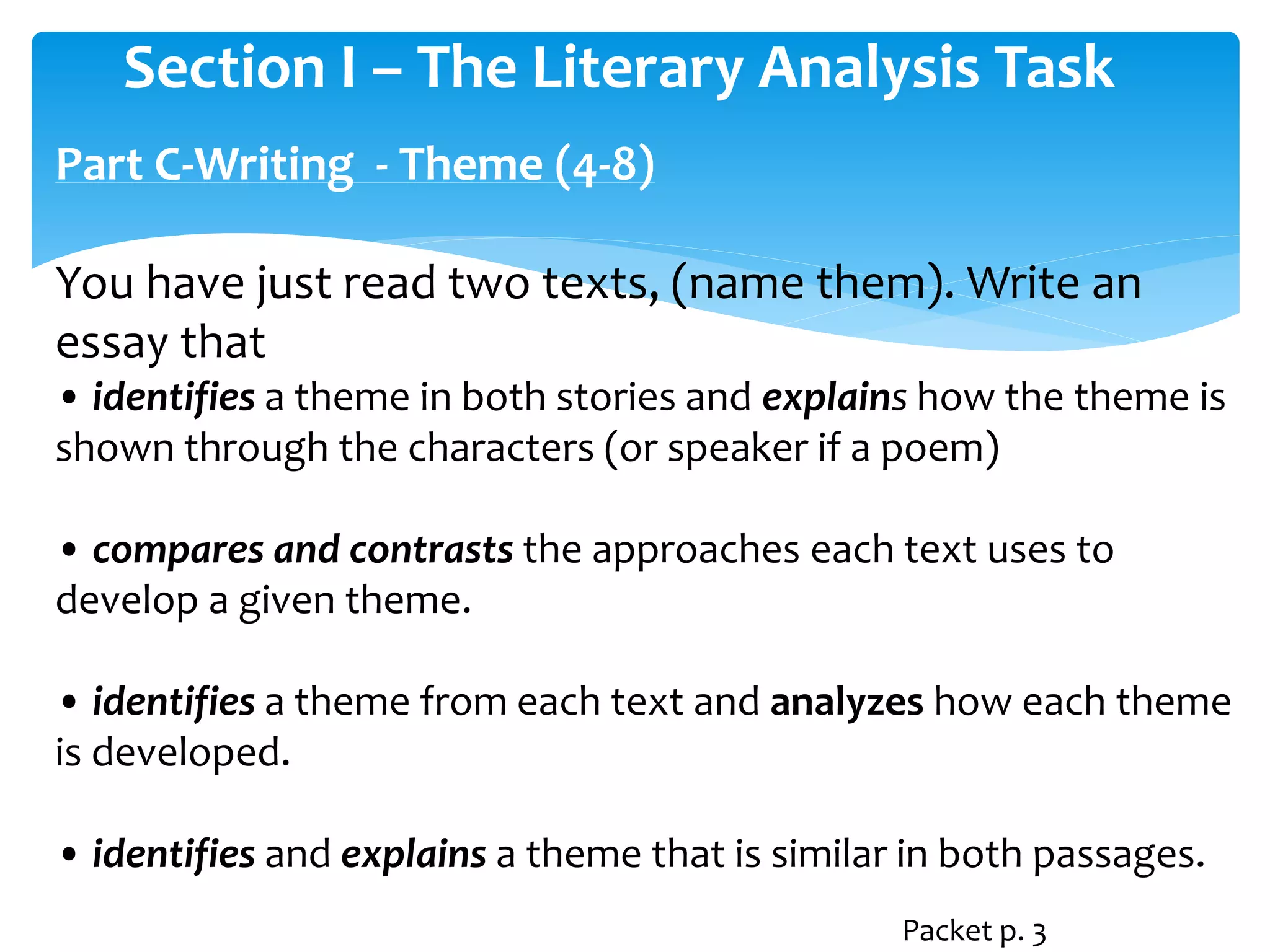
Part C-Writing - Theme (4-8) 
You have just read two texts, (name them). Write an 
essay that 
• identifies a theme in both stories and explains how the theme is 
shown through the characters (or speaker if a poem) 
• compares and contrasts the approaches each text uses to 
develop a given theme. 
• identifies a theme from each text and analyzes how each theme 
is developed. 
• identifies and explains a theme that is similar in both passages. 
Packet p. 3
Section I – The Literary Analysis Task 
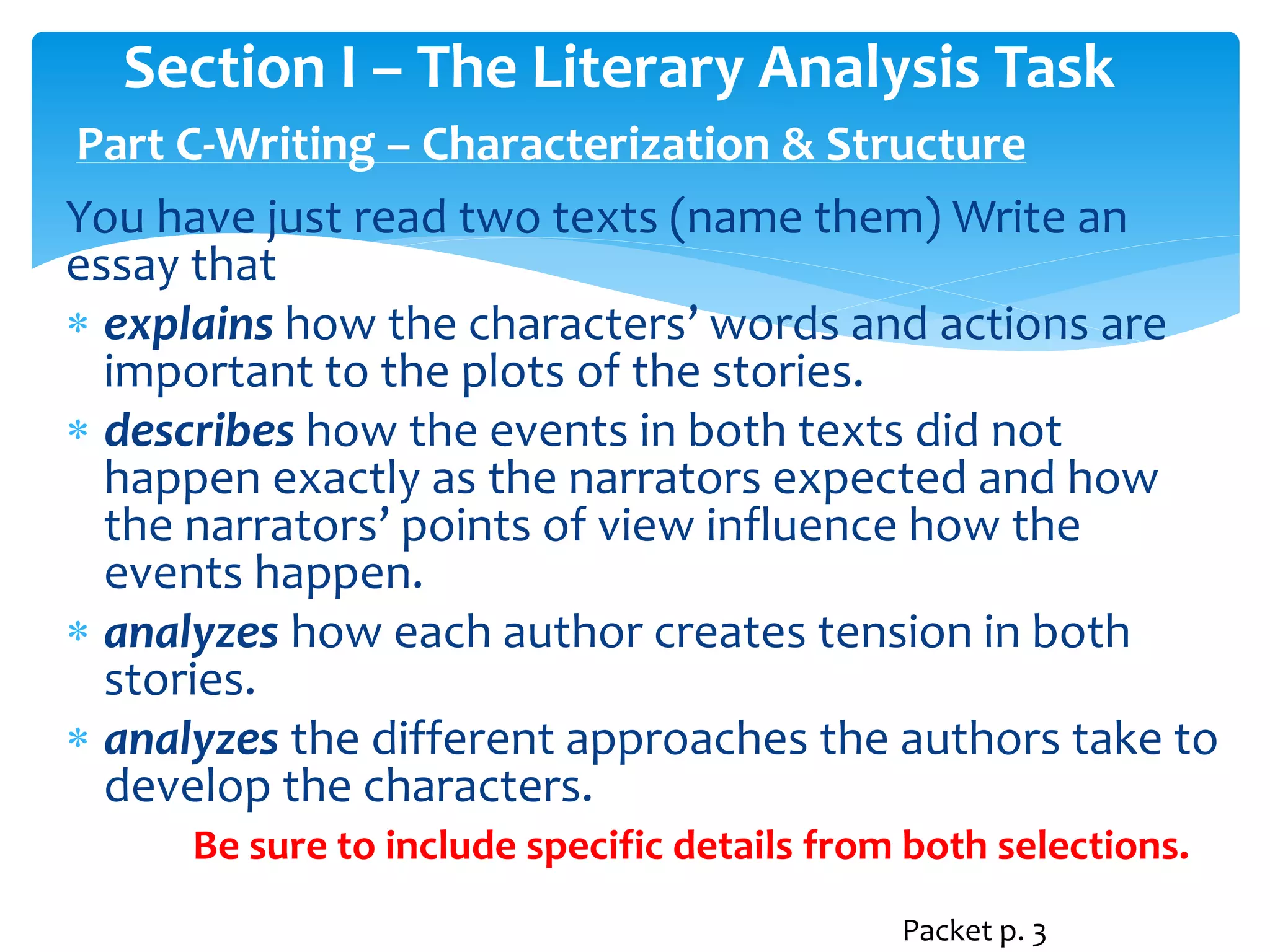
Part C-Writing – Characterization & Structure 
You have just read two texts (name them) Write an 
essay that 
 explains how the characters’ words and actions are 
important to the plots of the stories. 
 describes how the events in both texts did not 
happen exactly as the narrators expected and how 
the narrators’ points of view influence how the 
events happen. 
 analyzes how each author creates tension in both 
stories. 
 analyzes the different approaches the authors take to 
develop the characters. 
Be sure to include specific details from both selections. 
Packet p. 3
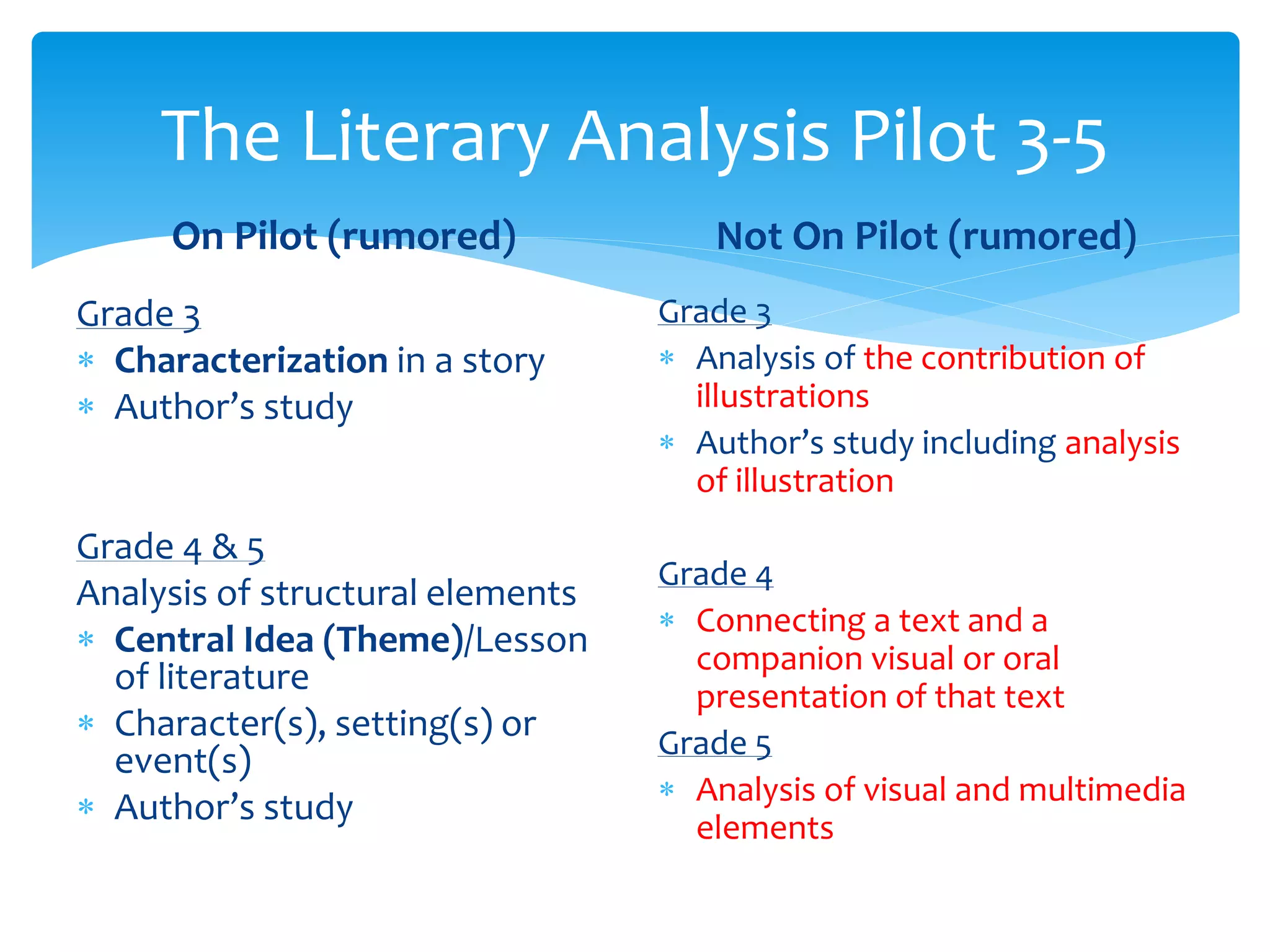
The Literary Analysis Pilot 3-5 
On Pilot (rumored) 
Grade 3 
 Characterization in a story 
 Author’s study 
Grade 4 & 5 
Analysis of structural elements 
 Central Idea (Theme)/Lesson 
of literature 
 Character(s), setting(s) or 
event(s) 
 Author’s study 
Not On Pilot (rumored) 
Grade 3 
 Analysis of the contribution of 
illustrations 
 Author’s study including analysis 
of illustration 
Grade 4 
 Connecting a text and a 
companion visual or oral 
presentation of that text 
Grade 5 
 Analysis of visual and multimedia 
elements
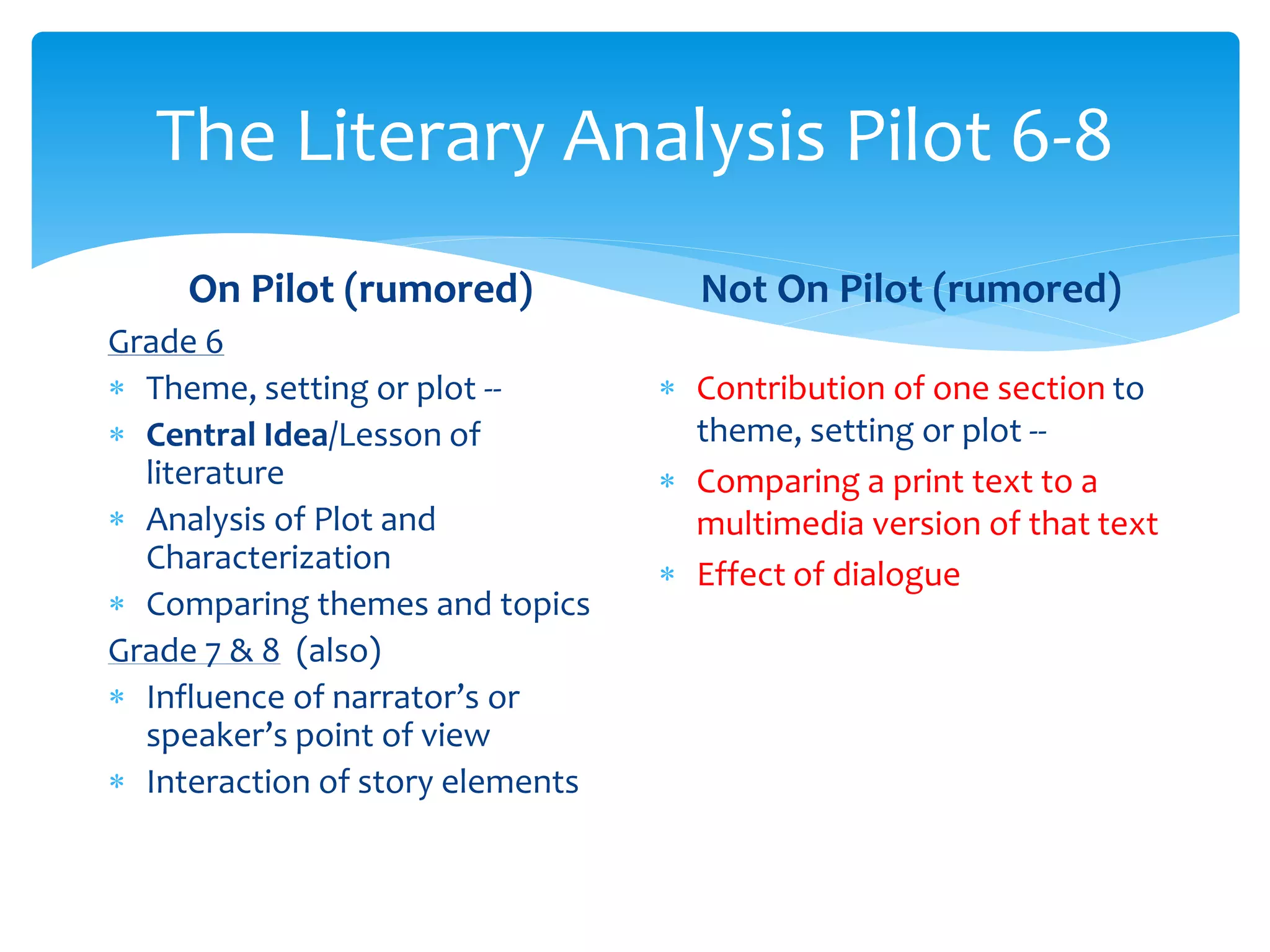
The Literary Analysis Pilot 6-8 
On Pilot (rumored) 
Grade 6 
 Theme, setting or plot -‐ 
 Central Idea/Lesson of 
literature 
 Analysis of Plot and 
Characterization 
 Comparing themes and topics 
Grade 7 & 8 (also) 
 Influence of narrator’s or 
speaker’s point of view 
 Interaction of story elements 
Not On Pilot (rumored) 
 Contribution of one section to 
theme, setting or plot -‐ 
 Comparing a print text to a 
multimedia version of that text 
 Effect of dialogue
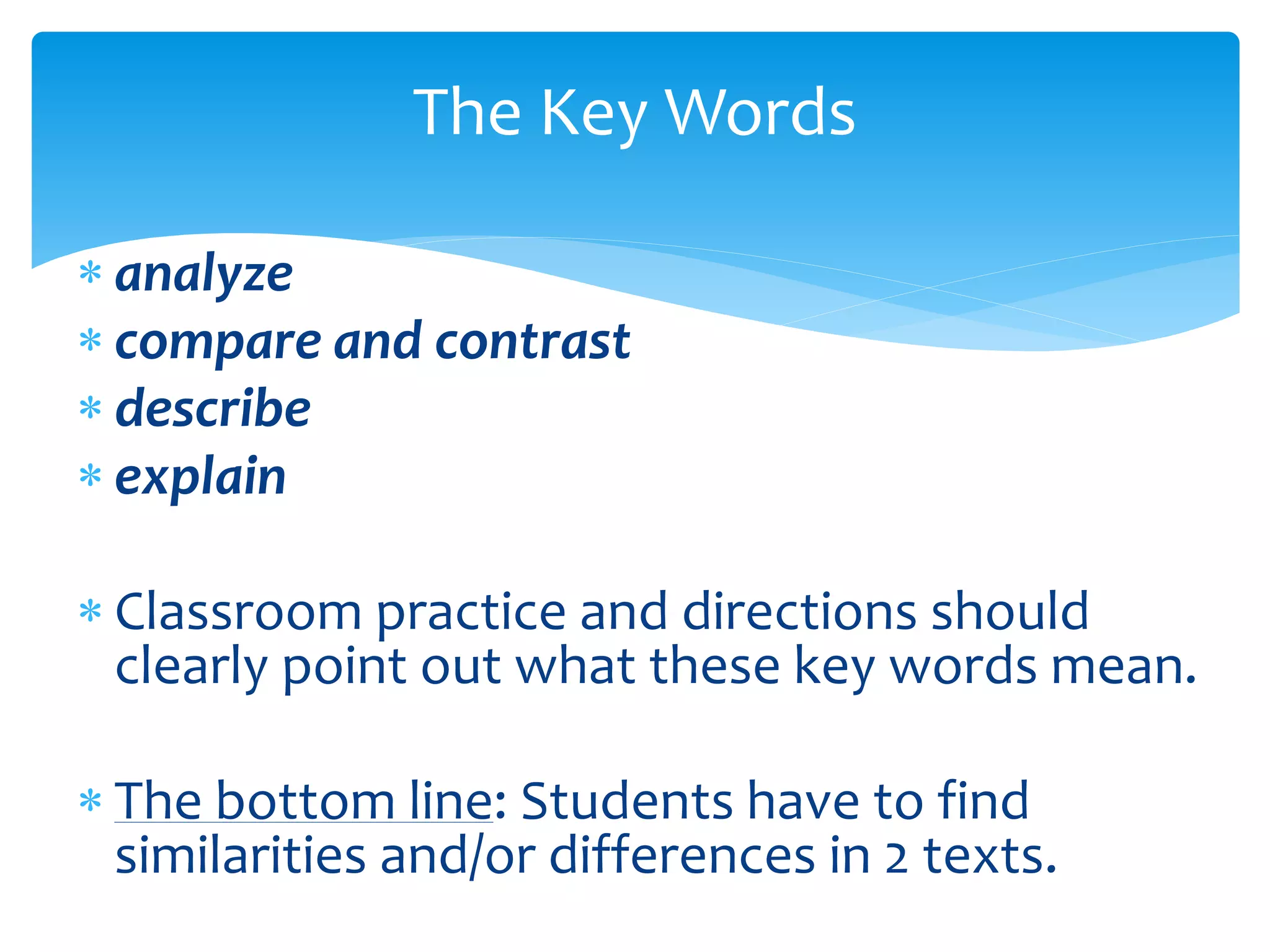
The Key Words 
 analyze 
 compare and contrast 
 describe 
 explain 
 Classroom practice and directions should 
clearly point out what these key words mean. 
 The bottom line: Students have to find 
similarities and/or differences in 2 texts.
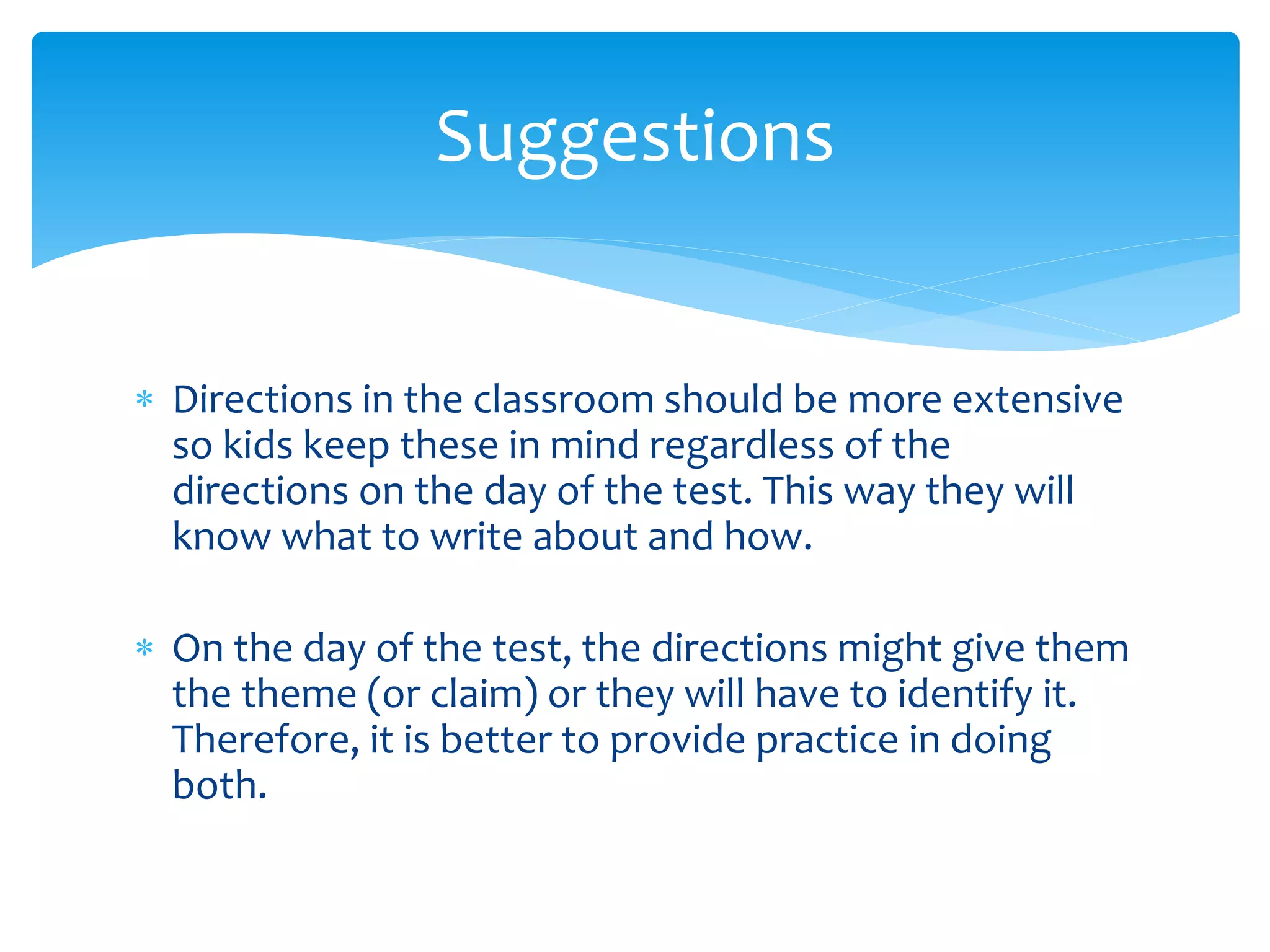
Suggestions 
 Directions in the classroom should be more extensive 
so kids keep these in mind regardless of the 
directions on the day of the test. This way they will 
know what to write about and how. 
 On the day of the test, the directions might give them 
the theme (or claim) or they will have to identify it. 
Therefore, it is better to provide practice in doing 
both.
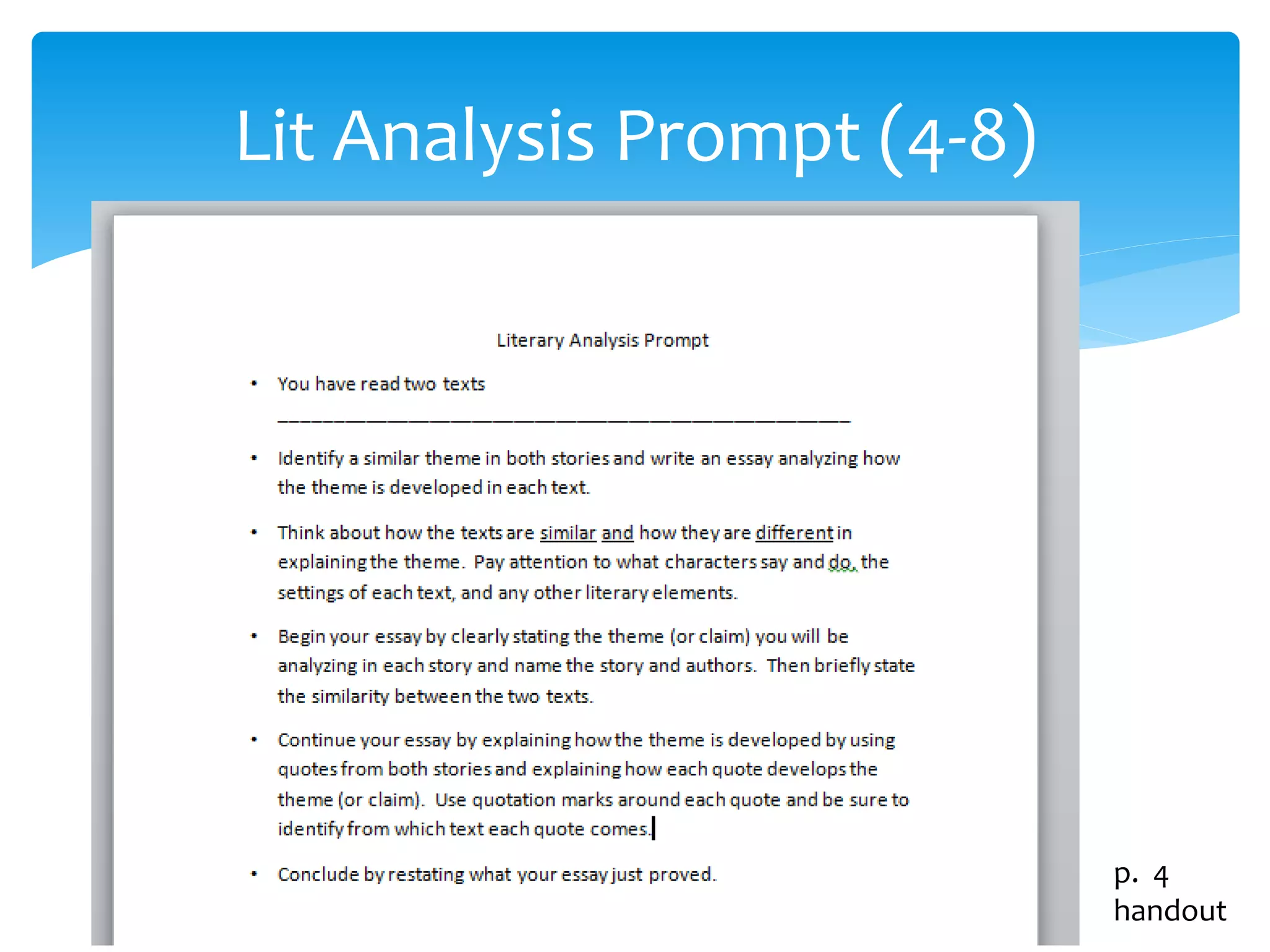
Lit Analysis Prompt (4-8) 
p. 4 
handout
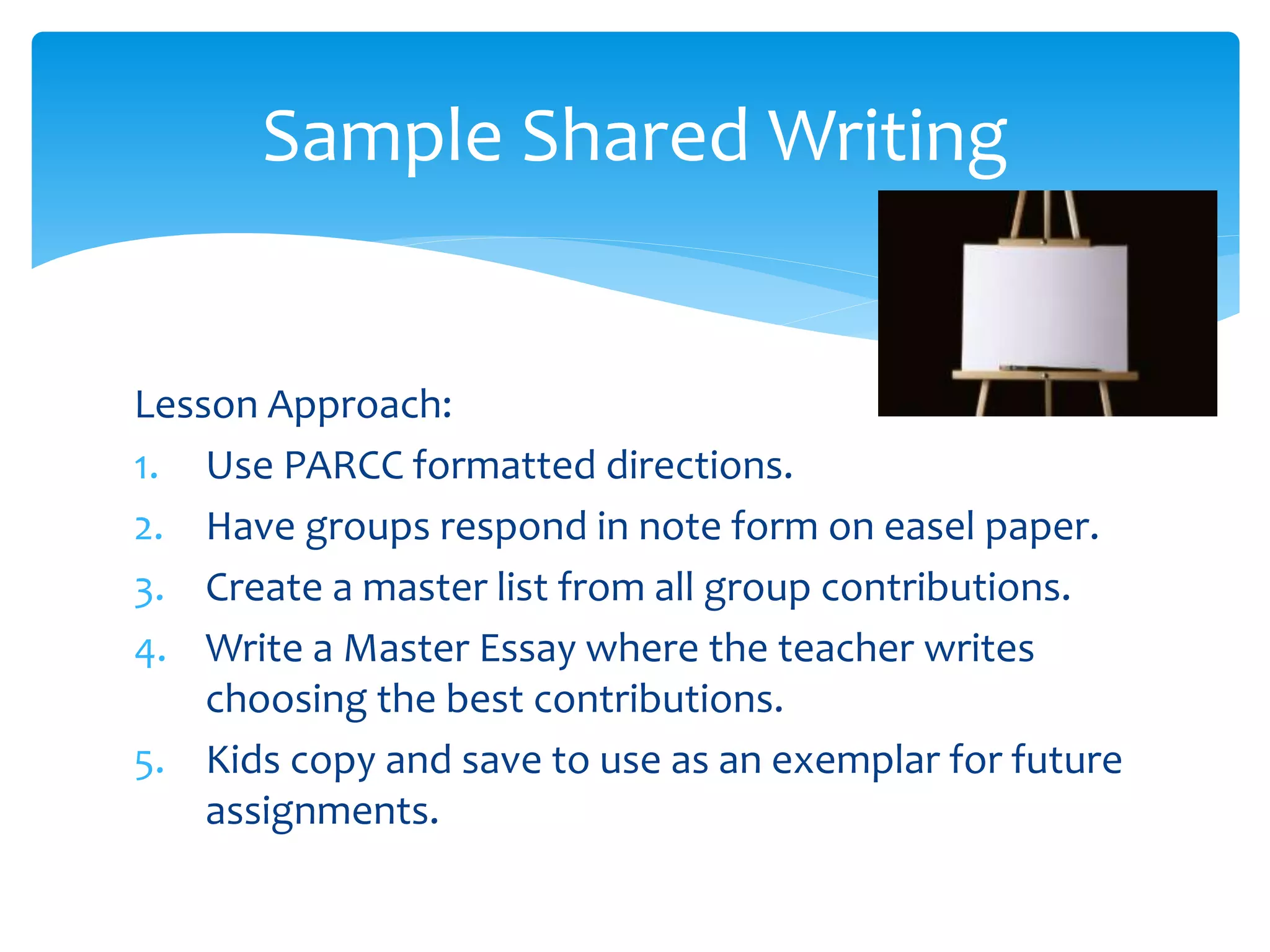
Sample Shared Writing 
Lesson Approach: 
1. Use PARCC formatted directions. 
2. Have groups respond in note form on easel paper. 
3. Create a master list from all group contributions. 
4. Write a Master Essay where the teacher writes 
choosing the best contributions. 
5. Kids copy and save to use as an exemplar for future 
assignments.
Other Elements 
In addition to theme, characterization and 
structure, prepare for essays on other elements. 
 Pick two texts that have a similarity or 
difference: 
 Point of view 
 Character development 
 Character relationships 
 Character reactions
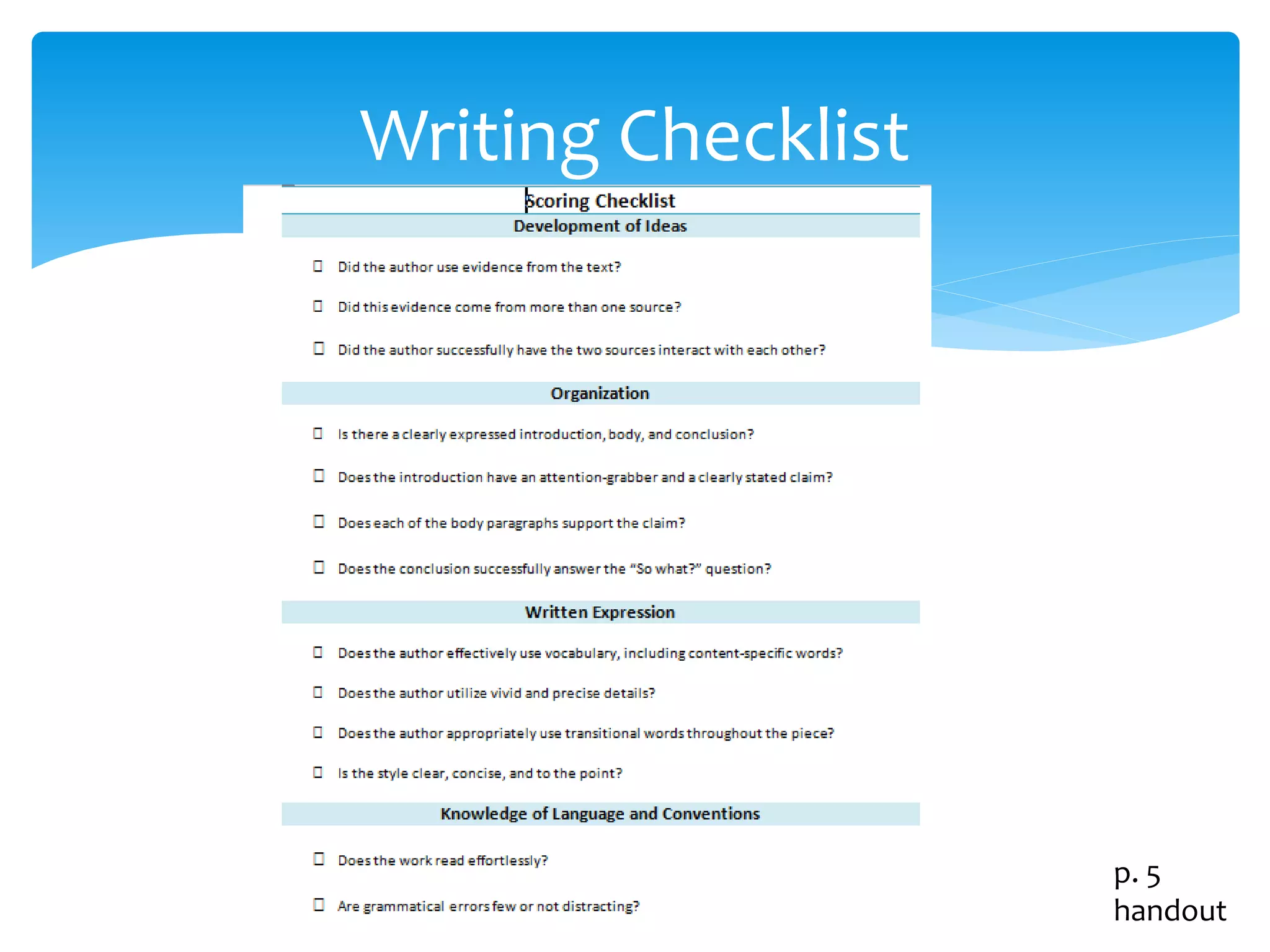
Writing Checklist 
p. 5 
handout
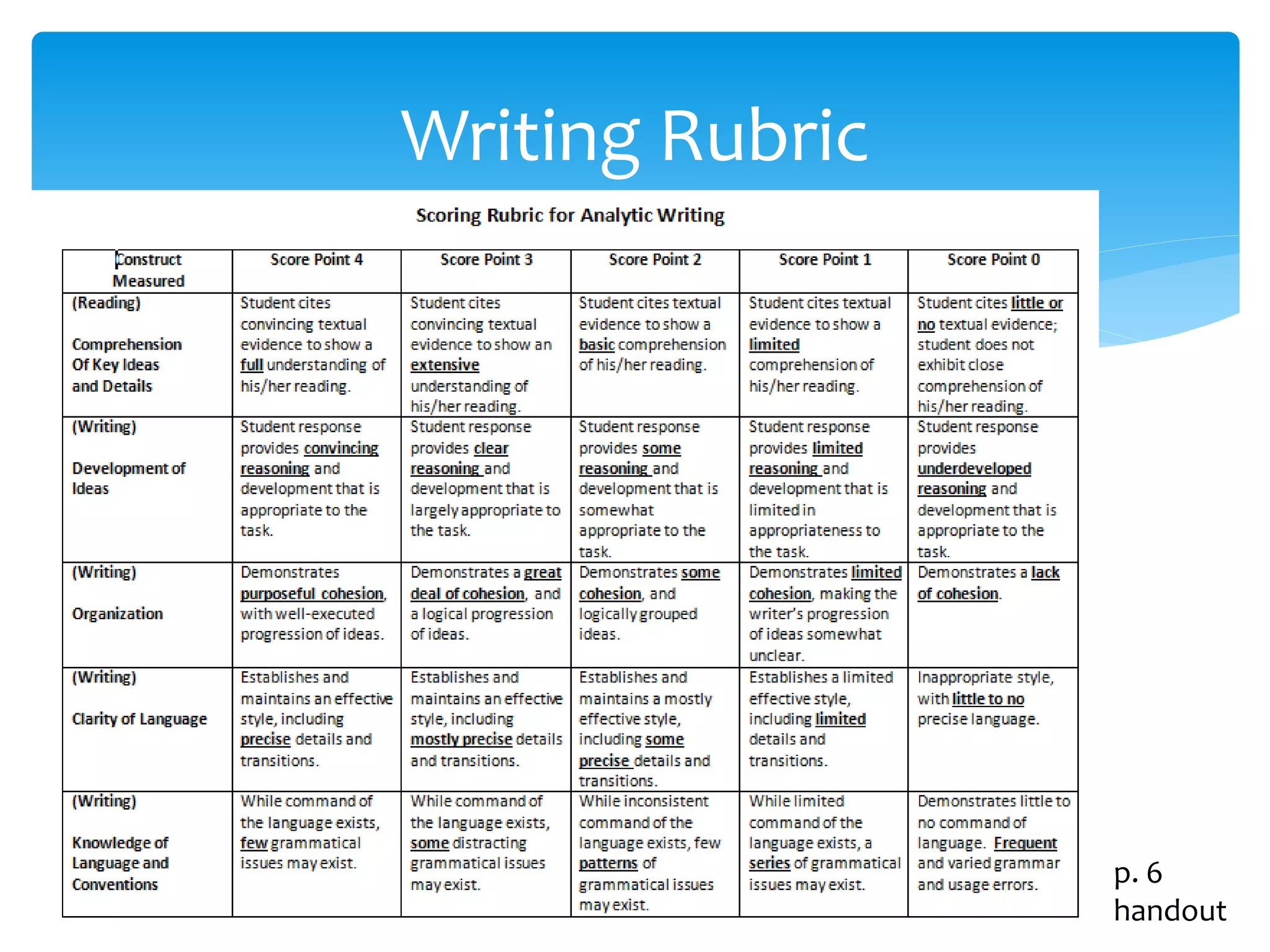
Writing Rubric 
p. 6 
handout
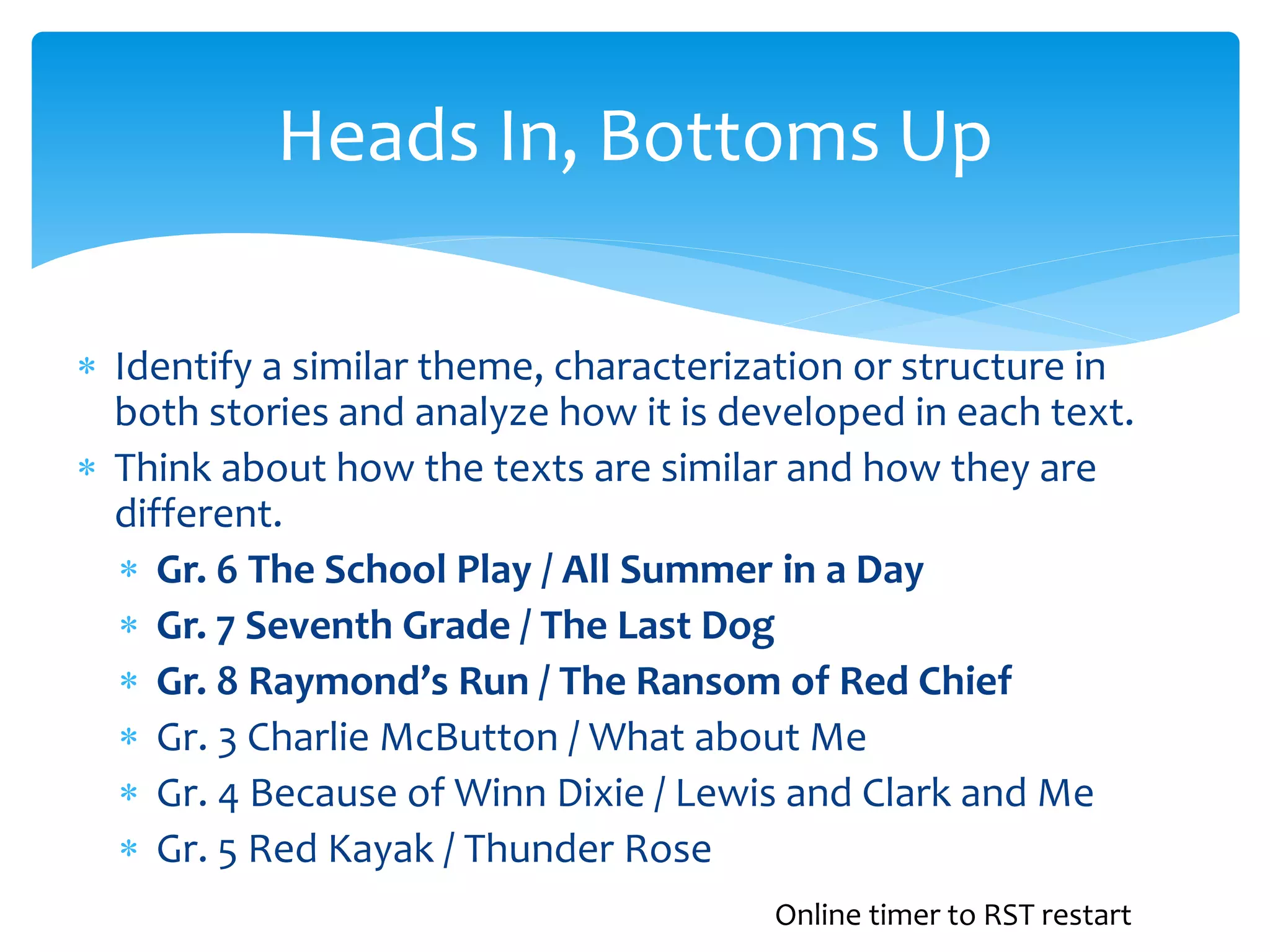
Heads In, Bottoms Up 
 Identify a similar theme, characterization or structure in 
both stories and analyze how it is developed in each text. 
 Think about how the texts are similar and how they are 
different. 
 Gr. 6 The School Play / All Summer in a Day 
 Gr. 7 Seventh Grade / The Last Dog 
 Gr. 8 Raymond’s Run / The Ransom of Red Chief 
 Gr. 3 Charlie McButton / What about Me 
 Gr. 4 Because of Winn Dixie / Lewis and Clark and Me 
 Gr. 5 Red Kayak / Thunder Rose 
Online timer to RST restart
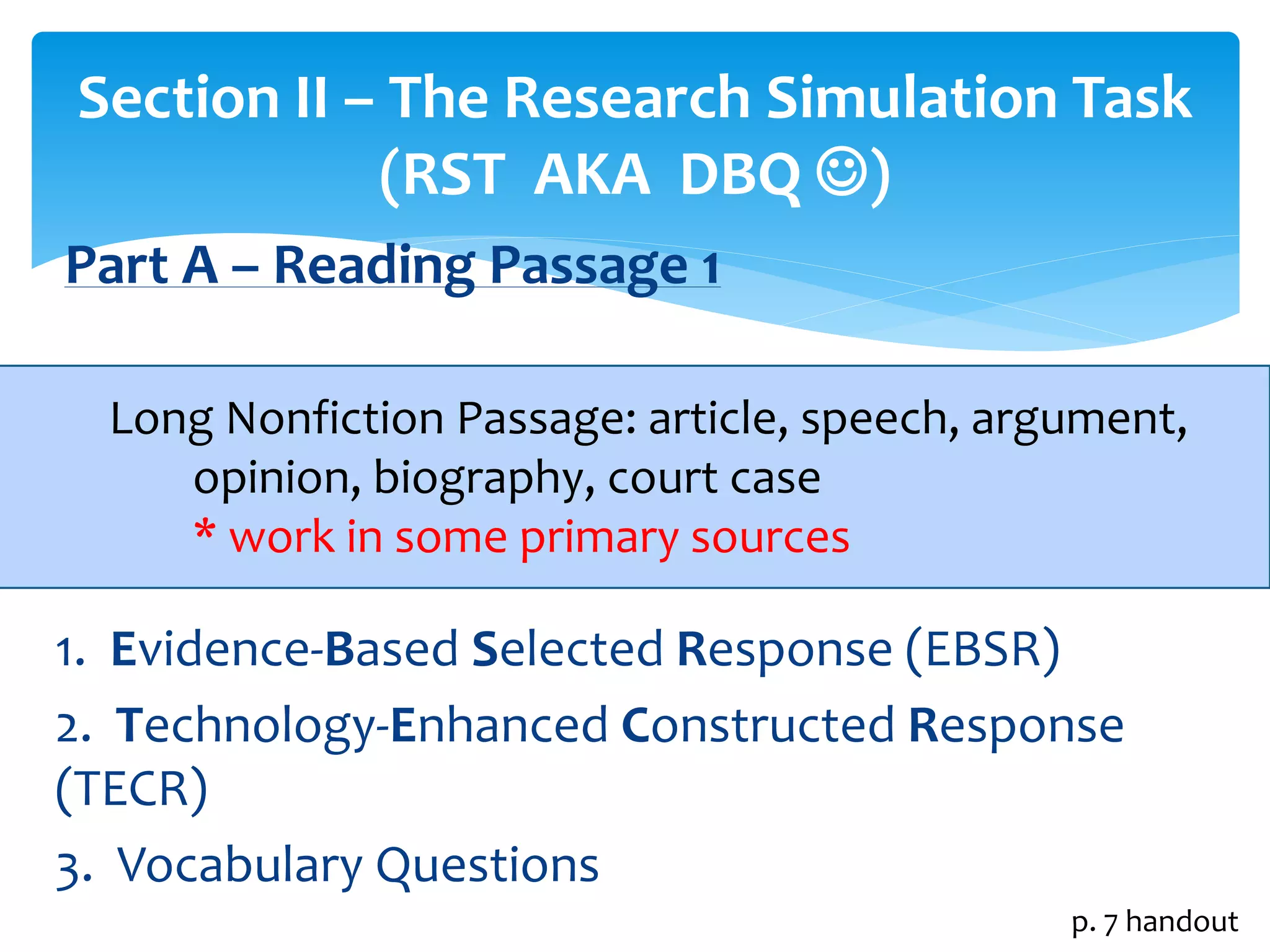
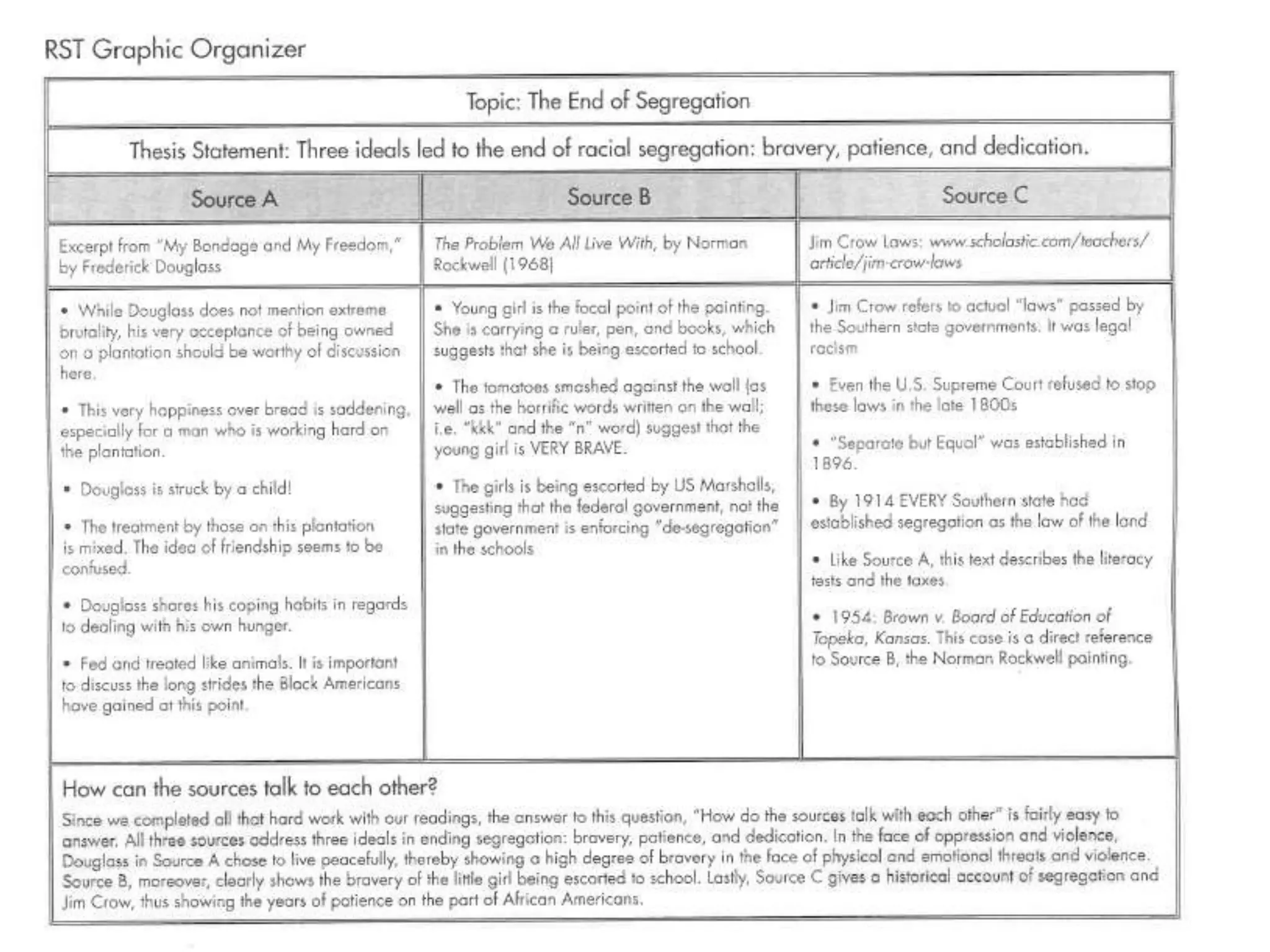
Section II – The Research Simulation Task 
(RST AKA DBQ ) 
Part A – Reading Passage 1 
 
Long Nonfiction Passage: article, speech, argument, 
opinion, biography, court case 
* work in some primary sources 
1. Evidence-Based Selected Response (EBSR) 
2. Technology-Enhanced Constructed Response 
(TECR) 
3. Vocabulary Questions 
p. 7 handout
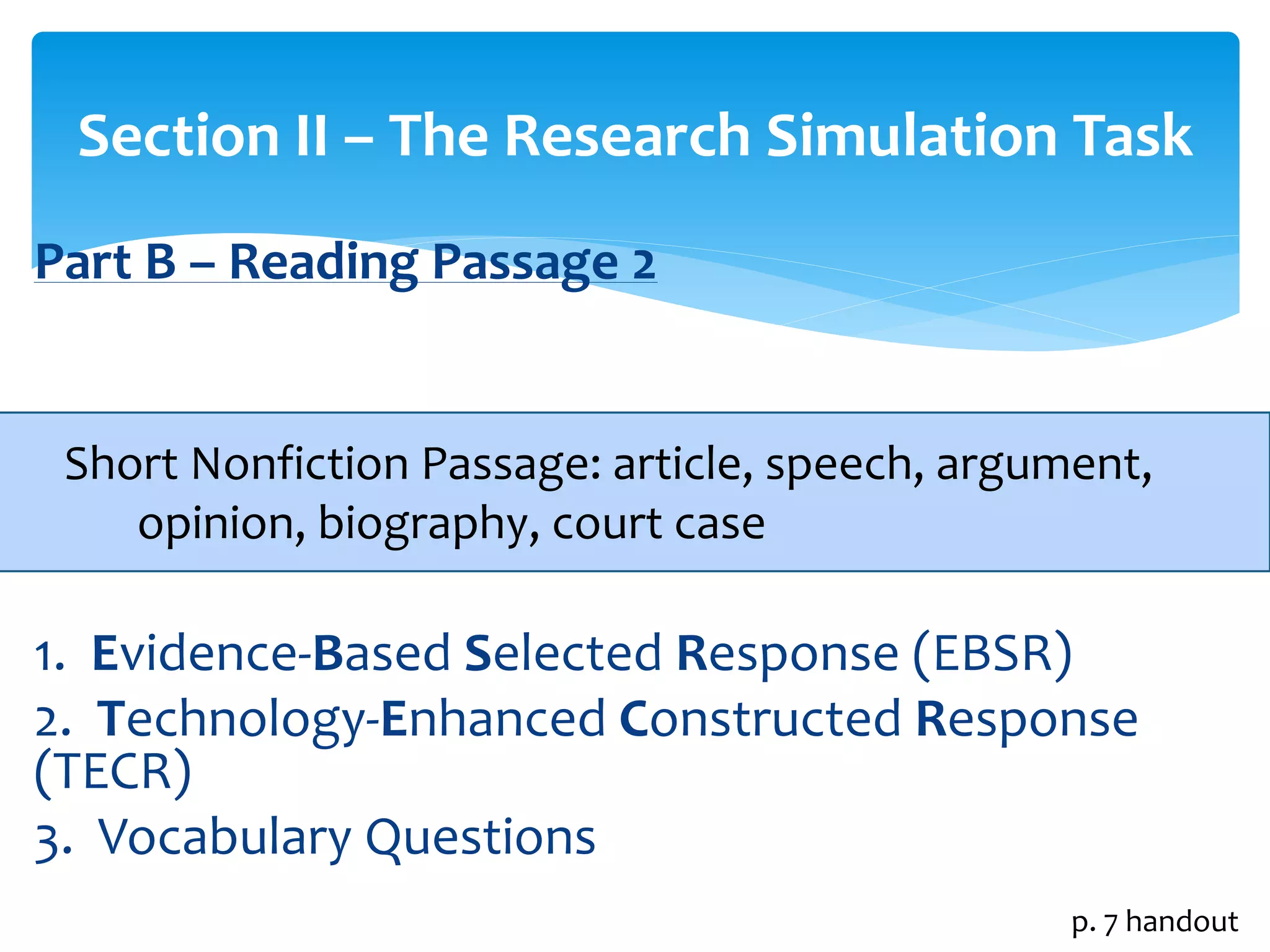
Section II – The Research Simulation Task 
Part B – Reading Passage 2 
Short Nonfiction Passage: article, speech, argument, 
opinion, biography, court case 
1. Evidence-Based Selected Response (EBSR) 
2. Technology-Enhanced Constructed Response 
(TECR) 
3. Vocabulary Questions 
p. 7 handout
Section II – The Research Simulation Task 
Part C – Reading Passage 3 
Short Nonfiction Passage or Video Clip 
1. Evidence-Based Selected Response (EBSR) 
2. Technology-Enhanced Constructed Response (TECR) 
3. Vocabulary Questions 
p. 7 handout
Section II – The Research Simulation Task 
Part D –Writing The Research Simulation Task - SCIENTIFIC-RELATED 
(animals, environment, chemistry, archeology) 
You have read two texts (name them) and viewed a video 
entitled (name it). In an essay 
• describe the roles of animals and humans in a process or procedure 
• compare how each source describes the roles of animals and humans in a 
process or procedure 
• identify a similar claim in the sources and then compare and contrast the 
evidence each source uses 
• compare the purposes of each source then analyze how each source uses 
information and evidence 
• compare and contrast the information in the texts with the information in 
the video 
• examine and/or delineate a phenomenon 
p. 7 handout
Section II – The Research Simulation Task 
Part D –Writing The Research Simulation Task for 
HISTORY-RELATED or ARGUMENT/OPINION 
• compare and contrast a primary argument in each text 
• explore author’s purpose 
Part D –Writing The Research Simulation Task for 
COURT CASE 
• analyze how effectively the arguments are presented 
for each side 
Remember to use evidence from all three (or at least 
two) sources to support your ideas 
p. 7 handout
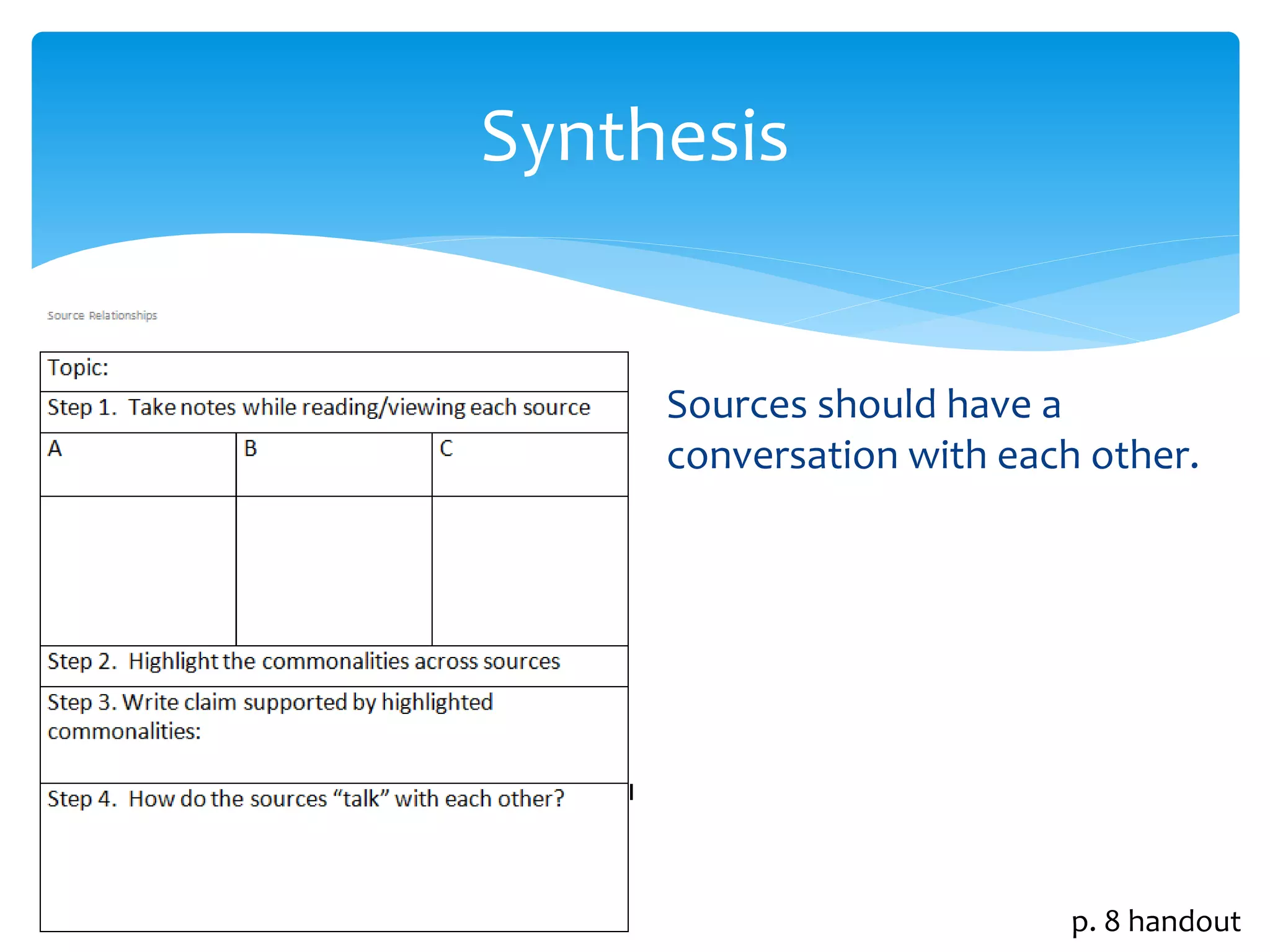
Synthesis 
Sources should have a 
conversation with each other. 
p. 8 handout
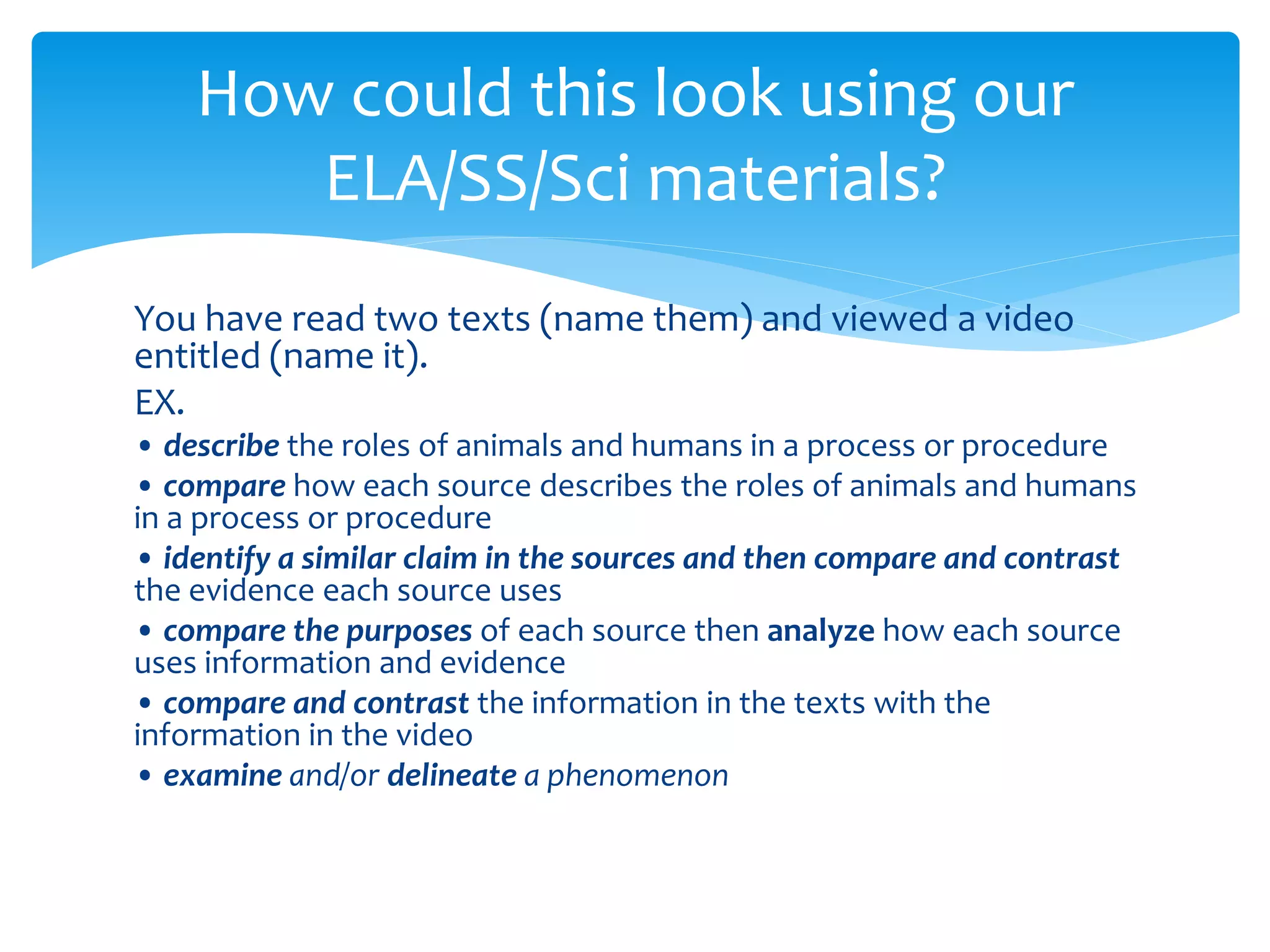
How could this look using our 
ELA/SS/Sci materials? 
You have read two texts (name them) and viewed a video 
entitled (name it). 
EX. 
• describe the roles of animals and humans in a process or procedure 
• compare how each source describes the roles of animals and humans 
in a process or procedure 
• identify a similar claim in the sources and then compare and contrast 
the evidence each source uses 
• compare the purposes of each source then analyze how each source 
uses information and evidence 
• compare and contrast the information in the texts with the 
information in the video 
• examine and/or delineate a phenomenon
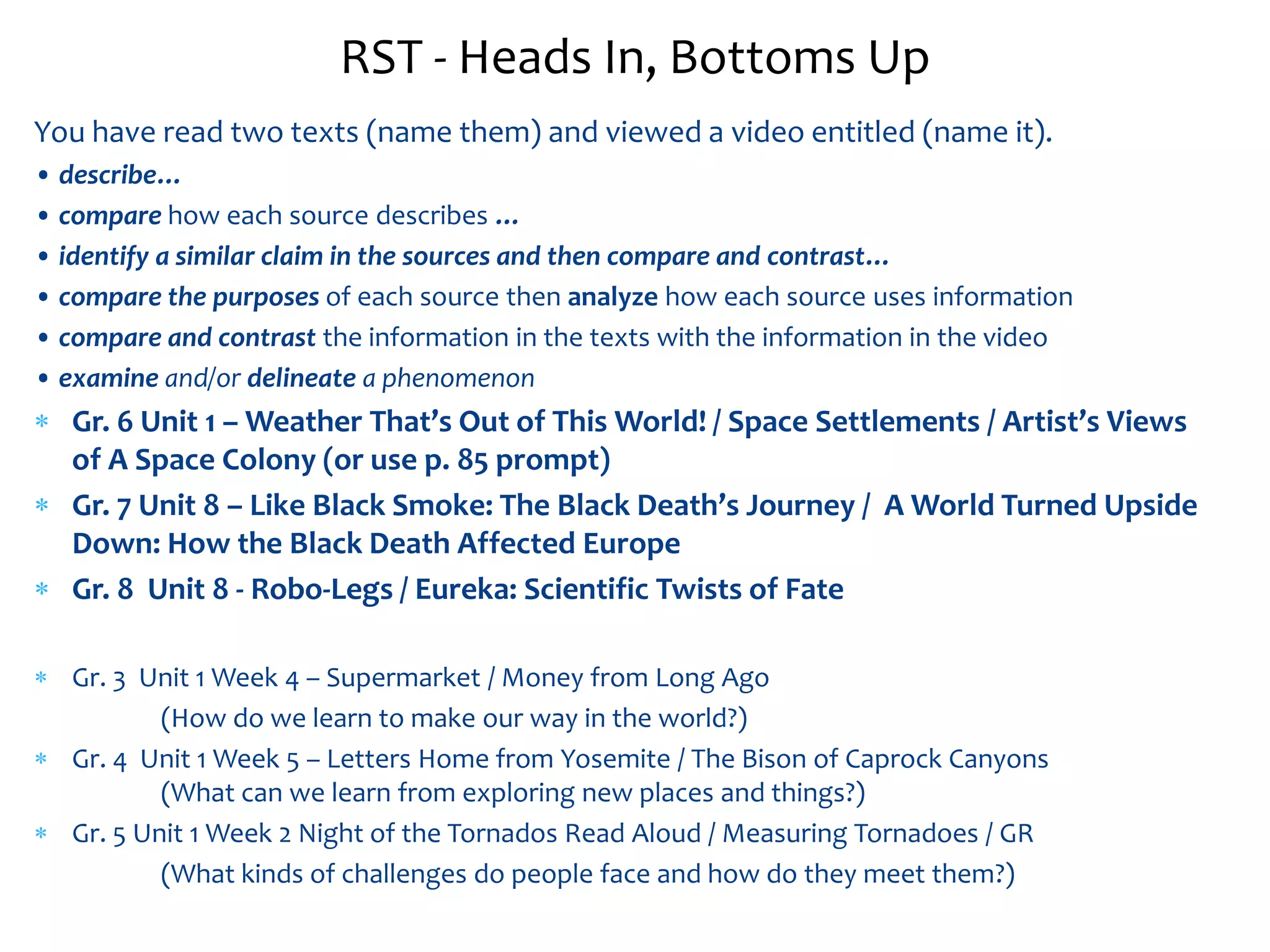
RST - Heads In, Bottoms Up 
You have read two texts (name them) and viewed a video entitled (name it). 
• describe… 
• compare how each source describes … 
• identify a similar claim in the sources and then compare and contrast… 
• compare the purposes of each source then analyze how each source uses information 
• compare and contrast the information in the texts with the information in the video 
• examine and/or delineate a phenomenon 
 Gr. 6 Unit 1 – Weather That’s Out of This World! / Space Settlements / Artist’s Views 
of A Space Colony (or use p. 85 prompt) 
 Gr. 7 Unit 8 – Like Black Smoke: The Black Death’s Journey / A World Turned Upside 
Down: How the Black Death Affected Europe 
 Gr. 8 Unit 8 - Robo-Legs / Eureka: Scientific Twists of Fate 
 Gr. 3 Unit 1 Week 4 – Supermarket / Money from Long Ago 
(How do we learn to make our way in the world?) 
 Gr. 4 Unit 1 Week 5 – Letters Home from Yosemite / The Bison of Caprock Canyons 
(What can we learn from exploring new places and things?) 
 Gr. 5 Unit 1 Week 2 Night of the Tornados Read Aloud / Measuring Tornadoes / GR 
(What kinds of challenges do people face and how do they meet them?)
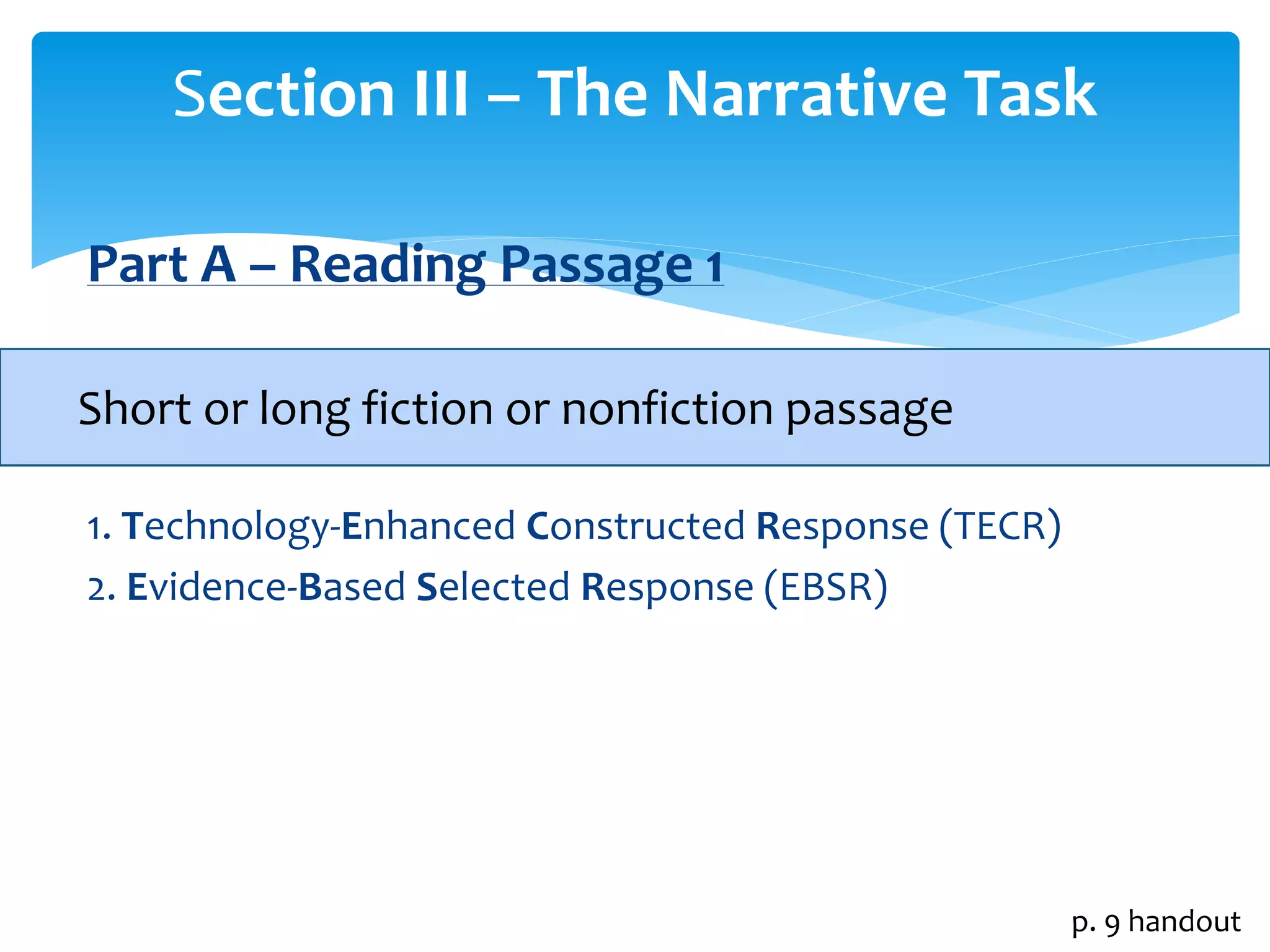
Section III – The Narrative Task 
Part A – Reading Passage 1 
Short or long fiction or nonfiction passage 
1. Technology-Enhanced Constructed Response (TECR) 
2. Evidence-Based Selected Response (EBSR) 
p. 9 handout
Section III – The Narrative Task 
Part B—Writing The Narrative Task 
for the FICTION TEXT 
You have read (name the text). 
• Write a journal entry from the character (name him or her) 
about what happened in the story. 
• Write a narrative story retelling the story from the point of 
view of (name the character). 
• Write an original short story that describes what (name the 
character) does next. 
Think about the details the author uses to create the characters, settings, and 
events in the story and use these as a guide in writing your own narrative. 
p. 9 handout
Section III – The Narrative Task 
Part B—Writing The Narrative Task (Continued) 
for the FICTION TEXT 
• Write a continuation of the story using details from the story 
you just read. 
• Write a narrative story that describes the major events in the 
passage from the point of view of (name the character—it could 
even be a character that was not in the story but was suggested 
in the story). 
• Write a narrative story that describes what the character 
(name the character) does and the experiences she or he has. 
p. 9 handout
Section III – The Narrative Task 
Part B—Writing The Narrative Task 
for the NON-FICTION TEXT 
You have just read an article on (a scientific or 
historical event) with a short personal introduction. 
• Write an original short story from the perspective 
of (name a person from the short personal 
introduction). 
Be sure to include details (scientific or historical) in 
your original short story. 
p. 9 handout
Test Talk 
Increasing success on EBSRs and TECRs 
http://www.flocabulary.com/test-taking-vocabulary/
The EBSR - Part A 
Q. On the PARRC multiple choice questions, how many 
right answers are there? 
A. Four… 
B. One is best 
 Students will also be required to negotiate plausible, 
text-‐based distractors
Q. Who was the first president of the 
United States? 
A. 
B. 
C. 
D. 
Q. What WRONG answers would you expect?
Q. Who was the first president of the 
United States? 
A. Martha Washington’s husband 
B. G. Washington 
C. General Washington 
D. The man who commanded the American 
Revolutionary army
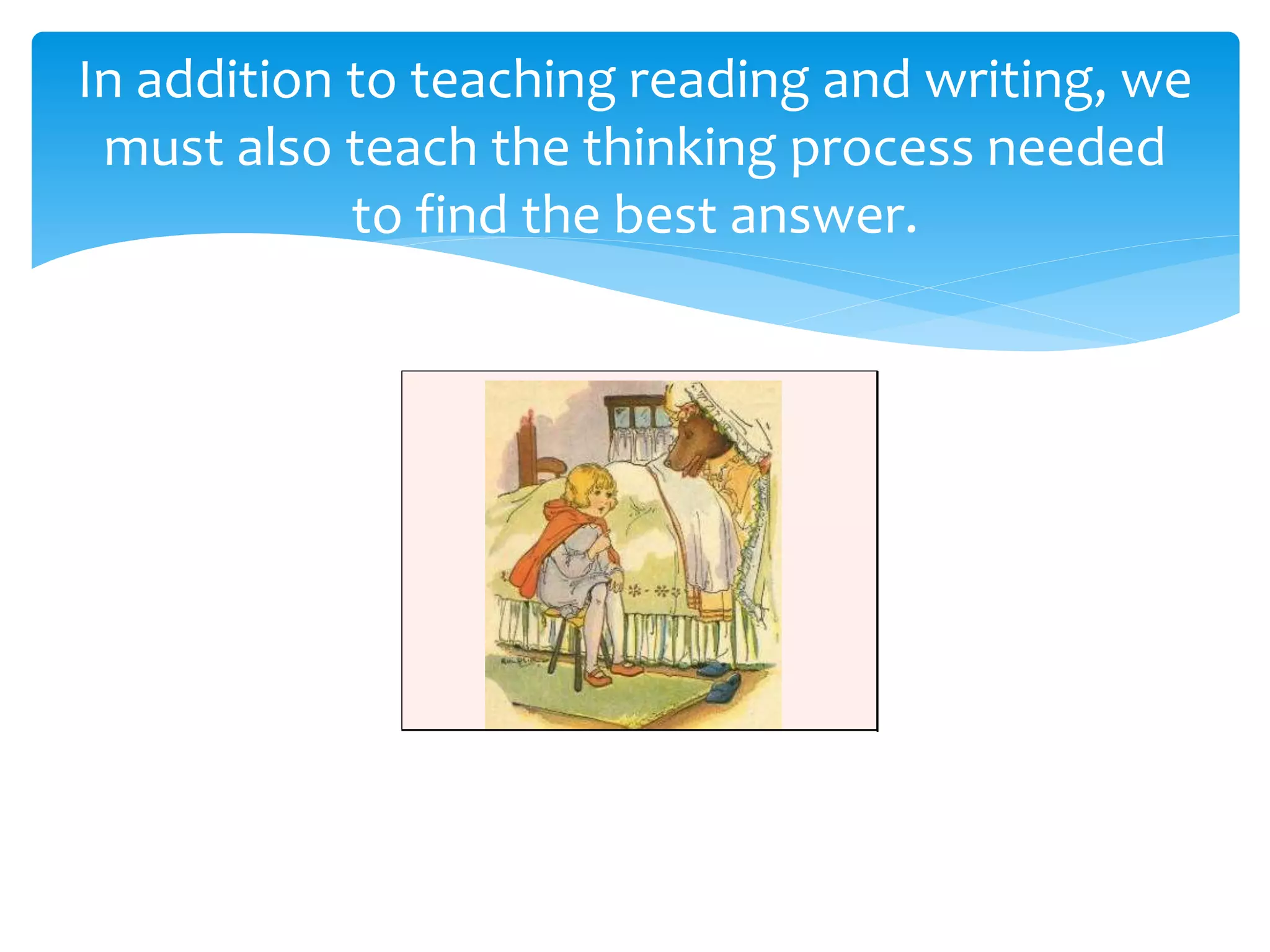
In addition to teaching reading and writing, we 
must also teach the thinking process needed 
to find the best answer.
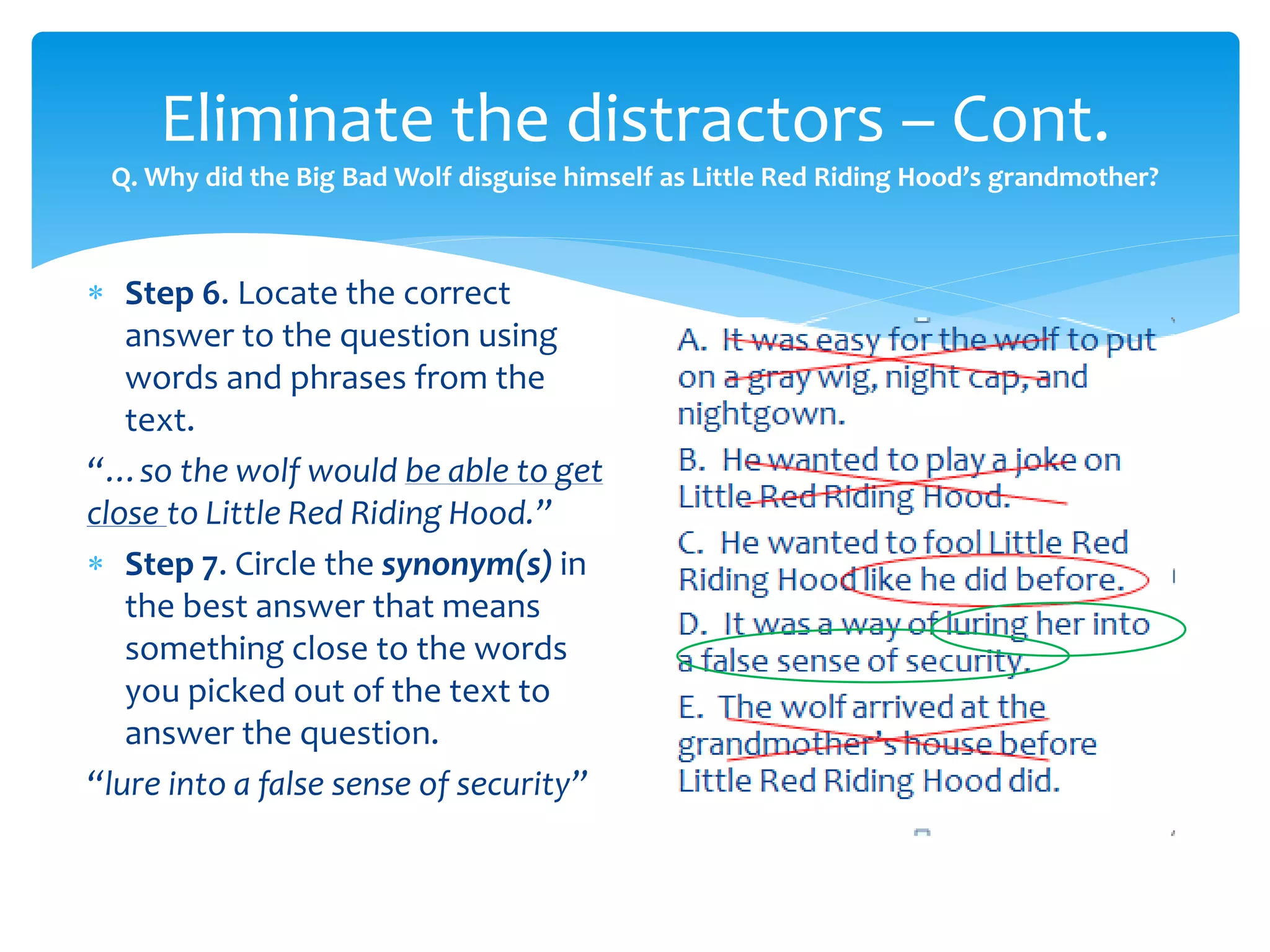
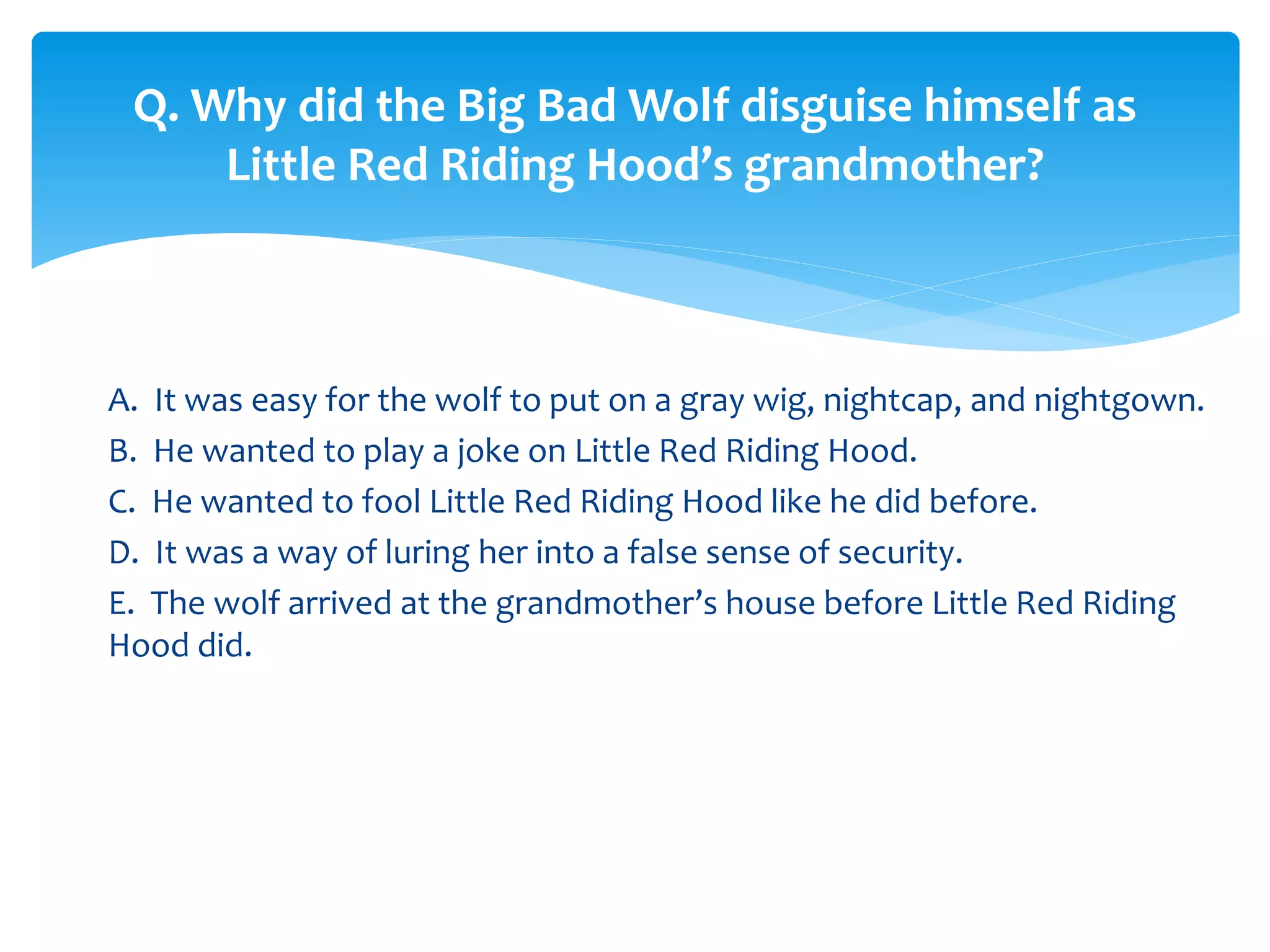
Q. Why did the Big Bad Wolf disguise himself as 
Little Red Riding Hood’s grandmother? 
A. It was easy for the wolf to put on a gray wig, nightcap, and nightgown. 
B. He wanted to play a joke on Little Red Riding Hood. 
C. He wanted to fool Little Red Riding Hood like he did before. 
D. It was a way of luring her into a false sense of security. 
E. The wolf arrived at the grandmother’s house before Little Red Riding 
Hood did.
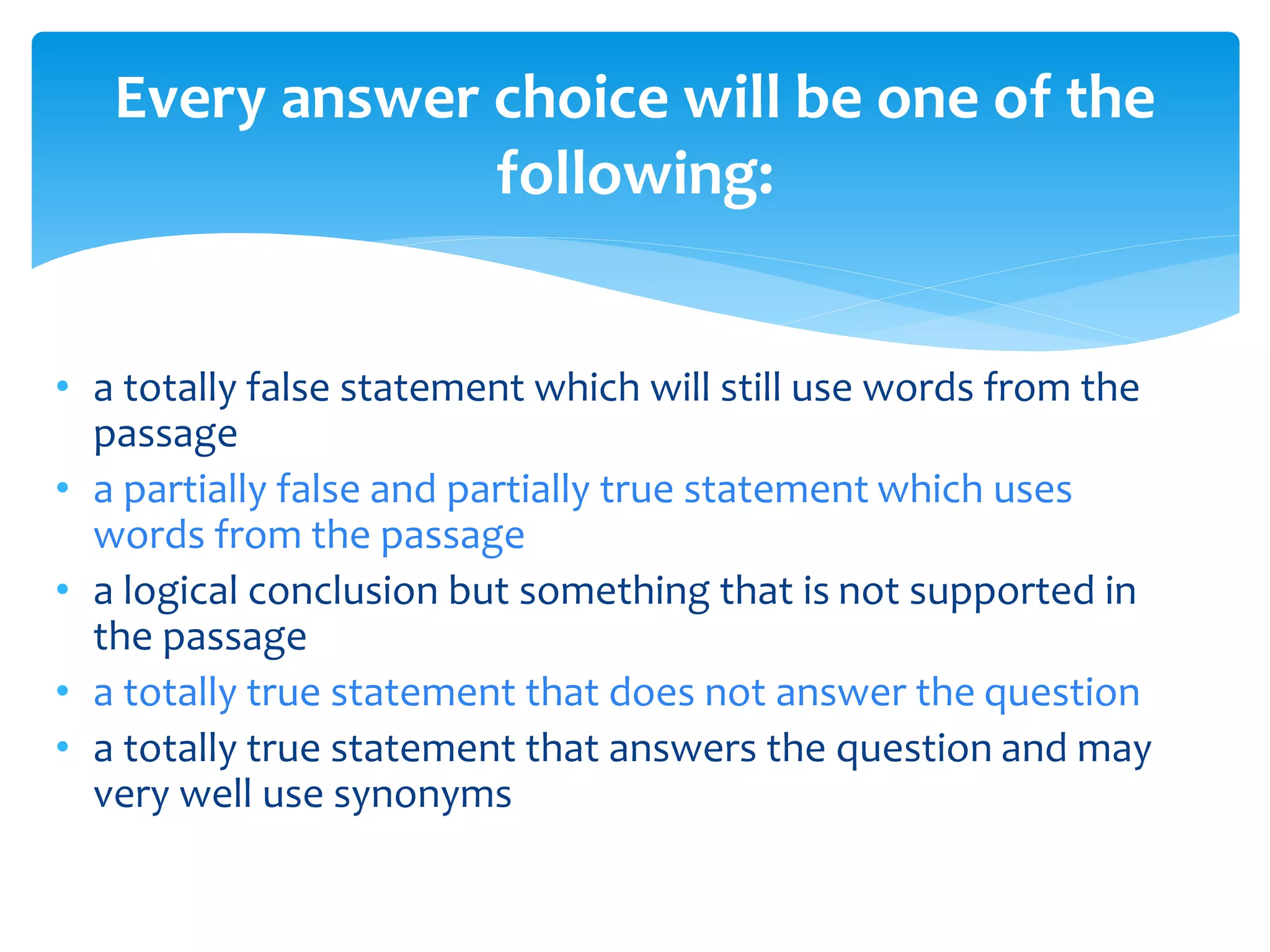
Every answer choice will be one of the 
following: 
• a totally false statement which will still use words from the 
passage 
• a partially false and partially true statement which uses 
words from the passage 
• a logical conclusion but something that is not supported in 
the passage 
• a totally true statement that does not answer the question 
• a totally true statement that answers the question and may 
very well use synonyms
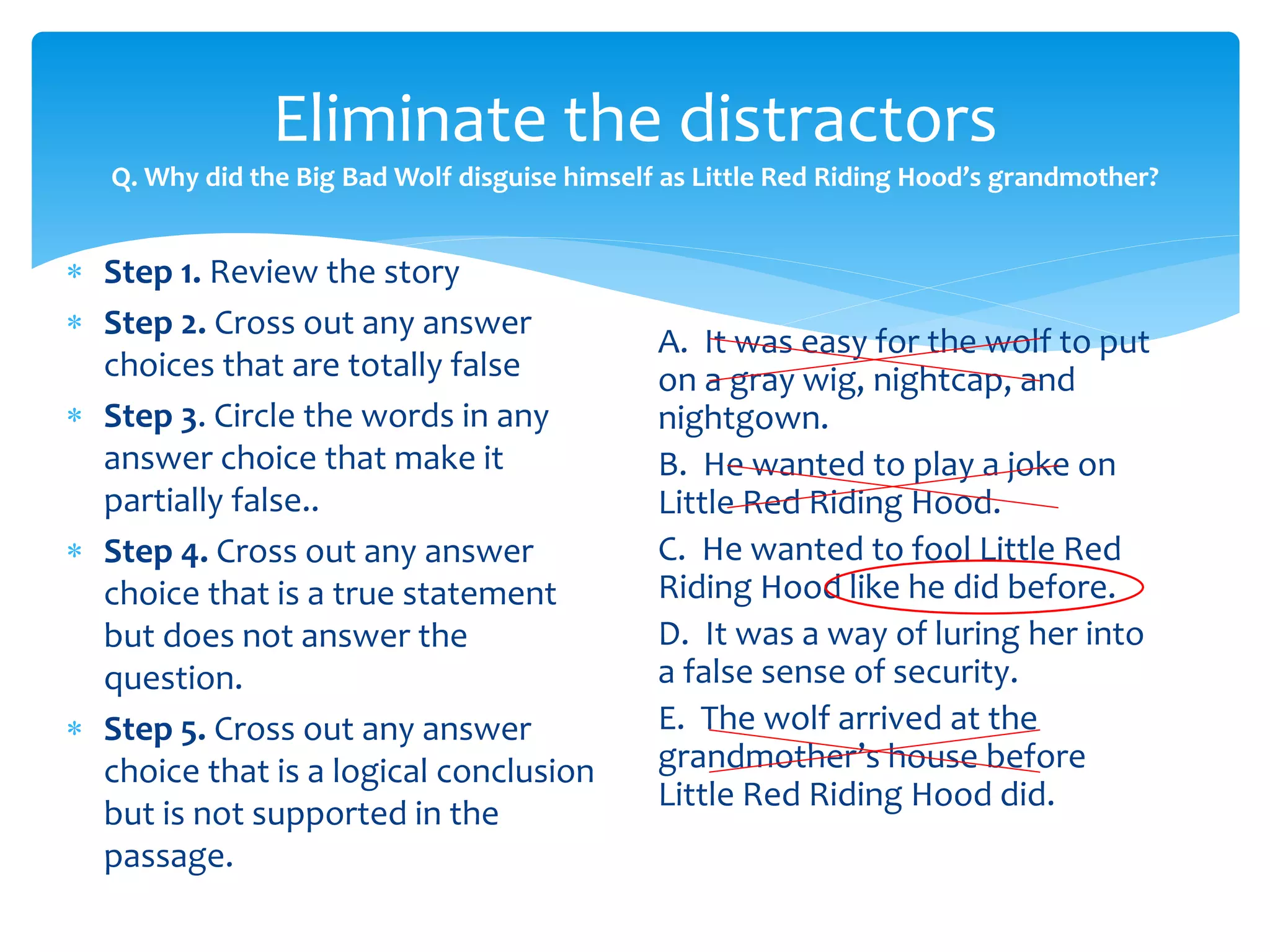
Eliminate the distractors 
Q. Why did the Big Bad Wolf disguise himself as Little Red Riding Hood’s grandmother? 
 Step 1. Review the story 
 Step 2. Cross out any answer 
choices that are totally false 
 Step 3. Circle the words in any 
answer choice that make it 
partially false.. 
 Step 4. Cross out any answer 
choice that is a true statement 
but does not answer the 
question. 
 Step 5. Cross out any answer 
choice that is a logical conclusion 
but is not supported in the 
passage. 
A. It was easy for the wolf to put 
on a gray wig, nightcap, and 
nightgown. 
B. He wanted to play a joke on 
Little Red Riding Hood. 
C. He wanted to fool Little Red 
Riding Hood like he did before. 
D. It was a way of luring her into 
a false sense of security. 
E. The wolf arrived at the 
grandmother’s house before 
Little Red Riding Hood did.
Eliminate the distractors – Cont. 
Q. Why did the Big Bad Wolf disguise himself as Little Red Riding Hood’s grandmother? 
 Step 6. Locate the correct 
answer to the question using 
words and phrases from the 
text. 
“…so the wolf would be able to get 
close to Little Red Riding Hood.” 
 Step 7. Circle the synonym(s) in 
the best answer that means 
something close to the words 
you picked out of the text to 
answer the question. 
“lure into a false sense of security”
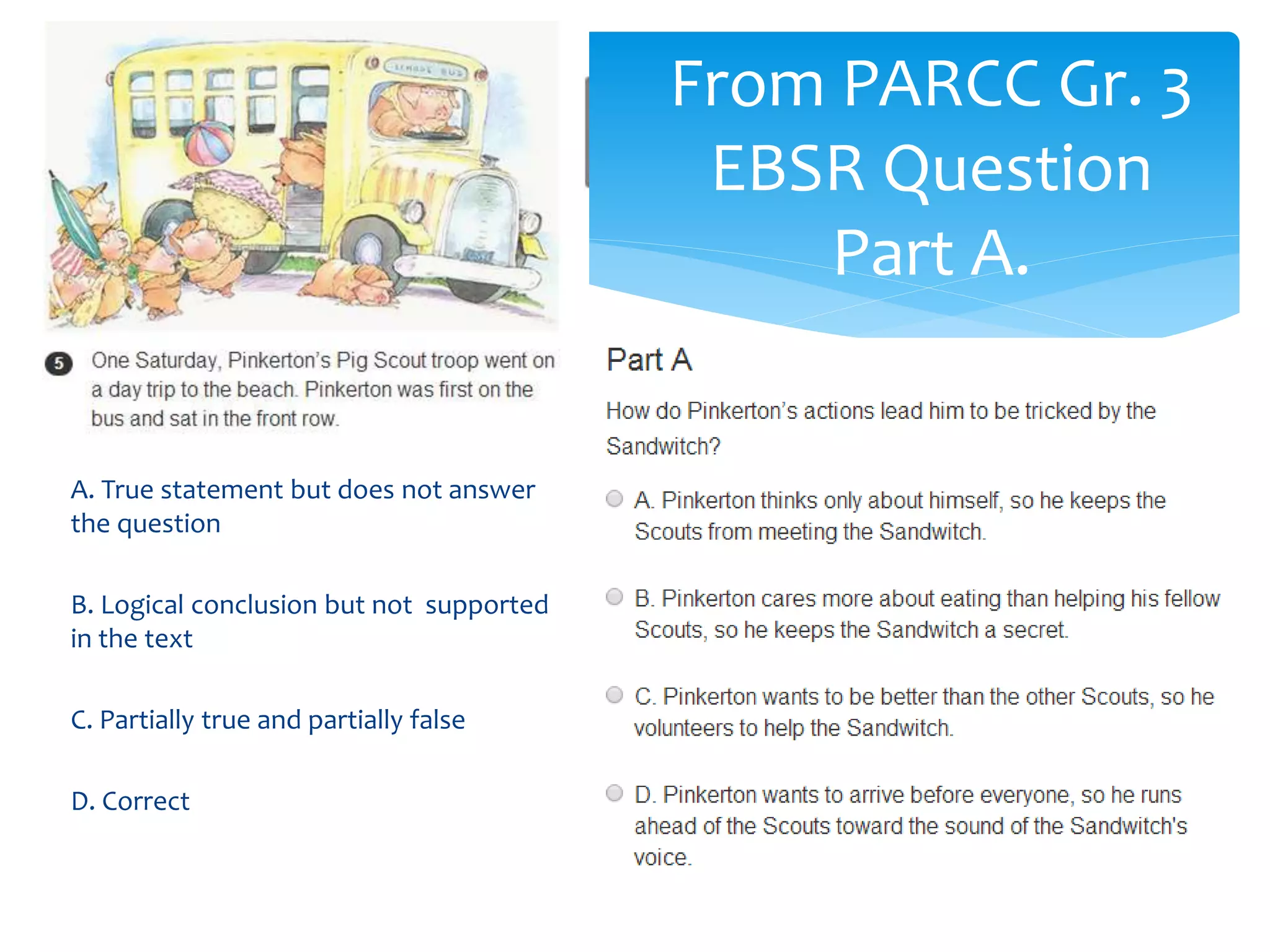
From PARCC Gr. 3 
EBSR Question 
Part A. 
A. True statement but does not answer 
the question 
B. Logical conclusion but not supported 
in the text 
C. Partially true and partially false 
D. Correct
How Vocabulary Questions Are Asking 
For More Than Definitions 
 “One should not underestimate the value of any 
meaningful encounter with a word, even if the encounter 
with a word is relatively small.” (Nagy and Herman)
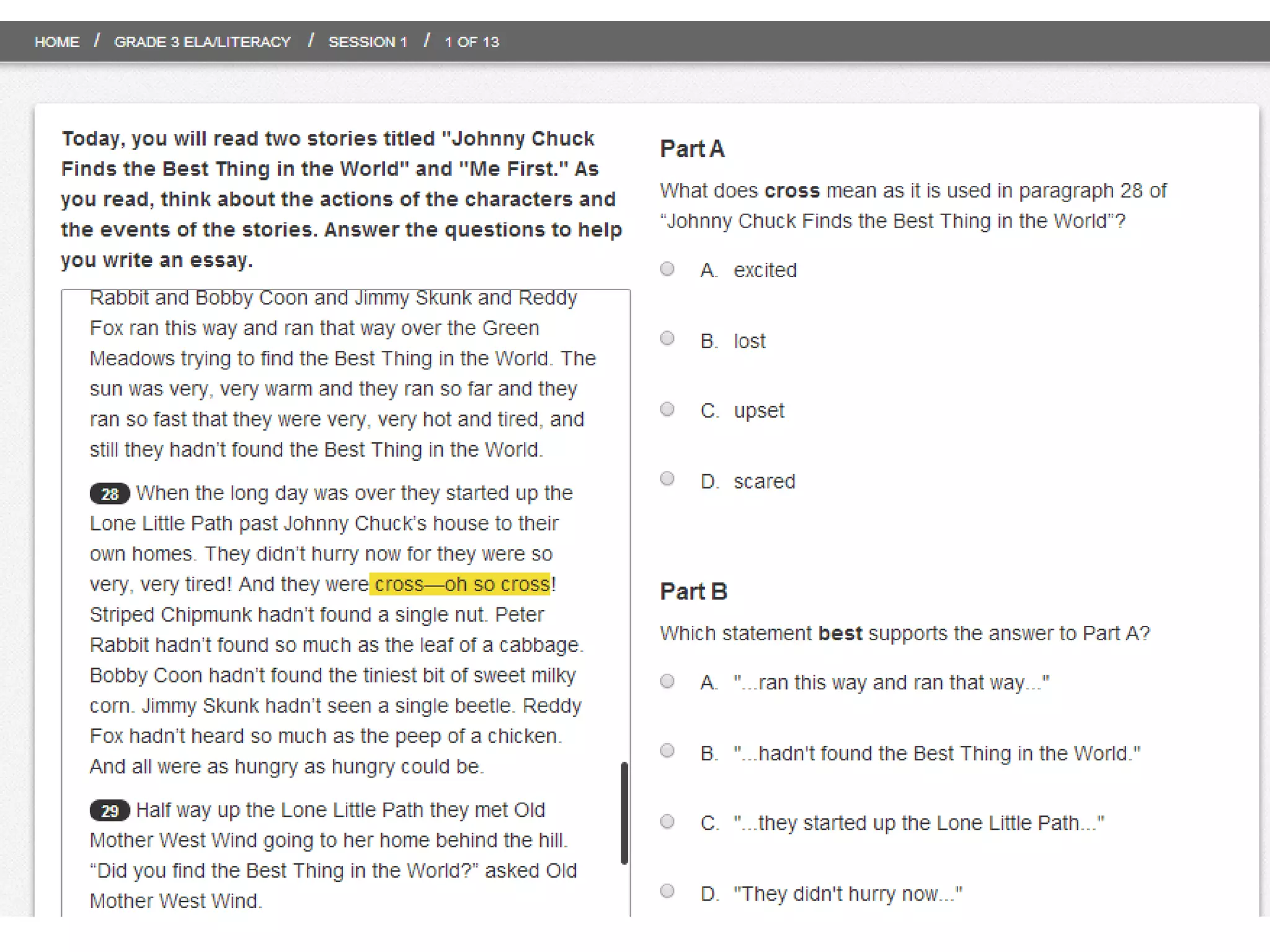
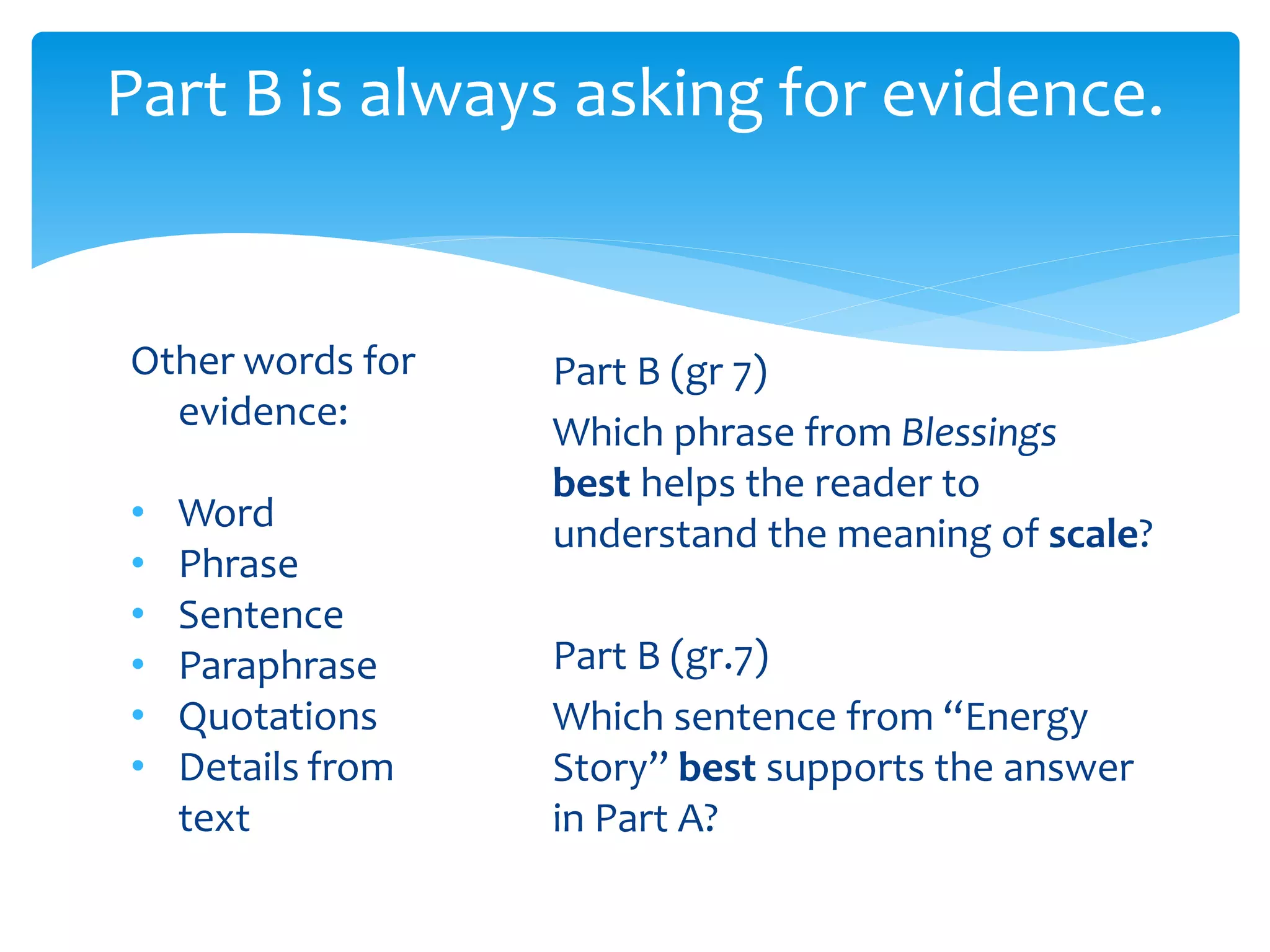
Part B is always asking for evidence. 
Otherwords for 
evidence: 
• Word 
• Phrase 
• Sentence 
• Paraphrase 
• Quotations 
• Details from 
text 
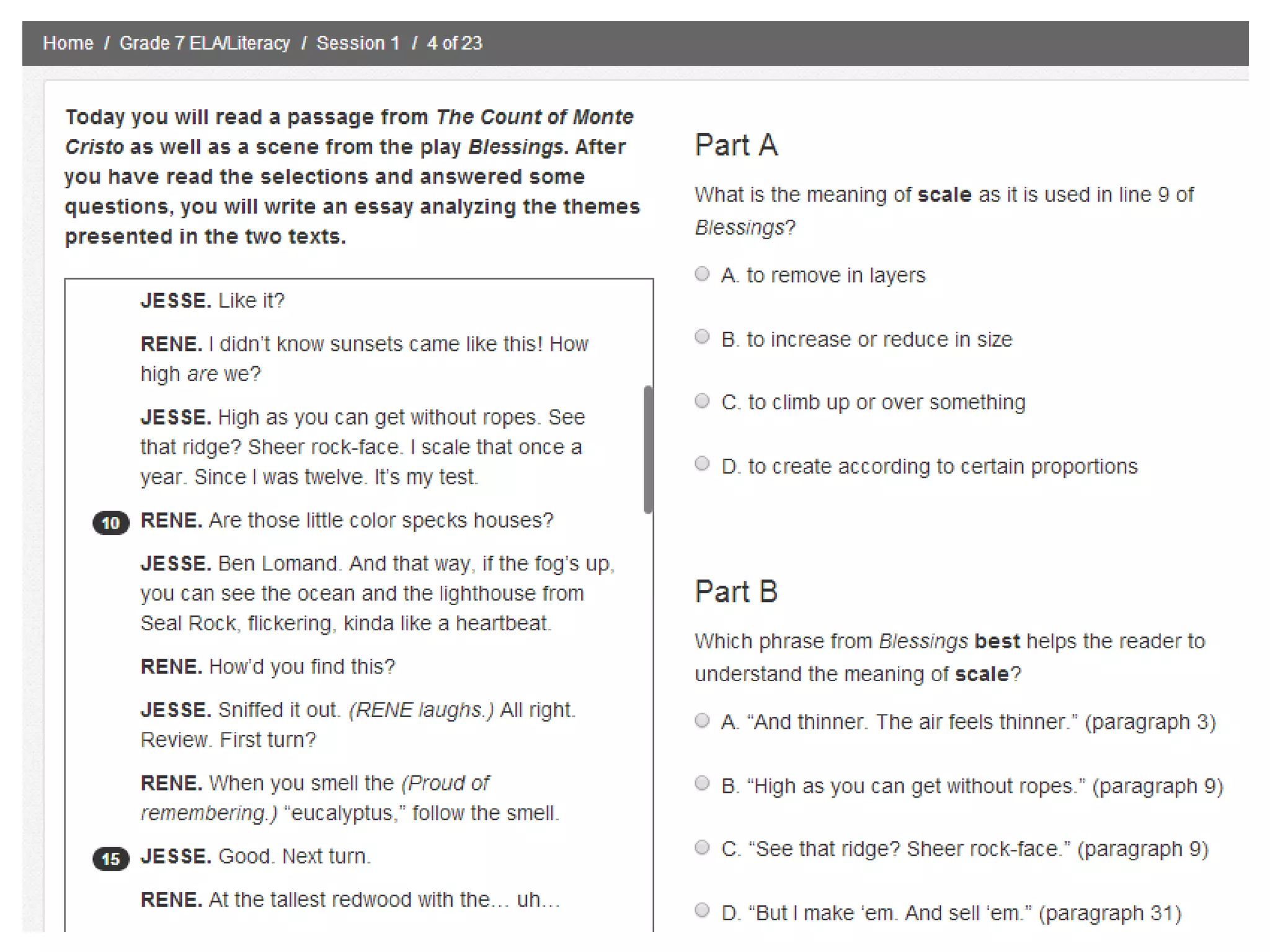
Part B (gr 7) 
Which phrase from Blessings 
best helps the reader to 
understand the meaning of scale? 
Part B (gr.7) 
Which sentence from “Energy 
Story” best supports the answer 
in Part A?
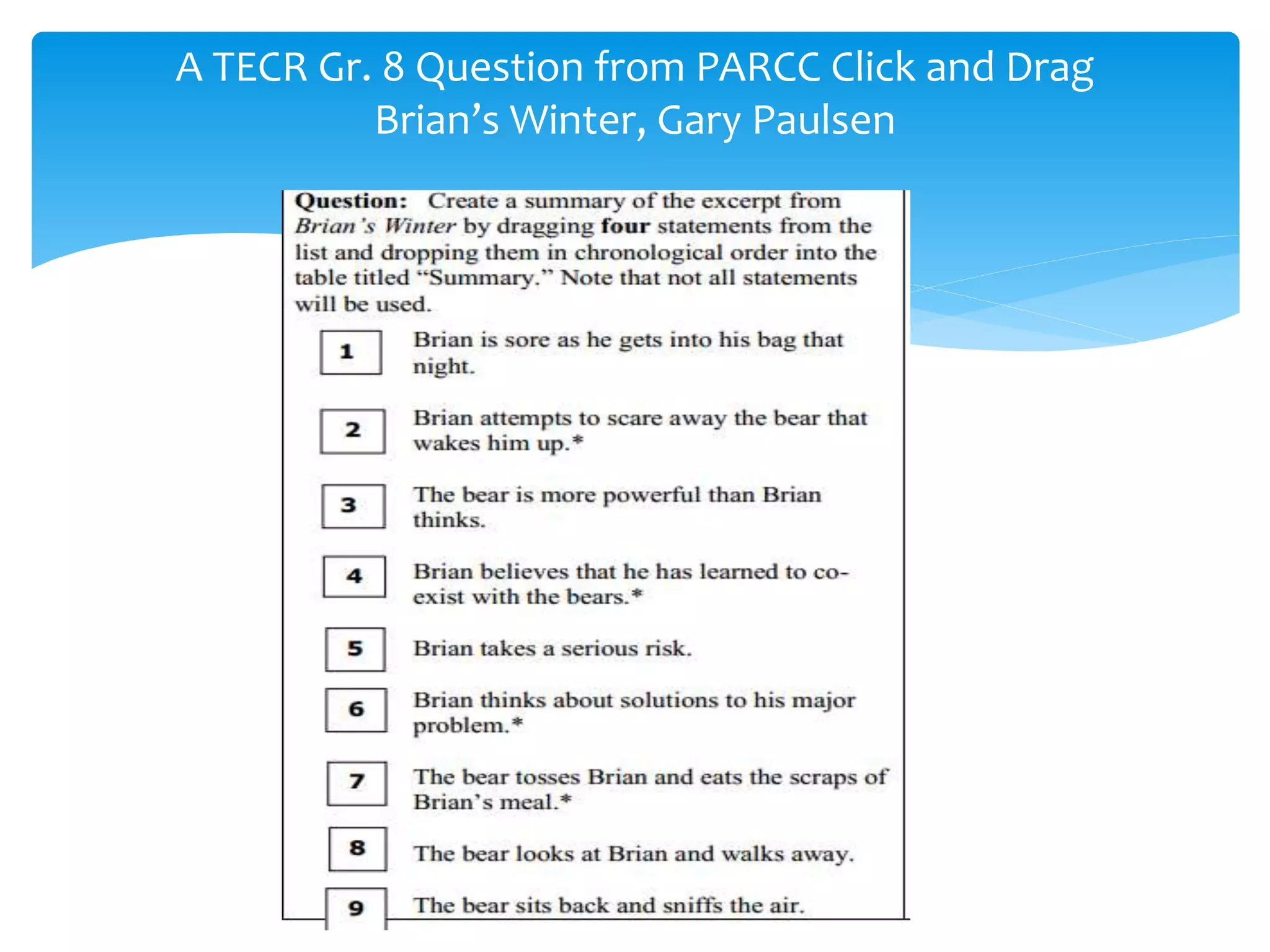
A TECR Gr. 8 Question from PARCC Click and Drag 
Brian’s Winter, Gary Paulsen
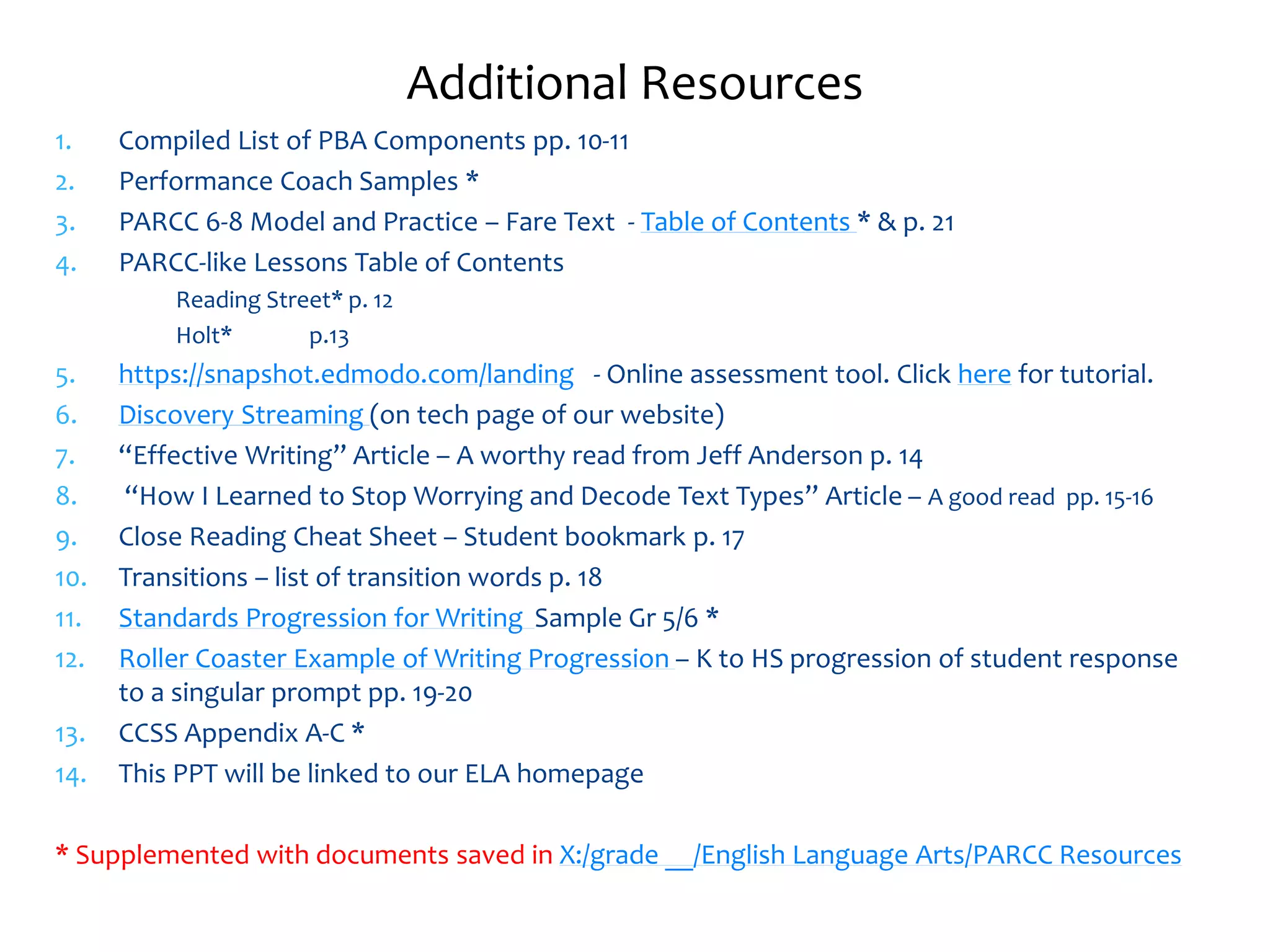
Additional Resources 
1. Compiled List of PBA Components pp. 10-11 
2. Performance Coach Samples * 
3. PARCC 6-8 Model and Practice – Fare Text - Table of Contents * & p. 21 
4. PARCC-like Lessons Table of Contents 
Reading Street* p. 12 
Holt* p.13 
5. https://snapshot.edmodo.com/landing - Online assessment tool. Click here for tutorial. 
6. Discovery Streaming (on tech page of our website) 
7. “Effective Writing” Article – A worthy read from Jeff Anderson p. 14 
8. “How I Learned to Stop Worrying and Decode Text Types” Article – A good read pp. 15-16 
9. Close Reading Cheat Sheet – Student bookmark p. 17 
10. Transitions – list of transition words p. 18 
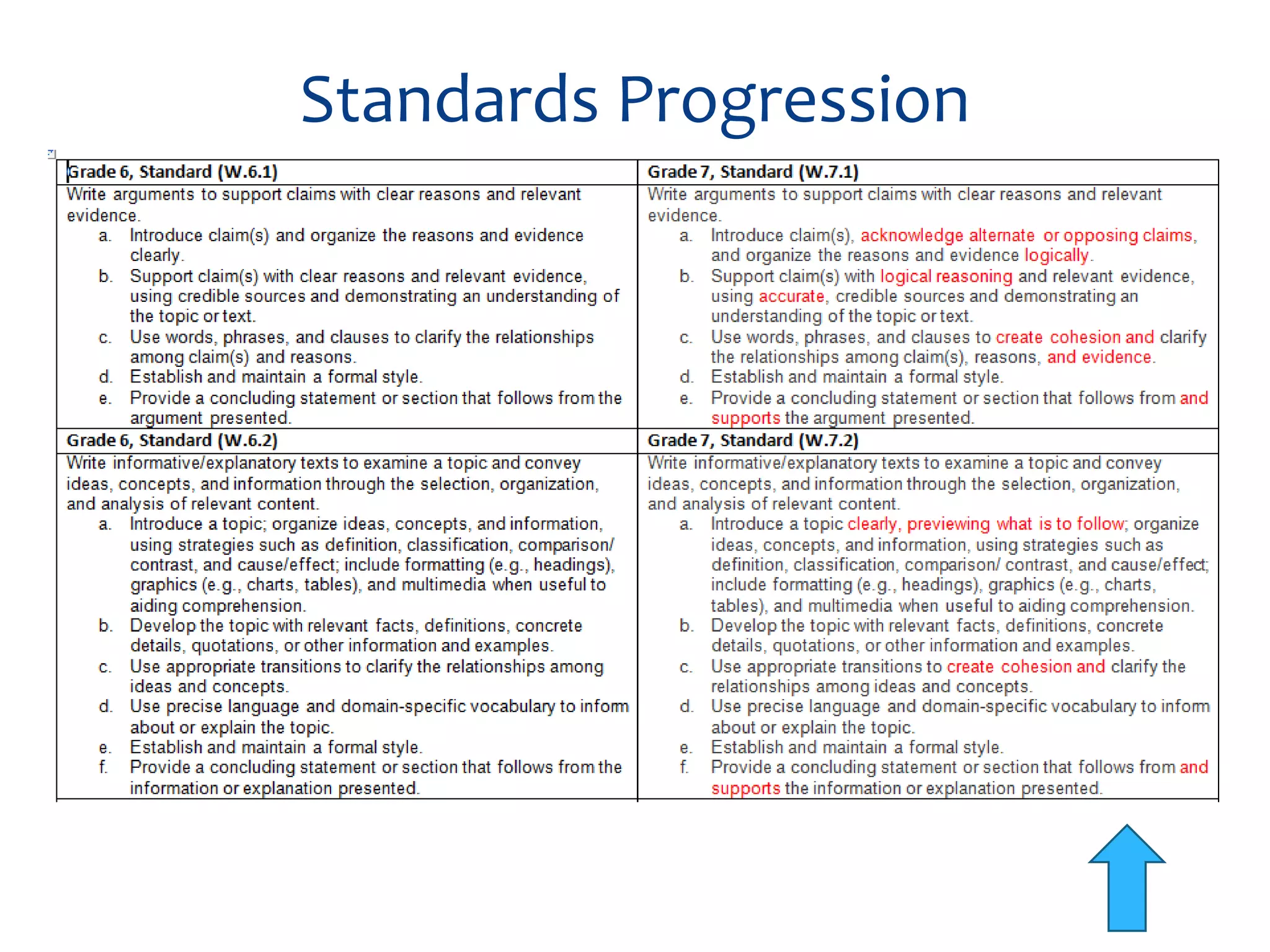
11. Standards Progression for Writing Sample Gr 5/6 * 
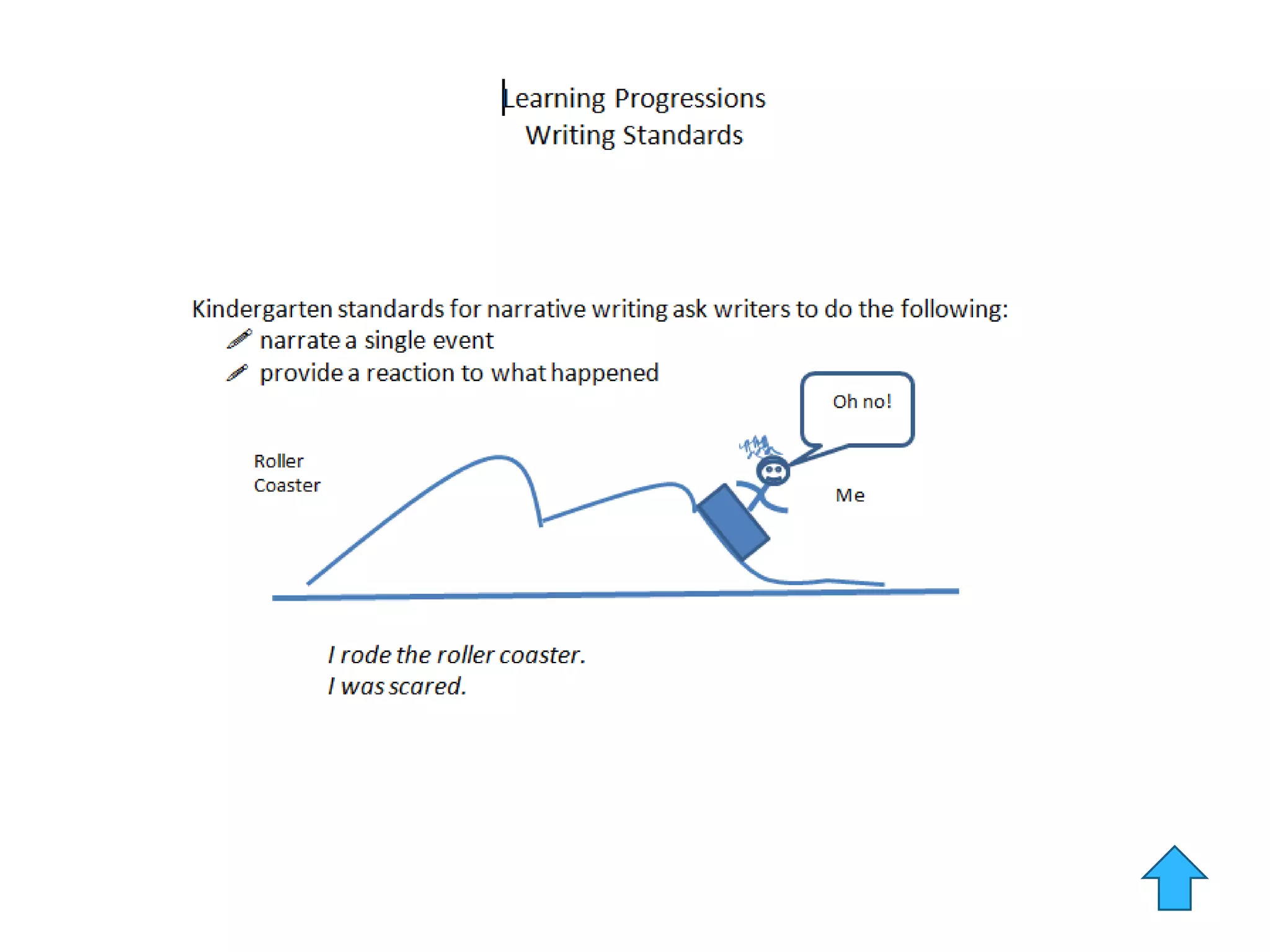
12. Roller Coaster Example of Writing Progression – K to HS progression of student response 
to a singular prompt pp. 19-20 
13. CCSS Appendix A-C * 
14. This PPT will be linked to our ELA homepage 
* Supplemented with documents saved in X:/grade __/English Language Arts/PARCC Resources
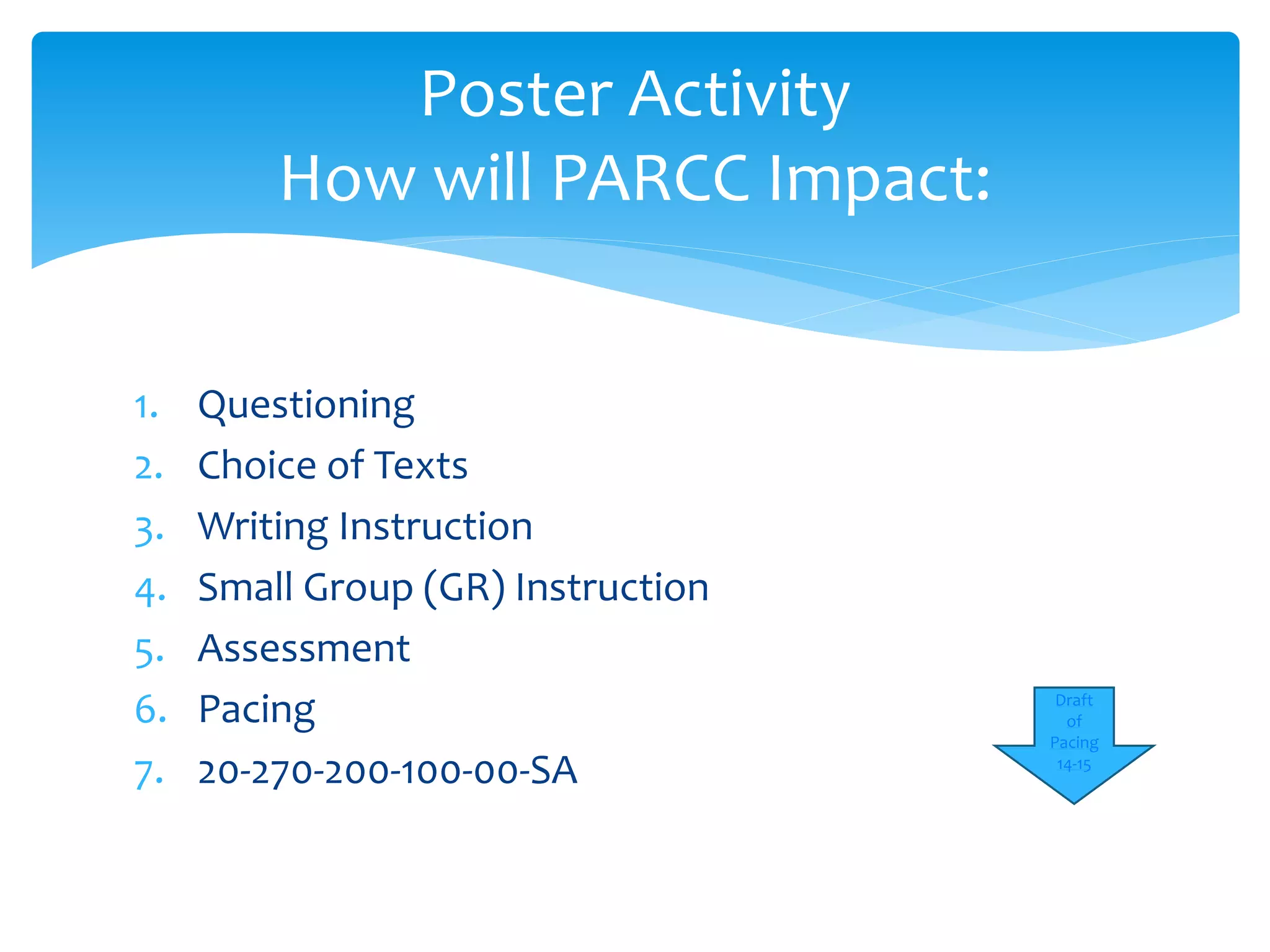
Poster Activity 
How will PARCC Impact: 
1. Questioning 
2. Choice of Texts 
3. Writing Instruction 
4. Small Group (GR) Instruction 
5. Assessment 
6. Pacing 
7. 20-270-200-100-00-SA 
Draft 
of 
Pacing 
14-15
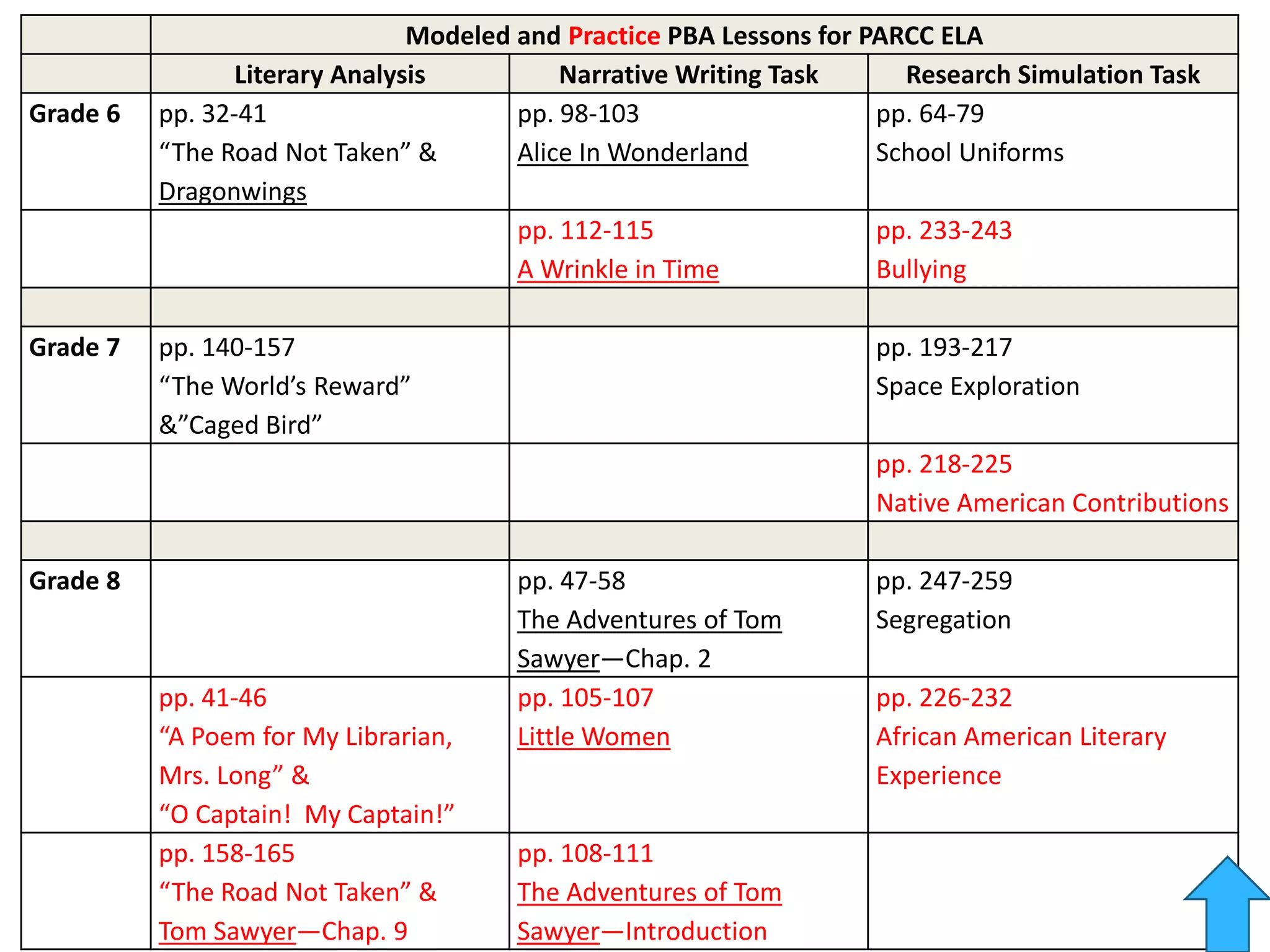
Modeled and Practice PBA Lessons for PARCC ELA 
Literary Analysis Narrative Writing Task Research Simulation Task 
Grade 6 pp. 32-41 
“The Road Not Taken” & 
Dragonwings 
pp. 98-103 
Alice In Wonderland 
pp. 64-79 
School Uniforms 
pp. 112-115 
A Wrinkle in Time 
pp. 233-243 
Bullying 
Grade 7 pp. 140-157 
“The World’s Reward” 
&”Caged Bird” 
pp. 193-217 
Space Exploration 
pp. 218-225 
Native American Contributions 
Grade 8 pp. 47-58 
The Adventures of Tom 
Sawyer—Chap. 2 
pp. 247-259 
Segregation 
pp. 41-46 
“A Poem for My Librarian, 
Mrs. Long” & 
“O Captain! My Captain!” 
pp. 105-107 
Little Women 
pp. 226-232 
African American Literary 
Experience 
pp. 158-165 
“The Road Not Taken” & 
Tom Sawyer—Chap. 9 
pp. 108-111 
The Adventures of Tom 
Sawyer—Introduction
Standards Progression
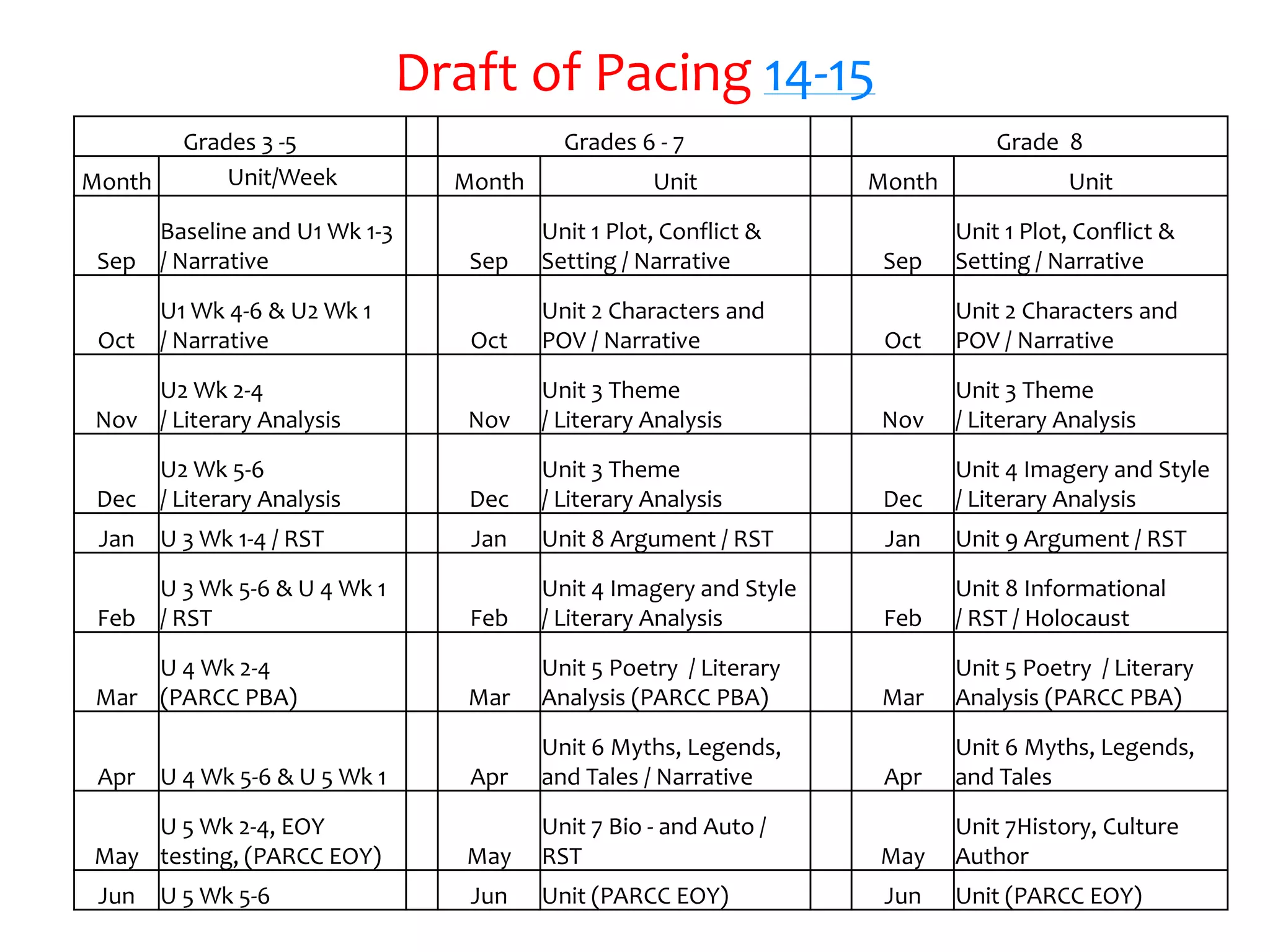
Draft of Pacing 14-15 
Grades 3 -5 Grades 6 - 7 Grade 8 
Month Unit/Week Month Unit Month Unit 
Sep 
Baseline and U1 Wk 1-3 
/ Narrative Sep 
Unit 1 Plot, Conflict & 
Setting / Narrative Sep 
Unit 1 Plot, Conflict & 
Setting / Narrative 
Oct 
U1 Wk 4-6 & U2 Wk 1 
/ Narrative Oct 
Unit 2 Characters and 
POV / Narrative Oct 
Unit 2 Characters and 
POV / Narrative 
Nov 
U2 Wk 2-4 
/ Literary Analysis Nov 
Unit 3 Theme 
/ Literary Analysis Nov 
Unit 3 Theme 
/ Literary Analysis 
Dec 
U2 Wk 5-6 
/ Literary Analysis Dec 
Unit 3 Theme 
/ Literary Analysis Dec 
Unit 4 Imagery and Style 
/ Literary Analysis 
Jan U 3 Wk 1-4 / RST Jan Unit 8 Argument / RST Jan Unit 9 Argument / RST 
Feb 
U 3 Wk 5-6 & U 4 Wk 1 
/ RST Feb 
Unit 4 Imagery and Style 
/ Literary Analysis Feb 
Unit 8 Informational 
/ RST / Holocaust 
Mar 
U 4 Wk 2-4 
(PARCC PBA) Mar 
Unit 5 Poetry / Literary 
Analysis (PARCC PBA) Mar 
Unit 5 Poetry / Literary 
Analysis (PARCC PBA) 
Apr U 4 Wk 5-6 & U 5 Wk 1 Apr 
Unit 6 Myths, Legends, 
and Tales / Narrative Apr 
Unit 6 Myths, Legends, 
and Tales 
May 
U 5 Wk 2-4, EOY 
testing, (PARCC EOY) May 
Unit 7 Bio - and Auto / 
RST May 
Unit 7History, Culture 
Author 
Jun U 5 Wk 5-6 Jun Unit (PARCC EOY) Jun Unit (PARCC EOY)

PARCC-ELA

  • 1.
    A Day inthe PARCC
  • 2.
    Get Yer’ Program,Here! Can’t tell one acronym from the next without yer program.
  • 3.
  • 4.
    P. 2 Blueprints PARCC Test Blueprints
  • 5.
    Section I –The Literary Analysis Task Part A – Reading Long Fiction Passage: prose, poem, or drama Grades 3-5: up to 800 words Grades 6-8: up to 1000 words 1. Evidence-Based Selected Response (EBSR) two part question 2. Technology-Enhanced Constructed Response (TECR) graphic organizers 3. Vocabulary Questions Packet p. 3
  • 6.
    Section I –The Literary Analysis Task Part B—Reading Short Fiction Passage: prose, poem, drama, video or audio Grades 3-5: 200-400 words Grades 6-8: 400-600 words 1. Evidence-Based Selected Response (EBSR) 2. Technology-Enhanced Constructed Response (TECR) 3. Vocabulary Questions Packet p. 3
  • 7.
    Section I –The Literary Analysis Task Part C-Writing - Theme (4-8) You have just read two texts, (name them). Write an essay that • identifies a theme in both stories and explains how the theme is shown through the characters (or speaker if a poem) • compares and contrasts the approaches each text uses to develop a given theme. • identifies a theme from each text and analyzes how each theme is developed. • identifies and explains a theme that is similar in both passages. Packet p. 3
  • 8.
    Section I –The Literary Analysis Task Part C-Writing – Characterization & Structure You have just read two texts (name them) Write an essay that  explains how the characters’ words and actions are important to the plots of the stories.  describes how the events in both texts did not happen exactly as the narrators expected and how the narrators’ points of view influence how the events happen.  analyzes how each author creates tension in both stories.  analyzes the different approaches the authors take to develop the characters. Be sure to include specific details from both selections. Packet p. 3
  • 9.
    The Literary AnalysisPilot 3-5 On Pilot (rumored) Grade 3  Characterization in a story  Author’s study Grade 4 & 5 Analysis of structural elements  Central Idea (Theme)/Lesson of literature  Character(s), setting(s) or event(s)  Author’s study Not On Pilot (rumored) Grade 3  Analysis of the contribution of illustrations  Author’s study including analysis of illustration Grade 4  Connecting a text and a companion visual or oral presentation of that text Grade 5  Analysis of visual and multimedia elements
  • 10.
    The Literary AnalysisPilot 6-8 On Pilot (rumored) Grade 6  Theme, setting or plot -‐  Central Idea/Lesson of literature  Analysis of Plot and Characterization  Comparing themes and topics Grade 7 & 8 (also)  Influence of narrator’s or speaker’s point of view  Interaction of story elements Not On Pilot (rumored)  Contribution of one section to theme, setting or plot -‐  Comparing a print text to a multimedia version of that text  Effect of dialogue
  • 11.
    The Key Words  analyze  compare and contrast  describe  explain  Classroom practice and directions should clearly point out what these key words mean.  The bottom line: Students have to find similarities and/or differences in 2 texts.
  • 12.
    Suggestions  Directionsin the classroom should be more extensive so kids keep these in mind regardless of the directions on the day of the test. This way they will know what to write about and how.  On the day of the test, the directions might give them the theme (or claim) or they will have to identify it. Therefore, it is better to provide practice in doing both.
  • 13.
    Lit Analysis Prompt(4-8) p. 4 handout
  • 14.
    Sample Shared Writing Lesson Approach: 1. Use PARCC formatted directions. 2. Have groups respond in note form on easel paper. 3. Create a master list from all group contributions. 4. Write a Master Essay where the teacher writes choosing the best contributions. 5. Kids copy and save to use as an exemplar for future assignments.
  • 15.
    Other Elements Inaddition to theme, characterization and structure, prepare for essays on other elements.  Pick two texts that have a similarity or difference:  Point of view  Character development  Character relationships  Character reactions
  • 16.
  • 17.
  • 18.
    Heads In, BottomsUp  Identify a similar theme, characterization or structure in both stories and analyze how it is developed in each text.  Think about how the texts are similar and how they are different.  Gr. 6 The School Play / All Summer in a Day  Gr. 7 Seventh Grade / The Last Dog  Gr. 8 Raymond’s Run / The Ransom of Red Chief  Gr. 3 Charlie McButton / What about Me  Gr. 4 Because of Winn Dixie / Lewis and Clark and Me  Gr. 5 Red Kayak / Thunder Rose Online timer to RST restart
  • 19.
    Section II –The Research Simulation Task (RST AKA DBQ ) Part A – Reading Passage 1  Long Nonfiction Passage: article, speech, argument, opinion, biography, court case * work in some primary sources 1. Evidence-Based Selected Response (EBSR) 2. Technology-Enhanced Constructed Response (TECR) 3. Vocabulary Questions p. 7 handout
  • 20.
    Section II –The Research Simulation Task Part B – Reading Passage 2 Short Nonfiction Passage: article, speech, argument, opinion, biography, court case 1. Evidence-Based Selected Response (EBSR) 2. Technology-Enhanced Constructed Response (TECR) 3. Vocabulary Questions p. 7 handout
  • 21.
    Section II –The Research Simulation Task Part C – Reading Passage 3 Short Nonfiction Passage or Video Clip 1. Evidence-Based Selected Response (EBSR) 2. Technology-Enhanced Constructed Response (TECR) 3. Vocabulary Questions p. 7 handout
  • 22.
    Section II –The Research Simulation Task Part D –Writing The Research Simulation Task - SCIENTIFIC-RELATED (animals, environment, chemistry, archeology) You have read two texts (name them) and viewed a video entitled (name it). In an essay • describe the roles of animals and humans in a process or procedure • compare how each source describes the roles of animals and humans in a process or procedure • identify a similar claim in the sources and then compare and contrast the evidence each source uses • compare the purposes of each source then analyze how each source uses information and evidence • compare and contrast the information in the texts with the information in the video • examine and/or delineate a phenomenon p. 7 handout
  • 23.
    Section II –The Research Simulation Task Part D –Writing The Research Simulation Task for HISTORY-RELATED or ARGUMENT/OPINION • compare and contrast a primary argument in each text • explore author’s purpose Part D –Writing The Research Simulation Task for COURT CASE • analyze how effectively the arguments are presented for each side Remember to use evidence from all three (or at least two) sources to support your ideas p. 7 handout
  • 24.
    Synthesis Sources shouldhave a conversation with each other. p. 8 handout
  • 26.
    How could thislook using our ELA/SS/Sci materials? You have read two texts (name them) and viewed a video entitled (name it). EX. • describe the roles of animals and humans in a process or procedure • compare how each source describes the roles of animals and humans in a process or procedure • identify a similar claim in the sources and then compare and contrast the evidence each source uses • compare the purposes of each source then analyze how each source uses information and evidence • compare and contrast the information in the texts with the information in the video • examine and/or delineate a phenomenon
  • 27.
    RST - HeadsIn, Bottoms Up You have read two texts (name them) and viewed a video entitled (name it). • describe… • compare how each source describes … • identify a similar claim in the sources and then compare and contrast… • compare the purposes of each source then analyze how each source uses information • compare and contrast the information in the texts with the information in the video • examine and/or delineate a phenomenon  Gr. 6 Unit 1 – Weather That’s Out of This World! / Space Settlements / Artist’s Views of A Space Colony (or use p. 85 prompt)  Gr. 7 Unit 8 – Like Black Smoke: The Black Death’s Journey / A World Turned Upside Down: How the Black Death Affected Europe  Gr. 8 Unit 8 - Robo-Legs / Eureka: Scientific Twists of Fate  Gr. 3 Unit 1 Week 4 – Supermarket / Money from Long Ago (How do we learn to make our way in the world?)  Gr. 4 Unit 1 Week 5 – Letters Home from Yosemite / The Bison of Caprock Canyons (What can we learn from exploring new places and things?)  Gr. 5 Unit 1 Week 2 Night of the Tornados Read Aloud / Measuring Tornadoes / GR (What kinds of challenges do people face and how do they meet them?)
  • 28.
    Section III –The Narrative Task Part A – Reading Passage 1 Short or long fiction or nonfiction passage 1. Technology-Enhanced Constructed Response (TECR) 2. Evidence-Based Selected Response (EBSR) p. 9 handout
  • 29.
    Section III –The Narrative Task Part B—Writing The Narrative Task for the FICTION TEXT You have read (name the text). • Write a journal entry from the character (name him or her) about what happened in the story. • Write a narrative story retelling the story from the point of view of (name the character). • Write an original short story that describes what (name the character) does next. Think about the details the author uses to create the characters, settings, and events in the story and use these as a guide in writing your own narrative. p. 9 handout
  • 30.
    Section III –The Narrative Task Part B—Writing The Narrative Task (Continued) for the FICTION TEXT • Write a continuation of the story using details from the story you just read. • Write a narrative story that describes the major events in the passage from the point of view of (name the character—it could even be a character that was not in the story but was suggested in the story). • Write a narrative story that describes what the character (name the character) does and the experiences she or he has. p. 9 handout
  • 31.
    Section III –The Narrative Task Part B—Writing The Narrative Task for the NON-FICTION TEXT You have just read an article on (a scientific or historical event) with a short personal introduction. • Write an original short story from the perspective of (name a person from the short personal introduction). Be sure to include details (scientific or historical) in your original short story. p. 9 handout
  • 32.
    Test Talk Increasingsuccess on EBSRs and TECRs http://www.flocabulary.com/test-taking-vocabulary/
  • 33.
    The EBSR -Part A Q. On the PARRC multiple choice questions, how many right answers are there? A. Four… B. One is best  Students will also be required to negotiate plausible, text-‐based distractors
  • 34.
    Q. Who wasthe first president of the United States? A. B. C. D. Q. What WRONG answers would you expect?
  • 35.
    Q. Who wasthe first president of the United States? A. Martha Washington’s husband B. G. Washington C. General Washington D. The man who commanded the American Revolutionary army
  • 36.
    In addition toteaching reading and writing, we must also teach the thinking process needed to find the best answer.
  • 37.
    Q. Why didthe Big Bad Wolf disguise himself as Little Red Riding Hood’s grandmother? A. It was easy for the wolf to put on a gray wig, nightcap, and nightgown. B. He wanted to play a joke on Little Red Riding Hood. C. He wanted to fool Little Red Riding Hood like he did before. D. It was a way of luring her into a false sense of security. E. The wolf arrived at the grandmother’s house before Little Red Riding Hood did.
  • 38.
    Every answer choicewill be one of the following: • a totally false statement which will still use words from the passage • a partially false and partially true statement which uses words from the passage • a logical conclusion but something that is not supported in the passage • a totally true statement that does not answer the question • a totally true statement that answers the question and may very well use synonyms
  • 39.
    Eliminate the distractors Q. Why did the Big Bad Wolf disguise himself as Little Red Riding Hood’s grandmother?  Step 1. Review the story  Step 2. Cross out any answer choices that are totally false  Step 3. Circle the words in any answer choice that make it partially false..  Step 4. Cross out any answer choice that is a true statement but does not answer the question.  Step 5. Cross out any answer choice that is a logical conclusion but is not supported in the passage. A. It was easy for the wolf to put on a gray wig, nightcap, and nightgown. B. He wanted to play a joke on Little Red Riding Hood. C. He wanted to fool Little Red Riding Hood like he did before. D. It was a way of luring her into a false sense of security. E. The wolf arrived at the grandmother’s house before Little Red Riding Hood did.
  • 40.
    Eliminate the distractors– Cont. Q. Why did the Big Bad Wolf disguise himself as Little Red Riding Hood’s grandmother?  Step 6. Locate the correct answer to the question using words and phrases from the text. “…so the wolf would be able to get close to Little Red Riding Hood.”  Step 7. Circle the synonym(s) in the best answer that means something close to the words you picked out of the text to answer the question. “lure into a false sense of security”
  • 41.
    From PARCC Gr.3 EBSR Question Part A. A. True statement but does not answer the question B. Logical conclusion but not supported in the text C. Partially true and partially false D. Correct
  • 42.
    How Vocabulary QuestionsAre Asking For More Than Definitions  “One should not underestimate the value of any meaningful encounter with a word, even if the encounter with a word is relatively small.” (Nagy and Herman)
  • 45.
    Part B isalways asking for evidence. Otherwords for evidence: • Word • Phrase • Sentence • Paraphrase • Quotations • Details from text Part B (gr 7) Which phrase from Blessings best helps the reader to understand the meaning of scale? Part B (gr.7) Which sentence from “Energy Story” best supports the answer in Part A?
  • 46.
    A TECR Gr.8 Question from PARCC Click and Drag Brian’s Winter, Gary Paulsen
  • 47.
    Additional Resources 1.Compiled List of PBA Components pp. 10-11 2. Performance Coach Samples * 3. PARCC 6-8 Model and Practice – Fare Text - Table of Contents * & p. 21 4. PARCC-like Lessons Table of Contents Reading Street* p. 12 Holt* p.13 5. https://snapshot.edmodo.com/landing - Online assessment tool. Click here for tutorial. 6. Discovery Streaming (on tech page of our website) 7. “Effective Writing” Article – A worthy read from Jeff Anderson p. 14 8. “How I Learned to Stop Worrying and Decode Text Types” Article – A good read pp. 15-16 9. Close Reading Cheat Sheet – Student bookmark p. 17 10. Transitions – list of transition words p. 18 11. Standards Progression for Writing Sample Gr 5/6 * 12. Roller Coaster Example of Writing Progression – K to HS progression of student response to a singular prompt pp. 19-20 13. CCSS Appendix A-C * 14. This PPT will be linked to our ELA homepage * Supplemented with documents saved in X:/grade __/English Language Arts/PARCC Resources
  • 48.
    Poster Activity Howwill PARCC Impact: 1. Questioning 2. Choice of Texts 3. Writing Instruction 4. Small Group (GR) Instruction 5. Assessment 6. Pacing 7. 20-270-200-100-00-SA Draft of Pacing 14-15
  • 49.
    Modeled and PracticePBA Lessons for PARCC ELA Literary Analysis Narrative Writing Task Research Simulation Task Grade 6 pp. 32-41 “The Road Not Taken” & Dragonwings pp. 98-103 Alice In Wonderland pp. 64-79 School Uniforms pp. 112-115 A Wrinkle in Time pp. 233-243 Bullying Grade 7 pp. 140-157 “The World’s Reward” &”Caged Bird” pp. 193-217 Space Exploration pp. 218-225 Native American Contributions Grade 8 pp. 47-58 The Adventures of Tom Sawyer—Chap. 2 pp. 247-259 Segregation pp. 41-46 “A Poem for My Librarian, Mrs. Long” & “O Captain! My Captain!” pp. 105-107 Little Women pp. 226-232 African American Literary Experience pp. 158-165 “The Road Not Taken” & Tom Sawyer—Chap. 9 pp. 108-111 The Adventures of Tom Sawyer—Introduction
  • 50.
  • 52.
    Draft of Pacing14-15 Grades 3 -5 Grades 6 - 7 Grade 8 Month Unit/Week Month Unit Month Unit Sep Baseline and U1 Wk 1-3 / Narrative Sep Unit 1 Plot, Conflict & Setting / Narrative Sep Unit 1 Plot, Conflict & Setting / Narrative Oct U1 Wk 4-6 & U2 Wk 1 / Narrative Oct Unit 2 Characters and POV / Narrative Oct Unit 2 Characters and POV / Narrative Nov U2 Wk 2-4 / Literary Analysis Nov Unit 3 Theme / Literary Analysis Nov Unit 3 Theme / Literary Analysis Dec U2 Wk 5-6 / Literary Analysis Dec Unit 3 Theme / Literary Analysis Dec Unit 4 Imagery and Style / Literary Analysis Jan U 3 Wk 1-4 / RST Jan Unit 8 Argument / RST Jan Unit 9 Argument / RST Feb U 3 Wk 5-6 & U 4 Wk 1 / RST Feb Unit 4 Imagery and Style / Literary Analysis Feb Unit 8 Informational / RST / Holocaust Mar U 4 Wk 2-4 (PARCC PBA) Mar Unit 5 Poetry / Literary Analysis (PARCC PBA) Mar Unit 5 Poetry / Literary Analysis (PARCC PBA) Apr U 4 Wk 5-6 & U 5 Wk 1 Apr Unit 6 Myths, Legends, and Tales / Narrative Apr Unit 6 Myths, Legends, and Tales May U 5 Wk 2-4, EOY testing, (PARCC EOY) May Unit 7 Bio - and Auto / RST May Unit 7History, Culture Author Jun U 5 Wk 5-6 Jun Unit (PARCC EOY) Jun Unit (PARCC EOY)

Editor's Notes

  • #20 3 How do we learn to make our way in the world? 4 What can we learn from exploring new places and things? 5 What kinds of challenges do people face and how do they meet them?
  • #29 3 How do we learn to make our way in the world? 4 What can we learn from exploring new places and things? 5 What kinds of challenges do people face and how do they meet them?
  • #35 Each distractor will require students to comprehend the whole passage.   1 A distractor is an incorrect response that may appear to be a plausible correct response to a student who has not mastered the skill or concept being tested.
  • #41 One kind of question can be asked in several ways. The kids have to know what the question is asking.
  • #48 TECR Questions mean lots of graphic organizers. They click and drag on the test but they can fill them out in class.