Leo Appleton, Professor Hazel Hall,
Professor Alistair Duff, Professor Robert Raeside
Information: Interactions and Impact Conference
27th – 30th June, 2017, Robert Gordon University, Aberdeen.
Demonstrating the impact of the public library on
citizenship development in the UK: focus group findings
• Brief background to the research project
• Literature review & Research questions
• Method
• Pilot study
• Focus Group findings
• Initial discussion and analysis
• Next steps
Overview
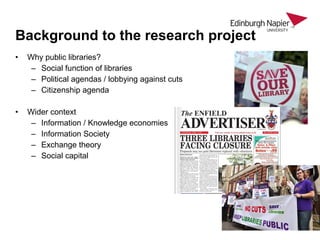
• Why public libraries?
– Social function of libraries
– Political agendas / lobbying against cuts
– Citizenship agenda
• Wider context
– Information / Knowledge economies
– Information Society
– Exchange theory
– Social capital
Background to the research project
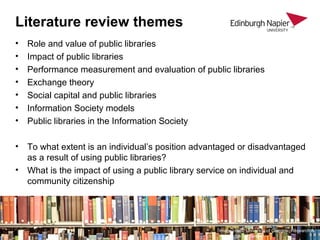
Literature review themes
• Role and value of public libraries
• Impact of public libraries
• Performance measurement and evaluation of public libraries
• Exchange theory
• Social capital and public libraries
• Information Society models
• Public libraries in the Information Society
• To what extent is an individual’s position advantaged or disadvantaged
as a result of using public libraries?
• What is the impact of using a public library service on individual and
community citizenship
Image credit: University of Glasgow, Research &
Knowledge Exchange
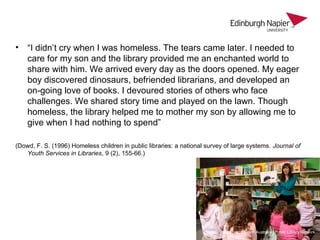
• “I didn’t cry when I was homeless. The tears came later. I needed to
care for my son and the library provided me an enchanted world to
share with him. We arrived every day as the doors opened. My eager
boy discovered dinosaurs, befriended librarians, and developed an
on-going love of books. I devoured stories of others who face
challenges. We shared story time and played on the lawn. Though
homeless, the library helped me to mother my son by allowing me to
give when I had nothing to spend”
(Dowd, F. S. (1996) Homeless children in public libraries: a national survey of large systems. Journal of
Youth Services in Libraries, 9 (2), 155-66.)
Image credit: South Australian Public Library Network
Pilot focus group
“When I come in, I have a dead positive vibe, when
I walk through the doors straight away, ‘cos I know
that I only need to spend fifteen minutes in here,
and I’ll have lost myself in a book…. You don’t care
what’s going on!”
“I could be quite dramatic and say that
reading saved my life!”
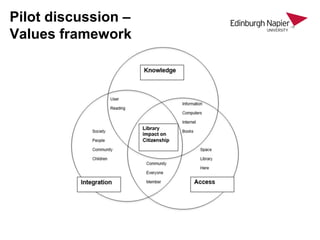
Pilot discussion –
Values framework
Method
– Commit to a focus group methodology
• Longitudinal cohort approach to focus groups
• Revisit annually over three years
– Scope of project
• Representative of UK library users
• Approach UK local library authorities
• Ensure that City/town councils, County councils and Metropolitan Borough
Councils all represented.
– Benefits of longitudinal approach
• Familiarity of group (common experiences)
• Willingness to share and discuss
• Deep and reflective discussion
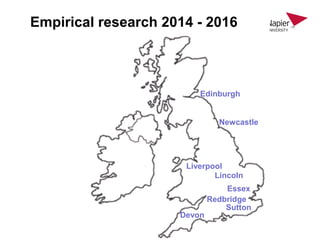
Empirical research 2014 - 2016
Edinburgh
Liverpool
Newcastle
Lincoln
Essex
Devon
Redbridge
Sutton
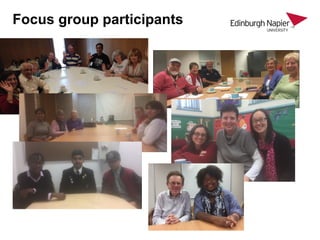
Focus group participants
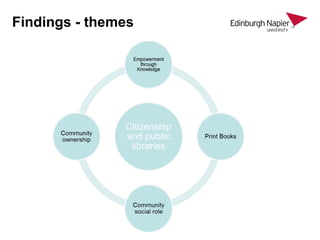
Findings - themes
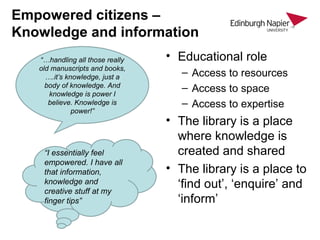
Empowered citizens –
Knowledge and information
• Educational role
– Access to resources
– Access to space
– Access to expertise
• The library is a place
where knowledge is
created and shared
• The library is a place to
‘find out’, ‘enquire’ and
‘inform’
“…handling all those really
old manuscripts and books,
….it’s knowledge, just a
body of knowledge. And
knowledge is power I
believe. Knowledge is
power!”
“I essentially feel
empowered. I have all
that information,
knowledge and
creative stuff at my
finger tips”
Print monographs
• “My favourite thing about the public library is that you can just grab
any book that you like and you can just sit as long as you like and
read it. And if you really like it you can get another one! Books!”
• “I cannot overstate how much libraries have meant to me, and
indirectly to other people. I have African heritage and the place where
my family comes from there are no libraries so there is no free
thought. They have an oral culture, but they don’t have a literary
culture. Although people are clever, they are well educated, but they
don’t think. They don’t think outside the box. When you read a book
you think, you think to yourself ‘well what do I think about that?’ There
people are more ‘well this is what you’re meant to think’ and for me it’s
connected to freedom, not just personal freedom but community
freedom and how we move on!”
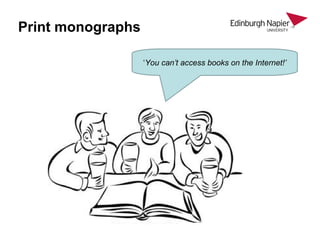
Print monographs
‘You can’t access books on the Internet!’
Community cohesion
and integration
“The library is a place of
great safety and security.”
“It’s inclusive. It makes you feel part
of the group. I think that society
consists of groups doesn’t it? But I
see the library more as a coherent
group and it’s very inclusive of
people from different backgrounds,
different ethnic backgrounds and
cultures.”“When you’re on the streets no one
cares about you. It’s like every man
for himself. When you come in here
you can just communicate with
anyone, you can discuss things with
people. There’s loads of things that
you can do.”
“You’re never too old to go to a
library. You see really old people
reading newspapers and you see
really young people on the
computers or like reading a book
or studying or researching. A
library is place where you see
every generation and you end up
socialising with every kind of
person”
“It is the one place
where everyone is
equal”
“It is the one place
where everyone is
equal”
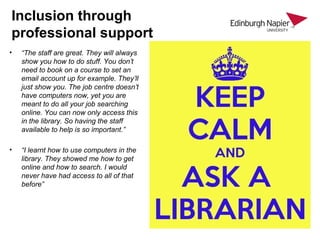
Inclusion through
professional support
• “The staff are great. They will always
show you how to do stuff. You don’t
need to book on a course to set an
email account up for example. They’ll
just show you. The job centre doesn’t
have computers now, yet you are
meant to do all your job searching
online. You can now only access this
in the library. So having the staff
available to help is so important.”
• “I learnt how to use computers in the
library. They showed me how to get
online and how to search. I would
never have had access to all of that
before”
Community ownership of libraries
• “If you close all the libraries you would be closing the door on opportunity an
education. You don’t just learn in the classroom, you also learn in the library.
You don’t just learn from teachers, you learn yourself, so if we close our
libraries you are closing down opportunities for people who might not have a
computer at home or can’t afford a printer. It’s taking your right to have an
education away from you! We would be closing down opportunities for people”
• “I think libraries make a very strong ideological statement like we’ve
already said, as well as access to knowledge and access to
imagination. It’s one of the few areas we’ve got that tries to level the
playing field and we have that here in Lincoln to an extent. And that’s
very important I think”
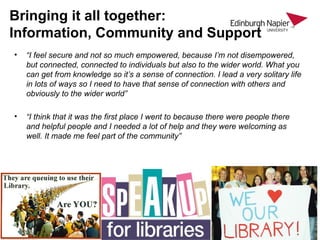
Bringing it all together:
Information, Community and Support
• “I feel secure and not so much empowered, because I’m not disempowered,
but connected, connected to individuals but also to the wider world. What you
can get from knowledge so it’s a sense of connection. I lead a very solitary life
in lots of ways so I need to have that sense of connection with others and
obviously to the wider world”
• “I think that it was the first place I went to because there were people there
and helpful people and I needed a lot of help and they were welcoming as
well. It made me feel part of the community”
Next Steps
• Round 3 focus groups (Winter 2017)
– Citizenship development
• Within Information Society context
• Through exchanges of capital
Thank you for listening
• L.Appleton@napier.ac.uk
• @leoappleton
•Questions?

Demonstrating the impact ofpublic libraries on citizenship development : focus groups

  • 1.
    Leo Appleton, ProfessorHazel Hall, Professor Alistair Duff, Professor Robert Raeside Information: Interactions and Impact Conference 27th – 30th June, 2017, Robert Gordon University, Aberdeen. Demonstrating the impact of the public library on citizenship development in the UK: focus group findings
  • 2.
    • Brief backgroundto the research project • Literature review & Research questions • Method • Pilot study • Focus Group findings • Initial discussion and analysis • Next steps Overview
  • 3.
    • Why publiclibraries? – Social function of libraries – Political agendas / lobbying against cuts – Citizenship agenda • Wider context – Information / Knowledge economies – Information Society – Exchange theory – Social capital Background to the research project
  • 4.
    Literature review themes •Role and value of public libraries • Impact of public libraries • Performance measurement and evaluation of public libraries • Exchange theory • Social capital and public libraries • Information Society models • Public libraries in the Information Society • To what extent is an individual’s position advantaged or disadvantaged as a result of using public libraries? • What is the impact of using a public library service on individual and community citizenship Image credit: University of Glasgow, Research & Knowledge Exchange
  • 5.
    • “I didn’tcry when I was homeless. The tears came later. I needed to care for my son and the library provided me an enchanted world to share with him. We arrived every day as the doors opened. My eager boy discovered dinosaurs, befriended librarians, and developed an on-going love of books. I devoured stories of others who face challenges. We shared story time and played on the lawn. Though homeless, the library helped me to mother my son by allowing me to give when I had nothing to spend” (Dowd, F. S. (1996) Homeless children in public libraries: a national survey of large systems. Journal of Youth Services in Libraries, 9 (2), 155-66.) Image credit: South Australian Public Library Network
  • 6.
    Pilot focus group “WhenI come in, I have a dead positive vibe, when I walk through the doors straight away, ‘cos I know that I only need to spend fifteen minutes in here, and I’ll have lost myself in a book…. You don’t care what’s going on!” “I could be quite dramatic and say that reading saved my life!”
  • 7.
  • 8.
    Method – Commit toa focus group methodology • Longitudinal cohort approach to focus groups • Revisit annually over three years – Scope of project • Representative of UK library users • Approach UK local library authorities • Ensure that City/town councils, County councils and Metropolitan Borough Councils all represented. – Benefits of longitudinal approach • Familiarity of group (common experiences) • Willingness to share and discuss • Deep and reflective discussion
  • 9.
    Empirical research 2014- 2016 Edinburgh Liverpool Newcastle Lincoln Essex Devon Redbridge Sutton
  • 10.
  • 11.
  • 12.
    Empowered citizens – Knowledgeand information • Educational role – Access to resources – Access to space – Access to expertise • The library is a place where knowledge is created and shared • The library is a place to ‘find out’, ‘enquire’ and ‘inform’ “…handling all those really old manuscripts and books, ….it’s knowledge, just a body of knowledge. And knowledge is power I believe. Knowledge is power!” “I essentially feel empowered. I have all that information, knowledge and creative stuff at my finger tips”
  • 13.
    Print monographs • “Myfavourite thing about the public library is that you can just grab any book that you like and you can just sit as long as you like and read it. And if you really like it you can get another one! Books!” • “I cannot overstate how much libraries have meant to me, and indirectly to other people. I have African heritage and the place where my family comes from there are no libraries so there is no free thought. They have an oral culture, but they don’t have a literary culture. Although people are clever, they are well educated, but they don’t think. They don’t think outside the box. When you read a book you think, you think to yourself ‘well what do I think about that?’ There people are more ‘well this is what you’re meant to think’ and for me it’s connected to freedom, not just personal freedom but community freedom and how we move on!”
  • 14.
    Print monographs ‘You can’taccess books on the Internet!’
  • 15.
    Community cohesion and integration “Thelibrary is a place of great safety and security.” “It’s inclusive. It makes you feel part of the group. I think that society consists of groups doesn’t it? But I see the library more as a coherent group and it’s very inclusive of people from different backgrounds, different ethnic backgrounds and cultures.”“When you’re on the streets no one cares about you. It’s like every man for himself. When you come in here you can just communicate with anyone, you can discuss things with people. There’s loads of things that you can do.” “You’re never too old to go to a library. You see really old people reading newspapers and you see really young people on the computers or like reading a book or studying or researching. A library is place where you see every generation and you end up socialising with every kind of person” “It is the one place where everyone is equal” “It is the one place where everyone is equal”
  • 16.
    Inclusion through professional support •“The staff are great. They will always show you how to do stuff. You don’t need to book on a course to set an email account up for example. They’ll just show you. The job centre doesn’t have computers now, yet you are meant to do all your job searching online. You can now only access this in the library. So having the staff available to help is so important.” • “I learnt how to use computers in the library. They showed me how to get online and how to search. I would never have had access to all of that before”
  • 17.
    Community ownership oflibraries • “If you close all the libraries you would be closing the door on opportunity an education. You don’t just learn in the classroom, you also learn in the library. You don’t just learn from teachers, you learn yourself, so if we close our libraries you are closing down opportunities for people who might not have a computer at home or can’t afford a printer. It’s taking your right to have an education away from you! We would be closing down opportunities for people” • “I think libraries make a very strong ideological statement like we’ve already said, as well as access to knowledge and access to imagination. It’s one of the few areas we’ve got that tries to level the playing field and we have that here in Lincoln to an extent. And that’s very important I think”
  • 18.
    Bringing it alltogether: Information, Community and Support • “I feel secure and not so much empowered, because I’m not disempowered, but connected, connected to individuals but also to the wider world. What you can get from knowledge so it’s a sense of connection. I lead a very solitary life in lots of ways so I need to have that sense of connection with others and obviously to the wider world” • “I think that it was the first place I went to because there were people there and helpful people and I needed a lot of help and they were welcoming as well. It made me feel part of the community”
  • 19.
    Next Steps • Round3 focus groups (Winter 2017) – Citizenship development • Within Information Society context • Through exchanges of capital
  • 20.
    Thank you forlistening • L.Appleton@napier.ac.uk • @leoappleton •Questions?

Editor's Notes

  • #3 This paper presents the findings of a research project that seeks to understand how public libraries operate and demonstrate value and social impact. The research considers how the multi-functionality and social impact of public libraries can be measured within a values framework, focusing on citizenship development. The focus of the paper is the findings from sixteen focus groups conducted with UK public library users during 2015 and 2016.
  • #5 Many public library commentators write about public libraries as being at the centre of their society. Brophy suggests that “libraries are at the heart of social systems; they exist to serve the needs of people, to help them live, learn and develop and to act as part of the social glue which holds communities together” (Brophy, 2006, p. 3). In an earlier study Brophy (2001) examines what constitutes a contemporary library service and argues that ‘libraries provide a very wide variety of activities and services for people in all walks of life’ and that the key concepts of this activity are “education, information storage and retrieval, and the transmission of knowledge.” (Brophy, 2001, p. 14). Similarly, Totterdell (2005) discusses the contemporary role of the library in society and suggests that the traditional public library in the UK has been based on four keystones: culture, education, leisure and recreation, and information. This suggests a multi-functional role for the public library spanning across different types of community provision. The idea of public libraries having this variety of societal roles means that they have different types of impact and value depending upon who is using them and for what purpose. In effect, it gives public libraries a greater outreach than would be possible if they fulfilled only one of the functions identified. These commentaries discuss the contemporary public library as a social entity with values around knowledge provision and discovery, support and assistance and accessibility. This particular theme suggests that in their multi-functional and societal roles, public libraries can benefit and advantage their users.   The measurement of library performance to demonstrate value and impact, has become a significant sub-discipline of library and information services management. Understanding the library user, their demands and expectations is essential for identifying success criteria and impact indicators (Hernon & Altman, 2010, p. 10). Markless and Streatfield (2006) illustrate how meaningful success criteria need to be set around outcomes of library usage and that libraries need to demonstrate beneficial ‘outcomes’ to their users. Examples of such outcomes could be around: knowledge gained by users; higher information literacy competencies; higher academic or professional success; social inclusion; or, an increase in individual wellbeing (Poll & Payne, 2006, p. 550). Similarly, social impact is frequently associated with public library services and the impact that they have on their communities and constituents (Kerslake & Kinnel, 1997, p.12).   Being able to demonstrate the impact and value of public libraries is fundamental to public libraries achieving their mission. For example, the Scottish Libraries and Information Council (SLIC) has developed a framework called How Good is Our Public Library Service which is intended to help demonstrate the impact libraries have on communities (SLIC, 2015). Such activity is now regarded essential at national levels and there is an increasing body of research and literature, which discusses how important it is to be able to analyse public library outcomes and the larger social role that they play on a national level. For example, Vakkari et al (2015) compare the perceived benefits of public library usage across five culturally different countries (Finland, Norway, the Netherlands, South Korea and the USA), and in doing so discuss the differences in societal outcomes for the public library services in each of these countries, as being determined by the individual nations’ social requirements from their library services. Another particular case study that stands out is that of Denmark, where a national initiative to introduce a portfolio of ‘citizen service’ was rolled out across the entire Danish public library system as part of its national library strategy (Pors, 2010).   The value of the public library service and the impact that it has on the citizenry that uses it can usefully be measured and demonstrated through identifying such social wellbeing and citizenship development outcomes and determining whether active usage of the public library services has afforded these. Therefore, there are two broad research questions to come from the literature:   •To what extent is an individual’s position advantaged or disadvantaged as a result of using public libraries?   •What is the impact of using a public library service on individual and community citizenship? In order to answer the research questions all of the above needed to be considered somehow. Information Society concepts, exchange theory and the generation and exchange of capital all needed to form part of the research as well as gaining a focus on societal outcome.
  • #6 Powerful quote that encapsulates some of this particularly the societal role of libraries, the epistemic knowledge and information function as well as the exchange of transactional, social and knowledge capital. This is the stuff I need to surface with my research…. But how?
  • #7 The pilot focus group was used to test the method and took place in September 2014 at Liverpool Central Library. Bearing in mind my research questions and the research needing to Questions had been developed around: ‘feelings and attitudes towards public libraries’ ‘Who are libraries for’ ‘what would a world with no libraries look like’ ‘Citizenship’ ‘what do you like about your library?’
  • #8 This generated three main sub themes – or values: Values around the epistemic function of libraries Vales around access Values around integration and inclusion And very quickly several sub themes emerged as well: Books and print vs electronic Staff support, knowledge and expertise Understanding of libraries
  • #9 A longitudinal focus group approach has been adopted in this study in order to obtain relevant data for analysis. Eight UK local authorities were approached to take part in the study in order for the research to carried out within a sample of representative UK public libraries. Focus groups, with up to ten participants in each, were convened and carried out during 2015-16 as the first phase of the empirical study. Participants discussed and shared their experiences of using public library services and reflected upon how their library usage had affected them.   A fundamental part of the methodology is its longitudinal approach. Because of the nature of the themes being discussed, it is desirable to reconvene each focus group, with the same participants at set intervals during the period of empirical research. This enables participants to reflect back on their most recent library usage and to discuss its impact and value in a current and personal context. Reconvening focus groups in which the participants are familiar with each other, also allows for a deeper and more open discussion, which in turn enables deeper and richer data to be obtained. The themes discussed during the first round of focus groups were around general library usage including: Attitudes and feelings towards public libraries The demand for and use of knowledge and information Who are libraries for and what is their role in society What is meant by the term citizenship and how does the library contribute to this   The questions posed during the first round of focus groups were designed to capture the immediate thoughts of library users and their historic experience of using libraries.   A second round of focus groups (phase two) was completed during 2016 in which participants were asked to discuss and reflect specifically on their personal development and involvement in their communities during the previous eight months (the period of time in between focus groups), and whether any of this had been facilitated through their library use. These themes and the questions used were largely informed by the themes identified during the first round of focus group and were intended to generate more reflection and to focus in on both individual and community learning and development afforded through public library use.
  • #11 54 participants across the eight first round focus groups which were convened during 2015 The themes discussed during the first round of focus groups were around general library focus on the three key values of the values framework: Attitudes and feelings towards public libraries The demand for and use of knowledge and information Who are libraries for and what is their role in society What is meant by the term citizenship and how does the library contribute to this   The questions posed during the first round of focus groups were designed to capture the immediate thoughts of library users and their historic experience of using libraries.   A second round of focus groups (phase two) was completed during 2016 in which a reduced number of 34 participants were asked to discuss and reflect specifically on their personal development and involvement in their communities during the previous eight months (the period of time in between focus groups), and whether any of this had been facilitated through their library use. These themes and the questions used were largely informed by the themes identified during the first round of focus group and were intended to generate more reflection and to focus in on both individual and community learning and development afforded through public library use. Again the values of access, inclusion and knowledge were used as the values framework in these discussions.
  • #12 The transcripts have been analysed using Nvivo and a coding methodology has been developed accordingly, which has allowed for me to analyse the data and four clear themes are emerging: The empowering nature of knowledge and information in citizenship development Print monographs as the main vehicle for the transfer of knowledge and information The changing nature and multi-functional role of the library – particularly with regard to community cohesion Community sense of ownership and pride in their libraries 9and loss when its gone)
  • #13 The epistemic and educational role of the library really stands out: Learning to read and literacy Study space, in your own time and in a personalise space / place Skills development – gardening, aromatherapy, local history, musical instruments, drawing, Acknowledgement throughout that the use of the resources in the library, both print and digital, as well as being able to access knowledgeable and expert staff allows for knowledge to be generated and exchanged. See a real link to exchange theory here in that nearly all particopants are discussing personal development and learning through a clear exchange of social capital, knowledge capital and transactional capital . This is validated where participants felt ‘let down’ or disadvantaged even, where the resources and support were clearly unavailable. In Lincoln there seemed to be a lot of concern about the ever diminishing levels of books and stock and several librarie sreported a lack of confidence in the library staff to be able to support them in the enquiries that they had (particularly around access to digital and using the computers) The final bullet, a library is a pace to find out, enquire and inform: great anecdotes of individuals finding out about events, community activities. In one instance in Sutton Libraries one participant went to the library to find out more about some planning persmission for a planned ‘traveller’s site’ proposed ro development on the estate on which he lived. He was then able to further inform his neighbours and lobby the council for a change in that particular decision. Citizenship participation in action
  • #14 The most surprising discovery…. Almost exclusively all participants demonstrated different information seeking habits when it came to using print books and using online information. There was a real distrust of online information and the monograph is being seen as the primary vehicle for information dissemination. For reference, children, literacy, fiction, across all information, books are seen as more trustworthy, credible and authoritative than their electronic counterparts. Even when it came to things like community information or bus timetables, lots of participants cited that they trusted the printed version more than the electronic That is not to say that the participants were not computer users…. They all were, but they saw computer and digital information as having a different role within their information seeking and usage behaviour. For me this behaviour and value placed on print is a phenomenon associated with public library users. Even those users who have access and experience to academic libraries and school libraries (which many participants were actively using) they saw the public library as something different. Essentially somewhere to come for their ‘print’ books. This is very interesting, particularly within Information Society studies in that books may well have a specific place outside of digital information…..
  • #15 …. And even ‘digitised information’. I just had to share this with you. A participant who had spoken at length about her use of print and of digital resources, made this remark in defence of printed monographs and it was well received by the participants… to the extent that they all essentially agreed. Even after acknowledging that e-books were digitised (and more searchable) version of their print couterparts, particpants still strongly favoured books. Two separate focus groups reported on reading groups having been supplied with kindles by their libraries in order to transport the fiction books that they were reading…. I both cases the reading groups resorted to print. In this case for social reasons, rather than credibility reasons
  • #16 Libraries are for everyone Everyone is equal in a library No prejudice Meeting people Libraries provide safe and secure space to access information, resources, knowledge and people Libraries provide community Communities expect to have access to libraries Lots of discussion around the changing nature of libraries and the access they provide to community information, help support, clubs, societies. Many reported on the clubs and groups that they were part of and how it was a channel of social interaction from grid clubs, to homework clubs to reading groups, music clubs and Zumba classes. A lot value in this functionality and clearly a leveller with regard to social interaction, local social mobility, networking – all manifesting itself effectively in the generation and exchange of social capital facilitated by the library.
  • #17 Staff allow for access and inclusion Staff expert across the whole library provision Staff add value Human capital Transactional capital