OPERATING PERSONAL COMPUTER
MODULE 1
IdentifyData, information, knowledge,
Wisdom/Attitudes
Defense University,
Major General Mulugeta
Buli Poly Technic College
From ICT Department
Introduction
 In this module you will study the basic of
 data,
 information,
 knowledge and
 wisdom/attitude.
 You will understand what data and information are and the
relation between the two.
 You will also be introduced to information technology (IT).
Septe-26-oct-07
2
Analyzing Data
Definition: Data
♦ is factual material used as a basis for discussion or decision,
calculating or measuring.
♦ Unstructured facts gathered about some entity
(student,course,section,department,instructor), event or
observation.
Characteristics
♦ Does not convey a meaning by it self
♦ Data alone tells no story. It must be processed
20-Nov-13
3
Analyzing Information
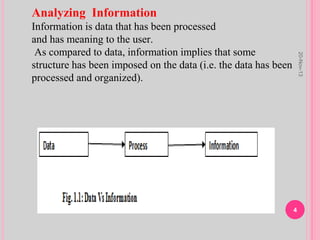
Information is data that has been processed
and has meaning to the user.
As compared to data, information implies that some
structure has been imposed on the data (i.e. the data has been
processed and organized).
20-Nov-13
4
Data Vs Information
 people confuse the terms data and information or use them wrongly.
 Data and information are different.
 Data refers to raw, unevaluated facts, figures, symbols, objects, events,
etc.
 Data may be a collection of facts lying in storage, like a telephone
directory or census records.
 Information is data that have been put in to a meaningful and useful
context and communicated to a recipient who uses it to make decisions.
 Information involves the communication and reception of intelligence
and knowledge.
 It reduces uncertainty, reveals additional alternatives or helps eliminate
irrelevant or poor ones, and influences individuals and stimulates them
to action.
 An element of data may constitute information in a specific context; for
example, when you want to contact your friend, his or her telephone
number is a piece of information;
 otherwise, it is just one element of data in the telephone directory.
20-Nov-13
5
 Computers have made the processing function much easier.
 Large quantities of data can be processed quickly through
computers aiding in the conversion of data to information.
 Raw data enter the system and are transformed into the
system’s output, that is, information to support managers in
their decision-making.
20-Nov-13
6
Forms of Data/Information
 Data/information exists in many forms:
 text,
 graphs,
 still images,
 sounds and
 video images.
20-Nov-13
7
Information Technology (IT)
 Information Technology is any form of computer-based system
 that has the capability
 to input,
 process,
 store and
 output data/ information.
 Although personal computer (PC) is the most popular example of
IT, microprocessor based system is also IT.
 The only constant in today’s society is change, and information
technology is driving it.
20-Nov-13
8
The effect of IT (Computers) on society
 Computers have essentially revolutionized data and information
processing.
 Computers have also changed some industries and actually created
others.
 The design and manufacturing of computer hardware has become
enormous industry, and the need for software by all sorts of tasks has
dramatically changed the development of application software
industry.
 growth of computer information industry and requires computer
literate users.
 No matter what type of business or organization you go in to, you
will probably be using computers.
 The employment picture for users (you) is good if you have had
some experience actually using computers as a prerequisite for
employment.
 Computers are becoming standard business tools for all employees,
from the president of the company to the clerks in the typing pool.
20-Nov-13
9
Computers in Business
 Different types of businesses commonly use computers to assist with
such day-to-day activity as:
♦Sales order entry: procedures for handling customer orders,
including receipt of the order and verification of availability of
ordered stock.
♦Inventory and control: procedures for tracking, counting, and
reordering stock items.
♦Personal managements: procedures for maintaining employee
information (such as hire date, salary, performance rating, and date
of last review) for both development and reporting purposes.
♦Payroll: procedures of producing pay checks and reports on employee
compensation.
♦Accounting: procedures for maintaining the company’s financial
records.
♦ Security: procedures for controlling who has access to what data and
information at what times and where, and who may enter data to a
computer-based information system.
♦ Investment and Management: procedures a company institutes,
follows, and reviews to guarantee profit and growth.
20-Nov-13
10
Computers at Home
 Computers are such versatile tools that people are bringing
them in to their homes in increasing numbers.
 A wide variety of software is available for home use,
including:
 Educational software for young children
 Personal financial management software
 Entertainment software
 Many professional also use computers in their home.
20-Nov-13
11
Computers in Learning and Education
 Computers have dramatically changed learning and education.
 Educational materials (text, audio, video) can now easily been
distributed on a CD and other similar media.
 Even better, people can learn anywhere anytime (electronic
learning/e-learning) provided there is an appropriate computer
network infrastructure.
20-Nov-13
12
Computers in Communication
 Computer networks/ the Internet have created new ways of
communication.
 The most popular example is an electronic mail (Email).
 Using email you can send messages to a person anywhere in
the world within seconds as compared to traditional mail.
20-Nov-13
13
Note: In a nutshell,
 information technology is affecting all aspects of society.
 Society is faced with virtuality (electronic realities and
connections) in almost every realm:
 ecology,
 governance,
 international relation and political power,
 health and medicine,
 learning and education,
 employment and entrepreneurship,
 leisure, entertainment, the arts etc.
20-Nov-13
14
Analyzing Knowledge
Knowledge is:
 general awareness or possession of information, facts, ideas,
truths, or principles
 clear awareness or explicit information, for example, of a
situation or fact
 all the information, facts, truths, and principles learned
throughout time
 Familiarity or understanding gained through experience or
study
20-Nov-13
15
 So what is information?
 What is the relationship between information, data and
knowledge?
 When information is entered and stored in a computer, it is
generally referred to as “data.”
 After processing (such as formatting and printing), output data
can again be perceived as “information.”
 When information is packaged or used for understanding or
doing something, it is known as "knowledge".
20-Nov-13
16
Analyzing Wisdom
Wisdom is:
 the knowledge and experience needed to make sensible decisions
and judgments, or the good sense shown by the decisions and
judgments made
 accumulated knowledge of life or in a particular sphere of activity
that has been gained through experience
 an opinion that almost everyone seems to share or express
 ancient teachings or sayings
20-Nov-13
17
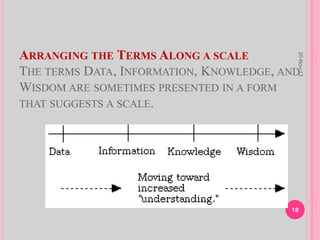
ARRANGING THE TERMS ALONG A SCALE
THE TERMS DATA, INFORMATION, KNOWLEDGE, AND
WISDOM ARE SOMETIMES PRESENTED IN A FORM
THAT SUGGESTS A SCALE.
20-Nov-13
18
 Information consists of data, but data is not have necessarily
information.
 Also, wisdom is knowledge, which in turn is information,
which in turn is data,
 but, for example, knowledge is not necessarily wisdom.
 So wisdom is a subset of knowledge, which is a subset of
information, which is a subset of data.
20-Nov-13
19
THANKYOU
20-Nov-13
20

MODULE 1.pptx

  • 1.
    OPERATING PERSONAL COMPUTER MODULE1 IdentifyData, information, knowledge, Wisdom/Attitudes Defense University, Major General Mulugeta Buli Poly Technic College From ICT Department
  • 2.
    Introduction  In thismodule you will study the basic of  data,  information,  knowledge and  wisdom/attitude.  You will understand what data and information are and the relation between the two.  You will also be introduced to information technology (IT). Septe-26-oct-07 2
  • 3.
    Analyzing Data Definition: Data ♦is factual material used as a basis for discussion or decision, calculating or measuring. ♦ Unstructured facts gathered about some entity (student,course,section,department,instructor), event or observation. Characteristics ♦ Does not convey a meaning by it self ♦ Data alone tells no story. It must be processed 20-Nov-13 3
  • 4.
    Analyzing Information Information isdata that has been processed and has meaning to the user. As compared to data, information implies that some structure has been imposed on the data (i.e. the data has been processed and organized). 20-Nov-13 4
  • 5.
    Data Vs Information people confuse the terms data and information or use them wrongly.  Data and information are different.  Data refers to raw, unevaluated facts, figures, symbols, objects, events, etc.  Data may be a collection of facts lying in storage, like a telephone directory or census records.  Information is data that have been put in to a meaningful and useful context and communicated to a recipient who uses it to make decisions.  Information involves the communication and reception of intelligence and knowledge.  It reduces uncertainty, reveals additional alternatives or helps eliminate irrelevant or poor ones, and influences individuals and stimulates them to action.  An element of data may constitute information in a specific context; for example, when you want to contact your friend, his or her telephone number is a piece of information;  otherwise, it is just one element of data in the telephone directory. 20-Nov-13 5
  • 6.
     Computers havemade the processing function much easier.  Large quantities of data can be processed quickly through computers aiding in the conversion of data to information.  Raw data enter the system and are transformed into the system’s output, that is, information to support managers in their decision-making. 20-Nov-13 6
  • 7.
    Forms of Data/Information Data/information exists in many forms:  text,  graphs,  still images,  sounds and  video images. 20-Nov-13 7
  • 8.
    Information Technology (IT) Information Technology is any form of computer-based system  that has the capability  to input,  process,  store and  output data/ information.  Although personal computer (PC) is the most popular example of IT, microprocessor based system is also IT.  The only constant in today’s society is change, and information technology is driving it. 20-Nov-13 8
  • 9.
    The effect ofIT (Computers) on society  Computers have essentially revolutionized data and information processing.  Computers have also changed some industries and actually created others.  The design and manufacturing of computer hardware has become enormous industry, and the need for software by all sorts of tasks has dramatically changed the development of application software industry.  growth of computer information industry and requires computer literate users.  No matter what type of business or organization you go in to, you will probably be using computers.  The employment picture for users (you) is good if you have had some experience actually using computers as a prerequisite for employment.  Computers are becoming standard business tools for all employees, from the president of the company to the clerks in the typing pool. 20-Nov-13 9
  • 10.
    Computers in Business Different types of businesses commonly use computers to assist with such day-to-day activity as: ♦Sales order entry: procedures for handling customer orders, including receipt of the order and verification of availability of ordered stock. ♦Inventory and control: procedures for tracking, counting, and reordering stock items. ♦Personal managements: procedures for maintaining employee information (such as hire date, salary, performance rating, and date of last review) for both development and reporting purposes. ♦Payroll: procedures of producing pay checks and reports on employee compensation. ♦Accounting: procedures for maintaining the company’s financial records. ♦ Security: procedures for controlling who has access to what data and information at what times and where, and who may enter data to a computer-based information system. ♦ Investment and Management: procedures a company institutes, follows, and reviews to guarantee profit and growth. 20-Nov-13 10
  • 11.
    Computers at Home Computers are such versatile tools that people are bringing them in to their homes in increasing numbers.  A wide variety of software is available for home use, including:  Educational software for young children  Personal financial management software  Entertainment software  Many professional also use computers in their home. 20-Nov-13 11
  • 12.
    Computers in Learningand Education  Computers have dramatically changed learning and education.  Educational materials (text, audio, video) can now easily been distributed on a CD and other similar media.  Even better, people can learn anywhere anytime (electronic learning/e-learning) provided there is an appropriate computer network infrastructure. 20-Nov-13 12
  • 13.
    Computers in Communication Computer networks/ the Internet have created new ways of communication.  The most popular example is an electronic mail (Email).  Using email you can send messages to a person anywhere in the world within seconds as compared to traditional mail. 20-Nov-13 13
  • 14.
    Note: In anutshell,  information technology is affecting all aspects of society.  Society is faced with virtuality (electronic realities and connections) in almost every realm:  ecology,  governance,  international relation and political power,  health and medicine,  learning and education,  employment and entrepreneurship,  leisure, entertainment, the arts etc. 20-Nov-13 14
  • 15.
    Analyzing Knowledge Knowledge is: general awareness or possession of information, facts, ideas, truths, or principles  clear awareness or explicit information, for example, of a situation or fact  all the information, facts, truths, and principles learned throughout time  Familiarity or understanding gained through experience or study 20-Nov-13 15
  • 16.
     So whatis information?  What is the relationship between information, data and knowledge?  When information is entered and stored in a computer, it is generally referred to as “data.”  After processing (such as formatting and printing), output data can again be perceived as “information.”  When information is packaged or used for understanding or doing something, it is known as "knowledge". 20-Nov-13 16
  • 17.
    Analyzing Wisdom Wisdom is: the knowledge and experience needed to make sensible decisions and judgments, or the good sense shown by the decisions and judgments made  accumulated knowledge of life or in a particular sphere of activity that has been gained through experience  an opinion that almost everyone seems to share or express  ancient teachings or sayings 20-Nov-13 17
  • 18.
    ARRANGING THE TERMSALONG A SCALE THE TERMS DATA, INFORMATION, KNOWLEDGE, AND WISDOM ARE SOMETIMES PRESENTED IN A FORM THAT SUGGESTS A SCALE. 20-Nov-13 18
  • 19.
     Information consistsof data, but data is not have necessarily information.  Also, wisdom is knowledge, which in turn is information, which in turn is data,  but, for example, knowledge is not necessarily wisdom.  So wisdom is a subset of knowledge, which is a subset of information, which is a subset of data. 20-Nov-13 19
  • 20.