ACGME/I Accreditation Council of Graduate Medical Education/International  Accreditation Orientation, Action plan and timelineKhaled Said, MDACGME/I  Emergency Medicine Coordinator
What is the Accreditation Council for Graduate Medical Education? The ACGME is a private, nonprofit organization that accredits about 8,700 residency programs in 130 specialties and subspecialties that educate about 109,000 residents. Established in 1981 out of a consensus need in the medical community for an independent accrediting organization for graduate medical education programsMission is to improve health care by assessing and advancing the quality of resident physicians’ education through exemplary accreditation. Governed by nominated Board of directors from American Association of Medical Colleges, American Board of Medical Specialties, American Hospital Association, American Medical Association, Council of Medical Specialty Societies, and a non-voting federal representative appointed by the Department of Health and Human Services
How does the accreditation process work?The work of reviewing specific programs and making accreditation decisions is carried out by 27 Residency Review Committees, one for each major specialty The Institutional Review Committee accredits institutions that sponsor residency programs. RRC members are volunteer physicians appointed by the appropriate medical specialty organization, medical specialty board and the AMA Council on Medical Education.
ACGME field staff representatives conduct one-day site visits to programs once every two to five years, depending on the strength of the program. About one-third of the programs are visited each year. The field staff representatives write objective narrative reports about the programs they visit, based on:Lengthy interviews with the program directors, FacultyResidentsReview of supporting documents.
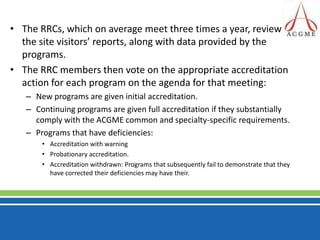
The RRCs, which on average meet three times a year, review the site visitors’ reports, along with data provided by the programs. The RRC members then vote on the appropriate accreditation action for each program on the agenda for that meeting: New programs are given initial accreditation.Continuing programs are given full accreditation if they substantially comply with the ACGME common and specialty-specific requirements. Programs that have deficiencies:Accreditation with warningProbationary accreditation.Accreditation withdrawn: Programs that subsequently fail to demonstrate that they have corrected their deficiencies may have their. 
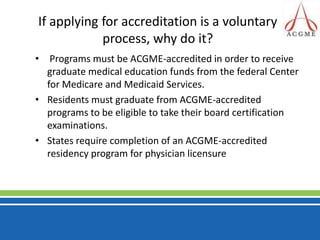
If applying for accreditation is a voluntary process, why do it? Programs must be ACGME-accredited in order to receive graduate medical education funds from the federal Center for Medicare and Medicaid Services. Residents must graduate from ACGME-accredited programs to be eligible to take their board certification examinations.States require completion of an ACGME-accredited residency program for physician licensure
ACGME Outcome Project
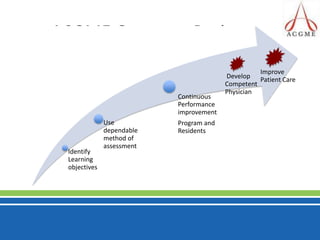
Goal of ACGME Accreditation Council of Graduate Medical EducationDevelop Competent PhysiciansImprove Patient Care
TerminologyFoundational Program Requirements (FPR)Application for International Program Accreditation (AIPA)Advance Specialty Program Information Forms AS-PIF);Resident and faculty survey question responses
Program Director/Associate must: Ensure the quality of didactic and clinical education.Dedicate no less that 50% (a minimum of 20 hours per week) of his/her professional effort to the administrative and educational activities of the educational program; Approve Associate director who is accountable for resident education;Approve the selection of program faculty as appropriate;Evaluate program faculty and approve the continued participation of program faculty based on evaluationMonitor resident supervisionPrepare and submit all information required and requested by the ACGME-IProvide each resident with documented semiannual evaluation of performance with feedbackImplement policies and procedures consistent with the institutional and program requirements.Monitor resident duty hours, according to institutional and program
Program Personnel and RecoursesThe institution and the program must jointly ensure the availability of all necessary professional, technical, and clerical personnel for the effective administration of the program.Program Coordinator.Program Secretary.Office spaces appropriate for PD, A/PD and PC.Core Faculty  meeting and administrative space.The institution and the program must jointly ensure the availability of adequate resources for resident education, as defined in the specialty program requirements.Medical Information Access.Appropriate space assigned specifically to accommodate resident meeting, reading and  assignments within close boundaries of  the ED.
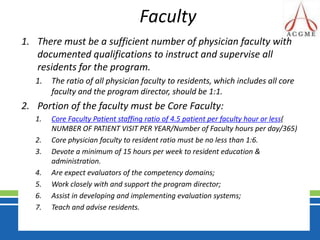
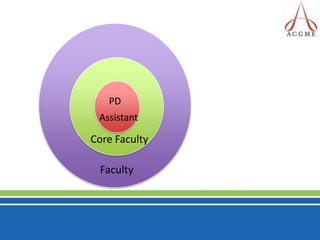
FacultyThere must be a sufficient number of physician faculty with documented qualifications to instruct and supervise all residents for the program. The ratio of all physician faculty to residents, which includes all core faculty and the program director, should be 1:1.Portion of the faculty must be Core Faculty:Core Faculty Patient staffing ratio of 4.5 patient per faculty hour or less( NUMBER OF PATIENT VISIT PER YEAR/Number of Faculty hours per day/365)Core physician faculty to resident ratio must be no less than 1:6.Devote a minimum of 15 hours per week to resident education & administration. Are expect evaluators of the competency domains; Work closely with and support the program director; Assist in developing and implementing evaluation systems; Teach and advise residents.
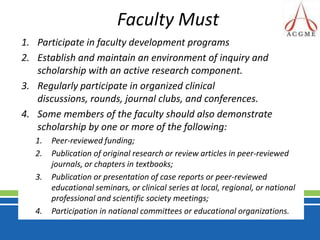
Faculty MustParticipate in faculty development programs Establish and maintain an environment of inquiry and scholarship with an active research component. Regularly participate in organized clinical discussions, rounds, journal clubs, and conferences. Some members of the faculty should also demonstrate scholarship by one or more of the following: Peer-reviewed funding; Publication of original research or review articles in peer-reviewed journals, or chapters in textbooks; Publication or presentation of case reports or peer-reviewed educational seminars, or clinical series at local, regional, or national professional and scientific society meetings; Participation in national committees or educational organizations.
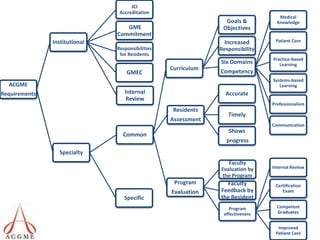
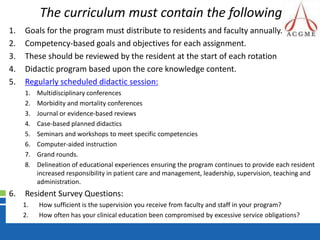
The curriculum must contain the following:Goals for the program must distribute to residents and faculty annually. Competency-based goals and objectives for each assignment.These should be reviewed by the resident at the start of each rotationDidactic program based upon the core knowledge content.Regularly scheduled didactic session:Multidisciplinary conferencesMorbidity and mortality conferencesJournal or evidence-based reviewsCase-based planned didacticsSeminars and workshops to meet specific competenciesComputer-aided instructionGrand rounds. Delineation of educational experiences ensuring the program continues to provide each resident increased responsibility in patient care and management, leadership, supervision, teaching and administration.Resident Survey Questions:How sufficient is the supervision you receive from faculty and staff in your program?How often has your clinical education been compromised by excessive service obligations?
Residents’ Scholarly Activities The curriculum must advance residents’ knowledge of the basic principles of research, including how research is conducted, evaluated, explained to patients ,and applied to patient care. Residents should participate in scholarly activity. [As further specified by the Advanced Specialty Program Requirements] The sponsoring institution and program should allocate adequate educational resources to facilitate resident involvement in scholarly activities. [As further specified by the Advanced Specialty Program Requirements]
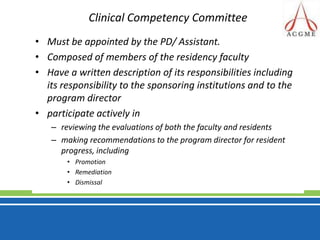
Clinical Competency Committee Must be appointed by the PD/ Assistant.Composed of members of the residency facultyHave a written description of its responsibilities including its responsibility to the sponsoring institutions and to the program directorparticipate actively inreviewing the evaluations of both the faculty and residentsmaking recommendations to the program director for resident progress, includingPromotionRemediationDismissal
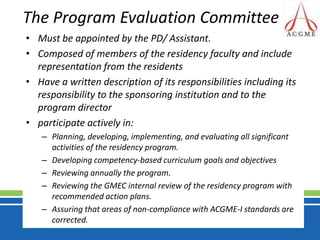
The Program Evaluation Committee Must be appointed by the PD/ Assistant.Composed of members of the residency faculty and include representation from the residentsHave a written description of its responsibilities including its responsibility to the sponsoring institution and to the program directorparticipate actively in:Planning, developing, implementing, and evaluating all significant activities of the residency program.Developing competency-based curriculum goals and objectivesReviewing annually the program.Reviewing the GMEC internal review of the residency program with recommended action plans.Assuring that areas of non-compliance with ACGME-I standards are corrected.
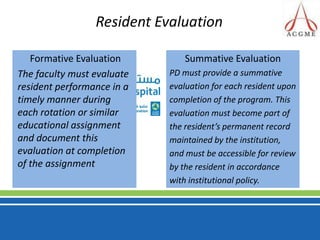
Resident Evaluation Formative Evaluation The faculty must evaluate resident performance in a timely manner during each rotation or similar educational assignment and document this evaluation at completion of the assignmentSummative EvaluationPD must provide a summativeevaluation for each resident uponcompletion of the program. Thisevaluation must become part ofthe resident’s permanent recordmaintained by the institution,and must be accessible for reviewby the resident in accordancewith institutional policy.
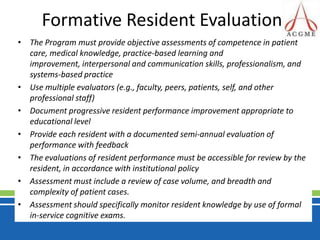
Formative Resident EvaluationThe Program must provide objective assessments of competence in patient care, medical knowledge, practice-based learning and improvement, interpersonal and communication skills, professionalism, and systems-based practiceUse multiple evaluators (e.g., faculty, peers, patients, self, and other professional staff)Document progressive resident performance improvement appropriate to educational levelProvide each resident with a documented semi-annual evaluation of performance with feedbackThe evaluations of resident performance must be accessible for review by the resident, in accordance with institutional policyAssessment must include a review of case volume, and breadth and complexity of patient cases.Assessment should specifically monitor resident knowledge by use of formal in-service cognitive exams.
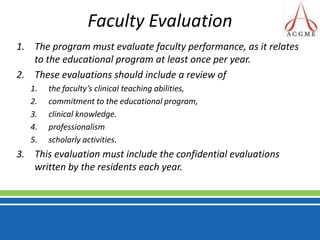
Faculty Evaluation The program must evaluate faculty performance, as it relates to the educational program at least once per year. These evaluations should include a review of the faculty’s clinical teaching abilities, commitment to the educational program, clinical knowledge.professionalismscholarly activities. This evaluation must include the confidential evaluations written by the residents each year.
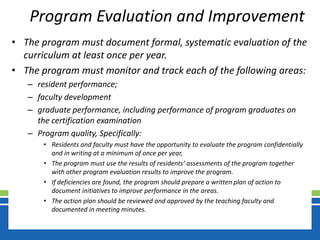
Program Evaluation and Improvement The program must document formal, systematic evaluation of the curriculum at least once per year. The program must monitor and track each of the following areas: resident performance; faculty developmentgraduate performance, including performance of program graduates on the certification examinationProgram quality, Specifically: Residents and faculty must have the opportunity to evaluate the program confidentially and in writing at a minimum of once per year, The program must use the results of residents’ assessments of the program together with other program evaluation results to improve the program. If deficiencies are found, the program should prepare a written plan of action to document initiatives to improve performance in the areas. The action plan should be reviewed and approved by the teaching faculty and documented in meeting minutes.
Emergency Program ACGME Accreditation Action Plan (EP3AP)Orientation: ACGME awareness for all ED staff:LeadershipQualityNursingSupport personnelHighlighting ACGME Requirements: More than 70 major required items.Emergency Program ACGME Accreditations Action Committees.(EP3AC)
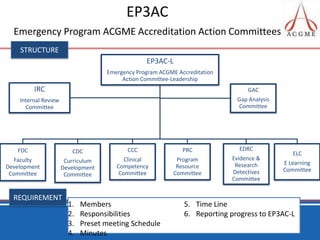
EP3ACEmergency Program ACGME Accreditation Action CommitteesStructureRequirementMembersResponsibilitiesPreset meeting ScheduleMinutesTime LineReporting progress to EP3AC-L
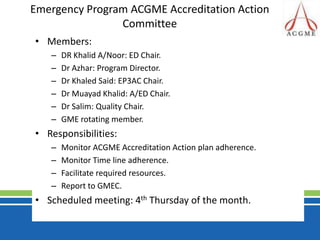
Emergency Program ACGME Accreditation Action CommitteeLeadership (EP3AC-L)Members:DR Khalid A/Noor: ED Chair.Dr Azhar: Program Director.Dr Khaled Said: EP3AC Chair.Dr Muayad Khalid: A/ED Chair.Dr Salim: Quality Chair.GME rotating member.Responsibilities:Monitor ACGME Accreditation Action plan adherence.Monitor Time line adherence.Facilitate required resources.Report to GMEC.Scheduled meeting: 4th Thursday of the month.
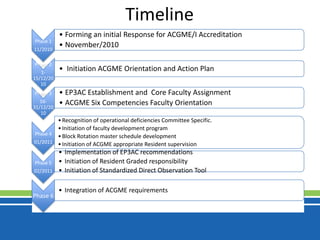
Timeline
Acgme action plan

Acgme action plan

  • 1.
    ACGME/I Accreditation Councilof Graduate Medical Education/International Accreditation Orientation, Action plan and timelineKhaled Said, MDACGME/I Emergency Medicine Coordinator
  • 2.
    What is theAccreditation Council for Graduate Medical Education? The ACGME is a private, nonprofit organization that accredits about 8,700 residency programs in 130 specialties and subspecialties that educate about 109,000 residents. Established in 1981 out of a consensus need in the medical community for an independent accrediting organization for graduate medical education programsMission is to improve health care by assessing and advancing the quality of resident physicians’ education through exemplary accreditation. Governed by nominated Board of directors from American Association of Medical Colleges, American Board of Medical Specialties, American Hospital Association, American Medical Association, Council of Medical Specialty Societies, and a non-voting federal representative appointed by the Department of Health and Human Services
  • 3.
    How does theaccreditation process work?The work of reviewing specific programs and making accreditation decisions is carried out by 27 Residency Review Committees, one for each major specialty The Institutional Review Committee accredits institutions that sponsor residency programs. RRC members are volunteer physicians appointed by the appropriate medical specialty organization, medical specialty board and the AMA Council on Medical Education.
  • 4.
    ACGME field staffrepresentatives conduct one-day site visits to programs once every two to five years, depending on the strength of the program. About one-third of the programs are visited each year. The field staff representatives write objective narrative reports about the programs they visit, based on:Lengthy interviews with the program directors, FacultyResidentsReview of supporting documents.
  • 5.
    The RRCs, whichon average meet three times a year, review the site visitors’ reports, along with data provided by the programs. The RRC members then vote on the appropriate accreditation action for each program on the agenda for that meeting: New programs are given initial accreditation.Continuing programs are given full accreditation if they substantially comply with the ACGME common and specialty-specific requirements. Programs that have deficiencies:Accreditation with warningProbationary accreditation.Accreditation withdrawn: Programs that subsequently fail to demonstrate that they have corrected their deficiencies may have their. 
  • 7.
    If applying foraccreditation is a voluntary process, why do it? Programs must be ACGME-accredited in order to receive graduate medical education funds from the federal Center for Medicare and Medicaid Services. Residents must graduate from ACGME-accredited programs to be eligible to take their board certification examinations.States require completion of an ACGME-accredited residency program for physician licensure
  • 8.
  • 9.
    Goal of ACGMEAccreditation Council of Graduate Medical EducationDevelop Competent PhysiciansImprove Patient Care
  • 10.
    TerminologyFoundational Program Requirements(FPR)Application for International Program Accreditation (AIPA)Advance Specialty Program Information Forms AS-PIF);Resident and faculty survey question responses
  • 11.
    Program Director/Associate must:Ensure the quality of didactic and clinical education.Dedicate no less that 50% (a minimum of 20 hours per week) of his/her professional effort to the administrative and educational activities of the educational program; Approve Associate director who is accountable for resident education;Approve the selection of program faculty as appropriate;Evaluate program faculty and approve the continued participation of program faculty based on evaluationMonitor resident supervisionPrepare and submit all information required and requested by the ACGME-IProvide each resident with documented semiannual evaluation of performance with feedbackImplement policies and procedures consistent with the institutional and program requirements.Monitor resident duty hours, according to institutional and program
  • 12.
    Program Personnel andRecoursesThe institution and the program must jointly ensure the availability of all necessary professional, technical, and clerical personnel for the effective administration of the program.Program Coordinator.Program Secretary.Office spaces appropriate for PD, A/PD and PC.Core Faculty meeting and administrative space.The institution and the program must jointly ensure the availability of adequate resources for resident education, as defined in the specialty program requirements.Medical Information Access.Appropriate space assigned specifically to accommodate resident meeting, reading and assignments within close boundaries of the ED.
  • 13.
    FacultyThere must bea sufficient number of physician faculty with documented qualifications to instruct and supervise all residents for the program. The ratio of all physician faculty to residents, which includes all core faculty and the program director, should be 1:1.Portion of the faculty must be Core Faculty:Core Faculty Patient staffing ratio of 4.5 patient per faculty hour or less( NUMBER OF PATIENT VISIT PER YEAR/Number of Faculty hours per day/365)Core physician faculty to resident ratio must be no less than 1:6.Devote a minimum of 15 hours per week to resident education & administration. Are expect evaluators of the competency domains; Work closely with and support the program director; Assist in developing and implementing evaluation systems; Teach and advise residents.
  • 15.
    Faculty MustParticipate infaculty development programs Establish and maintain an environment of inquiry and scholarship with an active research component. Regularly participate in organized clinical discussions, rounds, journal clubs, and conferences. Some members of the faculty should also demonstrate scholarship by one or more of the following: Peer-reviewed funding; Publication of original research or review articles in peer-reviewed journals, or chapters in textbooks; Publication or presentation of case reports or peer-reviewed educational seminars, or clinical series at local, regional, or national professional and scientific society meetings; Participation in national committees or educational organizations.
  • 16.
    The curriculum mustcontain the following:Goals for the program must distribute to residents and faculty annually. Competency-based goals and objectives for each assignment.These should be reviewed by the resident at the start of each rotationDidactic program based upon the core knowledge content.Regularly scheduled didactic session:Multidisciplinary conferencesMorbidity and mortality conferencesJournal or evidence-based reviewsCase-based planned didacticsSeminars and workshops to meet specific competenciesComputer-aided instructionGrand rounds. Delineation of educational experiences ensuring the program continues to provide each resident increased responsibility in patient care and management, leadership, supervision, teaching and administration.Resident Survey Questions:How sufficient is the supervision you receive from faculty and staff in your program?How often has your clinical education been compromised by excessive service obligations?
  • 17.
    Residents’ Scholarly ActivitiesThe curriculum must advance residents’ knowledge of the basic principles of research, including how research is conducted, evaluated, explained to patients ,and applied to patient care. Residents should participate in scholarly activity. [As further specified by the Advanced Specialty Program Requirements] The sponsoring institution and program should allocate adequate educational resources to facilitate resident involvement in scholarly activities. [As further specified by the Advanced Specialty Program Requirements]
  • 18.
    Clinical Competency CommitteeMust be appointed by the PD/ Assistant.Composed of members of the residency facultyHave a written description of its responsibilities including its responsibility to the sponsoring institutions and to the program directorparticipate actively inreviewing the evaluations of both the faculty and residentsmaking recommendations to the program director for resident progress, includingPromotionRemediationDismissal
  • 19.
    The Program EvaluationCommittee Must be appointed by the PD/ Assistant.Composed of members of the residency faculty and include representation from the residentsHave a written description of its responsibilities including its responsibility to the sponsoring institution and to the program directorparticipate actively in:Planning, developing, implementing, and evaluating all significant activities of the residency program.Developing competency-based curriculum goals and objectivesReviewing annually the program.Reviewing the GMEC internal review of the residency program with recommended action plans.Assuring that areas of non-compliance with ACGME-I standards are corrected.
  • 20.
    Resident Evaluation FormativeEvaluation The faculty must evaluate resident performance in a timely manner during each rotation or similar educational assignment and document this evaluation at completion of the assignmentSummative EvaluationPD must provide a summativeevaluation for each resident uponcompletion of the program. Thisevaluation must become part ofthe resident’s permanent recordmaintained by the institution,and must be accessible for reviewby the resident in accordancewith institutional policy.
  • 21.
    Formative Resident EvaluationTheProgram must provide objective assessments of competence in patient care, medical knowledge, practice-based learning and improvement, interpersonal and communication skills, professionalism, and systems-based practiceUse multiple evaluators (e.g., faculty, peers, patients, self, and other professional staff)Document progressive resident performance improvement appropriate to educational levelProvide each resident with a documented semi-annual evaluation of performance with feedbackThe evaluations of resident performance must be accessible for review by the resident, in accordance with institutional policyAssessment must include a review of case volume, and breadth and complexity of patient cases.Assessment should specifically monitor resident knowledge by use of formal in-service cognitive exams.
  • 22.
    Faculty Evaluation Theprogram must evaluate faculty performance, as it relates to the educational program at least once per year. These evaluations should include a review of the faculty’s clinical teaching abilities, commitment to the educational program, clinical knowledge.professionalismscholarly activities. This evaluation must include the confidential evaluations written by the residents each year.
  • 23.
    Program Evaluation andImprovement The program must document formal, systematic evaluation of the curriculum at least once per year. The program must monitor and track each of the following areas: resident performance; faculty developmentgraduate performance, including performance of program graduates on the certification examinationProgram quality, Specifically: Residents and faculty must have the opportunity to evaluate the program confidentially and in writing at a minimum of once per year, The program must use the results of residents’ assessments of the program together with other program evaluation results to improve the program. If deficiencies are found, the program should prepare a written plan of action to document initiatives to improve performance in the areas. The action plan should be reviewed and approved by the teaching faculty and documented in meeting minutes.
  • 25.
    Emergency Program ACGMEAccreditation Action Plan (EP3AP)Orientation: ACGME awareness for all ED staff:LeadershipQualityNursingSupport personnelHighlighting ACGME Requirements: More than 70 major required items.Emergency Program ACGME Accreditations Action Committees.(EP3AC)
  • 26.
    EP3ACEmergency Program ACGMEAccreditation Action CommitteesStructureRequirementMembersResponsibilitiesPreset meeting ScheduleMinutesTime LineReporting progress to EP3AC-L
  • 27.
    Emergency Program ACGMEAccreditation Action CommitteeLeadership (EP3AC-L)Members:DR Khalid A/Noor: ED Chair.Dr Azhar: Program Director.Dr Khaled Said: EP3AC Chair.Dr Muayad Khalid: A/ED Chair.Dr Salim: Quality Chair.GME rotating member.Responsibilities:Monitor ACGME Accreditation Action plan adherence.Monitor Time line adherence.Facilitate required resources.Report to GMEC.Scheduled meeting: 4th Thursday of the month.
  • 28.

Editor's Notes

  • #3 What:Body responsible for approving any residency training program in the US, only after approval and achiving certain standards, the residencies could apply for recognition by the American Board of Medicinal Specialities, and only after recognition by the board of medical speciality, the resident could apply for state licence to practice his speciality, only at that time the resident could apply to work in a hospital or a clinic and only at that time the hospital or the clinic could ask the insurance company to pay for what ever service this physician is providing.Why: multiple incentives for US hospital to have ACGME accredited program1-improving quality of care: by trying to meeti the ACGME standard2-Research incentives: legibility for research grant3-Perstigue4-Patient Centered Care5-Team Building cheap labour2-high compensation 150K/yr/ resident3-
  • #8 Accreditation of residency programs and sponsoring institutions by the ACGME is a voluntary process of evaluation and review performed by a non-governmental agency of peers. The goals of the process are to evaluate, improve, and publicly recognize programs or sponsoring institutions in GME that are in substantial compliance with standards of educational quality established by the ACGME. Accreditation was developed to benefit the public, protect the interests of residents, and improve the quality of teaching, learning, research, and professional practice