AGA 2013
        GI Training Directors
             Workshop

  Jo Meyer, Education Coordinator
Amy Oxentenko, MD, Program Director
   Division of Gastroenterology and Hepatology
            Mayo Clinic, Rochester, MN
Next Accreditation System
          (NAS)
for Program Coordinators
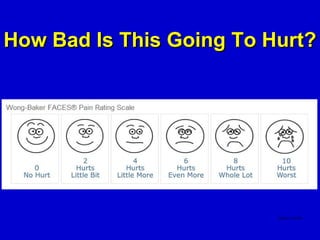
How Bad Is This Going To Hurt?
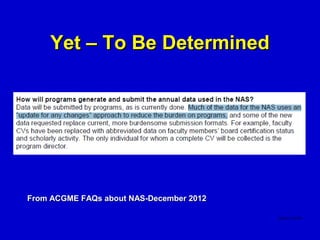
Yet – To Be Determined


From ACGME FAQs about NAS-December 2012
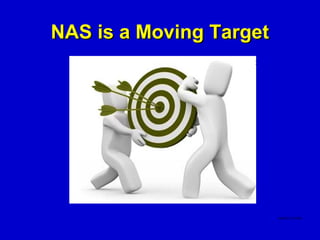
NAS is a Moving Target
What We Will Review
• Overview of NAS
  (Background; Core, Detail,
  Outcome; WebAds)
• CLER Program
• Clinical Competency Committee
• Direct Observation/
  Supervision of Fellows
What We Will Review
• Overview of NAS
  (Background; Core, Detail,
  Outcome; WebAds)
• CLER Program
• Clinical Competency Committee
• Direct Observation/
  Supervision of Fellows
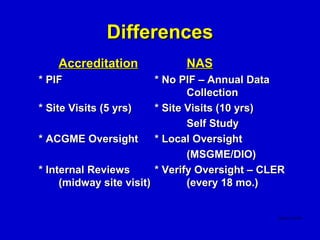
Differences
    Accreditation            NAS
* PIF                    * No PIF – Annual Data
                                Collection
* Site Visits (5 yrs)    * Site Visits (10 yrs)
                                Self Study
* ACGME Oversight        * Local Oversight
                                (MSGME/DIO)
* Internal Reviews       * Verify Oversight – CLER
     (midway site visit)        (every 18 mo.)
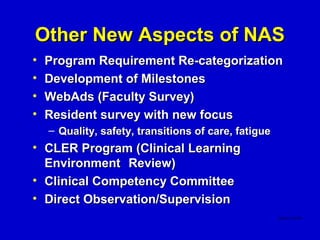
Other New Aspects of NAS
•   Program Requirement Re-categorization
•   Development of Milestones
•   WebAds (Faculty Survey)
•   Resident survey with new focus
    – Quality, safety, transitions of care, fatigue
• CLER Program (Clinical Learning
  Environment Review)
• Clinical Competency Committee
• Direct Observation/Supervision
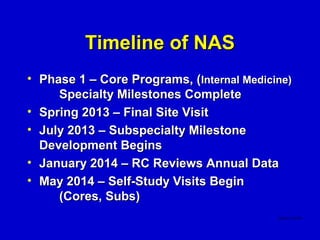
Timeline of NAS
• Phase 1 – Core Programs, (Internal Medicine)
     Specialty Milestones Complete
• Spring 2013 – Final Site Visit
• July 2013 – Subspecialty Milestone
  Development Begins
• January 2014 – RC Reviews Annual Data
• May 2014 – Self-Study Visits Begin
     (Cores, Subs)
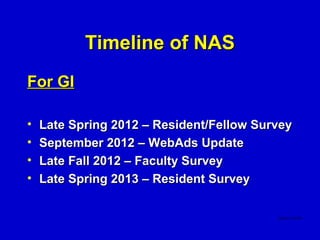
Timeline of NAS
For GI

•   Late Spring 2012 – Resident/Fellow Survey
•   September 2012 – WebAds Update
•   Late Fall 2012 – Faculty Survey
•   Late Spring 2013 – Resident Survey
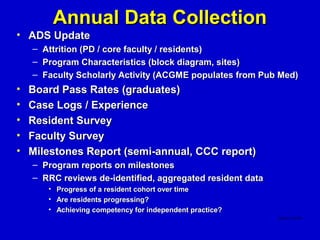
Annual Data Collection
• ADS Update
    –   Attrition (PD / core faculty / residents)
    –   Program Characteristics (block diagram, sites)
    –   Faculty Scholarly Activity (ACGME populates from Pub Med)
•   Board Pass Rates (graduates)
•   Case Logs / Experience
•   Resident Survey
•   Faculty Survey
•   Milestones Report (semi-annual, CCC report)
    – Program reports on milestones
    – RRC reviews de-identified, aggregated resident data
         •   Progress of a resident cohort over time
         •   Are residents progressing?
         •   Achieving competency for independent practice?
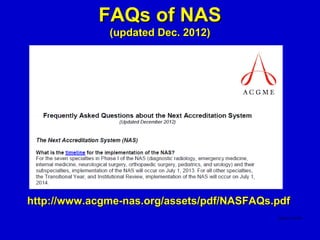
FAQs of NAS
              (updated Dec. 2012)


http://www.acgme-nas.org/assets/pdf/NASFAQs.pdf
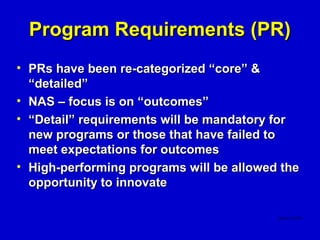
Program Requirements (PR)
• PRs have been re-categorized “core” &
  “detailed”
• NAS – focus is on “outcomes”
• “Detail” requirements will be mandatory for
  new programs or those that have failed to
  meet expectations for outcomes
• High-performing programs will be allowed the
  opportunity to innovate
“Core,” “Detailed,” &
    “Outcome”
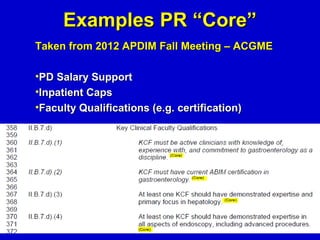
Examples PR “Core”
Taken from 2012 APDIM Fall Meeting – ACGME

•PD Salary Support
•Inpatient Caps
•Faculty Qualifications (e.g. certification)
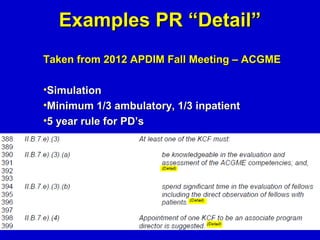
Examples PR “Detail”
Taken from 2012 APDIM Fall Meeting – ACGME

•Simulation
•Minimum 1/3 ambulatory, 1/3 inpatient
•5 year rule for PD’s
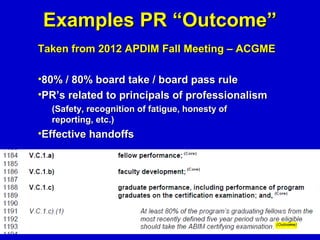
Examples PR “Outcome”
Taken from 2012 APDIM Fall Meeting – ACGME

•80% / 80% board take / board pass rule
•PR’s related to principals of professionalism
  (Safety, recognition of fatigue, honesty of
  reporting, etc.)
•Effective handoffs
Milestones

ACGME December 2012 FAQ’s define
Milestones as:
  – observable developmental steps,
    organized under the six competency
    areas, that describe a trajectory of
    progress on the competencies from
    novice (entering resident) to proficient
    (graduating resident) and, ultimately, to
    expert/master.
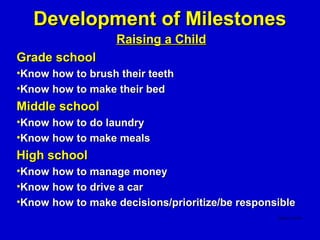
Development of Milestones
                  Raising a Child
Grade school
•Know how to brush their teeth
•Know how to make their bed
Middle school
•Know how to do laundry
•Know how to make meals
High school
•Know how to manage money
•Know how to drive a car
•Know how to make decisions/prioritize/be responsible
GI Milestones
• Development of milestones for
  subspecialty programs scheduled to
  begin July 2013

• Subspecialty milestones will also focus
  to a much greater extent on medical
  knowledge and patient care skills
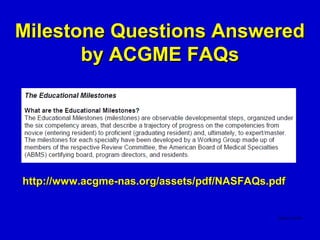
Milestone Questions Answered
       by ACGME FAQs


http://www.acgme-nas.org/assets/pdf/NASFAQs.pdf
What We Will Review
• Overview of NAS
  (Background; Core, Detail,
  Outcome; WebAds)
• CLER Program
• Clinical Competency Committee
• Direct Observation/
  Supervision of Fellows
Clinical Learning
Environment Review
  (CLER) Program
Aims of CLER

• Promote safety and quality of care

• Focus on six areas

• Care residents give and will provide
  after residency
Six Areas of Focus
•   Engaging Residents in Patient Safety
•   Engaging Residents in Quality Improvement
•   Patient Care Transitions
•   Resident Supervision
•   Duty Hour Oversite/Fatigue Management
•   Professionalism in the Learning Environment
CLER Visits
• Team of dedicated site visitors
• During the first 18-month cycle, SVs will visit
  only one major participating site for each
  Sponsoring Institution
• No less than 10 day’s notice
• Not required to complete documents
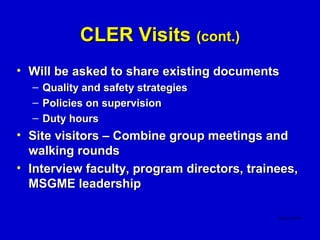
• Will be asked to share existing documents
CLER Visits (cont.)
• Will be asked to share existing documents
  –   Quality and safety strategies
  –   Policies on supervision
  –   Duty hours
• Site visitors – Combine group meetings and
  walking rounds
• Interview faculty, program directors, trainees,
  MSGME leadership
Data From CLER Visits

• Testing phase
• Continue to develop, test,
  implement
• Gather baseline data
• Give formative feedback
CLER Eval Process

Provide 3 opportunities for feedback
  1. Oral report
  2. Written report to institution before
     submission to CLER Evaluation
     Committee – Institution respond
  3. Final report to CLER Evaluation
     Committee
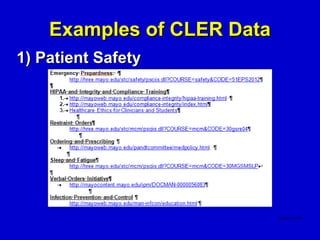
Examples of CLER Data
1) Patient Safety
Examples of CLER Data

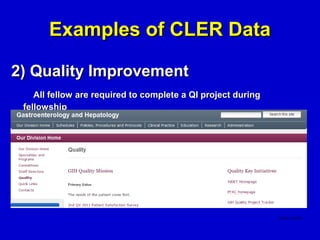
2) Quality Improvement
    All fellow are required to complete a QI project during
 fellowship
Examples of CLER Data

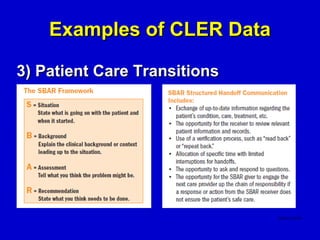
3) Patient Care Transitions
Examples of CLER Data
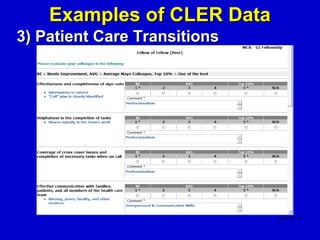
3) Patient Care Transitions
Examples of CLER Data


4) Resident Supervision
Examples of CLER Data

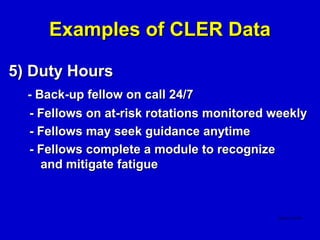
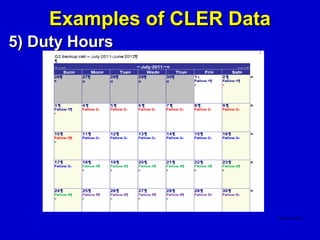
5) Duty Hours
  - Back-up fellow on call 24/7
  - Fellows on at-risk rotations monitored weekly
  - Fellows may seek guidance anytime
  - Fellows complete a module to recognize
     and mitigate fatigue
Examples of CLER Data
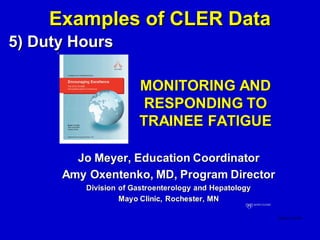
5) Duty Hours
Examples of CLER Data
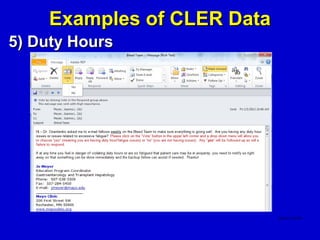
5) Duty Hours
Examples of CLER Data
5) Duty Hours
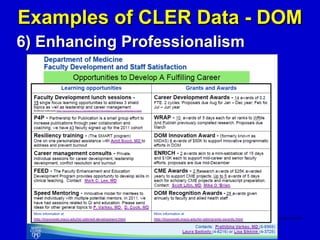
Examples of CLER Data - DOM
6) Enhancing Professionalism
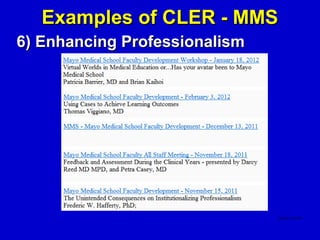
Examples of CLER - MMS
6) Enhancing Professionalism
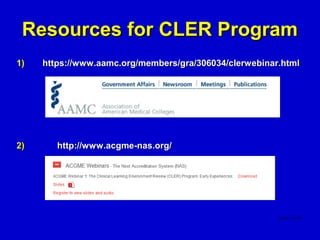
Resources for CLER Program
1)   https://www.aamc.org/members/gra/306034/clerwebinar.html


2)      http://www.acgme-nas.org/
Thank you!


Joanna L. Meyer (Jo)
 jmeyer@mayo.edu

Next accreditation system for program coordinators meyer3

  • 1.
    AGA 2013 GI Training Directors Workshop Jo Meyer, Education Coordinator Amy Oxentenko, MD, Program Director Division of Gastroenterology and Hepatology Mayo Clinic, Rochester, MN
  • 2.
    Next Accreditation System (NAS) for Program Coordinators
  • 3.
    How Bad IsThis Going To Hurt?
  • 4.
    Yet – ToBe Determined From ACGME FAQs about NAS-December 2012
  • 5.
    NAS is aMoving Target
  • 6.
    What We WillReview • Overview of NAS (Background; Core, Detail, Outcome; WebAds) • CLER Program • Clinical Competency Committee • Direct Observation/ Supervision of Fellows
  • 7.
    What We WillReview • Overview of NAS (Background; Core, Detail, Outcome; WebAds) • CLER Program • Clinical Competency Committee • Direct Observation/ Supervision of Fellows
  • 8.
    Differences Accreditation NAS * PIF * No PIF – Annual Data Collection * Site Visits (5 yrs) * Site Visits (10 yrs) Self Study * ACGME Oversight * Local Oversight (MSGME/DIO) * Internal Reviews * Verify Oversight – CLER (midway site visit) (every 18 mo.)
  • 9.
    Other New Aspectsof NAS • Program Requirement Re-categorization • Development of Milestones • WebAds (Faculty Survey) • Resident survey with new focus – Quality, safety, transitions of care, fatigue • CLER Program (Clinical Learning Environment Review) • Clinical Competency Committee • Direct Observation/Supervision
  • 10.
    Timeline of NAS •Phase 1 – Core Programs, (Internal Medicine) Specialty Milestones Complete • Spring 2013 – Final Site Visit • July 2013 – Subspecialty Milestone Development Begins • January 2014 – RC Reviews Annual Data • May 2014 – Self-Study Visits Begin (Cores, Subs)
  • 11.
    Timeline of NAS ForGI • Late Spring 2012 – Resident/Fellow Survey • September 2012 – WebAds Update • Late Fall 2012 – Faculty Survey • Late Spring 2013 – Resident Survey
  • 12.
    Annual Data Collection •ADS Update – Attrition (PD / core faculty / residents) – Program Characteristics (block diagram, sites) – Faculty Scholarly Activity (ACGME populates from Pub Med) • Board Pass Rates (graduates) • Case Logs / Experience • Resident Survey • Faculty Survey • Milestones Report (semi-annual, CCC report) – Program reports on milestones – RRC reviews de-identified, aggregated resident data • Progress of a resident cohort over time • Are residents progressing? • Achieving competency for independent practice?
  • 13.
    FAQs of NAS (updated Dec. 2012) http://www.acgme-nas.org/assets/pdf/NASFAQs.pdf
  • 14.
    Program Requirements (PR) •PRs have been re-categorized “core” & “detailed” • NAS – focus is on “outcomes” • “Detail” requirements will be mandatory for new programs or those that have failed to meet expectations for outcomes • High-performing programs will be allowed the opportunity to innovate
  • 15.
  • 16.
    Examples PR “Core” Takenfrom 2012 APDIM Fall Meeting – ACGME •PD Salary Support •Inpatient Caps •Faculty Qualifications (e.g. certification)
  • 17.
    Examples PR “Detail” Takenfrom 2012 APDIM Fall Meeting – ACGME •Simulation •Minimum 1/3 ambulatory, 1/3 inpatient •5 year rule for PD’s
  • 18.
    Examples PR “Outcome” Takenfrom 2012 APDIM Fall Meeting – ACGME •80% / 80% board take / board pass rule •PR’s related to principals of professionalism (Safety, recognition of fatigue, honesty of reporting, etc.) •Effective handoffs
  • 19.
    Milestones ACGME December 2012FAQ’s define Milestones as: – observable developmental steps, organized under the six competency areas, that describe a trajectory of progress on the competencies from novice (entering resident) to proficient (graduating resident) and, ultimately, to expert/master.
  • 20.
    Development of Milestones Raising a Child Grade school •Know how to brush their teeth •Know how to make their bed Middle school •Know how to do laundry •Know how to make meals High school •Know how to manage money •Know how to drive a car •Know how to make decisions/prioritize/be responsible
  • 21.
    GI Milestones • Developmentof milestones for subspecialty programs scheduled to begin July 2013 • Subspecialty milestones will also focus to a much greater extent on medical knowledge and patient care skills
  • 22.
    Milestone Questions Answered by ACGME FAQs http://www.acgme-nas.org/assets/pdf/NASFAQs.pdf
  • 23.
    What We WillReview • Overview of NAS (Background; Core, Detail, Outcome; WebAds) • CLER Program • Clinical Competency Committee • Direct Observation/ Supervision of Fellows
  • 24.
  • 25.
    Aims of CLER •Promote safety and quality of care • Focus on six areas • Care residents give and will provide after residency
  • 26.
    Six Areas ofFocus • Engaging Residents in Patient Safety • Engaging Residents in Quality Improvement • Patient Care Transitions • Resident Supervision • Duty Hour Oversite/Fatigue Management • Professionalism in the Learning Environment
  • 27.
    CLER Visits • Teamof dedicated site visitors • During the first 18-month cycle, SVs will visit only one major participating site for each Sponsoring Institution • No less than 10 day’s notice • Not required to complete documents • Will be asked to share existing documents
  • 28.
    CLER Visits (cont.) •Will be asked to share existing documents – Quality and safety strategies – Policies on supervision – Duty hours • Site visitors – Combine group meetings and walking rounds • Interview faculty, program directors, trainees, MSGME leadership
  • 29.
    Data From CLERVisits • Testing phase • Continue to develop, test, implement • Gather baseline data • Give formative feedback
  • 30.
    CLER Eval Process Provide3 opportunities for feedback 1. Oral report 2. Written report to institution before submission to CLER Evaluation Committee – Institution respond 3. Final report to CLER Evaluation Committee
  • 31.
    Examples of CLERData 1) Patient Safety
  • 32.
    Examples of CLERData 2) Quality Improvement All fellow are required to complete a QI project during fellowship
  • 33.
    Examples of CLERData 3) Patient Care Transitions
  • 34.
    Examples of CLERData 3) Patient Care Transitions
  • 35.
    Examples of CLERData 4) Resident Supervision
  • 36.
    Examples of CLERData 5) Duty Hours - Back-up fellow on call 24/7 - Fellows on at-risk rotations monitored weekly - Fellows may seek guidance anytime - Fellows complete a module to recognize and mitigate fatigue
  • 37.
    Examples of CLERData 5) Duty Hours
  • 38.
    Examples of CLERData 5) Duty Hours
  • 39.
    Examples of CLERData 5) Duty Hours
  • 40.
    Examples of CLERData - DOM 6) Enhancing Professionalism
  • 41.
    Examples of CLER- MMS 6) Enhancing Professionalism
  • 42.
    Resources for CLERProgram 1) https://www.aamc.org/members/gra/306034/clerwebinar.html 2) http://www.acgme-nas.org/
  • 43.
    Thank you! Joanna L.Meyer (Jo) jmeyer@mayo.edu