 
Md. Saifuddin Khalid
Assistant Professor
KANDIDATUDDANNELSEN I INFORMATIONSTEKNOLOGI,
IT OG LÆRING, MED SPECIALISERING I ORGANISATORISK OMSTILLING
Modulet: Interactionsdesign
Modulets placering: 8. semester , Modulets omfang: 5 ECTS
Forår 2017
Mon, 13 Feb 2017 Aalborg University
1
ID2-L1
 The session will facilitate the students to know about the
different software development lifecycle models (ref:
Programming and Prototyping course) and to identify the
differences in the activities and tasks in the different
phases.
 The students will be able to explain the integration of
human-centered design (HCD) process with agile
development framework, and in particular, assume
different SCRUM roles.
o HCD process: Activities involved in the interaction design and
digital production process
o Integration of human-centered design (HCD) activities with Agile
Development Framework and Scrum Methodology/Process
Mon, 13 Feb 2017 Aalborg University 2
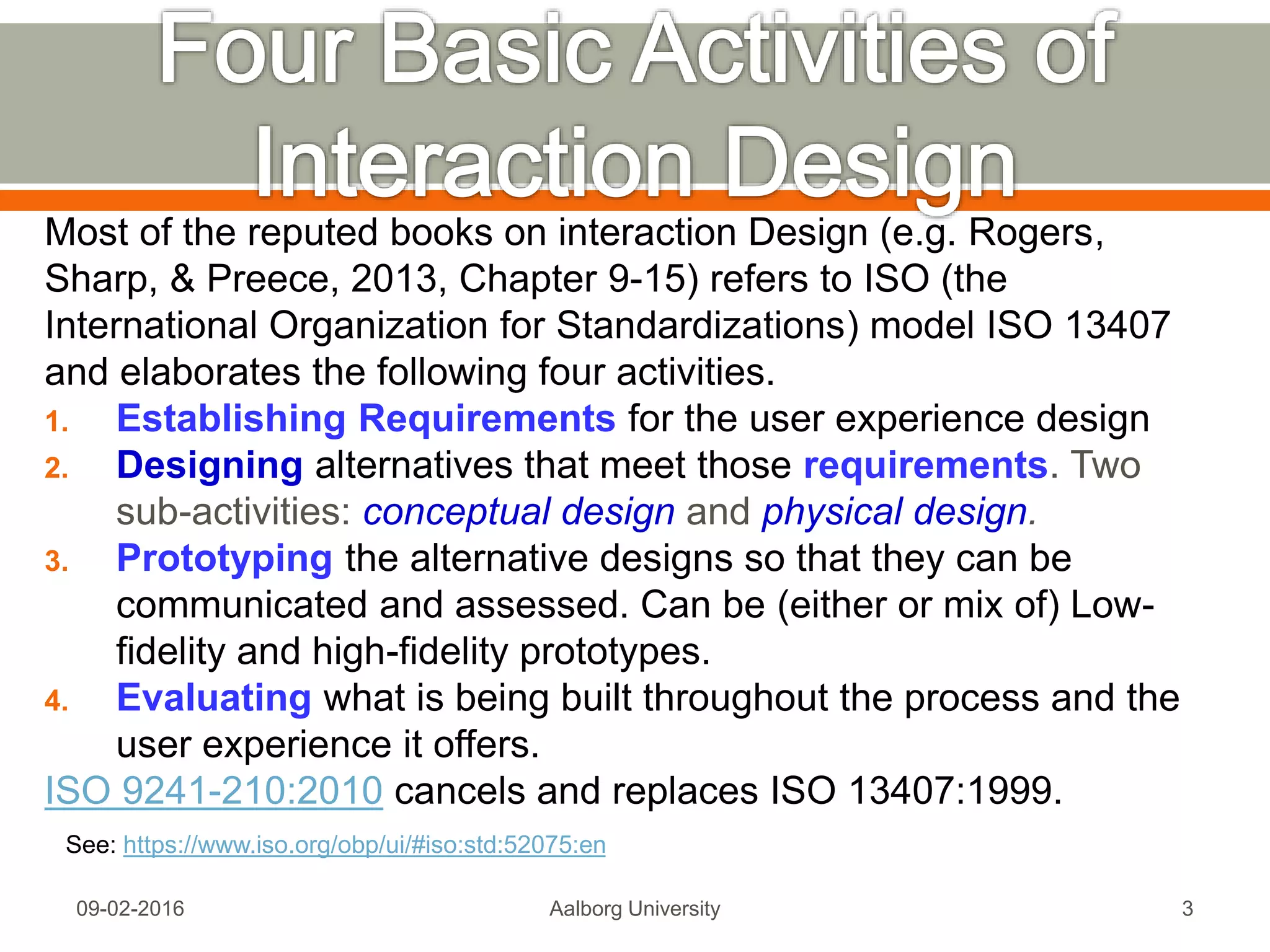
Most of the reputed books on interaction Design (e.g. Rogers,
Sharp, & Preece, 2013, Chapter 9-15) refers to ISO (the
International Organization for Standardizations) model ISO 13407
and elaborates the following four activities.
1. Establishing Requirements for the user experience design
2. Designing alternatives that meet those requirements. Two
sub-activities: conceptual design and physical design.
3. Prototyping the alternative designs so that they can be
communicated and assessed. Can be (either or mix of) Low-
fidelity and high-fidelity prototypes.
4. Evaluating what is being built throughout the process and the
user experience it offers.
ISO 9241-210:2010 cancels and replaces ISO 13407:1999.
Mon, 13 Feb 2017 Aalborg University 3
See: https://www.iso.org/obp/ui/#iso:std:52075:en
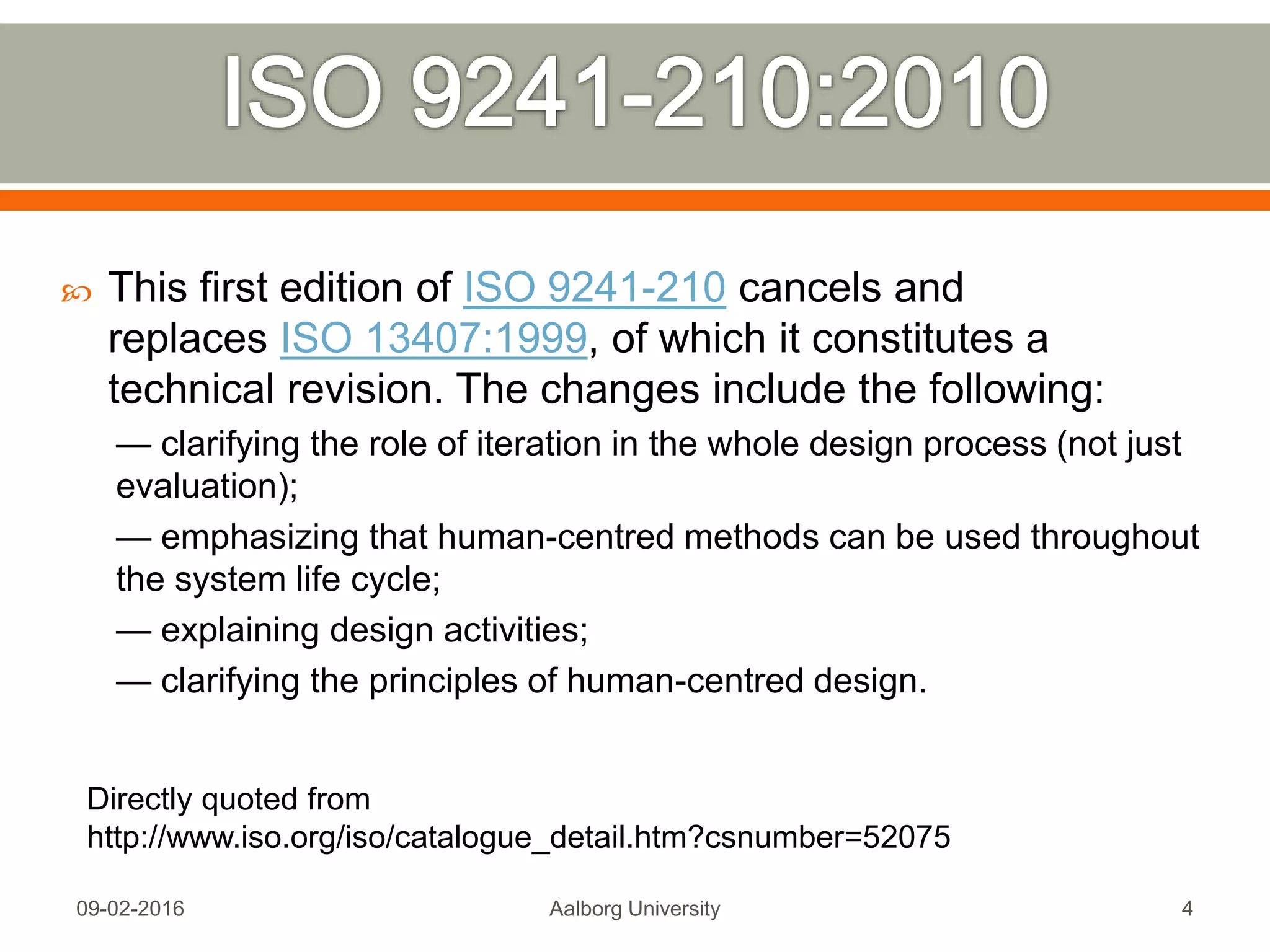
 This first edition of ISO 9241-210 cancels and
replaces ISO 13407:1999, of which it constitutes a
technical revision. The changes include the following:
— clarifying the role of iteration in the whole design process (not just
evaluation);
— emphasizing that human-centred methods can be used throughout
the system life cycle;
— explaining design activities;
— clarifying the principles of human-centred design.
Mon, 13 Feb 2017 Aalborg University 4
Directly quoted from
http://www.iso.org/iso/catalogue_detail.htm?csnumber=52075
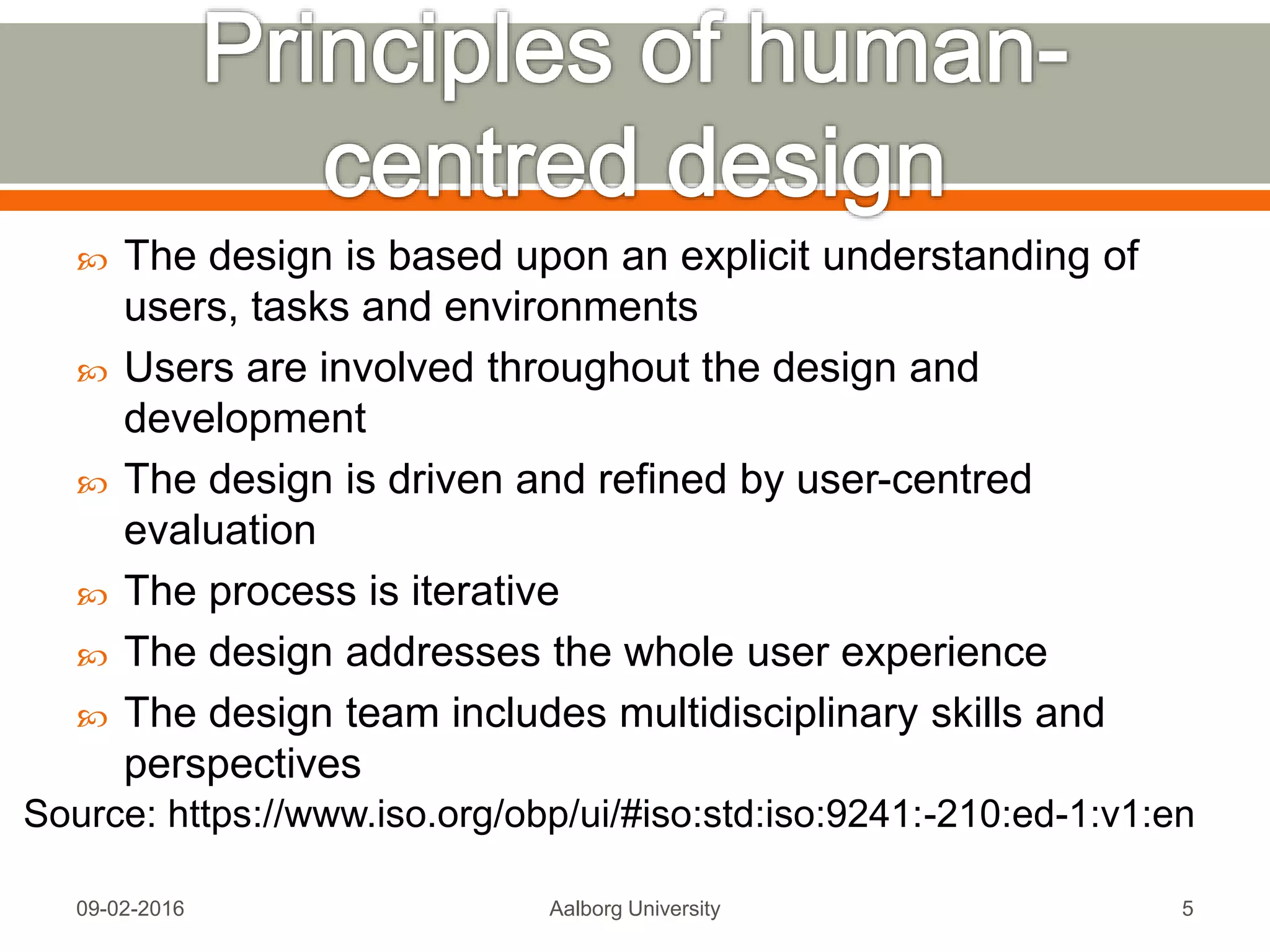
1. The design is based upon an explicit understanding of
users, tasks and environments
2. Users are involved throughout the design and
development
3. The design is driven and refined by user-centred
evaluation
4. The process is iterative
5. The design addresses the whole user experience
6. The design team includes multidisciplinary skills and
perspectives
Mon, 13 Feb 2017 Aalborg University 5
Source: https://www.iso.org/obp/ui/#iso:std:iso:9241:-210:ed-1:v1:en
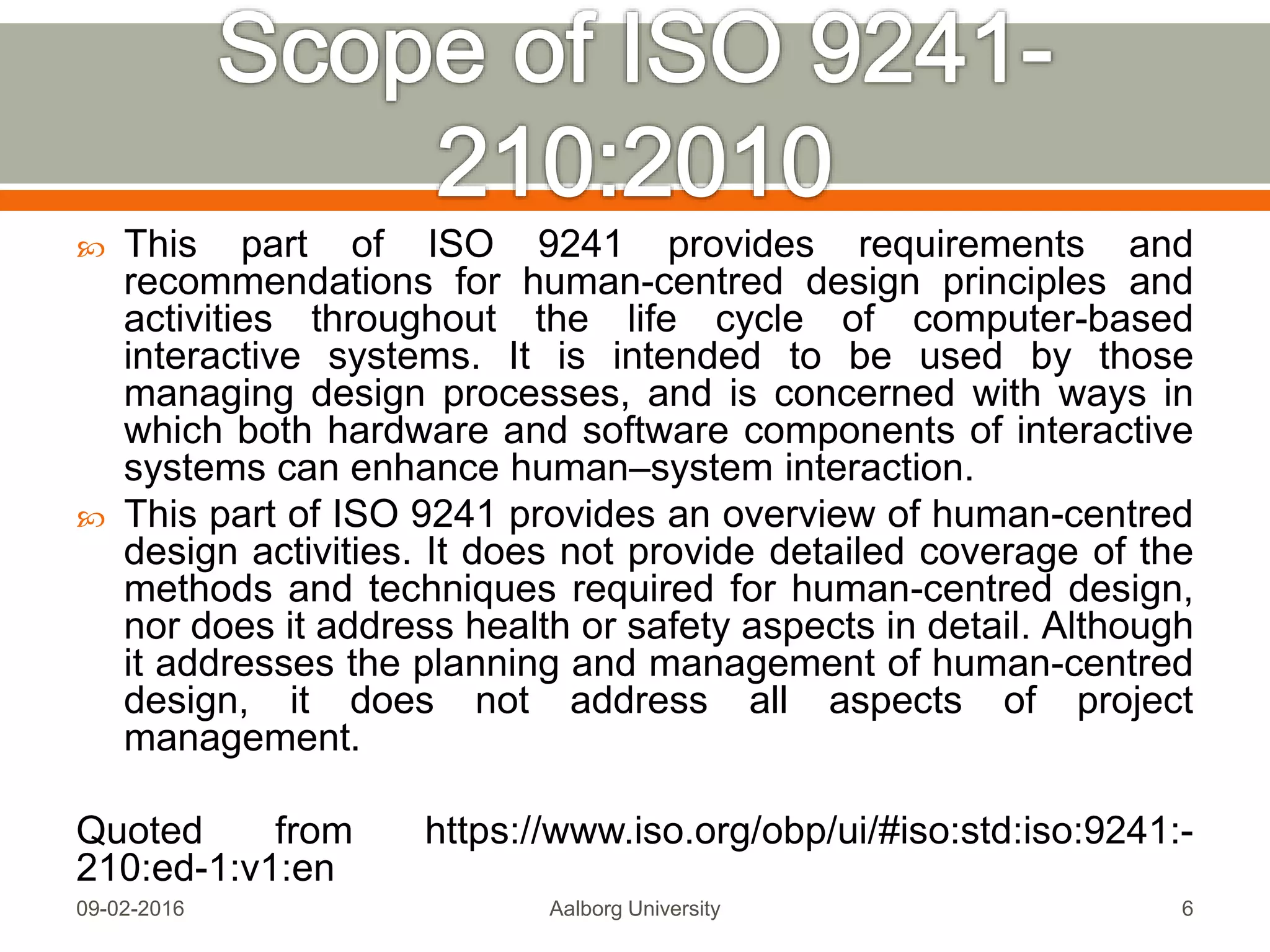
 This part of ISO 9241 provides requirements and
recommendations for human-centred design principles and
activities throughout the life cycle of computer-based
interactive systems. It is intended to be used by those
managing design processes, and is concerned with ways in
which both hardware and software components of interactive
systems can enhance human–system interaction.
 This part of ISO 9241 provides an overview of human-centred
design activities. It does not provide detailed coverage of the
methods and techniques required for human-centred design,
nor does it address health or safety aspects in detail. Although
it addresses the planning and management of human-centred
design, it does not address all aspects of project
management.
Quoted from https://www.iso.org/obp/ui/#iso:std:iso:9241:-
210:ed-1:v1:en
Mon, 13 Feb 2017 Aalborg University 6
Mon, 13 Feb 2017 Aalborg University 7
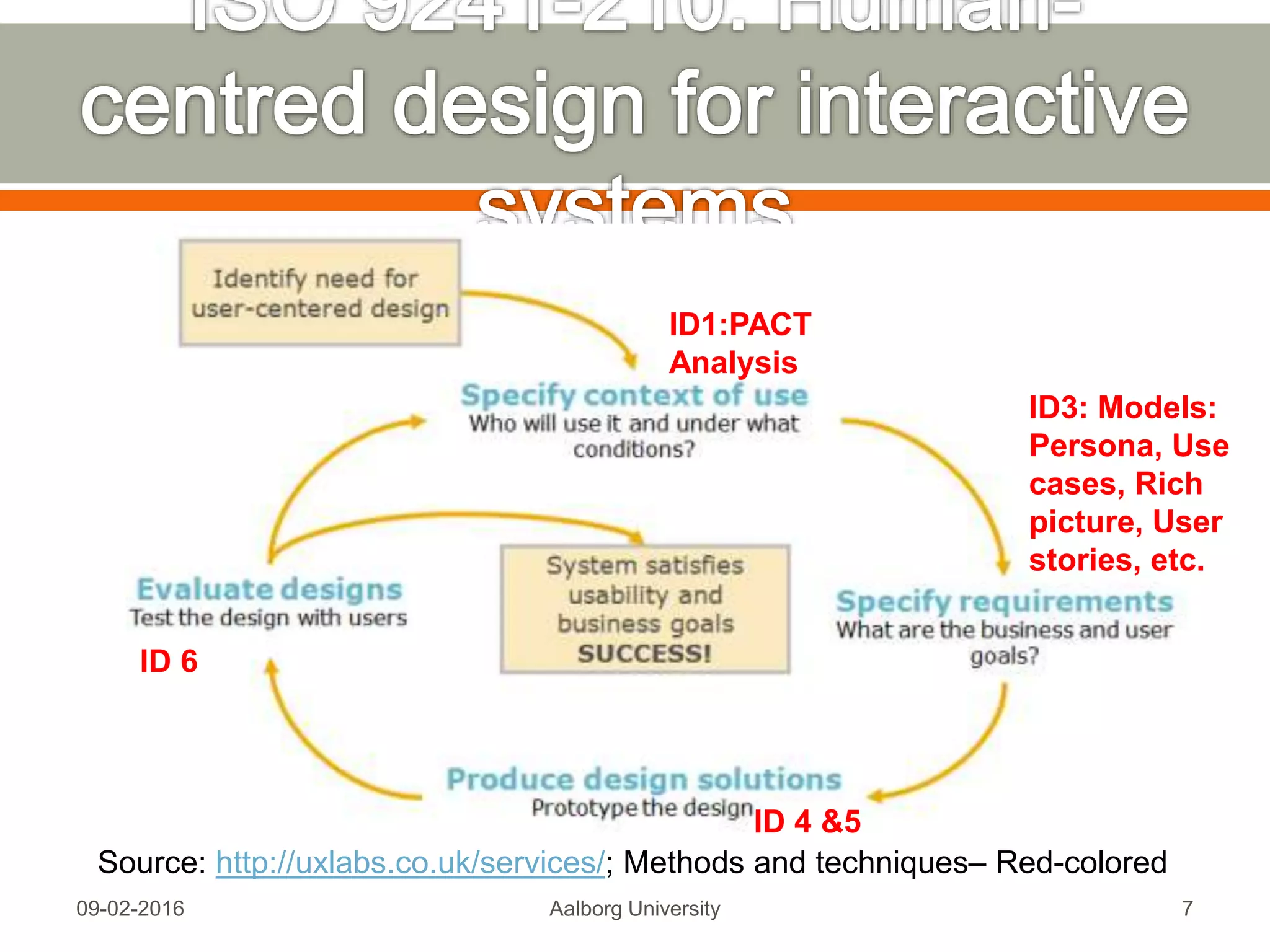
Source: http://uxlabs.co.uk/services/; Methods and techniques– Red-colored
ID1:PACT
Analysis
ID3: Models:
Persona, Use
cases, Rich
picture, User
stories, etc.
ID 4 &5
ID 6
 The new ISO standard for human centered design (HCD)
and the rapid adoption of the software development
methodologies under the “Agile Development Framework”
is now ISO (9241:210) standard practice since 2015.
 Agile framework led to the development of different
methodologies or software development lifecycles. Namely,
Adaptive Software Development (ASD), Agile Unified
Process (AUP), Crystal Methods (Crystal Clear), Dynamic
Systems Development Method (DSDM), Extreme
Programming (XP), Feature Driven Development (FDD),
Kanban, Lean software development, Scrum, Scrum-ban,
etc.
Mon, 13 Feb 2017 Aalborg University 8
Mon, 13 Feb 2017 Aalborg University 9
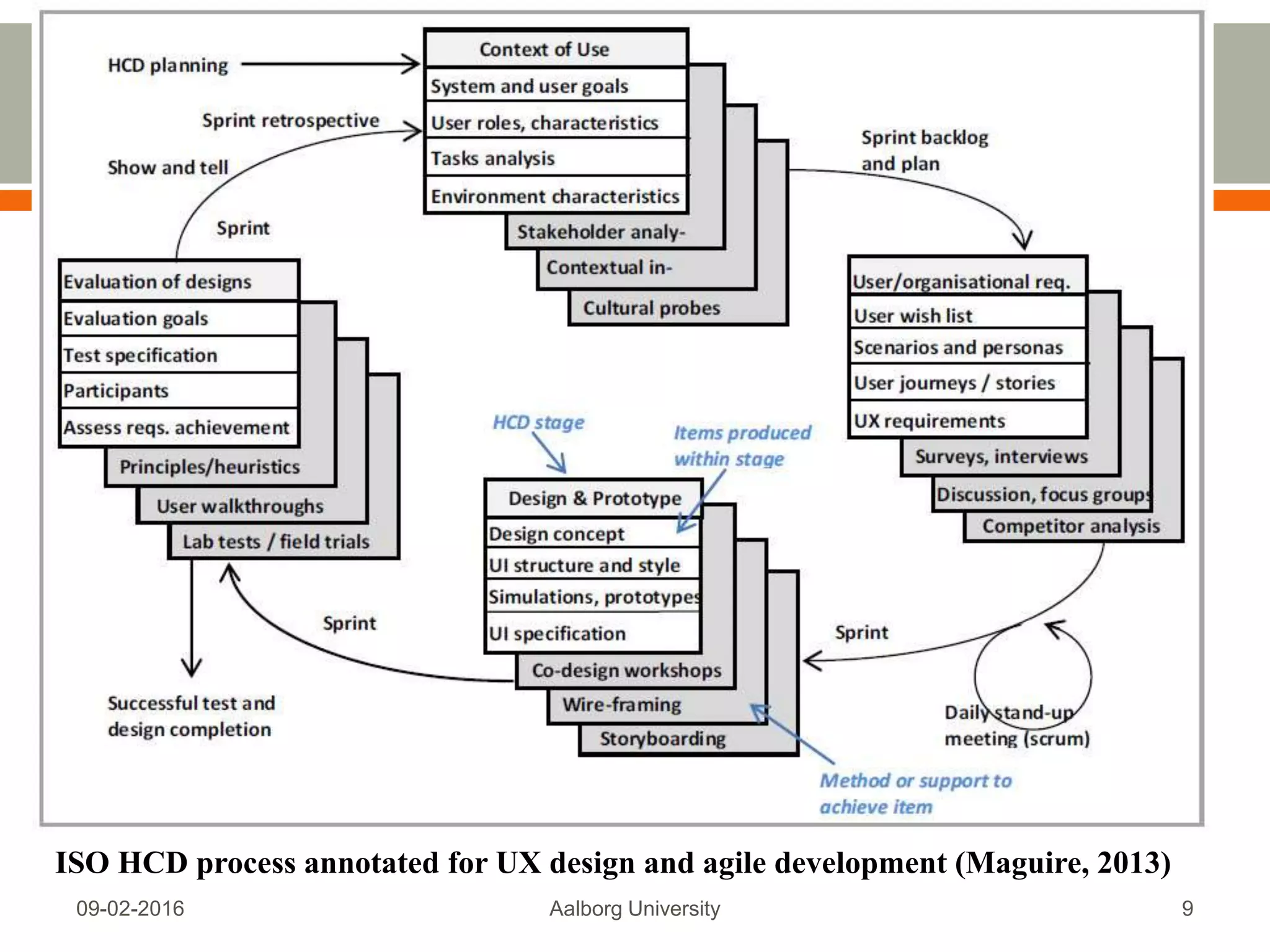
ISO HCD process annotated for UX design and agile development (Maguire, 2013)
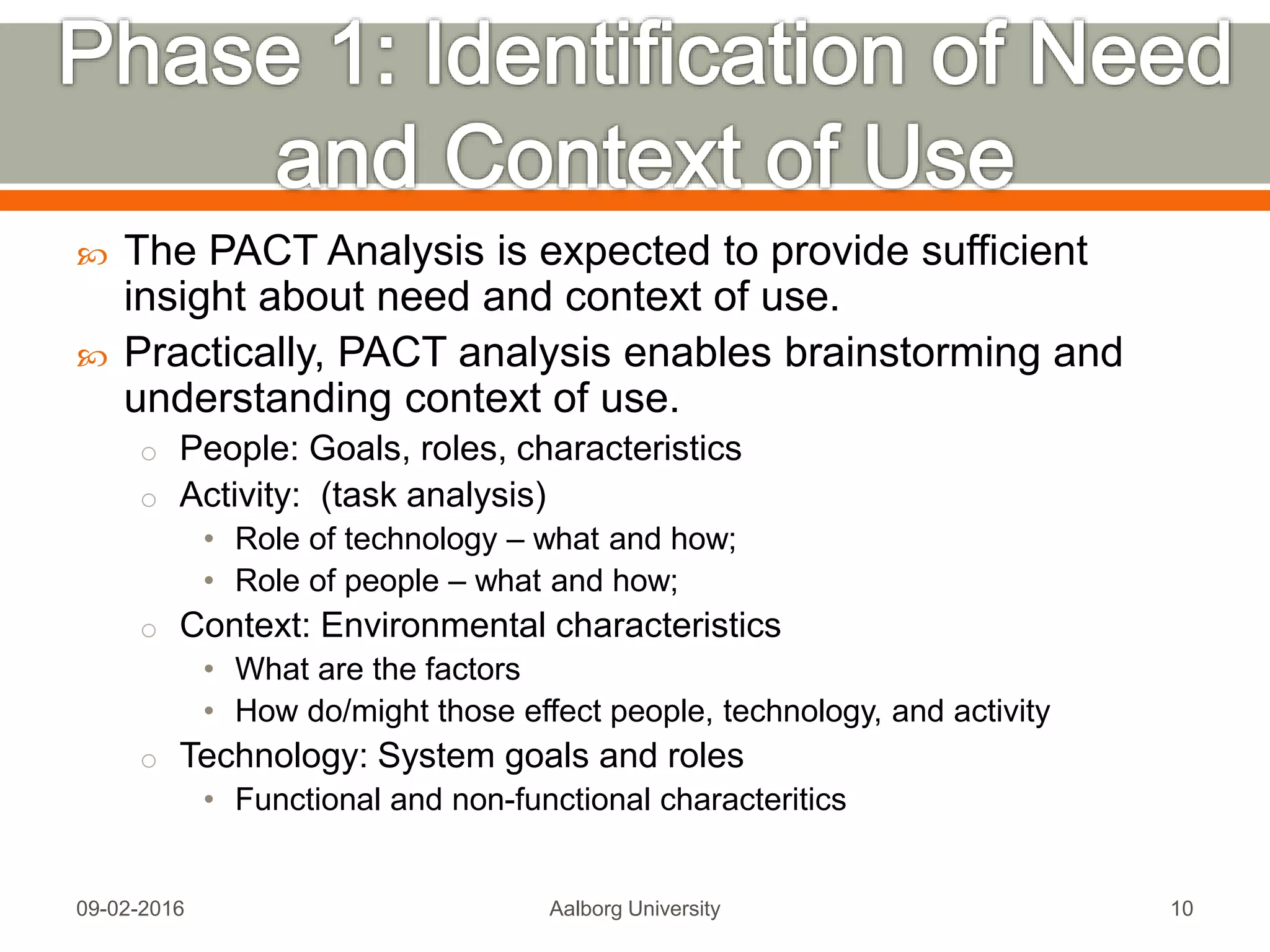
 The PACT Analysis is expected to provide sufficient
insight about need and context of use.
 Practically, PACT analysis enables brainstorming and
understanding context of use.
o People: Goals, roles, characteristics
o Activity: (task analysis)
• Role of technology – what and how;
• Role of people – what and how;
o Context: Environmental characteristics
• What are the factors
• How do/might those effect people, technology, and activity
o Technology: System goals and roles
• Functional and non-functional characteritics
Mon, 13 Feb 2017 Aalborg University 10
 Deliverables of this phase
o Persona and Scenarios
o User wish list
o User journeys/stories
o UX requirements
Mon, 13 Feb 2017 Aalborg University 11
 Prototypes are used extensively in the two design phases:
o Conceptual Design: Moving from requirements to first
design (e.g., what the product should do, behave and look
like)
o Physical Design (consider detail of the product including
the colors, sounds, images to use, menu design, icon
design, etc.)
 Types of Prototypes: Low-Fidelity and High-Fidelity
 Some of the prototyping techniques are: Card Sorting,
Wireframe, Storyboard, Paper prototyping, Digital interactive
prototyping, Blank model prototyping, Video Prototyping,
Wizard-of-oz prototyping, Coded Prototyping, Prototyping with
office suite applications, Prototyping with Visio, and
Prototyping with Acrobat.
(Rogers, Sharp and Preece, 2011, Chapter 11)
Mon, 13 Feb 2017 Aalborg University 12
 Evaluation occurs throughout the interaction design process.
At different stages, different methods will be more or less
effective.
o Obtaining feedback to inform early design concepts
o Deciding between different design options
o Checking/testing for usability problems
o Assessing the usability of a finished product
o As a means of involving people in the (participatory) design
process
 Approaches
o Expert evaluation: conducted by interaction designer or usability
expert or alike.
o Participant-based evaluation: conducted in collaboration - by
designer and actual users
o Others
(Benyon, 2010, Chapter 10)Mon, 13 Feb 2017 Aalborg University 13
Scrum Fundamentals Certification. http://www.scrumstudy.com/Scrum-Fundamentals-
Certified.asp Read online SCRUMstudy SBOK™ Guide e-book(340 pages). Take the free
SCRUM Fundamentails Certification online exam.
Mon, 13 Feb 2017 Aalborg University
14
 Scrum is an Agile framework for completing complex projects.
Scrum originally was formalized for software development
projects, but it works well for any complex, innovative scope of
work.
 Scrum is the leading agile development methodology, used by
Fortune 500 companies around the world. The Scrum Alliance
exists to transform the way we tackle complex projects, bringing
the Scrum framework and agile principles beyond software
development to the broader world of work.
 When Jeff Sutherland created the scrum process in 1993, he
borrowed the term "scrum" from an analogy put forth in a 1986
study by Takeuchi and Nonaka, published in the Harvard Business
Review. In that study, Takeuchi and Nonaka compare high-
performing, cross-functional teams to the scrum formation used by
Rugby teams.Mon, 13 Feb 2017 Aalborg University 15
 Three Roles
1. Product Owner
• Responsible for Return on Investment (ROI)
• Final arbiter of requirements questions
• Make business decisions focused more on what that on the how
2. Scrum Development Team (no hierarchy, ideally 4-9 people)
• Cross-functional Group
• Attempts to build a ”potentially shippable product increment” every
sprint
• Collaborates
• Self-Organizing
3. Scrum Master
• no managment authority of the team
• project management is split up among members
• Enforces time-boxing
Mon, 13 Feb 2017 Aalborg University 16
Source: http://scrumtrainingseries.com/Intro_to_Scrum/Intro_to_Scrum.htm
Mon, 13 Feb 2017 Aalborg University 17
Source: http://www.scrumstudy.com/SBOK/SCRUMstudy-SBOK-Guide-2013.pdf, p. 13
 Artefacts: Anyone can add items in product backlog,
prioritized by Product Owner, Scrum master make product
backlog items (PBIs) visible, PBIs are user stories or
scenarios
o Product backlog
o Sprint backlog
 Four Meetings
1. Sprint Planning meeting
2. Daily Scrum
3. Sprint review meeting
4. Sprint retrospective meeting
5. Additional – Backlog Refinement Meeting
 Rules
Mon, 13 Feb 2017 Aalborg University 18
About Agile Framework
http://agilemethodology.org/,
Mon, 13 Feb 2017 Aalborg University 19
A video on Introduction to Scrum
http://scrumtrainingseries.com/Intro_to_Scrum/Intro_to_Scrum.htm
Scrum Reference Card
http://scrumreferencecard.com/ScrumReferenceCard.
pdf
Mon, 13 Feb 2017 Aalborg University 20
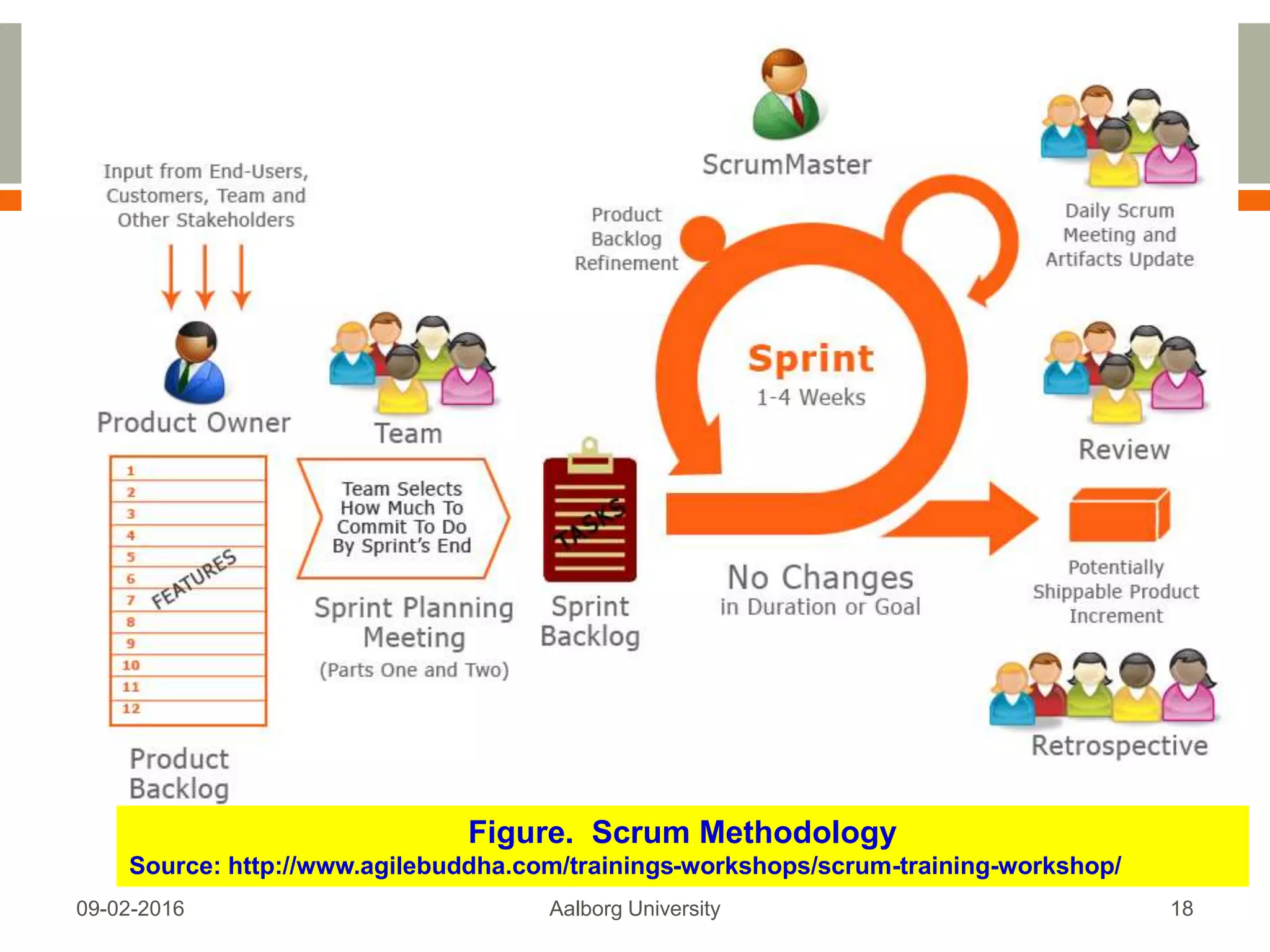
Figure. Scrum Methodology
Source: http://www.agilebuddha.com/trainings-workshops/scrum-training-workshop/
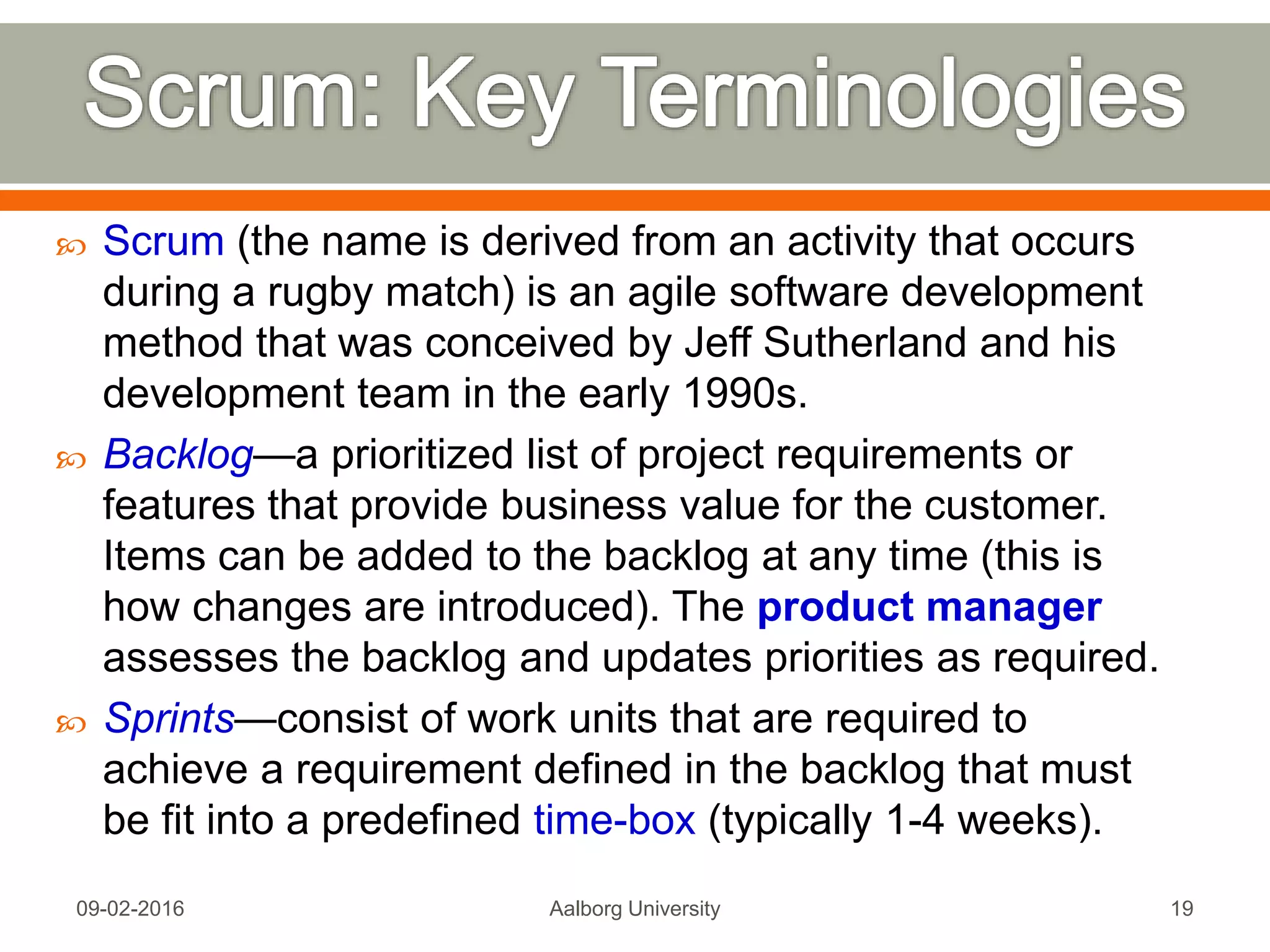
 Scrum (the name is derived from an activity that occurs
during a rugby match) is an agile software development
method that was conceived by Jeff Sutherland and his
development team in the early 1990s.
 Backlog—a prioritized list of project requirements or
features that provide business value for the customer.
Items can be added to the backlog at any time (this is
how changes are introduced). The product manager
assesses the backlog and updates priorities as required.
 Sprints—consist of work units that are required to
achieve a requirement defined in the backlog that must
be fit into a predefined time-box (typically 1-4 weeks).
Mon, 13 Feb 2017 Aalborg University 21
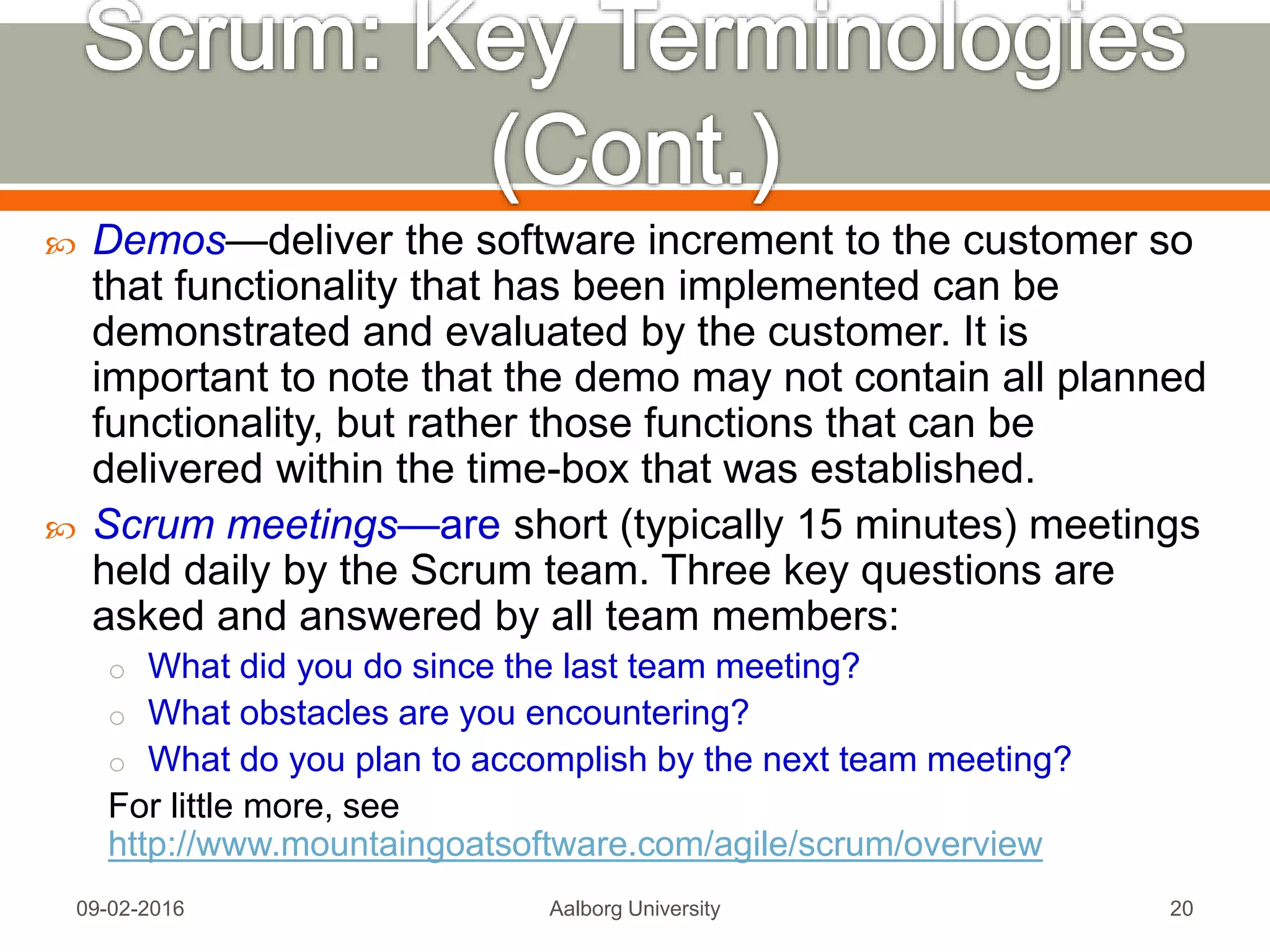
 Demos—deliver the software increment to the customer so
that functionality that has been implemented can be
demonstrated and evaluated by the customer. It is
important to note that the demo may not contain all planned
functionality, but rather those functions that can be
delivered within the time-box that was established.
 Scrum meetings—are short (typically 15 minutes) meetings
held daily by the Scrum team. Three key questions are
asked and answered by all team members:
o What did you do since the last team meeting?
o What obstacles are you encountering?
o What do you plan to accomplish by the next team meeting?
For little more, see
http://www.mountaingoatsoftware.com/agile/scrum/overview
Mon, 13 Feb 2017 Aalborg University 22

Product Owner, Scrum Team, Scrum Master
Mon, 13 Feb 2017 Aalborg University
23
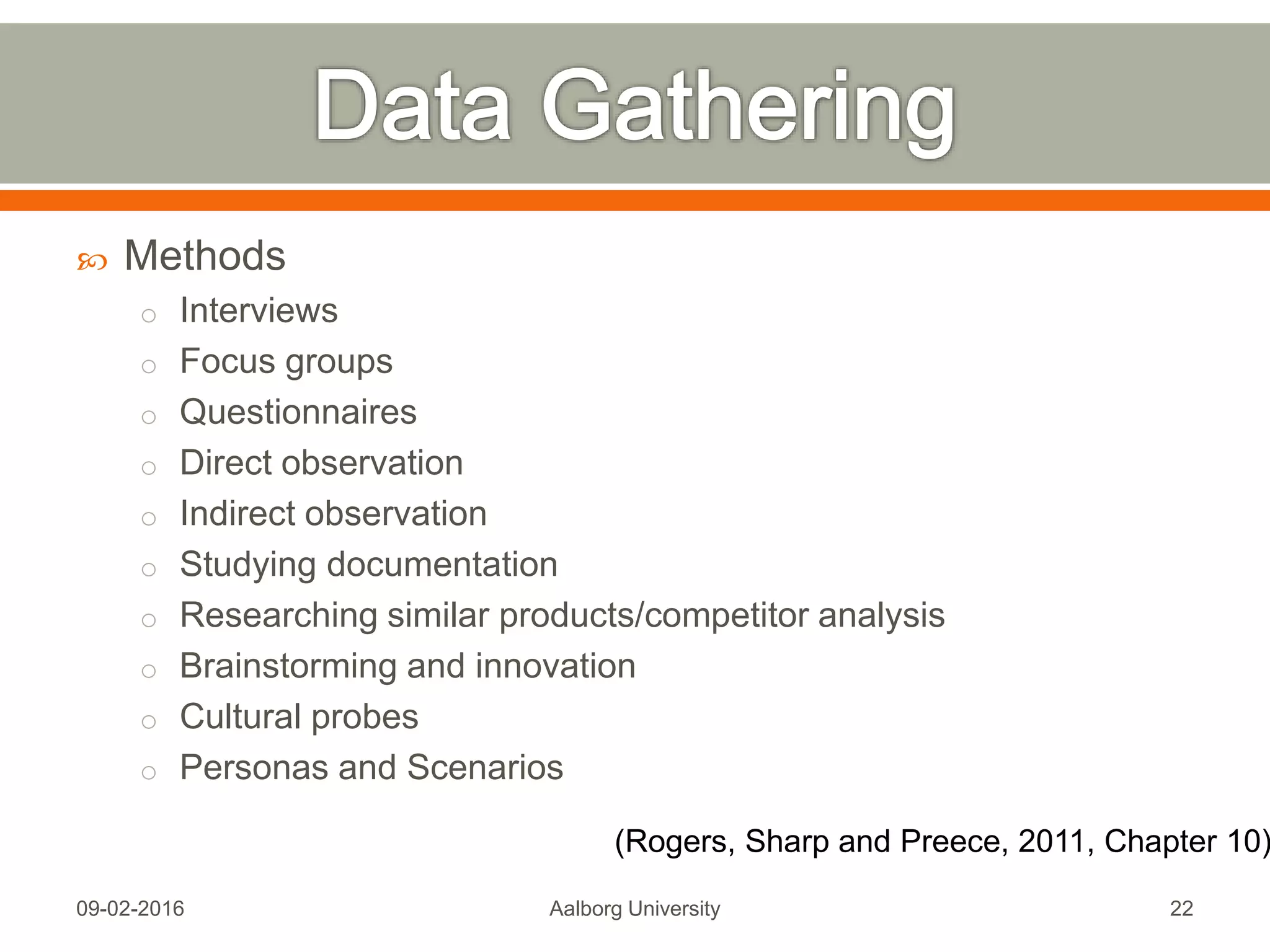
 Methods
o Interviews
o Focus groups
o Questionnaires
o Direct observation
o Indirect observation
o Studying documentation
o Researching similar products/competitor analysis
o Brainstorming and innovation
o Cultural probes
o Personas and Scenarios
Mon, 13 Feb 2017 Aalborg University 24
(Rogers, Sharp and Preece, 2011, Chapter 10)
Mon, 13 Feb 2017 Aalborg University 25
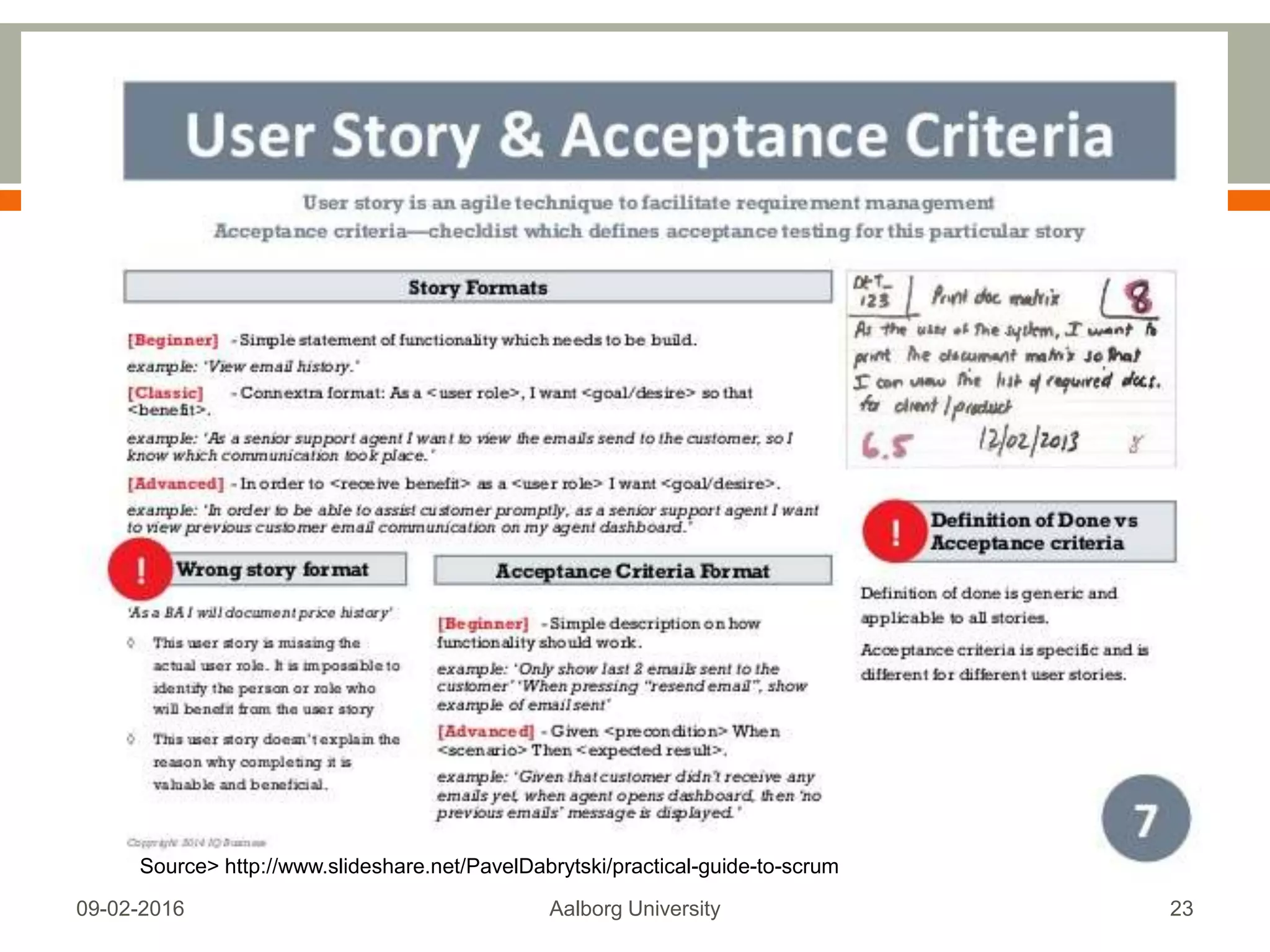
Source> http://www.slideshare.net/PavelDabrytski/practical-guide-to-scrum
Mon, 13 Feb 2017 Aalborg University 26
A good user story uses the “INVEST” model:
 Independent. Reduced dependencies = easier to plan
 Negotiable. Details added via collaboration
 Valuable. Provides value to the customer
 Estimable. Too big or too vague = not estimable
 Small. Can be done in less than a week by the team
 Testable. Good acceptance criteria
Source:
https://www.scrumalliance.org/community/articles/2010/april/new-to-
user-stories
Mon, 13 Feb 2017 Aalborg University 27
Mon, 13 Feb 2017 Aalborg University 28
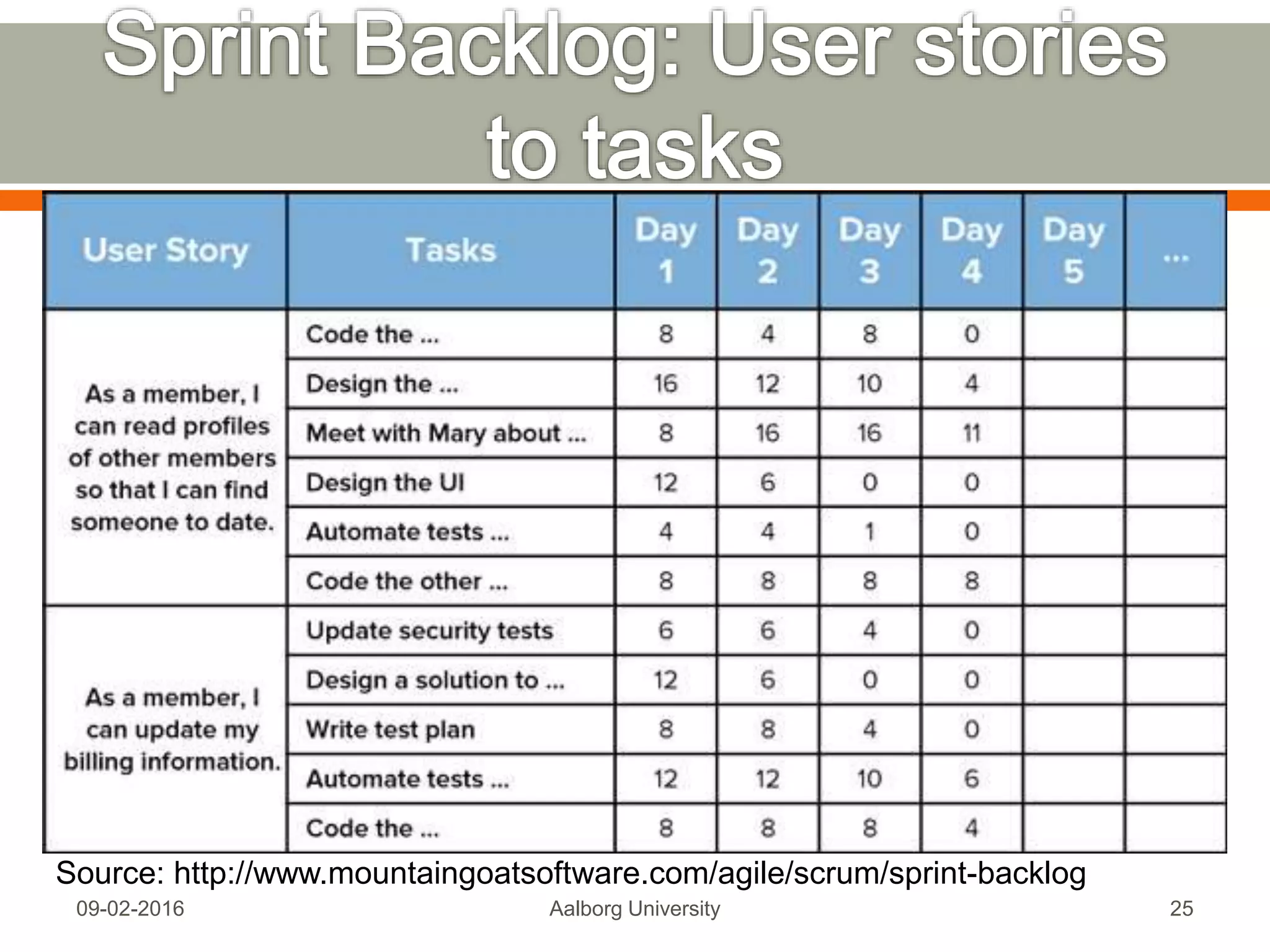
Source: http://www.mountaingoatsoftware.com/agile/scrum/sprint-backlog
Mon, 13 Feb 2017 Aalborg University 29
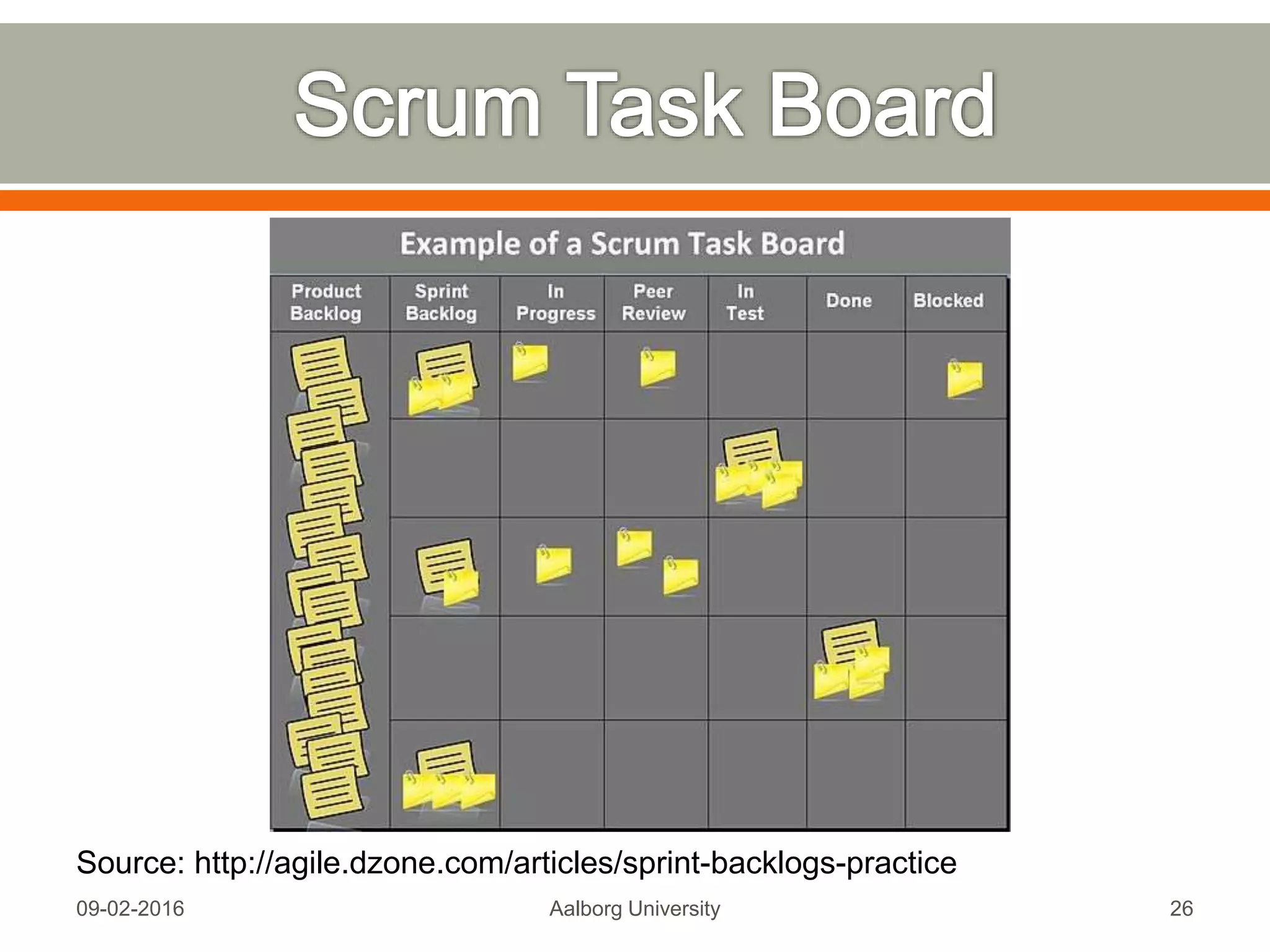
Source: http://agile.dzone.com/articles/sprint-backlogs-practice
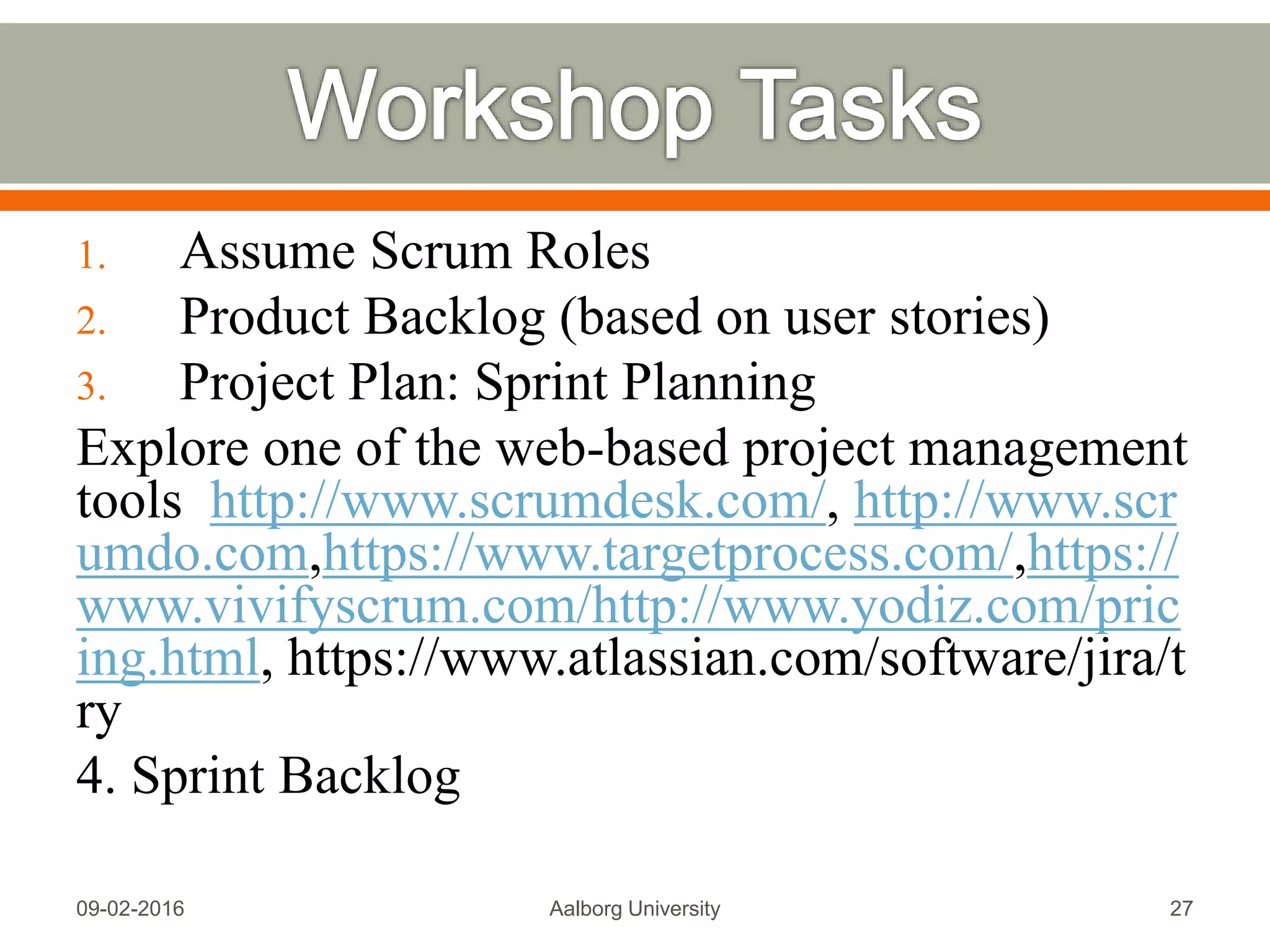
1. Assume Scrum Roles
2. Product Backlog (based on user stories)
3. Project Plan: Sprint Planning
Explore one of the web-based project management
tools http://www.scrumdesk.com/, http://www.scr
umdo.com,https://www.targetprocess.com/,https://
www.vivifyscrum.com/http://www.yodiz.com/pric
ing.html, https://www.atlassian.com/software/jira/t
ry
4. Sprint Backlog
Mon, 13 Feb 2017 Aalborg University 30

Scrum and ISO 9241:210 Interaction Design Process and User Stories

  • 1.
      Md. SaifuddinKhalid Assistant Professor KANDIDATUDDANNELSEN I INFORMATIONSTEKNOLOGI, IT OG LÆRING, MED SPECIALISERING I ORGANISATORISK OMSTILLING Modulet: Interactionsdesign Modulets placering: 8. semester , Modulets omfang: 5 ECTS Forår 2017 Mon, 13 Feb 2017 Aalborg University 1 ID2-L1
  • 2.
     The sessionwill facilitate the students to know about the different software development lifecycle models (ref: Programming and Prototyping course) and to identify the differences in the activities and tasks in the different phases.  The students will be able to explain the integration of human-centered design (HCD) process with agile development framework, and in particular, assume different SCRUM roles. o HCD process: Activities involved in the interaction design and digital production process o Integration of human-centered design (HCD) activities with Agile Development Framework and Scrum Methodology/Process Mon, 13 Feb 2017 Aalborg University 2
  • 3.
    Most of thereputed books on interaction Design (e.g. Rogers, Sharp, & Preece, 2013, Chapter 9-15) refers to ISO (the International Organization for Standardizations) model ISO 13407 and elaborates the following four activities. 1. Establishing Requirements for the user experience design 2. Designing alternatives that meet those requirements. Two sub-activities: conceptual design and physical design. 3. Prototyping the alternative designs so that they can be communicated and assessed. Can be (either or mix of) Low- fidelity and high-fidelity prototypes. 4. Evaluating what is being built throughout the process and the user experience it offers. ISO 9241-210:2010 cancels and replaces ISO 13407:1999. Mon, 13 Feb 2017 Aalborg University 3 See: https://www.iso.org/obp/ui/#iso:std:52075:en
  • 4.
     This firstedition of ISO 9241-210 cancels and replaces ISO 13407:1999, of which it constitutes a technical revision. The changes include the following: — clarifying the role of iteration in the whole design process (not just evaluation); — emphasizing that human-centred methods can be used throughout the system life cycle; — explaining design activities; — clarifying the principles of human-centred design. Mon, 13 Feb 2017 Aalborg University 4 Directly quoted from http://www.iso.org/iso/catalogue_detail.htm?csnumber=52075
  • 5.
    1. The designis based upon an explicit understanding of users, tasks and environments 2. Users are involved throughout the design and development 3. The design is driven and refined by user-centred evaluation 4. The process is iterative 5. The design addresses the whole user experience 6. The design team includes multidisciplinary skills and perspectives Mon, 13 Feb 2017 Aalborg University 5 Source: https://www.iso.org/obp/ui/#iso:std:iso:9241:-210:ed-1:v1:en
  • 6.
     This partof ISO 9241 provides requirements and recommendations for human-centred design principles and activities throughout the life cycle of computer-based interactive systems. It is intended to be used by those managing design processes, and is concerned with ways in which both hardware and software components of interactive systems can enhance human–system interaction.  This part of ISO 9241 provides an overview of human-centred design activities. It does not provide detailed coverage of the methods and techniques required for human-centred design, nor does it address health or safety aspects in detail. Although it addresses the planning and management of human-centred design, it does not address all aspects of project management. Quoted from https://www.iso.org/obp/ui/#iso:std:iso:9241:- 210:ed-1:v1:en Mon, 13 Feb 2017 Aalborg University 6
  • 7.
    Mon, 13 Feb2017 Aalborg University 7 Source: http://uxlabs.co.uk/services/; Methods and techniques– Red-colored ID1:PACT Analysis ID3: Models: Persona, Use cases, Rich picture, User stories, etc. ID 4 &5 ID 6
  • 8.
     The newISO standard for human centered design (HCD) and the rapid adoption of the software development methodologies under the “Agile Development Framework” is now ISO (9241:210) standard practice since 2015.  Agile framework led to the development of different methodologies or software development lifecycles. Namely, Adaptive Software Development (ASD), Agile Unified Process (AUP), Crystal Methods (Crystal Clear), Dynamic Systems Development Method (DSDM), Extreme Programming (XP), Feature Driven Development (FDD), Kanban, Lean software development, Scrum, Scrum-ban, etc. Mon, 13 Feb 2017 Aalborg University 8
  • 9.
    Mon, 13 Feb2017 Aalborg University 9 ISO HCD process annotated for UX design and agile development (Maguire, 2013)
  • 10.
     The PACTAnalysis is expected to provide sufficient insight about need and context of use.  Practically, PACT analysis enables brainstorming and understanding context of use. o People: Goals, roles, characteristics o Activity: (task analysis) • Role of technology – what and how; • Role of people – what and how; o Context: Environmental characteristics • What are the factors • How do/might those effect people, technology, and activity o Technology: System goals and roles • Functional and non-functional characteritics Mon, 13 Feb 2017 Aalborg University 10
  • 11.
     Deliverables ofthis phase o Persona and Scenarios o User wish list o User journeys/stories o UX requirements Mon, 13 Feb 2017 Aalborg University 11
  • 12.
     Prototypes areused extensively in the two design phases: o Conceptual Design: Moving from requirements to first design (e.g., what the product should do, behave and look like) o Physical Design (consider detail of the product including the colors, sounds, images to use, menu design, icon design, etc.)  Types of Prototypes: Low-Fidelity and High-Fidelity  Some of the prototyping techniques are: Card Sorting, Wireframe, Storyboard, Paper prototyping, Digital interactive prototyping, Blank model prototyping, Video Prototyping, Wizard-of-oz prototyping, Coded Prototyping, Prototyping with office suite applications, Prototyping with Visio, and Prototyping with Acrobat. (Rogers, Sharp and Preece, 2011, Chapter 11) Mon, 13 Feb 2017 Aalborg University 12
  • 13.
     Evaluation occursthroughout the interaction design process. At different stages, different methods will be more or less effective. o Obtaining feedback to inform early design concepts o Deciding between different design options o Checking/testing for usability problems o Assessing the usability of a finished product o As a means of involving people in the (participatory) design process  Approaches o Expert evaluation: conducted by interaction designer or usability expert or alike. o Participant-based evaluation: conducted in collaboration - by designer and actual users o Others (Benyon, 2010, Chapter 10)Mon, 13 Feb 2017 Aalborg University 13
  • 14.
    Scrum Fundamentals Certification.http://www.scrumstudy.com/Scrum-Fundamentals- Certified.asp Read online SCRUMstudy SBOK™ Guide e-book(340 pages). Take the free SCRUM Fundamentails Certification online exam. Mon, 13 Feb 2017 Aalborg University 14
  • 15.
     Scrum isan Agile framework for completing complex projects. Scrum originally was formalized for software development projects, but it works well for any complex, innovative scope of work.  Scrum is the leading agile development methodology, used by Fortune 500 companies around the world. The Scrum Alliance exists to transform the way we tackle complex projects, bringing the Scrum framework and agile principles beyond software development to the broader world of work.  When Jeff Sutherland created the scrum process in 1993, he borrowed the term "scrum" from an analogy put forth in a 1986 study by Takeuchi and Nonaka, published in the Harvard Business Review. In that study, Takeuchi and Nonaka compare high- performing, cross-functional teams to the scrum formation used by Rugby teams.Mon, 13 Feb 2017 Aalborg University 15
  • 16.
     Three Roles 1.Product Owner • Responsible for Return on Investment (ROI) • Final arbiter of requirements questions • Make business decisions focused more on what that on the how 2. Scrum Development Team (no hierarchy, ideally 4-9 people) • Cross-functional Group • Attempts to build a ”potentially shippable product increment” every sprint • Collaborates • Self-Organizing 3. Scrum Master • no managment authority of the team • project management is split up among members • Enforces time-boxing Mon, 13 Feb 2017 Aalborg University 16 Source: http://scrumtrainingseries.com/Intro_to_Scrum/Intro_to_Scrum.htm
  • 17.
    Mon, 13 Feb2017 Aalborg University 17 Source: http://www.scrumstudy.com/SBOK/SCRUMstudy-SBOK-Guide-2013.pdf, p. 13
  • 18.
     Artefacts: Anyonecan add items in product backlog, prioritized by Product Owner, Scrum master make product backlog items (PBIs) visible, PBIs are user stories or scenarios o Product backlog o Sprint backlog  Four Meetings 1. Sprint Planning meeting 2. Daily Scrum 3. Sprint review meeting 4. Sprint retrospective meeting 5. Additional – Backlog Refinement Meeting  Rules Mon, 13 Feb 2017 Aalborg University 18
  • 19.
    About Agile Framework http://agilemethodology.org/, Mon,13 Feb 2017 Aalborg University 19 A video on Introduction to Scrum http://scrumtrainingseries.com/Intro_to_Scrum/Intro_to_Scrum.htm Scrum Reference Card http://scrumreferencecard.com/ScrumReferenceCard. pdf
  • 20.
    Mon, 13 Feb2017 Aalborg University 20 Figure. Scrum Methodology Source: http://www.agilebuddha.com/trainings-workshops/scrum-training-workshop/
  • 21.
     Scrum (thename is derived from an activity that occurs during a rugby match) is an agile software development method that was conceived by Jeff Sutherland and his development team in the early 1990s.  Backlog—a prioritized list of project requirements or features that provide business value for the customer. Items can be added to the backlog at any time (this is how changes are introduced). The product manager assesses the backlog and updates priorities as required.  Sprints—consist of work units that are required to achieve a requirement defined in the backlog that must be fit into a predefined time-box (typically 1-4 weeks). Mon, 13 Feb 2017 Aalborg University 21
  • 22.
     Demos—deliver thesoftware increment to the customer so that functionality that has been implemented can be demonstrated and evaluated by the customer. It is important to note that the demo may not contain all planned functionality, but rather those functions that can be delivered within the time-box that was established.  Scrum meetings—are short (typically 15 minutes) meetings held daily by the Scrum team. Three key questions are asked and answered by all team members: o What did you do since the last team meeting? o What obstacles are you encountering? o What do you plan to accomplish by the next team meeting? For little more, see http://www.mountaingoatsoftware.com/agile/scrum/overview Mon, 13 Feb 2017 Aalborg University 22
  • 23.
     Product Owner, ScrumTeam, Scrum Master Mon, 13 Feb 2017 Aalborg University 23
  • 24.
     Methods o Interviews oFocus groups o Questionnaires o Direct observation o Indirect observation o Studying documentation o Researching similar products/competitor analysis o Brainstorming and innovation o Cultural probes o Personas and Scenarios Mon, 13 Feb 2017 Aalborg University 24 (Rogers, Sharp and Preece, 2011, Chapter 10)
  • 25.
    Mon, 13 Feb2017 Aalborg University 25 Source> http://www.slideshare.net/PavelDabrytski/practical-guide-to-scrum
  • 26.
    Mon, 13 Feb2017 Aalborg University 26
  • 27.
    A good userstory uses the “INVEST” model:  Independent. Reduced dependencies = easier to plan  Negotiable. Details added via collaboration  Valuable. Provides value to the customer  Estimable. Too big or too vague = not estimable  Small. Can be done in less than a week by the team  Testable. Good acceptance criteria Source: https://www.scrumalliance.org/community/articles/2010/april/new-to- user-stories Mon, 13 Feb 2017 Aalborg University 27
  • 28.
    Mon, 13 Feb2017 Aalborg University 28 Source: http://www.mountaingoatsoftware.com/agile/scrum/sprint-backlog
  • 29.
    Mon, 13 Feb2017 Aalborg University 29 Source: http://agile.dzone.com/articles/sprint-backlogs-practice
  • 30.
    1. Assume ScrumRoles 2. Product Backlog (based on user stories) 3. Project Plan: Sprint Planning Explore one of the web-based project management tools http://www.scrumdesk.com/, http://www.scr umdo.com,https://www.targetprocess.com/,https:// www.vivifyscrum.com/http://www.yodiz.com/pric ing.html, https://www.atlassian.com/software/jira/t ry 4. Sprint Backlog Mon, 13 Feb 2017 Aalborg University 30