Digital Phenology Project
Kayla Mullen
Biology 3000-001
What is Phenology?

  According to the World Book Encyclopedia, phenology
    “is the study of when certain biological events that
               depend on climate take place.”1

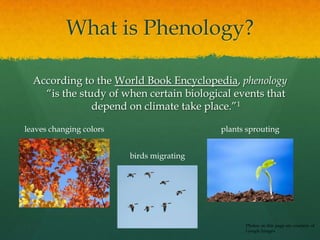
leaves changing colors                     plants sprouting


                         birds migrating


                                                 Photos on this page are courtesy of
                                                 Google Images
THE CLIMATE EFFECTS
  WHEN THINGS HAPPEN!

 Why do birds migrate in the Winter?

 Why do plants sprout in the Spring?

 Why do the leaves change colors in Fall, and why
  do they fall off??

   All of these questions can be answered by
               studying phenology!
 Let’s look at the last question: Why do leaves change
                      colors in the Fall?
Phenology of a Tulip Poplar
a 6-week case study of the changes in a deciduous tree in my backyard
Week 1
    October 14, 2012
       Mostly green leaves
       No trees adjacent
       Largest tree in my yard

    Tulip Poplar Facts2:
       Scientific name:
        Liriodendron tulipifera
       member of the magnolia
        family
       Feeds squirrels and deer
       Great for reforestation due
        to rapid growth
Week 2
      October 22, 2012
Most of the leaves are still
green, but some are
beginning to turn yellow.

NOTE:
The days are starting to get
shorter, which means less
sunlight. Less sunlight means
less photosynthesis! Less
photosynthesis means….
Less need for
CHLOROPLAST!
        Chloroplast is what makes
         plants GREEN and what
         allows them to
         PHOTOSYNTHESIZE.

        Without sunlight, plants
         don’t need it! So, they lose
         their green color, which
         allows other colors to come
         through the surface. They
         were always there…hiding
         behind the green
         chloroplast!3
Week 3
      October 29, 2012
Leaves are starting to fall at a
faster rate. More and more
leaves are turning yellow.

If this tree were in a backyard
in the northern United States,
it would probably have less
leaves and more colorful
leaves. How do I know this?

Foliage maps predict the
forecast of fall foliage for
travelers, farmers, and even
scientists!
4
Week 4
    November 10, 2012
Far less leaves than before!
Branches are starting to have
larger gaps of leaves and
more leaves are falling from
the bottom of the tree.

On some of the yellow leaves,
there are brown, splotchy
areas…..WHAT IS THIS!


It could be…….FUNGUS!
Leaf Spot Fungus

 According to Gardening
  Know How, “Spotted leaves
  occur when fungal spores
  in the air find a warm, wet,
  plant surface to cling to. As
  soon as that microscopic
  spore gets comfortable in
  its new home, sporulation
  (the fungal method of
  reproduction) occurs and
  the tiny brown fungal leaf
  spot begins to grow.”5
Week 5
    November 15, 2012
Wow! What a difference!
The tree is mostly yellow
and orange, a beautiful fall
combination. The leaves
are dry and brittle, and are
beginning to shrivel.

These leaves have changed
a great deal and are totally
different from the bright
green leaves from before.
Week 1 vs Week 5
     Leaf Contrast


Week 1                Week 5
                      Leaves
Leaves
                      • Brittle
• Soft
                      • Crumbles
• Cat face shape
                      • Rough
• Moist when torn
                      • Dry
• Smells like grass
                      • Curled up
Week 6
    November 19, 2012
The leaves on this tree will
continue to fall, as the
temperatures get colder and
the days get shorter. The tree
will survive through the
winter by using its stored
energy.
One reason why the tree has
not lost more leaves could be
because of the warmer
temperatures that are not
characteristic of this time of
year.
Global warming effects
everything!!!
Where is the energy stored in the
       different seasons?
This is how the tree lives through the winter; by using the energy it has
                            stored in its roots!


                                                              Photo courtesy of Google Images
Global Warming… :/


This is an interactive map with so much information on multiple global
              warming effects. Click HERE to check it out.6
Before & After

October 14, 2012   November 19, 2012
Conclusion

 Phenology is the study of the response of living
  organisms to seasonal & climatic changes to their
  environment.
 A tulip poplar tree in my backyard endures DRASTIC
  change in the course of only 6 weeks.
 Global warming effects everything, inlcuding phenology.
 Why do leaves change colors in the fall? Drop in amount
  of sunlight, drop in temperature, drop in photosynthesis,
  DROP IN CHLOROPLAST, which means more colors
  can shine through.
Citations

1.   The World Book Encyclopedia Vol 15 P. S.l.: S.n., 1988. Print.

2.   Dickerson, John. "Tulip Poplar." Http://plants.usda.gov. USDA NRCS, 5 Feb. 2002.
     Web. 21 Nov. 2012. <http://plants.usda.gov/factsheet/pdf/fs_litu.pdf>.

3.   "Autumn Leaves." BrainPOP. BrainPOP, n.d. Web. 20 Nov. 2012.
     <http://www.brainpop.com/science/ecologyandbehavior/autumnleaves/preview.weml>.

4.   "NJDEP New Jersey Department of Environmental Protection." NJDEP New Jersey
     Department of Environmental Protection. Forest Research Eduation Center, n.d. Web. 18
     Nov. 2012. <http://www.state.nj.us/dep/parksandforests/forest/fall_color.html>.

5.   Rhoades, Jackie. "Plants With Spotted Leaves? Fungal Leaf Spot Treatments."
     Gardening Know How RSS. Gardening Know How, n.d. Web. 20 Nov. 2012.
     <http://www.gardeningknowhow.com/plant-problems/disease/plant-leaf-spots.htm>.

6.   "Global Warming Effects Map." National Geographic. N.p., n.d. Web. 24 Nov. 2012.
     <http://environment.nationalgeographic.com/environment/global-warming/gw-impacts-
     interactive/>.

Phenology Project

  • 1.
    Digital Phenology Project KaylaMullen Biology 3000-001
  • 2.
    What is Phenology? According to the World Book Encyclopedia, phenology “is the study of when certain biological events that depend on climate take place.”1 leaves changing colors plants sprouting birds migrating Photos on this page are courtesy of Google Images
  • 3.
    THE CLIMATE EFFECTS WHEN THINGS HAPPEN!  Why do birds migrate in the Winter?  Why do plants sprout in the Spring?  Why do the leaves change colors in Fall, and why do they fall off?? All of these questions can be answered by studying phenology! Let’s look at the last question: Why do leaves change colors in the Fall?
  • 4.
    Phenology of aTulip Poplar a 6-week case study of the changes in a deciduous tree in my backyard
  • 5.
    Week 1  October 14, 2012  Mostly green leaves  No trees adjacent  Largest tree in my yard  Tulip Poplar Facts2:  Scientific name: Liriodendron tulipifera  member of the magnolia family  Feeds squirrels and deer  Great for reforestation due to rapid growth
  • 6.
    Week 2 October 22, 2012 Most of the leaves are still green, but some are beginning to turn yellow. NOTE: The days are starting to get shorter, which means less sunlight. Less sunlight means less photosynthesis! Less photosynthesis means….
  • 7.
    Less need for CHLOROPLAST!  Chloroplast is what makes plants GREEN and what allows them to PHOTOSYNTHESIZE.  Without sunlight, plants don’t need it! So, they lose their green color, which allows other colors to come through the surface. They were always there…hiding behind the green chloroplast!3
  • 8.
    Week 3 October 29, 2012 Leaves are starting to fall at a faster rate. More and more leaves are turning yellow. If this tree were in a backyard in the northern United States, it would probably have less leaves and more colorful leaves. How do I know this? Foliage maps predict the forecast of fall foliage for travelers, farmers, and even scientists!
  • 9.
  • 10.
    Week 4 November 10, 2012 Far less leaves than before! Branches are starting to have larger gaps of leaves and more leaves are falling from the bottom of the tree. On some of the yellow leaves, there are brown, splotchy areas…..WHAT IS THIS! It could be…….FUNGUS!
  • 11.
    Leaf Spot Fungus According to Gardening Know How, “Spotted leaves occur when fungal spores in the air find a warm, wet, plant surface to cling to. As soon as that microscopic spore gets comfortable in its new home, sporulation (the fungal method of reproduction) occurs and the tiny brown fungal leaf spot begins to grow.”5
  • 12.
    Week 5 November 15, 2012 Wow! What a difference! The tree is mostly yellow and orange, a beautiful fall combination. The leaves are dry and brittle, and are beginning to shrivel. These leaves have changed a great deal and are totally different from the bright green leaves from before.
  • 13.
    Week 1 vsWeek 5 Leaf Contrast Week 1 Week 5 Leaves Leaves • Brittle • Soft • Crumbles • Cat face shape • Rough • Moist when torn • Dry • Smells like grass • Curled up
  • 14.
    Week 6 November 19, 2012 The leaves on this tree will continue to fall, as the temperatures get colder and the days get shorter. The tree will survive through the winter by using its stored energy. One reason why the tree has not lost more leaves could be because of the warmer temperatures that are not characteristic of this time of year. Global warming effects everything!!!
  • 15.
    Where is theenergy stored in the different seasons? This is how the tree lives through the winter; by using the energy it has stored in its roots! Photo courtesy of Google Images
  • 16.
    Global Warming… :/ Thisis an interactive map with so much information on multiple global warming effects. Click HERE to check it out.6
  • 17.
    Before & After October14, 2012 November 19, 2012
  • 18.
    Conclusion  Phenology isthe study of the response of living organisms to seasonal & climatic changes to their environment.  A tulip poplar tree in my backyard endures DRASTIC change in the course of only 6 weeks.  Global warming effects everything, inlcuding phenology.  Why do leaves change colors in the fall? Drop in amount of sunlight, drop in temperature, drop in photosynthesis, DROP IN CHLOROPLAST, which means more colors can shine through.
  • 19.
    Citations 1. The World Book Encyclopedia Vol 15 P. S.l.: S.n., 1988. Print. 2. Dickerson, John. "Tulip Poplar." Http://plants.usda.gov. USDA NRCS, 5 Feb. 2002. Web. 21 Nov. 2012. <http://plants.usda.gov/factsheet/pdf/fs_litu.pdf>. 3. "Autumn Leaves." BrainPOP. BrainPOP, n.d. Web. 20 Nov. 2012. <http://www.brainpop.com/science/ecologyandbehavior/autumnleaves/preview.weml>. 4. "NJDEP New Jersey Department of Environmental Protection." NJDEP New Jersey Department of Environmental Protection. Forest Research Eduation Center, n.d. Web. 18 Nov. 2012. <http://www.state.nj.us/dep/parksandforests/forest/fall_color.html>. 5. Rhoades, Jackie. "Plants With Spotted Leaves? Fungal Leaf Spot Treatments." Gardening Know How RSS. Gardening Know How, n.d. Web. 20 Nov. 2012. <http://www.gardeningknowhow.com/plant-problems/disease/plant-leaf-spots.htm>. 6. "Global Warming Effects Map." National Geographic. N.p., n.d. Web. 24 Nov. 2012. <http://environment.nationalgeographic.com/environment/global-warming/gw-impacts- interactive/>.