Taxing implications on a
       Joint Venture
   Manish Madhukar     Kaushambi Ghosh


  Mohit Almal


Mirza Sakhawat Ullah    Manoj Mani Iyer   1
Agenda
• Joint Venture
  – Definition
  – Classification
  – Objectives
  – Factors involved
• Deal Structuring
• Case Citation


                       2
Joint Ventures
• Joint venture is a strategic alliance in
  which two or more firms create a
  legally independent company to share
  some of their resources and
  capabilities to develop a competitive
  advantage. The parties agree to
  create a new entity by both
  contributing equity, and they then
  share in the revenues, expenses, and
  control of the enterprise.


                                             3
Classification
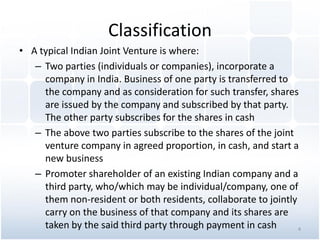
• A typical Indian Joint Venture is where:
   – Two parties (individuals or companies), incorporate a
     company in India. Business of one party is transferred to
     the company and as consideration for such transfer, shares
     are issued by the company and subscribed by that party.
     The other party subscribes for the shares in cash
   – The above two parties subscribe to the shares of the joint
     venture company in agreed proportion, in cash, and start a
     new business
   – Promoter shareholder of an existing Indian company and a
     third party, who/which may be individual/company, one of
     them non-resident or both residents, collaborate to jointly
     carry on the business of that company and its shares are
     taken by the said third party through payment in cash       4
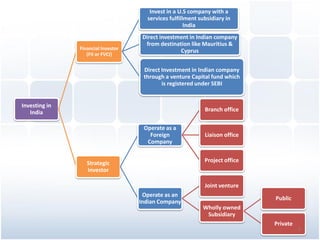
Invest in a U.S company with a
                                      services fulfillment subsidiary in
                                                      India
                                     Direct investment in Indian company
                                      from destination like Mauritius &
               Financial Investor                  Cyprus
                  (FII or FVCI)

                                     Direct Investment in Indian company
                                     through a venture Capital fund which
                                            is registered under SEBI


Investing in
   India                                                     Branch office

                                     Operate as a
                                       Foreign               Liaison office
                                      Company


                  Strategic                                  Project office
                  Investor

                                                             Joint venture
                                     Operate as an
                                                                              Public
                                    Indian Company
                                                            Wholly owned
                                                             Subsidiary
                                                                              Private
                                                                                        5
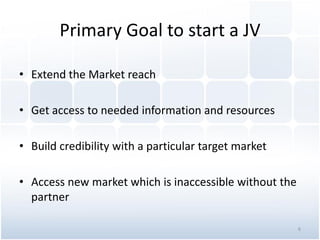
Primary Goal to start a JV

• Extend the Market reach

• Get access to needed information and resources

• Build credibility with a particular target market

• Access new market which is inaccessible without the
  partner

                                                        6
Types of JV

• Corporate Joint Ventures

• Contractual Joint Ventures

• Partnerships

• Trusts
                               7
Key factors involved in JV
•   Early considerations
•    Understanding FDI rules
•    Conducting appropriate due diligence
•    Structuring the joint venture vehicle
•    Company formation
•    Obtaining regulatory licences and approvals
•    Employee issues
•    Taxation and duties
•    Protecting intellectual property rights (IPR)
•   Joint venture documents

                                                     8
Government Approvals
 • All the joint ventures in India require governmental approvals,
   if a foreign partner or an NRI or PIO* partner is involved
 • The approval can be obtained from either from RBI or FIPB
   (Foreign Investment Promotion Board). In case, a joint venture
   is covered under automatic route, then the approval of
   Reserve bank of India is required
 • In other special cases, not covered under the automatic route,
   a special approval of FIPB is required

 Investment limits.xlsx
*Person of Indian Origin: For investments in immovable properties A foreign citizen (other than a
citizen of Pakistan, Bangladesh, Afghanistan, China, Iran, Bhutan, Sri Lanka, or Nepal) is deemed
to be of Indian origin if, (i) he held an Indian passport at any time, or (ii) he or his father or paternal
grand-father was a citizen of India by virtue of the Constitution of India or the Citizenship Act, 1955
(57 of 1955)                                                                                                  9
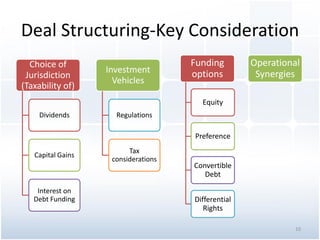
Deal Structuring-Key Consideration
  Choice of                          Funding        Operational
                   Investment        options         Synergies
 Jurisdiction
                     Vehicles
(Taxability of)
                                       Equity
     Dividends       Regulations

                                     Preference
                         Tax
   Capital Gains
                    considerations
                                     Convertible
                                        Debt

    Interest on
   Debt Funding                      Differential
                                        Rights

                                                              10
Choice of Jurisdiction
• Taxability of
  – Distribution of Dividends
     • In Indian context, any Jurisdiction is tax neutral due to the fact
       that DDT @ 16.995% is levied upon the distributing company
  – Capital Gains
     • Capital Gains would arise upon the sale of the investment in
       India. Thus, this aspect concerns the exit option for the
       investor.
     • In the Indian context, gains made on the sale of investment
       attracts a capital gain tax of 20% if the holding period of the
       asset is less than 3 years and 10% if the holding period
       exceeds 3 years. In view of the same, the investment can then
       be structured through a holding company set up at a location
       where such gains are exempt.                                   11
Choice of Jurisdiction
• Taxability of
  – Interest on Debt funding
     • Interest on debt funding is a very critical part of the entire
       transaction
     • The tax deductibility of these expenses is critical, since this
       would result in a considerable amount of savings


                                                                   12
Choice of Jurisdiction
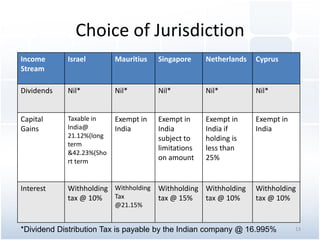
Income      Israel        Mauritius   Singapore     Netherlands   Cyprus
Stream

Dividends   Nil*          Nil*        Nil*          Nil*          Nil*


Capital     Taxable in    Exempt in   Exempt in     Exempt in     Exempt in
Gains       India@        India       India         India if      India
            21.12%(long               subject to    holding is
            term
                                      limitations   less than
            &42.23%(Sho
            rt term                   on amount     25%


Interest    Withholding Withholding Withholding Withholding       Withholding
            tax @ 10%   Tax         tax @ 15%   tax @ 10%         tax @ 10%
                          @21.15%


*Dividend Distribution Tax is payable by the Indian company @ 16.995%         13
Investment Vehicle
• The choice of investment vehicle is largely based on the
  regulations and the tax considerations existing in the country
  where the target company is situated
• The overall guiding principle would
  be that the investment vehicle qualifies to claim treaty benefit
  under the tax treaty between India and the relevant
  jurisdiction
• The choice of investment vehicle would be considered at 2
  levels :
   – Jurisdiction Level
   – Indian Level(Country of the target Company)

                                                                14
Investment Vehicle
• Jurisdiction level Parameters
  – Ease of formation and administration
  – Ease of Exit
  – Local Regulatory(non-tax considerations)
  – Tax treatment in the country of residence
  – Tax differentiators vis-à-vis tax treaties with India.
    This becomes critical due to the fact that
    the same income not be taxed twice under two
    different jurisdictions

                                                             15
Investment Vehicle
• Indian level Parameters
  – FDI restrictions in India based on the sectoral caps
    in place
  – Regulatory registrations and administration


                                                       16
Taxation and duties
• The impact of tax treaties and agreement
  between various countries and the optimum
  use of offshore finance centers and tax
  havens is critical for structuring a transaction


                                                     17
Funding Options
• The funding options available for the structuring would vary
  depending upon the present structure of the company and
  the availability of debt. The normal options available would be
  Equity, Preference, Convertible Debt and Differential Rights
  apart from the structured funding options. These would vary
  based on :
   – The investor's preference for dividend or liquidation or both
   – Prevailing Indian exchange control laws, which do not permit foreign
     equity investment beyond a certain level in certain sectors
   – The investor may wish to get disproportionate voting rights on its
     investment in return for the strategic value such investor may bring to
     the table
   – Restrictions placed by the Indian corporate and securities laws with
     respect to equity shares which may not suit the commercial
     understanding between the parties
                                                                           18
Equity
• Most sectors have been opened up for foreign investment
  and, hence, no approvals from the government of India are
  required for issue of fresh shares with respect to these sectors
• The tax implications are as under :
   – Dividends
      • Dividends can be freely repatriated under exchange regulations
      • Transfer to reserves before declaring dividends
      • Dividends not taxable in hands of shareholders
      • The domestic company must pay dividend distribution tax (DDT) at
         the rate of
         16.995% (15% plus surcharge of 10% and education cess of 3%)
   – Capital
      • Repatriation of funds not possible, as equity capital cannot be
         withdrawn during the life-span of the company, except in the case
         of a buy-back of shares                                          19
Preference Capital
• Preference shares (except foreign through fully convertible)
  are considered as debt and has to be issued in conformity
  with ECB guidelines/caps
• Tax Implications
   – Dividends
      • On fully convertible, can be repatriated but the maximum rate is capped
      • On any other type needs to confirm to the all-in-cost ceiling prescribed in
         the ECB
         guidelines
      • Tax Implications same as Equity shares
   – Capital
      • No company can issue preference shares that are either non-redeemable,
         or are redeemable after 20 years from the date of their issue

                                                                                  20
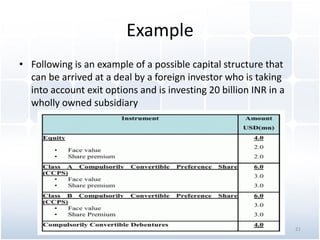
Example
• Following is an example of a possible capital structure that
  can be arrived at a deal by a foreign investor who is taking
  into account exit options and is investing 20 billion INR in a
  wholly owned subsidiary


                                                                   21
Example
• Parameters to be considered for Capital Structure
   – Different classes of shares in smaller amounts facilitate exit
     through buy back of an entire class of shares as against
     pro-rata buy back from all investors in the same class
   – Share premium can be utilized for buy back of shares
     under the Indian corporate laws in the absence of profits
   – 100% of the CCPS can be bought back in a single year
     unlike equity shares where there is a limit of 25% per year
   – CCD's facilitate exit and also improve IRRs through regular
     flow of interest


                                                                 22
Hutch-Vodafone Deal
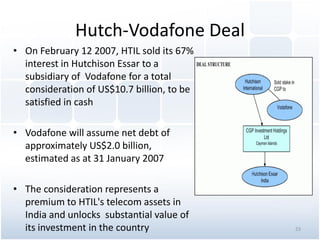
• On February 12 2007, HTIL sold its 67%
  interest in Hutchison Essar to a
  subsidiary of Vodafone for a total
  consideration of US$10.7 billion, to be
  satisfied in cash

• Vodafone will assume net debt of
  approximately US$2.0 billion,
  estimated as at 31 January 2007

• The consideration represents a
  premium to HTIL's telecom assets in
  India and unlocks substantial value of
  its investment in the country             23
Hutch Vodafone Deal
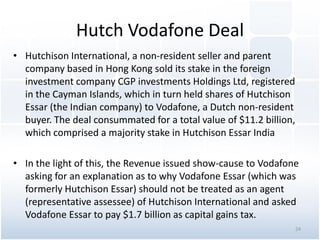
• Hutchison International, a non-resident seller and parent
  company based in Hong Kong sold its stake in the foreign
  investment company CGP investments Holdings Ltd, registered
  in the Cayman Islands, which in turn held shares of Hutchison
  Essar (the Indian company) to Vodafone, a Dutch non-resident
  buyer. The deal consummated for a total value of $11.2 billion,
  which comprised a majority stake in Hutchison Essar India

• In the light of this, the Revenue issued show-cause to Vodafone
  asking for an explanation as to why Vodafone Essar (which was
  formerly Hutchison Essar) should not be treated as an agent
  (representative assessee) of Hutchison International and asked
  Vodafone Essar to pay $1.7 billion as capital gains tax.
                                                                    24
Hutch Vodafone Deal
• Controversy
  – The whole controversy in the case of Vodafone is about
    the taxability of transfer of share capital of the Indian
    entity
  – Generally the transfer of shares of a non-resident company
    to another non- resident is not subject to tax in India
  – But the revenue department is of the view that this
    transfer represents transfer of beneficial interest of the
    shares of the Indian company and, hence, it will be
    subject to tax


                                                            25
Hutch Vodafone Deal
• Vodafone’s argument
  – Vodafone's argument is that there is no sale of shares of
    the Indian company and what it had acquired is a company
    incorporated in Cayman Islands which in turn holds the
    Indian entity. Hence the transaction is not subject to tax in
    India


                                                               26
Hutch Vodafone Deal
• Ruling favoring Vodafone             • Ruling favoring Revenue
   – Revenue would be left with          – Revenue authorities can go
     little choice but to propose an       ahead and assess the agent for
     amendment of the tax                  recovery of various tax
     legislation to include the            liabilities on transactions of the
     concept of beneficial                 non- resident entity, including
     ownership in the definition           the capital gains tax liability on
     of 'transfer‘                         the transfer of beneficial
   – Given the volume of cross-            ownership of the Indian entity
     border deals involving Indian       – This would mean any
     companies, the Revenue                transaction happening
     taking this step is not far-          anywhere in the world would
     fetched                               be subject to tax in India, if
                                           nexus with India is proved
                                                                          27
Thank You


            28

Taxing Implications On A Joint Venture

  • 1.
    Taxing implications ona Joint Venture Manish Madhukar Kaushambi Ghosh Mohit Almal Mirza Sakhawat Ullah Manoj Mani Iyer 1
  • 2.
    Agenda • Joint Venture – Definition – Classification – Objectives – Factors involved • Deal Structuring • Case Citation 2
  • 3.
    Joint Ventures • Jointventure is a strategic alliance in which two or more firms create a legally independent company to share some of their resources and capabilities to develop a competitive advantage. The parties agree to create a new entity by both contributing equity, and they then share in the revenues, expenses, and control of the enterprise. 3
  • 4.
    Classification • A typicalIndian Joint Venture is where: – Two parties (individuals or companies), incorporate a company in India. Business of one party is transferred to the company and as consideration for such transfer, shares are issued by the company and subscribed by that party. The other party subscribes for the shares in cash – The above two parties subscribe to the shares of the joint venture company in agreed proportion, in cash, and start a new business – Promoter shareholder of an existing Indian company and a third party, who/which may be individual/company, one of them non-resident or both residents, collaborate to jointly carry on the business of that company and its shares are taken by the said third party through payment in cash 4
  • 5.
    Invest in aU.S company with a services fulfillment subsidiary in India Direct investment in Indian company from destination like Mauritius & Financial Investor Cyprus (FII or FVCI) Direct Investment in Indian company through a venture Capital fund which is registered under SEBI Investing in India Branch office Operate as a Foreign Liaison office Company Strategic Project office Investor Joint venture Operate as an Public Indian Company Wholly owned Subsidiary Private 5
  • 6.
    Primary Goal tostart a JV • Extend the Market reach • Get access to needed information and resources • Build credibility with a particular target market • Access new market which is inaccessible without the partner 6
  • 7.
    Types of JV •Corporate Joint Ventures • Contractual Joint Ventures • Partnerships • Trusts 7
  • 8.
    Key factors involvedin JV • Early considerations • Understanding FDI rules • Conducting appropriate due diligence • Structuring the joint venture vehicle • Company formation • Obtaining regulatory licences and approvals • Employee issues • Taxation and duties • Protecting intellectual property rights (IPR) • Joint venture documents 8
  • 9.
    Government Approvals •All the joint ventures in India require governmental approvals, if a foreign partner or an NRI or PIO* partner is involved • The approval can be obtained from either from RBI or FIPB (Foreign Investment Promotion Board). In case, a joint venture is covered under automatic route, then the approval of Reserve bank of India is required • In other special cases, not covered under the automatic route, a special approval of FIPB is required Investment limits.xlsx *Person of Indian Origin: For investments in immovable properties A foreign citizen (other than a citizen of Pakistan, Bangladesh, Afghanistan, China, Iran, Bhutan, Sri Lanka, or Nepal) is deemed to be of Indian origin if, (i) he held an Indian passport at any time, or (ii) he or his father or paternal grand-father was a citizen of India by virtue of the Constitution of India or the Citizenship Act, 1955 (57 of 1955) 9
  • 10.
    Deal Structuring-Key Consideration Choice of Funding Operational Investment options Synergies Jurisdiction Vehicles (Taxability of) Equity Dividends Regulations Preference Tax Capital Gains considerations Convertible Debt Interest on Debt Funding Differential Rights 10
  • 11.
    Choice of Jurisdiction •Taxability of – Distribution of Dividends • In Indian context, any Jurisdiction is tax neutral due to the fact that DDT @ 16.995% is levied upon the distributing company – Capital Gains • Capital Gains would arise upon the sale of the investment in India. Thus, this aspect concerns the exit option for the investor. • In the Indian context, gains made on the sale of investment attracts a capital gain tax of 20% if the holding period of the asset is less than 3 years and 10% if the holding period exceeds 3 years. In view of the same, the investment can then be structured through a holding company set up at a location where such gains are exempt. 11
  • 12.
    Choice of Jurisdiction •Taxability of – Interest on Debt funding • Interest on debt funding is a very critical part of the entire transaction • The tax deductibility of these expenses is critical, since this would result in a considerable amount of savings 12
  • 13.
    Choice of Jurisdiction Income Israel Mauritius Singapore Netherlands Cyprus Stream Dividends Nil* Nil* Nil* Nil* Nil* Capital Taxable in Exempt in Exempt in Exempt in Exempt in Gains India@ India India India if India 21.12%(long subject to holding is term limitations less than &42.23%(Sho rt term on amount 25% Interest Withholding Withholding Withholding Withholding Withholding tax @ 10% Tax tax @ 15% tax @ 10% tax @ 10% @21.15% *Dividend Distribution Tax is payable by the Indian company @ 16.995% 13
  • 14.
    Investment Vehicle • Thechoice of investment vehicle is largely based on the regulations and the tax considerations existing in the country where the target company is situated • The overall guiding principle would be that the investment vehicle qualifies to claim treaty benefit under the tax treaty between India and the relevant jurisdiction • The choice of investment vehicle would be considered at 2 levels : – Jurisdiction Level – Indian Level(Country of the target Company) 14
  • 15.
    Investment Vehicle • Jurisdictionlevel Parameters – Ease of formation and administration – Ease of Exit – Local Regulatory(non-tax considerations) – Tax treatment in the country of residence – Tax differentiators vis-à-vis tax treaties with India. This becomes critical due to the fact that the same income not be taxed twice under two different jurisdictions 15
  • 16.
    Investment Vehicle • Indianlevel Parameters – FDI restrictions in India based on the sectoral caps in place – Regulatory registrations and administration 16
  • 17.
    Taxation and duties •The impact of tax treaties and agreement between various countries and the optimum use of offshore finance centers and tax havens is critical for structuring a transaction 17
  • 18.
    Funding Options • Thefunding options available for the structuring would vary depending upon the present structure of the company and the availability of debt. The normal options available would be Equity, Preference, Convertible Debt and Differential Rights apart from the structured funding options. These would vary based on : – The investor's preference for dividend or liquidation or both – Prevailing Indian exchange control laws, which do not permit foreign equity investment beyond a certain level in certain sectors – The investor may wish to get disproportionate voting rights on its investment in return for the strategic value such investor may bring to the table – Restrictions placed by the Indian corporate and securities laws with respect to equity shares which may not suit the commercial understanding between the parties 18
  • 19.
    Equity • Most sectorshave been opened up for foreign investment and, hence, no approvals from the government of India are required for issue of fresh shares with respect to these sectors • The tax implications are as under : – Dividends • Dividends can be freely repatriated under exchange regulations • Transfer to reserves before declaring dividends • Dividends not taxable in hands of shareholders • The domestic company must pay dividend distribution tax (DDT) at the rate of 16.995% (15% plus surcharge of 10% and education cess of 3%) – Capital • Repatriation of funds not possible, as equity capital cannot be withdrawn during the life-span of the company, except in the case of a buy-back of shares 19
  • 20.
    Preference Capital • Preferenceshares (except foreign through fully convertible) are considered as debt and has to be issued in conformity with ECB guidelines/caps • Tax Implications – Dividends • On fully convertible, can be repatriated but the maximum rate is capped • On any other type needs to confirm to the all-in-cost ceiling prescribed in the ECB guidelines • Tax Implications same as Equity shares – Capital • No company can issue preference shares that are either non-redeemable, or are redeemable after 20 years from the date of their issue 20
  • 21.
    Example • Following isan example of a possible capital structure that can be arrived at a deal by a foreign investor who is taking into account exit options and is investing 20 billion INR in a wholly owned subsidiary 21
  • 22.
    Example • Parameters tobe considered for Capital Structure – Different classes of shares in smaller amounts facilitate exit through buy back of an entire class of shares as against pro-rata buy back from all investors in the same class – Share premium can be utilized for buy back of shares under the Indian corporate laws in the absence of profits – 100% of the CCPS can be bought back in a single year unlike equity shares where there is a limit of 25% per year – CCD's facilitate exit and also improve IRRs through regular flow of interest 22
  • 23.
    Hutch-Vodafone Deal • OnFebruary 12 2007, HTIL sold its 67% interest in Hutchison Essar to a subsidiary of Vodafone for a total consideration of US$10.7 billion, to be satisfied in cash • Vodafone will assume net debt of approximately US$2.0 billion, estimated as at 31 January 2007 • The consideration represents a premium to HTIL's telecom assets in India and unlocks substantial value of its investment in the country 23
  • 24.
    Hutch Vodafone Deal •Hutchison International, a non-resident seller and parent company based in Hong Kong sold its stake in the foreign investment company CGP investments Holdings Ltd, registered in the Cayman Islands, which in turn held shares of Hutchison Essar (the Indian company) to Vodafone, a Dutch non-resident buyer. The deal consummated for a total value of $11.2 billion, which comprised a majority stake in Hutchison Essar India • In the light of this, the Revenue issued show-cause to Vodafone asking for an explanation as to why Vodafone Essar (which was formerly Hutchison Essar) should not be treated as an agent (representative assessee) of Hutchison International and asked Vodafone Essar to pay $1.7 billion as capital gains tax. 24
  • 25.
    Hutch Vodafone Deal •Controversy – The whole controversy in the case of Vodafone is about the taxability of transfer of share capital of the Indian entity – Generally the transfer of shares of a non-resident company to another non- resident is not subject to tax in India – But the revenue department is of the view that this transfer represents transfer of beneficial interest of the shares of the Indian company and, hence, it will be subject to tax 25
  • 26.
    Hutch Vodafone Deal •Vodafone’s argument – Vodafone's argument is that there is no sale of shares of the Indian company and what it had acquired is a company incorporated in Cayman Islands which in turn holds the Indian entity. Hence the transaction is not subject to tax in India 26
  • 27.
    Hutch Vodafone Deal •Ruling favoring Vodafone • Ruling favoring Revenue – Revenue would be left with – Revenue authorities can go little choice but to propose an ahead and assess the agent for amendment of the tax recovery of various tax legislation to include the liabilities on transactions of the concept of beneficial non- resident entity, including ownership in the definition the capital gains tax liability on of 'transfer‘ the transfer of beneficial – Given the volume of cross- ownership of the Indian entity border deals involving Indian – This would mean any companies, the Revenue transaction happening taking this step is not far- anywhere in the world would fetched be subject to tax in India, if nexus with India is proved 27
  • 28.