PLAY
As a Competitive
Advantage


                   July 2012
                     Image credit: niznoz
WHAT WE’LL COVER
Methodology

Play As a Competitive Advantage
     •Defining Play
     •Benefits of Play
     •Impediments to Play
     •Manifestations
     •What It Means

Appendix
    •More About Our Experts/Influencers
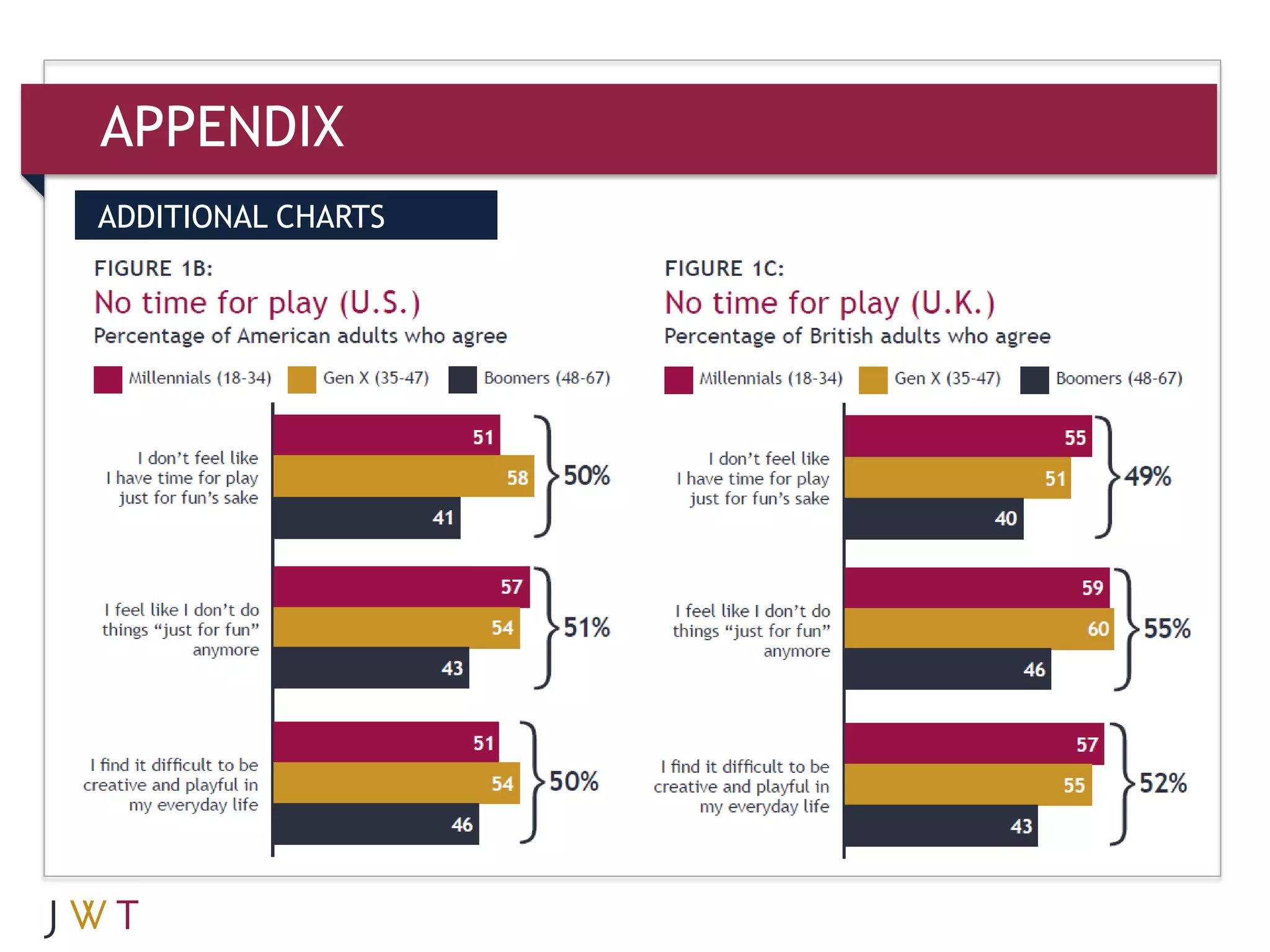
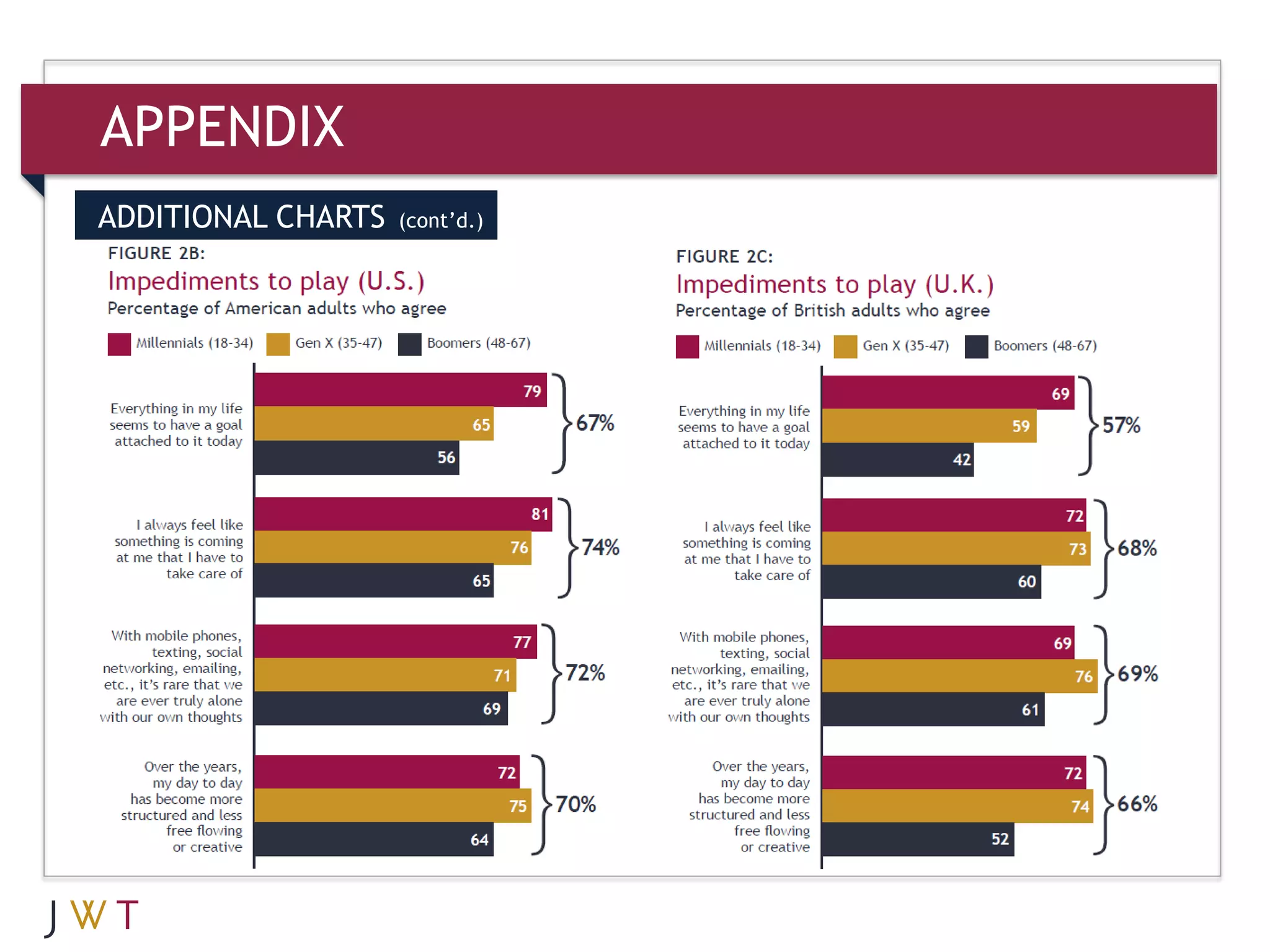
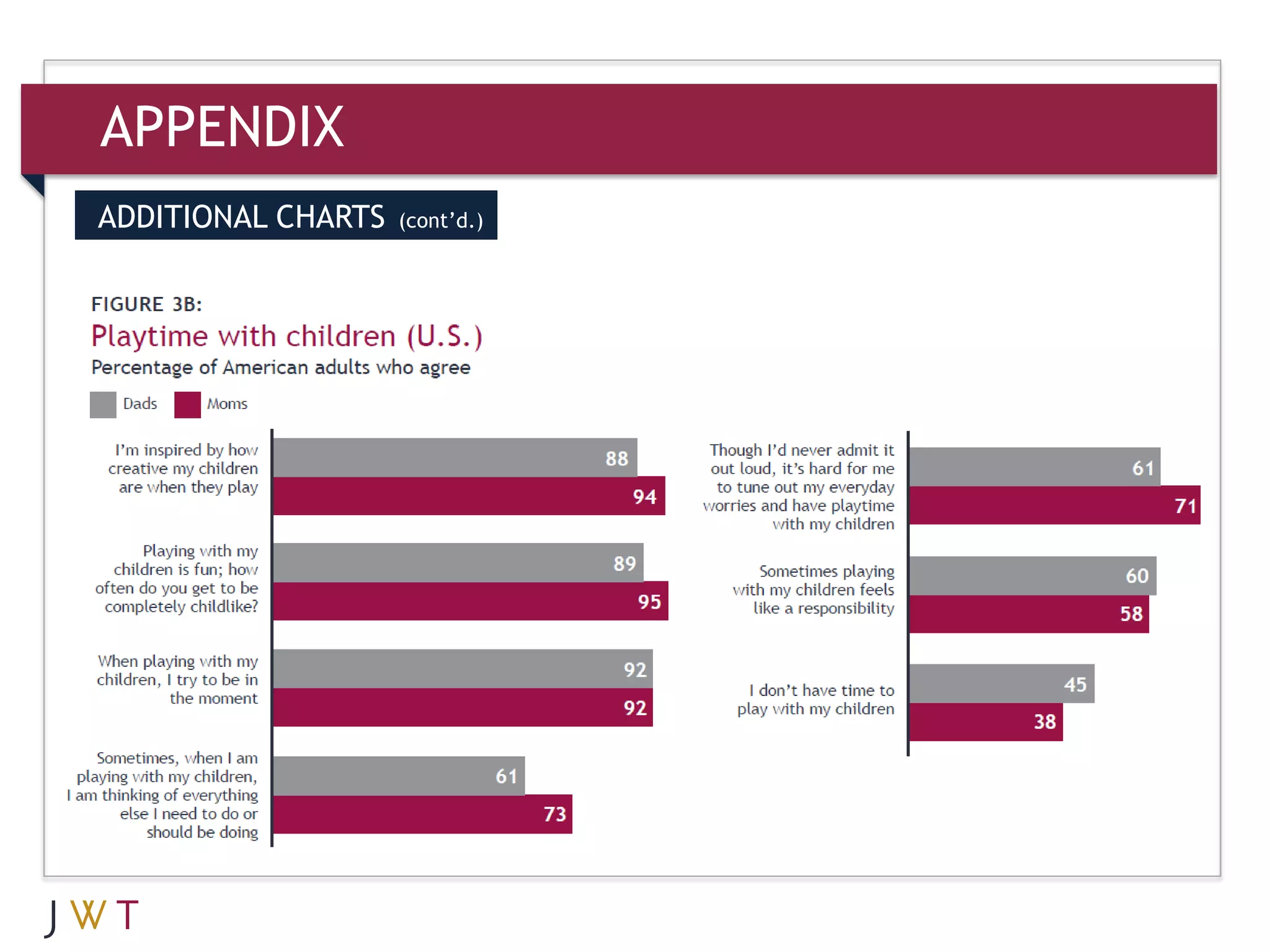
    •Additional Charts
METHODOLOGY
SONAR™

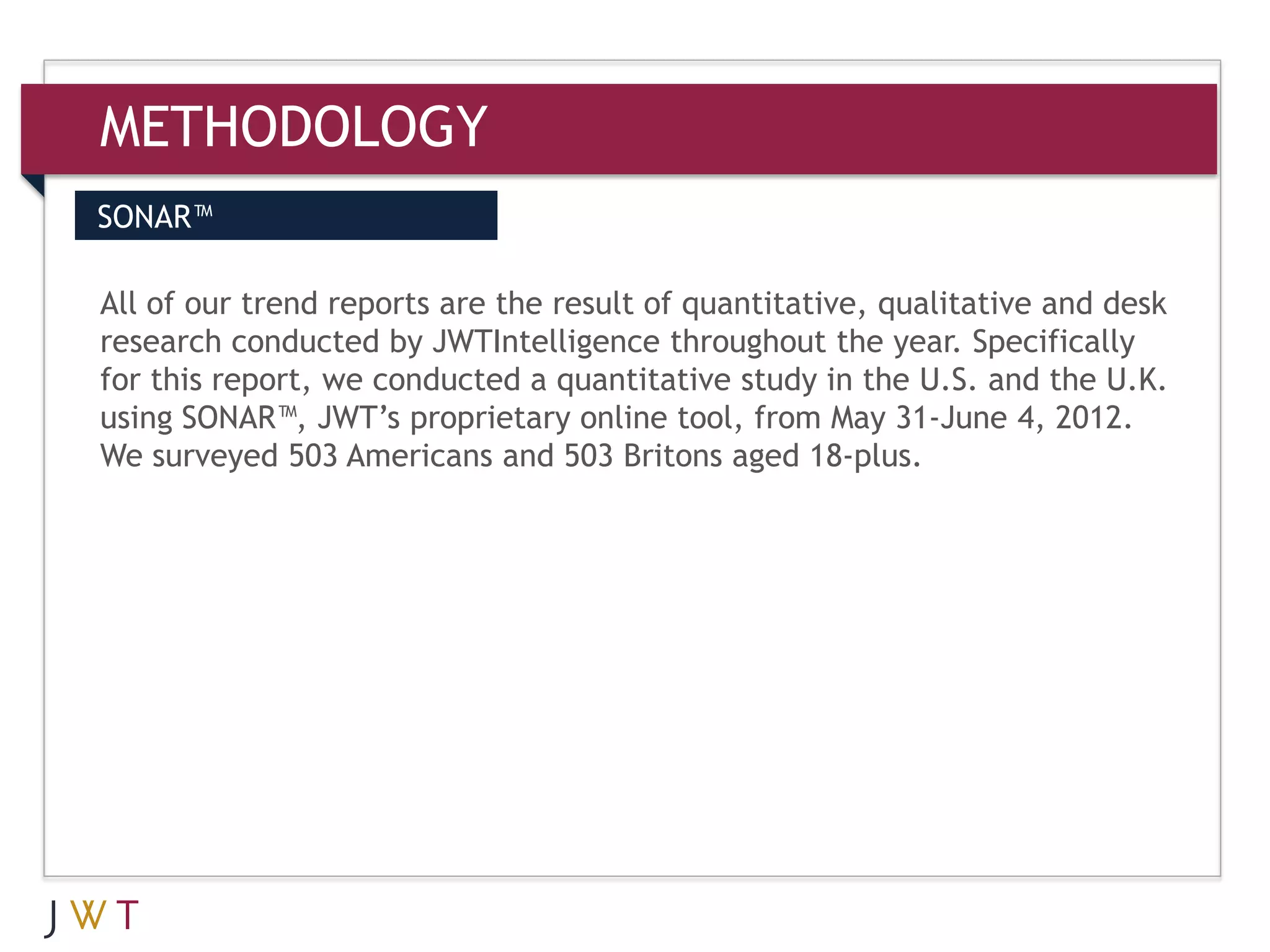
All of our trend reports are the result of quantitative, qualitative and desk
research conducted by JWTIntelligence throughout the year. Specifically
for this report, we conducted a quantitative study in the U.S. and the U.K.
using SONAR™, JWT’s proprietary online tool, from May 31-June 4, 2012.
We surveyed 503 Americans and 503 Britons aged 18-plus.
METHODOLOGY                 (cont’d.)


Influencers and experts

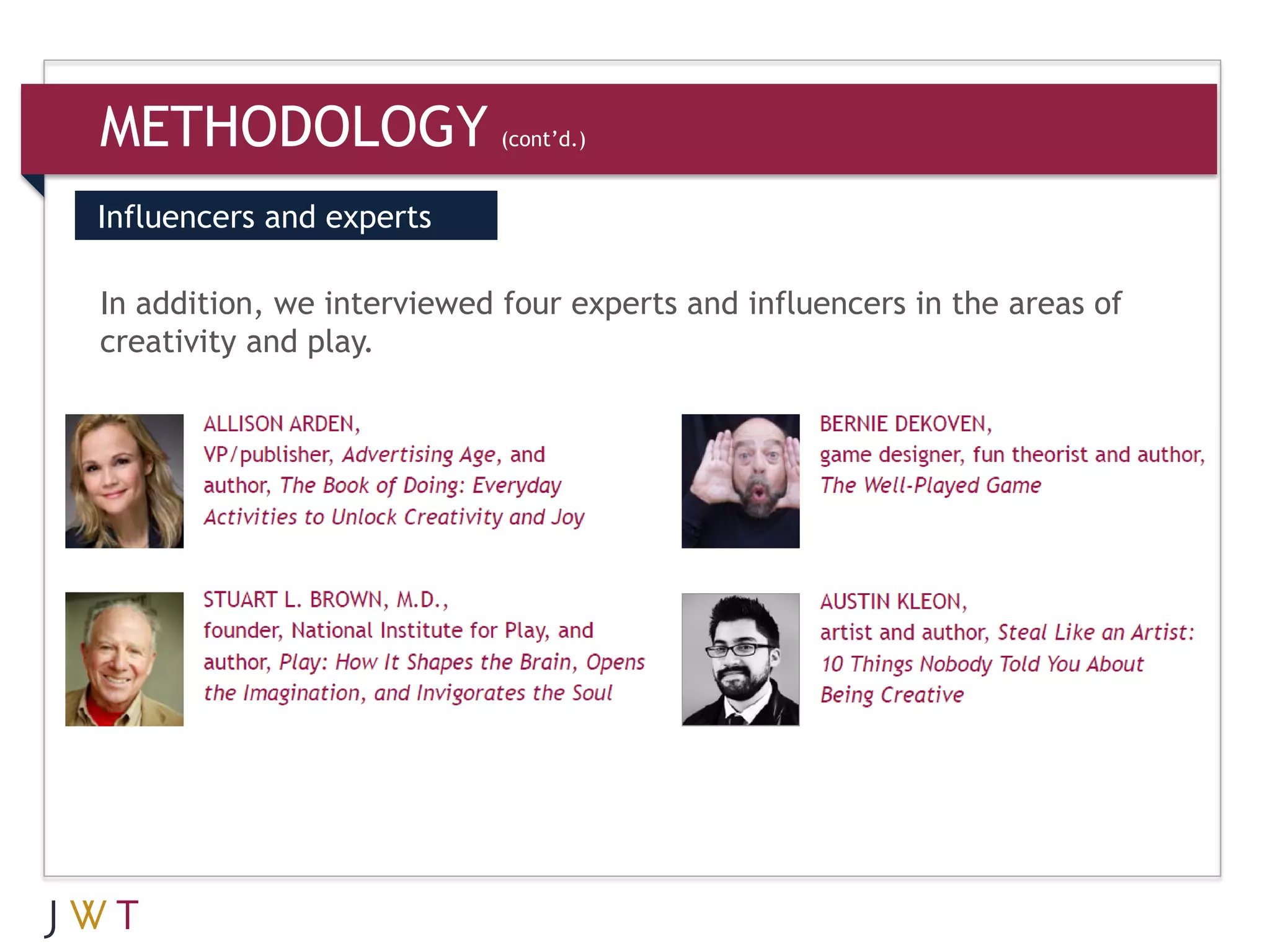
In addition, we interviewed four experts and influencers in the areas of
creativity and play.
3 GEERATION GO
PLAY AS A COMPETITIVE ADVANTAGE
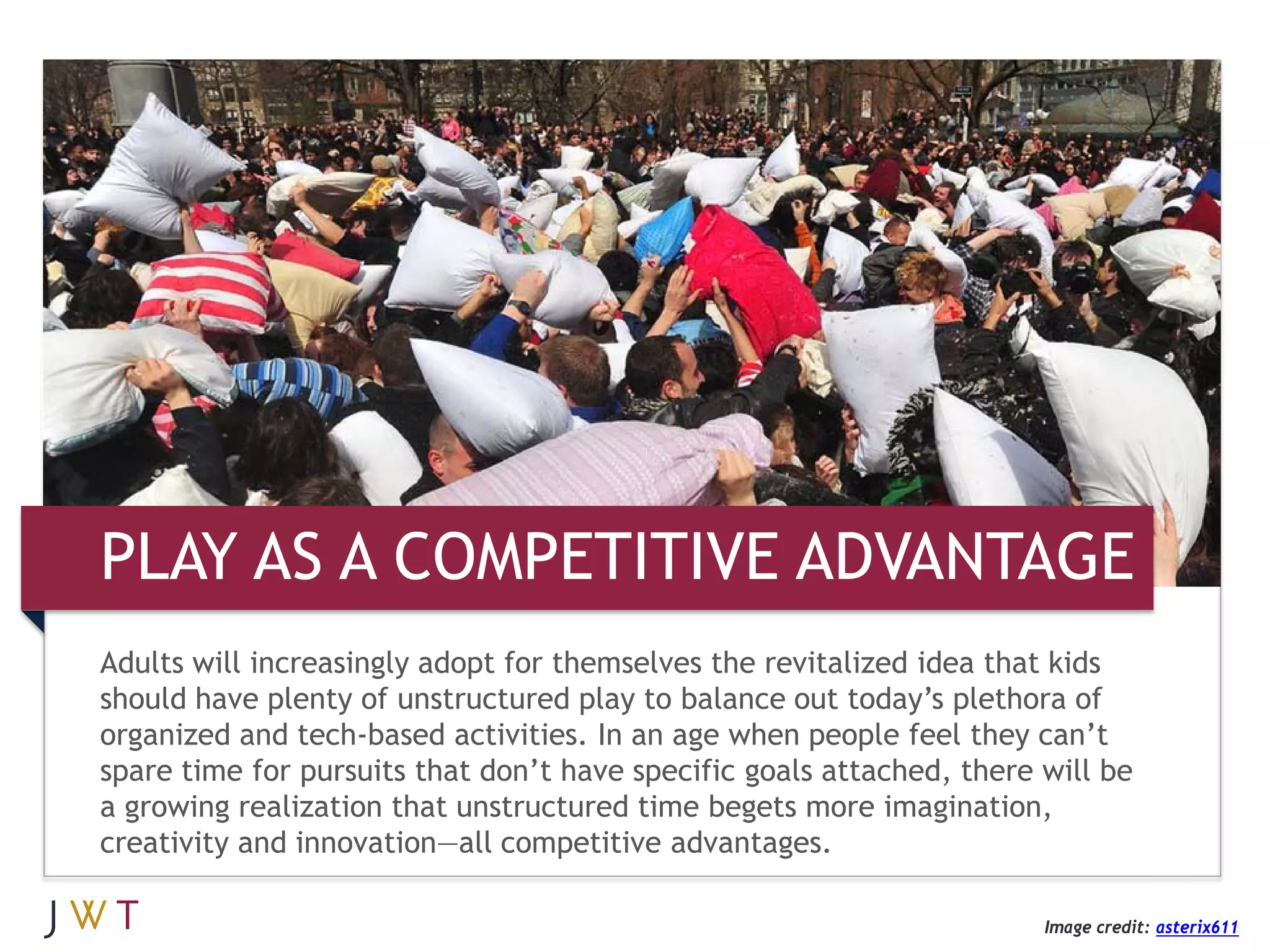
Adults will increasingly adopt for themselves the revitalized idea that kids
should have plenty of unstructured play to balance out today’s plethora of
organized and tech-based activities. In an age when people feel they can’t
spare time for pursuits that don’t have specific goals attached, there will be
a growing realization that unstructured time begets more imagination,
creativity and innovation—all competitive advantages.

                                                                       Image credit: asterix611
PLAY AS A COMPETITIVE ADVANTAGE                                             (cont’d.)


 DEFINING PLAY

This report defines play in its purest sense, as recreational activity. Play is
about doing something simply for the fun of it—no scores or goals attached.
No rules and no guidelines. In fact, play is purposeless. To ascribe purpose
takes the joy out of it.

   Play is “a free activity standing quite
   consciously outside ‘ordinary’ life as being
   ‘not serious’ but at the same time absorbing
   the player intensely and utterly.”
            —Dutch historian JOHAN HUIZINGA,
                                Homo Ludens

                                                    An essential component of play is its
                                                   frivolity; biologists generally use phrases like
                                                   ‘apparently purposeless activity’ in their
                                                   definitions of play
                                                  —Robin Marantz Henig, “Taking Play Seriously,”
                                                            The New York Times, Feb. 17, 2008
PLAY AS A COMPETITIVE ADVANTAGE                                                    (cont’d.)


     DEFINING PLAY         (cont’d.)


            The problem is that to insist on [play’s]                    Play is one of those things we tend to
            benefits risks violating the spirit, if not                 take for granted until we miss it. It is
            the very meaning, of play. … One plays                      much like breathing or dreaming in
because it’s fun to do so, not because of any             the way it fits seamlessly, invisibly, into a healthy
instrumental advantage it may yield. The point            life. It is a natural capacity of the human mind.
isn’t to perform well or to master a skill, even          As with breathing, we do it effortlessly. And as
though those things might end up happening. …             with dreaming, while we can be totally immersed
Play, then, is about process not product. It has no       in play, we often forget about it when we are
goal other than itself. And among the external            done. To try to find the point in play is to miss
goals that are inconsistent with play is a                the point of it. Play, after all, has no point; it’s
deliberate effort to do something better or faster        purposeless.”
than someone else. If you’re keeping score—in                     —MARK EPSTEIN, M.D., “Play’s the Thing,”
fact, if you’re competing at all— then what you’re                      O, The Oprah Magazine, May 2002
doing isn’t play.”
           —author and lecturer ALFIE KOHN, “The
             Point of Play Is That It Has No Point,”
                            Big Think, Dec. 3, 2011
PLAY AS A COMPETITIVE ADVANTAGE                                                      (cont’d.)


 PROPERTIES OF PLAY
Apparently purposeless: Done for its own sake.
Voluntary: It is not obligatory.
Inherent attraction: It’s fun, and it makes us feel good.
Freedom from time: When fully engaged in play, we lose a sense of the passage of
time.
Diminished consciousness of self: We stop worrying about whether we look good or
awkward, smart or stupid.
Improvisational potential: We’re not locked into a rigid way of doing things and are
therefore open to serendipity and chance. The result? We stumble on new behaviors,
thoughts, strategies, movements or ways of being.
Continuation desire: We desire to keep doing it, and the pleasure of the experience
drives that desire.

          Derived from Play, by Stuart Brown, M.D., founder of the National Institute for Play, with
          Christopher Vaughan
BENEFITS OF PLAY


                   Image credit: Criss Cross Circus
BENEFITS OF PLAY


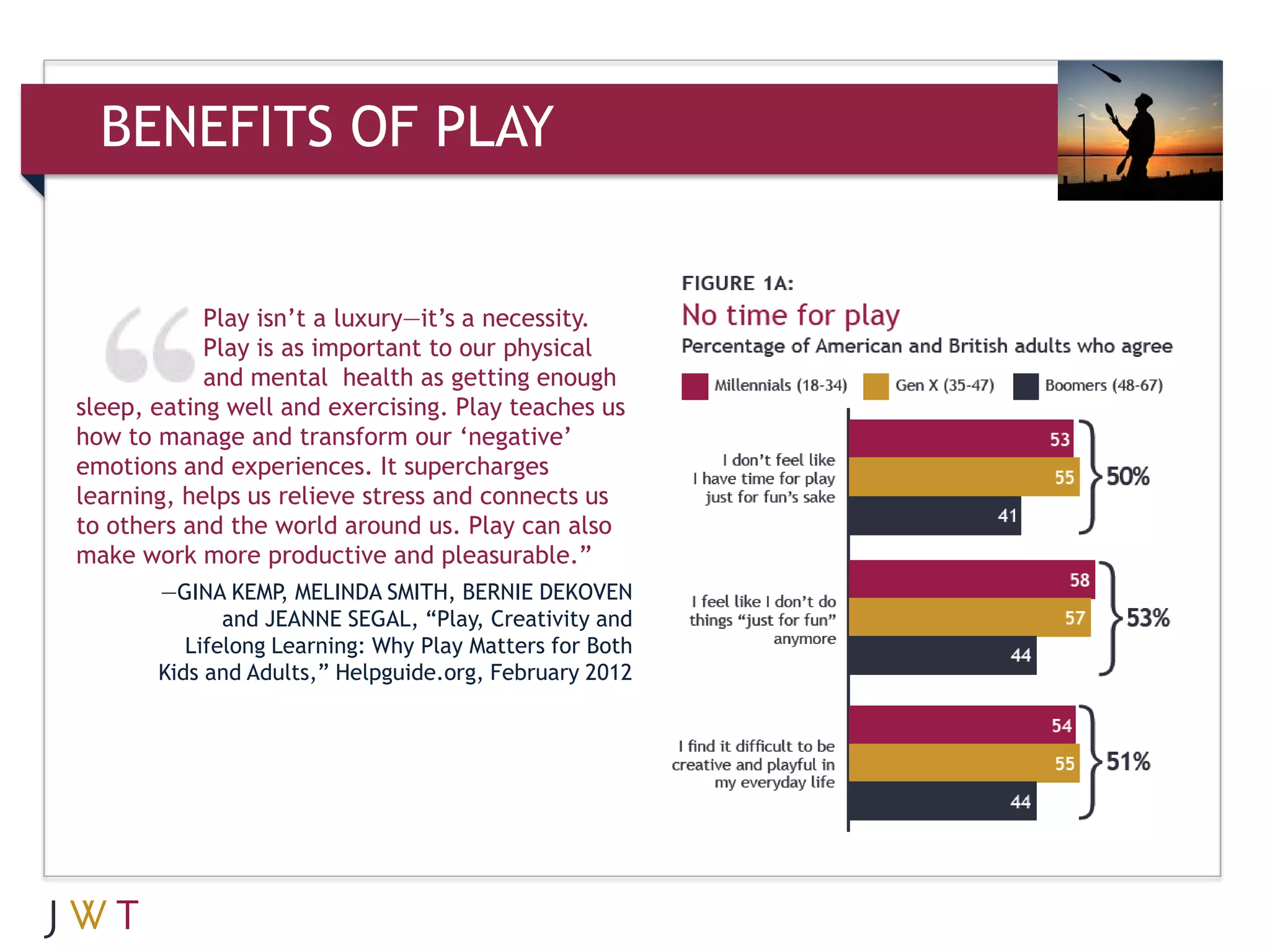
            Play isn’t a luxury—it’s a necessity.
            Play is as important to our physical
            and mental health as getting enough
sleep, eating well and exercising. Play teaches us
how to manage and transform our ‘negative’
emotions and experiences. It supercharges
learning, helps us relieve stress and connects us
to others and the world around us. Play can also
make work more productive and pleasurable.”
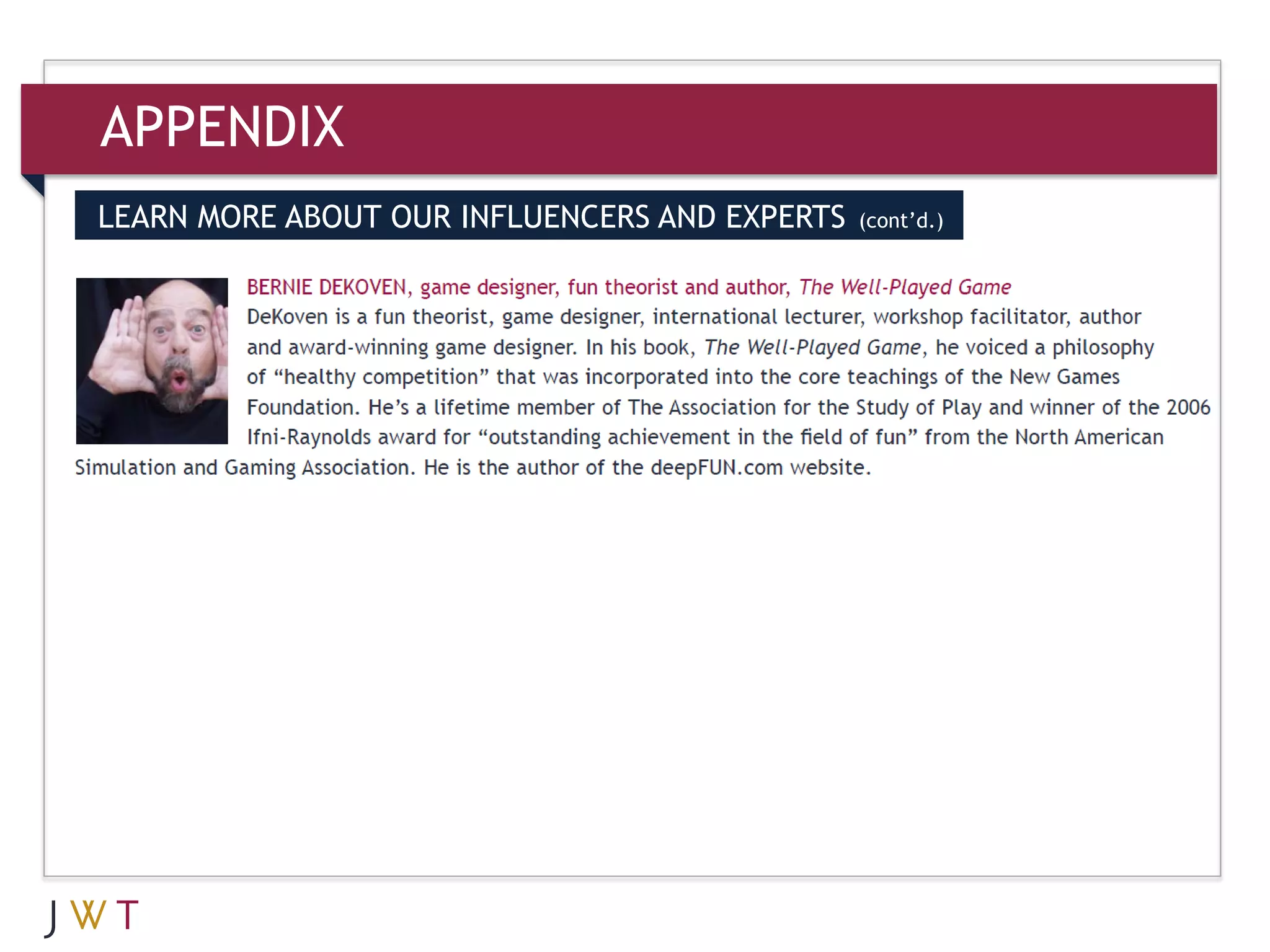
       —GINA KEMP, MELINDA SMITH, BERNIE DEKOVEN
              and JEANNE SEGAL, “Play, Creativity and
          Lifelong Learning: Why Play Matters for Both
       Kids and Adults,” Helpguide.org, February 2012
BENEFITS OF PLAY              (cont’d.)


                          There’s this certain confidence that
                          comes from unstructured play. It’s
                          like, ‘I don’t know what I’m doing.
                          It just feels good. I’m just
                          following this thing until it tells me
                          where it’s going.’ A lot of people
                          can’t deal with that because the
                          whole world tells you, when you go
       to kung fu lessons or violin practice or whatever you
       do, at the end of it you’re supposed to be better. And
       the whole thing about creative work is that you just
       don’t know what’s going to happen ’cause you can’t
       guarantee that you’re going to have a final product.”
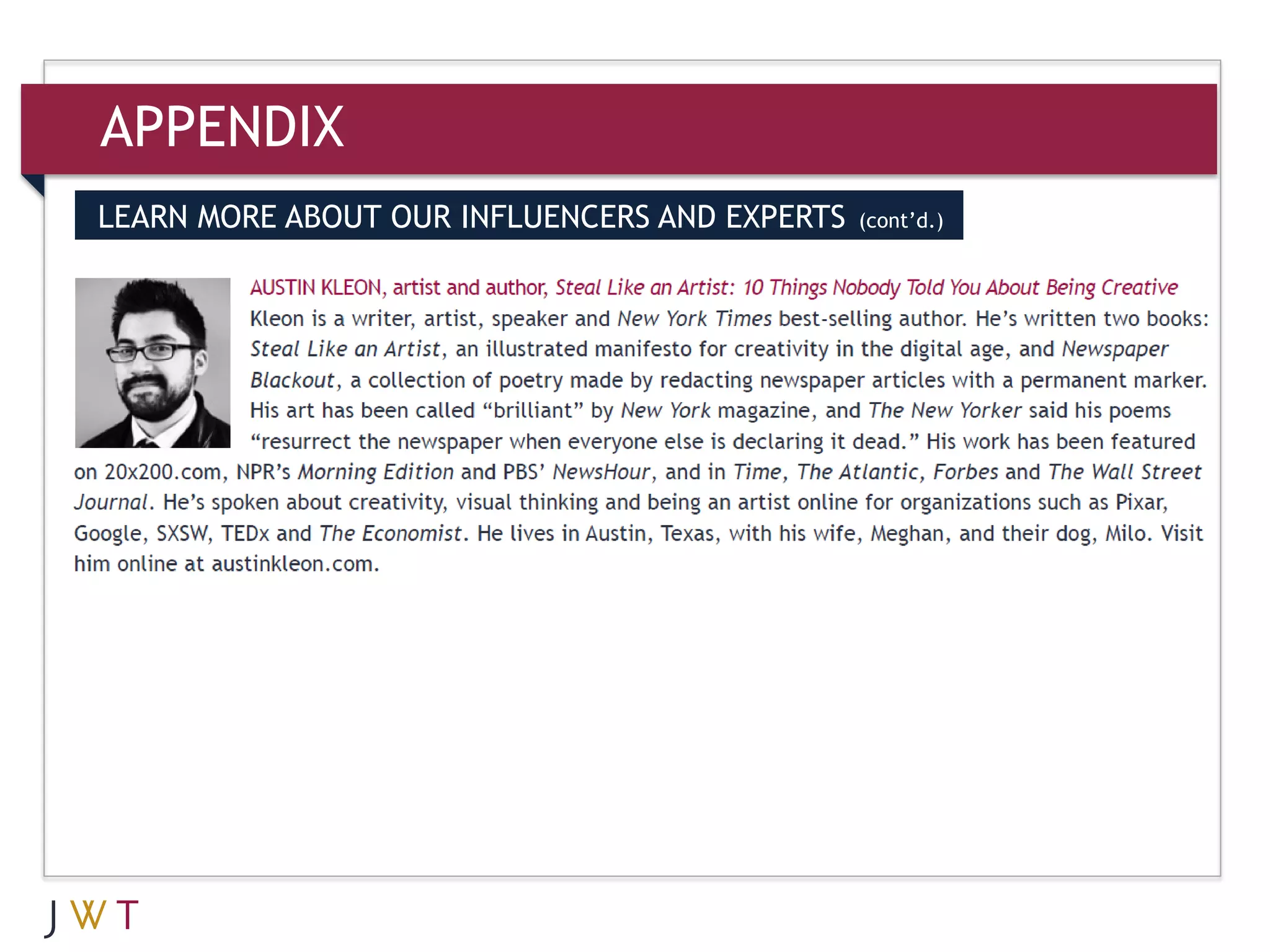
                    —AUSTIN KLEON, artist and author of Steal
                                               Like an Artist
BENEFITS OF PLAY                    (cont’d.)


         Look at life without play, and it’s
         not much of a life. If you think of
         all the things we do that are play-
         related and erase those, it’s pretty
         hard to keep going. [Without play,]
         there’s a sense of dullness,
         lassitude and pessimism, which
         doesn’t work well in the world
         we live.”
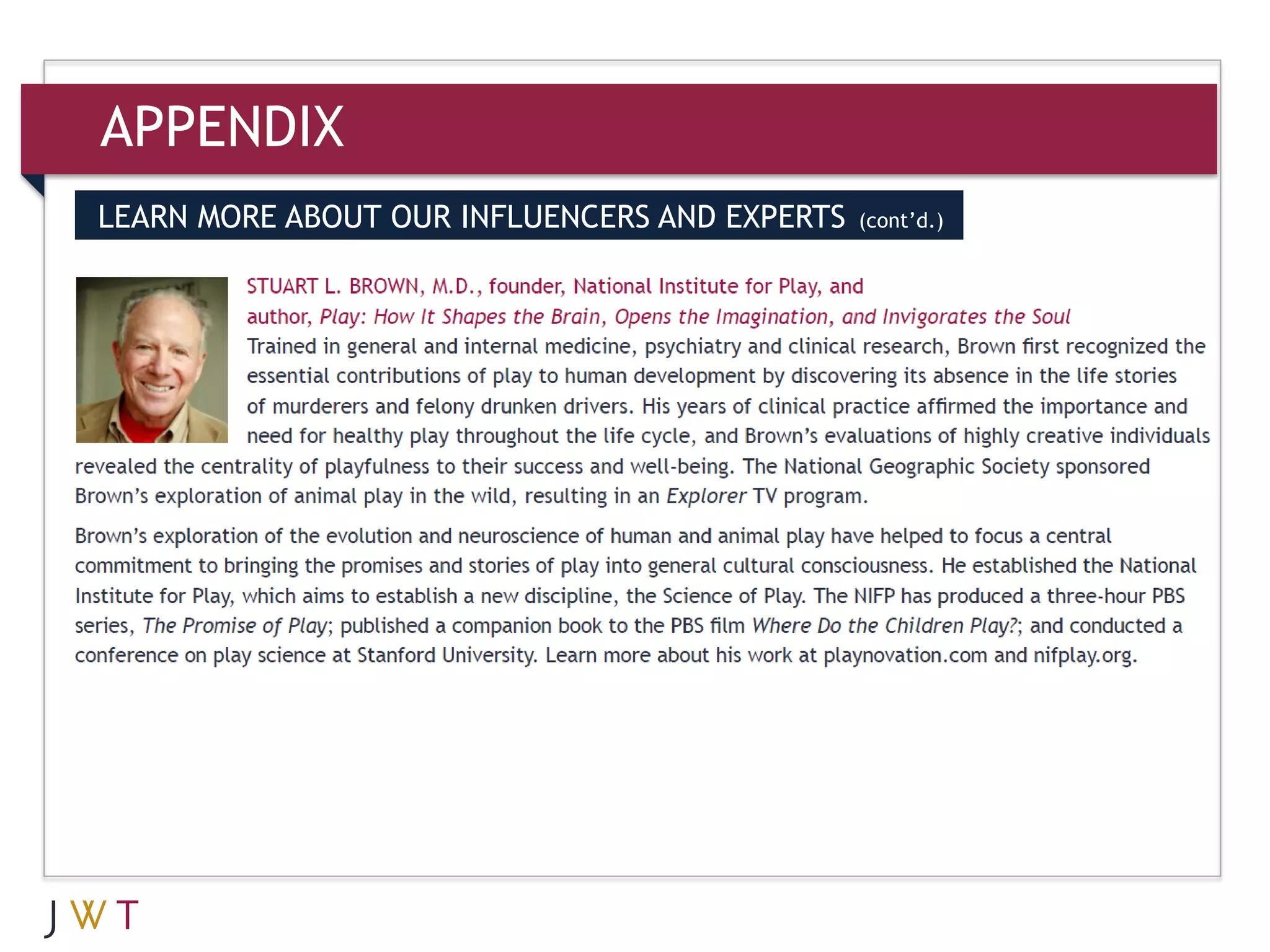
    —STUART BROWN, founder of the National
                         Institute for Play
BENEFITS OF PLAY                              (cont’d.)


                              PLAY IS WHAT THE DOCTOR ORDERED
                                       WORK BENEFITS
      • Triggers creativity and innovation                                   • Increases energy and
      • Keeps you functional under stress                                      helps prevent burnout
      • Refreshes your mind and body                                         • Makes you more happy,
      • Encourages teamwork                                                    flexible and resilient
      • Helps you see problems in new ways                                   • Increases productivity

              SOCIAL BENEFITS                                      EMOTIONAL/MENTAL BENEFITS
• Increases trust                                            • Brings happiness
• Strengthens group bonds                                    • Improves problem-solving skills
• Builds empathy                                             • Teaches perseverance
• Builds compassion                                          • Fights off burnout
• Generates capacity for intimacy                            • Provides clarity
• Builds more meaningful connections                         • Builds confidence
• Fosters cooperation and teamwork                           • Promotes serenity, calm and relaxation
• Teaches social skills through give and take                • Builds motivation
• Fights loneliness, isolation, anxiety and depression       • Fosters creativity
• Increases sense of community
• Brings joy, vitality and resilience to relationships
• Heals resentments and disagreements


                                                         Source: Gina Kemp, Melinda Smith, Bernie DeKoven and Jeanne Segal, “Play, Creativity and
                                                                Learning: Why Play Matters for Both Kids and Adults,” Helpguide.org, February 2012
BENEFITS OF PLAY                           (cont’d.)


             Through play, an individual
            avoids what [Patrick Bateson, a                          We’re living in a world that is
            Cambridge University biologist                           changing so quickly. Things that
and prominent play scholar] called the lure                          were the right answer are no
of ‘false endpoints,’ a problem-solving style                        longer necessarily the right answer.
more typical of harried adults than of playful                       And so we need to be able to
youngsters. False endpoints are avoided                              explore the possibilities and be
through play, Bateson wrote, because players                         open. If we can bring play more
are having so much fun they keep noodling                            into our adult lives, start moving
away at a problem and might well arrive at        our creativity into our adult lives, there are some
something better than the first, good-enough      great benefits to that.”
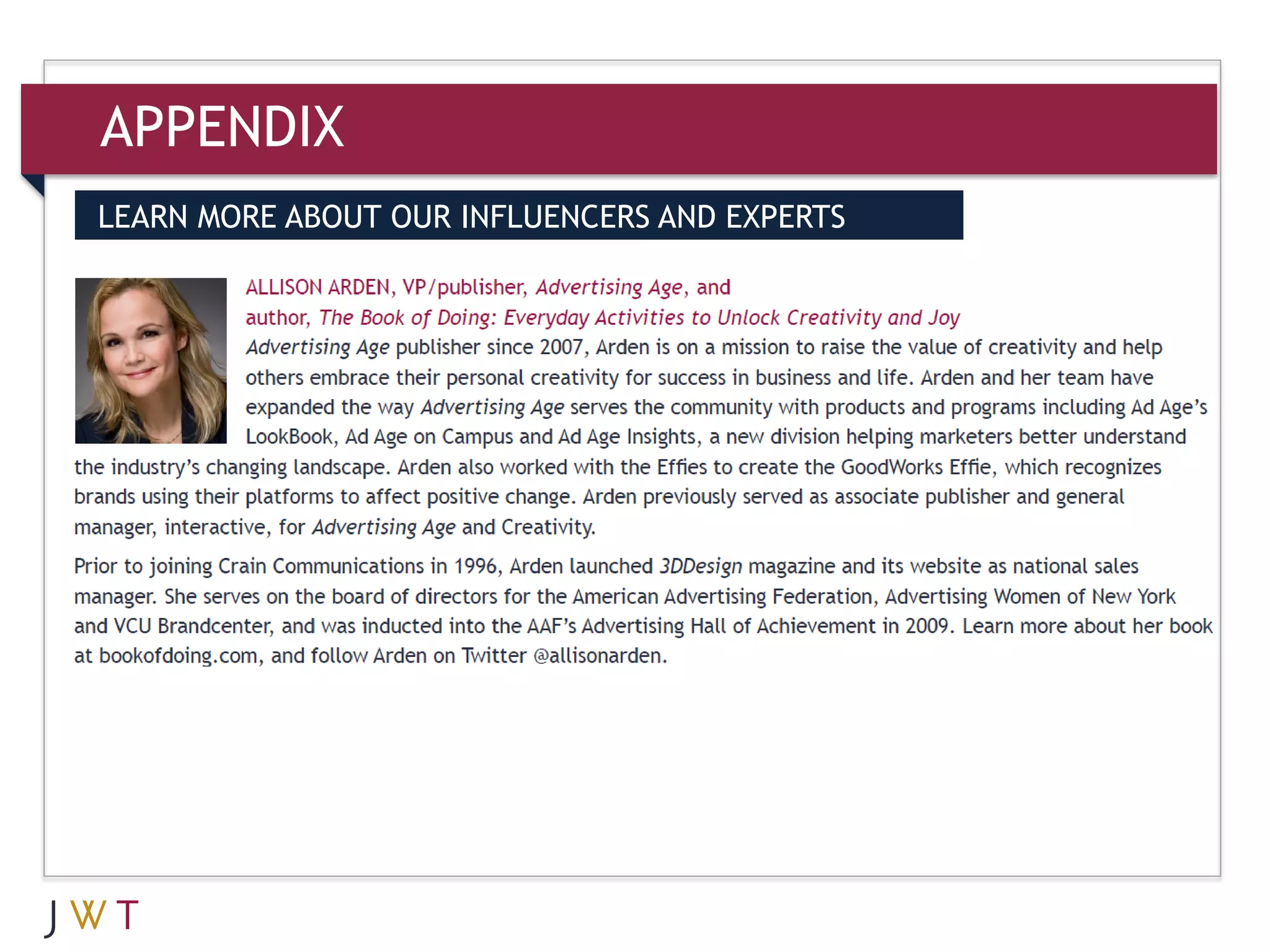
solution.”                                                 —ALLISON ARDEN, publisher of Advertising Age
                      —ROBIN MARANTZ HENIG,
                                                                       and author of The Book of Doing
                  “Taking Play Seriously,” The
                New York Times, Feb. 17, 2008
IMPEDIMENTS TO PLAY


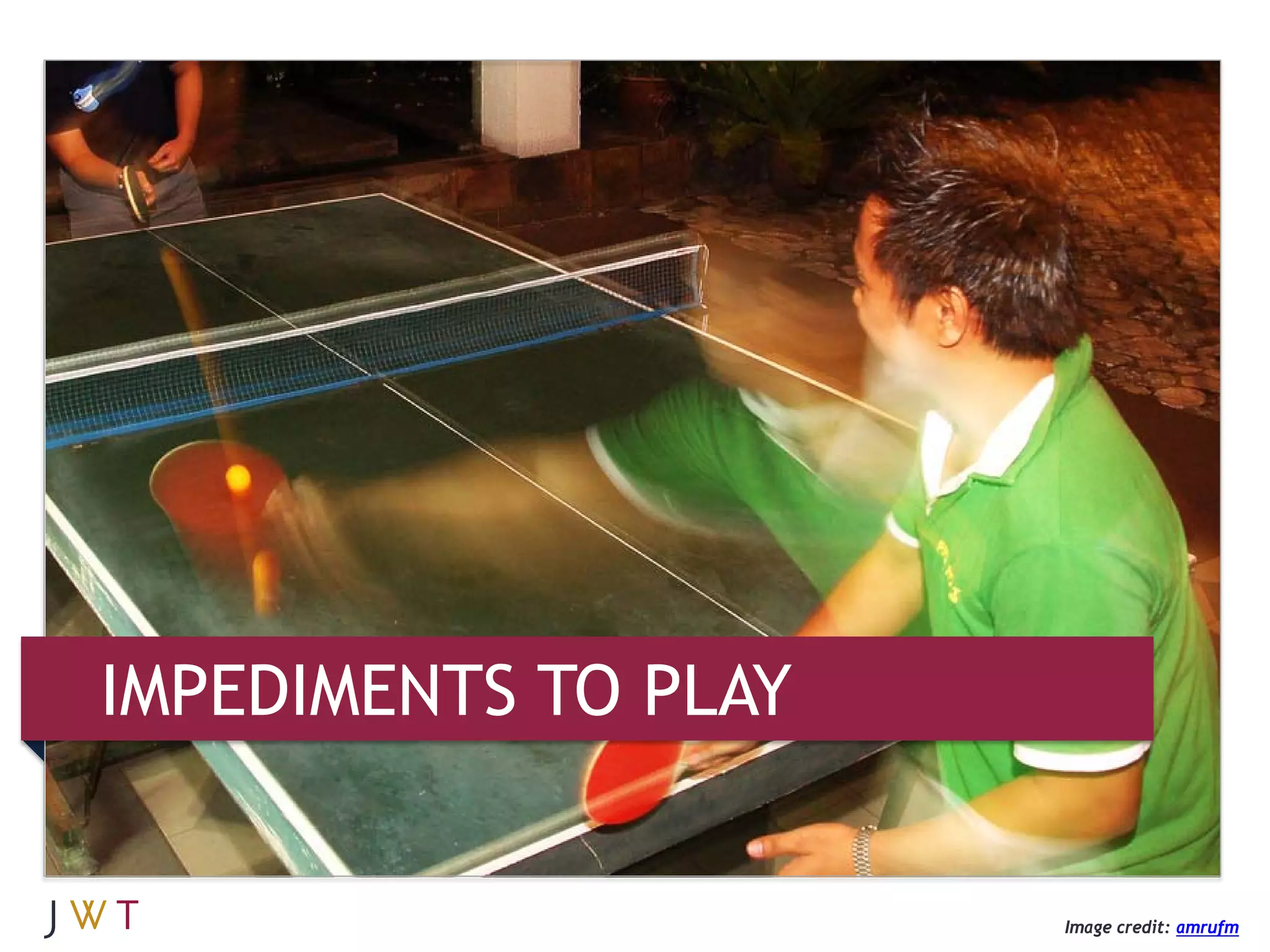
                      Image credit: amrufm
IMPEDIMENTS TO PLAY


                I think there is an assembly-line       [Our culture] is not really what I
                mentality that if you don’t keep        would call conducive to play, so
                the assembly line moving, if you        you’d have to make a conscious
                don’t keep having very specific         choice to have fun, and that’s
                guidelines as to work output, if        very hard. And oddly enough, it
                there isn’t a clock to punch,           takes a lot of discipline, because
                people aren’t going to get things       you have to give yourself
                done. And I think that wise             permission.”
management transcends that.”
            —STUART BROWN, founder of the National    —BERNIE DEKOVEN, game designer, fun
                                 Institute for Play                   theorist and author
IMPEDIMENTS TO PLAY                (cont’d.)


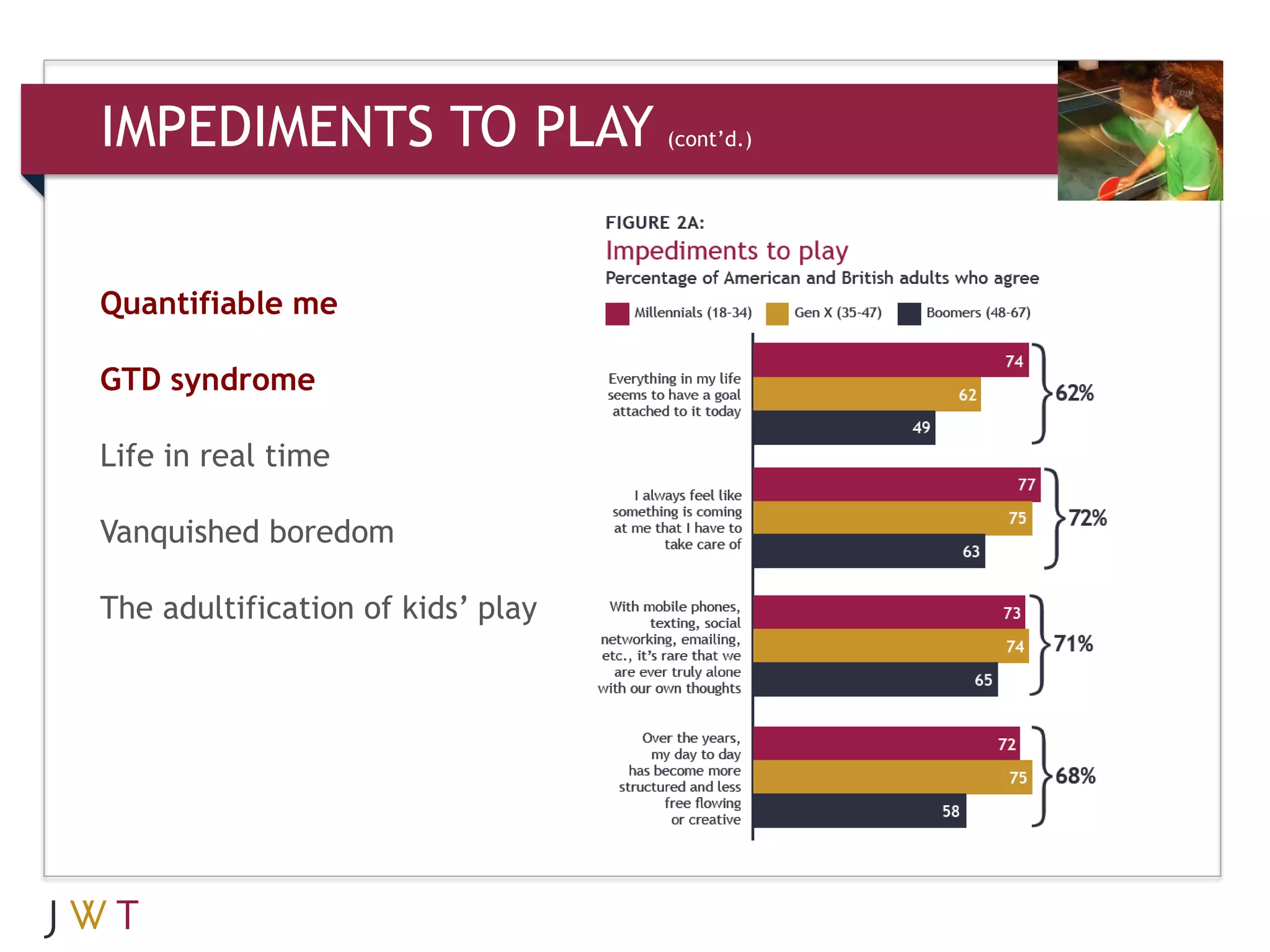
Quantifiable me

GTD syndrome

Life in real time

Vanquished boredom

The adultification of kids’ play
IMPEDIMENTS TO PLAY                   (cont’d.)


                                               The question that drives
Quantifiable me                                [Millennials’] work is ‘What do I
                                               need to respond to?’ rather than
GTD syndrome                       ‘What should I create today?’ They swat
                                   emails that fly at them, sit in meetings that
                                   they unthinkingly agreed to two months
Life in real time                  earlier, take phone calls seeking their
                                   approval or advice. But they don’t build.
Vanquished boredom                 They don’t sit and think.”
                                                  —PRIYA PARKER, founder of visioning
                                                       and strategy firm Thrive Labs,
The adultification of kids’ play                               CNN.com, March 2012
IMPEDIMENTS TO PLAY                (cont’d.)


Quantifiable me

GTD syndrome

Life in real time

Vanquished boredom

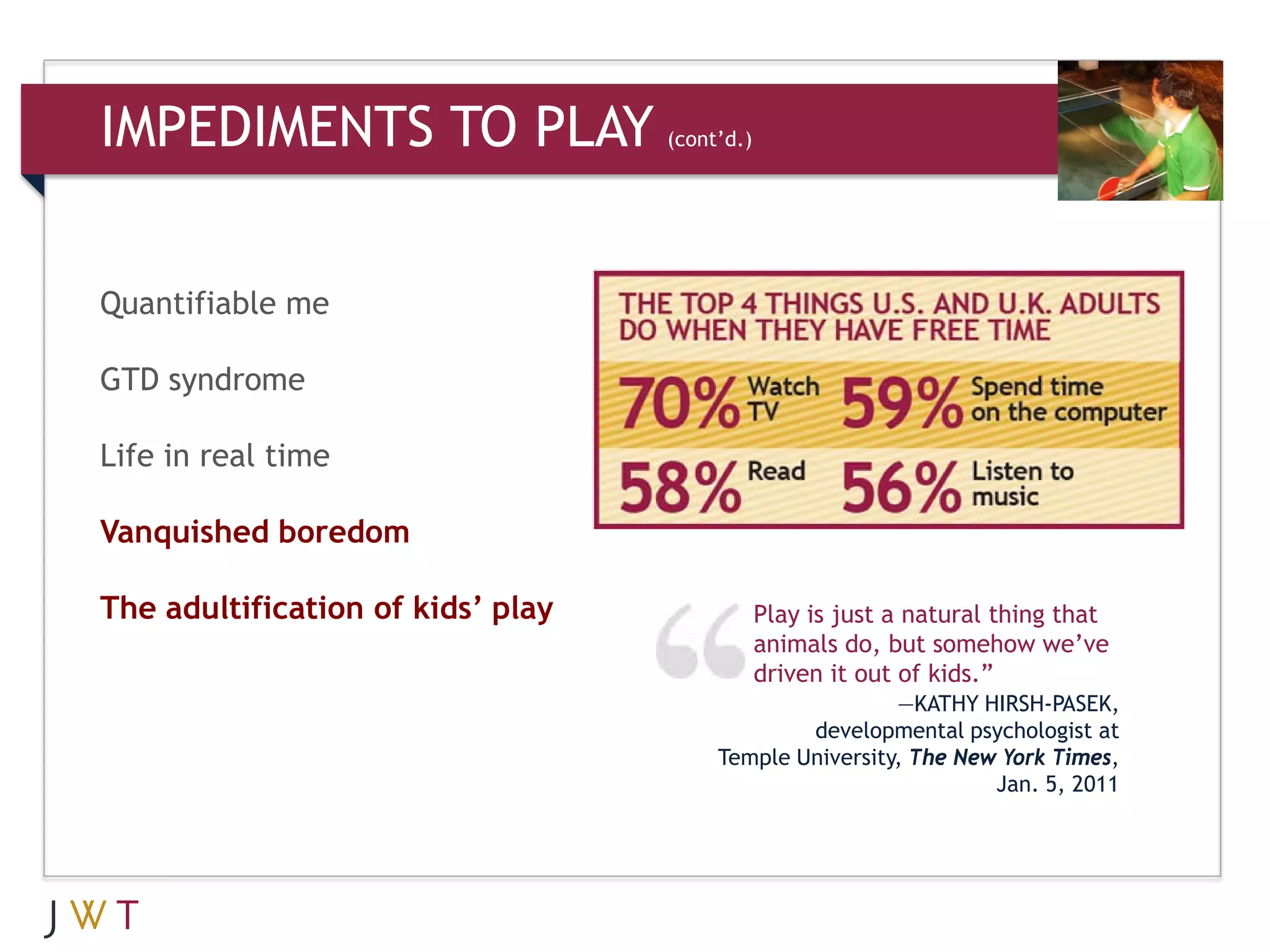
The adultification of kids’ play               Play is just a natural thing that
                                               animals do, but somehow we’ve
                                               driven it out of kids.”
                                                         —KATHY HIRSH-PASEK,
                                                developmental psychologist at
                                        Temple University, The New York Times,
                                                                  Jan. 5, 2011
IMPEDIMENTS TO PLAY                (cont’d.)


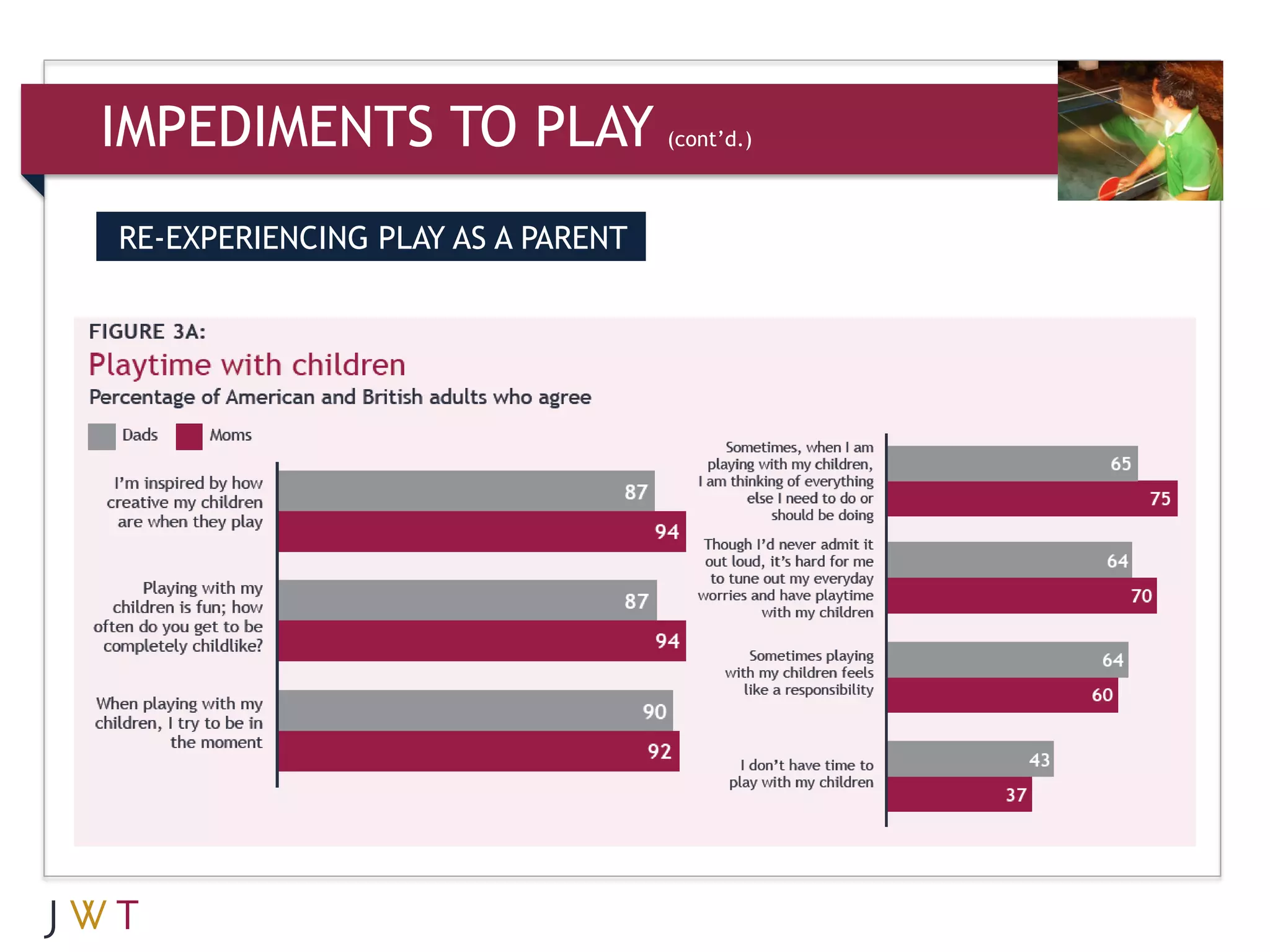
RE-EXPERIENCING PLAY AS A PARENT
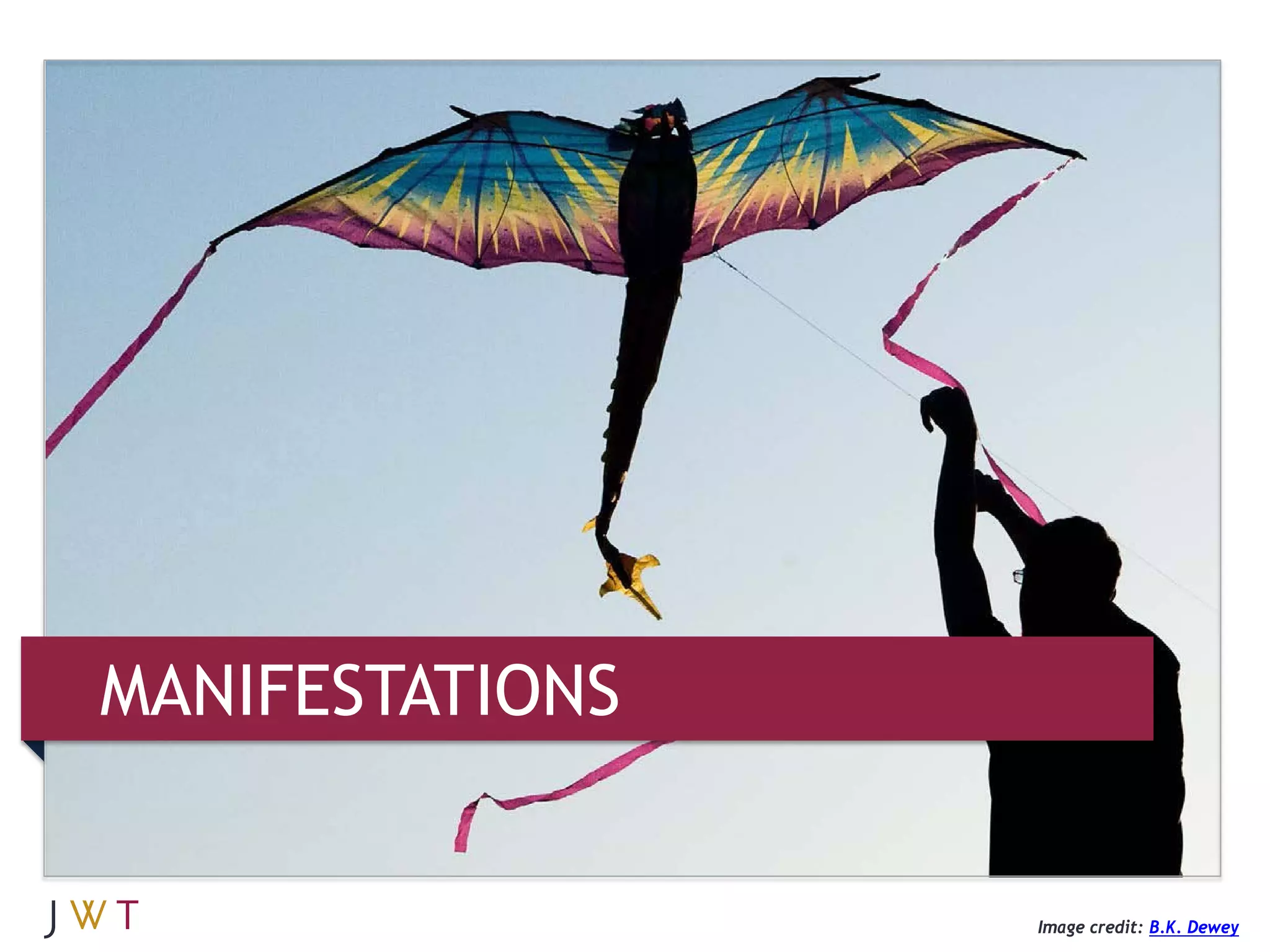
MANIFESTATIONS


                 Image credit: B.K. Dewey
MANIFESTATIONS
 PLAY IN THE BUSINESS MODEL

Recognizing the benefits of play, some high-profile companies inject play
into their employees’ lives, beyond simply outfitting workplaces with
basketball courts or pool tables.
MANIFESTATIONS            (cont’d.)


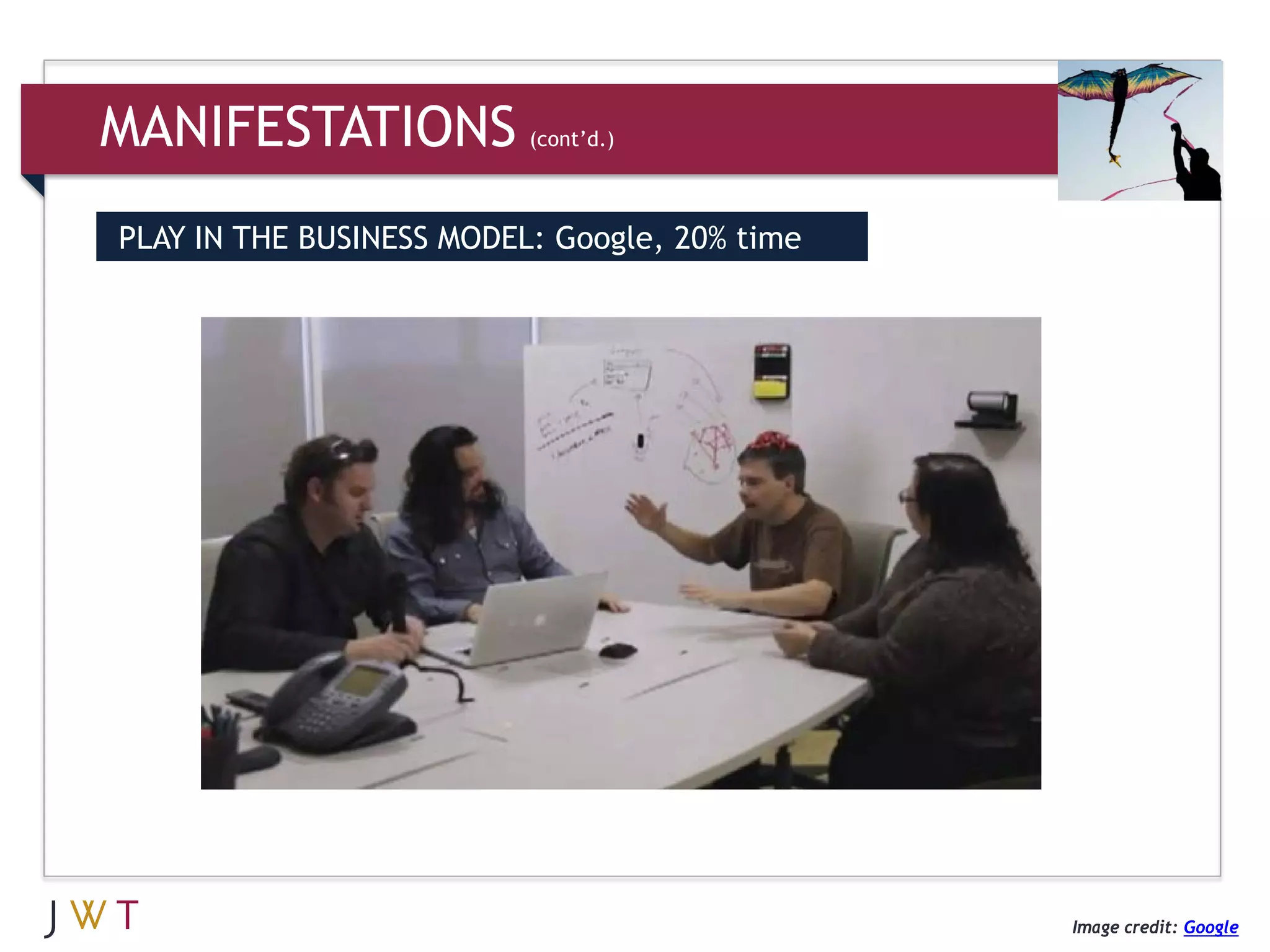
PLAY IN THE BUSINESS MODEL: Google, 20% time


                                               Image credit: Google
MANIFESTATIONS            (cont’d.)


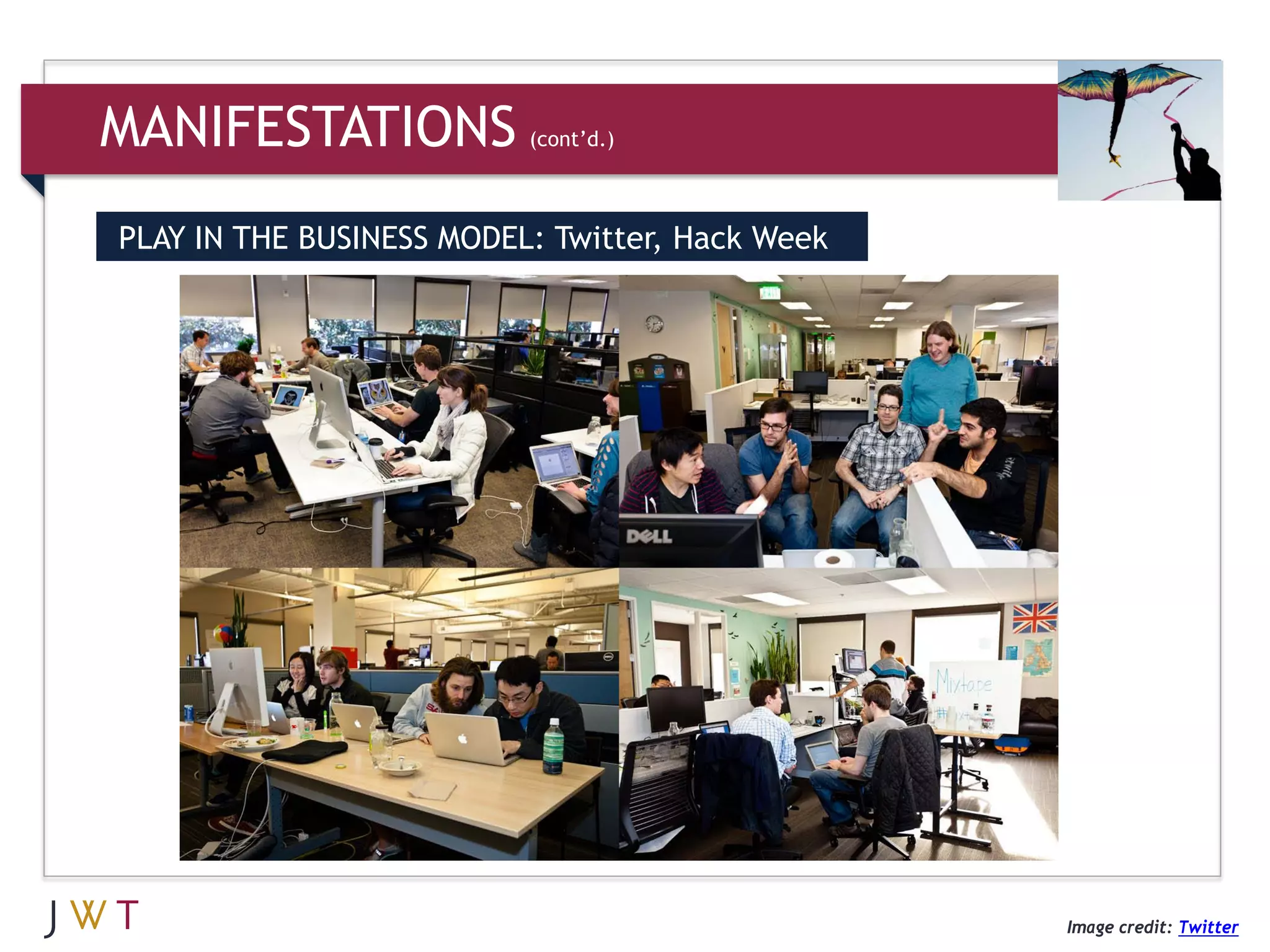
PLAY IN THE BUSINESS MODEL: Twitter, Hack Week


                                                 Image credit: Twitter
MANIFESTATIONS            (cont’d.)


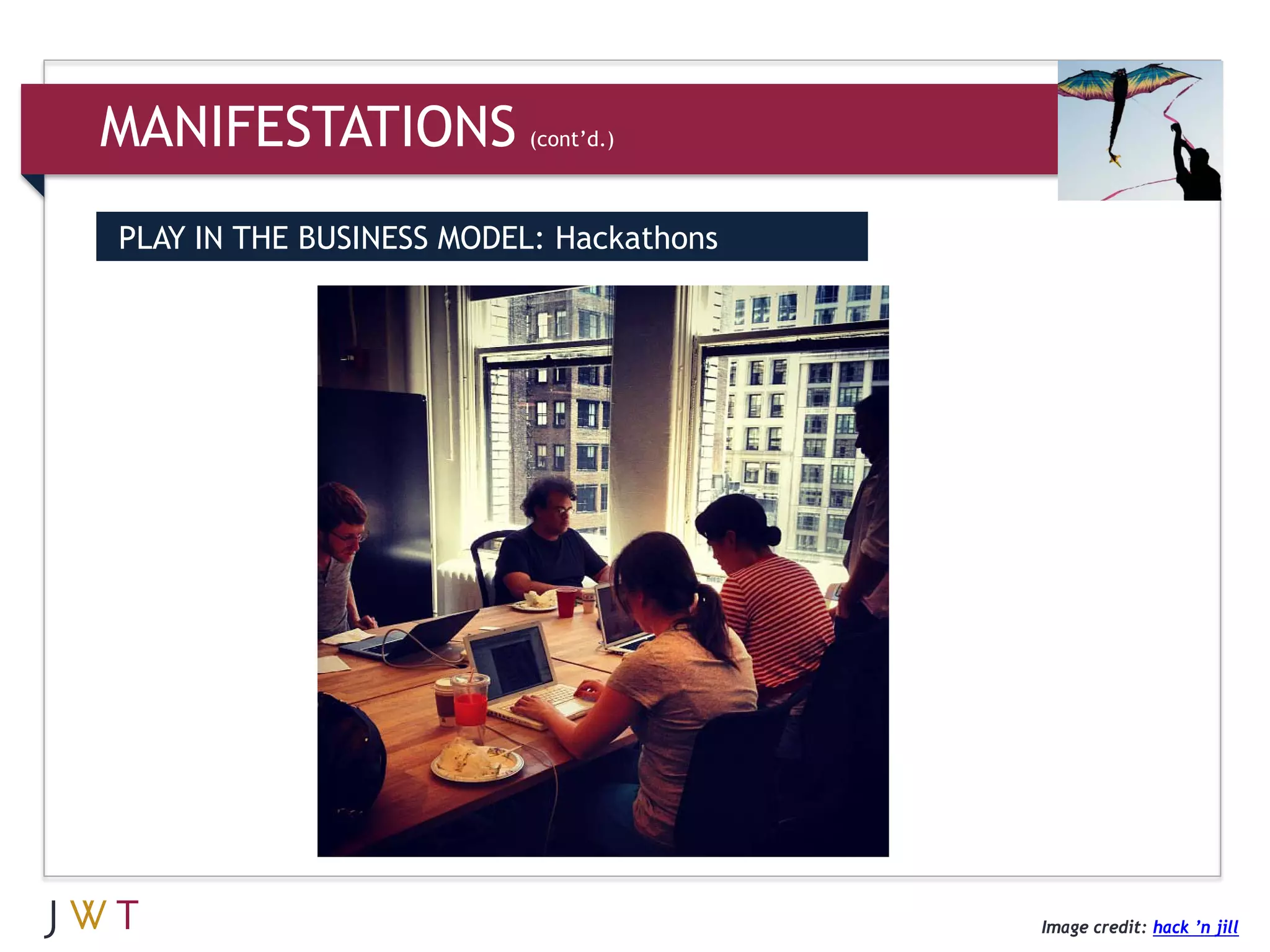
PLAY IN THE BUSINESS MODEL: Hackathons


                                         Image credit: hack ’n jill
MANIFESTATIONS            (cont’d.)


PLAY IN THE BUSINESS MODEL: Pixar


                                      Image credits: Marcin Wichary; Pixar
MANIFESTATIONS            (cont’d.)


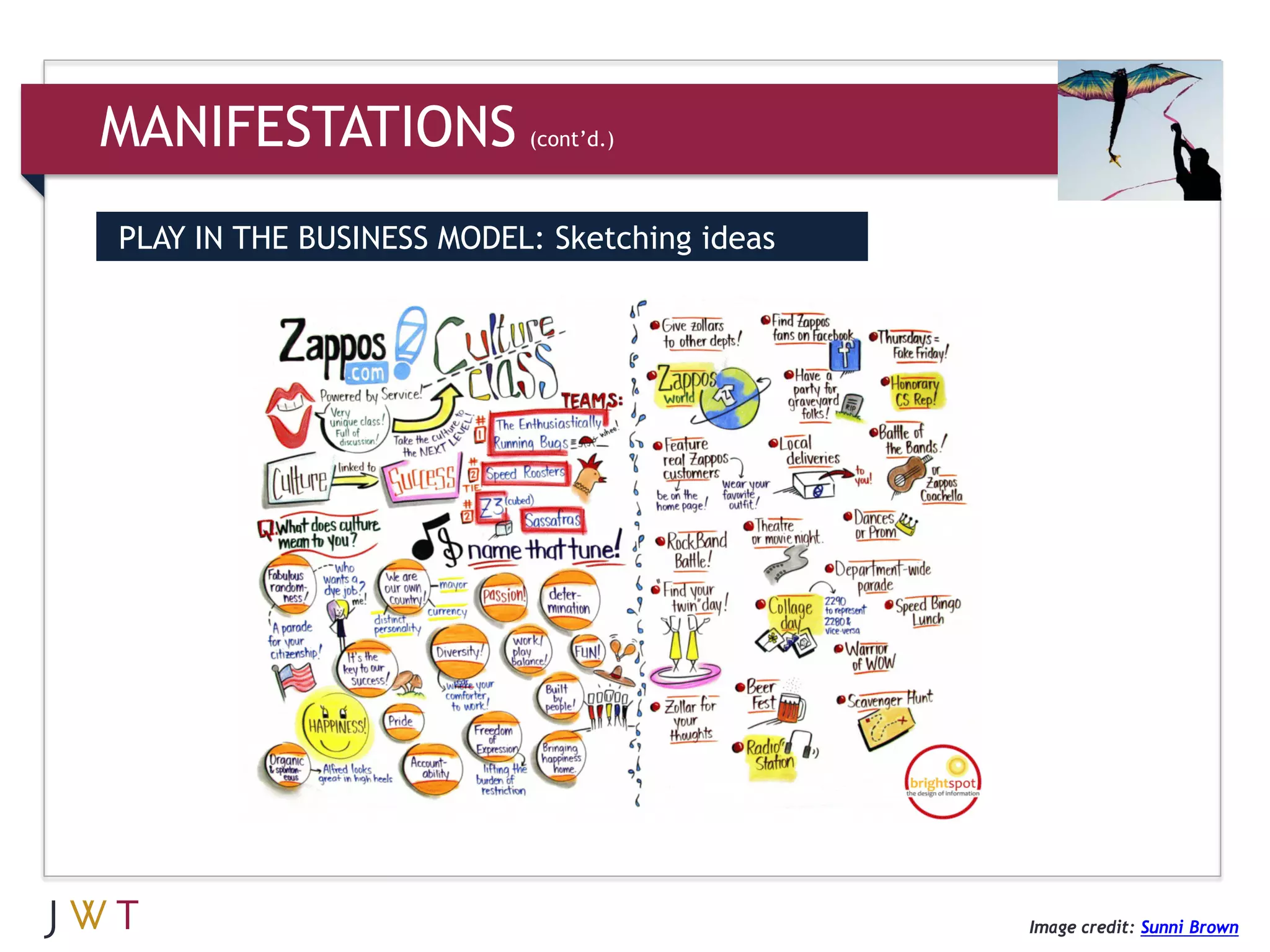
PLAY IN THE BUSINESS MODEL: Sketching ideas


                                              Image credit: Sunni Brown
MANIFESTATIONS               (cont’d.)


 MARKETERS ADVOCATING FOR PLAY

While brands often want to be associated with lightheartedness and fun, a
number of recent marketing campaigns have specifically depicted adults
putting some play back into their lives.
MANIFESTATIONS           (cont’d.)


MARKETERS ADVOCATING FOR PLAY: Kit Kat, “Crane” and Chunky 3 campaign


                                                        Image credits: Kit Kat [1],[2]
MANIFESTATIONS           (cont’d.)


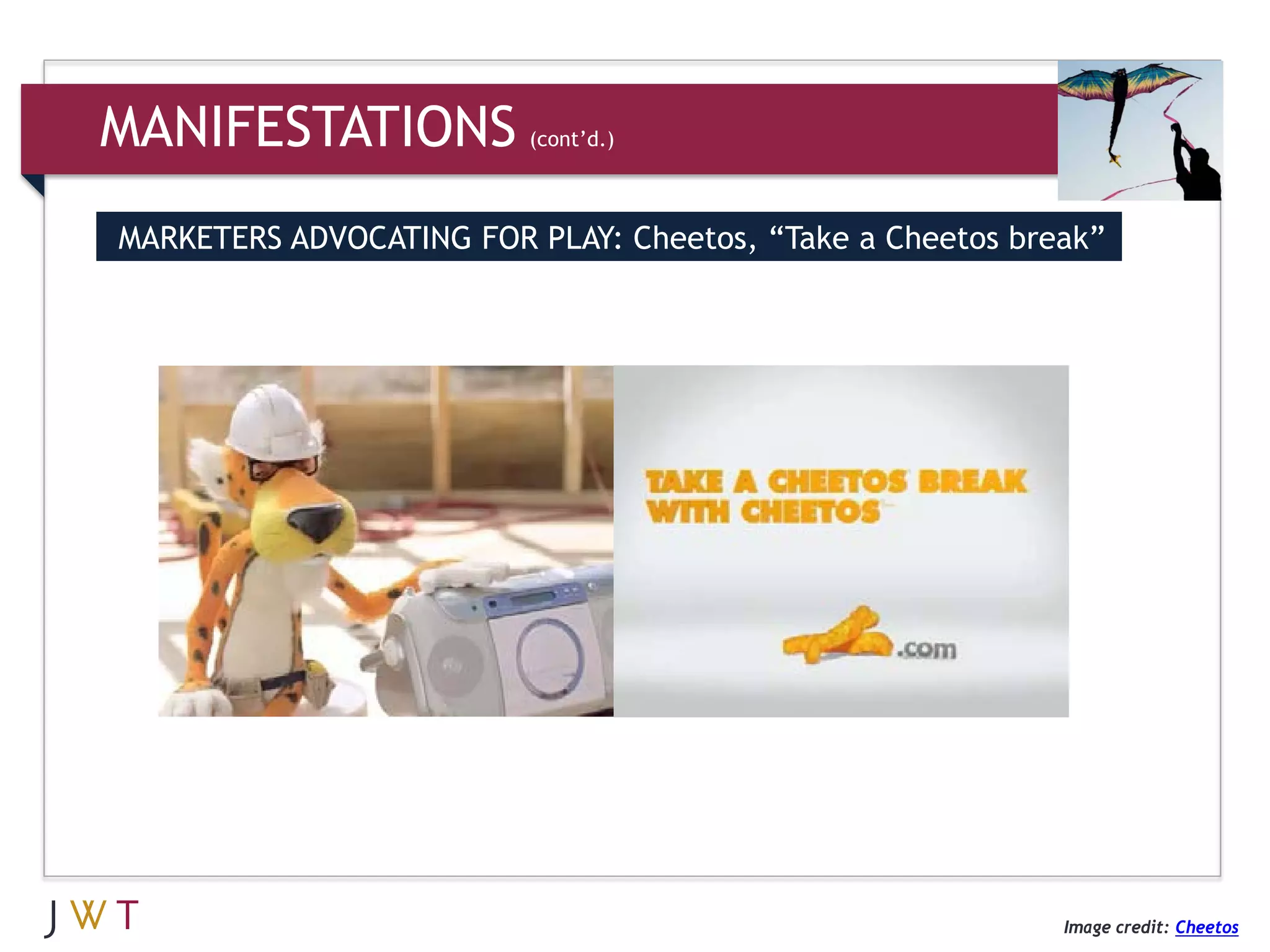
MARKETERS ADVOCATING FOR PLAY: Cheetos, “Take a Cheetos break”


                                                           Image credit: Cheetos
MANIFESTATIONS           (cont’d.)


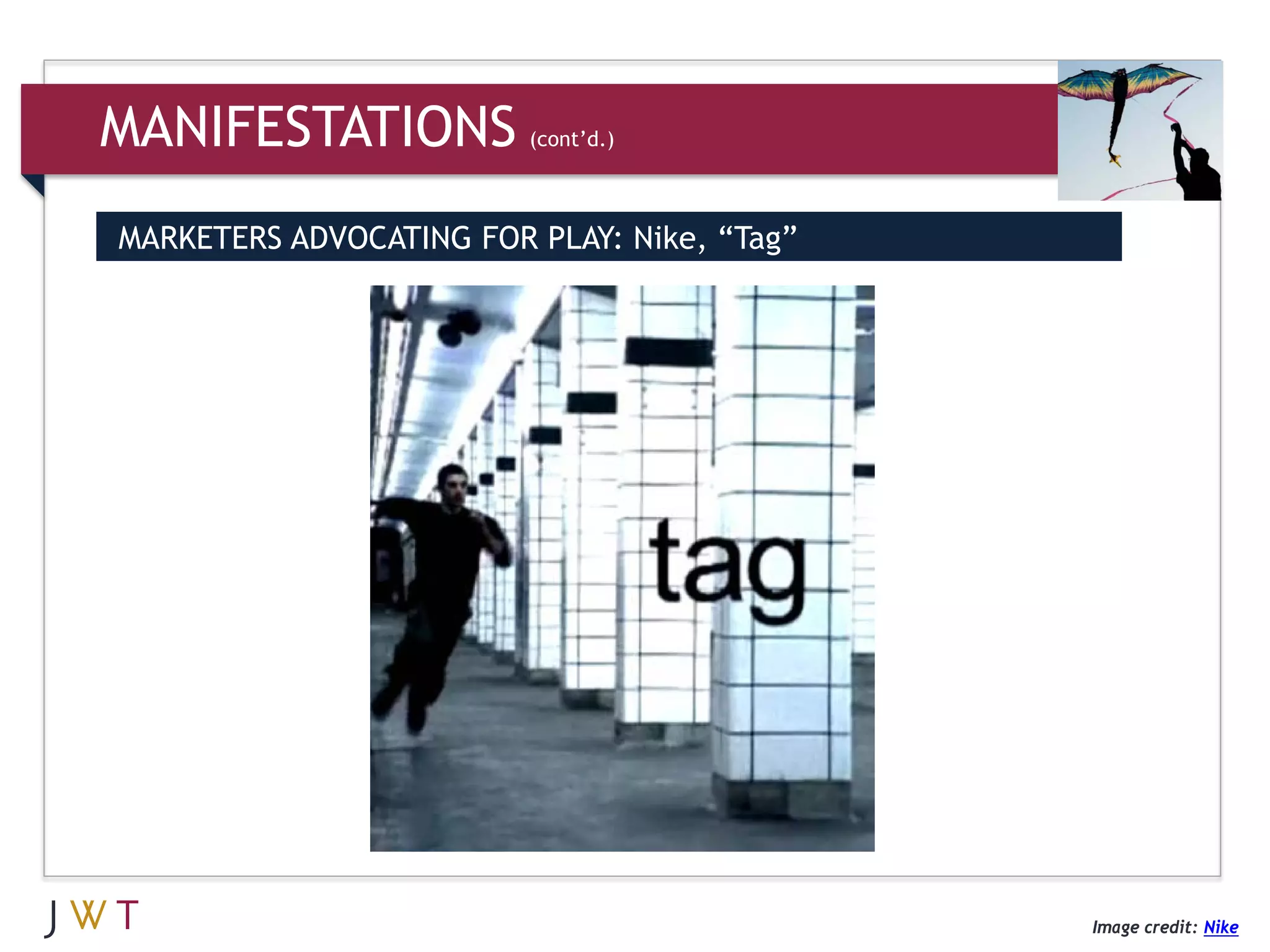
MARKETERS ADVOCATING FOR PLAY: Nike, “Tag”


                                             Image credit: Nike
MANIFESTATIONS           (cont’d.)


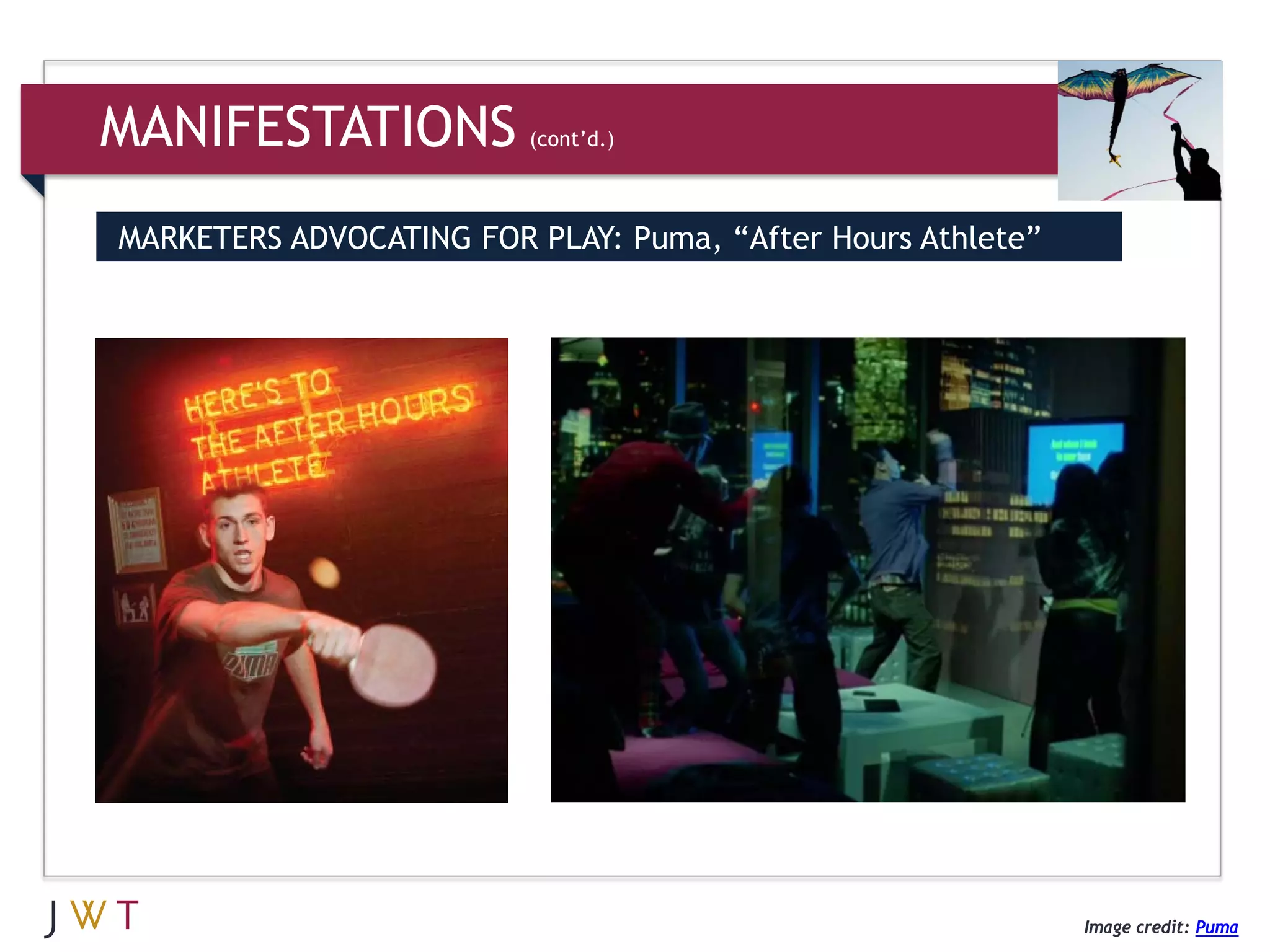
MARKETERS ADVOCATING FOR PLAY: Puma, “After Hours Athlete”


                                                             Image credit: Puma
MANIFESTATIONS            (cont’d.)


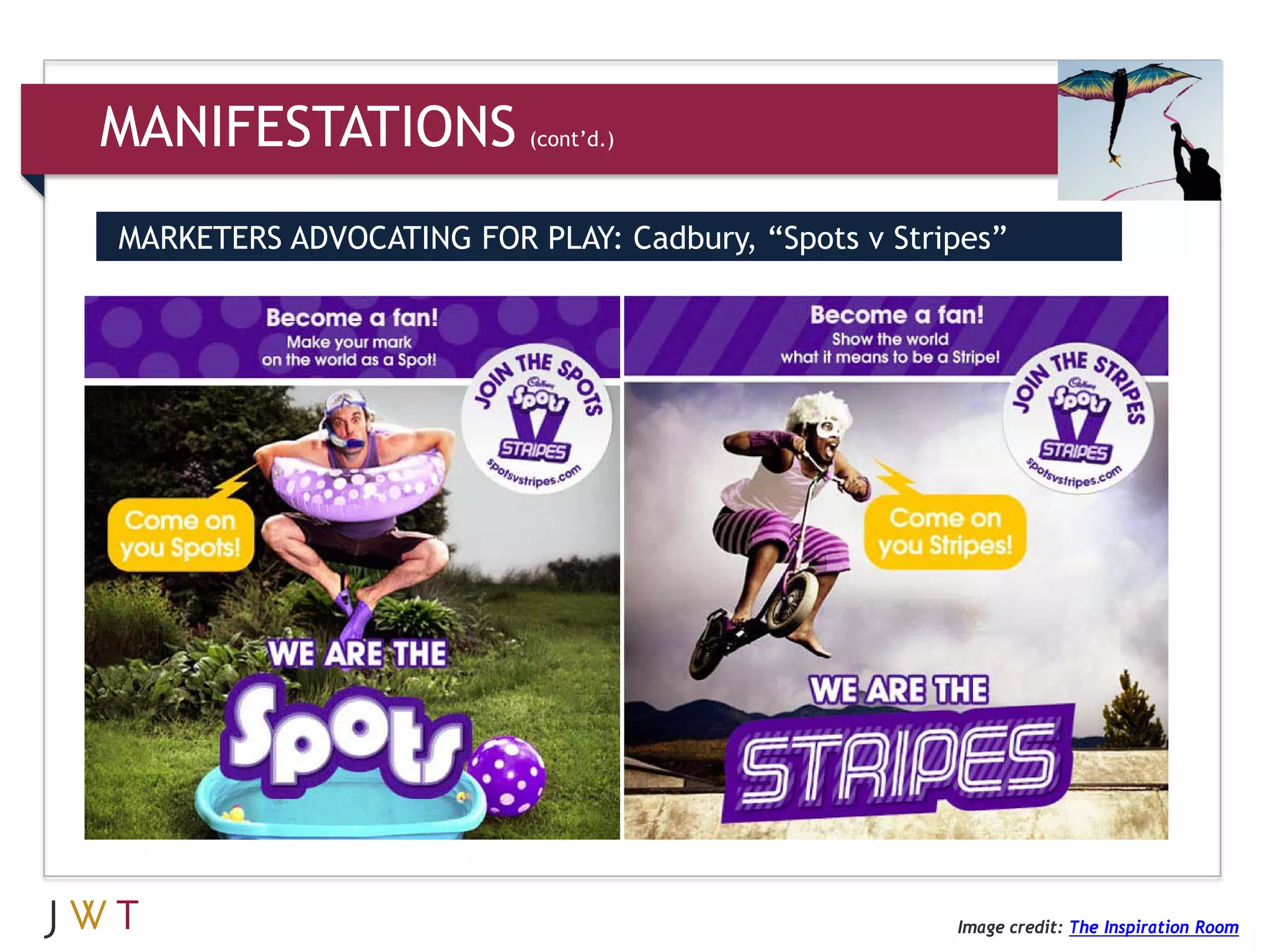
MARKETERS ADVOCATING FOR PLAY: Cadbury, “Spots v Stripes”


                                                     Image credit: The Inspiration Room
MANIFESTATIONS           (cont’d.)


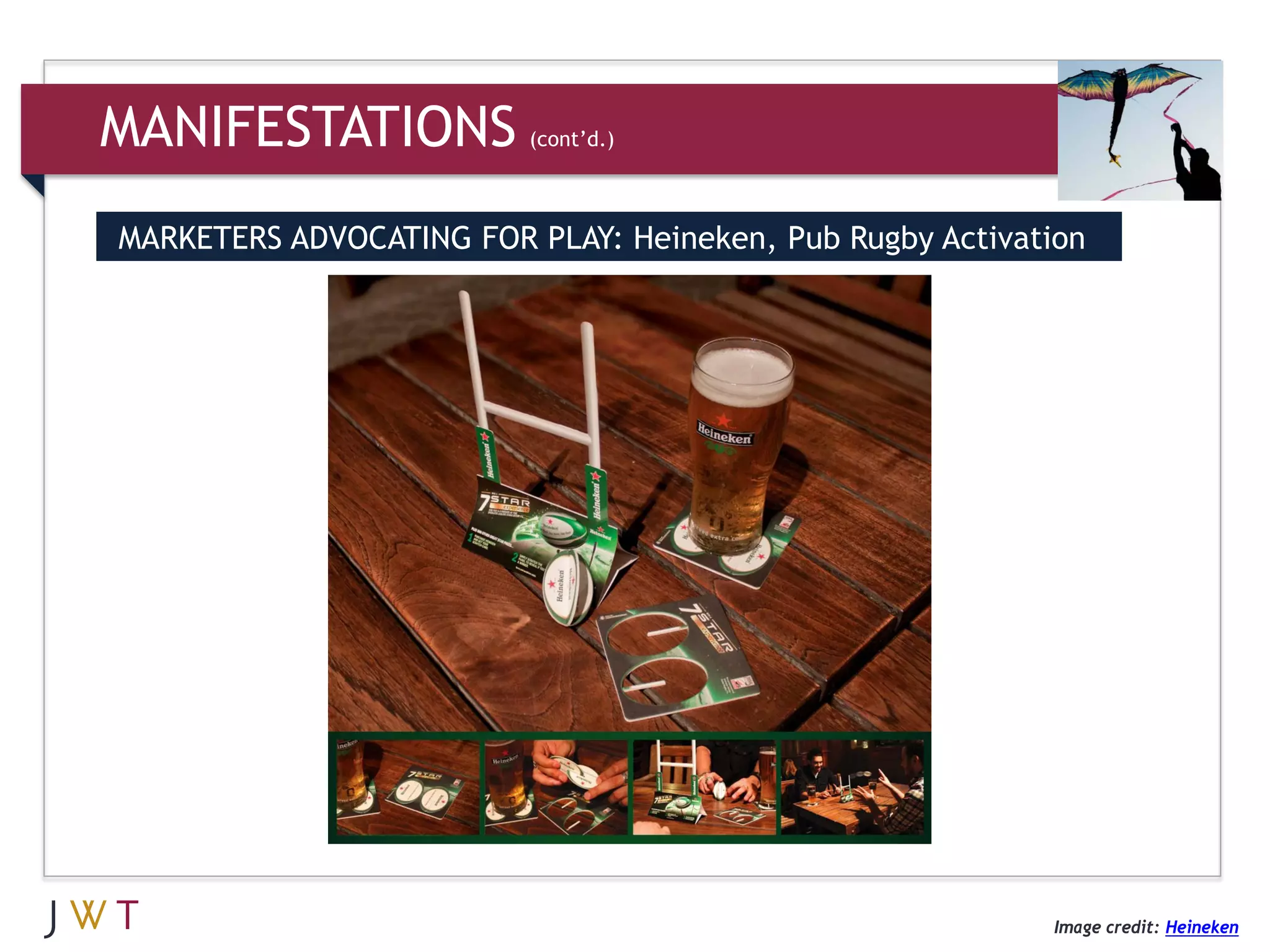
MARKETERS ADVOCATING FOR PLAY: Heineken, Pub Rugby Activation


                                                          Image credit: Heineken
MANIFESTATIONS           (cont’d.)


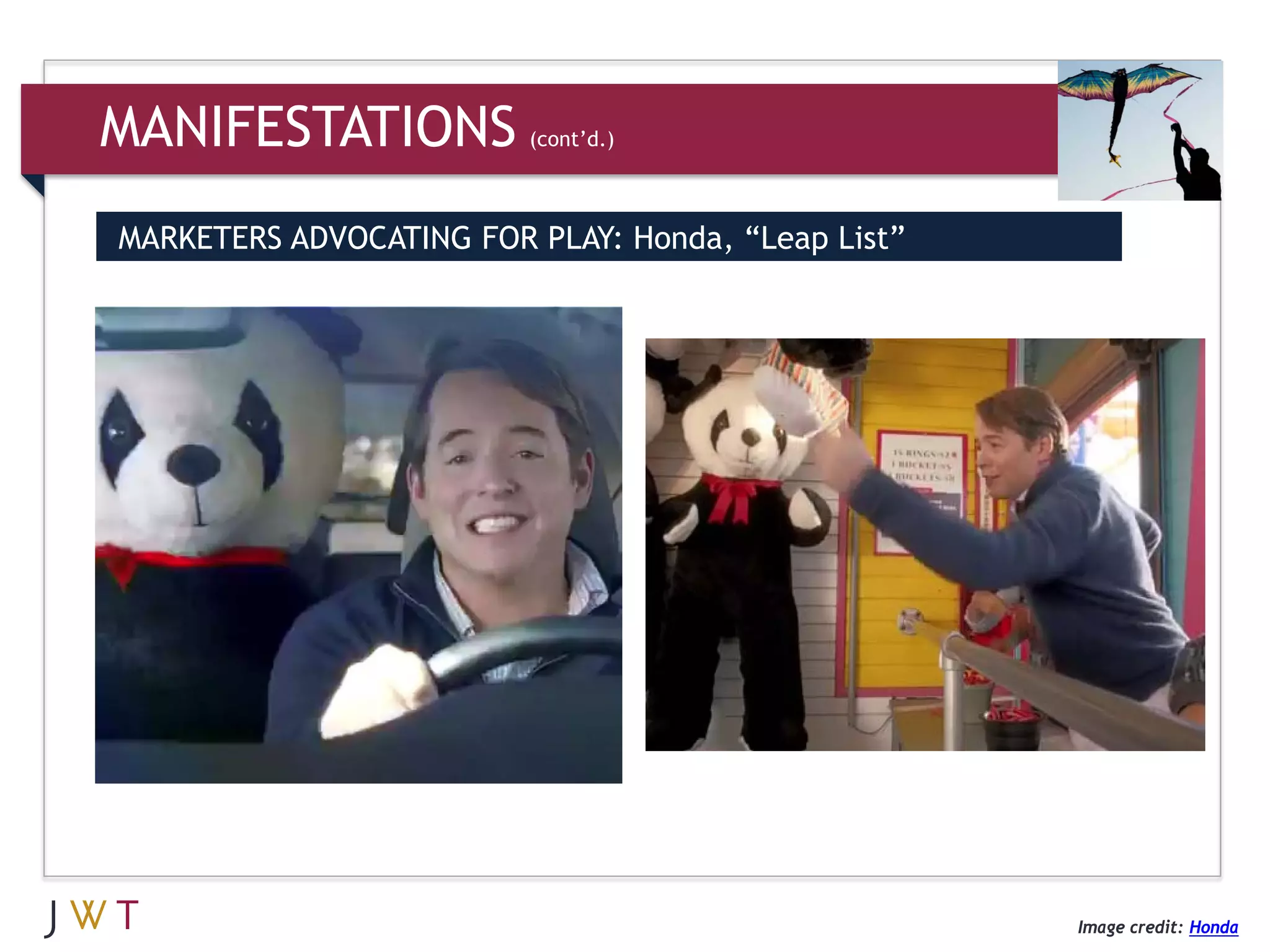
MARKETERS ADVOCATING FOR PLAY: Honda, “Leap List”


                                                    Image credit: Honda
MANIFESTATIONS            (cont’d.)


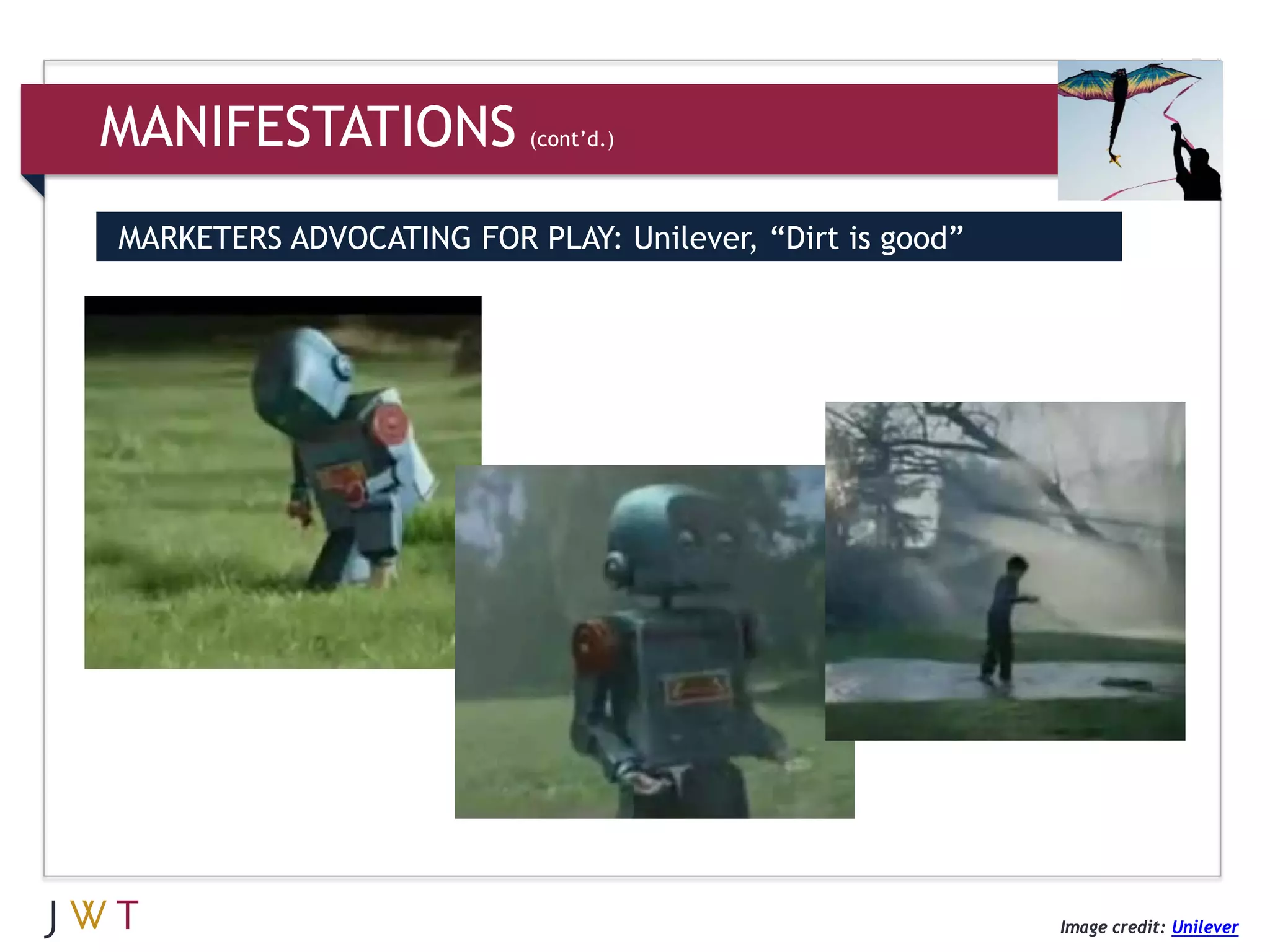
MARKETERS ADVOCATING FOR PLAY: Unilever, “Dirt is good”


                                                          Image credit: Unilever
MANIFESTATIONS                (cont’d.)


 PLAY IN CULTURE

The concept that play is important for adults can be found in books,
research and real-life examples that are all helping to inspire people.
MANIFESTATIONS              (cont’d.)


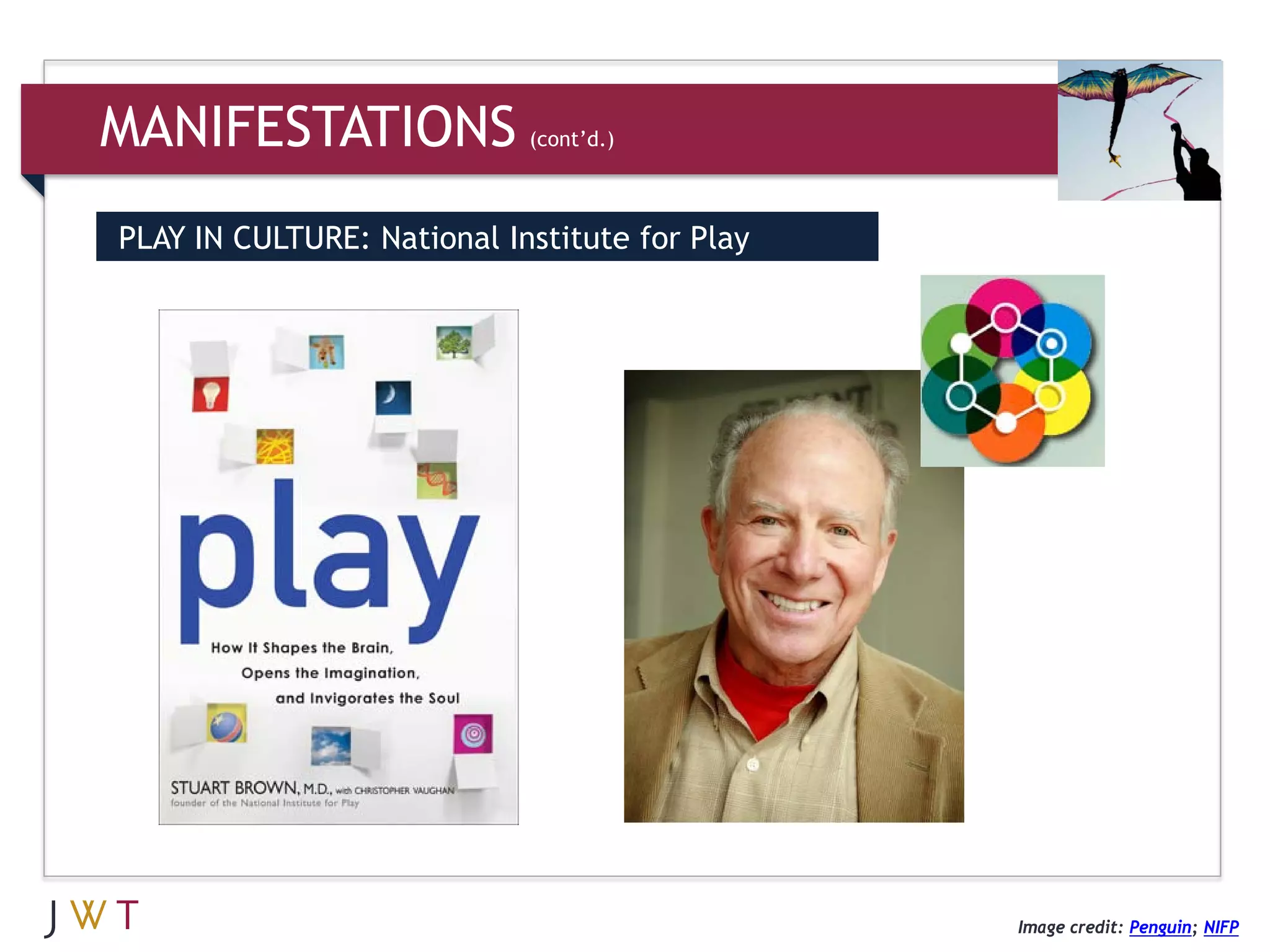
PLAY IN CULTURE: National Institute for Play


                                               Image credit: Penguin; NIFP
MANIFESTATIONS              (cont’d.)


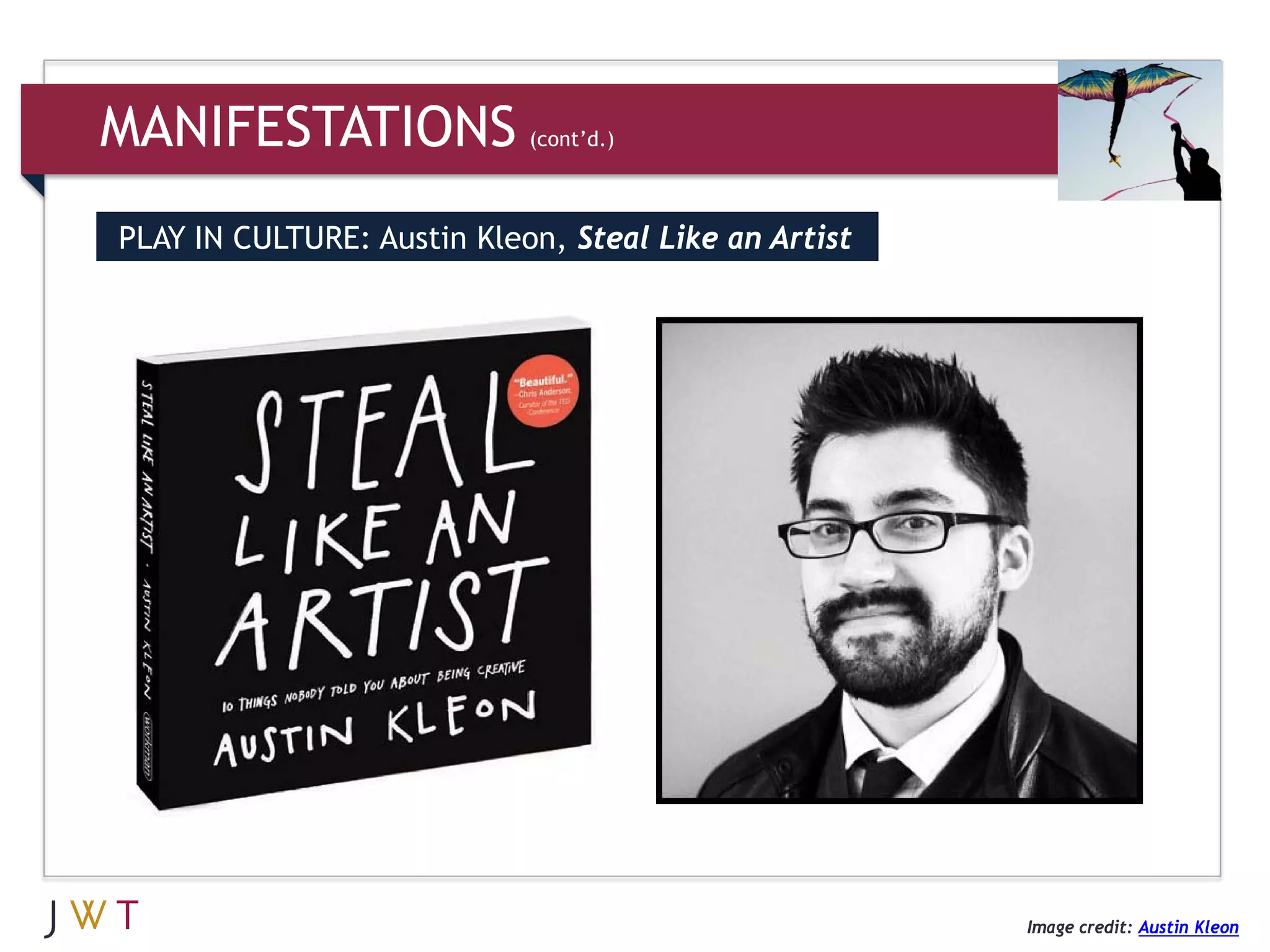
PLAY IN CULTURE: Austin Kleon, Steal Like an Artist


                                                      Image credit: Austin Kleon
MANIFESTATIONS             (cont’d.)


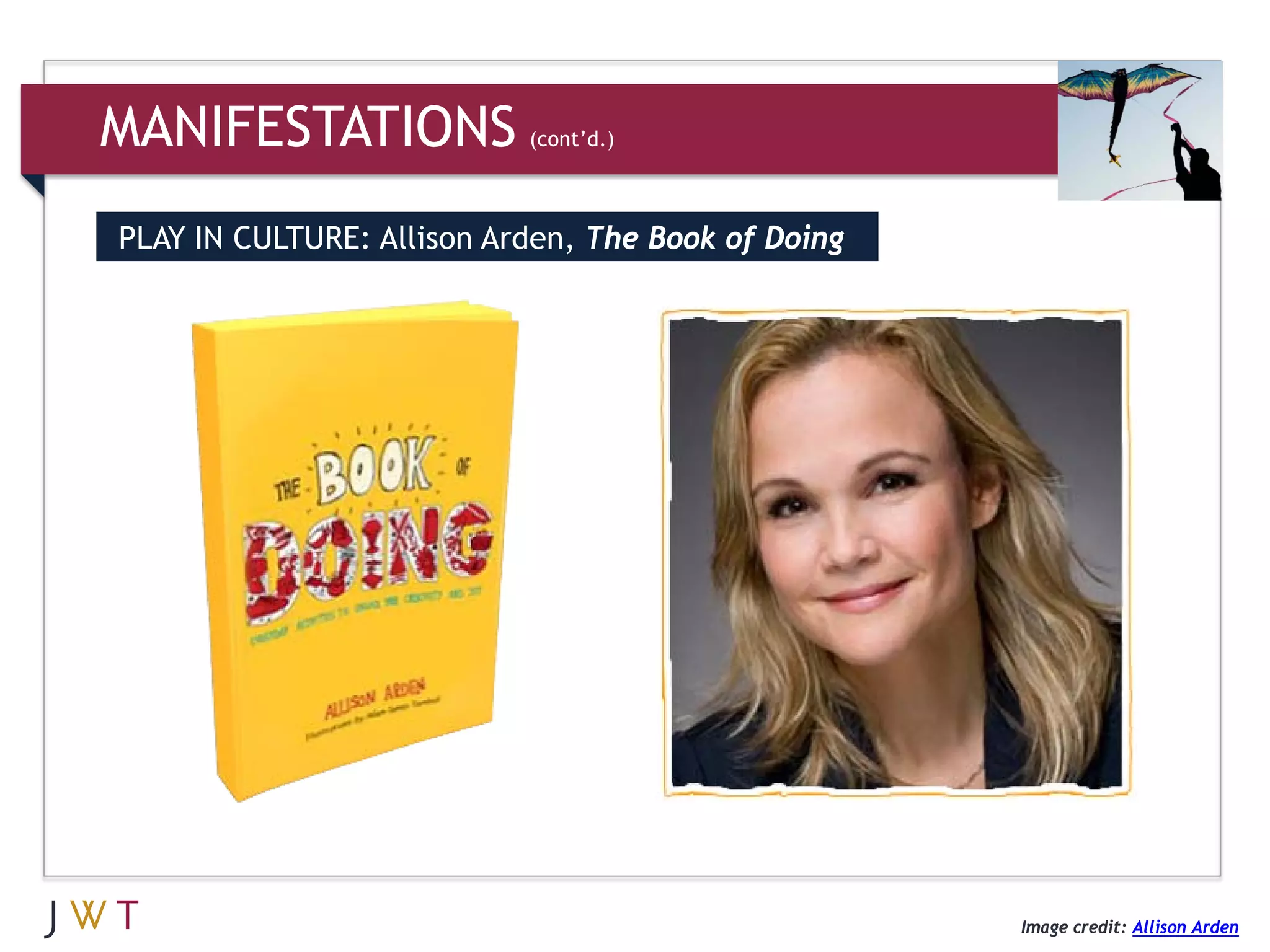
PLAY IN CULTURE: Allison Arden, The Book of Doing


                                                    Image credit: Allison Arden
MANIFESTATIONS             (cont’d.)


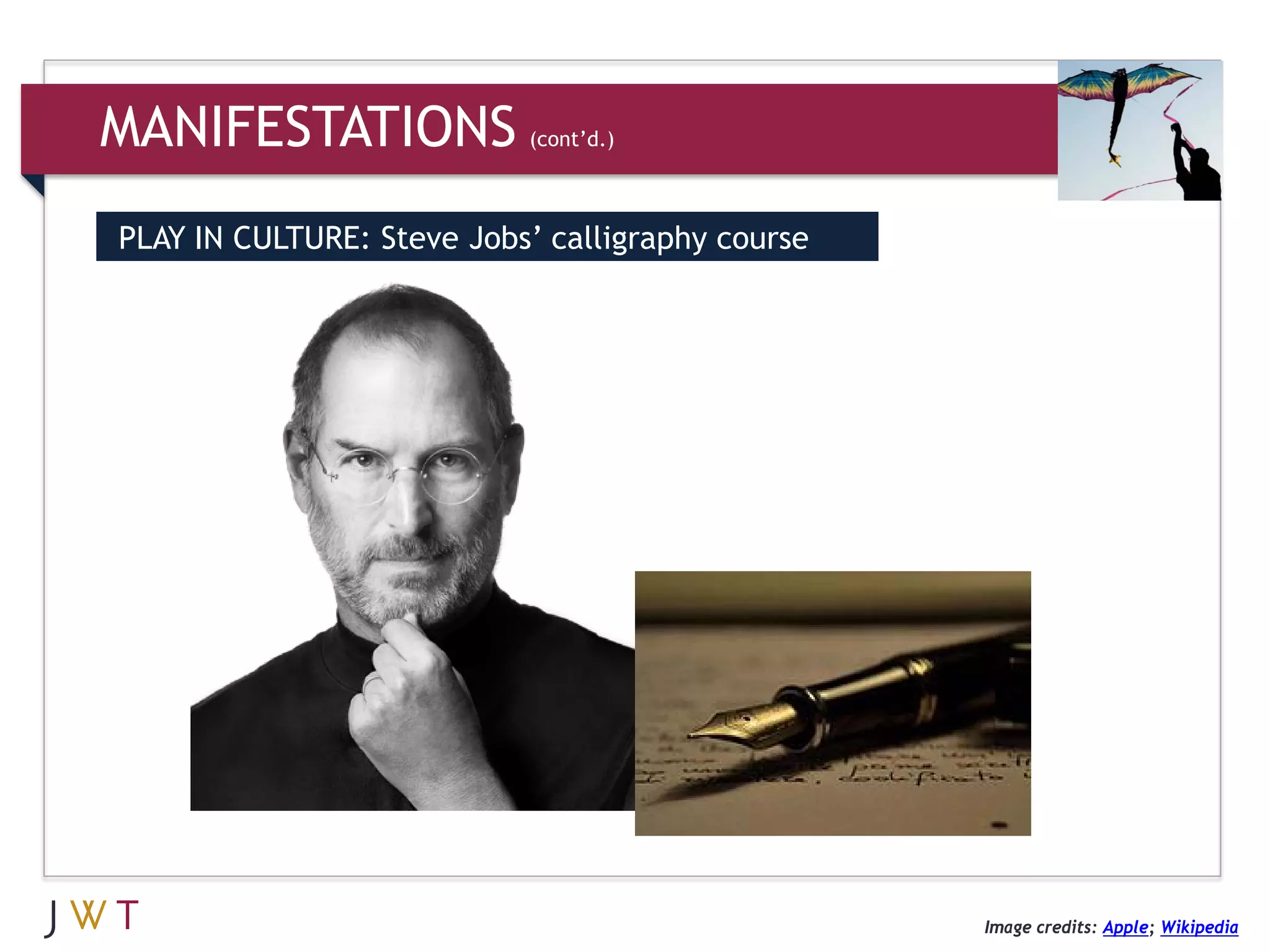
PLAY IN CULTURE: Steve Jobs’ calligraphy course


                                                  Image credits: Apple; Wikipedia
MANIFESTATIONS            (cont’d.)


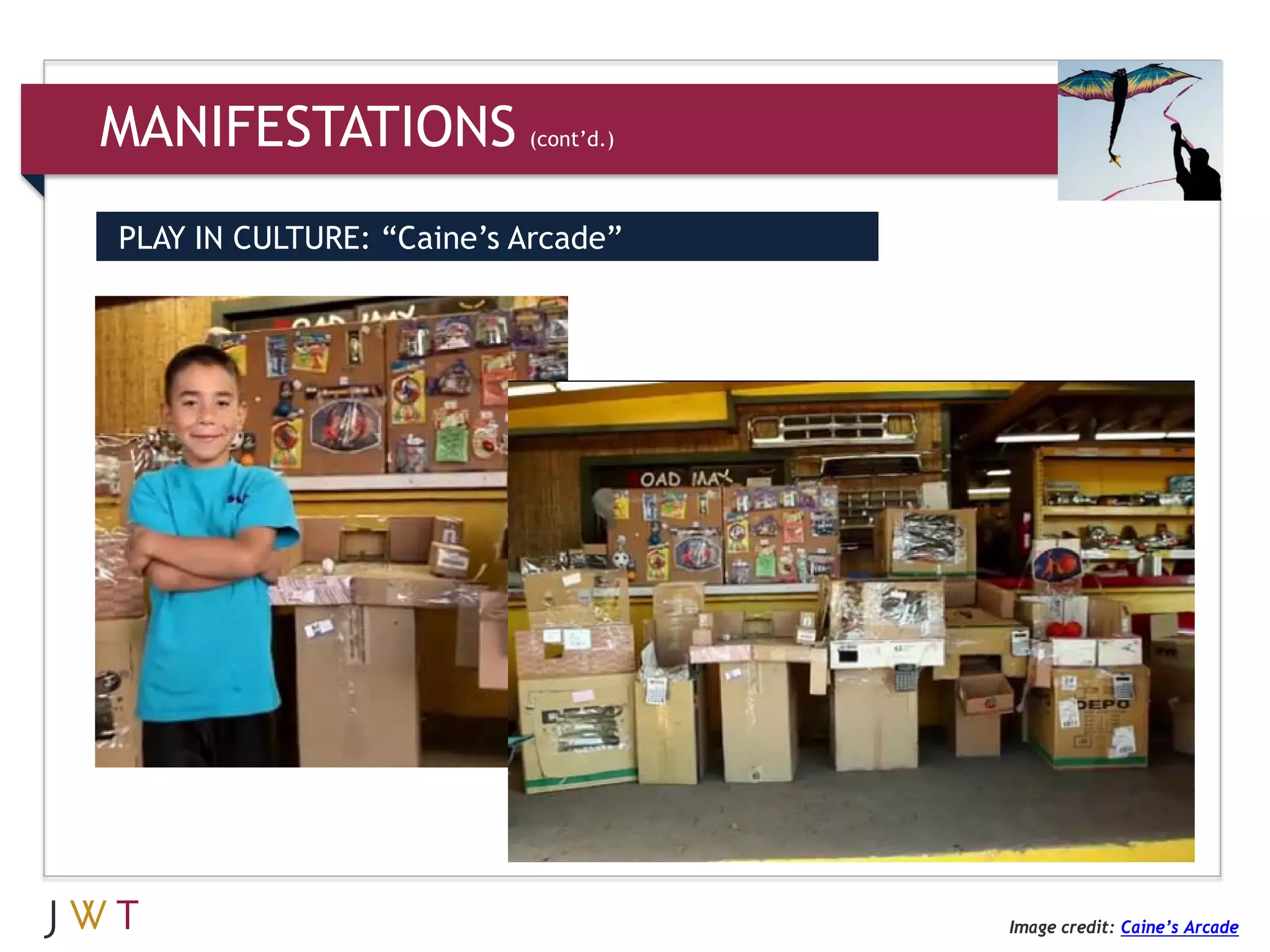
PLAY IN CULTURE: “Caine’s Arcade”


                                      Image credit: Caine’s Arcade
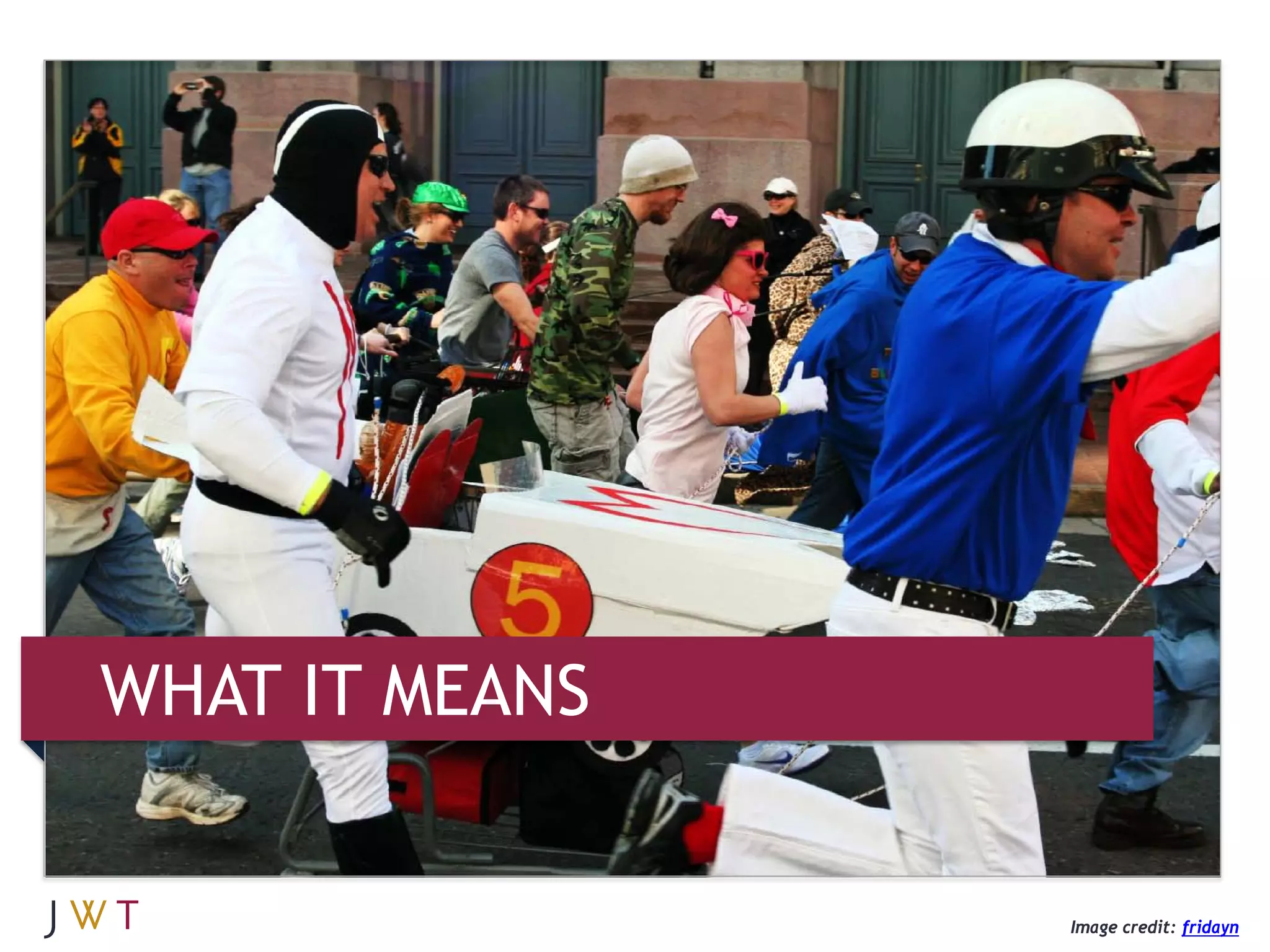
WHAT IT MEANS


                Image credit: fridayn
WHAT IT MEANS

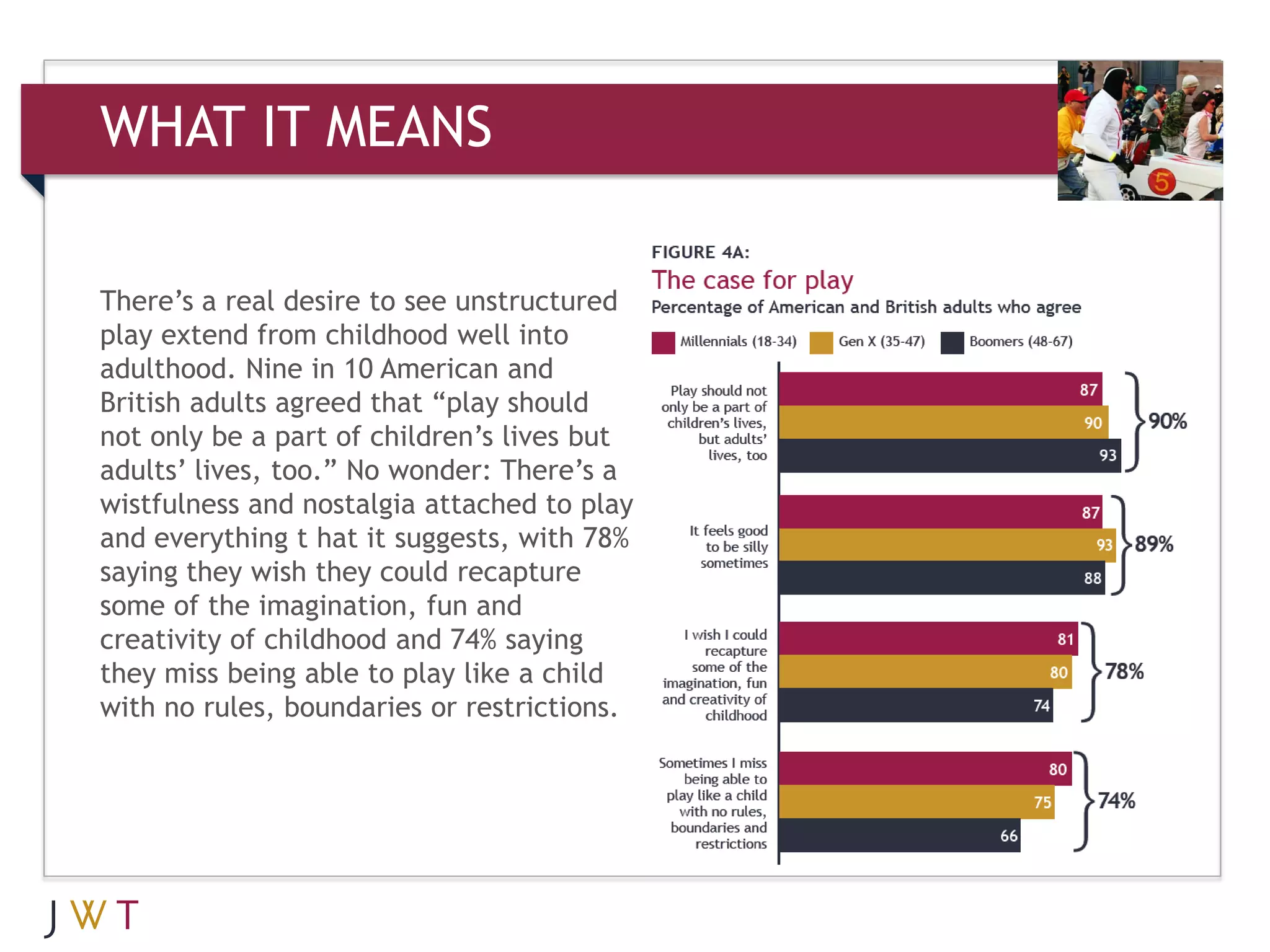
There’s a real desire to see unstructured
play extend from childhood well into
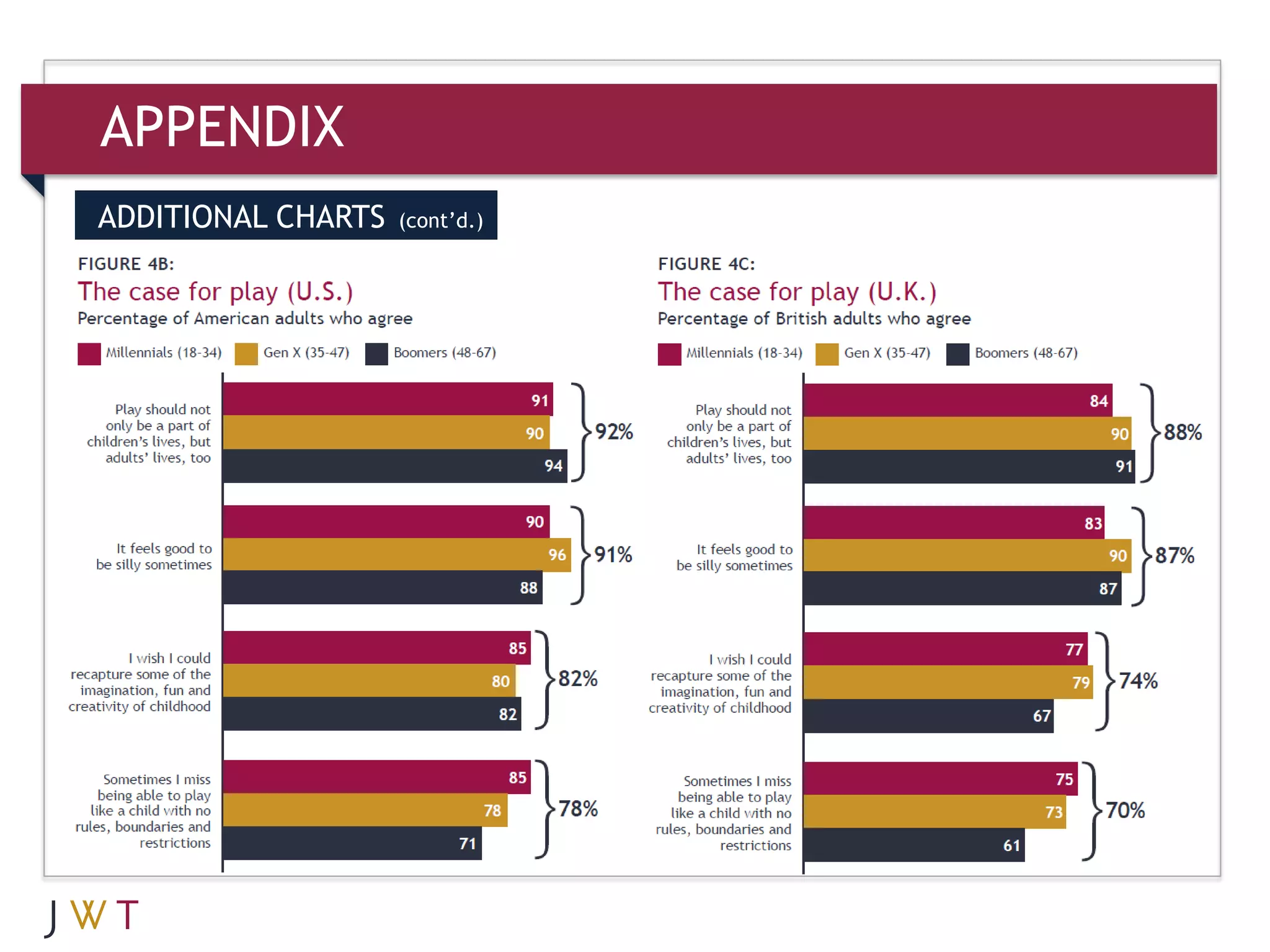
adulthood. Nine in 10 American and
British adults agreed that “play should
not only be a part of children’s lives but
adults’ lives, too.” No wonder: There’s a
wistfulness and nostalgia attached to play
and everything t hat it suggests, with 78%
saying they wish they could recapture
some of the imagination, fun and
creativity of childhood and 74% saying
they miss being able to play like a child
with no rules, boundaries or restrictions.
WHAT IT MEANS                  (cont’d.)


Society has become so automated and                      Play isn’t just for children. The idea
results-oriented that most of us don’t                   of play is closely related to
have the time or inclination to take                     imagination, inventiveness, and that
forays outside the structured framework.    deep sense of absorption. … Read virtually any
But in a quickly changing world, people     account of creativity, in the humanities or the
                                            sciences, and you’ll find mentions of the
who aren’t afraid to rewrite the rules or   relevance of daydreaming, fooling around with
rethink the status quo are those who get    possibilities…. The argument here isn’t just that
a head. Explains Allison Arden: “When       we need to let little kids play so they’ll be
you go through the shorthand of creating    creative when they’re older, but that play, or
things based on what other people have      something quite close to it, should be a part of
done, you oftentimes miss the               a teenager’s or adult’s life, too.”
opportunity or lose the recognition of
what you have the capability of doing
yourself.”                                               —ALFIE KOHN, author and lecturer,
                                                         “The Point of Play Is That It Has No
                                                             Point,” Big Think, Dec. 3, 2011
WHAT IT MEANS                       (cont’d.)


Injecting play into everyday life—doing things that bring joy, regardless of how closely these
activities are aligned with an end goal—can help to foster discovery and exploration, both
essential for creative economies. “Play is the greatest natural resource in a creative economy,”
declared Laura Seargeant Richardson, an experience designer at Frog Design, in a keynote speech
at MIT’s Sandbox Summit in 2010. She expanded on this in The Atlantic last May:

           In the future, economies won’t be driven by financial capital or even the more
           narrowly focused scientific capital, but by play capital as well. I predict
           countries that take play seriously, not only nurturing it in education and the
           workforce but also formalizing it as a national effort, will quickly rise in the world
           order. This is not Twister in the boardroom. Rather it’s what Jeremy Levy, a physics
           professor at the University of Pittsburgh, would call “a highly advanced form of play.


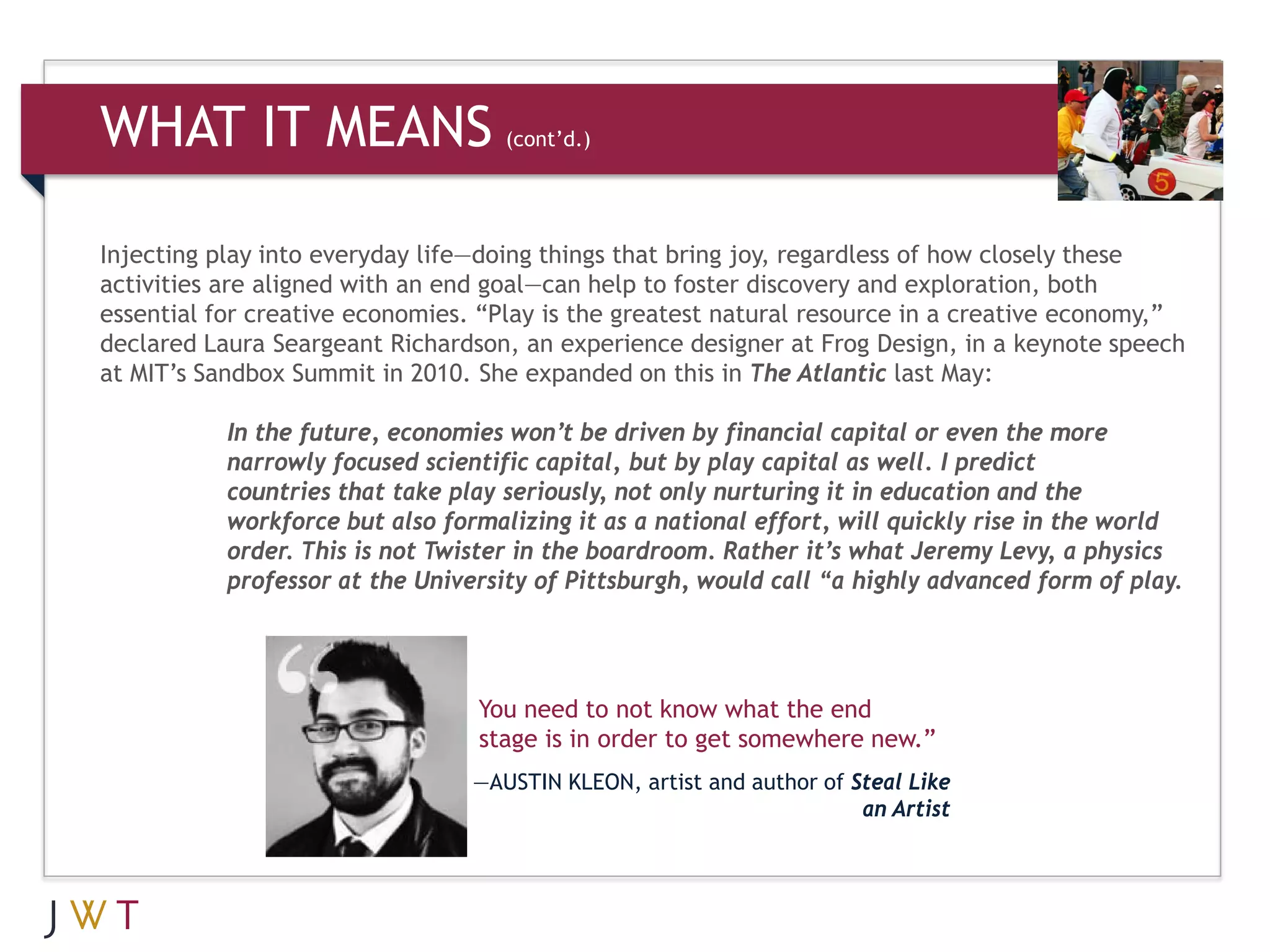
                                 You need to not know what the end
                                 stage is in order to get somewhere new.”
                                 —AUSTIN KLEON, artist and author of Steal Like
                                                                      an Artist
WHAT IT MEANS                       (cont’d.)


Marketers that speak to the value of play are tapping into an innate human desire. Brands can
help people reimagine their world and become more active participants in it through play. This
may mean helping consumers see their day-to-day environment through a more playful lens—as
Kit Kat has done—or encouraging people to dial down the constant stream of information, images
and digital conversations so they can focus on real-world doing.

Employers seeking to foster play in business need to move away from product without process—
focusing on each layer of the problem at hand instead of trying to steamroll through to a specific
result. The willingness to abandon a creation in favor of new, better ideas and solutions, crucial
to the play mentality, is a key to nurturing innovation in the business world.


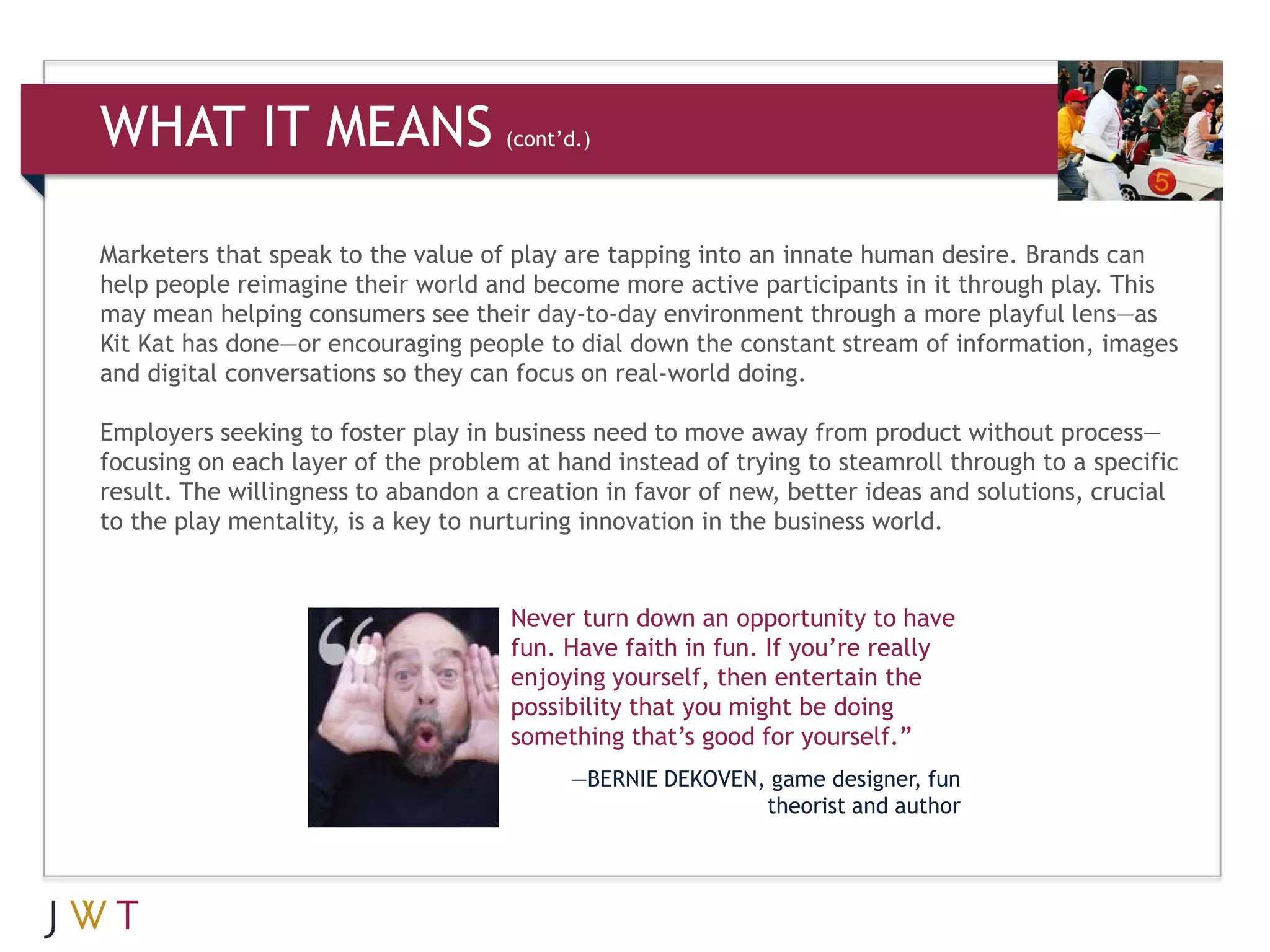
                                     Never turn down an opportunity to have
                                     fun. Have faith in fun. If you’re really
                                     enjoying yourself, then entertain the
                                     possibility that you might be doing
                                     something that’s good for yourself.”
                                          —BERNIE DEKOVEN, game designer, fun
                                                          theorist and author
APPENDIX: LEARN MORE ABOUT OUR
EXPERTS AND INFLUENCERS


                                 Image credit: niznoz
APPENDIX
LEARN MORE ABOUT OUR INFLUENCERS AND EXPERTS
APPENDIX
LEARN MORE ABOUT OUR INFLUENCERS AND EXPERTS   (cont’d.)
APPENDIX
LEARN MORE ABOUT OUR INFLUENCERS AND EXPERTS   (cont’d.)
APPENDIX
LEARN MORE ABOUT OUR INFLUENCERS AND EXPERTS   (cont’d.)
APPENDIX: ADDITIONAL CHARTS


                          Image credit: niznoz
APPENDIX
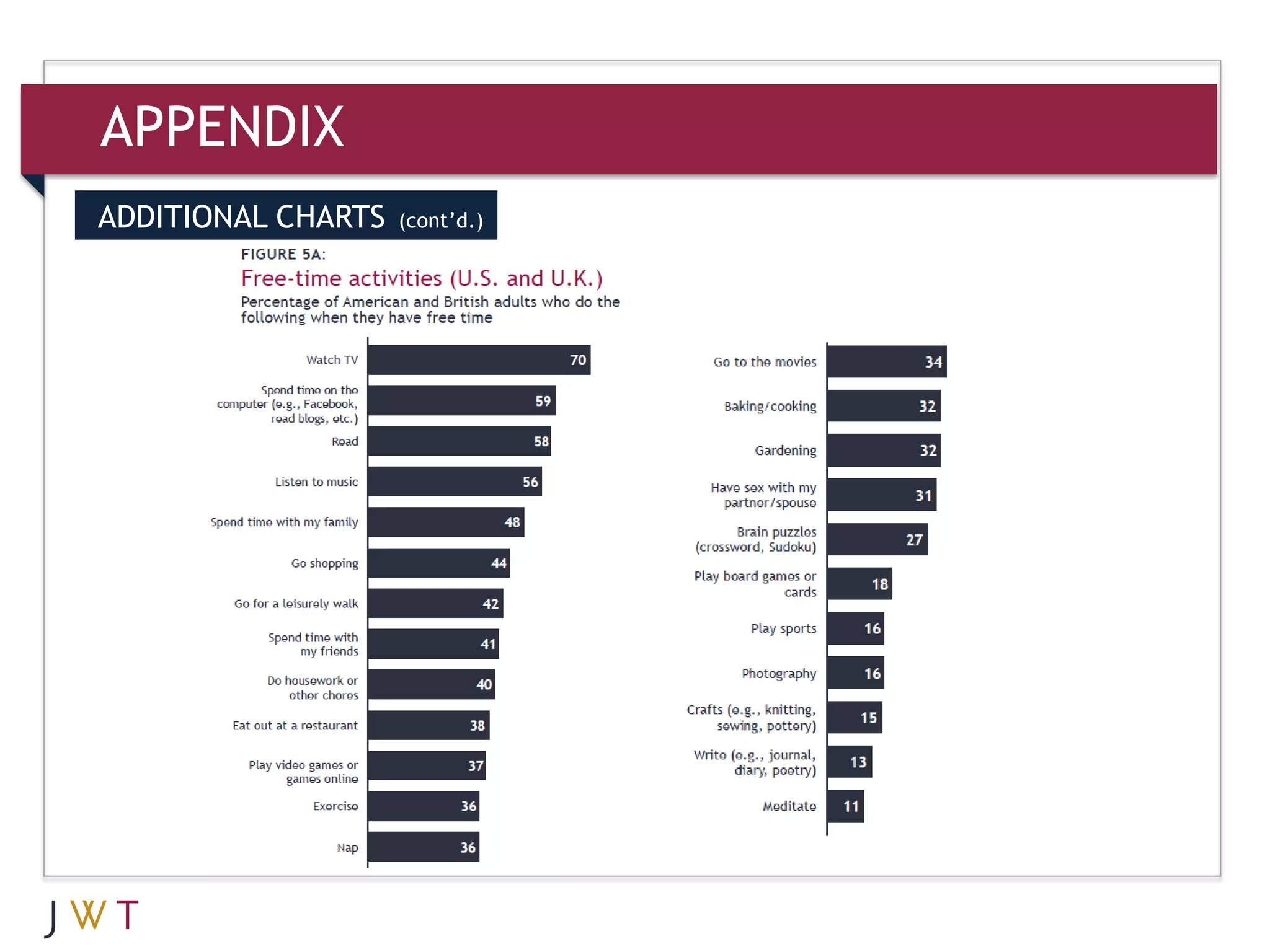
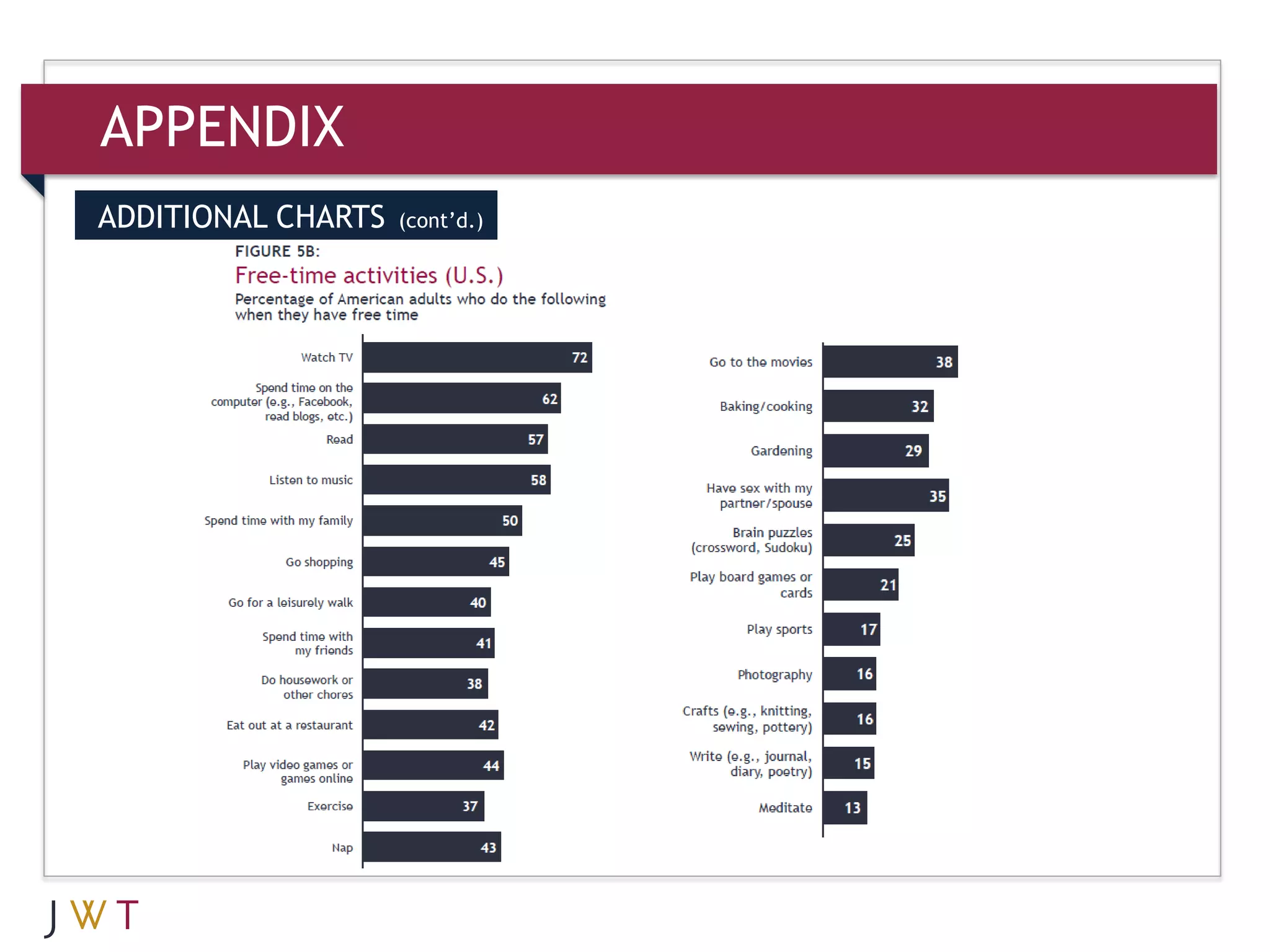
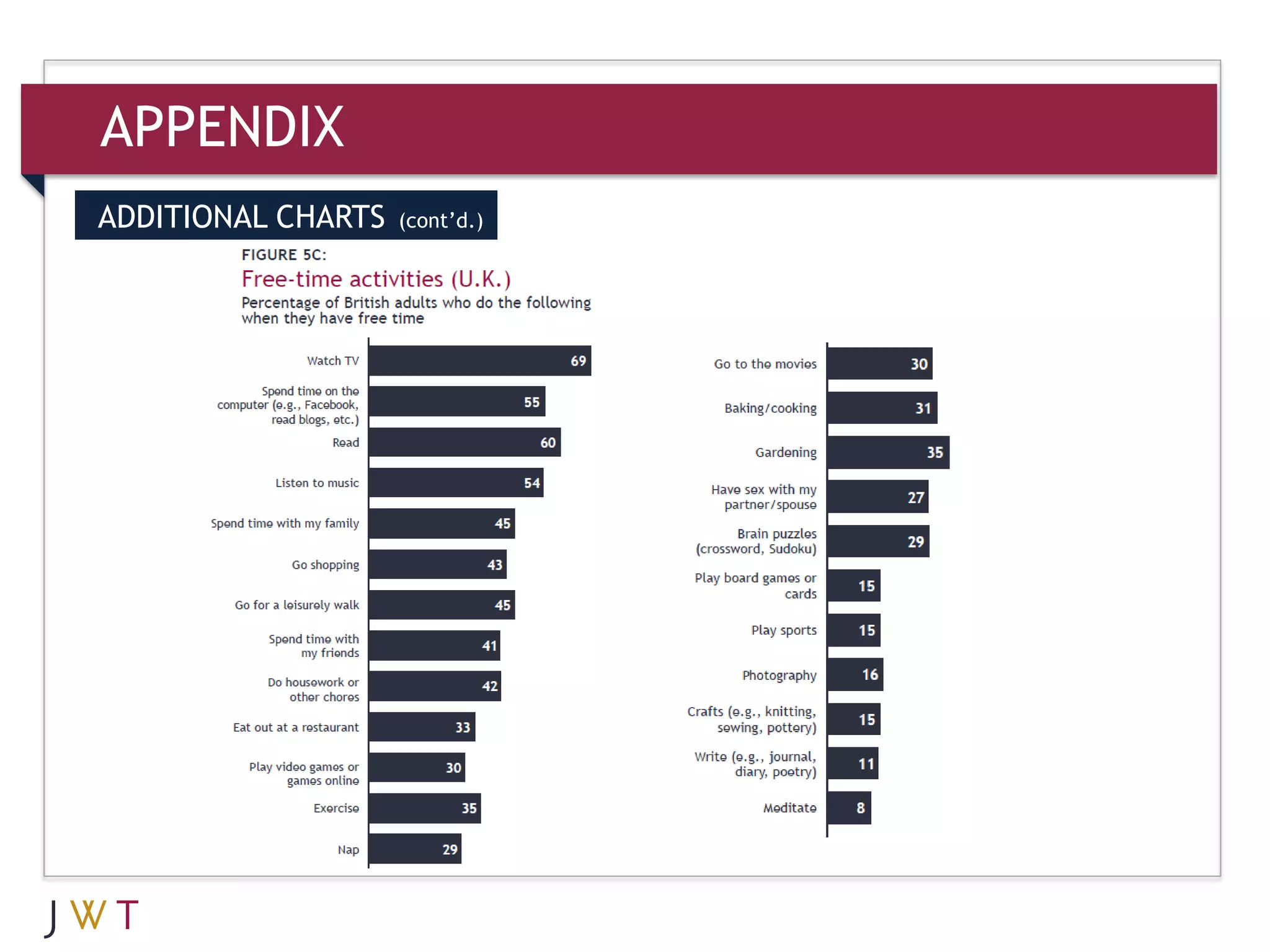
ADDITIONAL CHARTS
APPENDIX
ADDITIONAL CHARTS   (cont’d.)
APPENDIX
ADDITIONAL CHARTS   (cont’d.)
APPENDIX
ADDITIONAL CHARTS   (cont’d.)
APPENDIX
ADDITIONAL CHARTS   (cont’d.)
APPENDIX
ADDITIONAL CHARTS   (cont’d.)
APPENDIX
ADDITIONAL CHARTS   (cont’d.)
APPENDIX
ADDITIONAL CHARTS   (cont’d.)
THANK YOU
THANK YOU

Play as a Competitive Advantage (July 2012)

  • 1.
    PLAY As a Competitive Advantage July 2012 Image credit: niznoz
  • 2.
    WHAT WE’LL COVER Methodology PlayAs a Competitive Advantage •Defining Play •Benefits of Play •Impediments to Play •Manifestations •What It Means Appendix •More About Our Experts/Influencers •Additional Charts
  • 3.
    METHODOLOGY SONAR™ All of ourtrend reports are the result of quantitative, qualitative and desk research conducted by JWTIntelligence throughout the year. Specifically for this report, we conducted a quantitative study in the U.S. and the U.K. using SONAR™, JWT’s proprietary online tool, from May 31-June 4, 2012. We surveyed 503 Americans and 503 Britons aged 18-plus.
  • 4.
    METHODOLOGY (cont’d.) Influencers and experts In addition, we interviewed four experts and influencers in the areas of creativity and play.
  • 5.
    3 GEERATION GO PLAYAS A COMPETITIVE ADVANTAGE Adults will increasingly adopt for themselves the revitalized idea that kids should have plenty of unstructured play to balance out today’s plethora of organized and tech-based activities. In an age when people feel they can’t spare time for pursuits that don’t have specific goals attached, there will be a growing realization that unstructured time begets more imagination, creativity and innovation—all competitive advantages. Image credit: asterix611
  • 6.
    PLAY AS ACOMPETITIVE ADVANTAGE (cont’d.) DEFINING PLAY This report defines play in its purest sense, as recreational activity. Play is about doing something simply for the fun of it—no scores or goals attached. No rules and no guidelines. In fact, play is purposeless. To ascribe purpose takes the joy out of it. Play is “a free activity standing quite consciously outside ‘ordinary’ life as being ‘not serious’ but at the same time absorbing the player intensely and utterly.” —Dutch historian JOHAN HUIZINGA, Homo Ludens An essential component of play is its frivolity; biologists generally use phrases like ‘apparently purposeless activity’ in their definitions of play —Robin Marantz Henig, “Taking Play Seriously,” The New York Times, Feb. 17, 2008
  • 7.
    PLAY AS ACOMPETITIVE ADVANTAGE (cont’d.) DEFINING PLAY (cont’d.) The problem is that to insist on [play’s] Play is one of those things we tend to benefits risks violating the spirit, if not take for granted until we miss it. It is the very meaning, of play. … One plays much like breathing or dreaming in because it’s fun to do so, not because of any the way it fits seamlessly, invisibly, into a healthy instrumental advantage it may yield. The point life. It is a natural capacity of the human mind. isn’t to perform well or to master a skill, even As with breathing, we do it effortlessly. And as though those things might end up happening. … with dreaming, while we can be totally immersed Play, then, is about process not product. It has no in play, we often forget about it when we are goal other than itself. And among the external done. To try to find the point in play is to miss goals that are inconsistent with play is a the point of it. Play, after all, has no point; it’s deliberate effort to do something better or faster purposeless.” than someone else. If you’re keeping score—in —MARK EPSTEIN, M.D., “Play’s the Thing,” fact, if you’re competing at all— then what you’re O, The Oprah Magazine, May 2002 doing isn’t play.” —author and lecturer ALFIE KOHN, “The Point of Play Is That It Has No Point,” Big Think, Dec. 3, 2011
  • 8.
    PLAY AS ACOMPETITIVE ADVANTAGE (cont’d.) PROPERTIES OF PLAY Apparently purposeless: Done for its own sake. Voluntary: It is not obligatory. Inherent attraction: It’s fun, and it makes us feel good. Freedom from time: When fully engaged in play, we lose a sense of the passage of time. Diminished consciousness of self: We stop worrying about whether we look good or awkward, smart or stupid. Improvisational potential: We’re not locked into a rigid way of doing things and are therefore open to serendipity and chance. The result? We stumble on new behaviors, thoughts, strategies, movements or ways of being. Continuation desire: We desire to keep doing it, and the pleasure of the experience drives that desire. Derived from Play, by Stuart Brown, M.D., founder of the National Institute for Play, with Christopher Vaughan
  • 9.
    BENEFITS OF PLAY Image credit: Criss Cross Circus
  • 10.
    BENEFITS OF PLAY Play isn’t a luxury—it’s a necessity. Play is as important to our physical and mental health as getting enough sleep, eating well and exercising. Play teaches us how to manage and transform our ‘negative’ emotions and experiences. It supercharges learning, helps us relieve stress and connects us to others and the world around us. Play can also make work more productive and pleasurable.” —GINA KEMP, MELINDA SMITH, BERNIE DEKOVEN and JEANNE SEGAL, “Play, Creativity and Lifelong Learning: Why Play Matters for Both Kids and Adults,” Helpguide.org, February 2012
  • 11.
    BENEFITS OF PLAY (cont’d.) There’s this certain confidence that comes from unstructured play. It’s like, ‘I don’t know what I’m doing. It just feels good. I’m just following this thing until it tells me where it’s going.’ A lot of people can’t deal with that because the whole world tells you, when you go to kung fu lessons or violin practice or whatever you do, at the end of it you’re supposed to be better. And the whole thing about creative work is that you just don’t know what’s going to happen ’cause you can’t guarantee that you’re going to have a final product.” —AUSTIN KLEON, artist and author of Steal Like an Artist
  • 12.
    BENEFITS OF PLAY (cont’d.) Look at life without play, and it’s not much of a life. If you think of all the things we do that are play- related and erase those, it’s pretty hard to keep going. [Without play,] there’s a sense of dullness, lassitude and pessimism, which doesn’t work well in the world we live.” —STUART BROWN, founder of the National Institute for Play
  • 13.
    BENEFITS OF PLAY (cont’d.) PLAY IS WHAT THE DOCTOR ORDERED WORK BENEFITS • Triggers creativity and innovation • Increases energy and • Keeps you functional under stress helps prevent burnout • Refreshes your mind and body • Makes you more happy, • Encourages teamwork flexible and resilient • Helps you see problems in new ways • Increases productivity SOCIAL BENEFITS EMOTIONAL/MENTAL BENEFITS • Increases trust • Brings happiness • Strengthens group bonds • Improves problem-solving skills • Builds empathy • Teaches perseverance • Builds compassion • Fights off burnout • Generates capacity for intimacy • Provides clarity • Builds more meaningful connections • Builds confidence • Fosters cooperation and teamwork • Promotes serenity, calm and relaxation • Teaches social skills through give and take • Builds motivation • Fights loneliness, isolation, anxiety and depression • Fosters creativity • Increases sense of community • Brings joy, vitality and resilience to relationships • Heals resentments and disagreements Source: Gina Kemp, Melinda Smith, Bernie DeKoven and Jeanne Segal, “Play, Creativity and Learning: Why Play Matters for Both Kids and Adults,” Helpguide.org, February 2012
  • 14.
    BENEFITS OF PLAY (cont’d.) Through play, an individual avoids what [Patrick Bateson, a We’re living in a world that is Cambridge University biologist changing so quickly. Things that and prominent play scholar] called the lure were the right answer are no of ‘false endpoints,’ a problem-solving style longer necessarily the right answer. more typical of harried adults than of playful And so we need to be able to youngsters. False endpoints are avoided explore the possibilities and be through play, Bateson wrote, because players open. If we can bring play more are having so much fun they keep noodling into our adult lives, start moving away at a problem and might well arrive at our creativity into our adult lives, there are some something better than the first, good-enough great benefits to that.” solution.” —ALLISON ARDEN, publisher of Advertising Age —ROBIN MARANTZ HENIG, and author of The Book of Doing “Taking Play Seriously,” The New York Times, Feb. 17, 2008
  • 15.
    IMPEDIMENTS TO PLAY Image credit: amrufm
  • 16.
    IMPEDIMENTS TO PLAY I think there is an assembly-line [Our culture] is not really what I mentality that if you don’t keep would call conducive to play, so the assembly line moving, if you you’d have to make a conscious don’t keep having very specific choice to have fun, and that’s guidelines as to work output, if very hard. And oddly enough, it there isn’t a clock to punch, takes a lot of discipline, because people aren’t going to get things you have to give yourself done. And I think that wise permission.” management transcends that.” —STUART BROWN, founder of the National —BERNIE DEKOVEN, game designer, fun Institute for Play theorist and author
  • 17.
    IMPEDIMENTS TO PLAY (cont’d.) Quantifiable me GTD syndrome Life in real time Vanquished boredom The adultification of kids’ play
  • 18.
    IMPEDIMENTS TO PLAY (cont’d.) The question that drives Quantifiable me [Millennials’] work is ‘What do I need to respond to?’ rather than GTD syndrome ‘What should I create today?’ They swat emails that fly at them, sit in meetings that they unthinkingly agreed to two months Life in real time earlier, take phone calls seeking their approval or advice. But they don’t build. Vanquished boredom They don’t sit and think.” —PRIYA PARKER, founder of visioning and strategy firm Thrive Labs, The adultification of kids’ play CNN.com, March 2012
  • 19.
    IMPEDIMENTS TO PLAY (cont’d.) Quantifiable me GTD syndrome Life in real time Vanquished boredom The adultification of kids’ play Play is just a natural thing that animals do, but somehow we’ve driven it out of kids.” —KATHY HIRSH-PASEK, developmental psychologist at Temple University, The New York Times, Jan. 5, 2011
  • 20.
    IMPEDIMENTS TO PLAY (cont’d.) RE-EXPERIENCING PLAY AS A PARENT
  • 21.
    MANIFESTATIONS Image credit: B.K. Dewey
  • 22.
    MANIFESTATIONS PLAY INTHE BUSINESS MODEL Recognizing the benefits of play, some high-profile companies inject play into their employees’ lives, beyond simply outfitting workplaces with basketball courts or pool tables.
  • 23.
    MANIFESTATIONS (cont’d.) PLAY IN THE BUSINESS MODEL: Google, 20% time Image credit: Google
  • 24.
    MANIFESTATIONS (cont’d.) PLAY IN THE BUSINESS MODEL: Twitter, Hack Week Image credit: Twitter
  • 25.
    MANIFESTATIONS (cont’d.) PLAY IN THE BUSINESS MODEL: Hackathons Image credit: hack ’n jill
  • 26.
    MANIFESTATIONS (cont’d.) PLAY IN THE BUSINESS MODEL: Pixar Image credits: Marcin Wichary; Pixar
  • 27.
    MANIFESTATIONS (cont’d.) PLAY IN THE BUSINESS MODEL: Sketching ideas Image credit: Sunni Brown
  • 28.
    MANIFESTATIONS (cont’d.) MARKETERS ADVOCATING FOR PLAY While brands often want to be associated with lightheartedness and fun, a number of recent marketing campaigns have specifically depicted adults putting some play back into their lives.
  • 29.
    MANIFESTATIONS (cont’d.) MARKETERS ADVOCATING FOR PLAY: Kit Kat, “Crane” and Chunky 3 campaign Image credits: Kit Kat [1],[2]
  • 30.
    MANIFESTATIONS (cont’d.) MARKETERS ADVOCATING FOR PLAY: Cheetos, “Take a Cheetos break” Image credit: Cheetos
  • 31.
    MANIFESTATIONS (cont’d.) MARKETERS ADVOCATING FOR PLAY: Nike, “Tag” Image credit: Nike
  • 32.
    MANIFESTATIONS (cont’d.) MARKETERS ADVOCATING FOR PLAY: Puma, “After Hours Athlete” Image credit: Puma
  • 33.
    MANIFESTATIONS (cont’d.) MARKETERS ADVOCATING FOR PLAY: Cadbury, “Spots v Stripes” Image credit: The Inspiration Room
  • 34.
    MANIFESTATIONS (cont’d.) MARKETERS ADVOCATING FOR PLAY: Heineken, Pub Rugby Activation Image credit: Heineken
  • 35.
    MANIFESTATIONS (cont’d.) MARKETERS ADVOCATING FOR PLAY: Honda, “Leap List” Image credit: Honda
  • 36.
    MANIFESTATIONS (cont’d.) MARKETERS ADVOCATING FOR PLAY: Unilever, “Dirt is good” Image credit: Unilever
  • 37.
    MANIFESTATIONS (cont’d.) PLAY IN CULTURE The concept that play is important for adults can be found in books, research and real-life examples that are all helping to inspire people.
  • 38.
    MANIFESTATIONS (cont’d.) PLAY IN CULTURE: National Institute for Play Image credit: Penguin; NIFP
  • 39.
    MANIFESTATIONS (cont’d.) PLAY IN CULTURE: Austin Kleon, Steal Like an Artist Image credit: Austin Kleon
  • 40.
    MANIFESTATIONS (cont’d.) PLAY IN CULTURE: Allison Arden, The Book of Doing Image credit: Allison Arden
  • 41.
    MANIFESTATIONS (cont’d.) PLAY IN CULTURE: Steve Jobs’ calligraphy course Image credits: Apple; Wikipedia
  • 42.
    MANIFESTATIONS (cont’d.) PLAY IN CULTURE: “Caine’s Arcade” Image credit: Caine’s Arcade
  • 43.
    WHAT IT MEANS Image credit: fridayn
  • 44.
    WHAT IT MEANS There’sa real desire to see unstructured play extend from childhood well into adulthood. Nine in 10 American and British adults agreed that “play should not only be a part of children’s lives but adults’ lives, too.” No wonder: There’s a wistfulness and nostalgia attached to play and everything t hat it suggests, with 78% saying they wish they could recapture some of the imagination, fun and creativity of childhood and 74% saying they miss being able to play like a child with no rules, boundaries or restrictions.
  • 45.
    WHAT IT MEANS (cont’d.) Society has become so automated and Play isn’t just for children. The idea results-oriented that most of us don’t of play is closely related to have the time or inclination to take imagination, inventiveness, and that forays outside the structured framework. deep sense of absorption. … Read virtually any But in a quickly changing world, people account of creativity, in the humanities or the sciences, and you’ll find mentions of the who aren’t afraid to rewrite the rules or relevance of daydreaming, fooling around with rethink the status quo are those who get possibilities…. The argument here isn’t just that a head. Explains Allison Arden: “When we need to let little kids play so they’ll be you go through the shorthand of creating creative when they’re older, but that play, or things based on what other people have something quite close to it, should be a part of done, you oftentimes miss the a teenager’s or adult’s life, too.” opportunity or lose the recognition of what you have the capability of doing yourself.” —ALFIE KOHN, author and lecturer, “The Point of Play Is That It Has No Point,” Big Think, Dec. 3, 2011
  • 46.
    WHAT IT MEANS (cont’d.) Injecting play into everyday life—doing things that bring joy, regardless of how closely these activities are aligned with an end goal—can help to foster discovery and exploration, both essential for creative economies. “Play is the greatest natural resource in a creative economy,” declared Laura Seargeant Richardson, an experience designer at Frog Design, in a keynote speech at MIT’s Sandbox Summit in 2010. She expanded on this in The Atlantic last May: In the future, economies won’t be driven by financial capital or even the more narrowly focused scientific capital, but by play capital as well. I predict countries that take play seriously, not only nurturing it in education and the workforce but also formalizing it as a national effort, will quickly rise in the world order. This is not Twister in the boardroom. Rather it’s what Jeremy Levy, a physics professor at the University of Pittsburgh, would call “a highly advanced form of play. You need to not know what the end stage is in order to get somewhere new.” —AUSTIN KLEON, artist and author of Steal Like an Artist
  • 47.
    WHAT IT MEANS (cont’d.) Marketers that speak to the value of play are tapping into an innate human desire. Brands can help people reimagine their world and become more active participants in it through play. This may mean helping consumers see their day-to-day environment through a more playful lens—as Kit Kat has done—or encouraging people to dial down the constant stream of information, images and digital conversations so they can focus on real-world doing. Employers seeking to foster play in business need to move away from product without process— focusing on each layer of the problem at hand instead of trying to steamroll through to a specific result. The willingness to abandon a creation in favor of new, better ideas and solutions, crucial to the play mentality, is a key to nurturing innovation in the business world. Never turn down an opportunity to have fun. Have faith in fun. If you’re really enjoying yourself, then entertain the possibility that you might be doing something that’s good for yourself.” —BERNIE DEKOVEN, game designer, fun theorist and author
  • 48.
    APPENDIX: LEARN MOREABOUT OUR EXPERTS AND INFLUENCERS Image credit: niznoz
  • 49.
    APPENDIX LEARN MORE ABOUTOUR INFLUENCERS AND EXPERTS
  • 50.
    APPENDIX LEARN MORE ABOUTOUR INFLUENCERS AND EXPERTS (cont’d.)
  • 51.
    APPENDIX LEARN MORE ABOUTOUR INFLUENCERS AND EXPERTS (cont’d.)
  • 52.
    APPENDIX LEARN MORE ABOUTOUR INFLUENCERS AND EXPERTS (cont’d.)
  • 53.
    APPENDIX: ADDITIONAL CHARTS Image credit: niznoz
  • 54.
  • 55.
  • 56.
  • 57.
  • 58.
  • 59.
  • 60.
  • 61.
  • 62.
  • 63.