“ Federalism”   You’re Not the Boss of Me! (Oh wait, yes you are.)
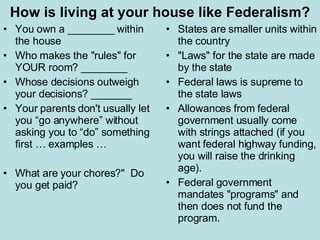
How is living at your house like Federalism? You own a ________ within the house Who makes the "rules" for YOUR room? ________ Whose decisions outweigh your decisions? _______ Your parents don't usually let you “go anywhere” without asking you to “do” something first … examples … What are your chores?"  Do you get paid?  States are smaller units within the country "Laws" for the state are made by the state Federal laws is supreme to the state laws Allowances from federal government usually come with strings attached (if you want federal highway funding, you will raise the drinking age). Federal government mandates "programs" and then does not fund the program.
Both you and your parents have assigned responsibilities, what are your responsibilities around the house?  (Parental expectations) How does your family "share" the work-load? What do you and your parents argue about? Can you think of any time when you came up with a solution and the family implemented it? Federal and State governments have separate responsibilities (Federal protects the country/economy, the states protect general welfare of the people within their state) A lot of programs are "shared" by both the federal and state. Both levels are constantly seeking to maintain "power"  States try new programs, if they work at state level, they are brought up to the federal level.
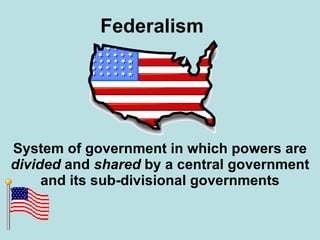
Federalism System of government in which powers are  divided  and  shared  by a central government and its sub-divisional governments
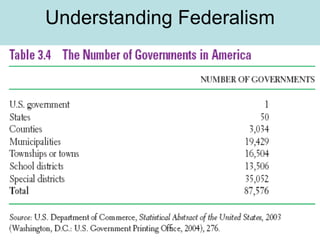
Understanding Federalism
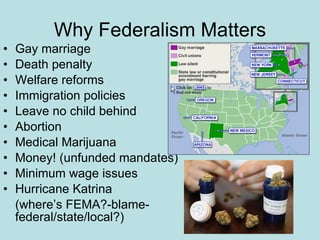
Why Federalism Matters Gay marriage Death penalty Welfare reforms Immigration policies Leave no child behind Abortion Medical Marijuana Money! (unfunded mandates) Minimum wage issues Hurricane Katrina (where’s FEMA?-blame-federal/state/local?)
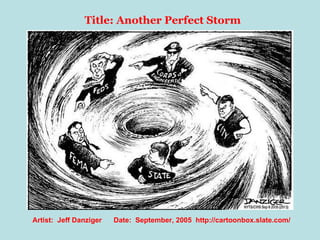
Title: Another Perfect Storm Artist:  Jeff Danziger  Date:  September, 2005  http://cartoonbox.slate.com/
States have their own laws…check these laws out  
Federalism in practice State Laws on the books today… It is illegal for a driver to be blindfolded while operating a vehicle.  It is illegal to wear a fake mustache that causes laughter in church.  A L A B A M A
Federalism in practice State Laws on the books today… Animals are banned from mating publicly within 1,500 feet of a tavern, school, or place of worship.  It is a misdemeanor to shoot at any kind of game from a moving vehicle, unless the target is a whale.  C A L I F O R N I A
Federalism in practice State Laws on the books today… Prohibits shooting rabbits from a motorboat. K A N S A S  It is illegal to rob a bank and then shoot at the bank teller with a water pistol.  L O U I S I A N A
Federalism in practice State Laws on the books today… It is illegal to take more than three sips of beer at a time while standing.  It is illegal to drive without windshield wipers but a windshield is not required It is illegal for one to shoot a buffalo from the second story of a hotel.  It is illegal to milk another person's cow.  T E X A S
So What is Federalism? System of government in which powers are  divided  and  shared  by a central government and its sub-divisional governments
What is Federalism? Mere  existence  of  state  and  federal  governments does not make it a federal system. Both the  federal  government and the  state  government get their power from a common source -  the constitution.
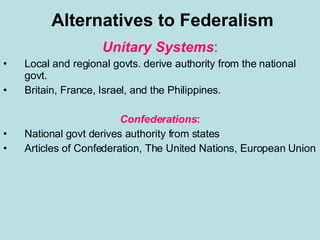
Alternatives to Federalism Unitary   Systems : Local and regional govts. derive authority from the national govt. Britain, France, Israel, and the Philippines. Confederations : National govt derives authority from states Articles of Confederation, The United Nations, European Union
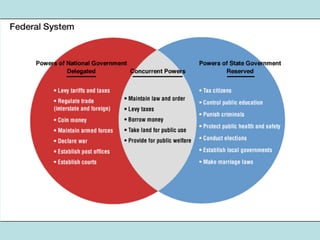
Powers of the  National Government  “Delegated Powers” Enumerated or Expressed powers Art. I Sec. 8 Declare war Mint money Regulate trade between states Etc…
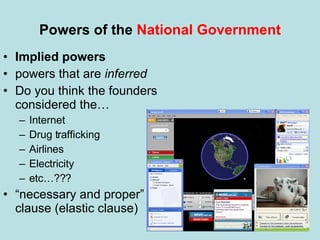
Powers of the  National Government Implied powers powers that are  inferred Do you think the founders considered the… Internet Drug trafficking Airlines Electricity etc…??? “ necessary and proper” clause (elastic clause)
Supremacy Clause Article VI National law is supreme to all other laws passed by states Ex. Migratory Bird Treaty Act 1918-prohibit killing of birds Missouri argued that they can regulate hunting  - 10 th  Amendment Federal law supreme
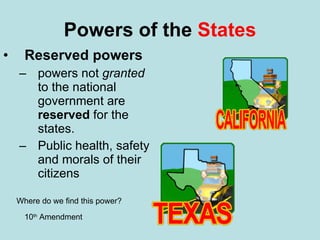
Powers of the  States Reserved powers powers not  granted  to the national government are  reserved  for the states. Public health, safety and morals of their citizens Where do we find this power? 10 th  Amendment
Concurrent Powers Concurrent powers powers that are  shared  by both federal and state governments. Examples include: To tax To define laws  To punish criminals Many others…
 
Relations Among States Article IV of Constitution Full Faith and Credit Clause – each state must give “Full Faith and Credit … to the public Acts, Records and Judicial Proceedings of every other State.” Extradition  Art. I Sec. 10 Interstate Compacts Ex. Drivers License Compact – to help nationwide recognition of licenses  Article VI – Privileges and Immunities
Federalism and the Scope of Government-Why has the Federal Gov. grown so much? As the U.S. has  changed from agriculture to industry , new demands for government arose. The national government answered with a national banking system,  subsidies for railroads, and airlines  and a host of other policies created to expand the economy. The  formation of large corporations led to abuses  and many interests asked the national government to  regulate  and encourage open competition. Farmers also sought services such as price supports Unions sought better working conditions , better pay, and a wide range of social policy.
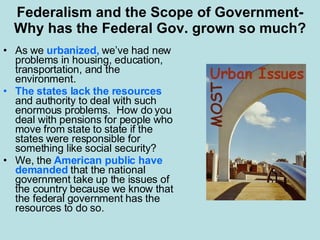
Federalism and the Scope of Government-Why has the Federal Gov. grown so much? As we  urbanized,  we’ve had new problems in housing, education, transportation, and the environment. The states lack the resources  and authority to deal with such enormous problems.  How do you deal with pensions for people who move from state to state if the states were responsible for something like social security? We, the  American public have demanded  that the national government take up the issues of the country because we know that the federal government has the resources to do so.
Development of Federalism The Marshall Court McCulloch v. Maryland  (1819) - necessary and proper clause; state power to tax federal govt. Gibbons v. Ogden  (1824) – commerce clause Dual Federalism: The Taney Court, Slavery and the Civil War Separate and equally powerful state and national govt. Federal govt should not exceed the enumerated powers Dred Scott v. Sanford  (1857) – Mo. Compromise unconst’l; Congress lacks authority to ban slavery in territories Post Civil War – federal power grew (ex., Civil War Amendments, Sherman Anti-Trust Act of 1890) but Court maintained belief in dual federalism (ex. Plessy v. Ferguson (1896)) Late 1800’s - Congress takes more power 16 th  Amendment – power to collect income tax 17 th  Amend – direct election of Senators
Development of Federalism (cont.) Cooperative Federalism CF – the intertwined relationship among nat’l, state and local govt The New Deal First, Court ruled many programs unconst’l Then, Court packing plan Then, Court allowed programs NLRB v. Jones and Laughlin Steel Co . (1937) – allowed collective bargaining Fair Labor Standards Act- minimum wage Grants to States Morrill Land Grant Act 1862 New Deal Categorical Grants – Cong gives funds for specific purposes
Development of Federalism (cont.) New Federalism (1980 – 2001) Returning power to the states Reagan Revolution (Repub.) Block grants – few strings attached New Federalism (1980 – 2001) Devolution Revolution – Clinton (Dem) Repub controlled Cong Contract with America-scale back federal govt
Development of Federalism (cont.) New Federalism (1980 – 2001) (cont.) Devolution Revolution – Clinton (Dem) Repub controlled Cong Contract with America-scale back federal govt Unfunded Mandates Reform Act 1995 Personal Responsibility and Work Opportunity Reconciliation Act of 1996 State budget surpluses Bush Administration Sept 11 Department of Homeland Security No Child Left Behind Preemption – Supremacy Clause Budget deficits
Development of Federalism (cont.) New Federalism (1980 – 2001) (cont.) The Supreme Court Returning power to states Abortion Webster v. Reproductive Health Services (1989) Planned Parenthood of Southeastern Penn v. Casey (1992) Commerce Clause US v. Lopez (1995) – carrying guns near schools US v. Morrison (2000) – Violence Against Women Act  Sovereign Immunity – 11 th  Amendment Opposite decision - Family Medical Leave Act

Federalism

  • 1.
    “ Federalism” You’re Not the Boss of Me! (Oh wait, yes you are.)
  • 2.
    How is livingat your house like Federalism? You own a ________ within the house Who makes the "rules" for YOUR room? ________ Whose decisions outweigh your decisions? _______ Your parents don't usually let you “go anywhere” without asking you to “do” something first … examples … What are your chores?" Do you get paid? States are smaller units within the country "Laws" for the state are made by the state Federal laws is supreme to the state laws Allowances from federal government usually come with strings attached (if you want federal highway funding, you will raise the drinking age). Federal government mandates "programs" and then does not fund the program.
  • 3.
    Both you andyour parents have assigned responsibilities, what are your responsibilities around the house? (Parental expectations) How does your family "share" the work-load? What do you and your parents argue about? Can you think of any time when you came up with a solution and the family implemented it? Federal and State governments have separate responsibilities (Federal protects the country/economy, the states protect general welfare of the people within their state) A lot of programs are "shared" by both the federal and state. Both levels are constantly seeking to maintain "power" States try new programs, if they work at state level, they are brought up to the federal level.
  • 4.
    Federalism System ofgovernment in which powers are divided and shared by a central government and its sub-divisional governments
  • 5.
  • 6.
    Why Federalism MattersGay marriage Death penalty Welfare reforms Immigration policies Leave no child behind Abortion Medical Marijuana Money! (unfunded mandates) Minimum wage issues Hurricane Katrina (where’s FEMA?-blame-federal/state/local?)
  • 7.
    Title: Another PerfectStorm Artist: Jeff Danziger Date: September, 2005 http://cartoonbox.slate.com/
  • 8.
    States have theirown laws…check these laws out 
  • 9.
    Federalism in practiceState Laws on the books today… It is illegal for a driver to be blindfolded while operating a vehicle. It is illegal to wear a fake mustache that causes laughter in church. A L A B A M A
  • 10.
    Federalism in practiceState Laws on the books today… Animals are banned from mating publicly within 1,500 feet of a tavern, school, or place of worship. It is a misdemeanor to shoot at any kind of game from a moving vehicle, unless the target is a whale. C A L I F O R N I A
  • 11.
    Federalism in practiceState Laws on the books today… Prohibits shooting rabbits from a motorboat. K A N S A S It is illegal to rob a bank and then shoot at the bank teller with a water pistol. L O U I S I A N A
  • 12.
    Federalism in practiceState Laws on the books today… It is illegal to take more than three sips of beer at a time while standing. It is illegal to drive without windshield wipers but a windshield is not required It is illegal for one to shoot a buffalo from the second story of a hotel. It is illegal to milk another person's cow. T E X A S
  • 13.
    So What isFederalism? System of government in which powers are divided and shared by a central government and its sub-divisional governments
  • 14.
    What is Federalism?Mere existence of state and federal governments does not make it a federal system. Both the federal government and the state government get their power from a common source - the constitution.
  • 15.
    Alternatives to FederalismUnitary Systems : Local and regional govts. derive authority from the national govt. Britain, France, Israel, and the Philippines. Confederations : National govt derives authority from states Articles of Confederation, The United Nations, European Union
  • 16.
    Powers of the National Government “Delegated Powers” Enumerated or Expressed powers Art. I Sec. 8 Declare war Mint money Regulate trade between states Etc…
  • 17.
    Powers of the National Government Implied powers powers that are inferred Do you think the founders considered the… Internet Drug trafficking Airlines Electricity etc…??? “ necessary and proper” clause (elastic clause)
  • 18.
    Supremacy Clause ArticleVI National law is supreme to all other laws passed by states Ex. Migratory Bird Treaty Act 1918-prohibit killing of birds Missouri argued that they can regulate hunting - 10 th Amendment Federal law supreme
  • 19.
    Powers of the States Reserved powers powers not granted to the national government are reserved for the states. Public health, safety and morals of their citizens Where do we find this power? 10 th Amendment
  • 20.
    Concurrent Powers Concurrentpowers powers that are shared by both federal and state governments. Examples include: To tax To define laws To punish criminals Many others…
  • 21.
  • 22.
    Relations Among StatesArticle IV of Constitution Full Faith and Credit Clause – each state must give “Full Faith and Credit … to the public Acts, Records and Judicial Proceedings of every other State.” Extradition Art. I Sec. 10 Interstate Compacts Ex. Drivers License Compact – to help nationwide recognition of licenses Article VI – Privileges and Immunities
  • 23.
    Federalism and theScope of Government-Why has the Federal Gov. grown so much? As the U.S. has changed from agriculture to industry , new demands for government arose. The national government answered with a national banking system, subsidies for railroads, and airlines and a host of other policies created to expand the economy. The formation of large corporations led to abuses and many interests asked the national government to regulate and encourage open competition. Farmers also sought services such as price supports Unions sought better working conditions , better pay, and a wide range of social policy.
  • 24.
    Federalism and theScope of Government-Why has the Federal Gov. grown so much? As we urbanized, we’ve had new problems in housing, education, transportation, and the environment. The states lack the resources and authority to deal with such enormous problems. How do you deal with pensions for people who move from state to state if the states were responsible for something like social security? We, the American public have demanded that the national government take up the issues of the country because we know that the federal government has the resources to do so.
  • 25.
    Development of FederalismThe Marshall Court McCulloch v. Maryland (1819) - necessary and proper clause; state power to tax federal govt. Gibbons v. Ogden (1824) – commerce clause Dual Federalism: The Taney Court, Slavery and the Civil War Separate and equally powerful state and national govt. Federal govt should not exceed the enumerated powers Dred Scott v. Sanford (1857) – Mo. Compromise unconst’l; Congress lacks authority to ban slavery in territories Post Civil War – federal power grew (ex., Civil War Amendments, Sherman Anti-Trust Act of 1890) but Court maintained belief in dual federalism (ex. Plessy v. Ferguson (1896)) Late 1800’s - Congress takes more power 16 th Amendment – power to collect income tax 17 th Amend – direct election of Senators
  • 26.
    Development of Federalism(cont.) Cooperative Federalism CF – the intertwined relationship among nat’l, state and local govt The New Deal First, Court ruled many programs unconst’l Then, Court packing plan Then, Court allowed programs NLRB v. Jones and Laughlin Steel Co . (1937) – allowed collective bargaining Fair Labor Standards Act- minimum wage Grants to States Morrill Land Grant Act 1862 New Deal Categorical Grants – Cong gives funds for specific purposes
  • 27.
    Development of Federalism(cont.) New Federalism (1980 – 2001) Returning power to the states Reagan Revolution (Repub.) Block grants – few strings attached New Federalism (1980 – 2001) Devolution Revolution – Clinton (Dem) Repub controlled Cong Contract with America-scale back federal govt
  • 28.
    Development of Federalism(cont.) New Federalism (1980 – 2001) (cont.) Devolution Revolution – Clinton (Dem) Repub controlled Cong Contract with America-scale back federal govt Unfunded Mandates Reform Act 1995 Personal Responsibility and Work Opportunity Reconciliation Act of 1996 State budget surpluses Bush Administration Sept 11 Department of Homeland Security No Child Left Behind Preemption – Supremacy Clause Budget deficits
  • 29.
    Development of Federalism(cont.) New Federalism (1980 – 2001) (cont.) The Supreme Court Returning power to states Abortion Webster v. Reproductive Health Services (1989) Planned Parenthood of Southeastern Penn v. Casey (1992) Commerce Clause US v. Lopez (1995) – carrying guns near schools US v. Morrison (2000) – Violence Against Women Act Sovereign Immunity – 11 th Amendment Opposite decision - Family Medical Leave Act