Chapter 3
 Federalism
Background

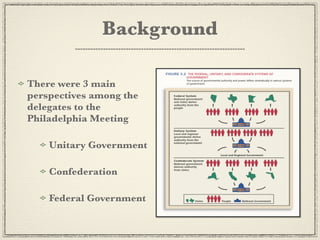
There were 3 main
perspectives among the
delegates to the
Philadelphia Meeting

    Unitary Government

    Confederation

    Federal Government
The Powers of National
 & State Governments
  What Does the Constitution State?
Enumerated Powers (Article I, Sec. 8)

 Power to tax, borrow, spend, regulate
 interstate commerce, coin money,
 declare war, raise & maintain an army,
 conduct foreign affairs and create a
 national court system
 Necessary & Proper Clause
    Implied Powers
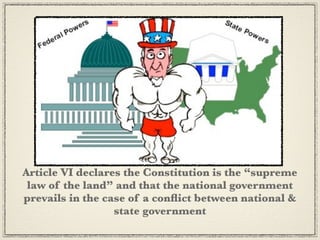
Article VI declares the Constitution is the “supreme
 law of the land” and that the national government
prevails in the case of a conflict between national &
                  state government
State Powers (Reserve/Police Powers) are not listed
            in the Constitution...Why?
State Powers
“Time, Place and Manner” for Elections
Guarantees 2 Senators
States Must Appoint Electors to Vote for President
Guarantees Republican Form of Government
Guarantees States Protection from Domestic
Rebellion or Foreign Attack
Ratify proposed amendments to U.S. Constitution
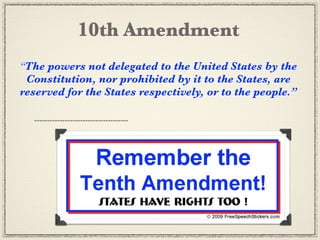
10th Amendment
“The powers not delegated to the United States by the
 Constitution, nor prohibited by it to the States, are
reserved for the States respectively, or to the people.”
Nature of
      Federalism

   CONFLICT BETWEEN

“Necessary & Proper” Clause
     (Implied Powers)

            vs.               Debate Over What
                               is NOT Stated
     10th Amendment
The powers granted to the states via the 10th
Amendment are known as police or reserve powers.
 They include the power to legislate for the public
   health, safety, and morals of their citizens.
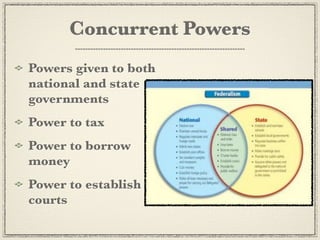
Concurrent Powers
Powers given to both
national and state
governments
Power to tax
Power to borrow
money
Power to establish
courts
Powers Denied

States:
  Entering into treaties with foreign nations

  Coin money

  Impairing obligations of contracts

  Entering compacts without Congressional approval

National:
  Congress may not discriminate against a state in regulating commerce

  Congress cannot tax exports

  Congress cannot ban slave trade (1808)

  Deny writ of habeas corpus, pass law of attainder or ex post facto law
  (both)
Relations Among the
       States
Full Faith & Credit, Privileges and
    Immunities and Extradition
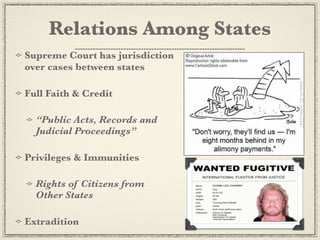
Relations Among States
Supreme Court has jurisdiction
over cases between states

Full Faith & Credit

  “Public Acts, Records and
  Judicial Proceedings”

Privileges & Immunities

  Rights of Citizens from
  Other States

Extradition
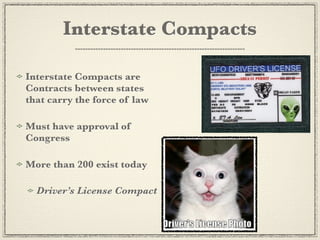
Interstate Compacts

Interstate Compacts are
Contracts between states
that carry the force of law

Must have approval of
Congress

More than 200 exist today

  Driver’s License Compact
Evolution of Federalism

It is important to understand that the application
of federalism is determined by the courts and
ultimately the Supreme Court. The federal
courts interpret the U.S. Constitution. If a
question arises regarding which level of
government should exercise a certain right, it is
the courts that make that determination. Thus,
the courts set the parameters within which
federalism will operate. The Supreme Court is
the “umpire” of the federal system.
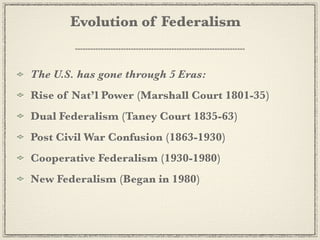
Evolution of Federalism


The U.S. has gone through 5 Eras:
Rise of Nat’l Power (Marshall Court 1801-35)
Dual Federalism (Taney Court 1835-63)
Post Civil War Confusion (1863-1930)
Cooperative Federalism (1930-1980)
New Federalism (Began in 1980)
Federalism & the
    Marshall Court
  McCulloch v. Maryland (1819)
     Gibbons v. Ogden (1824)
THE RISE OF NATIONAL POWER
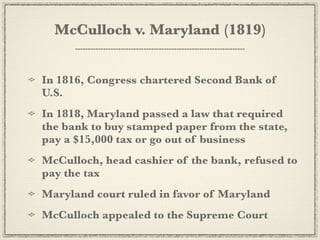
McCulloch v. Maryland (1819)


In 1816, Congress chartered Second Bank of
U.S.
In 1818, Maryland passed a law that required
the bank to buy stamped paper from the state,
pay a $15,000 tax or go out of business
McCulloch, head cashier of the bank, refused to
pay the tax
Maryland court ruled in favor of Maryland
McCulloch appealed to the Supreme Court
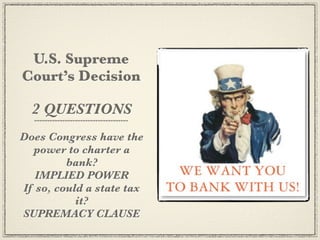
U.S. Supreme
Court’s Decision

  2 QUESTIONS
Does Congress have the
  power to charter a
         bank?
   IMPLIED POWER
If so, could a state tax
           it?
SUPREMACY CLAUSE
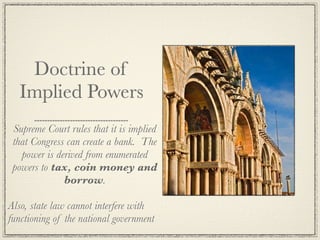
Doctrine of
  Implied Powers
 Supreme Court rules that it is implied
 that Congress can create a bank. The
   power is derived from enumerated
 powers to tax, coin money and
              borrow.

Also, state law cannot interfere with
functioning of the national government
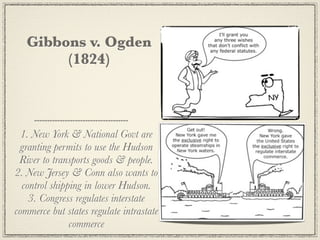
Gibbons v. Ogden
        (1824)


  1. New York & National Govt are
 granting permits to use the Hudson
 River to transports goods & people.
2. New Jersey & Conn also wants to
  control shipping in lower Hudson.
    3. Congress regulates interstate
commerce but states regulate intrastate
               commerce
Ruling

What is the scope of Congress’s power to regulate
interstate commerce? (Need a working definition of
commerce to answer this.)
SC ruled that commerce includes all commercial
activity and has no limits except what is specifically
stated in the Constitution
New York’s actions interfered with interstate
commerce and were therefore unconstitutional
(violates supremacy clause)
The Era of Dual
         Federalism
                  1835-1863
  Taney Court will scale back definition of
interstate trade, therefore, decreasing national
        power in the area of commerce
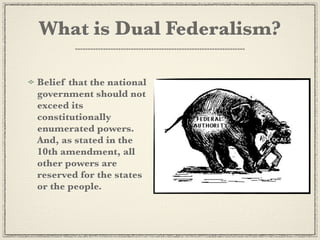
What is Dual Federalism?

Belief that the national
government should not
exceed its
constitutionally
enumerated powers.
And, as stated in the
10th amendment, all
other powers are
reserved for the states
or the people.
The Question of Slavery
Dred Scott v. Sandford (1857)
  Lived in Wisconsin at one time. This is free state under the
  Missouri Compromise.
Court ruled that the Missouri Compromise was unconstitutional
because Congress lacked the authority to ban slavery.
Only the states had this power.
  Emancipation Proclamation....13th Amendment
  Ruling scaled back national power in favor of state power
Following the Civil War (1863-1930‘s) the court remained
committed to dual federalism but their rulings were inconsistent
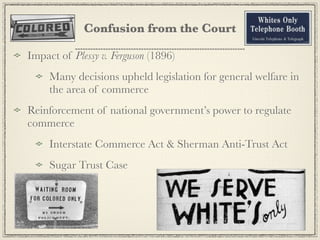
Confusion from the Court

Impact of Plessy v. Ferguson (1896)
     Many decisions upheld legislation for general welfare in
     the area of commerce
Reinforcement of national government’s power to regulate
commerce
     Interstate Commerce Act & Sherman Anti-Trust Act
     Sugar Trust Case
Setting the stage....
For a stronger national government

              1895
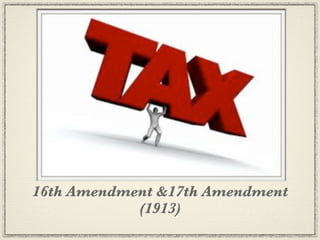
16th Amendment &17th Amendment
            (1913)
Cooperative Federalism
   The New Deal & Growth of
      National Government
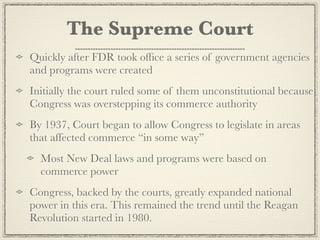
The Supreme Court
Quickly after FDR took office a series of government agencies
and programs were created
Initially the court ruled some of them unconstitutional because
Congress was overstepping its commerce authority
By 1937, Court began to allow Congress to legislate in areas
that affected commerce “in some way”
  Most New Deal laws and programs were based on
  commerce power
Congress, backed by the courts, greatly expanded national
power in this era. This remained the trend until the Reagan
Revolution started in 1980.
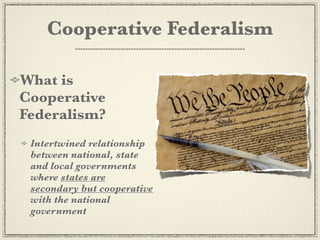
Cooperative Federalism

What is
Cooperative
Federalism?
 Intertwined relationship
 between national, state
 and local governments
 where states are
 secondary but cooperative
 with the national
 government
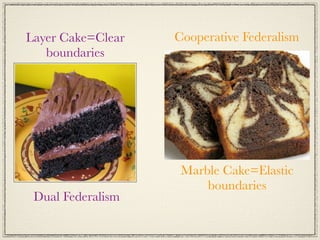
Layer Cake=Clear   Cooperative Federalism
   boundaries


                    Marble Cake=Elastic
                        boundaries
 Dual Federalism
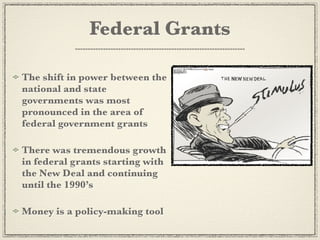
Federal Grants

The shift in power between the
national and state
governments was most
pronounced in the area of
federal government grants

There was tremendous growth
in federal grants starting with
the New Deal and continuing
until the 1990’s

Money is a policy-making tool
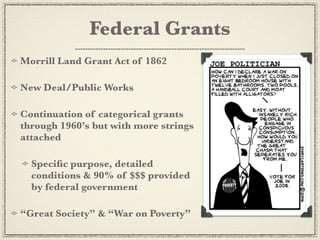
Federal Grants
Morrill Land Grant Act of 1862

New Deal/Public Works

Continuation of categorical grants
through 1960’s but with more strings
attached

  Specific purpose, detailed
  conditions & 90% of $$$ provided
  by federal government

“Great Society” & “War on Poverty”
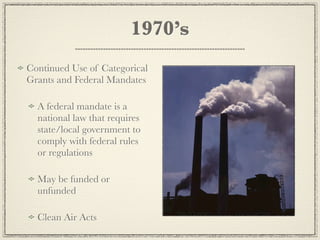
1970’s
Continued Use of Categorical
Grants and Federal Mandates

  A federal mandate is a
  national law that requires
  state/local government to
  comply with federal rules
  or regulations

  May be funded or
  unfunded

  Clean Air Acts
New Federalism
Bipartisan Effort to Return Power
           to the States
Reagan Revolution


Ronald Reagan & George H.W. Bush cut aid to states and
  categorical grants became block grants that had few
    strings attached. The hope was the states would
  experiment and become more efficient with federal
                        money.
Bill Clinton
Clinton was more favorable of federal programs
but had to work with a Republican Congress

  Contract with America

  Devolution Revolution

Unfunded Mandates Reform Act

Personal Responsibility & Work
Opportunity Act of 1996

  “Welfare to Work” Reform
Federalism & the Bush
   Administration
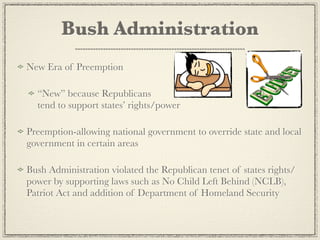
Bush Administration
New Era of Preemption

  “New” because Republicans
  tend to support states’ rights/power

Preemption-allowing national government to override state and local
government in certain areas

Bush Administration violated the Republican tenet of states rights/
power by supporting laws such as No Child Left Behind (NCLB),
Patriot Act and addition of Department of Homeland Security
The Supreme Court
  A Return to State Rights?
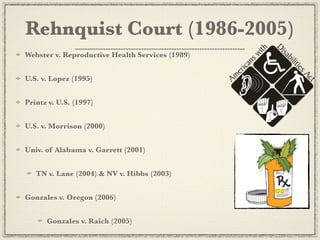
Rehnquist Court (1986-2005)
Webster v. Reproductive Health Services (1989)


U.S. v. Lopez (1995)


Printz v. U.S. (1997)


U.S. v. Morrison (2000)


Univ. of Alabama v. Garrett (2001)


   TN v. Lane (2004) & NV v. Hibbs (2003)


Gonzales v. Oregon (2006)


      Gonzales v. Raich (2005)
Advantages


Advantages: management of social/political
conflict (problems differ)
Encourages innovation & Diminishes risk
Easier access.....more participation
More protection of individual freedom
Allows greater diversity of opinion in public
policy
Disadvantages


Coordination of efforts....duplication
Local biases can damage national interest
Undue delays and obstruction
Justice may be unevenly applied
Local autonomy can get in the way of national
unity

Keynote 3

  • 1.
  • 2.
    Background There were 3main perspectives among the delegates to the Philadelphia Meeting Unitary Government Confederation Federal Government
  • 3.
    The Powers ofNational & State Governments What Does the Constitution State?
  • 4.
    Enumerated Powers (ArticleI, Sec. 8) Power to tax, borrow, spend, regulate interstate commerce, coin money, declare war, raise & maintain an army, conduct foreign affairs and create a national court system Necessary & Proper Clause Implied Powers
  • 5.
    Article VI declaresthe Constitution is the “supreme law of the land” and that the national government prevails in the case of a conflict between national & state government
  • 6.
    State Powers (Reserve/PolicePowers) are not listed in the Constitution...Why?
  • 7.
    State Powers “Time, Placeand Manner” for Elections Guarantees 2 Senators States Must Appoint Electors to Vote for President Guarantees Republican Form of Government Guarantees States Protection from Domestic Rebellion or Foreign Attack Ratify proposed amendments to U.S. Constitution
  • 8.
    10th Amendment “The powersnot delegated to the United States by the Constitution, nor prohibited by it to the States, are reserved for the States respectively, or to the people.”
  • 9.
    Nature of Federalism CONFLICT BETWEEN “Necessary & Proper” Clause (Implied Powers) vs. Debate Over What is NOT Stated 10th Amendment
  • 10.
    The powers grantedto the states via the 10th Amendment are known as police or reserve powers. They include the power to legislate for the public health, safety, and morals of their citizens.
  • 11.
    Concurrent Powers Powers givento both national and state governments Power to tax Power to borrow money Power to establish courts
  • 12.
    Powers Denied States: Entering into treaties with foreign nations Coin money Impairing obligations of contracts Entering compacts without Congressional approval National: Congress may not discriminate against a state in regulating commerce Congress cannot tax exports Congress cannot ban slave trade (1808) Deny writ of habeas corpus, pass law of attainder or ex post facto law (both)
  • 13.
    Relations Among the States Full Faith & Credit, Privileges and Immunities and Extradition
  • 14.
    Relations Among States SupremeCourt has jurisdiction over cases between states Full Faith & Credit “Public Acts, Records and Judicial Proceedings” Privileges & Immunities Rights of Citizens from Other States Extradition
  • 15.
    Interstate Compacts Interstate Compactsare Contracts between states that carry the force of law Must have approval of Congress More than 200 exist today Driver’s License Compact
  • 16.
    Evolution of Federalism Itis important to understand that the application of federalism is determined by the courts and ultimately the Supreme Court. The federal courts interpret the U.S. Constitution. If a question arises regarding which level of government should exercise a certain right, it is the courts that make that determination. Thus, the courts set the parameters within which federalism will operate. The Supreme Court is the “umpire” of the federal system.
  • 17.
    Evolution of Federalism TheU.S. has gone through 5 Eras: Rise of Nat’l Power (Marshall Court 1801-35) Dual Federalism (Taney Court 1835-63) Post Civil War Confusion (1863-1930) Cooperative Federalism (1930-1980) New Federalism (Began in 1980)
  • 18.
    Federalism & the Marshall Court McCulloch v. Maryland (1819) Gibbons v. Ogden (1824) THE RISE OF NATIONAL POWER
  • 19.
    McCulloch v. Maryland(1819) In 1816, Congress chartered Second Bank of U.S. In 1818, Maryland passed a law that required the bank to buy stamped paper from the state, pay a $15,000 tax or go out of business McCulloch, head cashier of the bank, refused to pay the tax Maryland court ruled in favor of Maryland McCulloch appealed to the Supreme Court
  • 20.
    U.S. Supreme Court’s Decision 2 QUESTIONS Does Congress have the power to charter a bank? IMPLIED POWER If so, could a state tax it? SUPREMACY CLAUSE
  • 21.
    Doctrine of Implied Powers Supreme Court rules that it is implied that Congress can create a bank. The power is derived from enumerated powers to tax, coin money and borrow. Also, state law cannot interfere with functioning of the national government
  • 22.
    Gibbons v. Ogden (1824) 1. New York & National Govt are granting permits to use the Hudson River to transports goods & people. 2. New Jersey & Conn also wants to control shipping in lower Hudson. 3. Congress regulates interstate commerce but states regulate intrastate commerce
  • 23.
    Ruling What is thescope of Congress’s power to regulate interstate commerce? (Need a working definition of commerce to answer this.) SC ruled that commerce includes all commercial activity and has no limits except what is specifically stated in the Constitution New York’s actions interfered with interstate commerce and were therefore unconstitutional (violates supremacy clause)
  • 24.
    The Era ofDual Federalism 1835-1863 Taney Court will scale back definition of interstate trade, therefore, decreasing national power in the area of commerce
  • 25.
    What is DualFederalism? Belief that the national government should not exceed its constitutionally enumerated powers. And, as stated in the 10th amendment, all other powers are reserved for the states or the people.
  • 26.
    The Question ofSlavery Dred Scott v. Sandford (1857) Lived in Wisconsin at one time. This is free state under the Missouri Compromise. Court ruled that the Missouri Compromise was unconstitutional because Congress lacked the authority to ban slavery. Only the states had this power. Emancipation Proclamation....13th Amendment Ruling scaled back national power in favor of state power Following the Civil War (1863-1930‘s) the court remained committed to dual federalism but their rulings were inconsistent
  • 27.
    Confusion from theCourt Impact of Plessy v. Ferguson (1896) Many decisions upheld legislation for general welfare in the area of commerce Reinforcement of national government’s power to regulate commerce Interstate Commerce Act & Sherman Anti-Trust Act Sugar Trust Case
  • 28.
    Setting the stage.... Fora stronger national government 1895
  • 29.
    16th Amendment &17thAmendment (1913)
  • 30.
    Cooperative Federalism The New Deal & Growth of National Government
  • 31.
    The Supreme Court Quicklyafter FDR took office a series of government agencies and programs were created Initially the court ruled some of them unconstitutional because Congress was overstepping its commerce authority By 1937, Court began to allow Congress to legislate in areas that affected commerce “in some way” Most New Deal laws and programs were based on commerce power Congress, backed by the courts, greatly expanded national power in this era. This remained the trend until the Reagan Revolution started in 1980.
  • 32.
    Cooperative Federalism What is Cooperative Federalism? Intertwined relationship between national, state and local governments where states are secondary but cooperative with the national government
  • 33.
    Layer Cake=Clear Cooperative Federalism boundaries Marble Cake=Elastic boundaries Dual Federalism
  • 34.
    Federal Grants The shiftin power between the national and state governments was most pronounced in the area of federal government grants There was tremendous growth in federal grants starting with the New Deal and continuing until the 1990’s Money is a policy-making tool
  • 35.
    Federal Grants Morrill LandGrant Act of 1862 New Deal/Public Works Continuation of categorical grants through 1960’s but with more strings attached Specific purpose, detailed conditions & 90% of $$$ provided by federal government “Great Society” & “War on Poverty”
  • 36.
    1970’s Continued Use ofCategorical Grants and Federal Mandates A federal mandate is a national law that requires state/local government to comply with federal rules or regulations May be funded or unfunded Clean Air Acts
  • 37.
    New Federalism Bipartisan Effortto Return Power to the States
  • 38.
    Reagan Revolution Ronald Reagan& George H.W. Bush cut aid to states and categorical grants became block grants that had few strings attached. The hope was the states would experiment and become more efficient with federal money.
  • 39.
    Bill Clinton Clinton wasmore favorable of federal programs but had to work with a Republican Congress Contract with America Devolution Revolution Unfunded Mandates Reform Act Personal Responsibility & Work Opportunity Act of 1996 “Welfare to Work” Reform
  • 40.
    Federalism & theBush Administration
  • 41.
    Bush Administration New Eraof Preemption “New” because Republicans tend to support states’ rights/power Preemption-allowing national government to override state and local government in certain areas Bush Administration violated the Republican tenet of states rights/ power by supporting laws such as No Child Left Behind (NCLB), Patriot Act and addition of Department of Homeland Security
  • 42.
    The Supreme Court A Return to State Rights?
  • 43.
    Rehnquist Court (1986-2005) Websterv. Reproductive Health Services (1989) U.S. v. Lopez (1995) Printz v. U.S. (1997) U.S. v. Morrison (2000) Univ. of Alabama v. Garrett (2001) TN v. Lane (2004) & NV v. Hibbs (2003) Gonzales v. Oregon (2006) Gonzales v. Raich (2005)
  • 44.
    Advantages Advantages: management ofsocial/political conflict (problems differ) Encourages innovation & Diminishes risk Easier access.....more participation More protection of individual freedom Allows greater diversity of opinion in public policy
  • 45.
    Disadvantages Coordination of efforts....duplication Localbiases can damage national interest Undue delays and obstruction Justice may be unevenly applied Local autonomy can get in the way of national unity