The Chemical Equation J. Hervol
The Chemical Equation The chemical equation is a written representation of what happens during a chemical reaction. It includes chemical  formulas  and  symbols . J. Hervol
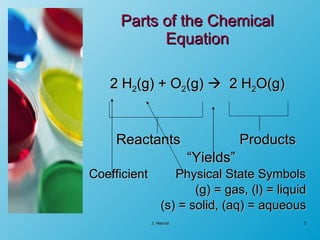
Parts of the Chemical Equation 2 H 2 (g) + O 2 (g)     2 H 2 O(g) Reactants  Products “ Yields” Coefficient  Physical State Symbols (g) = gas, (l) = liquid (s) = solid, (aq) = aqueous J. Hervol
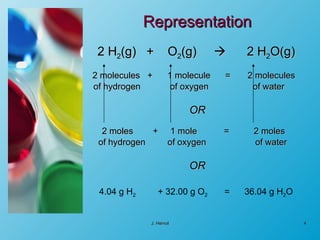
Representation 2 H 2 (g)  +  O 2 (g)     2 H 2 O(g) 2 molecules  +  1 molecule  =  2 molecules of hydrogen  of oxygen  of water OR 2 moles  +  1 mole  =  2 moles of hydrogen  of oxygen  of water OR J. Hervol 4.04 g H 2 + 32.00 g O 2 =  36.04 g H 2 O
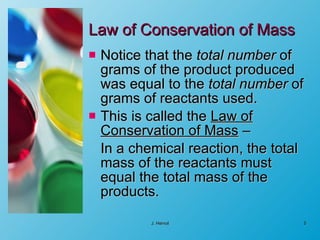
Law of Conservation of Mass Notice that the  total number  of grams of the product produced was equal to the  total number  of grams of reactants used. This is called the  Law of Conservation of Mass  – In a chemical reaction, the total mass of the reactants must equal the total mass of the products.  J. Hervol
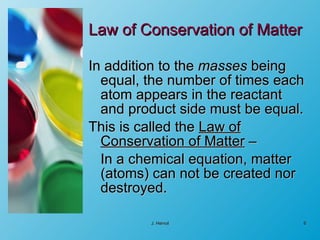
Law of Conservation of Matter In addition to the  masses  being equal, the number of times each atom appears in the reactant and product side must be equal. This is called the  Law of Conservation of Matter  – In a chemical equation, matter (atoms) can not be created nor destroyed. J. Hervol
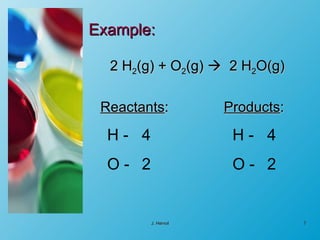
Example: 2 H 2 (g) + O 2 (g)     2 H 2 O(g) Reactants :  Products : J. Hervol H -  O -  H -  O -  4 2 4 2
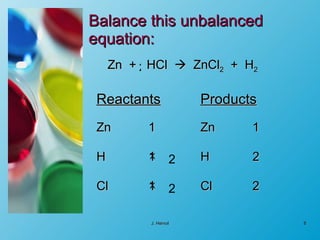
Balance this unbalanced equation: Zn  +  HCl     ZnCl 2   +  H 2 J. Hervol Cl H Zn Reactants 1 1 1 2 Cl 2 H 1 Zn Products 2 X X 2 2
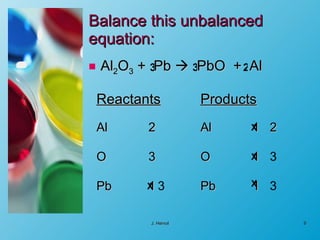
Balance this unbalanced equation: Al 2 O 3  +  Pb     PbO  +  Al J. Hervol Pb O Al Reactants 1 3 2 1 Pb O 1 Al Products 1 2 X 2 3 X 3 X 3 X 3 3
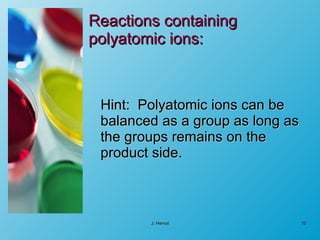
Reactions containing polyatomic ions: Hint:  Polyatomic ions can be balanced as a group as long as the groups remains on the product side. J. Hervol
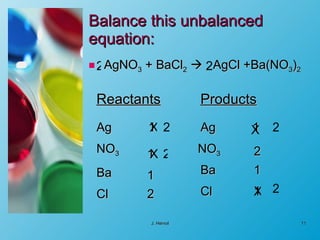
Balance this unbalanced equation: AgNO 3  + BaCl 2      AgCl +Ba(NO 3 ) 2 J. Hervol Ba NO 3 Ag Reactants 1 1 1 1 Ba NO 3 1 Ag Products 2 Cl Cl 2 1 2 X 2 X 2 2 X 2 X 2

The Chemical Equation

  • 1.
  • 2.
    The Chemical EquationThe chemical equation is a written representation of what happens during a chemical reaction. It includes chemical formulas and symbols . J. Hervol
  • 3.
    Parts of theChemical Equation 2 H 2 (g) + O 2 (g)  2 H 2 O(g) Reactants Products “ Yields” Coefficient Physical State Symbols (g) = gas, (l) = liquid (s) = solid, (aq) = aqueous J. Hervol
  • 4.
    Representation 2 H2 (g) + O 2 (g)  2 H 2 O(g) 2 molecules + 1 molecule = 2 molecules of hydrogen of oxygen of water OR 2 moles + 1 mole = 2 moles of hydrogen of oxygen of water OR J. Hervol 4.04 g H 2 + 32.00 g O 2 = 36.04 g H 2 O
  • 5.
    Law of Conservationof Mass Notice that the total number of grams of the product produced was equal to the total number of grams of reactants used. This is called the Law of Conservation of Mass – In a chemical reaction, the total mass of the reactants must equal the total mass of the products. J. Hervol
  • 6.
    Law of Conservationof Matter In addition to the masses being equal, the number of times each atom appears in the reactant and product side must be equal. This is called the Law of Conservation of Matter – In a chemical equation, matter (atoms) can not be created nor destroyed. J. Hervol
  • 7.
    Example: 2 H2 (g) + O 2 (g)  2 H 2 O(g) Reactants : Products : J. Hervol H - O - H - O - 4 2 4 2
  • 8.
    Balance this unbalancedequation: Zn + HCl  ZnCl 2 + H 2 J. Hervol Cl H Zn Reactants 1 1 1 2 Cl 2 H 1 Zn Products 2 X X 2 2
  • 9.
    Balance this unbalancedequation: Al 2 O 3 + Pb  PbO + Al J. Hervol Pb O Al Reactants 1 3 2 1 Pb O 1 Al Products 1 2 X 2 3 X 3 X 3 X 3 3
  • 10.
    Reactions containing polyatomicions: Hint: Polyatomic ions can be balanced as a group as long as the groups remains on the product side. J. Hervol
  • 11.
    Balance this unbalancedequation: AgNO 3 + BaCl 2  AgCl +Ba(NO 3 ) 2 J. Hervol Ba NO 3 Ag Reactants 1 1 1 1 Ba NO 3 1 Ag Products 2 Cl Cl 2 1 2 X 2 X 2 2 X 2 X 2