Boolean Expressions and Boolean Functions
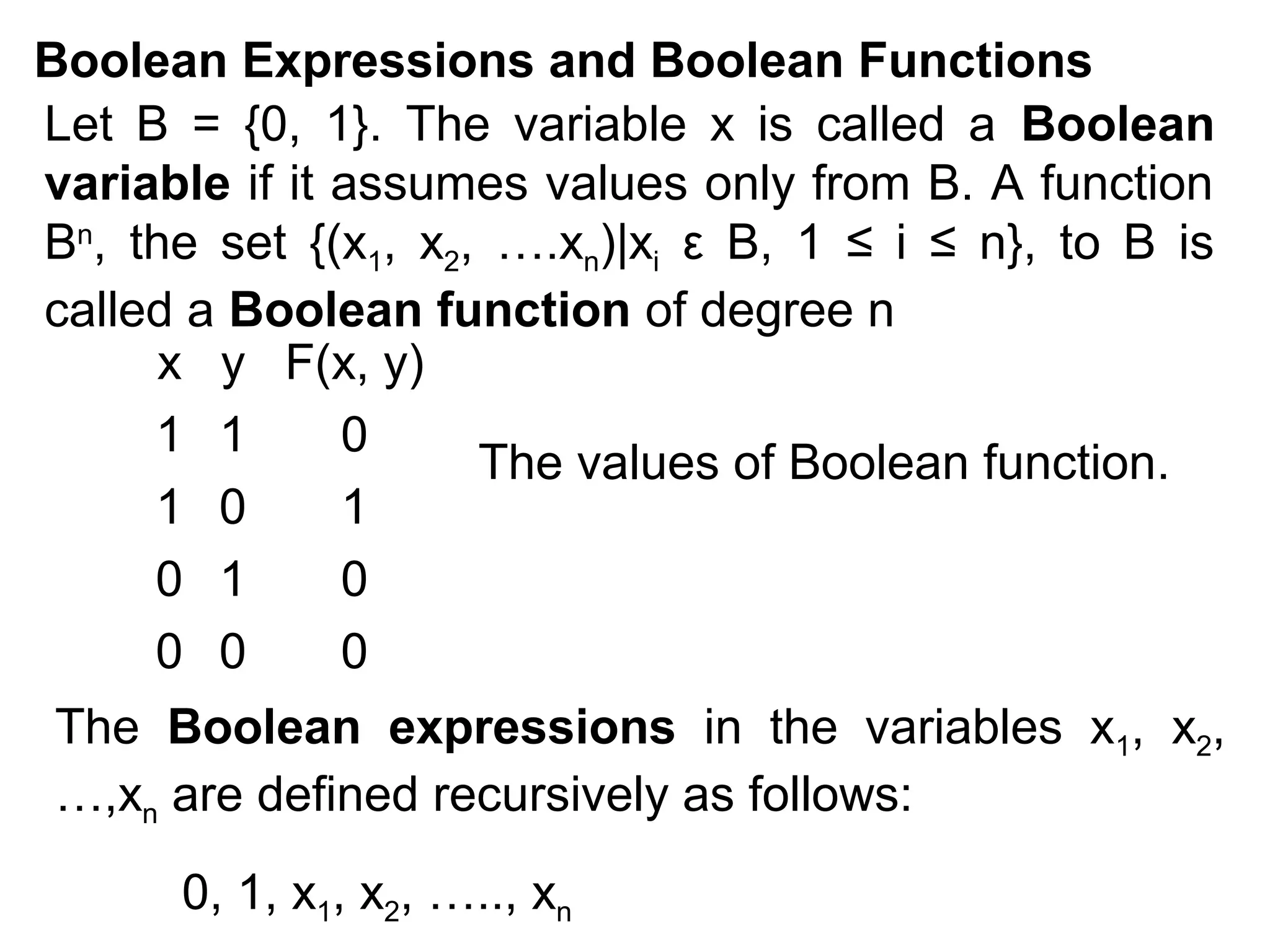
Let B = {0, 1}. The variable x is called a Boolean
variable if it assumes values only from B. A function
Bn, the set {(x1, x2, ….xn)|xi ε B, 1 ≤ i ≤ n}, to B is
called a Boolean function of degree n
x y F(x, y)
1 1
0
The values of Boolean function.
1 0
1
0 1
0
0 0
0
The Boolean expressions in the variables x1, x2,
…,xn are defined recursively as follows:
0, 1, x1, x2, ….., xn
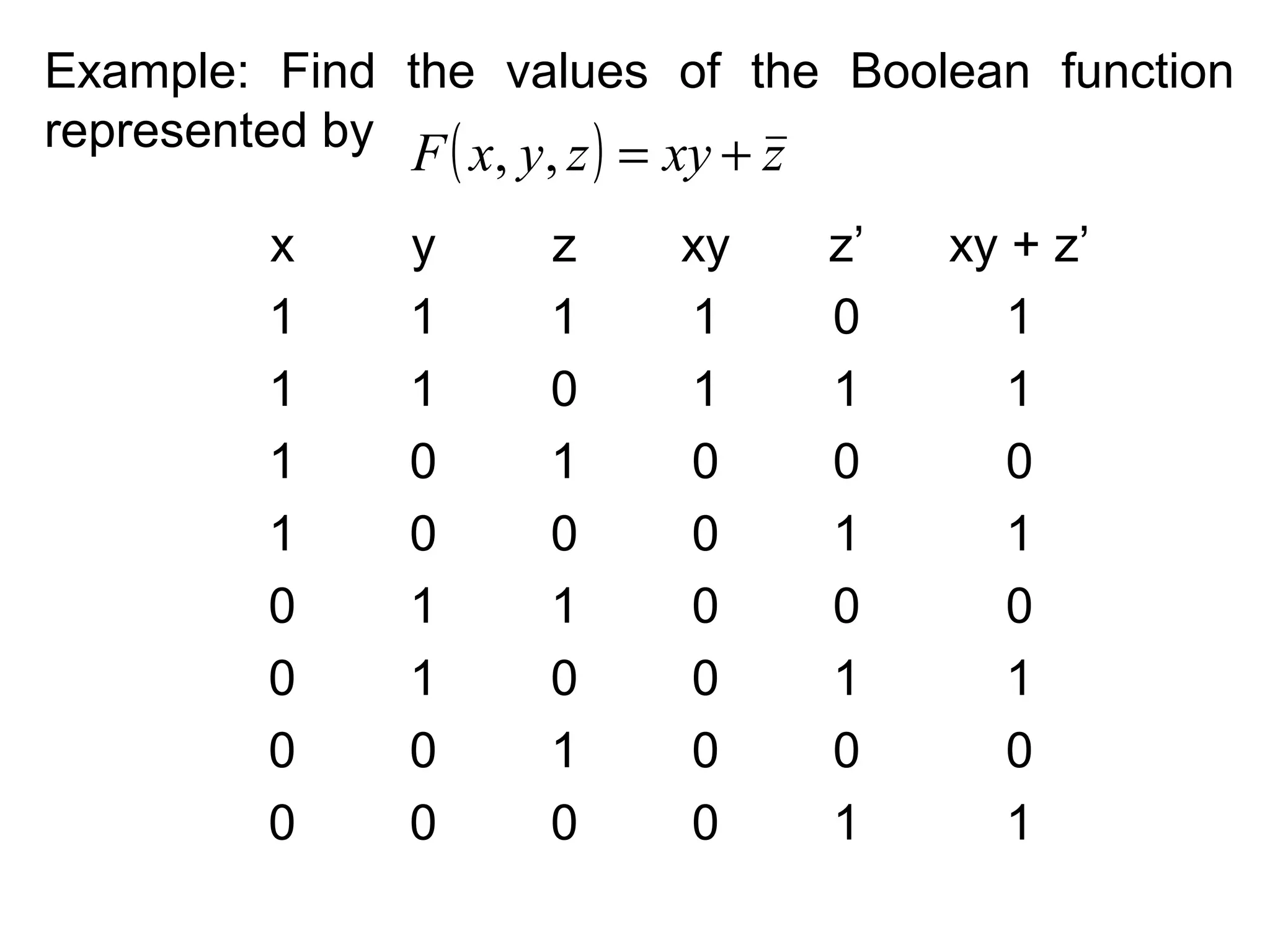
Example: Find the values of the Boolean function
represented by F ( x, y, z ) = xy + z
x
1
1
1
1
0
0
0
0

y
1
1
0
0
1
1
0
0

z
1
0
1
0
1
0
1
0

xy
1
1
0
0
0
0
0
0

z’
0
1
0
1
0
1
0
1

xy + z’
1
1
0
1
0
1
0
1
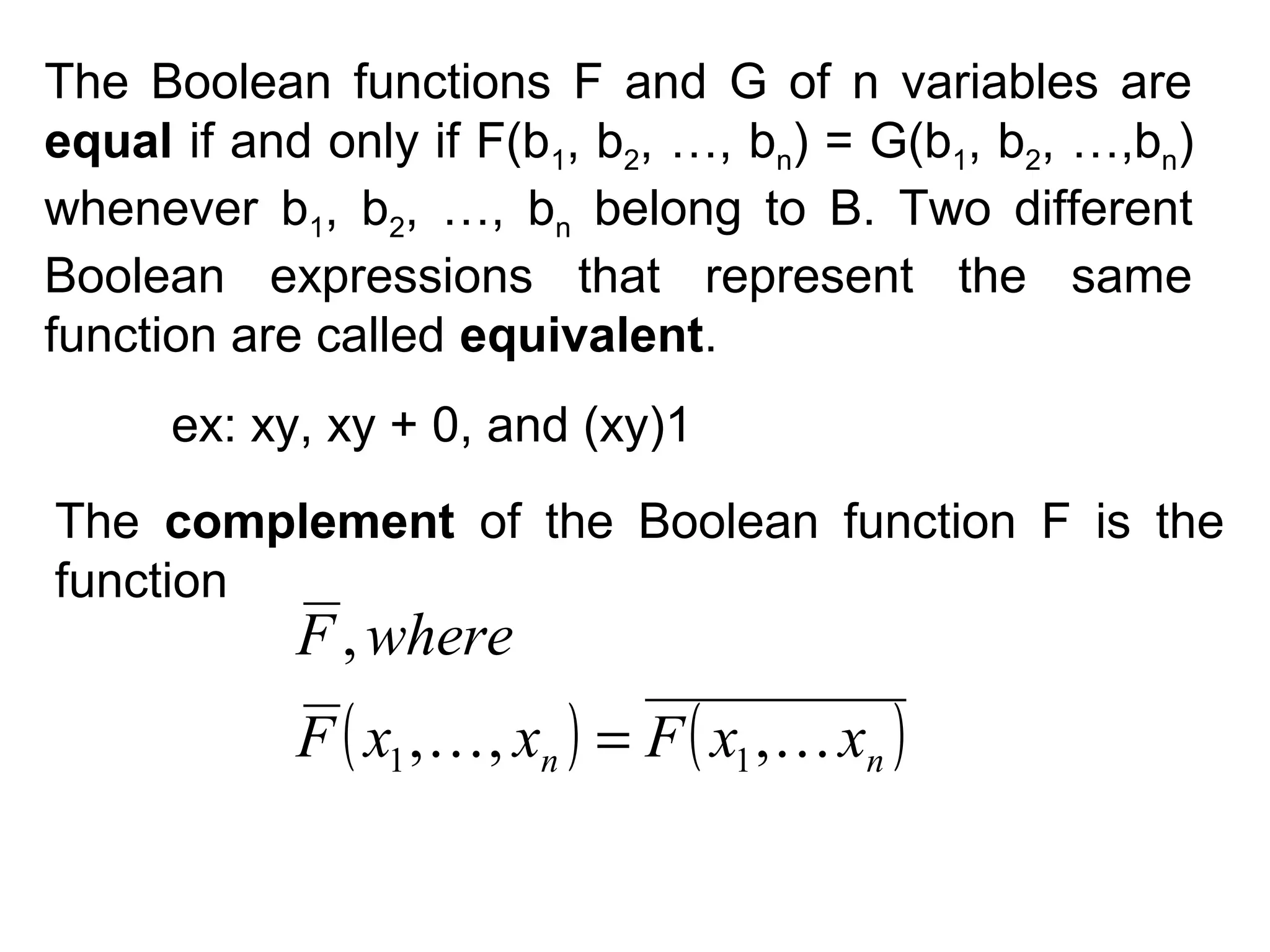
The Boolean functions F and G of n variables are
equal if and only if F(b1, b2, …, bn) = G(b1, b2, …,bn)
whenever b1, b2, …, bn belong to B. Two different
Boolean expressions that represent the same
function are called equivalent.
ex: xy, xy + 0, and (xy)1
The complement of the Boolean function F is the
function

F , where

F ( x1 ,  , xn ) = F ( x1 ,  xn )
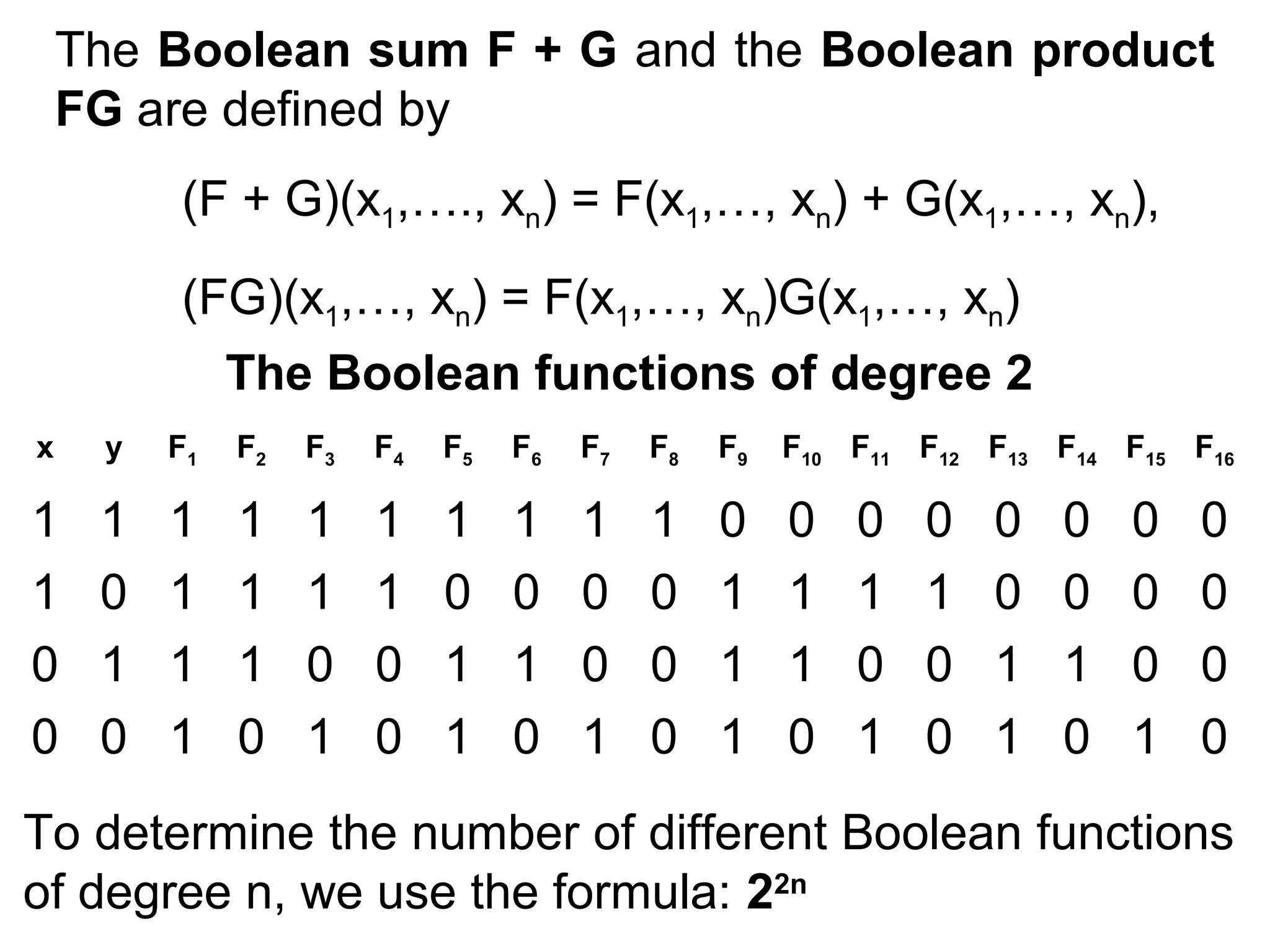
The Boolean sum F + G and the Boolean product
FG are defined by
(F + G)(x1,…., xn) = F(x1,…, xn) + G(x1,…, xn),
(FG)(x1,…, xn) = F(x1,…, xn)G(x1,…, xn)
The Boolean functions of degree 2
x

y

F1

F2

F3

F4

F5

F6

F7

F8

F9

F10 F11 F12 F13 F14 F15 F16

1
1
0
0

1
0
1
0

1
1
1
1

1
1
1
0

1
1
0
1

1
1
0
0

1
0
1
1

1
0
1
0

1
0
0
1

1
0
0
0

0
1
1
1

0
1
1
0

0
1
0
1

0
1
0
0

0
0
1
1

0
0
1
0

0
0
0
1

0
0
0
0

To determine the number of different Boolean functions
of degree n, we use the formula: 22n
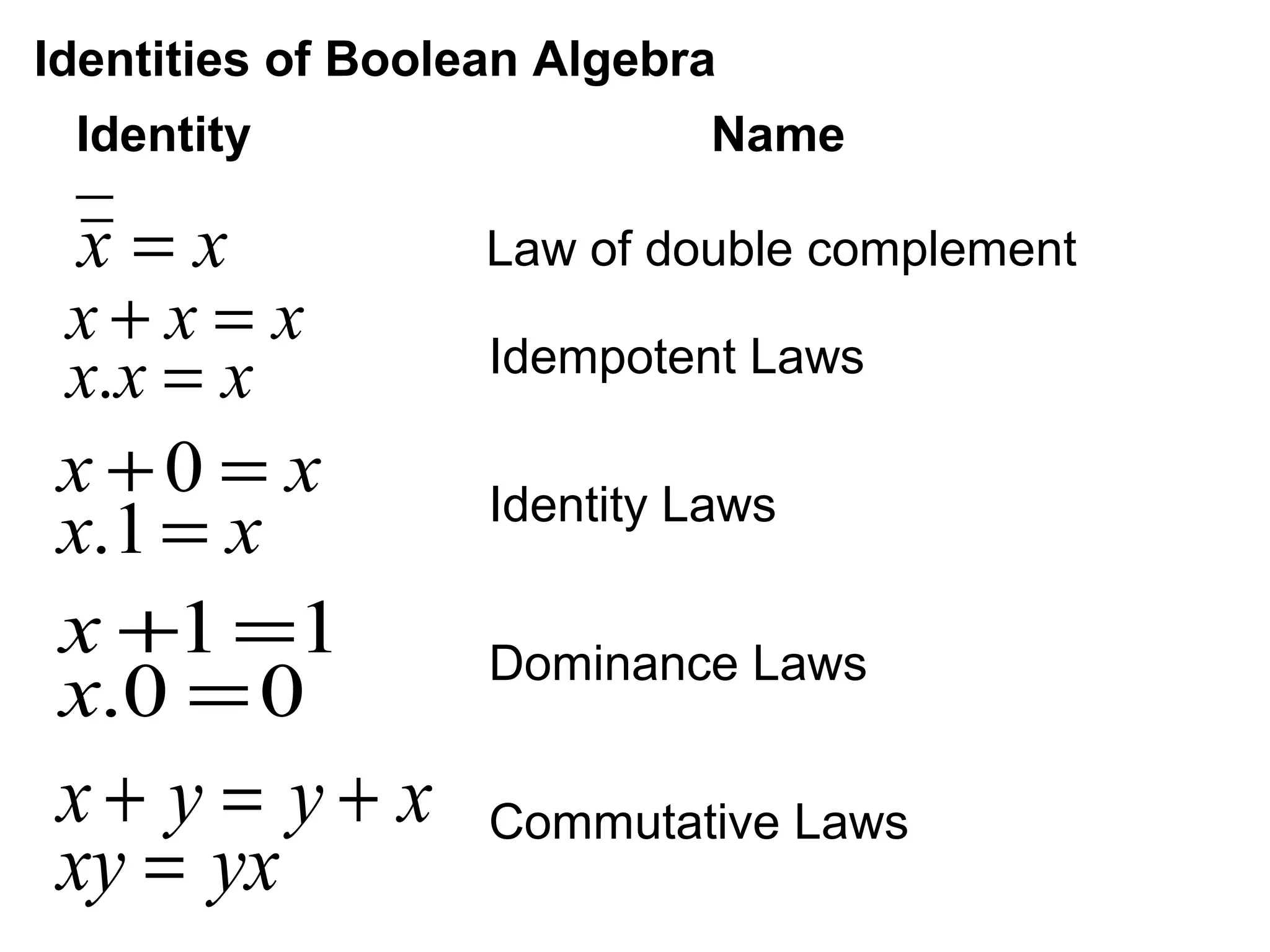
Identities of Boolean Algebra
Identity

Name

x=x

Law of double complement

x+x = x
x.x = x

x +0 = x
x.1 = x
x +1 =1
x.0 = 0

x+ y = y+ x
xy = yx

Idempotent Laws
Identity Laws
Dominance Laws
Commutative Laws
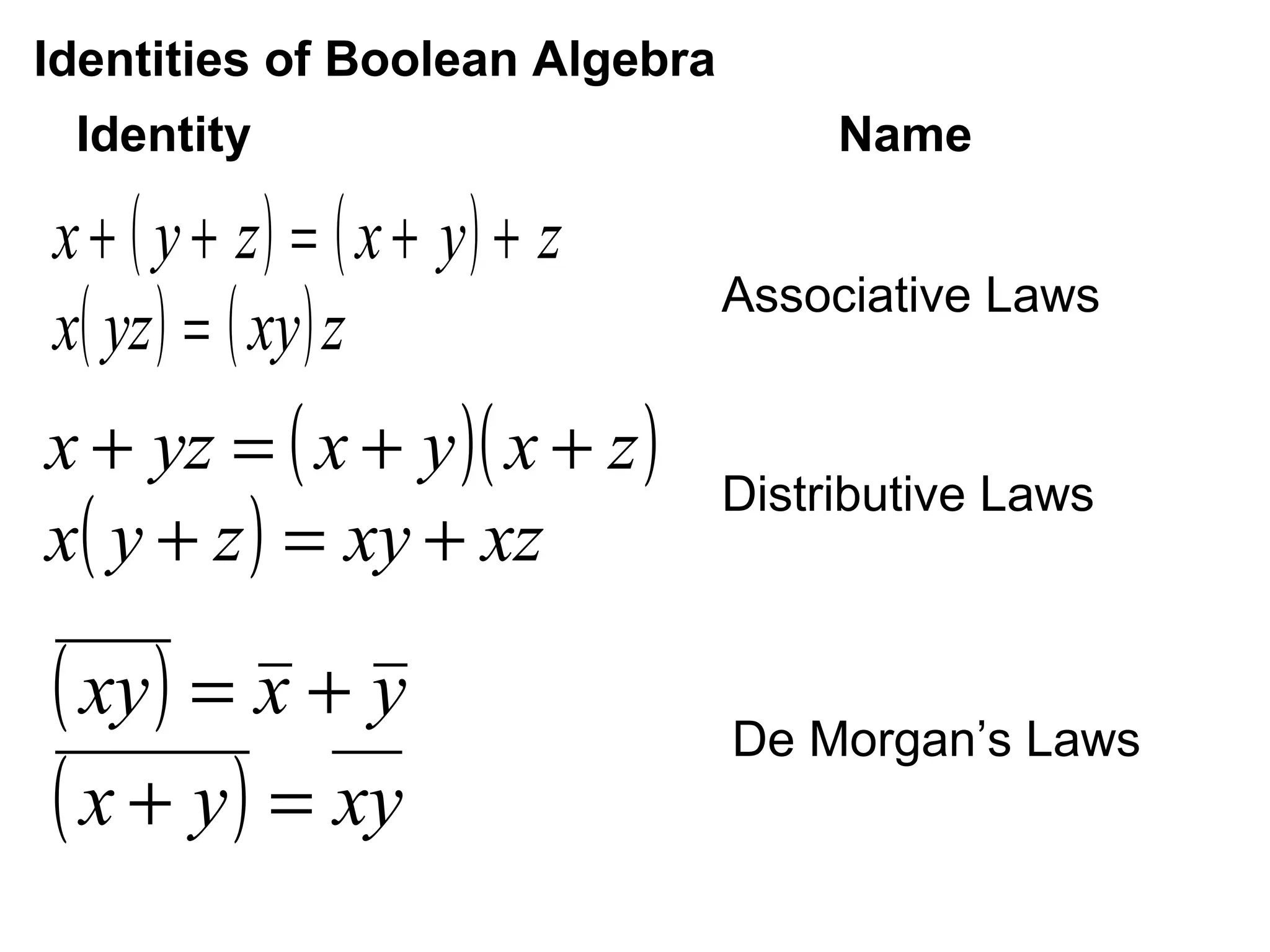
Identities of Boolean Algebra
Identity

x + ( y + z) = ( x + y) + z
x( yz ) = ( xy ) z

Name
Associative Laws

x + yz = ( x + y )( x + z )
x( y + z ) = xy + xz

Distributive Laws

( xy ) = x + y
( x + y ) = xy

De Morgan’s Laws
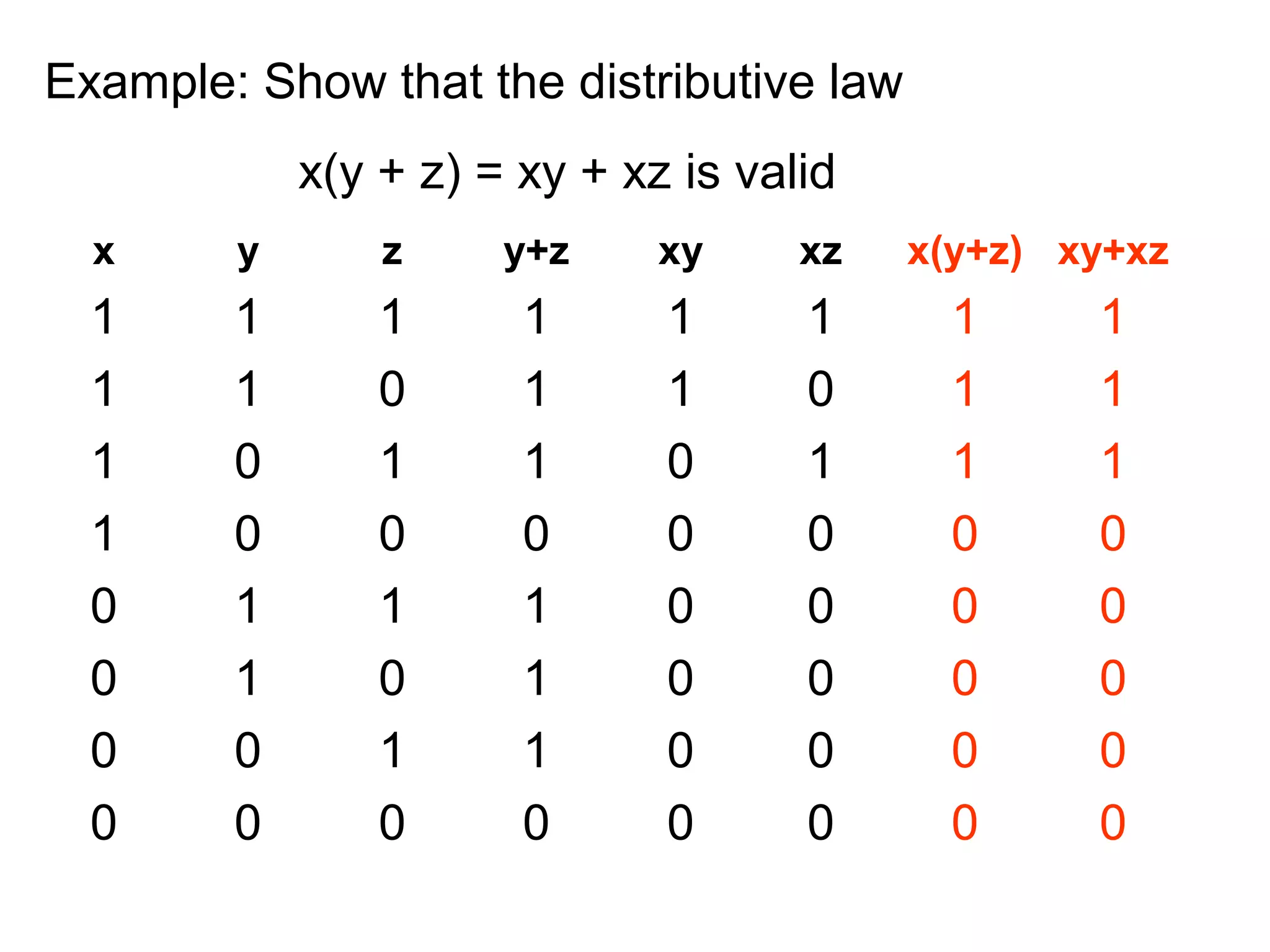
Example: Show that the distributive law
x(y + z) = xy + xz is valid
x

y

z

y+z

xy

xz

1
1
1
1
0
0
0
0

1
1
0
0
1
1
0
0

1
0
1
0
1
0
1
0

1
1
1
0
1
1
1
0

1
1
0
0
0
0
0
0

1
0
1
0
0
0
0
0

x(y+z) xy+xz

1
1
1
0
0
0
0
0

1
1
1
0
0
0
0
0
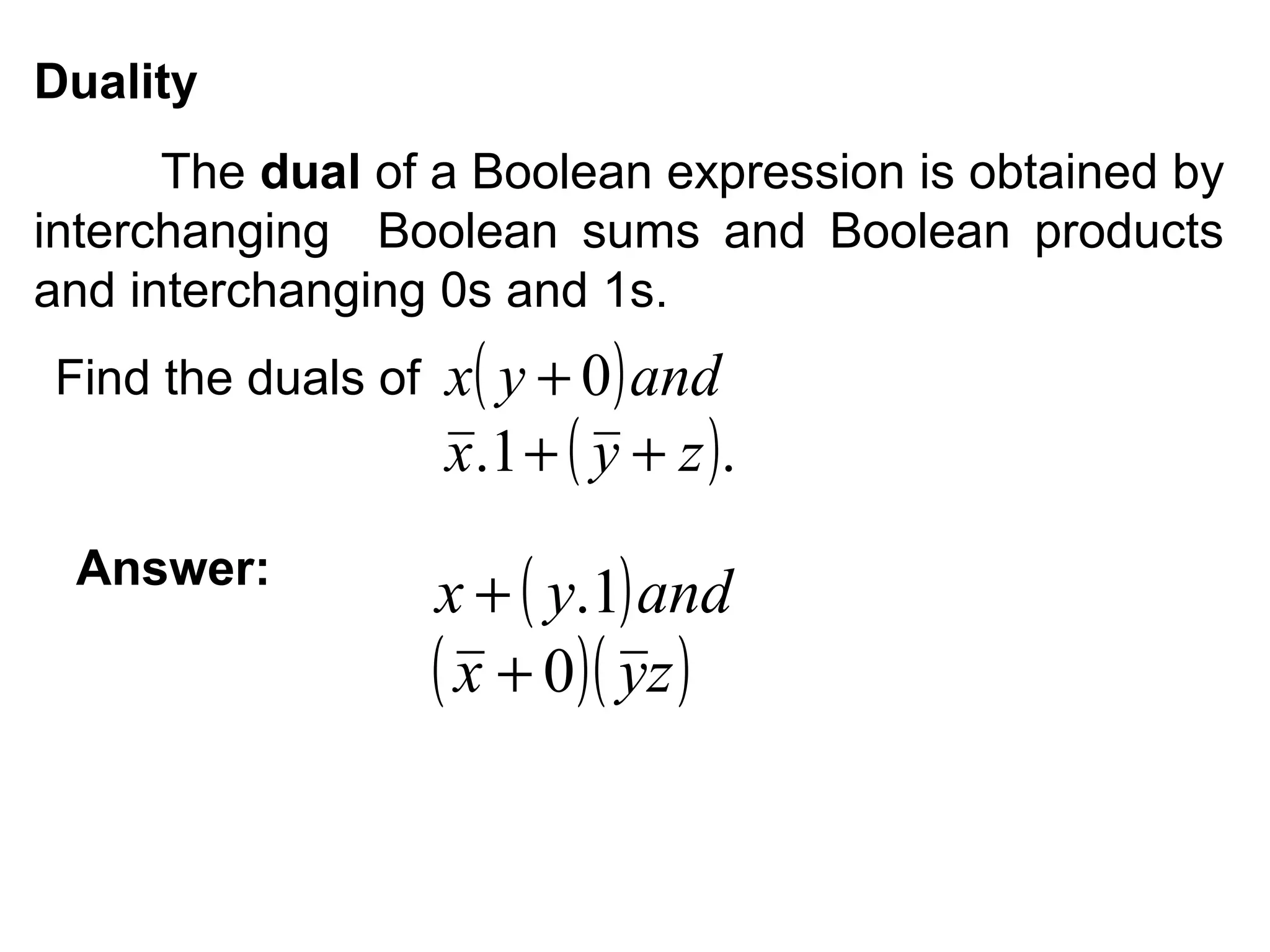
Duality
The dual of a Boolean expression is obtained by
interchanging Boolean sums and Boolean products
and interchanging 0s and 1s.
Find the duals of

Answer:

x( y + 0 ) and
x .1 + ( y + z ) .

x + ( y.1) and
( x + 0)( yz )
Note:
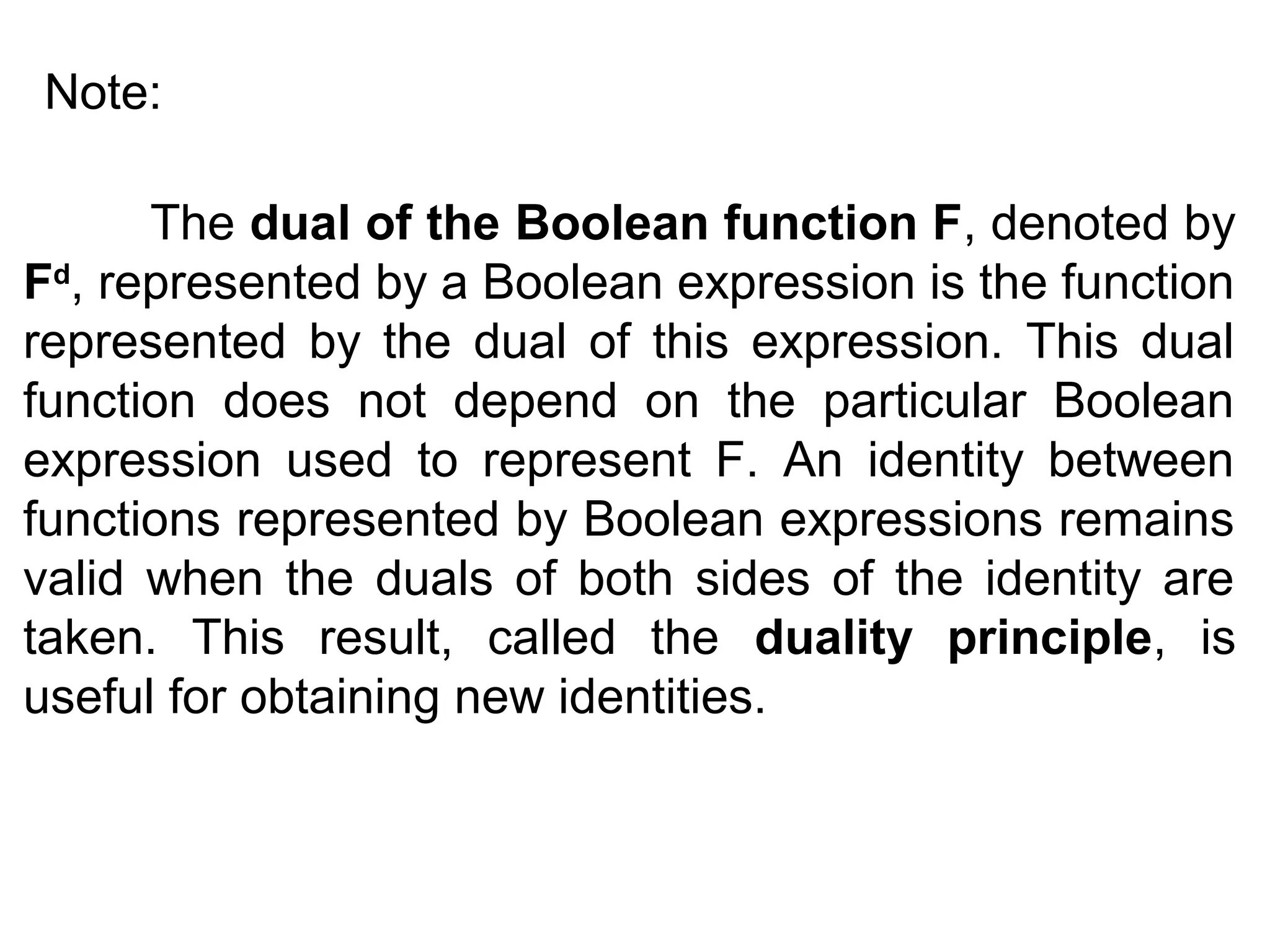
The dual of the Boolean function F, denoted by
Fd, represented by a Boolean expression is the function
represented by the dual of this expression. This dual
function does not depend on the particular Boolean
expression used to represent F. An identity between
functions represented by Boolean expressions remains
valid when the duals of both sides of the identity are
taken. This result, called the duality principle, is
useful for obtaining new identities.
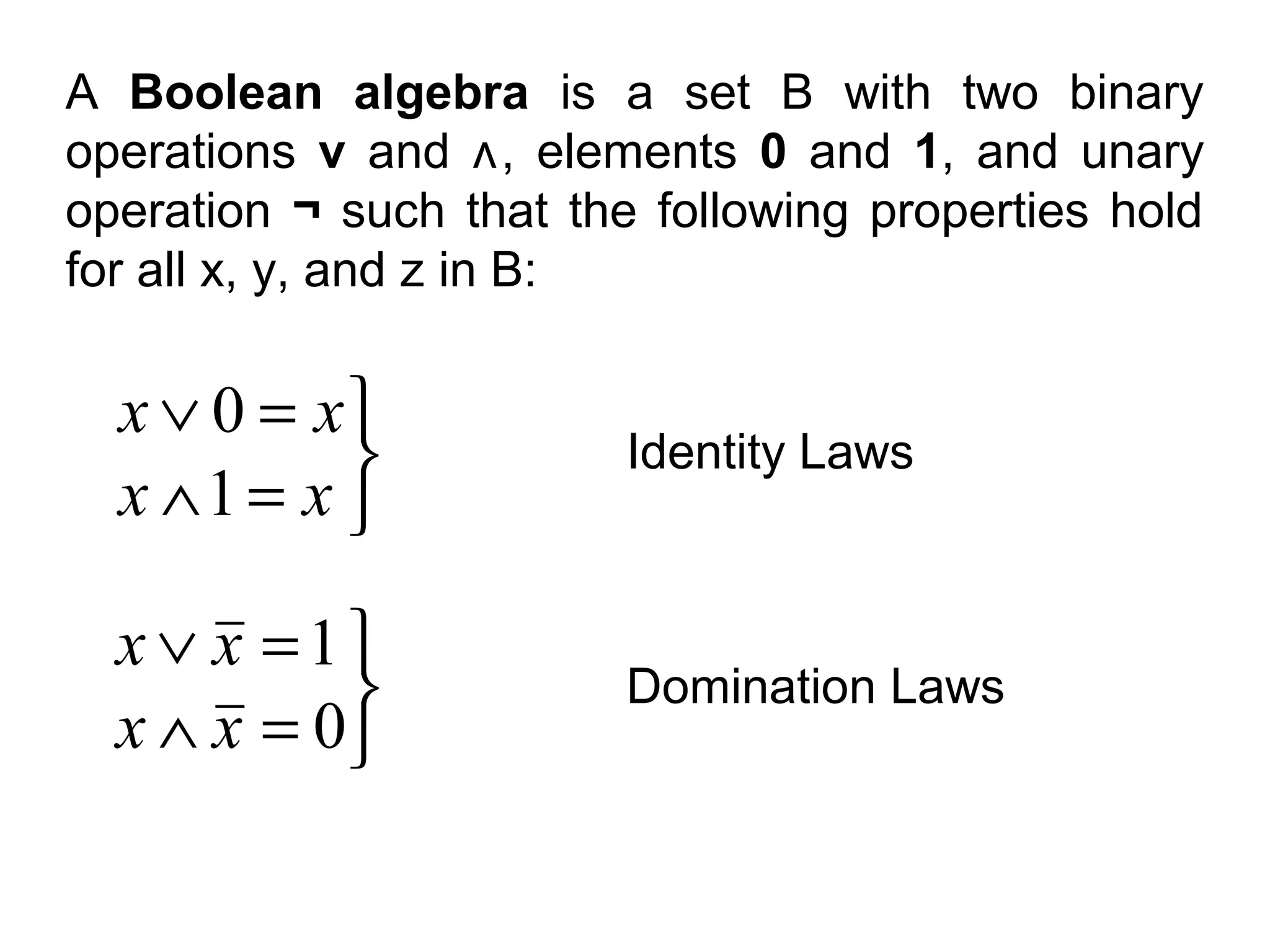
A Boolean algebra is a set B with two binary
operations v and ʌ, elements 0 and 1, and unary
operation ¬ such that the following properties hold
for all x, y, and z in B:

x ∨ 0 = x

x ∧1 = x 

Identity Laws

x ∨ x =1

x ∧ x = 0

Domination Laws
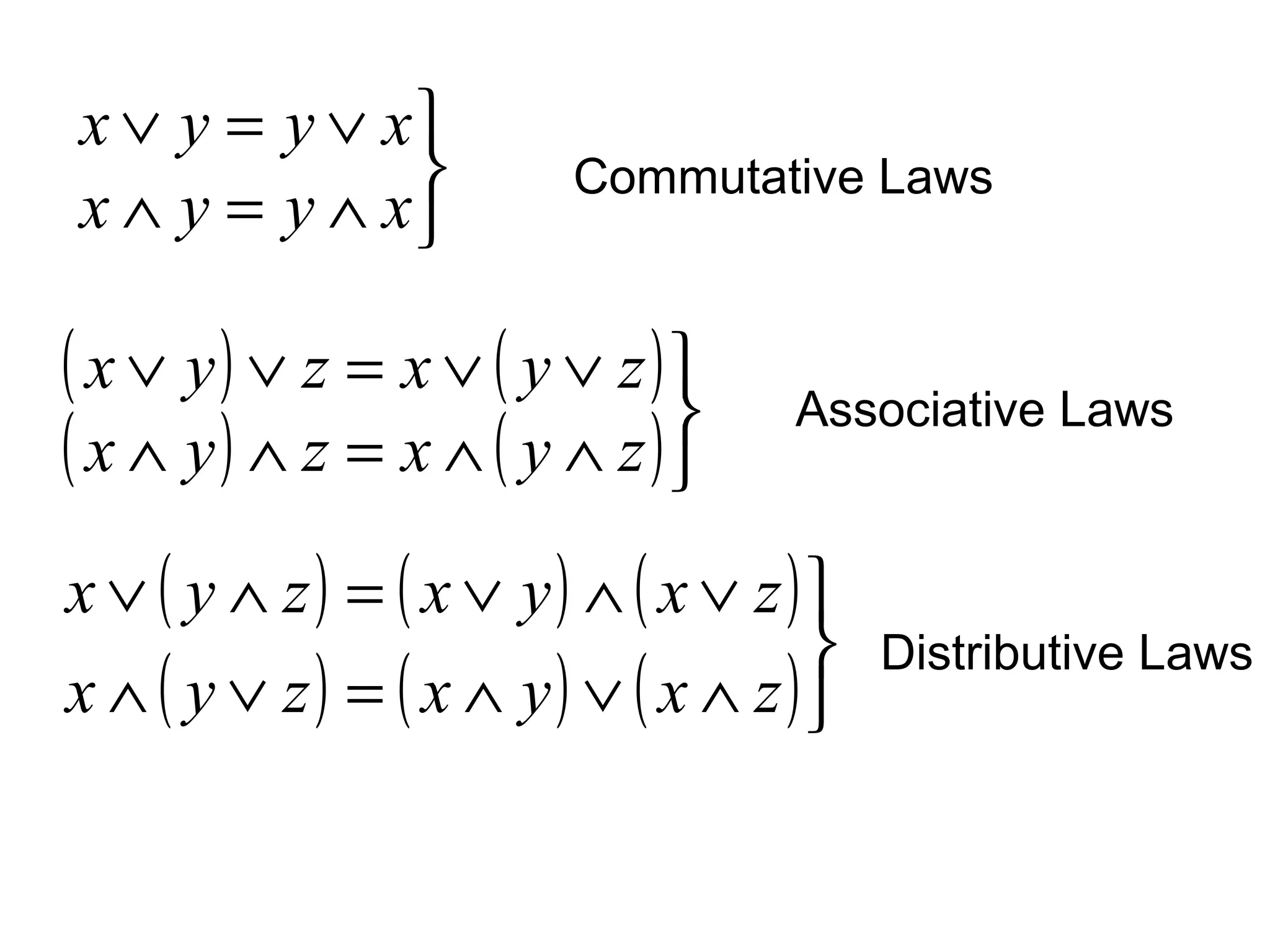
x ∨ y = y ∨ x

x ∧ y = y ∧ x

Commutative Laws

( x ∨ y) ∨ z = x ∨ ( y ∨ z)

( x ∧ y) ∧ z = x ∧ ( y ∧ z)

Associative Laws

x ∨ ( y ∧ z) = ( x ∨ y) ∧ ( x ∨ z)

x ∧ ( y ∨ z) = ( x ∧ y) ∨ ( x ∧ z)

Distributive Laws
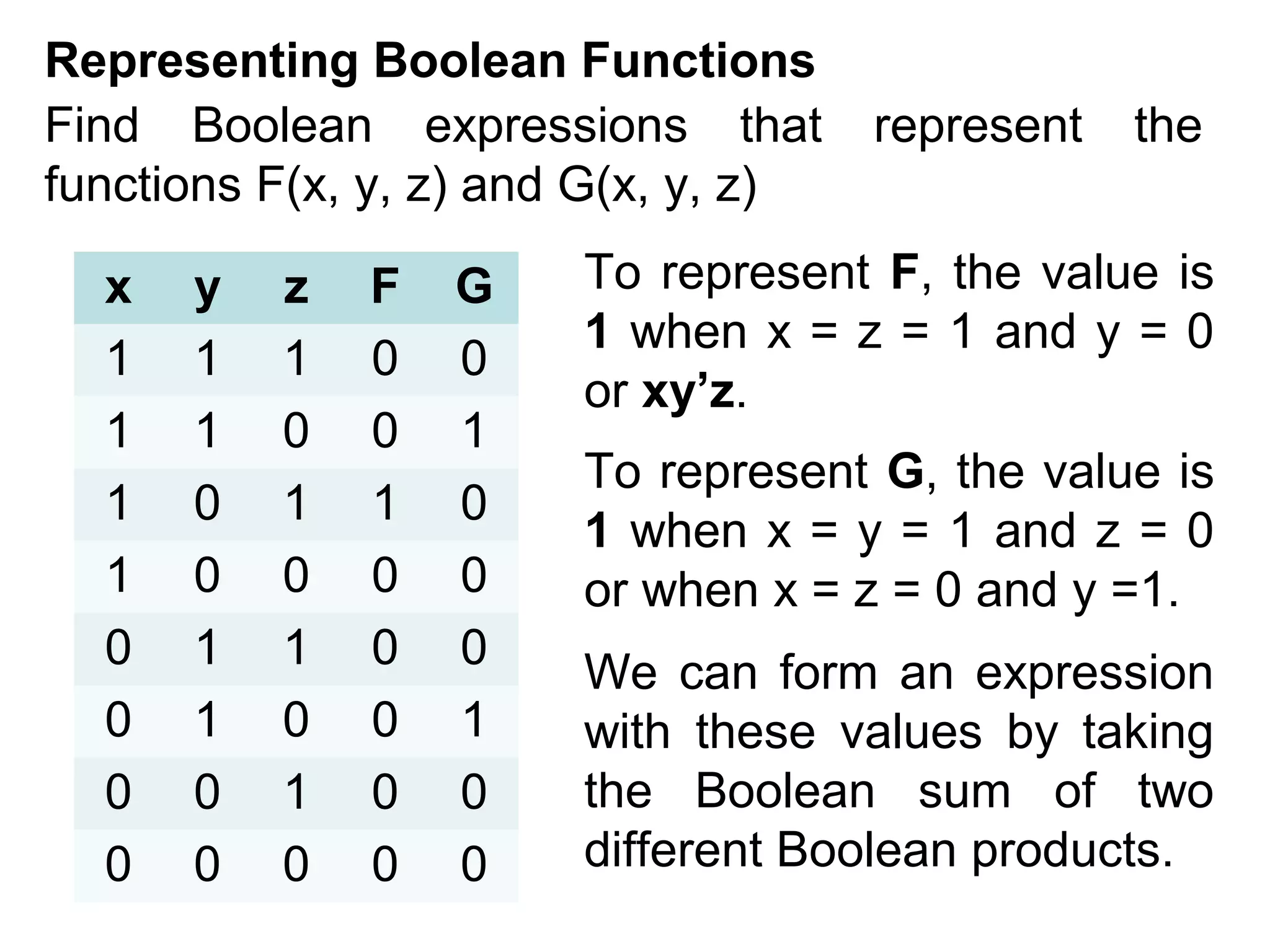
Representing Boolean Functions
Find Boolean expressions that
functions F(x, y, z) and G(x, y, z)
x
1
1
1
1
0
0
0
0

y
1
1
0
0
1
1
0
0

z
1
0
1
0
1
0
1
0

F
0
0
1
0
0
0
0
0

G
0
1
0
0
0
1
0
0

represent

the

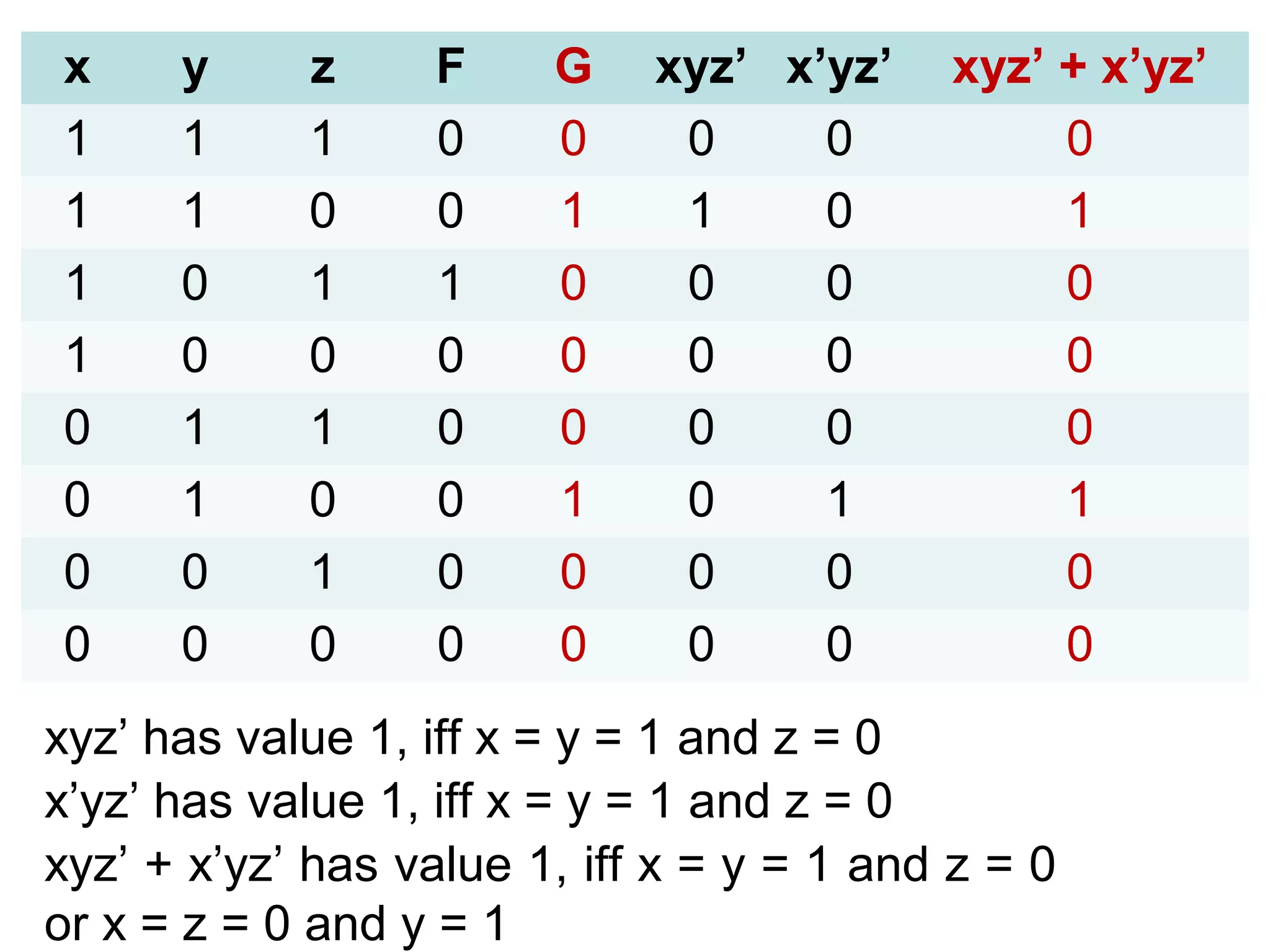
To represent F, the value is
1 when x = z = 1 and y = 0
or xy’z.
To represent G, the value is
1 when x = y = 1 and z = 0
or when x = z = 0 and y =1.
We can form an expression
with these values by taking
the Boolean sum of two
different Boolean products.
x
1
1
1
1
0
0
0
0

y
1
1
0
0
1
1
0
0

z
1
0
1
0
1
0
1
0

F
0
0
1
0
0
0
0
0

G
0
1
0
0
0
1
0
0

xyz’ x’yz’
0
0
1
0
0
0
0
0
0
0
0
1
0
0
0
0

xyz’ + x’yz’
0
1
0
0
0
1
0
0

xyz’ has value 1, iff x = y = 1 and z = 0
x’yz’ has value 1, iff x = y = 1 and z = 0
xyz’ + x’yz’ has value 1, iff x = y = 1 and z = 0
or x = z = 0 and y = 1
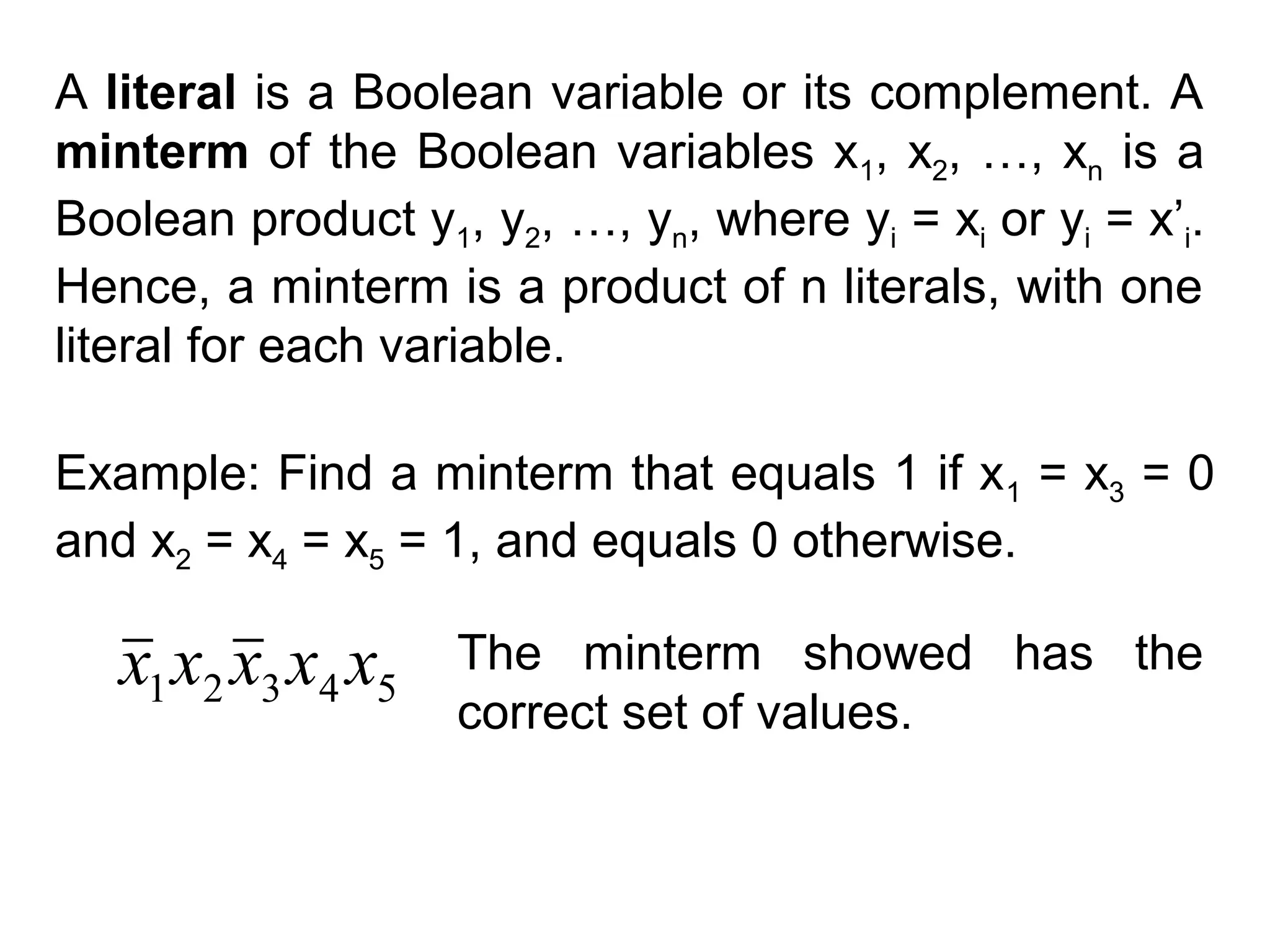
A literal is a Boolean variable or its complement. A
minterm of the Boolean variables x1, x2, …, xn is a
Boolean product y1, y2, …, yn, where yi = xi or yi = x’i.
Hence, a minterm is a product of n literals, with one
literal for each variable.
Example: Find a minterm that equals 1 if x 1 = x3 = 0
and x2 = x4 = x5 = 1, and equals 0 otherwise.

x1 x2 x3 x4 x5

The minterm showed has the
correct set of values.
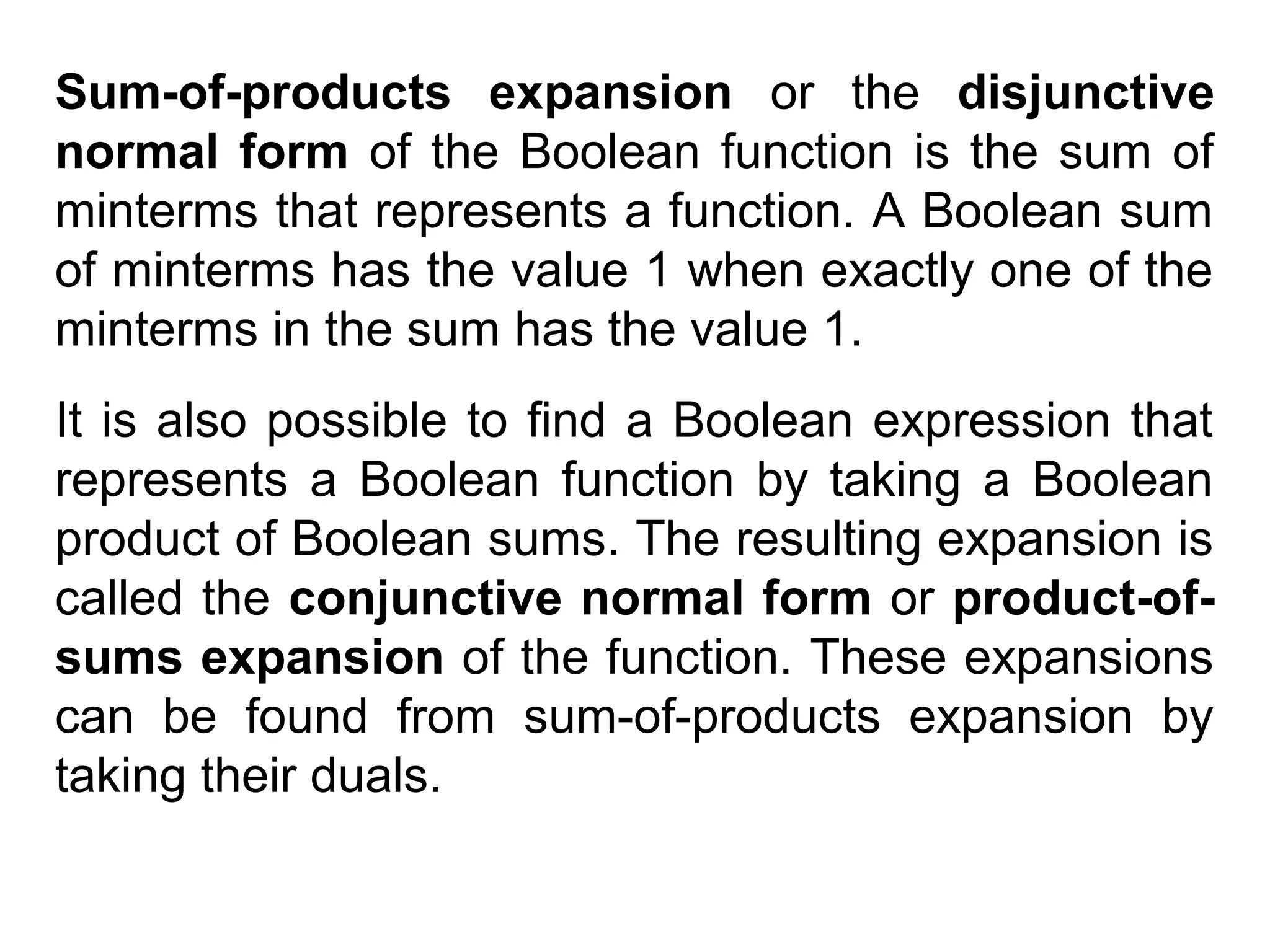
Sum-of-products expansion or the disjunctive
normal form of the Boolean function is the sum of
minterms that represents a function. A Boolean sum
of minterms has the value 1 when exactly one of the
minterms in the sum has the value 1.
It is also possible to find a Boolean expression that
represents a Boolean function by taking a Boolean
product of Boolean sums. The resulting expansion is
called the conjunctive normal form or product-ofsums expansion of the function. These expansions
can be found from sum-of-products expansion by
taking their duals.
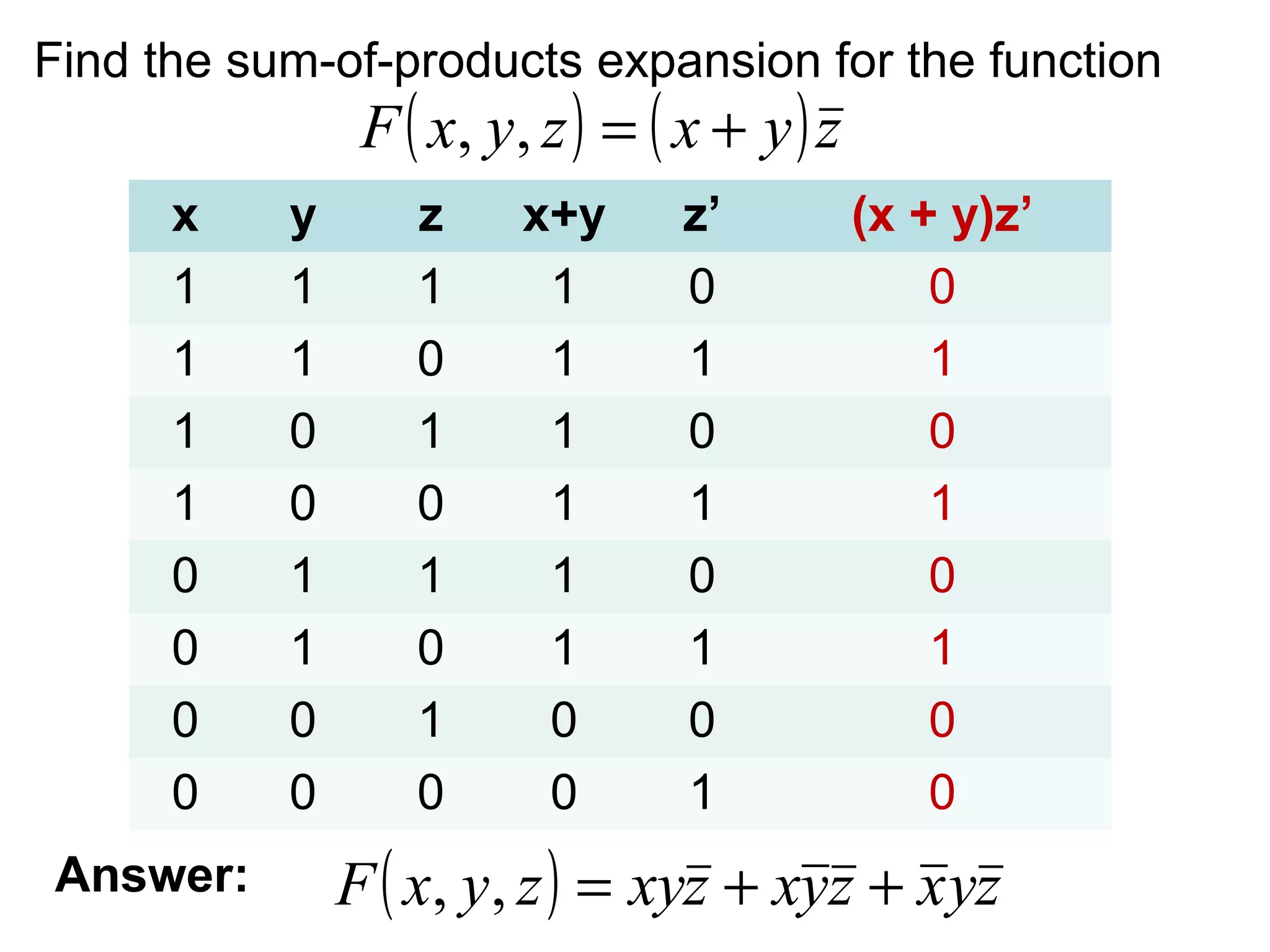
Find the sum-of-products expansion for the function

F ( x, y , z ) = ( x + y ) z

x
1
1
1
1
0
0
0
0
Answer:

y
1
1
0
0
1
1
0
0

z
1
0
1
0
1
0
1
0

x+y
1
1
1
1
1
1
0
0

z’
0
1
0
1
0
1
0
1

(x + y)z’
0
1
0
1
0
1
0
0

F ( x, y, z ) = xyz + xyz + x yz
Logic Gates
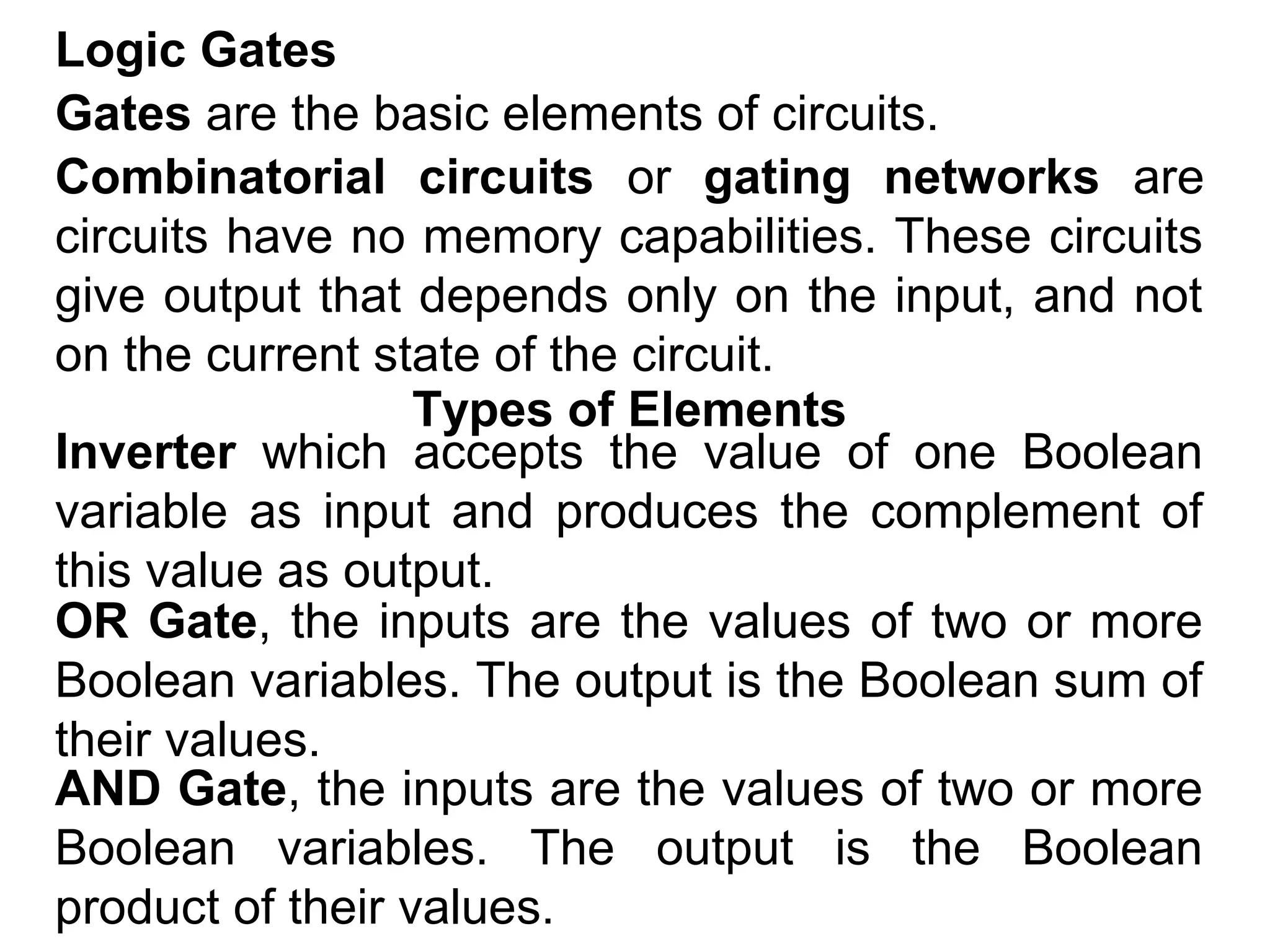
Gates are the basic elements of circuits.
Combinatorial circuits or gating networks are
circuits have no memory capabilities. These circuits
give output that depends only on the input, and not
on the current state of the circuit.
Types of Elements
Inverter which accepts the value of one Boolean
variable as input and produces the complement of
this value as output.
OR Gate, the inputs are the values of two or more
Boolean variables. The output is the Boolean sum of
their values.
AND Gate, the inputs are the values of two or more
Boolean variables. The output is the Boolean
product of their values.
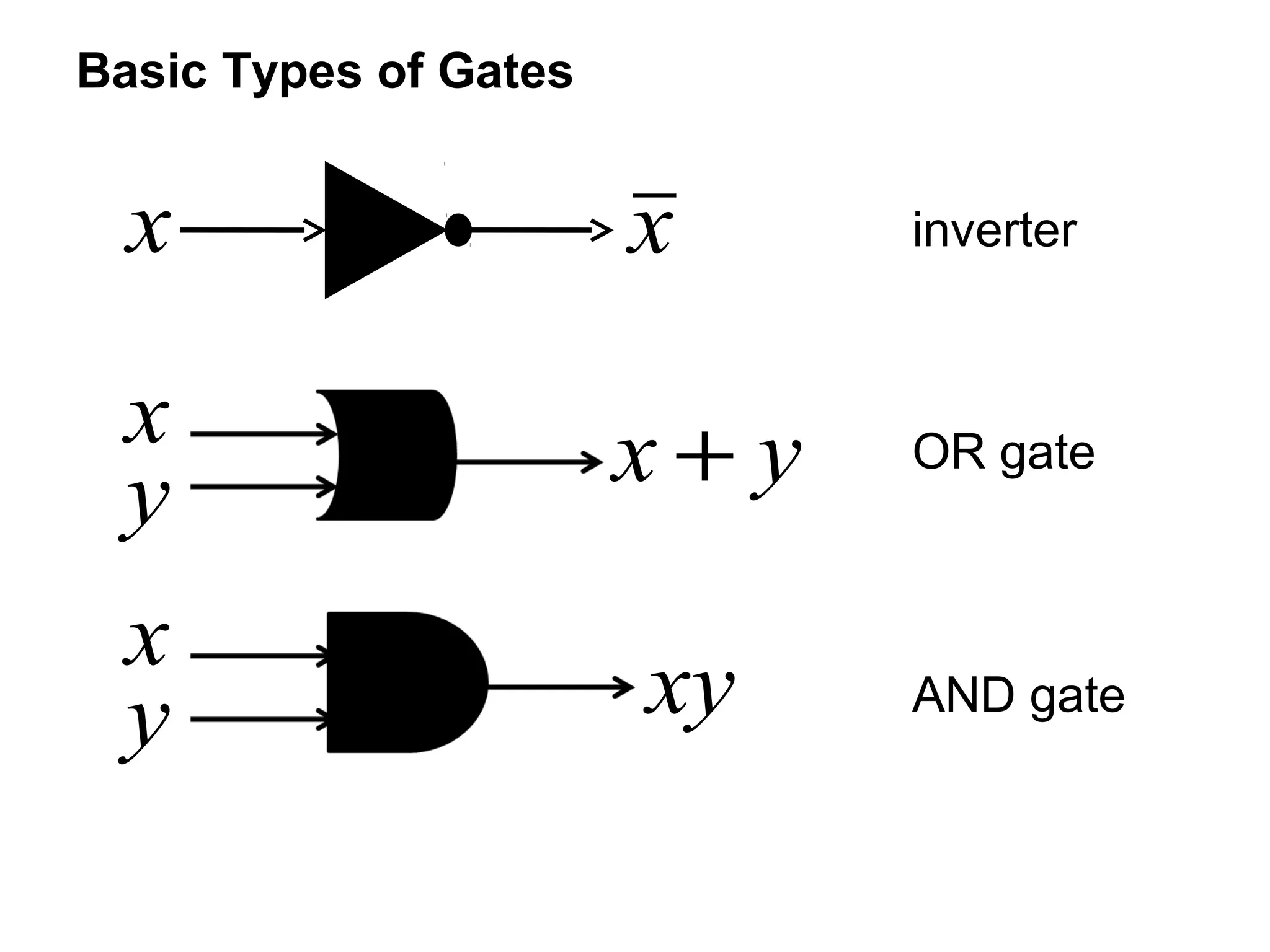
Basic Types of Gates

x

x

x
y

x+y

x
y

xy

inverter

OR gate

AND gate
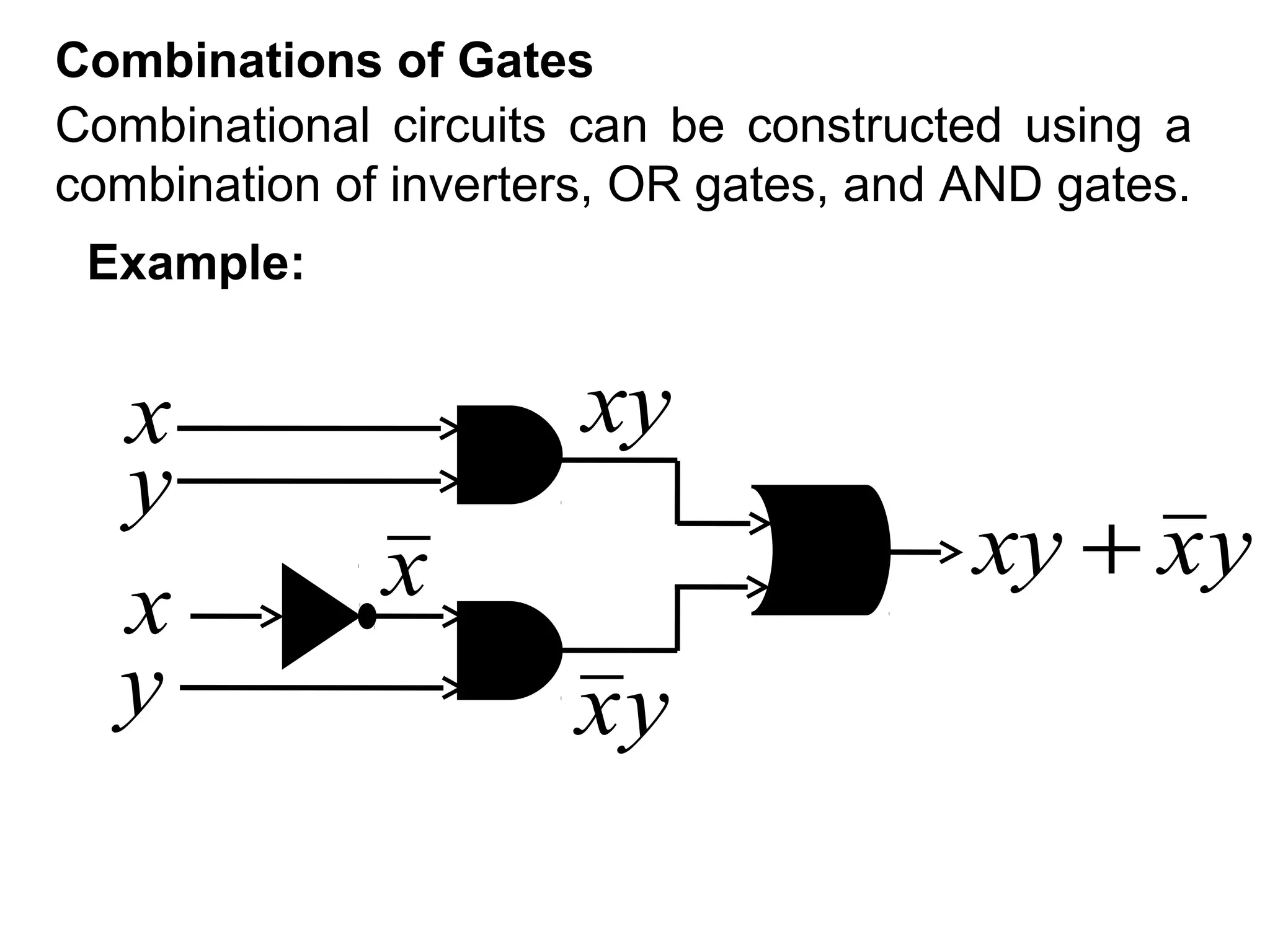
Combinations of Gates
Combinational circuits can be constructed using a
combination of inverters, OR gates, and AND gates.
Example:

x
y
x
y

xy
xy + x y

x
xy
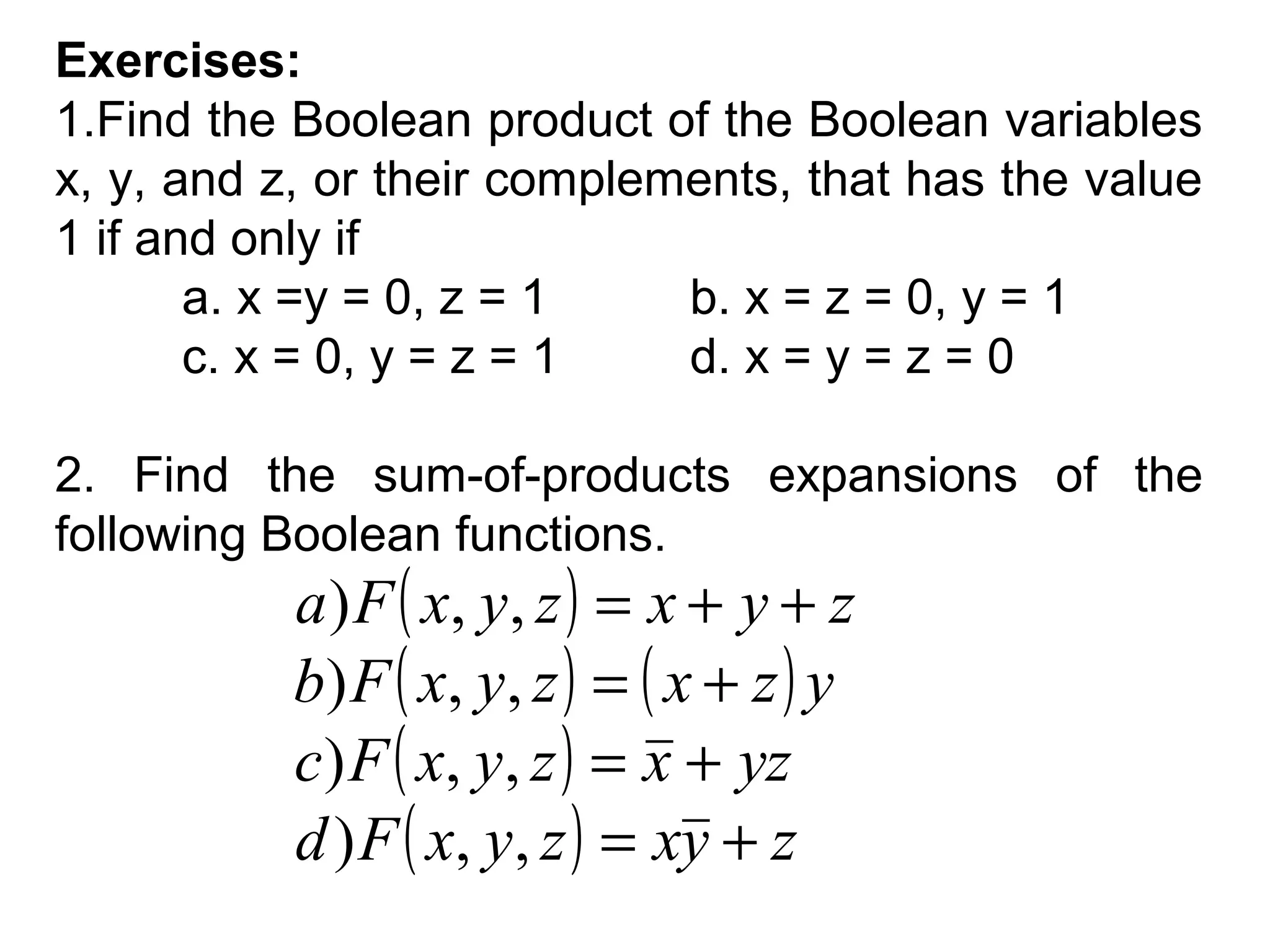
Exercises:
1.Find the Boolean product of the Boolean variables
x, y, and z, or their complements, that has the value
1 if and only if
a. x =y = 0, z = 1
b. x = z = 0, y = 1
c. x = 0, y = z = 1
d. x = y = z = 0
2. Find the sum-of-products expansions of the
following Boolean functions.

a ) F ( x, y , z ) = x + y + z
b ) F ( x, y , z ) = ( x + z ) y
c) F ( x, y, z ) = x + yz
d ) F ( x, y, z ) = xy + z
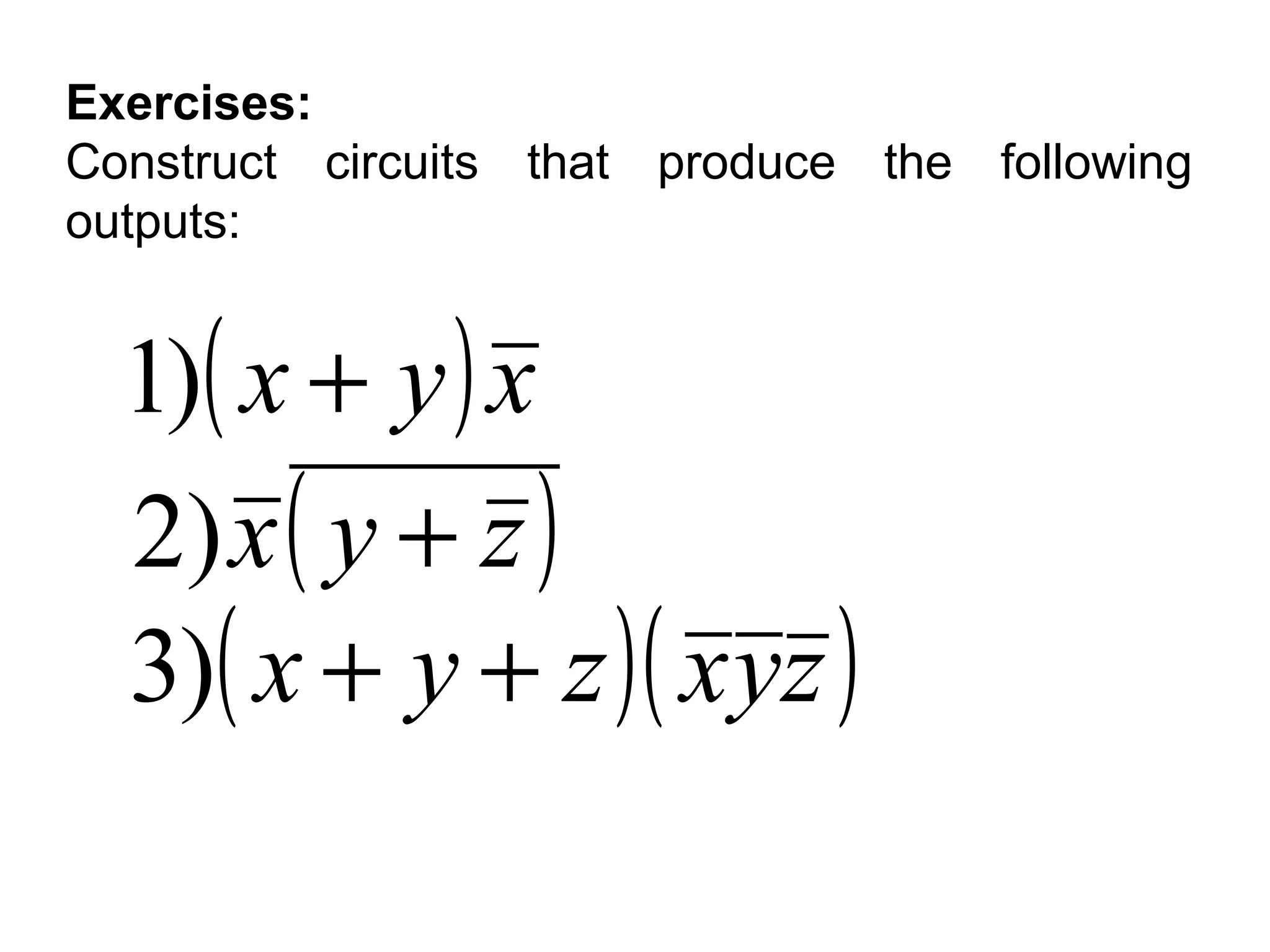
Exercises:
Construct circuits that produce the following
outputs:

1)( x + y ) x
2) x ( y + z )
3)( x + y + z )( x yz )

Boolean

  • 1.
    Boolean Expressions andBoolean Functions Let B = {0, 1}. The variable x is called a Boolean variable if it assumes values only from B. A function Bn, the set {(x1, x2, ….xn)|xi ε B, 1 ≤ i ≤ n}, to B is called a Boolean function of degree n x y F(x, y) 1 1 0 The values of Boolean function. 1 0 1 0 1 0 0 0 0 The Boolean expressions in the variables x1, x2, …,xn are defined recursively as follows: 0, 1, x1, x2, ….., xn
  • 2.
    Example: Find thevalues of the Boolean function represented by F ( x, y, z ) = xy + z x 1 1 1 1 0 0 0 0 y 1 1 0 0 1 1 0 0 z 1 0 1 0 1 0 1 0 xy 1 1 0 0 0 0 0 0 z’ 0 1 0 1 0 1 0 1 xy + z’ 1 1 0 1 0 1 0 1
  • 3.
    The Boolean functionsF and G of n variables are equal if and only if F(b1, b2, …, bn) = G(b1, b2, …,bn) whenever b1, b2, …, bn belong to B. Two different Boolean expressions that represent the same function are called equivalent. ex: xy, xy + 0, and (xy)1 The complement of the Boolean function F is the function F , where F ( x1 ,  , xn ) = F ( x1 ,  xn )
  • 4.
    The Boolean sumF + G and the Boolean product FG are defined by (F + G)(x1,…., xn) = F(x1,…, xn) + G(x1,…, xn), (FG)(x1,…, xn) = F(x1,…, xn)G(x1,…, xn) The Boolean functions of degree 2 x y F1 F2 F3 F4 F5 F6 F7 F8 F9 F10 F11 F12 F13 F14 F15 F16 1 1 0 0 1 0 1 0 1 1 1 1 1 1 1 0 1 1 0 1 1 1 0 0 1 0 1 1 1 0 1 0 1 0 0 1 1 0 0 0 0 1 1 1 0 1 1 0 0 1 0 1 0 1 0 0 0 0 1 1 0 0 1 0 0 0 0 1 0 0 0 0 To determine the number of different Boolean functions of degree n, we use the formula: 22n
  • 5.
    Identities of BooleanAlgebra Identity Name x=x Law of double complement x+x = x x.x = x x +0 = x x.1 = x x +1 =1 x.0 = 0 x+ y = y+ x xy = yx Idempotent Laws Identity Laws Dominance Laws Commutative Laws
  • 6.
    Identities of BooleanAlgebra Identity x + ( y + z) = ( x + y) + z x( yz ) = ( xy ) z Name Associative Laws x + yz = ( x + y )( x + z ) x( y + z ) = xy + xz Distributive Laws ( xy ) = x + y ( x + y ) = xy De Morgan’s Laws
  • 7.
    Example: Show thatthe distributive law x(y + z) = xy + xz is valid x y z y+z xy xz 1 1 1 1 0 0 0 0 1 1 0 0 1 1 0 0 1 0 1 0 1 0 1 0 1 1 1 0 1 1 1 0 1 1 0 0 0 0 0 0 1 0 1 0 0 0 0 0 x(y+z) xy+xz 1 1 1 0 0 0 0 0 1 1 1 0 0 0 0 0
  • 8.
    Duality The dual ofa Boolean expression is obtained by interchanging Boolean sums and Boolean products and interchanging 0s and 1s. Find the duals of Answer: x( y + 0 ) and x .1 + ( y + z ) . x + ( y.1) and ( x + 0)( yz )
  • 9.
    Note: The dual ofthe Boolean function F, denoted by Fd, represented by a Boolean expression is the function represented by the dual of this expression. This dual function does not depend on the particular Boolean expression used to represent F. An identity between functions represented by Boolean expressions remains valid when the duals of both sides of the identity are taken. This result, called the duality principle, is useful for obtaining new identities.
  • 10.
    A Boolean algebrais a set B with two binary operations v and ʌ, elements 0 and 1, and unary operation ¬ such that the following properties hold for all x, y, and z in B: x ∨ 0 = x  x ∧1 = x  Identity Laws x ∨ x =1  x ∧ x = 0 Domination Laws
  • 11.
    x ∨ y= y ∨ x  x ∧ y = y ∧ x Commutative Laws ( x ∨ y) ∨ z = x ∨ ( y ∨ z)  ( x ∧ y) ∧ z = x ∧ ( y ∧ z) Associative Laws x ∨ ( y ∧ z) = ( x ∨ y) ∧ ( x ∨ z)  x ∧ ( y ∨ z) = ( x ∧ y) ∨ ( x ∧ z) Distributive Laws
  • 12.
    Representing Boolean Functions FindBoolean expressions that functions F(x, y, z) and G(x, y, z) x 1 1 1 1 0 0 0 0 y 1 1 0 0 1 1 0 0 z 1 0 1 0 1 0 1 0 F 0 0 1 0 0 0 0 0 G 0 1 0 0 0 1 0 0 represent the To represent F, the value is 1 when x = z = 1 and y = 0 or xy’z. To represent G, the value is 1 when x = y = 1 and z = 0 or when x = z = 0 and y =1. We can form an expression with these values by taking the Boolean sum of two different Boolean products.
  • 13.
    x 1 1 1 1 0 0 0 0 y 1 1 0 0 1 1 0 0 z 1 0 1 0 1 0 1 0 F 0 0 1 0 0 0 0 0 G 0 1 0 0 0 1 0 0 xyz’ x’yz’ 0 0 1 0 0 0 0 0 0 0 0 1 0 0 0 0 xyz’ +x’yz’ 0 1 0 0 0 1 0 0 xyz’ has value 1, iff x = y = 1 and z = 0 x’yz’ has value 1, iff x = y = 1 and z = 0 xyz’ + x’yz’ has value 1, iff x = y = 1 and z = 0 or x = z = 0 and y = 1
  • 14.
    A literal isa Boolean variable or its complement. A minterm of the Boolean variables x1, x2, …, xn is a Boolean product y1, y2, …, yn, where yi = xi or yi = x’i. Hence, a minterm is a product of n literals, with one literal for each variable. Example: Find a minterm that equals 1 if x 1 = x3 = 0 and x2 = x4 = x5 = 1, and equals 0 otherwise. x1 x2 x3 x4 x5 The minterm showed has the correct set of values.
  • 15.
    Sum-of-products expansion orthe disjunctive normal form of the Boolean function is the sum of minterms that represents a function. A Boolean sum of minterms has the value 1 when exactly one of the minterms in the sum has the value 1. It is also possible to find a Boolean expression that represents a Boolean function by taking a Boolean product of Boolean sums. The resulting expansion is called the conjunctive normal form or product-ofsums expansion of the function. These expansions can be found from sum-of-products expansion by taking their duals.
  • 16.
    Find the sum-of-productsexpansion for the function F ( x, y , z ) = ( x + y ) z x 1 1 1 1 0 0 0 0 Answer: y 1 1 0 0 1 1 0 0 z 1 0 1 0 1 0 1 0 x+y 1 1 1 1 1 1 0 0 z’ 0 1 0 1 0 1 0 1 (x + y)z’ 0 1 0 1 0 1 0 0 F ( x, y, z ) = xyz + xyz + x yz
  • 17.
    Logic Gates Gates arethe basic elements of circuits. Combinatorial circuits or gating networks are circuits have no memory capabilities. These circuits give output that depends only on the input, and not on the current state of the circuit. Types of Elements Inverter which accepts the value of one Boolean variable as input and produces the complement of this value as output. OR Gate, the inputs are the values of two or more Boolean variables. The output is the Boolean sum of their values. AND Gate, the inputs are the values of two or more Boolean variables. The output is the Boolean product of their values.
  • 18.
    Basic Types ofGates x x x y x+y x y xy inverter OR gate AND gate
  • 19.
    Combinations of Gates Combinationalcircuits can be constructed using a combination of inverters, OR gates, and AND gates. Example: x y x y xy xy + x y x xy
  • 20.
    Exercises: 1.Find the Booleanproduct of the Boolean variables x, y, and z, or their complements, that has the value 1 if and only if a. x =y = 0, z = 1 b. x = z = 0, y = 1 c. x = 0, y = z = 1 d. x = y = z = 0 2. Find the sum-of-products expansions of the following Boolean functions. a ) F ( x, y , z ) = x + y + z b ) F ( x, y , z ) = ( x + z ) y c) F ( x, y, z ) = x + yz d ) F ( x, y, z ) = xy + z
  • 21.
    Exercises: Construct circuits thatproduce the following outputs: 1)( x + y ) x 2) x ( y + z ) 3)( x + y + z )( x yz )

Editor's Notes