Circadian Rhythm
and Jet-Lag
2018-04-01
Presented by
Jea Kwon
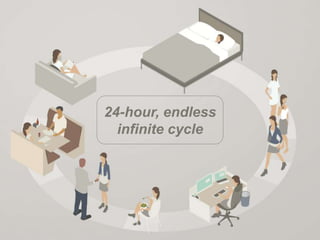
24-hour, endless
infinite cycle
3
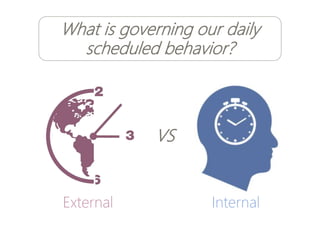
What is governing our daily
scheduled behavior?
External Internal
VS
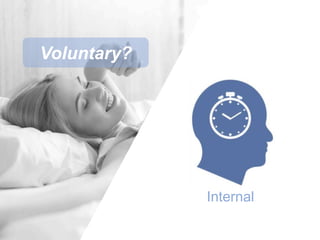
Forced?
External
Voluntary?
Internal
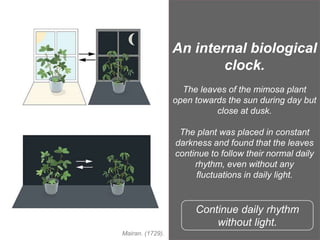
An internal biological
clock.
The leaves of the mimosa plant
open towards the sun during day but
close at dusk.
The plant was placed in constant
darkness and found that the leaves
continue to follow their normal daily
rhythm, even without any
fluctuations in daily light.
Continue daily rhythm
without light.
Mairan. (1729).
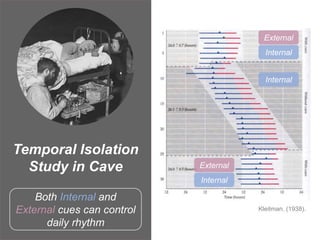
Temporal Isolation
Study in Cave
Both Internal and
External cues can control
daily rhythm
External
Internal
Internal
External
Internal
Kleitman. (1938).
8
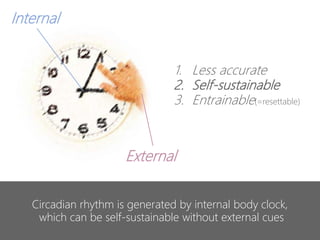
1. Less accurate
2. Self-sustainable
3. Entrainable(=resettable)
Internal
External
Circadian rhythm is generated by internal body clock,
which can be self-sustainable without external cues
9
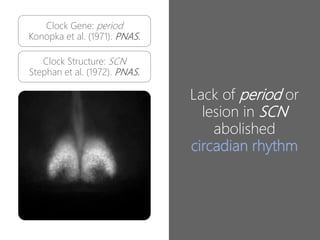
Clock Gene: period
Konopka et al. (1971). PNAS.
Clock Structure: SCN
Stephan et al. (1972). PNAS.
Lack of period or
lesion in SCN
abolished
circadian rhythm
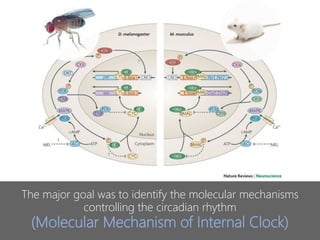
The major goal was to identify the molecular mechanisms
controlling the circadian rhythm
(Molecular Mechanism of Internal Clock)
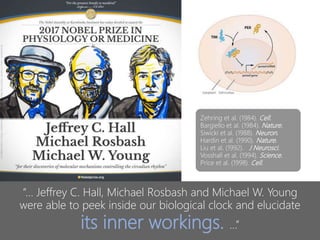
Zehring et al. (1984). Cell.
Bargiello et al. (1984). Nature.
Siwicki et al. (1988). Neuron.
Hardin et al. (1990). Nature.
Liu et al. (1992). J Neurosci.
Vosshall et al. (1994). Science.
Price et al. (1998). Cell.
“… Jeffrey C. Hall, Michael Rosbash and Michael W. Young
were able to peek inside our biological clock and elucidate
its inner workings. …”
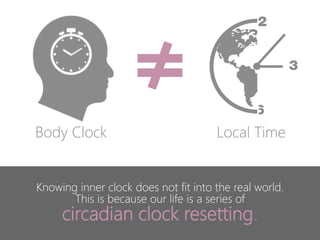
Knowing inner clock does not fit into the real world.
This is because our life is a series of
circadian clock resetting.
Body Clock Local Time
13
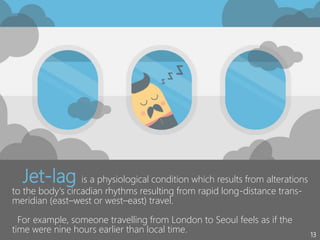
Jet-lag is a physiological condition which results from alterations
to the body's circadian rhythms resulting from rapid long-distance trans-
meridian (east–west or west–east) travel.
For example, someone travelling from London to Seoul feels as if the
time were nine hours earlier than local time.
14
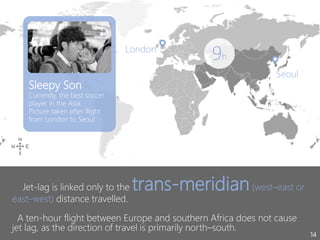
London
Seoul
9h
Sleepy Son
Currently, the best soccer
player in the Asia.
Picture taken after flight
from London to Seoul.
Jet-lag is linked only to the trans-meridian(west–east or
east–west) distance travelled.
A ten-hour flight between Europe and southern Africa does not cause
jet lag, as the direction of travel is primarily north–south.
15
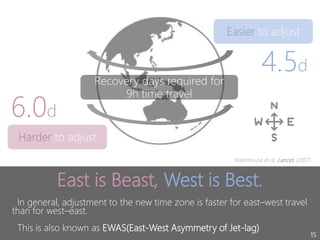
East is Beast, West is Best.
In general, adjustment to the new time zone is faster for east–west travel
than for west–east.
This is also known as EWAS(East-West Asymmetry of Jet-lag)
Easier to adjust
Harder to adjust
4.5d
6.0d
Recovery days required for
9h time travel
Waterhouse et al. Lancet. (2007)
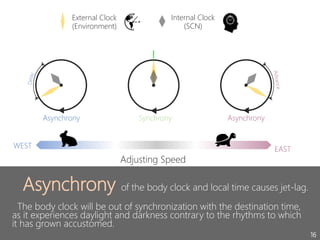
Asynchrony of the body clock and local time causes jet-lag.
The body clock will be out of synchronization with the destination time,
as it experiences daylight and darkness contrary to the rhythms to which
it has grown accustomed.
16
Asynchrony Synchrony
!
Adjusting Speed
WEST EAST
Asynchrony
Internal Clock
(SCN)
External Clock
(Environment)
17
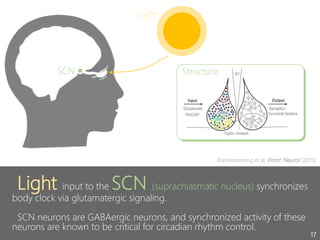
Light input to the SCN (suprachiasmatic nucleus) synchronizes
body clock via glutamatergic signaling.
SCN neurons are GABAergic neurons, and synchronized activity of these
neurons are known to be critical for circadian rhythm control.
SCN
Light
Ramkisoensing et al. Front. Neurol. (2015)
Structure

Circadian Rhythm & Jet lag

  • 1.
  • 2.
  • 3.
    3 What is governingour daily scheduled behavior? External Internal VS
  • 4.
  • 5.
  • 6.
    An internal biological clock. Theleaves of the mimosa plant open towards the sun during day but close at dusk. The plant was placed in constant darkness and found that the leaves continue to follow their normal daily rhythm, even without any fluctuations in daily light. Continue daily rhythm without light. Mairan. (1729).
  • 7.
    Temporal Isolation Study inCave Both Internal and External cues can control daily rhythm External Internal Internal External Internal Kleitman. (1938).
  • 8.
    8 1. Less accurate 2.Self-sustainable 3. Entrainable(=resettable) Internal External Circadian rhythm is generated by internal body clock, which can be self-sustainable without external cues
  • 9.
    9 Clock Gene: period Konopkaet al. (1971). PNAS. Clock Structure: SCN Stephan et al. (1972). PNAS. Lack of period or lesion in SCN abolished circadian rhythm
  • 10.
    The major goalwas to identify the molecular mechanisms controlling the circadian rhythm (Molecular Mechanism of Internal Clock)
  • 11.
    Zehring et al.(1984). Cell. Bargiello et al. (1984). Nature. Siwicki et al. (1988). Neuron. Hardin et al. (1990). Nature. Liu et al. (1992). J Neurosci. Vosshall et al. (1994). Science. Price et al. (1998). Cell. “… Jeffrey C. Hall, Michael Rosbash and Michael W. Young were able to peek inside our biological clock and elucidate its inner workings. …”
  • 12.
    Knowing inner clockdoes not fit into the real world. This is because our life is a series of circadian clock resetting. Body Clock Local Time
  • 13.
    13 Jet-lag is aphysiological condition which results from alterations to the body's circadian rhythms resulting from rapid long-distance trans- meridian (east–west or west–east) travel. For example, someone travelling from London to Seoul feels as if the time were nine hours earlier than local time.
  • 14.
    14 London Seoul 9h Sleepy Son Currently, thebest soccer player in the Asia. Picture taken after flight from London to Seoul. Jet-lag is linked only to the trans-meridian(west–east or east–west) distance travelled. A ten-hour flight between Europe and southern Africa does not cause jet lag, as the direction of travel is primarily north–south.
  • 15.
    15 East is Beast,West is Best. In general, adjustment to the new time zone is faster for east–west travel than for west–east. This is also known as EWAS(East-West Asymmetry of Jet-lag) Easier to adjust Harder to adjust 4.5d 6.0d Recovery days required for 9h time travel Waterhouse et al. Lancet. (2007)
  • 16.
    Asynchrony of thebody clock and local time causes jet-lag. The body clock will be out of synchronization with the destination time, as it experiences daylight and darkness contrary to the rhythms to which it has grown accustomed. 16 Asynchrony Synchrony ! Adjusting Speed WEST EAST Asynchrony Internal Clock (SCN) External Clock (Environment)
  • 17.
    17 Light input tothe SCN (suprachiasmatic nucleus) synchronizes body clock via glutamatergic signaling. SCN neurons are GABAergic neurons, and synchronized activity of these neurons are known to be critical for circadian rhythm control. SCN Light Ramkisoensing et al. Front. Neurol. (2015) Structure

Editor's Notes

  • #3 For 30 years of my life, I think I have slept nearly everyday, and I woke up every morning. When I woke up I go out and do some outside activities. What is interesting is that people eat meals fairly regular intervals, like three or four times a day. What I’d like to point out is that the behaviors during our life is fairly well scheduled. From this point of view, we can imagine that our daily behaviors seem to be governed by some kind of oscillatory rhythms that we don’t know.
  • #5 In early days, people thought that our behaviors are solely depend on the external cues such as light. This is because the 24-hour revolution of earth which makes day and night determined peoples lifestyles. Indeed, I am a person who heavily depends on the alarm clocks to wake up everyday. These evidence are highly persuasive that our daily rhythm is governed by exterrnal cues.
  • #6 However, in very rare case, I sometimes experience that I woke up right before alarm clock ringing. Moreover, some people can even voluntarily wake up without any aids. WOW!. Any way this can be the opposing evidence that our daily rhythm is solely controlled by external cues.
  • #7 Until 1729, people didn’t have any “scientific evidence” for the existence of internal biological clock. However, in that year, there was an interesting report that there might be a internal biological clock which can control daily rhythm of plant without external cues!
  • #8 Although Mairan’s report was very intriguing finding, that study failed to attract other scientists to follow up her findings. However, in 1938 there was a shocking report from Kleiman, the scientist also known as cave man, that in human brain, there is a circadian rhythm oscillator that can persist without any external cues. He proved this idea by putting himself into the deep dark cave and record his activity for 32 consecutive days. His finding was entirely shocking because he proved not only there is a internal circadian oscillator in our body, but also this internal oscillator can be entrained by external cues.