Isaac Alpizar-Chacon, Jordan Barria-Pineda, Kamil Akhuseyinoglu , Sergey Sosnovsky, and Peter Brusilovsky
Integrating Textbooks with Smart Interactive
Content for Learning Programming
2
25-06-2021
Motivation
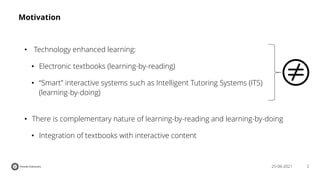
• Technology enhanced learning:
• Electronic textbooks (learning-by-reading)
• “Smart” interactive systems such as Intelligent Tutoring Systems (ITS)
(learning-by-doing)
• There is complementary nature of learning-by-reading and learning-by-doing
• Integration of textbooks with interactive content
3
25-06-2021
Motivation
• Problem:
• what content to associate? - which interactive activity is the best match for a
section or text?
• Manual allocation of interactive content
Goal
Automatically cross the border between
text and smart interactive content for
learning computer programming
6/25/21 4
5
25-06-2021
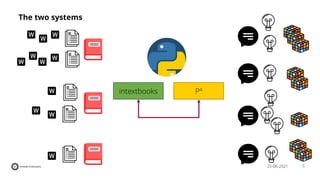
The two systems
intextbooks P4
6/25/21 7
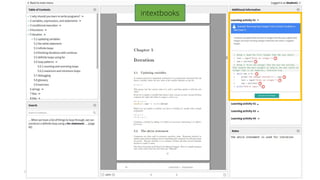
intextbooks
6/25/21
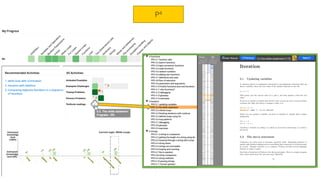
P4
6/25/21 9
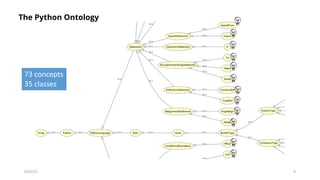
73 concepts
35 classes
The Python Ontology
10
25-06-2021
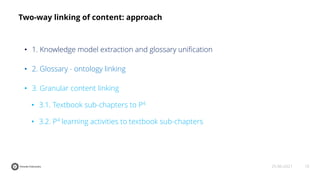
Two-way linking of content: approach
• 1. Knowledge model extraction and glossary unification
• 2. Glossary - ontology linking
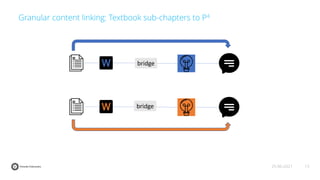
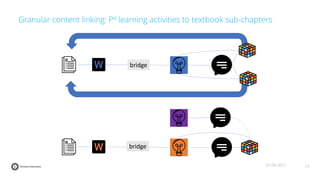
• 3. Granular content linking
• 3.1. Textbook sub-chapters to P4
• 3.2. P4 learning activities to textbook sub-chapters
11
25-06-2021
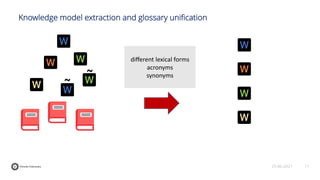
Knowledge model extraction and glossary unification
~
~
different lexical forms
acronyms
synonyms
12
25-06-2021
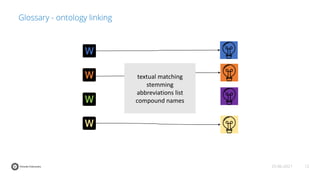
Glossary - ontology linking
textual matching
stemming
abbreviations list
compound names
13
25-06-2021
Granular content linking: Textbook sub-chapters to P4
bridge
bridge
14
25-06-2021
Granular content linking: P4 learning activities to textbook sub-chapters
bridge
bridge
15
25-06-2021
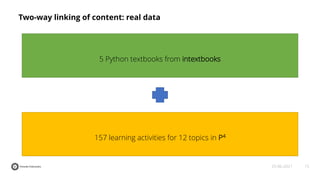
Two-way linking of content: real data
5 Python textbooks from intextbooks
157 learning activities for 12 topics in P4
16
25-06-2021
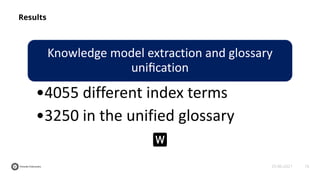
Results
Knowledge model extraction and glossary
unification
•4055 different index terms
•3250 in the unified glossary
17
25-06-2021
Results
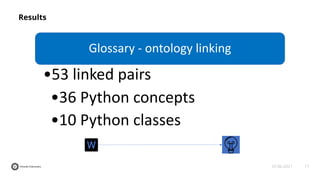
Glossary - ontology linking
•53 linked pairs
•36 Python concepts
•10 Python classes
18
25-06-2021
Results
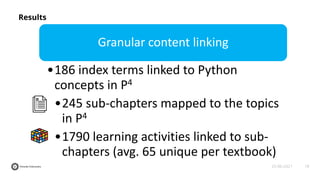
Granular content linking
•186 index terms linked to Python
concepts in P4
•245 sub-chapters mapped to the topics
in P4
•1790 learning activities linked to sub-
chapters (avg. 65 unique per textbook)
19
25-06-2021
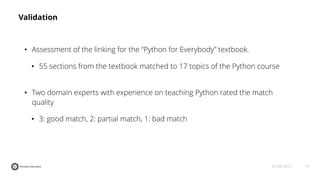
Validation
• Assessment of the linking for the “Python for Everybody” textbook.
• 55 sections from the textbook matched to 17 topics of the Python course
• Two domain experts with experience on teaching Python rated the match
quality
• 3: good match, 2: partial match, 1: bad match
20
25-06-2021
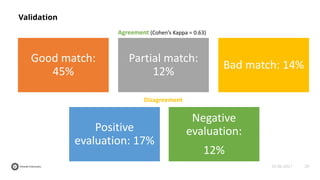
Validation
Good match:
45%
Partial match:
12%
Bad match: 14%
Positive
evaluation: 17%
Negative
evaluation:
12%
Agreement (Cohen’s Kappa = 0.63)
Disagreement
21
25-06-2021
Conclusion and future work
• We showed a two-way linking between textbook and smart learning content
• First step to resolving the problem of automatic linking
• Number of linked sub-chapters to topics (245) and the learning activities to
sub-chapters (1790) is promising
• Explore:
• a more “fine-grained” association of concepts (e.g., at a paragraph level)
• different domains
Thanks!
You can contact me at: i.alpizarchacon@uu.nl
Any questions?

Integrating Textbooks with Smart Interactive Content for Learning Programming