How to do backward curriculum design
Charlie Inskip | Alison Hicks
Department of Information Studies, UCL
Liverpool, April 4th – 6th 2018
overview
This Masterclass will focus on backward design, an approach to curriculum design
developed by Wiggins and McTighe (2006) and adopted by the new ACRL Framework.
This approach, which uses learning outcomes to determine assessment approaches and
course content, will be explained and demonstrated
There will be an informed discussion on its relevance and validity in teaching information
literacy.
The workshop will take a practical approach, devising learning outcomes, assessment
and content for a learning intervention to be agreed in the session.
It will draw from our experience in learning and teaching across a wide range of higher
educational and professional contexts in the UK and the USA.
Attendees will be able to take away a backward-designed lesson-plan which they can
then use as a basis for running a session in their workplace.
learning outcomes
Apply theoretical principles and
practical examples in order to
create and evaluate a lesson
plan relevant to your work
librarian-as-teacher
• Professional competences
• Library school curriculum
• Professional identity
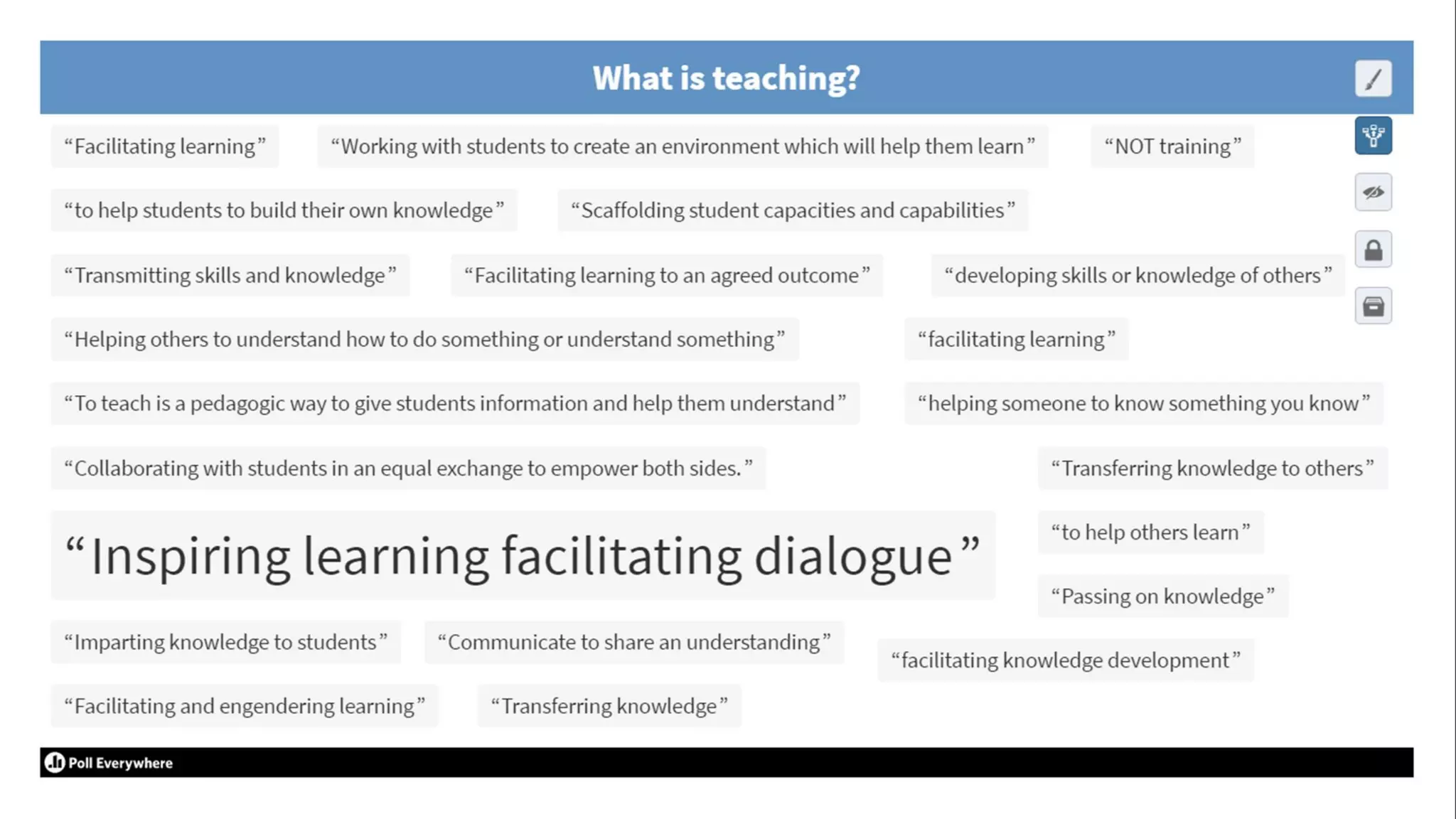
What is teaching?
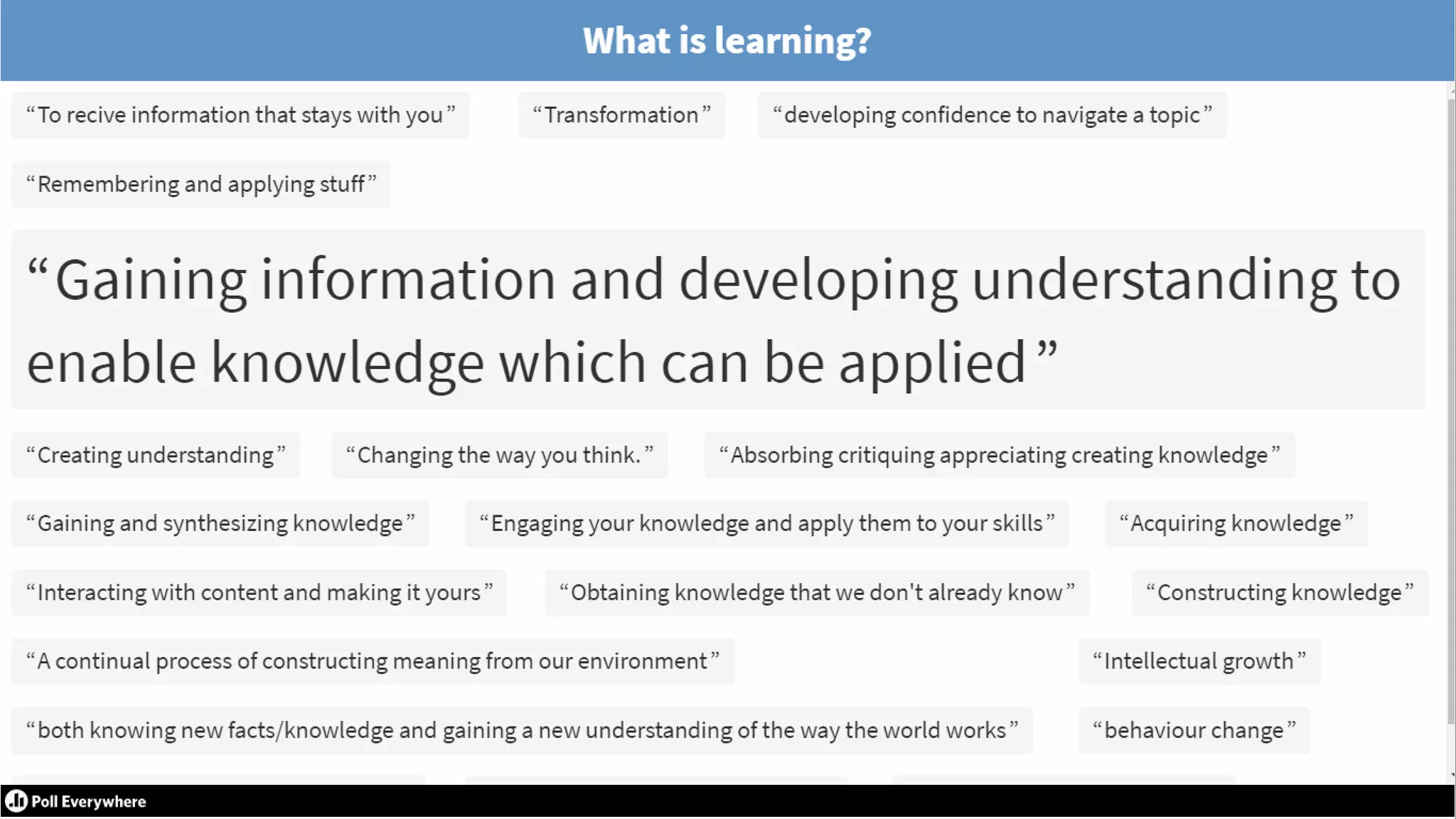
What is learning?
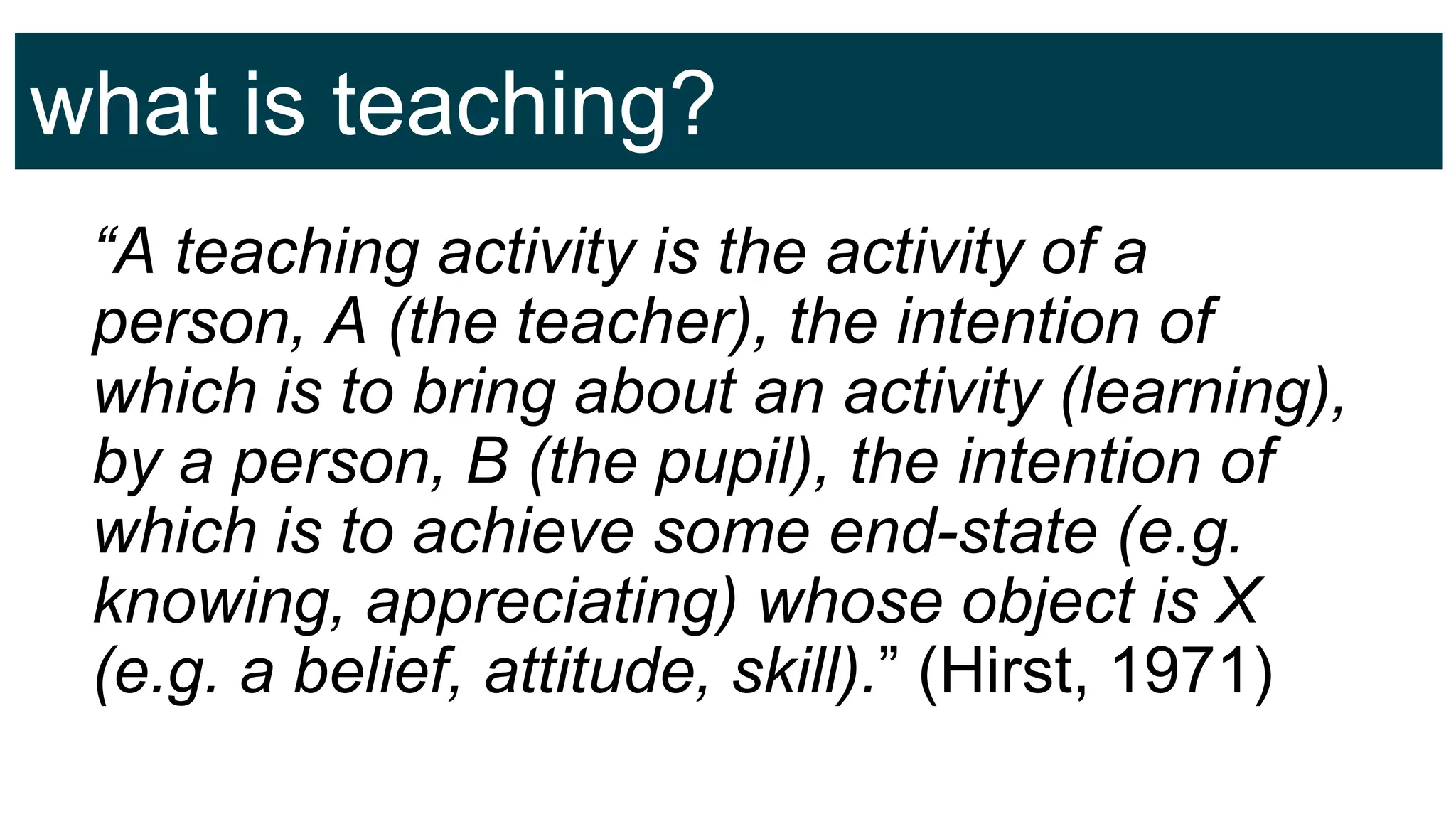
what is teaching?
“A teaching activity is the activity of a
person, A (the teacher), the intention of
which is to bring about an activity (learning),
by a person, B (the pupil), the intention of
which is to achieve some end-state (e.g.
knowing, appreciating) whose object is X
(e.g. a belief, attitude, skill).” (Hirst, 1971)
what is learning?
“making meaning” (Marton and Booth, 1997)
“relatively permanent change in behaviour as a
consequence of experience” (Haselgrove, 2016)
“mastering abstract principles, understanding proofs,
remembering factual information, acquiring methods,
techniques and approaches, recognition, reasoning,
debating ideas, or developing behaviour appropriate
to specific situations” (Fry et al., 2009)
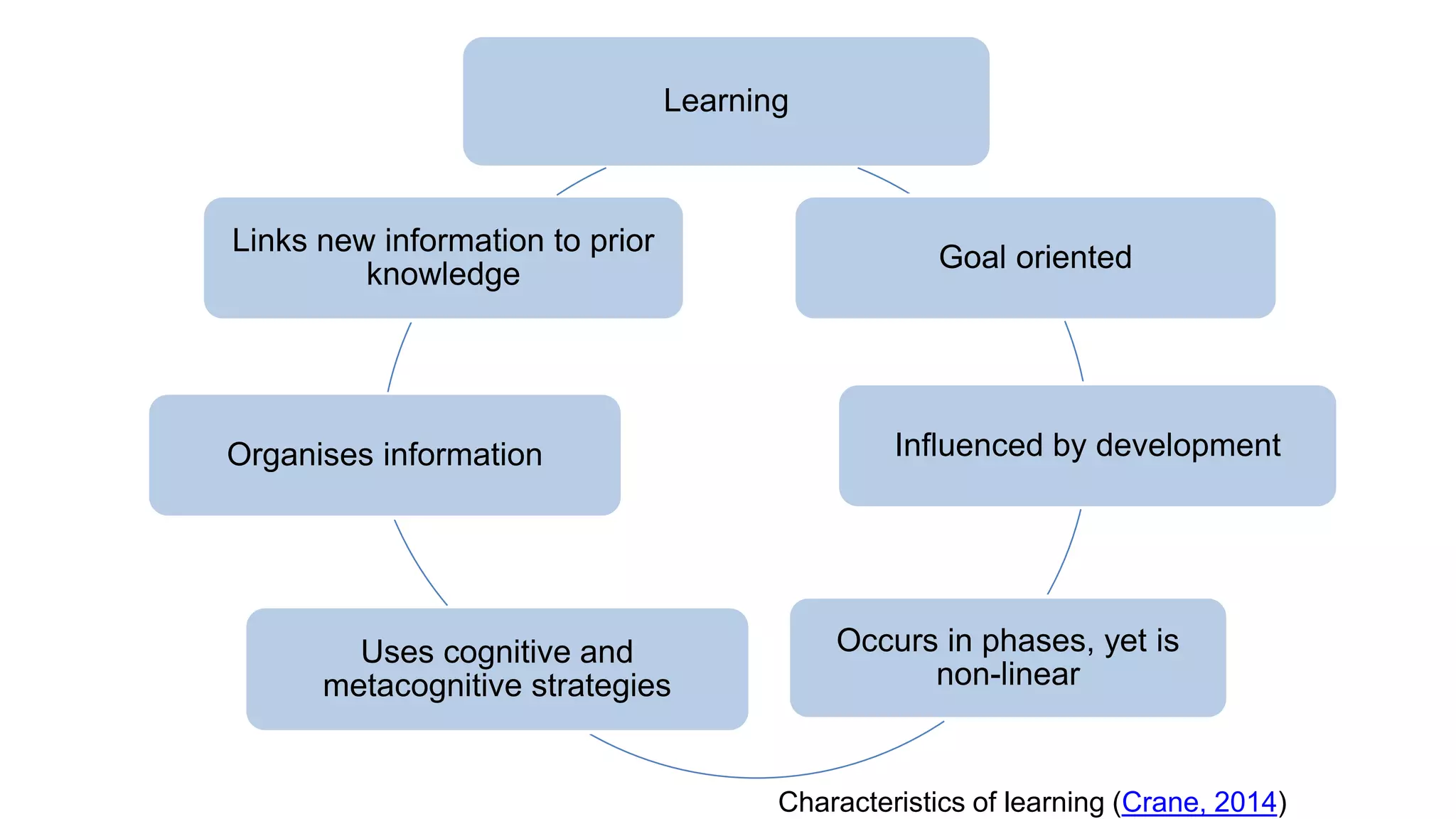
Learning
Goal oriented
Influenced by development
Occurs in phases, yet is
non-linear
Uses cognitive and
metacognitive strategies
Organises information
Links new information to prior
knowledge
Characteristics of learning (Crane, 2014)
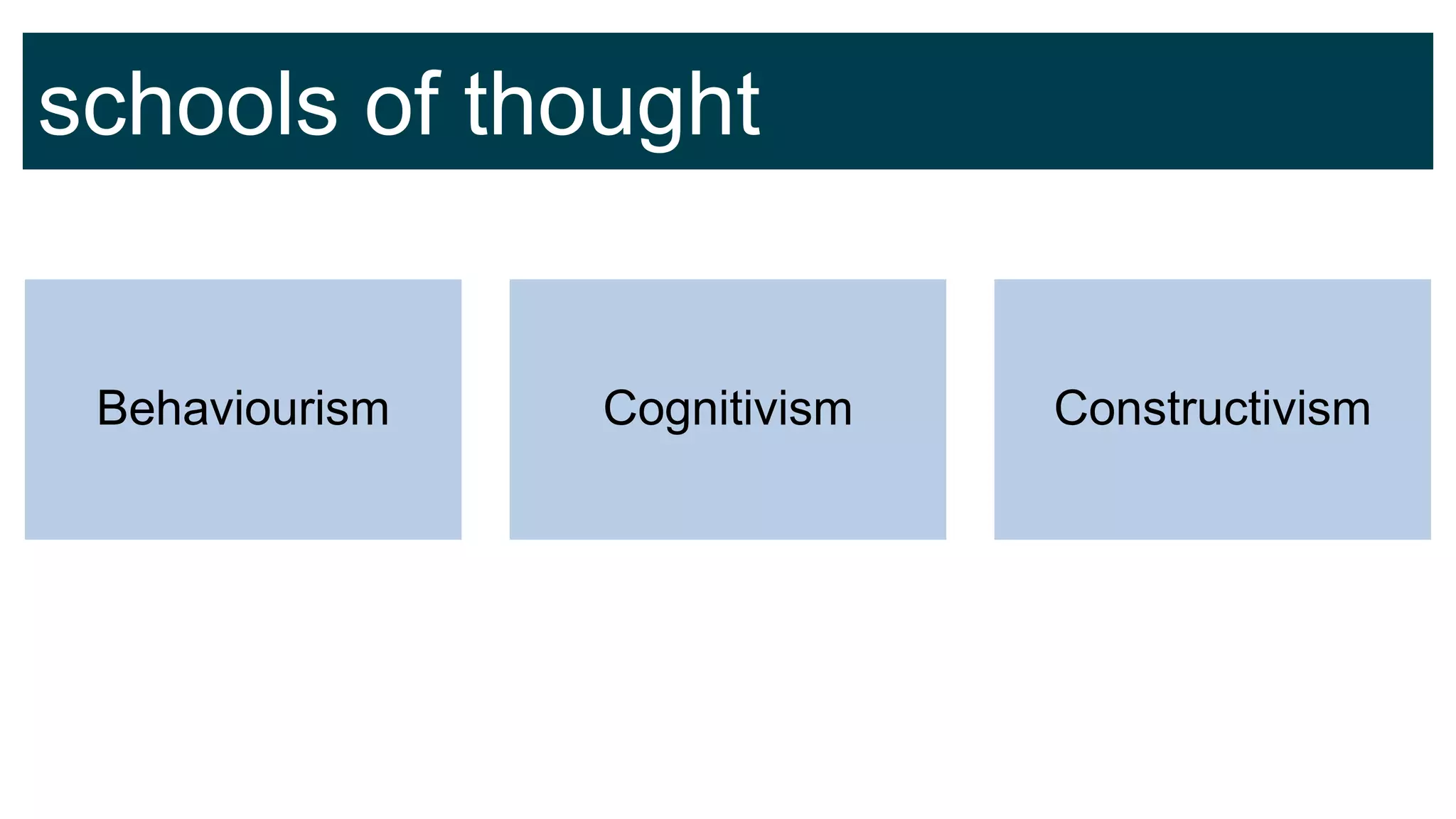
schools of thought
Behaviourism Cognitivism Constructivism
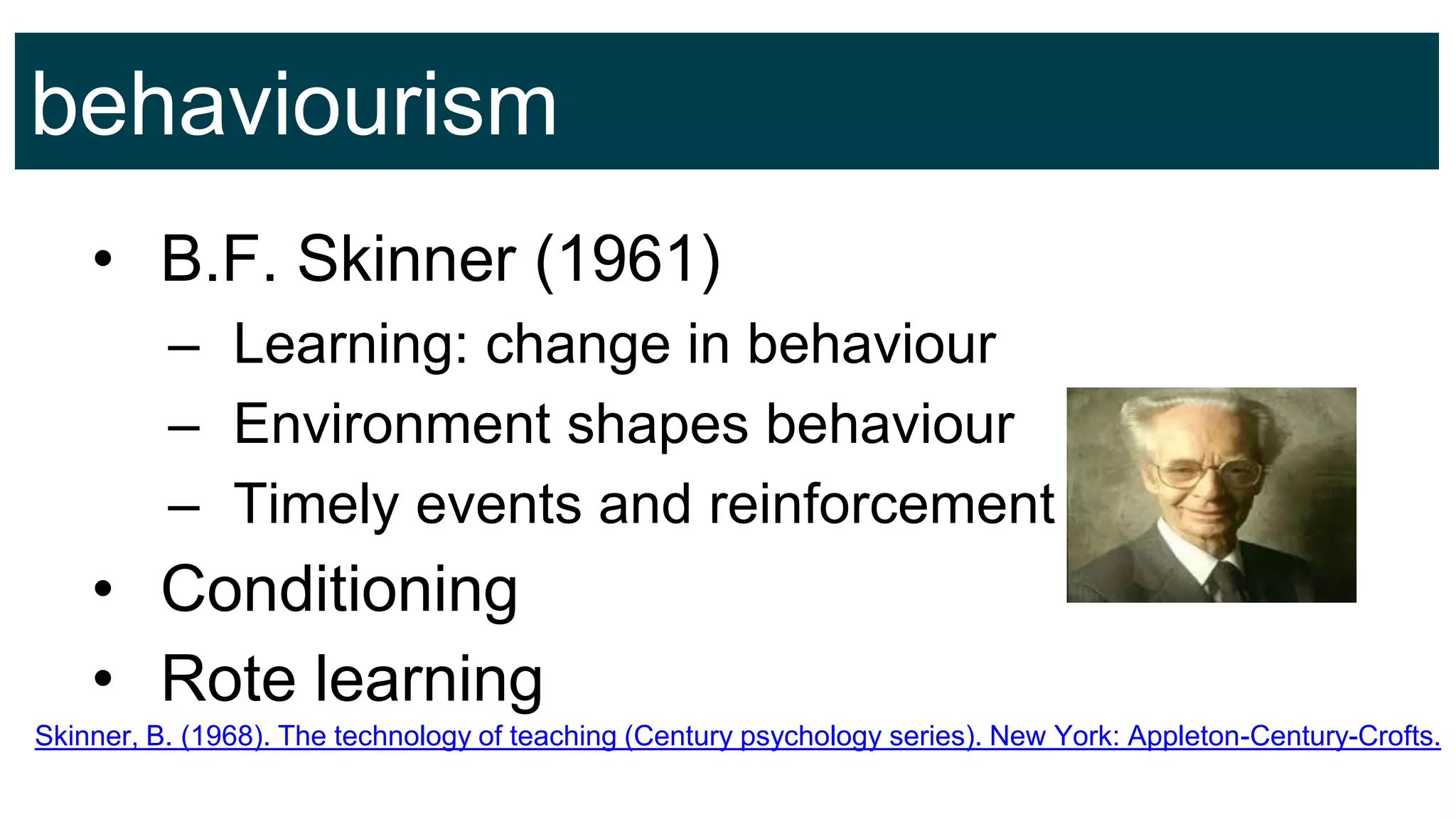
behaviourism
• B.F. Skinner (1961)
– Learning: change in behaviour
– Environment shapes behaviour
– Timely events and reinforcement
• Conditioning
• Rote learning
Skinner, B. (1968). The technology of teaching (Century psychology series). New York: Appleton-Century-Crofts.
cognitivism
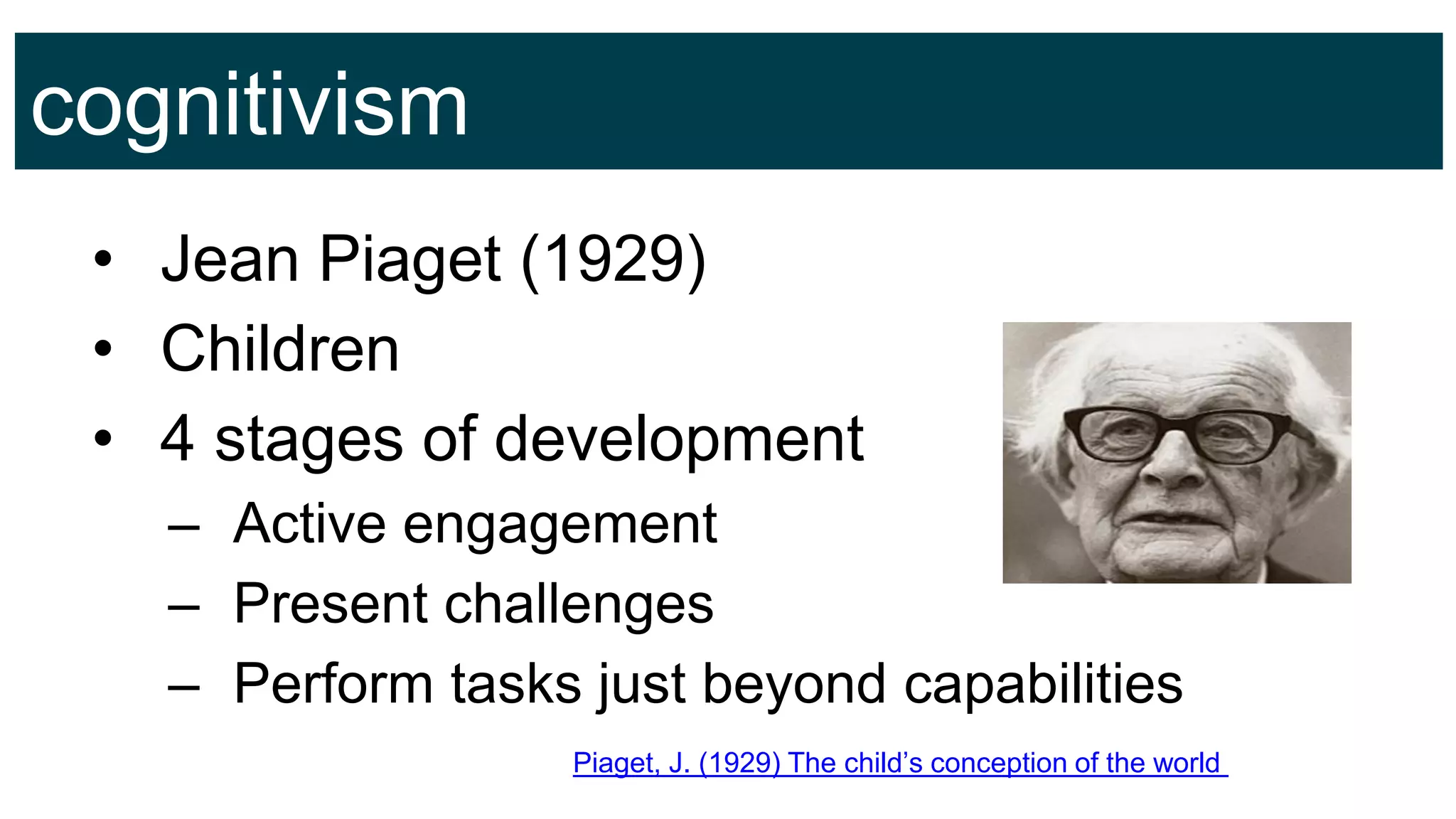
• Jean Piaget (1929)
• Children
• 4 stages of development
– Active engagement
– Present challenges
– Perform tasks just beyond capabilities
Piaget, J. (1929) The child’s conception of the world
constructivism
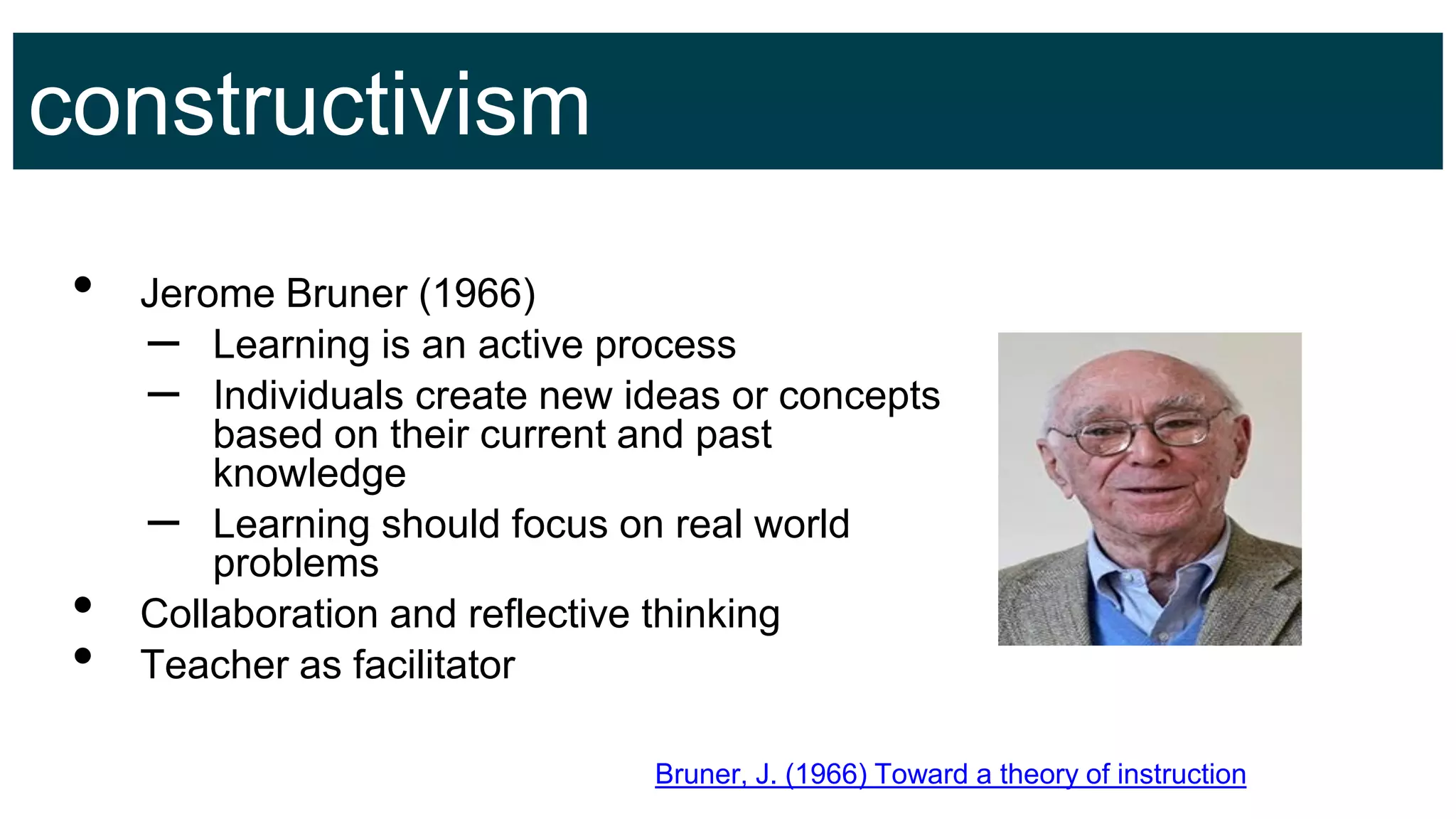
• Jerome Bruner (1966)
– Learning is an active process
– Individuals create new ideas or concepts
based on their current and past
knowledge
– Learning should focus on real world
problems
• Collaboration and reflective thinking
• Teacher as facilitator
Bruner, J. (1966) Toward a theory of instruction
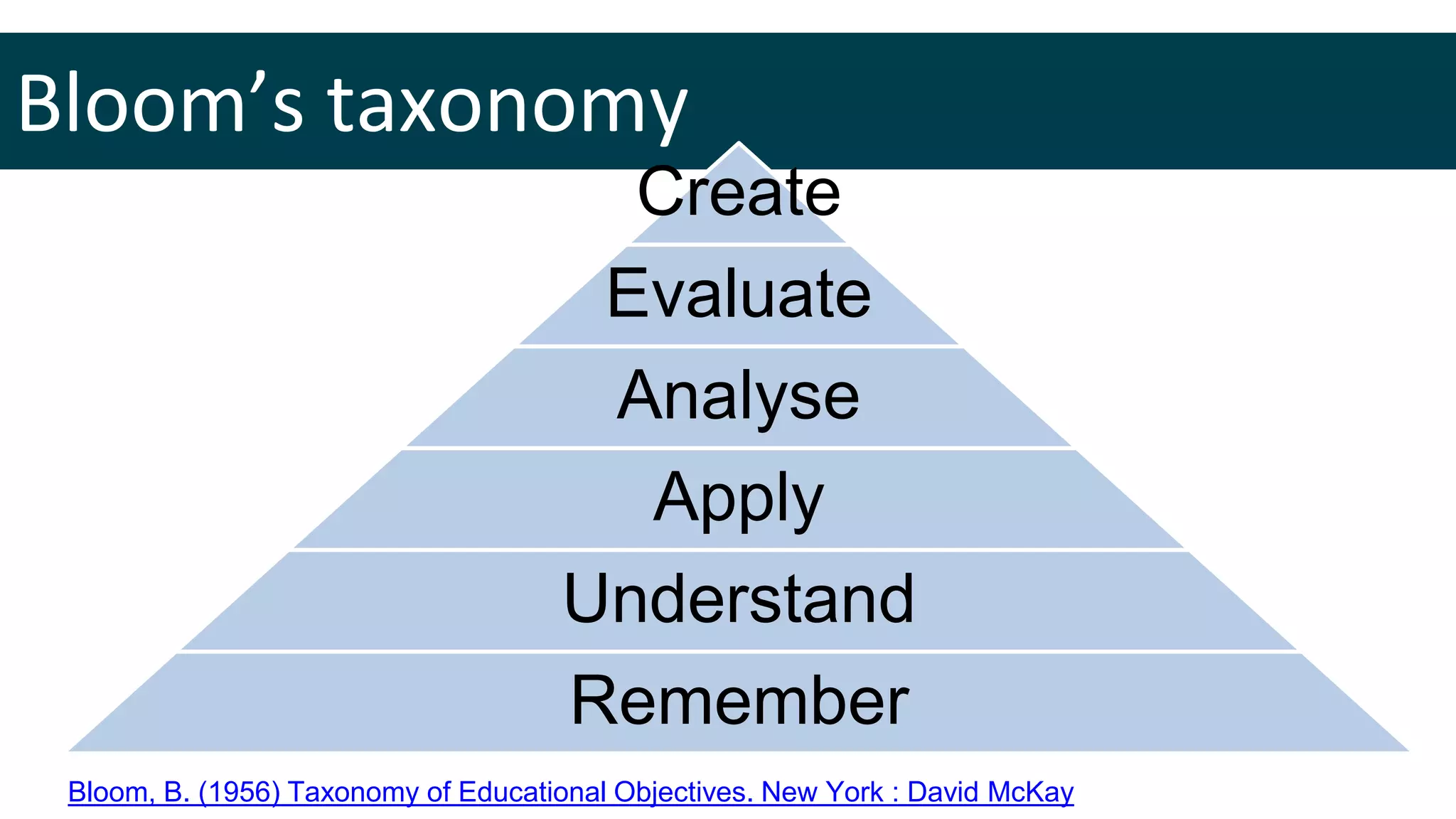
Bloom’s taxonomy
Create
Evaluate
Analyse
Apply
Understand
Remember
Bloom, B. (1956) Taxonomy of Educational Objectives. New York : David McKay
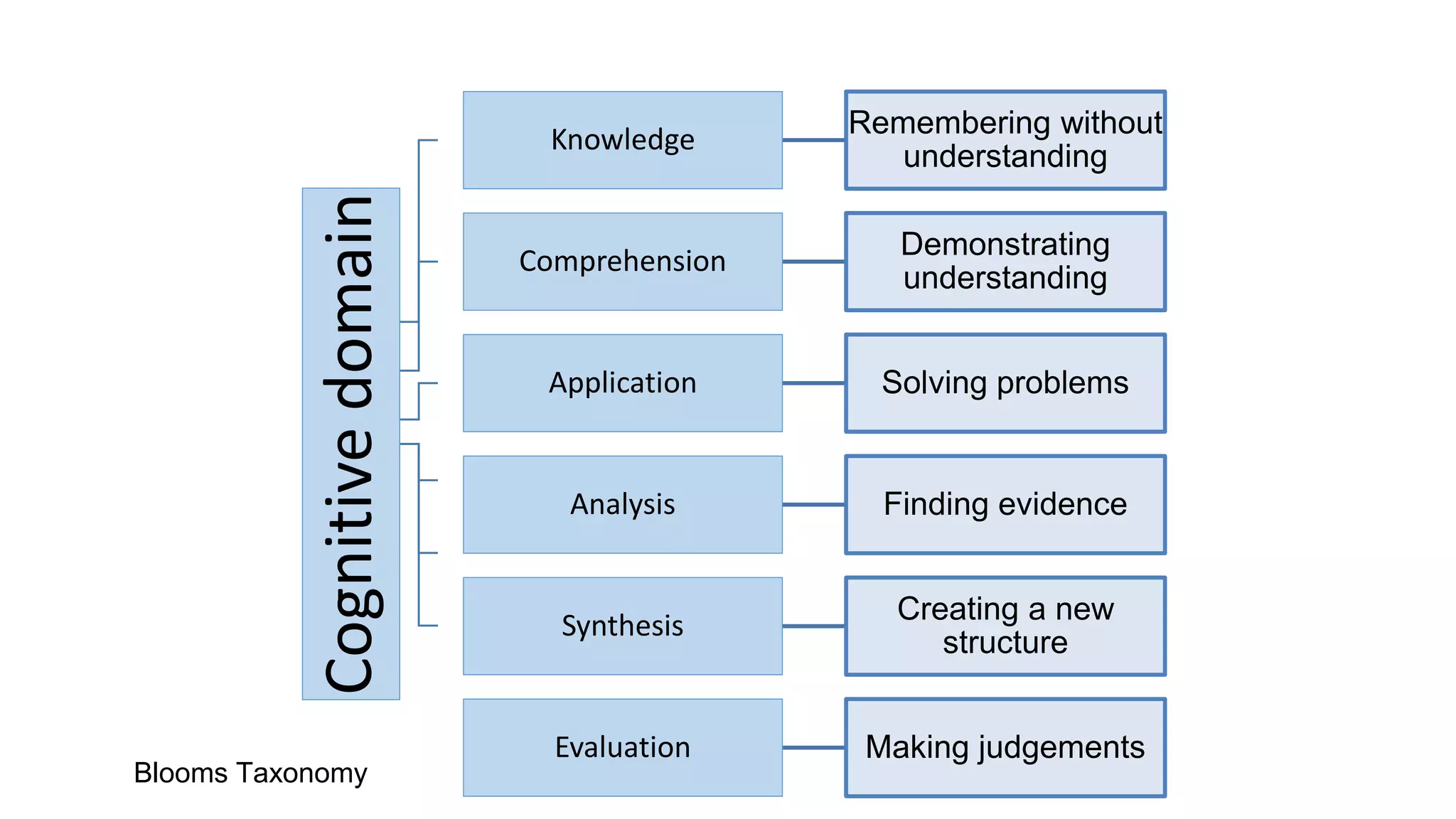
Cognitivedomain
Knowledge Remembering without
understanding
Comprehension Demonstrating
understanding
Application Solving problems
Analysis Finding evidence
Synthesis Creating a new
structure
Evaluation Making judgements
Blooms Taxonomy
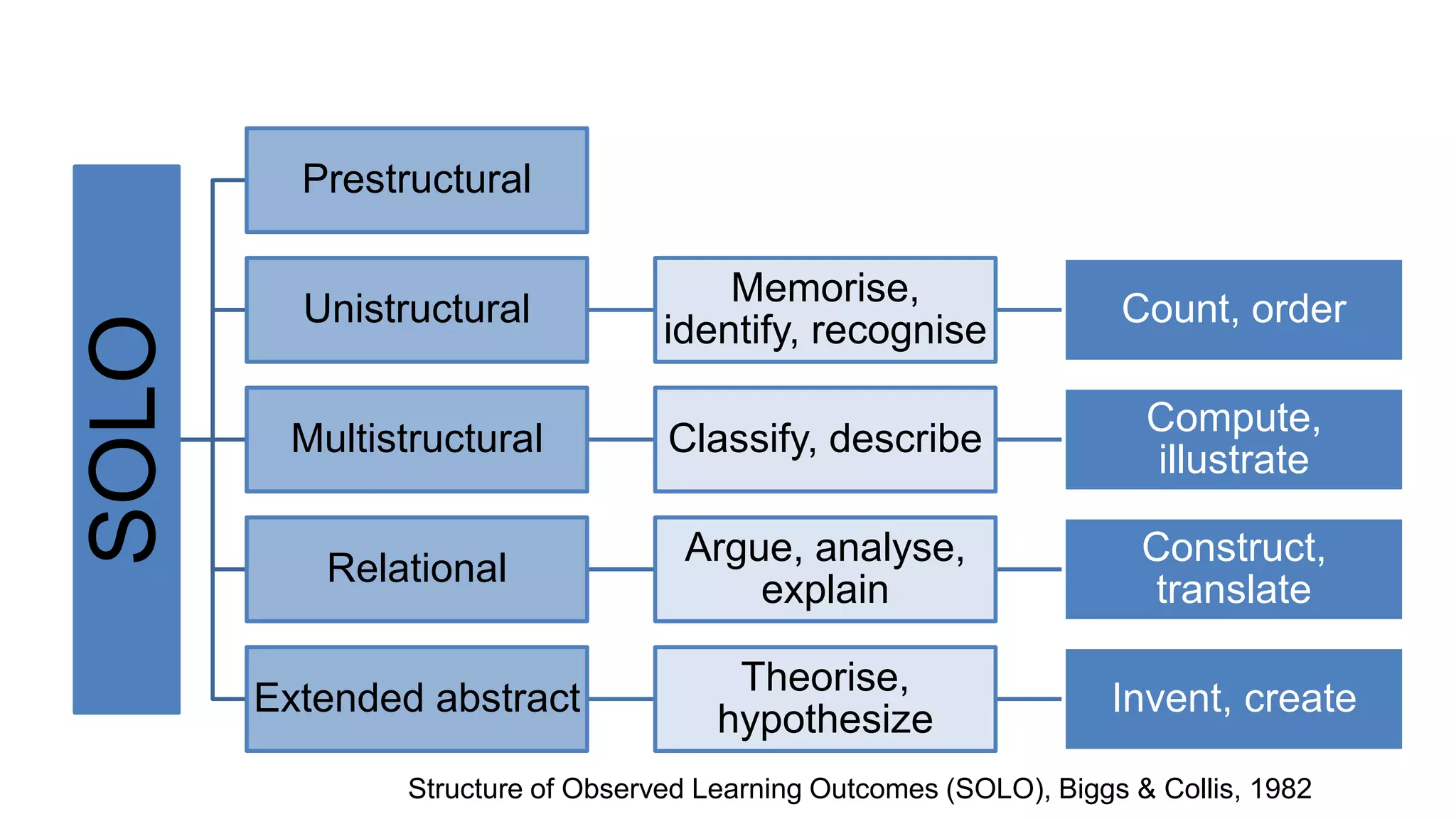
SOLO Prestructural
Unistructural
Memorise,
identify, recognise
Count, order
Multistructural Classify, describe
Compute,
illustrate
Relational
Argue, analyse,
explain
Construct,
translate
Extended abstract
Theorise,
hypothesize
Invent, create
Structure of Observed Learning Outcomes (SOLO), Biggs & Collis, 1982
thresholdconcepts
transformative changes your views
troublesome counter-intuitive
irreversible cannot be unlearned
integrative
bring together
previously unrelated
ideas
bounded has special terminology
discursive extends language use
reconstitutive shifts your perceptions
liminality
have an unstable 'in-
between' state
Threshold concepts, Meyer & Land, 2003
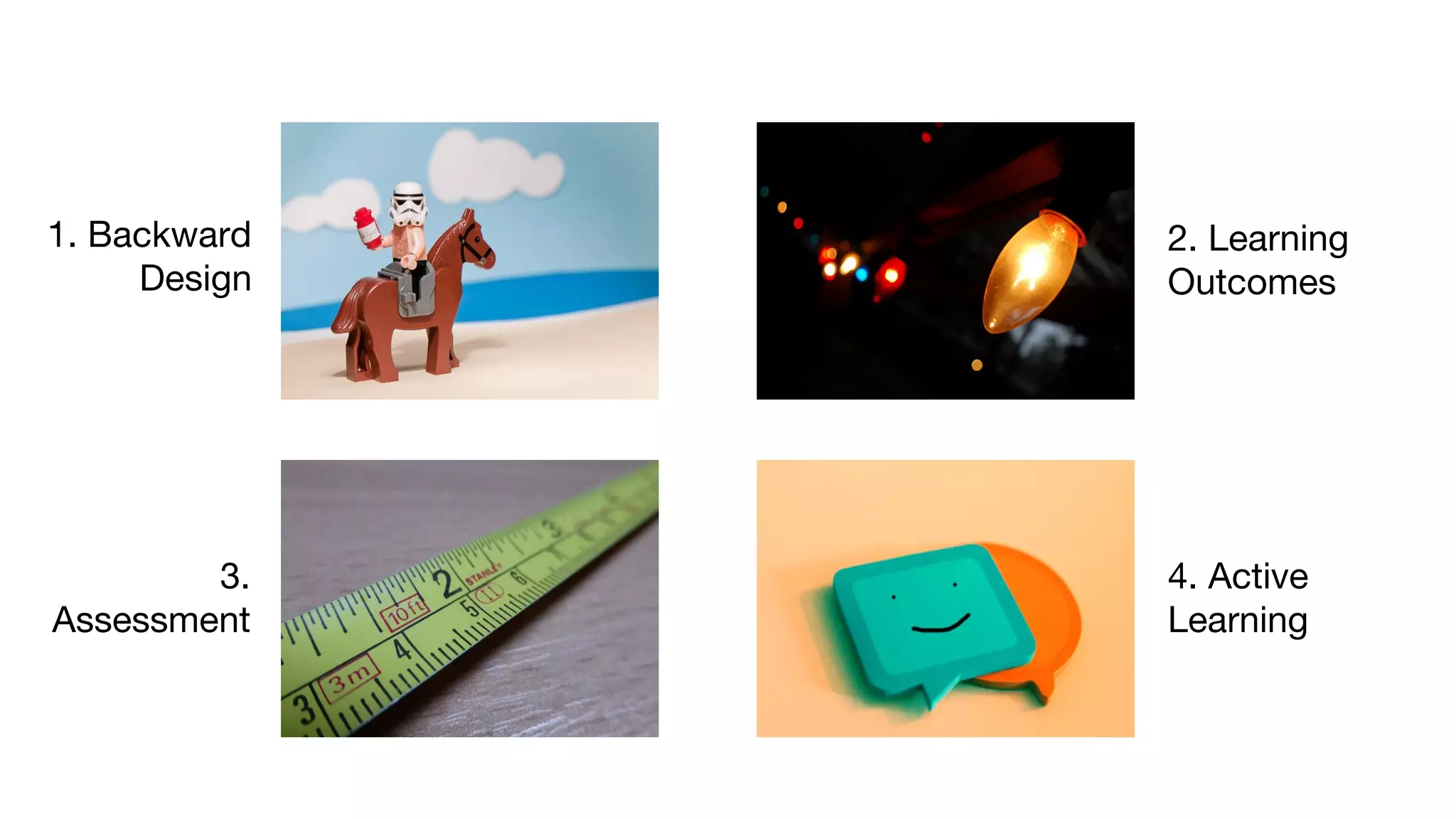
1. Backward
Design
2. Learning
Outcomes
3.
Assessment
4. Active
Learning
Backward Design
1. Backward Design
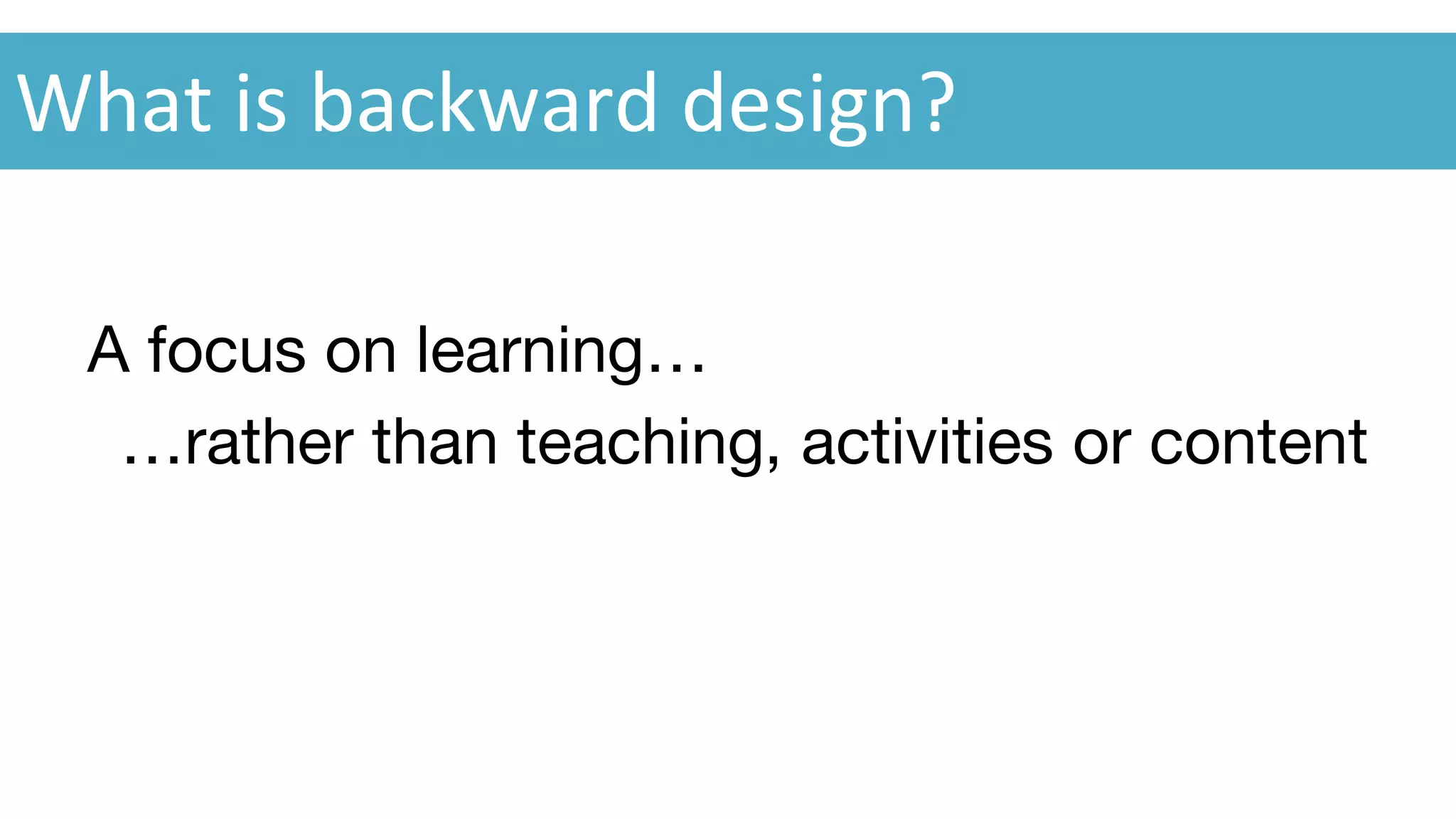
A focus on learning…
…rather than teaching, activities or content
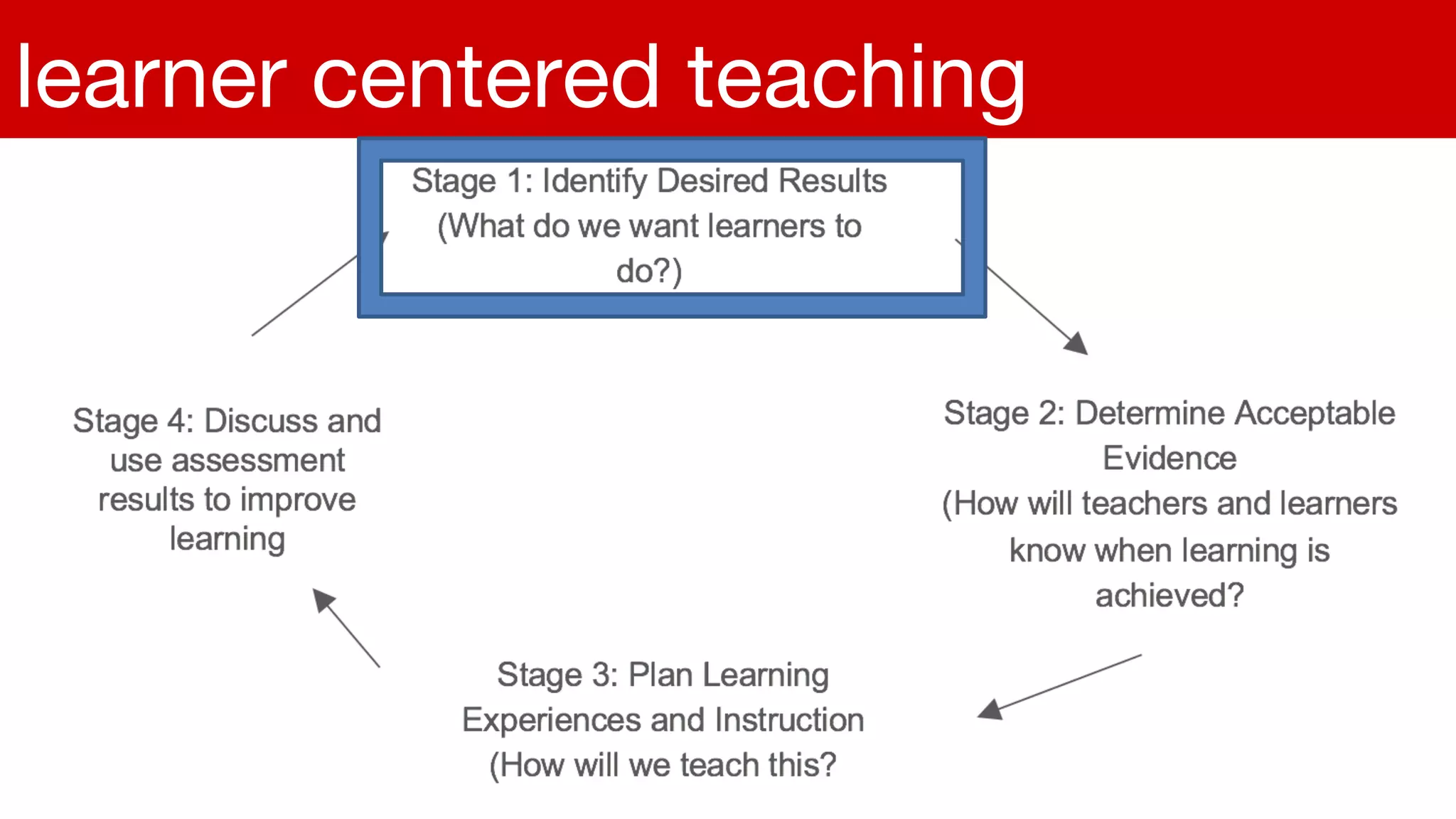
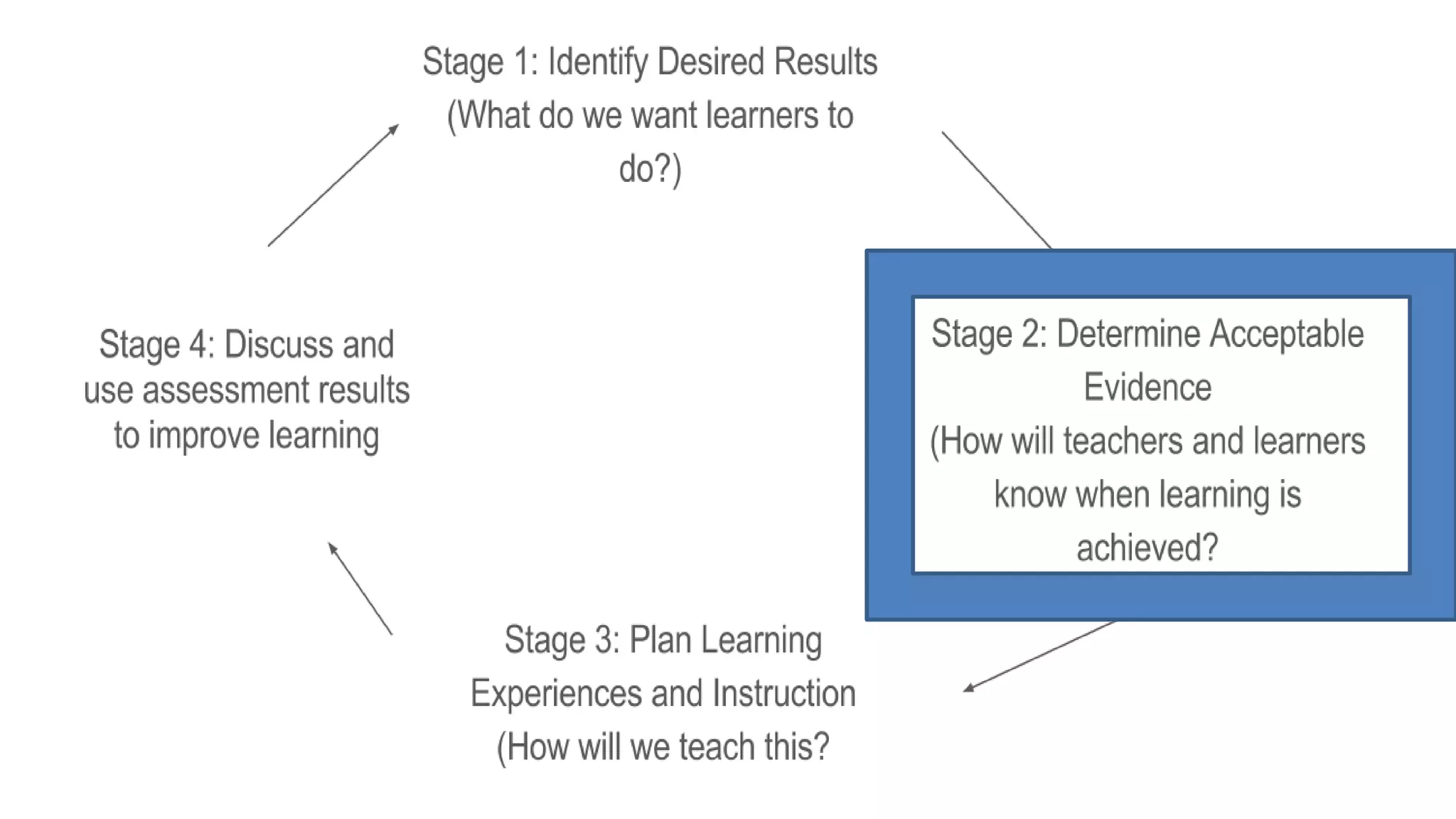
What is backward design?
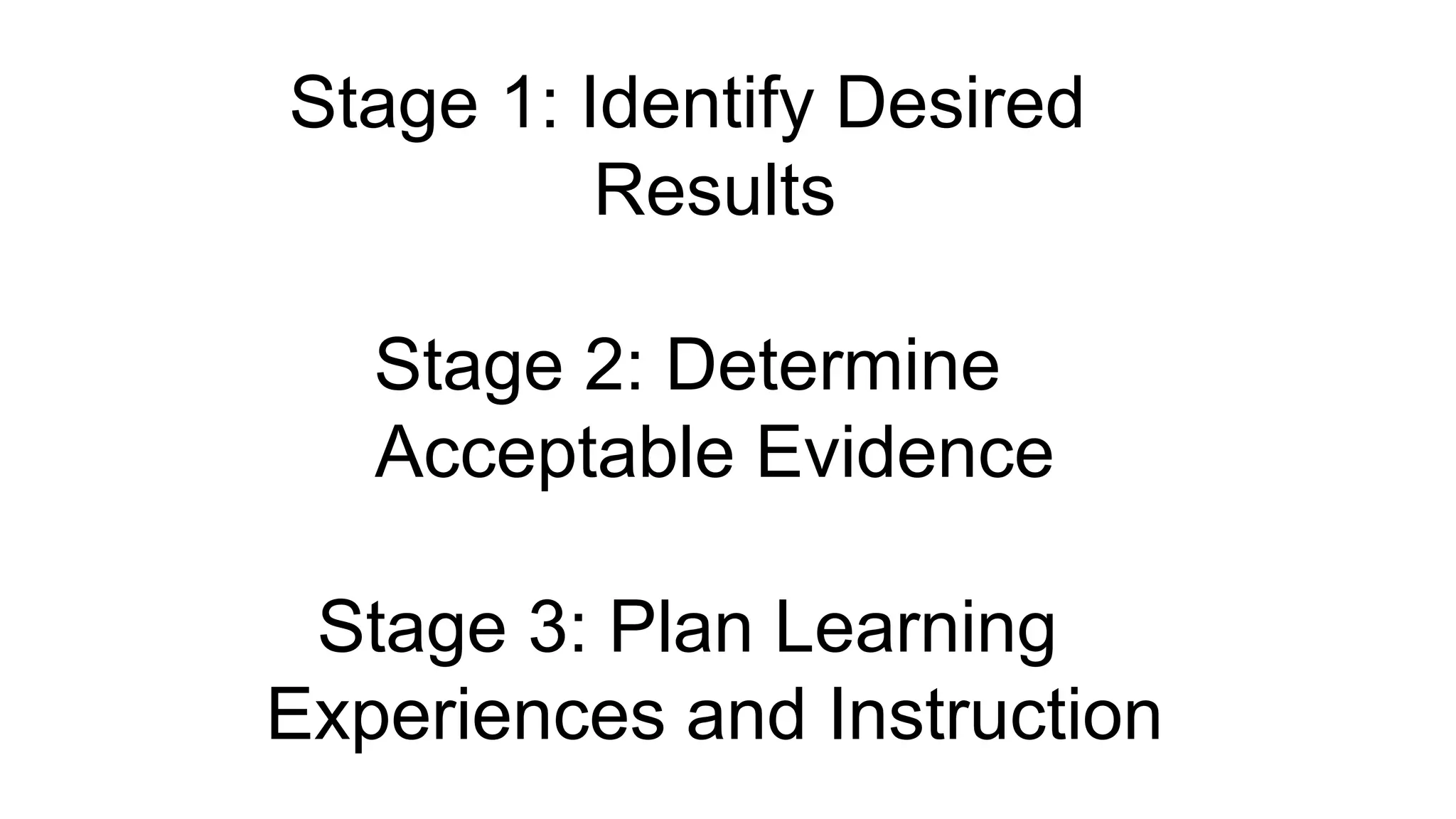
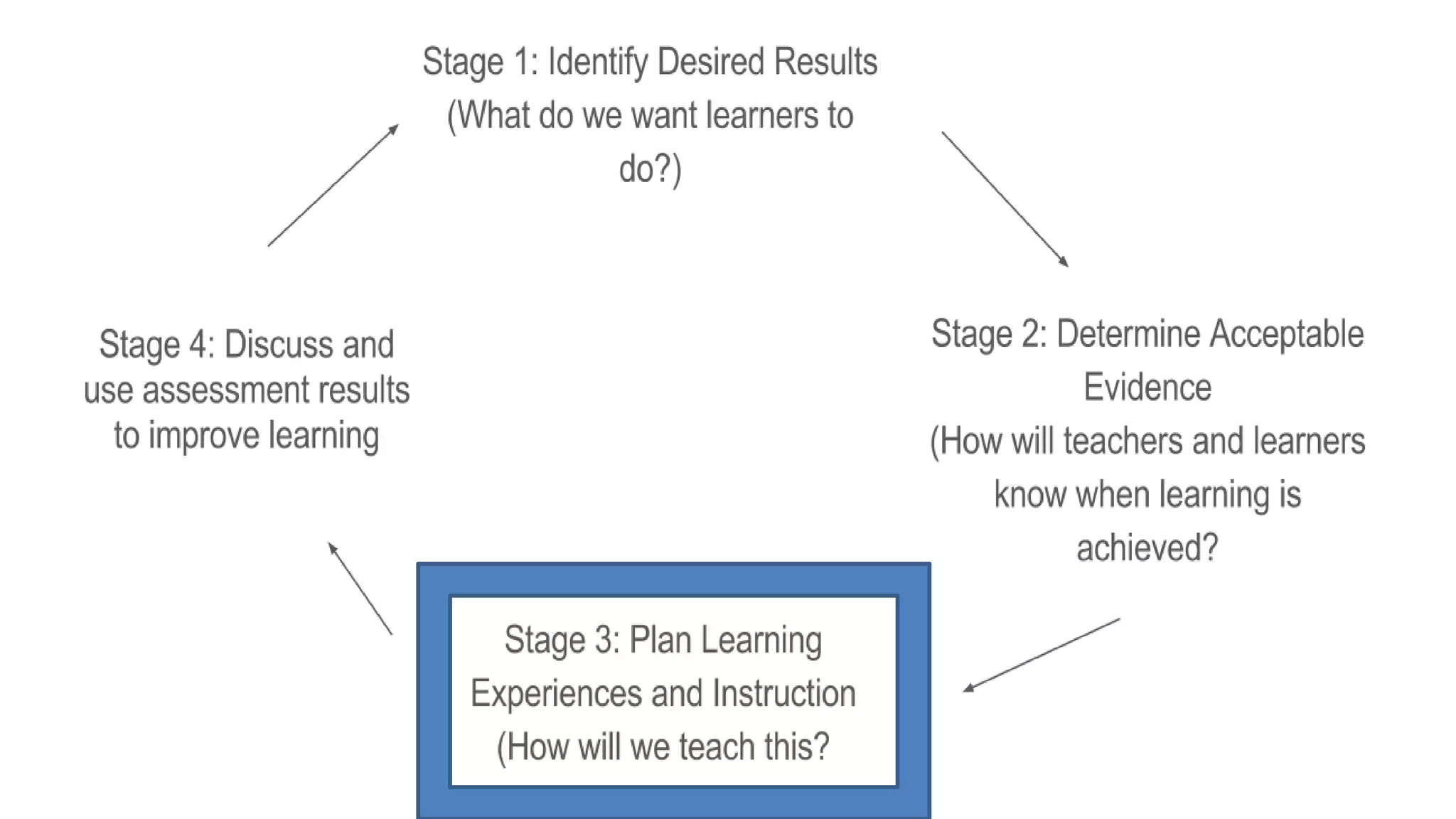
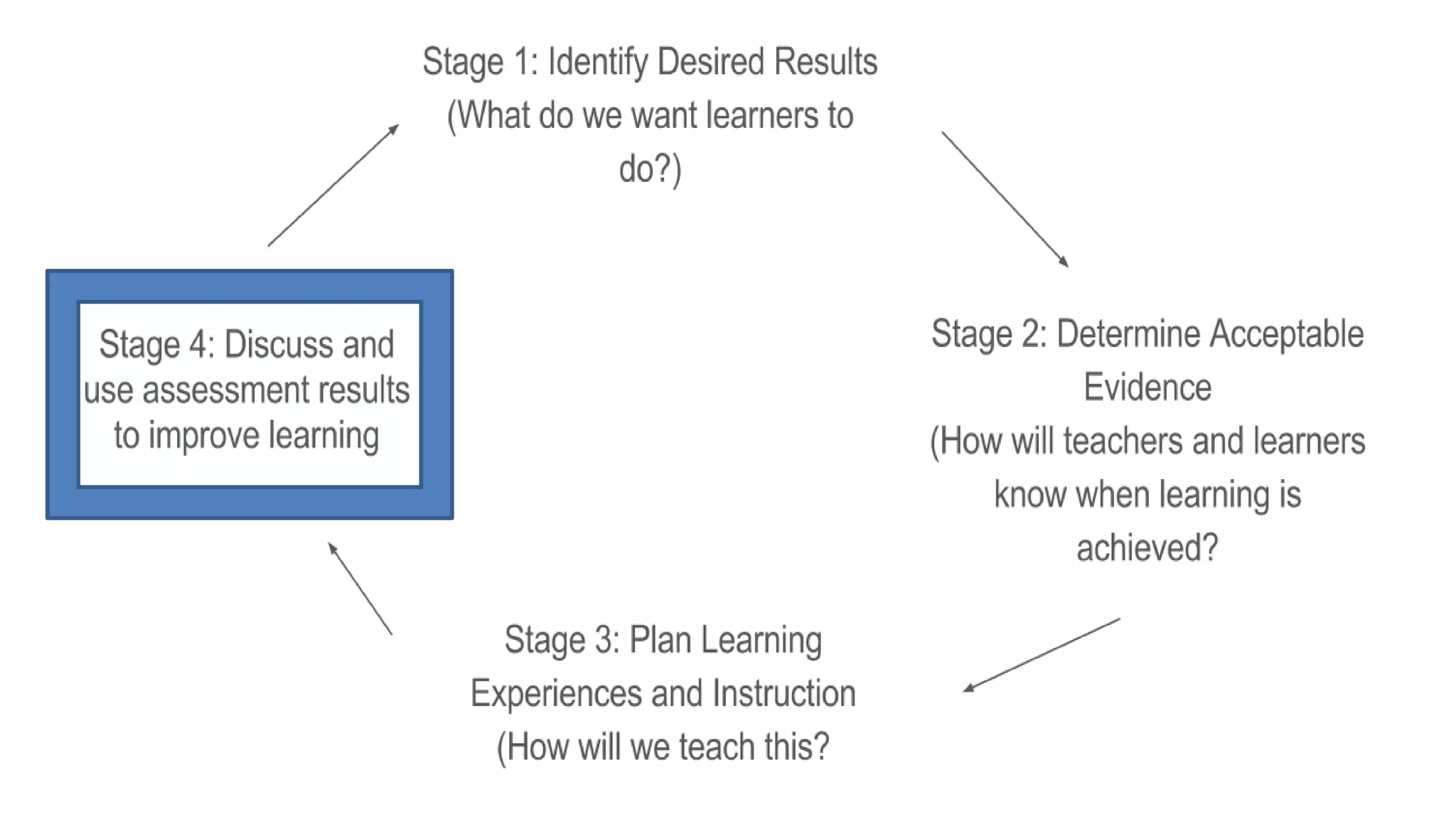
Stage 1: Identify Desired
Results
Stage 2: Determine
Acceptable Evidence
Stage 3: Plan Learning
Experiences and Instruction
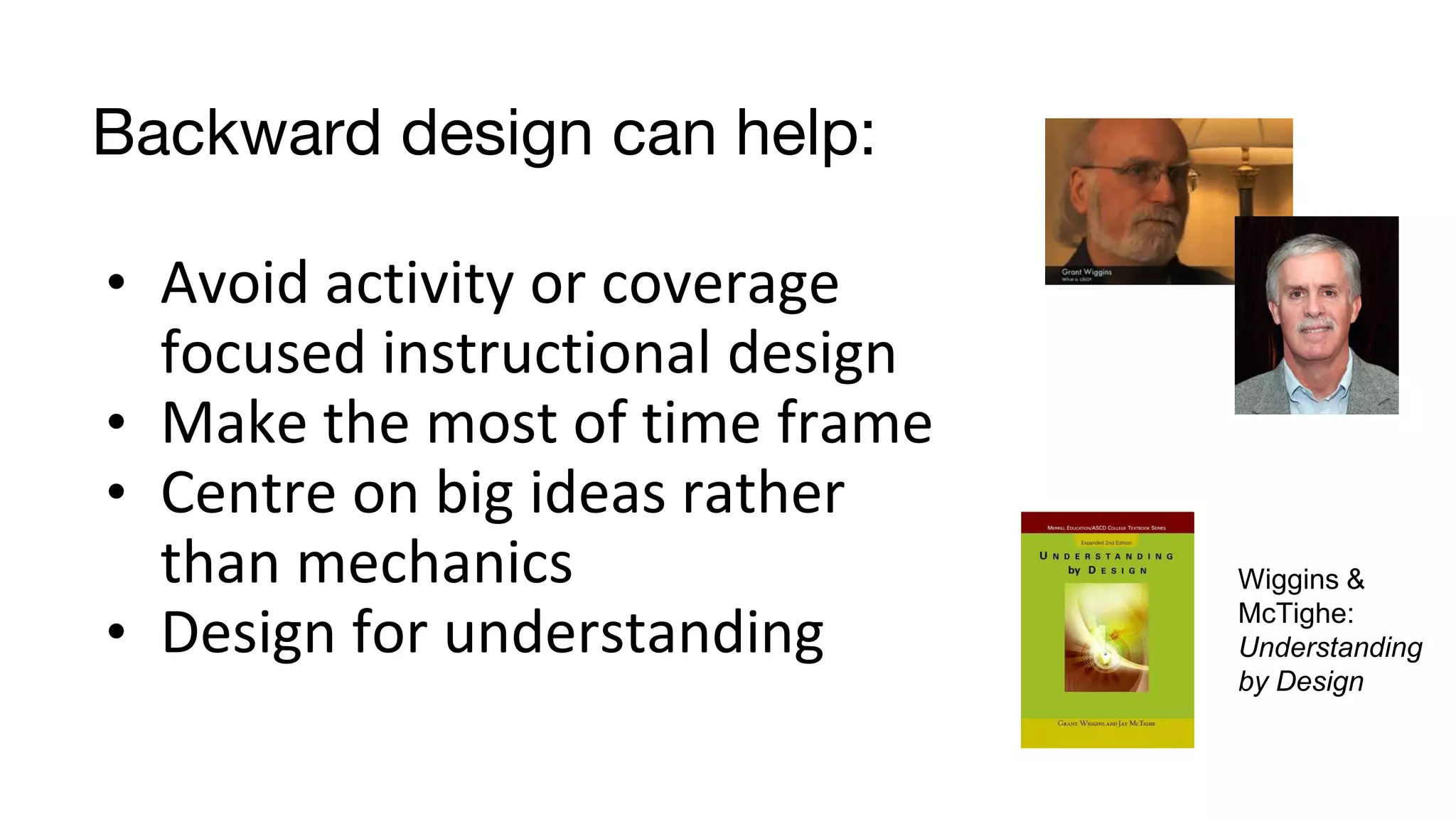
Backward design can help:
• Avoid activity or coverage
focused instructional design
• Make the most of time frame
• Centre on big ideas rather
than mechanics
• Design for understanding
Wiggins &
McTighe:
Understanding
by Design
2. Learning Outcomes
learner centered teaching
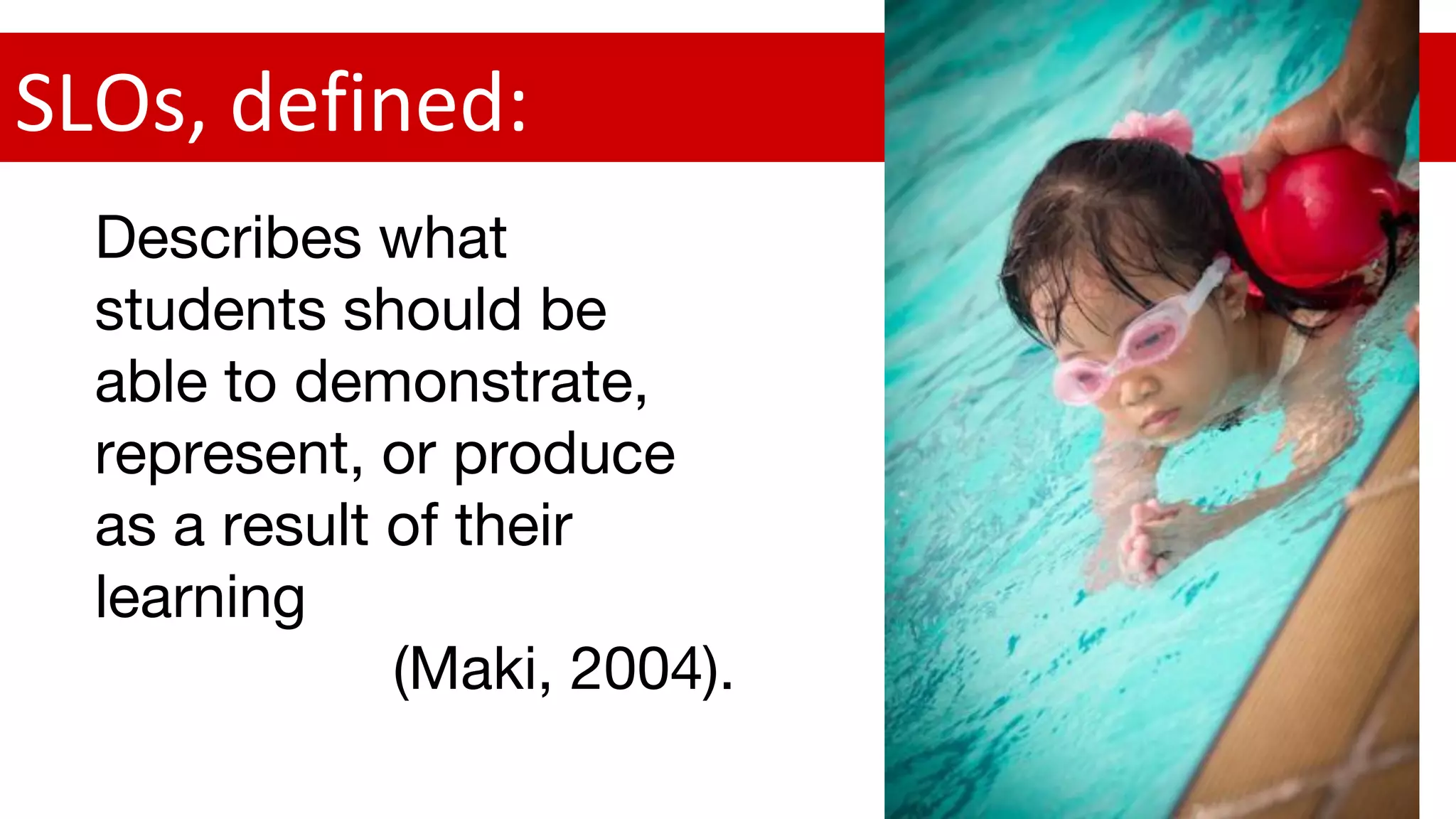
Describes what
students should be
able to demonstrate,
represent, or produce
as a result of their
learning
(Maki, 2004).
SLOs, defined:
• build a structure for the
unit/session
• communicate to
students how to be
successful
why SLO’s matter...
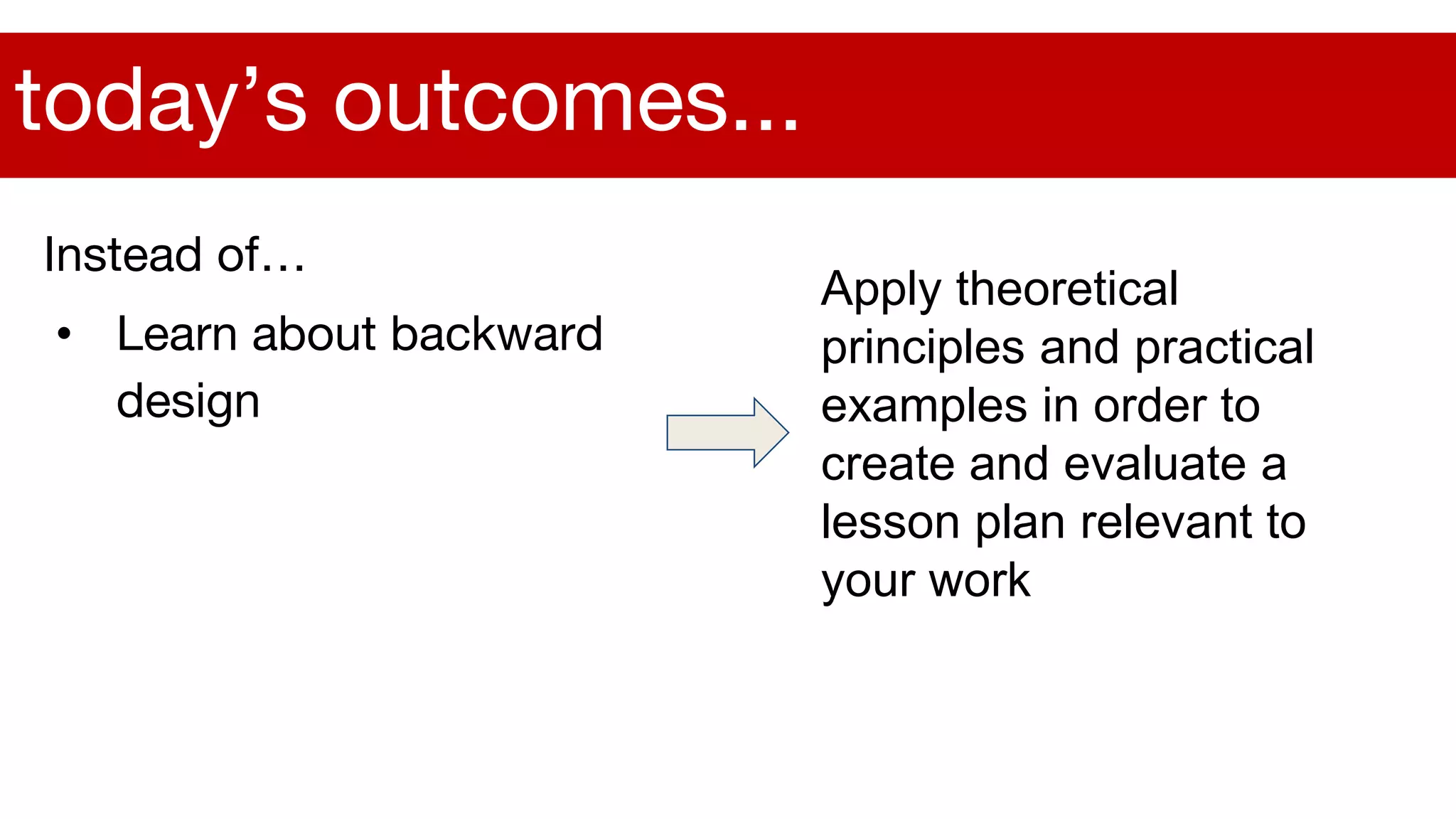
today’s outcomes...
Instead of…
• Learn about backward
design
Apply theoretical
principles and practical
examples in order to
create and evaluate a
lesson plan relevant to
your work
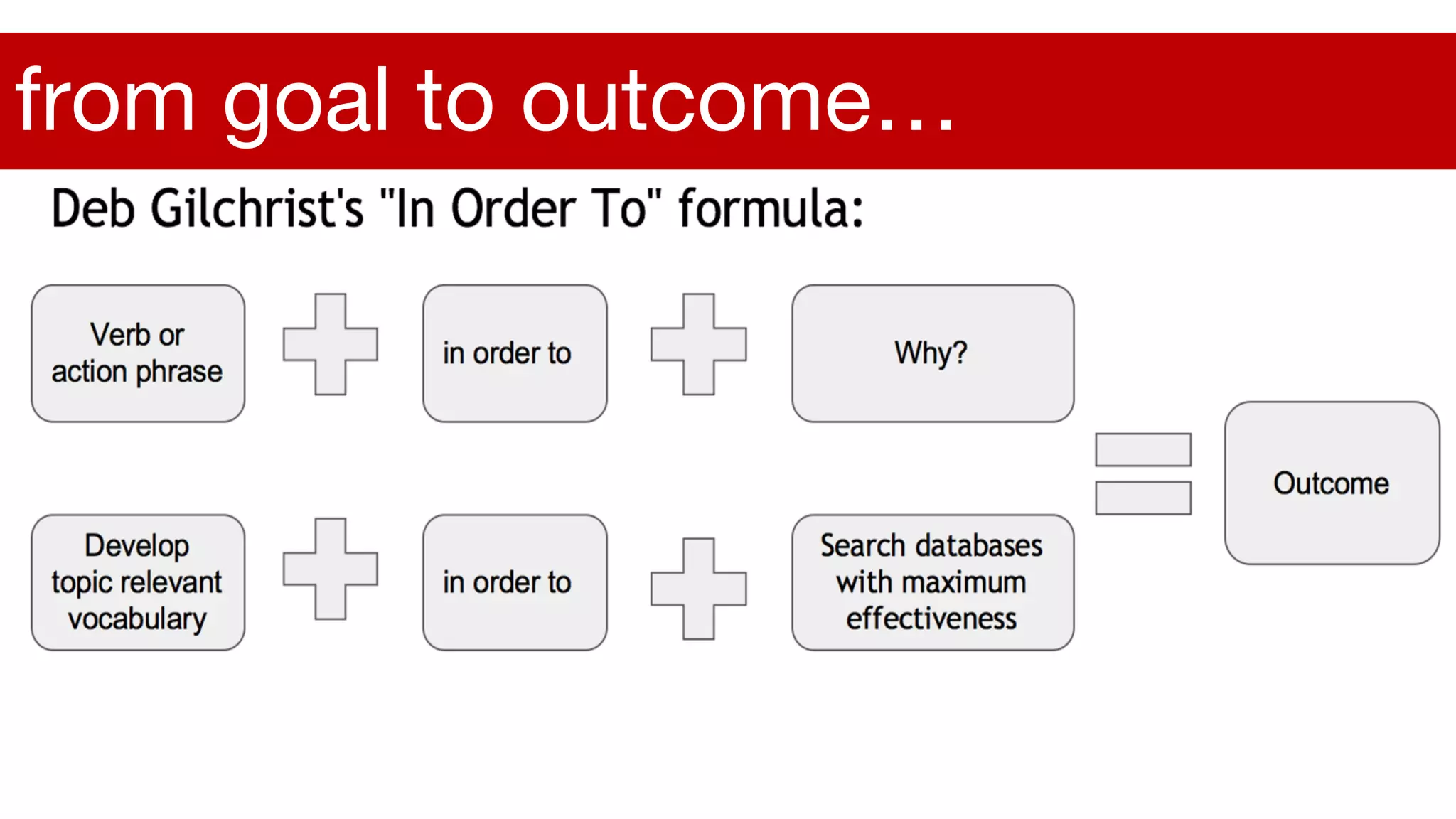
from goal to outcome…
• Match the two halves
of an outcome
• Choose one outcome
to focus on for the
rest of this session
try it…
3. Assessment
Assessment for:
● Teaching
● Learning
● Legitimisation...
reflective, authentic assessment
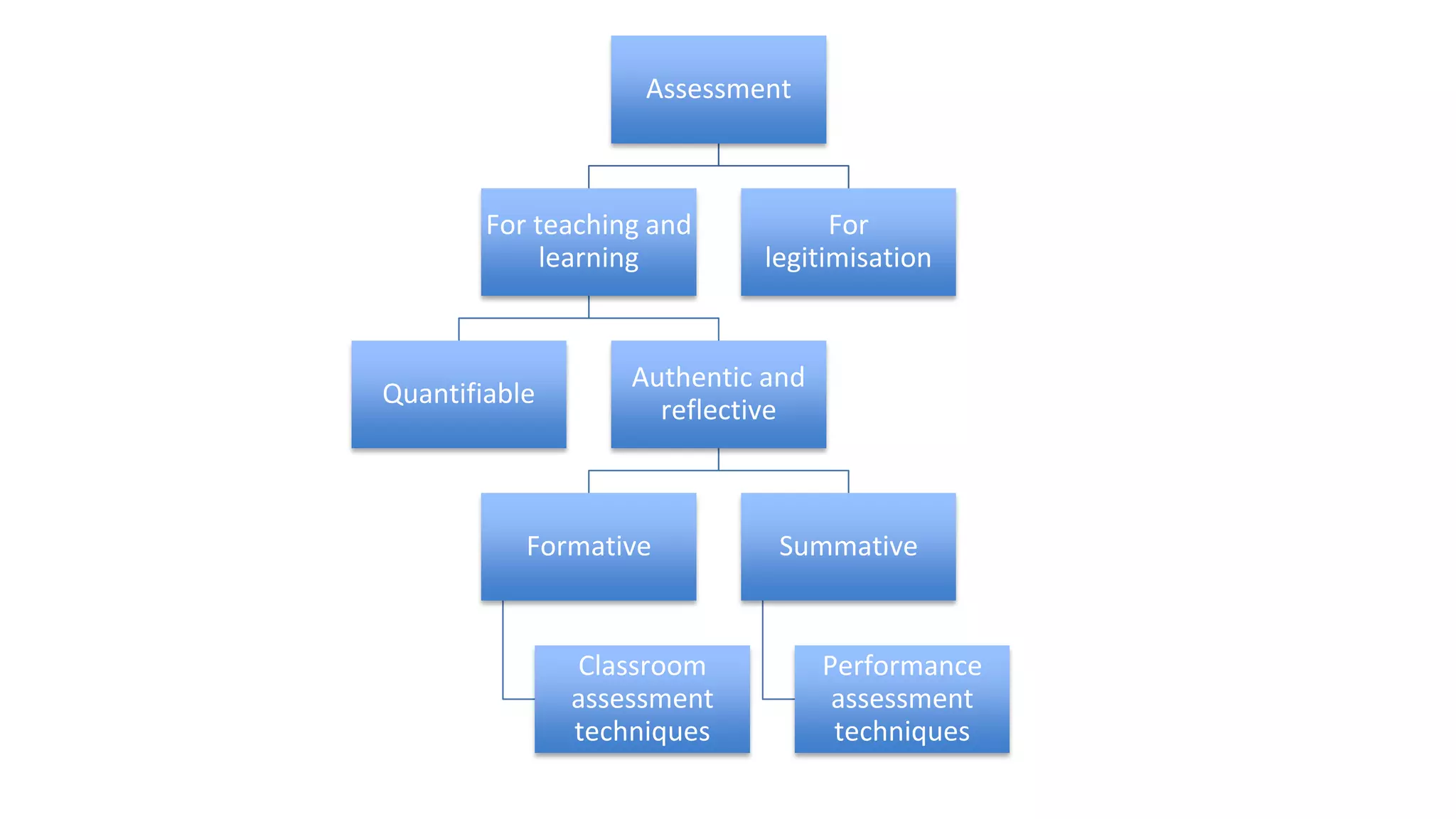
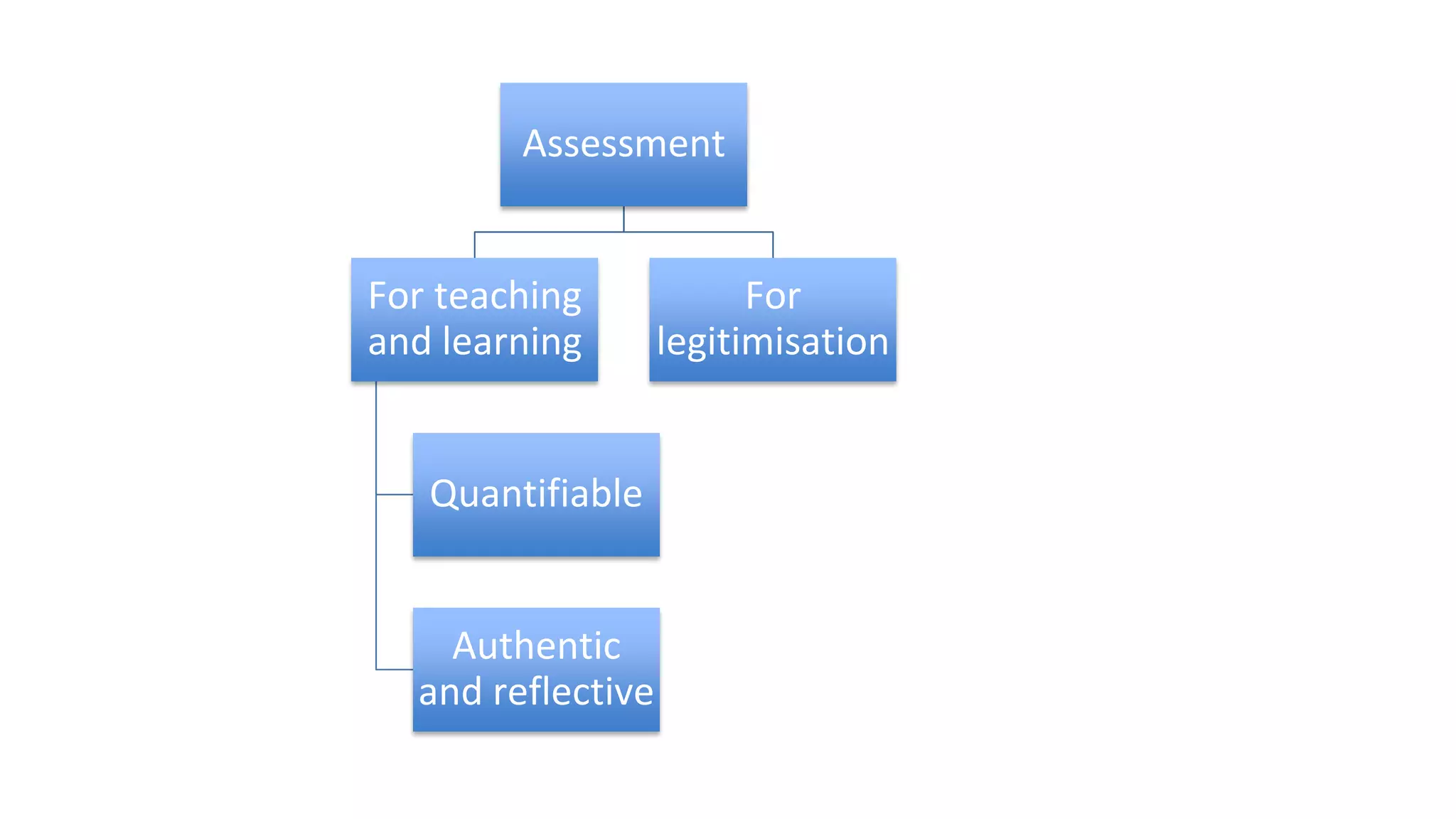
Assessment
For teaching
and learning
Quantifiable
Authentic
and reflective
For
legitimisation
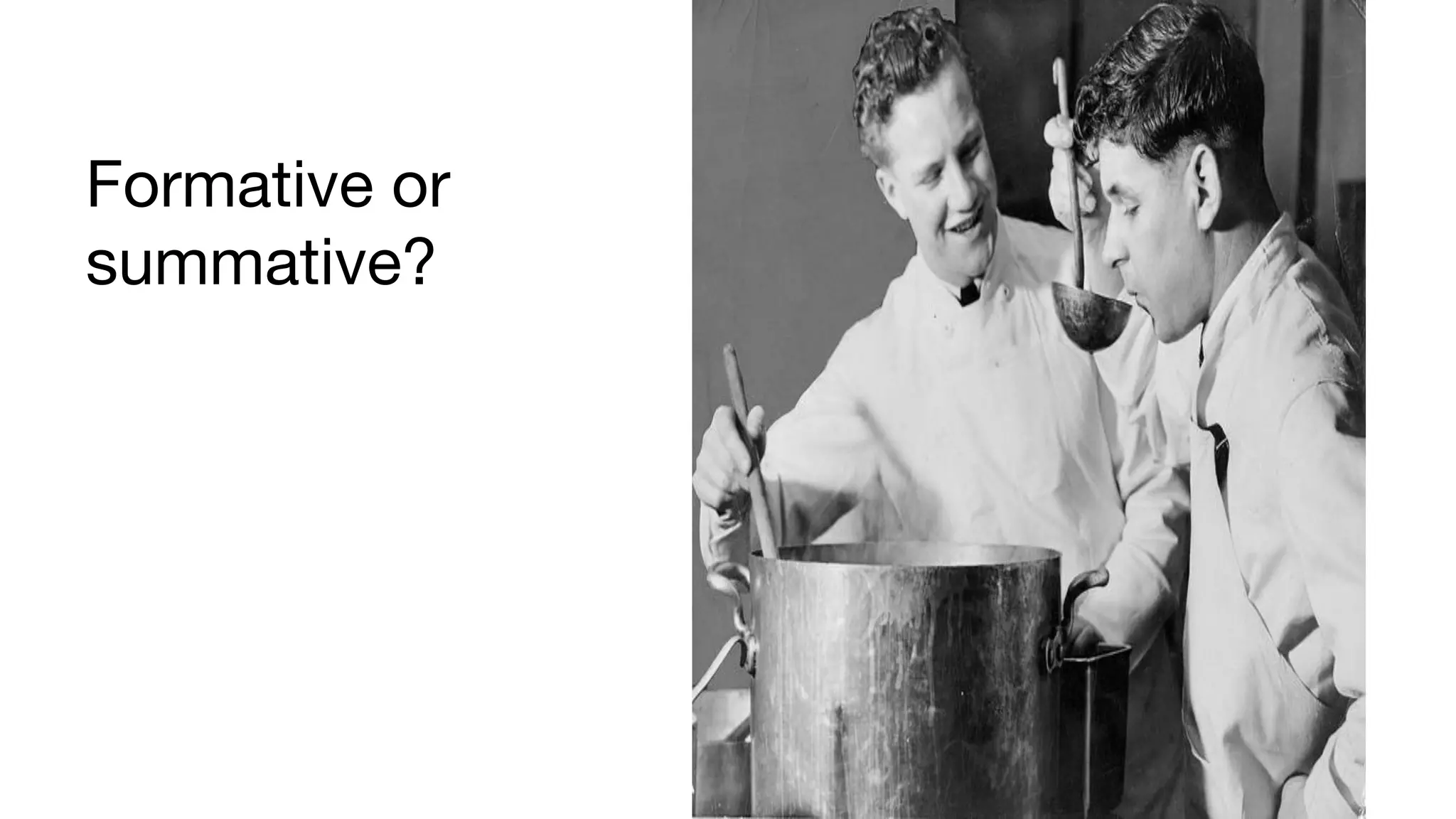
Formative or
summative?
Assessment
For teaching and
learning
Quantifiable
Authentic and
reflective
Formative
Classroom
assessment
techniques
Summative
Performance
assessment
techniques
For
legitimisation
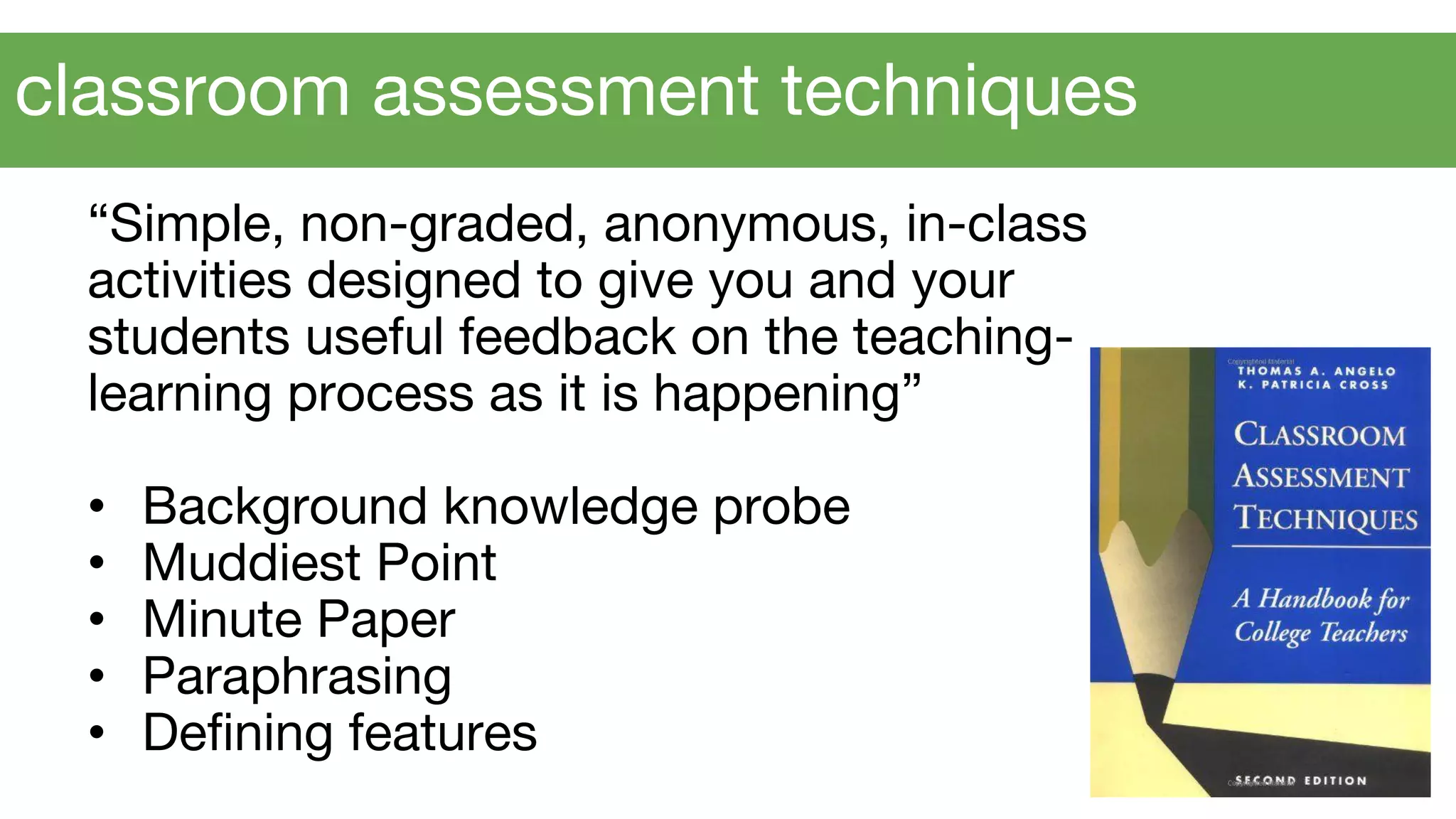
“Simple, non-graded, anonymous, in-class
activities designed to give you and your
students useful feedback on the teaching-
learning process as it is happening”
• Background knowledge probe
• Muddiest Point
• Minute Paper
• Paraphrasing
• Defining features
classroom assessment techniques
“known as alternative or authentic assessment,
it’s a form of testing that requires students to
perform a task rather than select an answer
from a ready-made list.”
• Open-ended or extended response exercises
• Solve problems
• Often measured by rubrics
performance assessment techniques
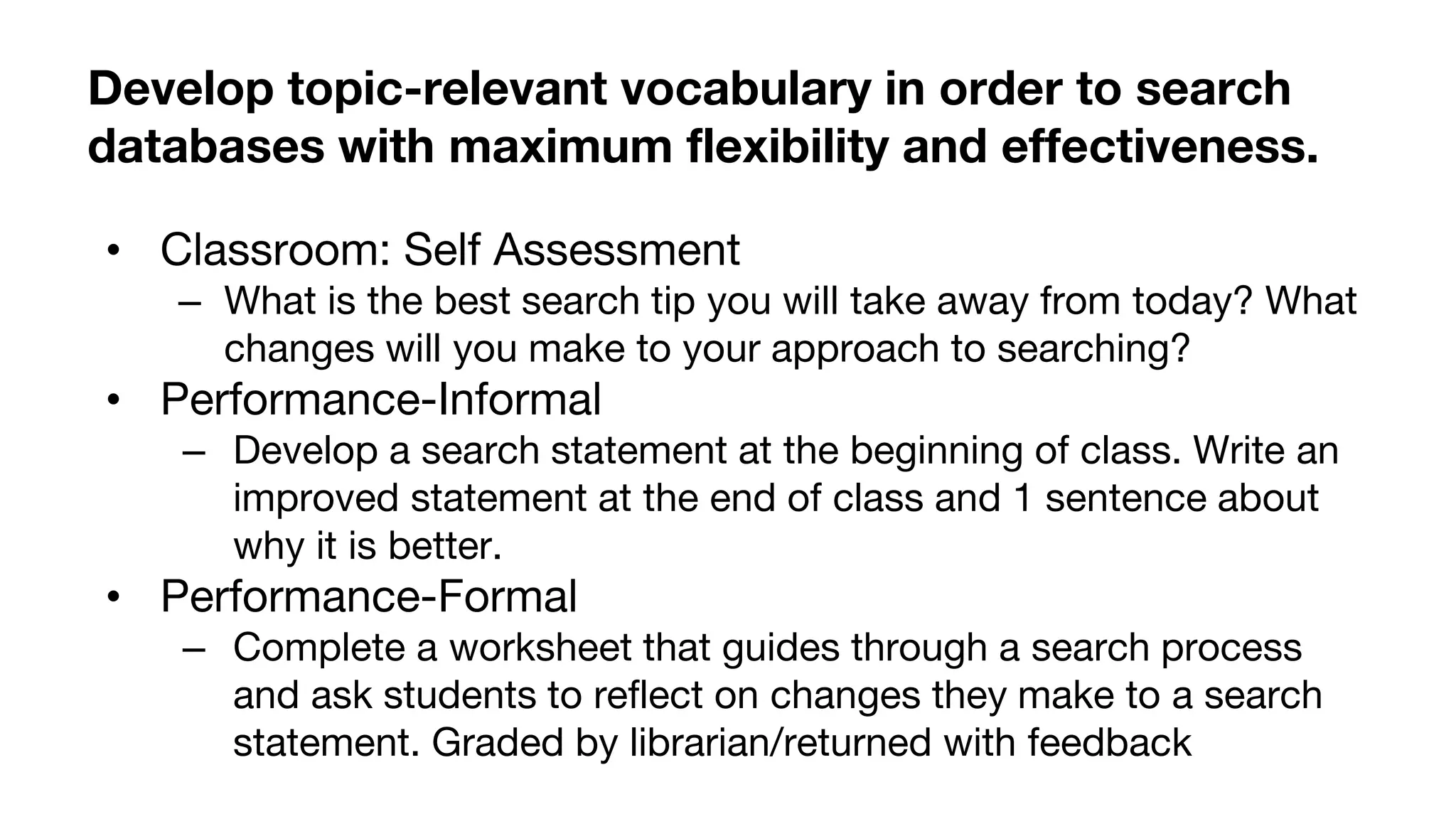
Develop topic-relevant vocabulary in order to search
databases with maximum flexibility and effectiveness.
• Classroom: Self Assessment
– What is the best search tip you will take away from today? What
changes will you make to your approach to searching?
• Performance-Informal
– Develop a search statement at the beginning of class. Write an
improved statement at the end of class and 1 sentence about
why it is better.
• Performance-Formal
– Complete a worksheet that guides through a search process
and ask students to reflect on changes they make to a search
statement. Graded by librarian/returned with feedback
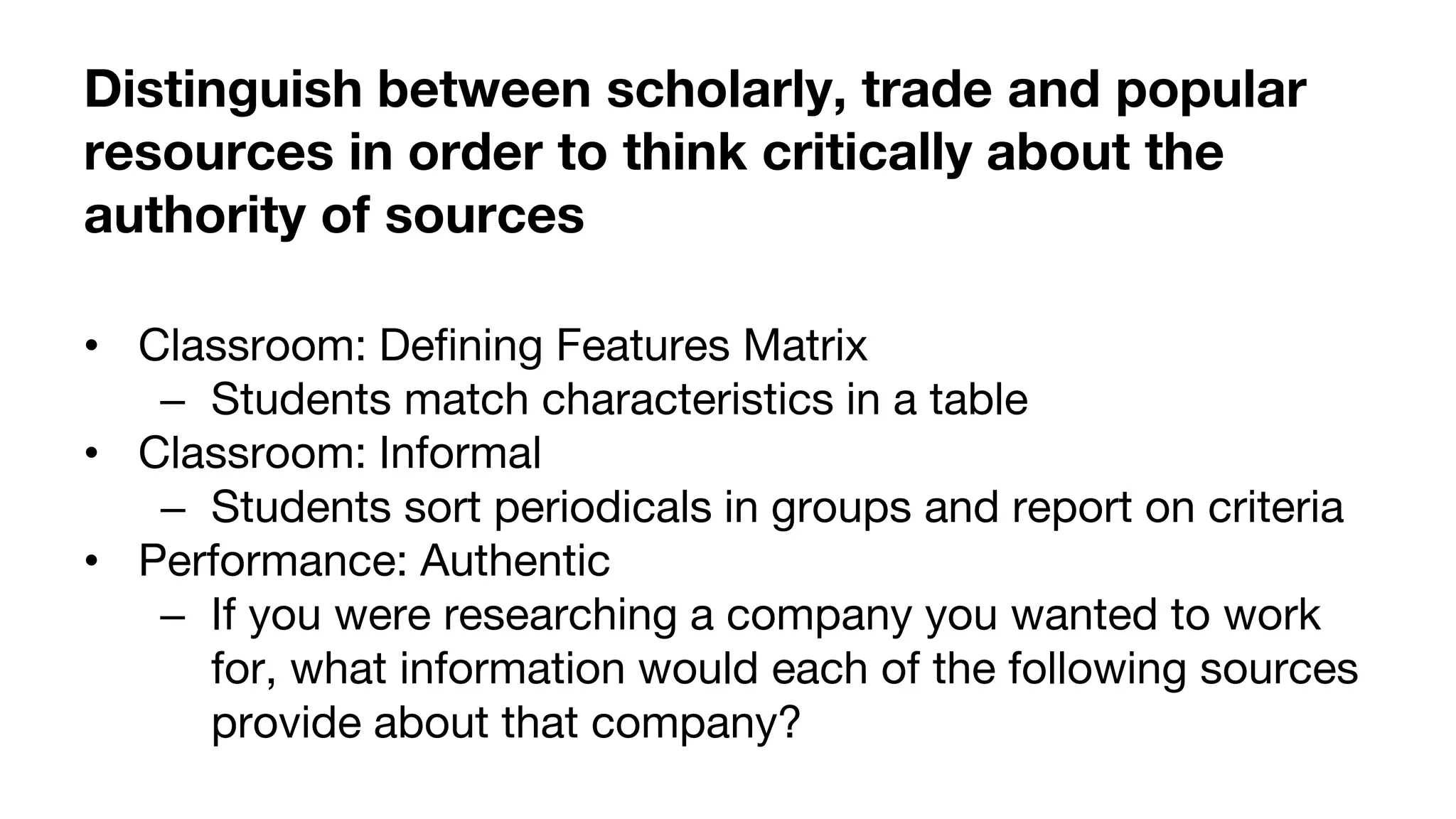
Distinguish between scholarly, trade and popular
resources in order to think critically about the
authority of sources
• Classroom: Defining Features Matrix
– Students match characteristics in a table
• Classroom: Informal
– Students sort periodicals in groups and report on criteria
• Performance: Authentic
– If you were researching a company you wanted to work
for, what information would each of the following sources
provide about that company?
Take a look through the list of
assessments. Choose one that
aligns with and will help you
assess your learning outcome.
• What are its benefits and
drawbacks?
• How could the librarian
respond to the results from
this assessment?
your turn!
4. Active Learning
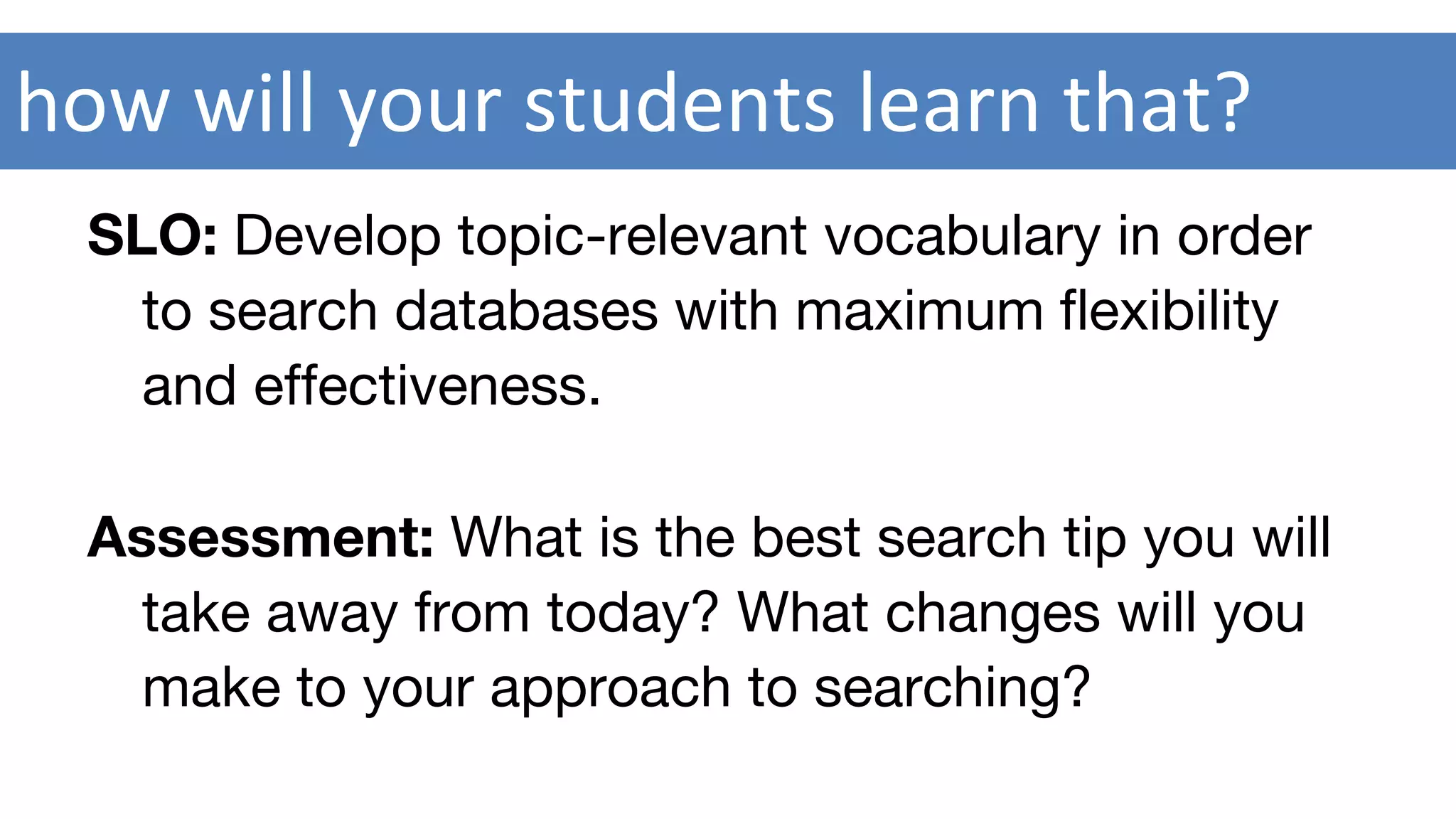
how will your students learn that?
SLO: Develop topic-relevant vocabulary in order
to search databases with maximum flexibility
and effectiveness.
Assessment: What is the best search tip you will
take away from today? What changes will you
make to your approach to searching?
Active learning: teaching in a half-ass way that makes
students have to go home and learn it on their own…
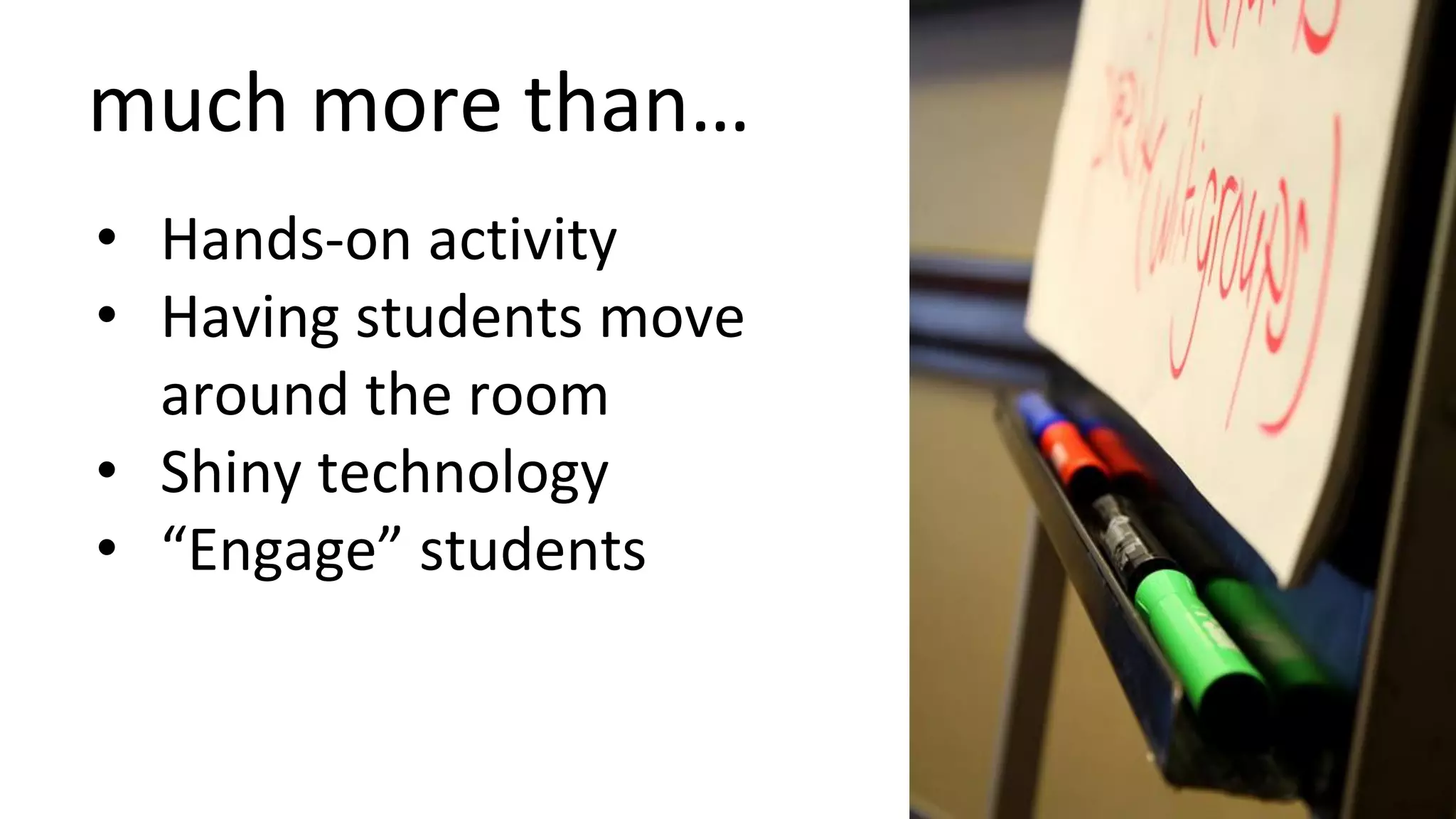
much more than…
• Hands-on activity
• Having students move
around the room
• Shiny technology
• “Engage” students
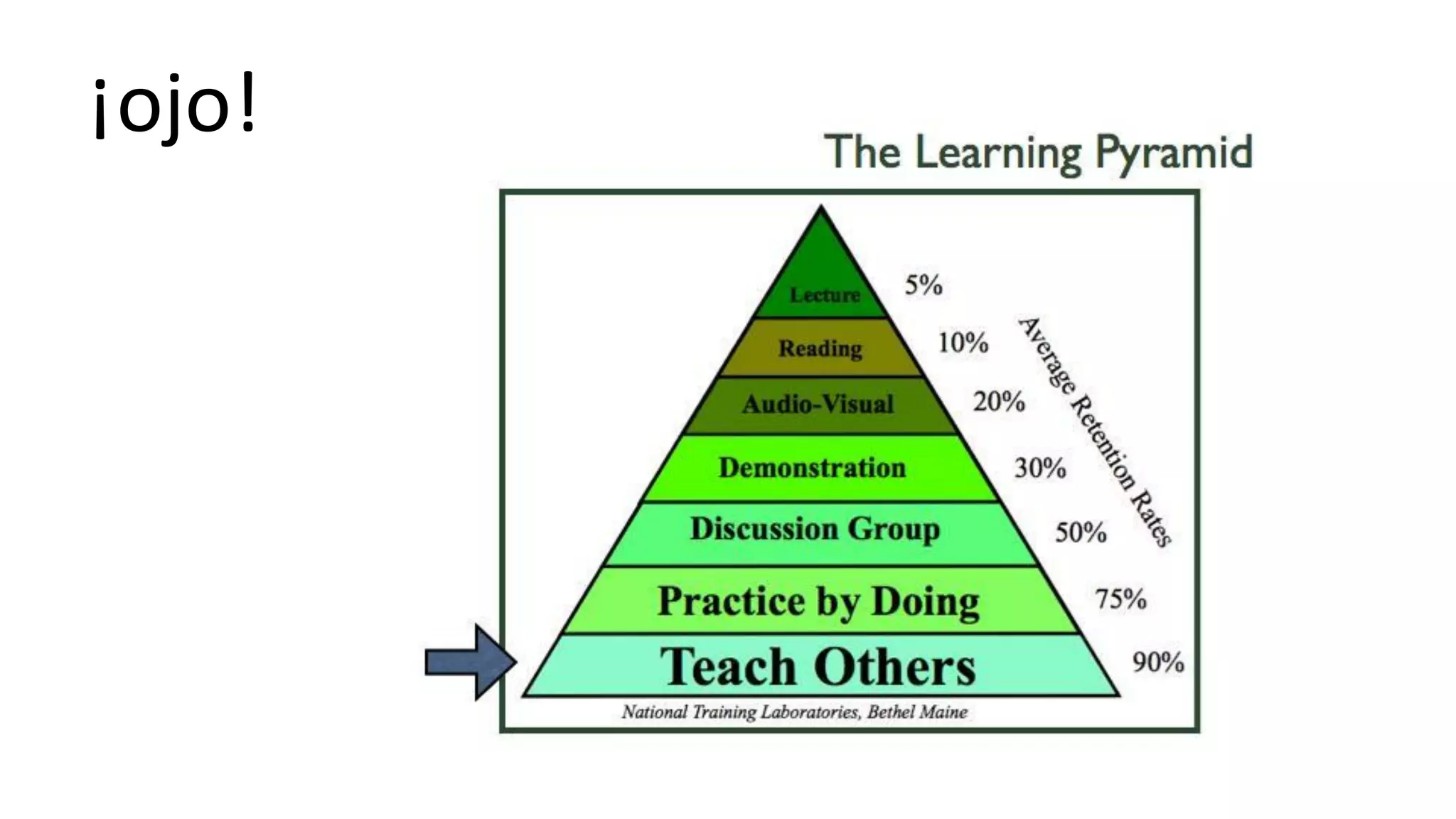
“Active learning is a process
whereby students engage in
activities, such as reading,
writing, discussion, or
problem solving that promote
analysis, synthesis, and
evaluation of class content.”
Michigan Center for Teaching and Learning
¡ojo!
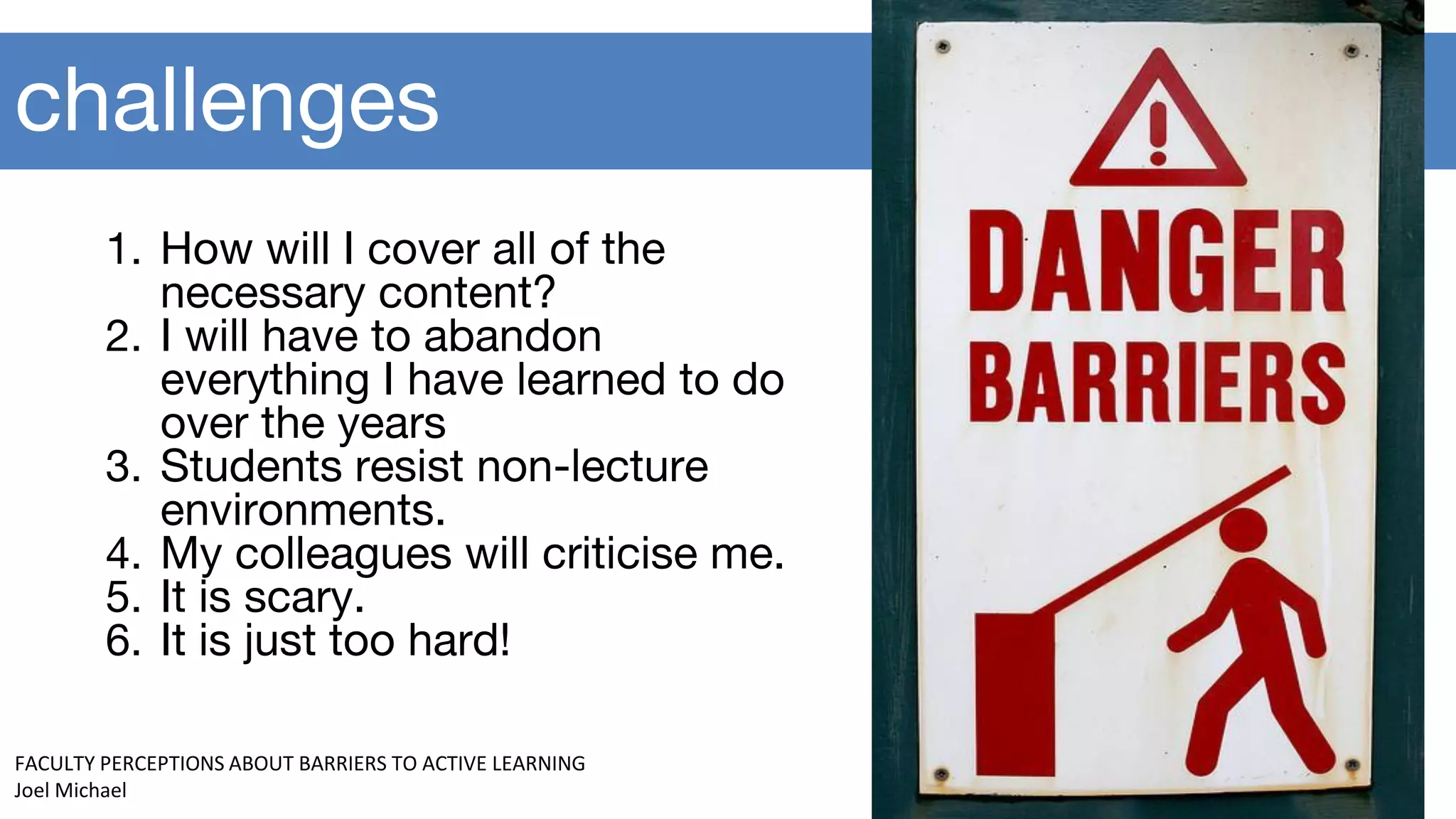
challenges
1. How will I cover all of the
necessary content?
2. I will have to abandon
everything I have learned to do
over the years
3. Students resist non-lecture
environments.
4. My colleagues will criticise me.
5. It is scary.
6. It is just too hard!
FACULTY PERCEPTIONS ABOUT BARRIERS TO ACTIVE LEARNING
Joel Michael
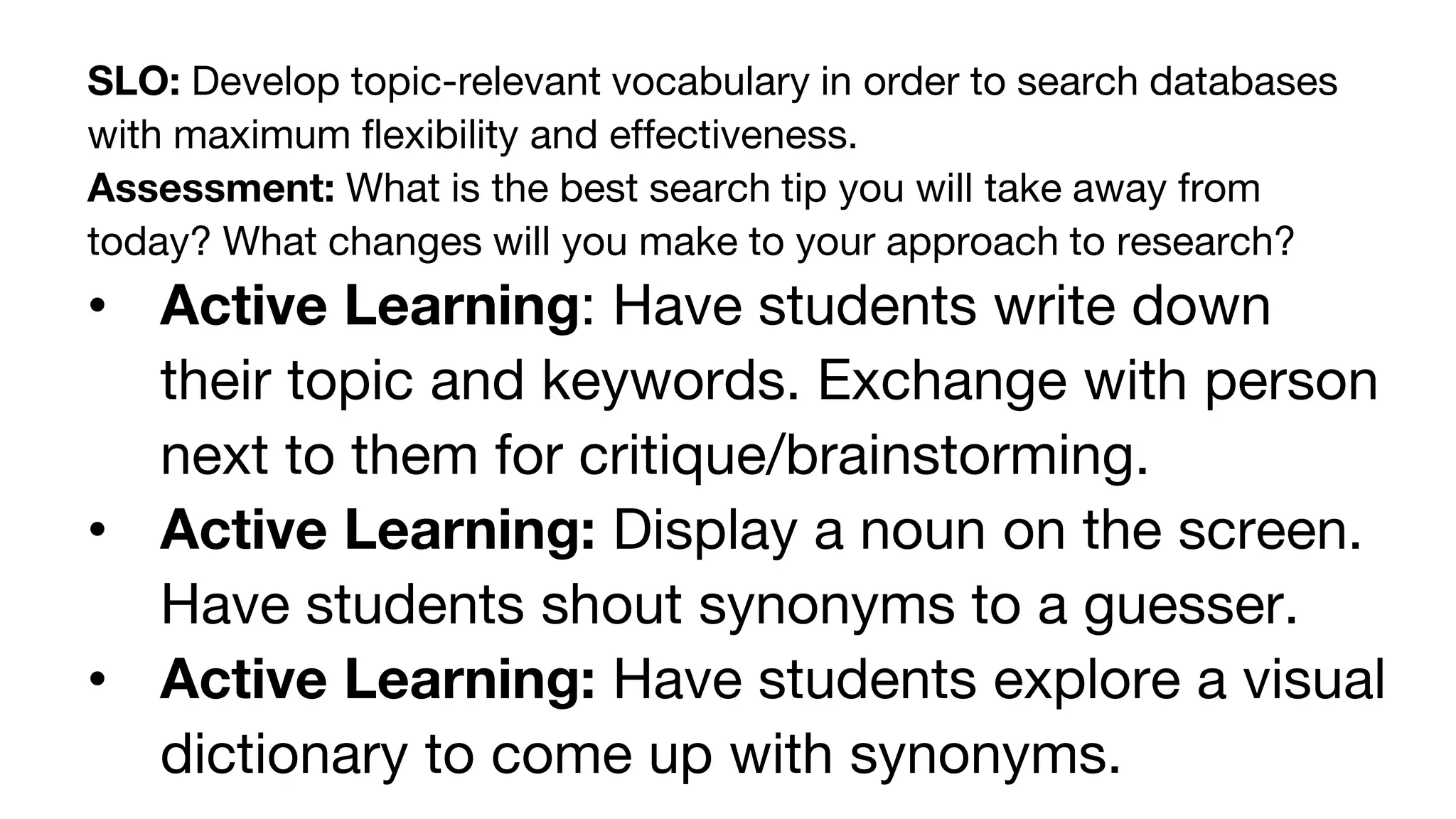
SLO: Develop topic-relevant vocabulary in order to search databases
with maximum flexibility and effectiveness.
Assessment: What is the best search tip you will take away from
today? What changes will you make to your approach to research?
• Active Learning: Have students write down
their topic and keywords. Exchange with person
next to them for critique/brainstorming.
• Active Learning: Display a noun on the screen.
Have students shout synonyms to a guesser.
• Active Learning: Have students explore a visual
dictionary to come up with synonyms.
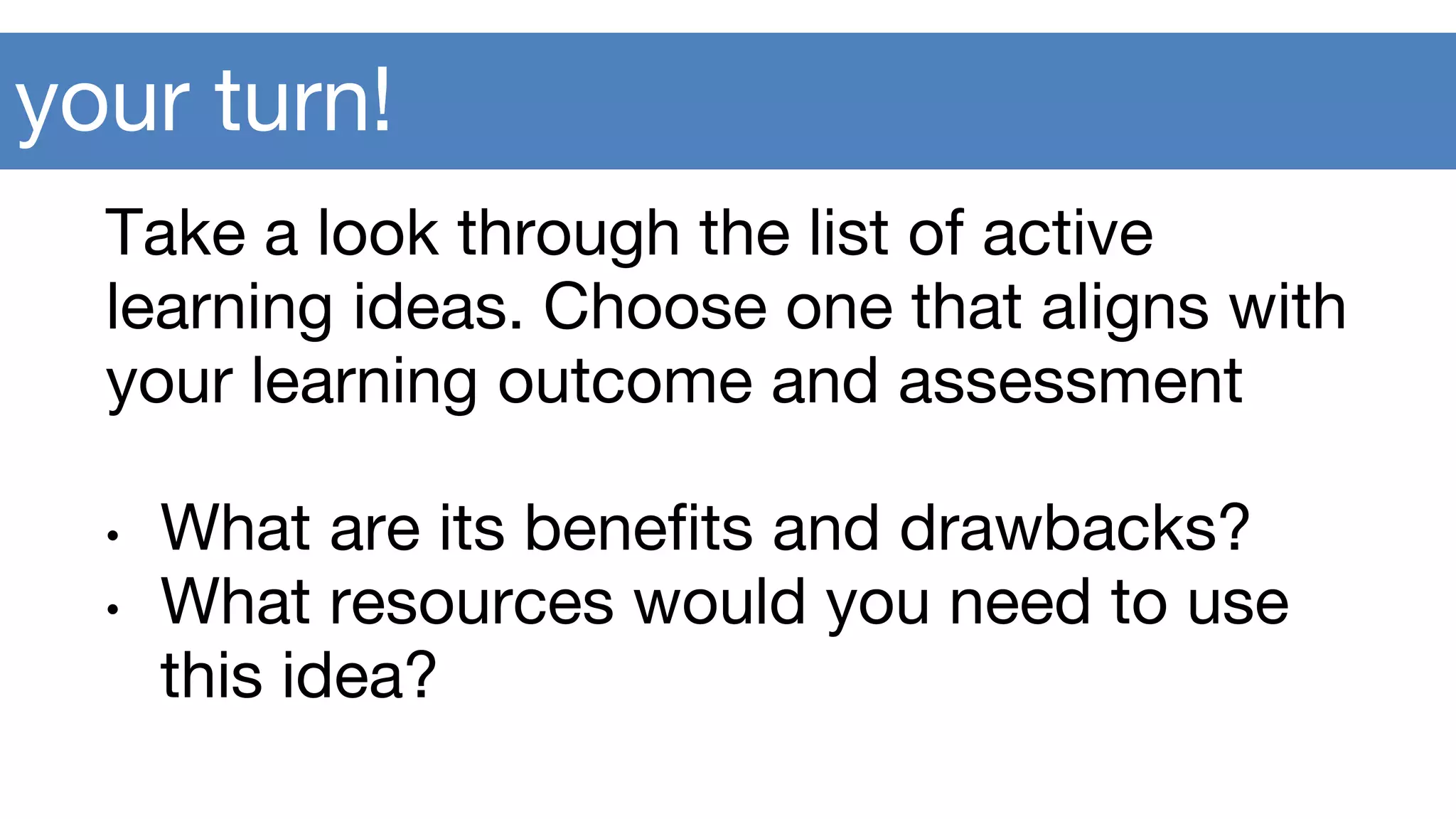
your turn!
Take a look through the list of active
learning ideas. Choose one that aligns with
your learning outcome and assessment
• What are its benefits and drawbacks?
• What resources would you need to use
this idea?
Thanks for attending our masterclass!
c.inskip@ucl.ac.uk | @charlieinskip
a.hicks@ucl.ac.uk | @alisonhicks0
Images
https://www.flickr.com/photos/missnita/380929930
https://www.flickr.com/photos/sveinhal/2488694307
https://www.flickr.com/photos/derekbruff/6286735551
https://www.flickr.com/photos/joybot/7747594318
https://www.flickr.com/photos/96dpi/1063145950
https://www.flickr.com/photos/dkuropatwa/2097911609
https://www.flickr.com/photos/empowernetwork-gerardoalmaraz/7779017198
https://www.flickr.com/photos/electropod/3869271590

How to do backward curriculum design - Inskip & Hicks

  • 1.
    How to dobackward curriculum design Charlie Inskip | Alison Hicks Department of Information Studies, UCL Liverpool, April 4th – 6th 2018
  • 2.
    overview This Masterclass willfocus on backward design, an approach to curriculum design developed by Wiggins and McTighe (2006) and adopted by the new ACRL Framework. This approach, which uses learning outcomes to determine assessment approaches and course content, will be explained and demonstrated There will be an informed discussion on its relevance and validity in teaching information literacy. The workshop will take a practical approach, devising learning outcomes, assessment and content for a learning intervention to be agreed in the session. It will draw from our experience in learning and teaching across a wide range of higher educational and professional contexts in the UK and the USA. Attendees will be able to take away a backward-designed lesson-plan which they can then use as a basis for running a session in their workplace.
  • 3.
    learning outcomes Apply theoreticalprinciples and practical examples in order to create and evaluate a lesson plan relevant to your work
  • 4.
    librarian-as-teacher • Professional competences •Library school curriculum • Professional identity
  • 5.
  • 7.
  • 9.
    what is teaching? “Ateaching activity is the activity of a person, A (the teacher), the intention of which is to bring about an activity (learning), by a person, B (the pupil), the intention of which is to achieve some end-state (e.g. knowing, appreciating) whose object is X (e.g. a belief, attitude, skill).” (Hirst, 1971)
  • 10.
    what is learning? “makingmeaning” (Marton and Booth, 1997) “relatively permanent change in behaviour as a consequence of experience” (Haselgrove, 2016) “mastering abstract principles, understanding proofs, remembering factual information, acquiring methods, techniques and approaches, recognition, reasoning, debating ideas, or developing behaviour appropriate to specific situations” (Fry et al., 2009)
  • 11.
    Learning Goal oriented Influenced bydevelopment Occurs in phases, yet is non-linear Uses cognitive and metacognitive strategies Organises information Links new information to prior knowledge Characteristics of learning (Crane, 2014)
  • 12.
    schools of thought BehaviourismCognitivism Constructivism
  • 13.
    behaviourism • B.F. Skinner(1961) – Learning: change in behaviour – Environment shapes behaviour – Timely events and reinforcement • Conditioning • Rote learning Skinner, B. (1968). The technology of teaching (Century psychology series). New York: Appleton-Century-Crofts.
  • 14.
    cognitivism • Jean Piaget(1929) • Children • 4 stages of development – Active engagement – Present challenges – Perform tasks just beyond capabilities Piaget, J. (1929) The child’s conception of the world
  • 15.
    constructivism • Jerome Bruner(1966) – Learning is an active process – Individuals create new ideas or concepts based on their current and past knowledge – Learning should focus on real world problems • Collaboration and reflective thinking • Teacher as facilitator Bruner, J. (1966) Toward a theory of instruction
  • 16.
    Bloom’s taxonomy Create Evaluate Analyse Apply Understand Remember Bloom, B.(1956) Taxonomy of Educational Objectives. New York : David McKay
  • 17.
    Cognitivedomain Knowledge Remembering without understanding ComprehensionDemonstrating understanding Application Solving problems Analysis Finding evidence Synthesis Creating a new structure Evaluation Making judgements Blooms Taxonomy
  • 18.
    SOLO Prestructural Unistructural Memorise, identify, recognise Count,order Multistructural Classify, describe Compute, illustrate Relational Argue, analyse, explain Construct, translate Extended abstract Theorise, hypothesize Invent, create Structure of Observed Learning Outcomes (SOLO), Biggs & Collis, 1982
  • 19.
    thresholdconcepts transformative changes yourviews troublesome counter-intuitive irreversible cannot be unlearned integrative bring together previously unrelated ideas bounded has special terminology discursive extends language use reconstitutive shifts your perceptions liminality have an unstable 'in- between' state Threshold concepts, Meyer & Land, 2003
  • 20.
  • 21.
  • 22.
    A focus onlearning… …rather than teaching, activities or content What is backward design?
  • 23.
    Stage 1: IdentifyDesired Results Stage 2: Determine Acceptable Evidence Stage 3: Plan Learning Experiences and Instruction
  • 24.
    Backward design canhelp: • Avoid activity or coverage focused instructional design • Make the most of time frame • Centre on big ideas rather than mechanics • Design for understanding Wiggins & McTighe: Understanding by Design
  • 25.
  • 26.
  • 27.
    Describes what students shouldbe able to demonstrate, represent, or produce as a result of their learning (Maki, 2004). SLOs, defined:
  • 29.
    • build astructure for the unit/session • communicate to students how to be successful why SLO’s matter...
  • 30.
    today’s outcomes... Instead of… •Learn about backward design Apply theoretical principles and practical examples in order to create and evaluate a lesson plan relevant to your work
  • 31.
    from goal tooutcome…
  • 32.
    • Match thetwo halves of an outcome • Choose one outcome to focus on for the rest of this session try it…
  • 33.
  • 35.
    Assessment for: ● Teaching ●Learning ● Legitimisation...
  • 38.
  • 39.
  • 40.
  • 41.
    Assessment For teaching and learning Quantifiable Authenticand reflective Formative Classroom assessment techniques Summative Performance assessment techniques For legitimisation
  • 42.
    “Simple, non-graded, anonymous,in-class activities designed to give you and your students useful feedback on the teaching- learning process as it is happening” • Background knowledge probe • Muddiest Point • Minute Paper • Paraphrasing • Defining features classroom assessment techniques
  • 43.
    “known as alternativeor authentic assessment, it’s a form of testing that requires students to perform a task rather than select an answer from a ready-made list.” • Open-ended or extended response exercises • Solve problems • Often measured by rubrics performance assessment techniques
  • 44.
    Develop topic-relevant vocabularyin order to search databases with maximum flexibility and effectiveness. • Classroom: Self Assessment – What is the best search tip you will take away from today? What changes will you make to your approach to searching? • Performance-Informal – Develop a search statement at the beginning of class. Write an improved statement at the end of class and 1 sentence about why it is better. • Performance-Formal – Complete a worksheet that guides through a search process and ask students to reflect on changes they make to a search statement. Graded by librarian/returned with feedback
  • 45.
    Distinguish between scholarly,trade and popular resources in order to think critically about the authority of sources • Classroom: Defining Features Matrix – Students match characteristics in a table • Classroom: Informal – Students sort periodicals in groups and report on criteria • Performance: Authentic – If you were researching a company you wanted to work for, what information would each of the following sources provide about that company?
  • 46.
    Take a lookthrough the list of assessments. Choose one that aligns with and will help you assess your learning outcome. • What are its benefits and drawbacks? • How could the librarian respond to the results from this assessment? your turn!
  • 47.
  • 49.
    how will yourstudents learn that? SLO: Develop topic-relevant vocabulary in order to search databases with maximum flexibility and effectiveness. Assessment: What is the best search tip you will take away from today? What changes will you make to your approach to searching?
  • 50.
    Active learning: teachingin a half-ass way that makes students have to go home and learn it on their own…
  • 51.
    much more than… •Hands-on activity • Having students move around the room • Shiny technology • “Engage” students
  • 52.
    “Active learning isa process whereby students engage in activities, such as reading, writing, discussion, or problem solving that promote analysis, synthesis, and evaluation of class content.” Michigan Center for Teaching and Learning
  • 53.
  • 54.
    challenges 1. How willI cover all of the necessary content? 2. I will have to abandon everything I have learned to do over the years 3. Students resist non-lecture environments. 4. My colleagues will criticise me. 5. It is scary. 6. It is just too hard! FACULTY PERCEPTIONS ABOUT BARRIERS TO ACTIVE LEARNING Joel Michael
  • 55.
    SLO: Develop topic-relevantvocabulary in order to search databases with maximum flexibility and effectiveness. Assessment: What is the best search tip you will take away from today? What changes will you make to your approach to research? • Active Learning: Have students write down their topic and keywords. Exchange with person next to them for critique/brainstorming. • Active Learning: Display a noun on the screen. Have students shout synonyms to a guesser. • Active Learning: Have students explore a visual dictionary to come up with synonyms.
  • 56.
    your turn! Take alook through the list of active learning ideas. Choose one that aligns with your learning outcome and assessment • What are its benefits and drawbacks? • What resources would you need to use this idea?
  • 58.
    Thanks for attendingour masterclass! c.inskip@ucl.ac.uk | @charlieinskip a.hicks@ucl.ac.uk | @alisonhicks0
  • 59.