MARGINAL EMISSIONS RATES IN ENERGY SYSTEM CHANGE

Dr A.D. Hawkes
Principal Consultant in Modelling, AEA
Visiting Fellow, Imperial College London
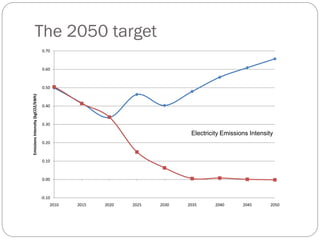
The 2050 target
                                   700
                                  0.70
                                                               UK CO2 Emissions
                                  0.60
                                   600


                                  0.50
                                   500
Emissions Intensity (kgCO2/kWh)


                                  0.40
       Emissions (MtCO2)


                                   400

                                  0.30

                                   300                                            Electricity Emissions Intensity
                                  0.20

                                   200
                                  0.10


                                   100
                                  0.00


                            -0.100
                                     2010
                                      2010   2015
                                              2015   2020
                                                      2020   2025
                                                              2025   2030
                                                                      2030    2035
                                                                                2035       2040
                                                                                             2040    2045
                                                                                                       2045     2050
                                                                                                                  2050
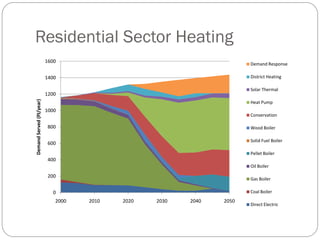
Residential Sector Heating
                          1600
                                                                       Demand Response

                          1400                                         District Heating

                                                                       Solar Thermal
                          1200
Demand Served (PJ/year)


                                                                       Heat Pump
                          1000
                                                                       Conservation

                          800                                          Wood Boiler

                                                                       Solid Fuel Boiler
                          600
                                                                       Pellet Boiler
                          400
                                                                       Oil Boiler

                          200
                                                                       Gas Boiler

                            0                                          Coal Boiler
                             2000   2010   2020   2030   2040   2050
                                                                       Direct Electric
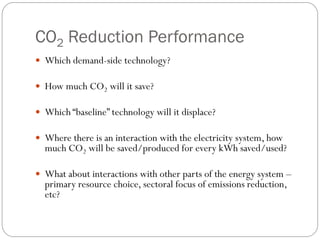
CO2 Reduction Performance
 Which demand-side technology?

 How much CO2 will it save?

 Which “baseline” technology will it displace?

 Where there is an interaction with the electricity system, how
  much CO2 will be saved/produced for every kWh saved/used?

 What about interactions with other parts of the energy system –
  primary resource choice, sectoral focus of emissions reduction,
  etc?
The usual method
 Choose a baseline system
   E.g. For heating in the UK; the combustion of natural gas in a condensing boiler


 Figure out how much of each “energy carrier” the alternative
  system saves/produces (relative to the consumption/production
  of the baseline).
   E.g. A CHP system may consume an additional 3000kWh of gas/year, and
    produce an additional 2500kWh of electricity

 Multiply change in consumption for each energy carrier by the
  respective standard emissions rates; ~0.19kgCO2/kWh for gas,
  and 0.43kgCO2/kWh for electricity in the UK
   E.g. Change in CO2 = 0.19*3000 – 0.43*2500 = -1075kg CO2
An alternative method - marginal CO2 rates


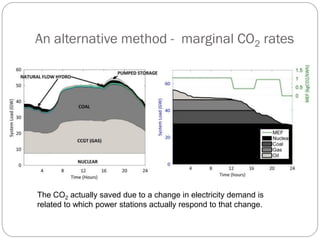
The CO2 actually saved due to a change in electricity demand is
related to which power stations actually respond to that change.
The observed response of generators in GB
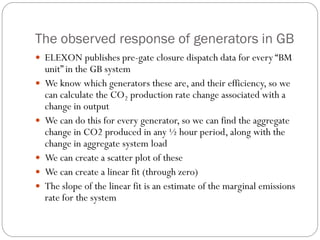
 ELEXON publishes pre-gate closure dispatch data for every “BM
    unit” in the GB system
   We know which generators these are, and their efficiency, so we
    can calculate the CO2 production rate change associated with a
    change in output
   We can do this for every generator, so we can find the aggregate
    change in CO2 produced in any ½ hour period, along with the
    change in aggregate system load
   We can create a scatter plot of these
   We can create a linear fit (through zero)
   The slope of the linear fit is an estimate of the marginal emissions
    rate for the system
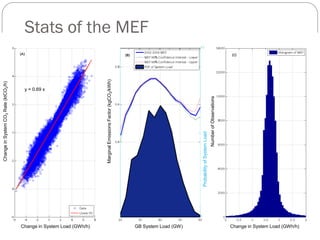
GB Electricity Marginal Emissions
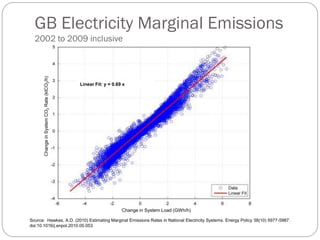
  2002 to 2009 inclusive
       Change in System CO2 Rate (ktCO2/h)


                                             Linear Fit: y = 0.69 x


                                                                 Change in System Load (GWh/h)

Source: Hawkes, A.D. (2010) Estimating Marginal Emissions Rates in National Electricity Systems. Energy Policy 38(10) 5977-5987.
doi:10.1016/j.enpol.2010.05.053
Change in System CO2 Rate (ktCO2/h)


                                                                           y = 0.69 x


Change in System Load (GWh/h)
                                           Marginal Emissions Factor (kgCO2/kWh)
                                                                                        Stats of the MEF


GB System Load (GW)
                                Probability of System Load
                                                  Number of Observations

Change in System Load (GWh/h)
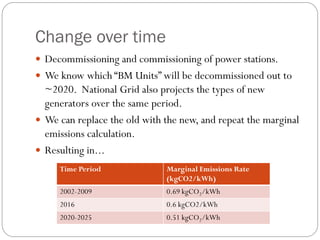
Change over time
 Decommissioning and commissioning of power stations.
 We know which “BM Units” will be decommissioned out to
  ~2020. National Grid also projects the types of new
  generators over the same period.
 We can replace the old with the new, and repeat the marginal
  emissions calculation.
 Resulting in...
     Time Period              Marginal Emissions Rate
                              (kgCO2/kWh)
     2002-2009                0.69 kgCO2/kWh
     2016                     0.6 kgCO2/kWh
     2020-2025                0.51 kgCO2/kWh
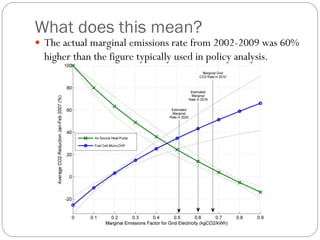
What does this mean?
 The actual marginal emissions rate from 2002-2009 was 60%
  higher than the figure typically used in policy analysis.
But...

 What about changes elsewhere in the energy system, and
  over a much longer timeframe?

 => Analysis using the UK MARKAL Model
  MARKAL (Market Allocation) chooses the least cost pathway for
   energy system change over a 50 year time horizon. It is an
   optimisation model, with objective function of discounted
   system cost, user-defined constraints, and thousands of decision
   variables.
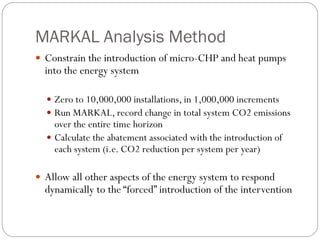
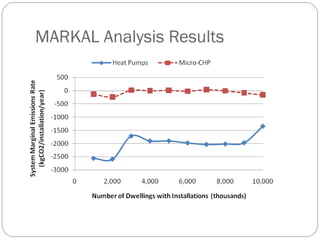
MARKAL Analysis Method
 Constrain the introduction of micro-CHP and heat pumps
  into the energy system

   Zero to 10,000,000 installations, in 1,000,000 increments
   Run MARKAL, record change in total system CO2 emissions
    over the entire time horizon
   Calculate the abatement associated with the introduction of
    each system (i.e. CO2 reduction per system per year)

 Allow all other aspects of the energy system to respond
  dynamically to the “forced” introduction of the intervention
MARKAL Analysis Results
Conclusion
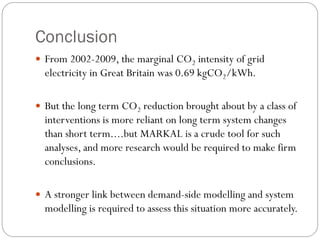
 From 2002-2009, the marginal CO2 intensity of grid
  electricity in Great Britain was 0.69 kgCO2/kWh.

 But the long term CO2 reduction brought about by a class of
  interventions is more reliant on long term system changes
  than short term....but MARKAL is a crude tool for such
  analyses, and more research would be required to make firm
  conclusions.

 A stronger link between demand-side modelling and system
  modelling is required to assess this situation more accurately.
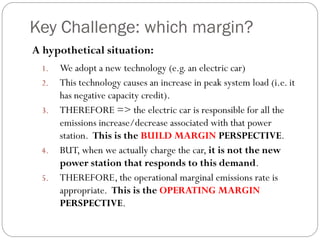
Key Challenge: which margin?
A hypothetical situation:
 1.   We adopt a new technology (e.g. an electric car)
 2.   This technology causes an increase in peak system load (i.e. it
      has negative capacity credit).
 3.   THEREFORE => the electric car is responsible for all the
      emissions increase/decrease associated with that power
      station. This is the BUILD MARGIN PERSPECTIVE.
 4.   BUT, when we actually charge the car, it is not the new
      power station that responds to this demand.
 5.   THEREFORE, the operational marginal emissions rate is
      appropriate. This is the OPERATING MARGIN
      PERSPECTIVE.

Marginal Emissions Rates in Energy System Change | Dr A.D. Hawkes

  • 1.
    MARGINAL EMISSIONS RATESIN ENERGY SYSTEM CHANGE Dr A.D. Hawkes Principal Consultant in Modelling, AEA Visiting Fellow, Imperial College London
  • 2.
    The 2050 target 700 0.70 UK CO2 Emissions 0.60 600 0.50 500 Emissions Intensity (kgCO2/kWh) 0.40 Emissions (MtCO2) 400 0.30 300 Electricity Emissions Intensity 0.20 200 0.10 100 0.00 -0.100 2010 2010 2015 2015 2020 2020 2025 2025 2030 2030 2035 2035 2040 2040 2045 2045 2050 2050
  • 3.
    Residential Sector Heating 1600 Demand Response 1400 District Heating Solar Thermal 1200 Demand Served (PJ/year) Heat Pump 1000 Conservation 800 Wood Boiler Solid Fuel Boiler 600 Pellet Boiler 400 Oil Boiler 200 Gas Boiler 0 Coal Boiler 2000 2010 2020 2030 2040 2050 Direct Electric
  • 4.
    CO2 Reduction Performance Which demand-side technology?  How much CO2 will it save?  Which “baseline” technology will it displace?  Where there is an interaction with the electricity system, how much CO2 will be saved/produced for every kWh saved/used?  What about interactions with other parts of the energy system – primary resource choice, sectoral focus of emissions reduction, etc?
  • 5.
    The usual method Choose a baseline system  E.g. For heating in the UK; the combustion of natural gas in a condensing boiler  Figure out how much of each “energy carrier” the alternative system saves/produces (relative to the consumption/production of the baseline).  E.g. A CHP system may consume an additional 3000kWh of gas/year, and produce an additional 2500kWh of electricity  Multiply change in consumption for each energy carrier by the respective standard emissions rates; ~0.19kgCO2/kWh for gas, and 0.43kgCO2/kWh for electricity in the UK  E.g. Change in CO2 = 0.19*3000 – 0.43*2500 = -1075kg CO2
  • 6.
    An alternative method- marginal CO2 rates The CO2 actually saved due to a change in electricity demand is related to which power stations actually respond to that change.
  • 7.
    The observed responseof generators in GB  ELEXON publishes pre-gate closure dispatch data for every “BM unit” in the GB system  We know which generators these are, and their efficiency, so we can calculate the CO2 production rate change associated with a change in output  We can do this for every generator, so we can find the aggregate change in CO2 produced in any ½ hour period, along with the change in aggregate system load  We can create a scatter plot of these  We can create a linear fit (through zero)  The slope of the linear fit is an estimate of the marginal emissions rate for the system
  • 8.
    GB Electricity MarginalEmissions 2002 to 2009 inclusive Change in System CO2 Rate (ktCO2/h) Linear Fit: y = 0.69 x Change in System Load (GWh/h) Source: Hawkes, A.D. (2010) Estimating Marginal Emissions Rates in National Electricity Systems. Energy Policy 38(10) 5977-5987. doi:10.1016/j.enpol.2010.05.053
  • 9.
    Change in SystemCO2 Rate (ktCO2/h) y = 0.69 x Change in System Load (GWh/h) Marginal Emissions Factor (kgCO2/kWh) Stats of the MEF GB System Load (GW) Probability of System Load Number of Observations Change in System Load (GWh/h)
  • 10.
    Change over time Decommissioning and commissioning of power stations.  We know which “BM Units” will be decommissioned out to ~2020. National Grid also projects the types of new generators over the same period.  We can replace the old with the new, and repeat the marginal emissions calculation.  Resulting in... Time Period Marginal Emissions Rate (kgCO2/kWh) 2002-2009 0.69 kgCO2/kWh 2016 0.6 kgCO2/kWh 2020-2025 0.51 kgCO2/kWh
  • 11.
    What does thismean?  The actual marginal emissions rate from 2002-2009 was 60% higher than the figure typically used in policy analysis.
  • 12.
    But...  What aboutchanges elsewhere in the energy system, and over a much longer timeframe?  => Analysis using the UK MARKAL Model MARKAL (Market Allocation) chooses the least cost pathway for energy system change over a 50 year time horizon. It is an optimisation model, with objective function of discounted system cost, user-defined constraints, and thousands of decision variables.
  • 13.
    MARKAL Analysis Method Constrain the introduction of micro-CHP and heat pumps into the energy system  Zero to 10,000,000 installations, in 1,000,000 increments  Run MARKAL, record change in total system CO2 emissions over the entire time horizon  Calculate the abatement associated with the introduction of each system (i.e. CO2 reduction per system per year)  Allow all other aspects of the energy system to respond dynamically to the “forced” introduction of the intervention
  • 14.
  • 15.
    Conclusion  From 2002-2009,the marginal CO2 intensity of grid electricity in Great Britain was 0.69 kgCO2/kWh.  But the long term CO2 reduction brought about by a class of interventions is more reliant on long term system changes than short term....but MARKAL is a crude tool for such analyses, and more research would be required to make firm conclusions.  A stronger link between demand-side modelling and system modelling is required to assess this situation more accurately.
  • 16.
    Key Challenge: whichmargin? A hypothetical situation: 1. We adopt a new technology (e.g. an electric car) 2. This technology causes an increase in peak system load (i.e. it has negative capacity credit). 3. THEREFORE => the electric car is responsible for all the emissions increase/decrease associated with that power station. This is the BUILD MARGIN PERSPECTIVE. 4. BUT, when we actually charge the car, it is not the new power station that responds to this demand. 5. THEREFORE, the operational marginal emissions rate is appropriate. This is the OPERATING MARGIN PERSPECTIVE.