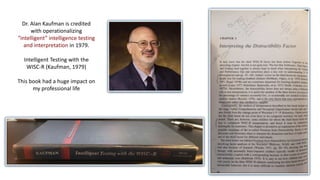

Dr. Alan Kaufman is credited
with operationalizing
“intelligent” intelligence testing
and interpretation in 1979.
Intelligent Testing with the
WISC-R (Kaufman, 1979)
This book had a huge impact on
my professional life
Waves Of Intelligence Test Interpretation
(Kamphaus et al., 1997)
• Wave 1 - Quantification of a General Level (g)
• Wave 2 - Clinical Profile Analysis
• Wave 3 - Psychometric Profile Analysis
• Wave 4 - Applying Theory to Intelligence Test Interpretation
Cohen, J. (1959). The factorial structure
of the WISC at ages 7-6, 10-6, and 13-6,
Journal of Consulting Psychology, 23,
285-299.
Wave 3:
Psychometric Profile Analyses
Kaufman, A. S. (1979). Intelligent
testing with the WISC-R. New York:
Wiley-Interscience.
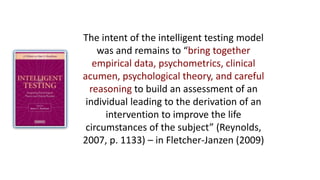
The intent of the intelligent testing model
was and remains to “bring together
empirical data, psychometrics, clinical
acumen, psychological theory, and careful
reasoning to build an assessment of an
individual leading to the derivation of an
intervention to improve the life
circumstances of the subject” (Reynolds,
2007, p. 1133) – in Fletcher-Janzen (2009)
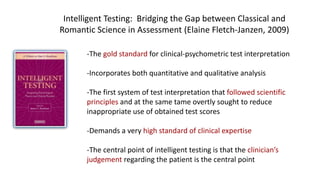
-The gold standard for clinical-psychometric test interpretation
-Incorporates both quantitative and qualitative analysis
-The first system of test interpretation that followed scientific
principles and at the same tame overtly sought to reduce
inappropriate use of obtained test scores
-Demands a very high standard of clinical expertise
-The central point of intelligent testing is that the clinician’s
judgement regarding the patient is the central point
Intelligent Testing: Bridging the Gap between Classical and
Romantic Science in Assessment (Elaine Fletch-Janzen, 2009)
“ Tests do not think for themselves, nor do they directly
communicate with patients. Like a stethoscope, a blood
pressure gauge, or an MRI scan, a psychological test is a
dumb tool, and the worth of the tool cannot be
separated from the sophistication of the clinician who
draws inferences from it and then communicates with
patients and professionals”
Meyer et al. (2001). Psychological testing and psychological
assessment. American Psychologist
If you give a monkey a Stradivarius
violin and you get bad music……
You don’t blame the violin !!!!
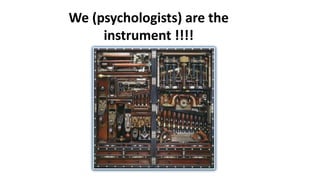
We (psychologists) are the
instrument !!!!
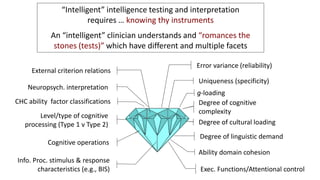
“Intelligent” intelligence testing and interpretation
requires … knowing thy instruments
An “intelligent” clinician understands and “romances the
stones (tests)” which have different and multiple facets
CHC ability factor classifications
Neuropsych. interpretation
External criterion relations
Info. Proc. stimulus & response
characteristics (e.g., BIS)
Cognitive operations
Level/type of cognitive
processing (Type 1 v Type 2)
Exec. Functions/Attentional control
Error variance (reliability)
Uniqueness (specificity)
g-loading
Degree of cultural loading
Degree of linguistic demand
Ability domain cohesion
Degree of cognitive
complexity

What is "intelligent" intelligence testing

  • 1.
    Dr. Alan Kaufmanis credited with operationalizing “intelligent” intelligence testing and interpretation in 1979. Intelligent Testing with the WISC-R (Kaufman, 1979) This book had a huge impact on my professional life
  • 2.
    Waves Of IntelligenceTest Interpretation (Kamphaus et al., 1997) • Wave 1 - Quantification of a General Level (g) • Wave 2 - Clinical Profile Analysis • Wave 3 - Psychometric Profile Analysis • Wave 4 - Applying Theory to Intelligence Test Interpretation
  • 3.
    Cohen, J. (1959).The factorial structure of the WISC at ages 7-6, 10-6, and 13-6, Journal of Consulting Psychology, 23, 285-299. Wave 3: Psychometric Profile Analyses Kaufman, A. S. (1979). Intelligent testing with the WISC-R. New York: Wiley-Interscience.
  • 8.
    The intent ofthe intelligent testing model was and remains to “bring together empirical data, psychometrics, clinical acumen, psychological theory, and careful reasoning to build an assessment of an individual leading to the derivation of an intervention to improve the life circumstances of the subject” (Reynolds, 2007, p. 1133) – in Fletcher-Janzen (2009)
  • 9.
    -The gold standardfor clinical-psychometric test interpretation -Incorporates both quantitative and qualitative analysis -The first system of test interpretation that followed scientific principles and at the same tame overtly sought to reduce inappropriate use of obtained test scores -Demands a very high standard of clinical expertise -The central point of intelligent testing is that the clinician’s judgement regarding the patient is the central point Intelligent Testing: Bridging the Gap between Classical and Romantic Science in Assessment (Elaine Fletch-Janzen, 2009)
  • 10.
    “ Tests donot think for themselves, nor do they directly communicate with patients. Like a stethoscope, a blood pressure gauge, or an MRI scan, a psychological test is a dumb tool, and the worth of the tool cannot be separated from the sophistication of the clinician who draws inferences from it and then communicates with patients and professionals” Meyer et al. (2001). Psychological testing and psychological assessment. American Psychologist
  • 11.
    If you givea monkey a Stradivarius violin and you get bad music…… You don’t blame the violin !!!!
  • 12.
    We (psychologists) arethe instrument !!!!
  • 13.
    “Intelligent” intelligence testingand interpretation requires … knowing thy instruments An “intelligent” clinician understands and “romances the stones (tests)” which have different and multiple facets CHC ability factor classifications Neuropsych. interpretation External criterion relations Info. Proc. stimulus & response characteristics (e.g., BIS) Cognitive operations Level/type of cognitive processing (Type 1 v Type 2) Exec. Functions/Attentional control Error variance (reliability) Uniqueness (specificity) g-loading Degree of cultural loading Degree of linguistic demand Ability domain cohesion Degree of cognitive complexity