Getting real with erlang
    From the idea to a live system

      Knut Nesheim @knutin
     Paolo Negri @hungryblank
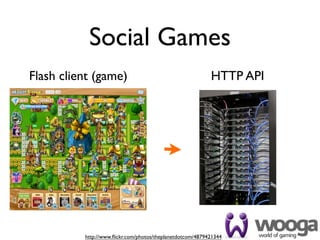
Social Games
Flash client (game)                                        HTTP API


          http://www.flickr.com/photos/theplanetdotcom/4879421344
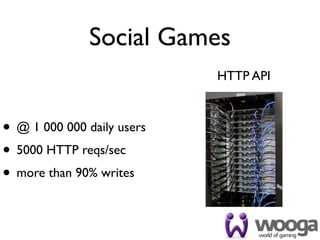
Social Games
                            HTTP API


• @ 1 000 000 daily users
• 5000 HTTP reqs/sec
• more than 90% writes
November 2010

• At the erlang user group!
• Learn where/how erlang is used
• 0 lines of erlang code across all
  @wooga code base
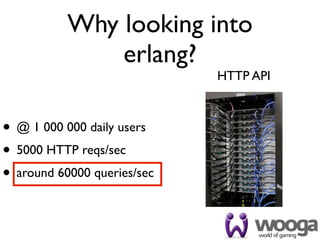
Why looking into
               erlang?
                             HTTP API


• @ 1 000 000 daily users
• 5000 HTTP reqs/sec
• around 60000 queries/sec
60000 qps

• Most maintenance effort in databases
• mix of SQL / NoSQL
• Already using in RAM data stores (REDIS)
• RAM DB are fast but expensive / high
  maintenance
Social games data

• User data self contained
• Strong hot/cold pattern - gaming session
• Heavy write load (caching is ineffective)
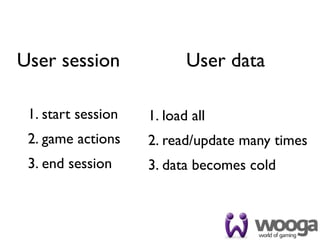
User session               User data

 1. start session   1. load all
 2. game actions    2. read/update many times
 3. end session     3. data becomes cold
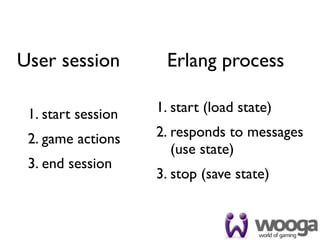
User session         Erlang process

 1. start session   1. start (load state)

 2. game actions    2. responds to messages
                       (use state)
 3. end session
                    3. stop (save state)
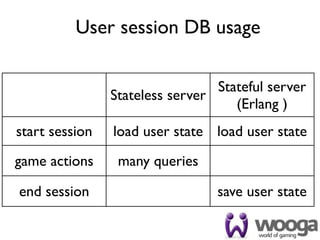
User session DB usage

                                 Stateful server
                Stateless server
                                    (Erlang )
start session   load user state load user state
game actions     many queries

end session                      save user state
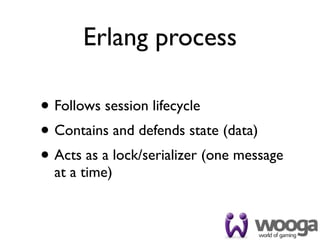
Erlang process

• Follows session lifecycle
• Contains and defends state (data)
• Acts as a lock/serializer (one message
  at a time)
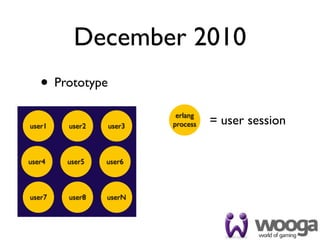
December 2010
   • Prototype
                          erlang
user1   user2    user3   process   = user session


user4   user5   user6


user7   user8   userN
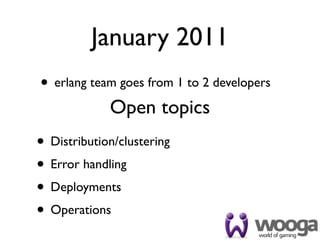
January 2011
• erlang team goes from 1 to 2 developers
             Open topics
• Distribution/clustering
• Error handling
• Deployments
• Operations
Architecture
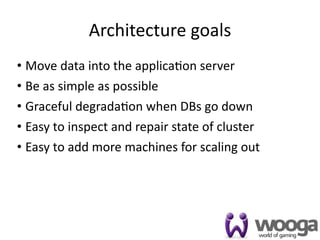
Architecture goals
• Move data into the applica4on server
• Be as simple as possible
• Graceful degrada4on when DBs go down
• Easy to inspect and repair state of cluster
• Easy to add more machines for scaling out


                                                15
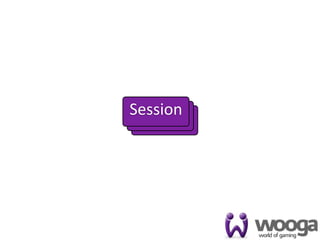
Session
 Session
  Session


            16
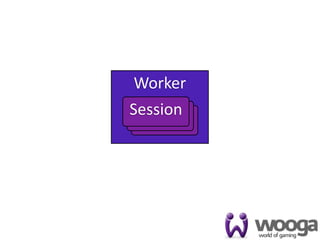
Worker
Session
 Session
  Session


            17
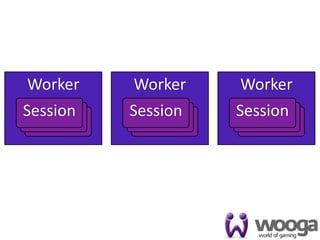
Worker      Worker      Worker
Session
 Session    Session
             Session    Session
                         Session
  Session     Session     Session


                                    18
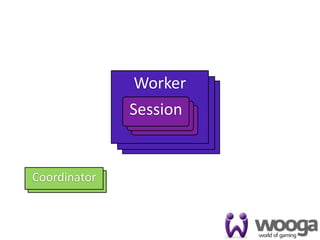
Worker
                Worker
                 Worker
              Session
               Session
               Session
                Session
                Session
                 Session
                  Session

Coordinator
Coordinator


                            19
Worker
                Worker
                 Worker
              Session
               Session
               Session
                Session
                Session
                 Session
                  Session

Coordinator
Coordinator                 Lock


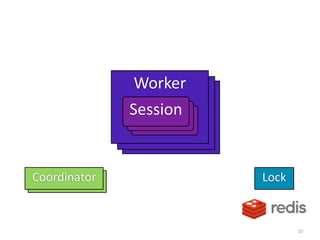
                                   20
Worker
                Worker
                 Worker
              Session
               Session
               Session
                Session
                Session
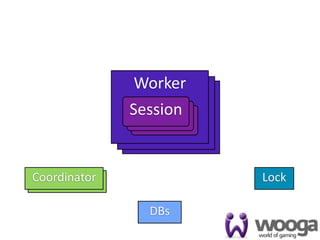
                 Session
                  Session

Coordinator
Coordinator                 Lock

                 DBs
                                   21
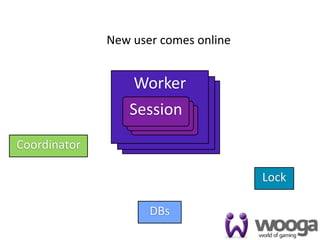
New user comes online


                  Worker
                   Worker
                    Worker
                 Session
                  Session
                  Session
                   Session
                   Session
                    Session
                     Session
Coordinator

                                      Lock

                     DBs
                                             22
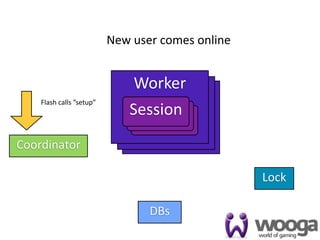
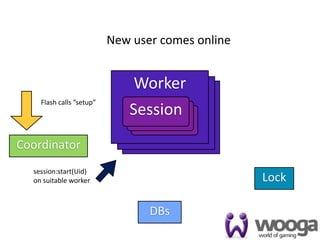
New user comes online


                              Worker
                               Worker
    Flash calls ”setup”
                                Worker
                             Session
                              Session
                              Session
                               Session
                               Session
                                Session
                                 Session
Coordinator

                                                  Lock

                                 DBs
                                                         22
New user comes online


                              Worker
                               Worker
    Flash calls ”setup”
                                Worker
                             Session
                              Session
                              Session
                               Session
                               Session
                                Session
                                 Session
Coordinator
  session:start(Uid)
  on suitable worker                              Lock

                                 DBs
                                                         22
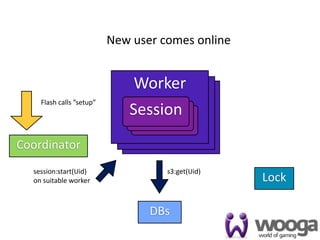
New user comes online


                              Worker
                               Worker
    Flash calls ”setup”
                                Worker
                             Session
                              Session
                              Session
                               Session
                               Session
                                Session
                                 Session
Coordinator
  session:start(Uid)                s3:get(Uid)
  on suitable worker                              Lock

                                 DBs
                                                         22
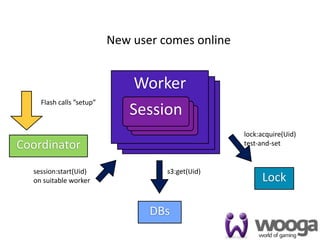
New user comes online


                              Worker
                               Worker
    Flash calls ”setup”
                                Worker
                             Session
                              Session
                              Session
                               Session
                               Session
                                Session
                                 Session          lock:acquire(Uid)
Coordinator                                       test‐and‐set


  session:start(Uid)                s3:get(Uid)
  on suitable worker                                   Lock

                                 DBs
                                                                      22
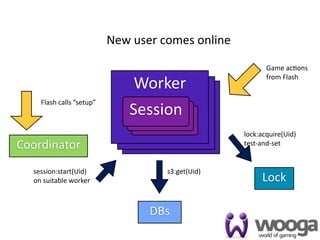
New user comes online

                                                         Game ac4ons 

                              Worker
                                                         from Flash

                               Worker
                                Worker
    Flash calls ”setup”
                             Session
                              Session
                              Session
                               Session
                               Session
                                Session
                                 Session          lock:acquire(Uid)
Coordinator                                       test‐and‐set


  session:start(Uid)                s3:get(Uid)
  on suitable worker                                   Lock

                                 DBs
                                                                      22
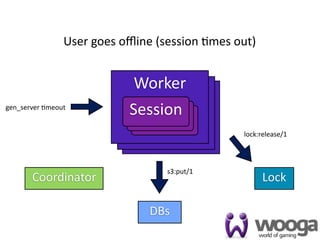
User goes offline (session 4mes out)


                            Worker
                             Worker
                              Worker
gen_server 4meout
                           Session
                            Session
                            Session
                             Session
                             Session
                              Session
                               Session         lock:release/1


                                  s3:put/1
       Coordinator                                   Lock

                               DBs
                                                                23
Implementa4on of game logic
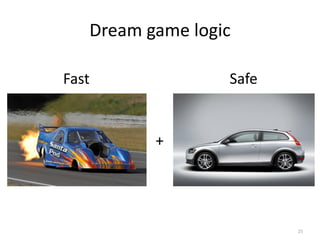
Dream game logic

Fast              Safe


          +


                         25
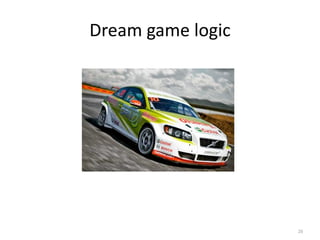
Dream game logic


                   26
Dream game logic
• We want high throughput (for scaling)
  – Try to spend as li[le CPU 4me as possible
  – Avoid heavy computa4on
  – Try to avoid crea4ng garbage
• ..and simple and testable logic (correctness)
  – Func4onal game logic makes thinking about code easy
  – Single entry point, gets ”request” and game state
  – Code for happy case, roll back on game‐related excep4on


                                                              27
How we avoid using CPU
• Remove need for DB serializa4on by storing data in 
  process
• Game is designed to avoid heavy licing in the backend, 
  very simple game logic
• Op4mize hot parts on the cri4cal path, like collision 
  detec4on, regrowing of forest
• Generate erlang modules for read‐heavy configura4on 
  (~1 billion reads/1 write per week)
• Use NIFs for parsing JSON (jiffy)

                                                       28
How to find where CPU is used
• Profile (eprof, fprof, kprof[1])
• Measure garbage collec4on (process_info/1, gcprof[2])
• Conduct experiment: change code, measure, repeat
• Is the increased performance worth the increase in 
  complexity?
• Some4mes a radically different approach is needed..


 [1]: github.com/knu4n/kprof
 [2]: github.com/knu4n/gcprof

                                                          29
Opera4ons
August 2011 ‐ ...
Opera4ons
• At wooga, developers also operate the game
• Most developers are ex‐sysadmins
• Simple tools:
 –remsh for deployments, maintenance, debugging
 –automa4on with chef
 –syslog, tail, cut, awk, grep
 –verbose crash logs (SASL)
 –alarms only when something really bad happens

                                                  31
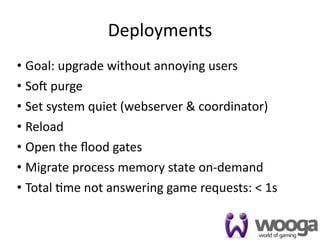
Deployments
• Goal: upgrade without annoying users
• Soc purge
• Set system quiet (webserver & coordinator)
• Reload
• Open the flood gates
• Migrate process memory state on‐demand
• Total 4me not answering game requests: < 1s

                                                32
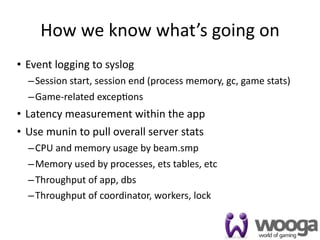
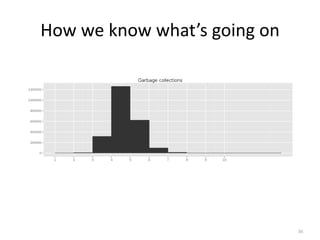
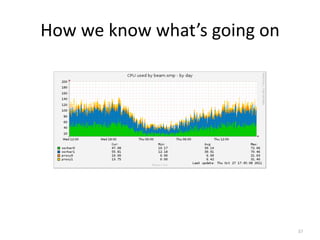
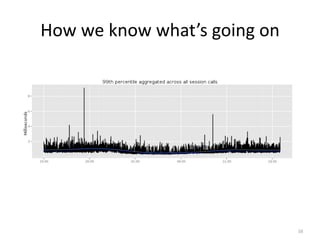
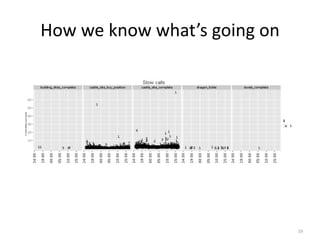
How we know what’s going on
• Event logging to syslog
  – Session start, session end (process memory, gc, game stats)
  – Game‐related excep4ons
• Latency measurement within the app
• Use munin to pull overall server stats
  – CPU and memory usage by beam.smp
  – Memory used by processes, ets tables, etc
  – Throughput of app, dbs
  – Throughput of coordinator, workers, lock


                                                                  33
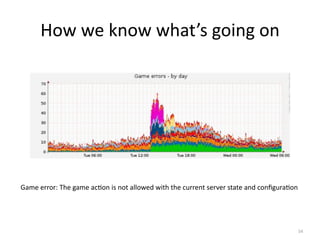
How we know what’s going on


Game error: The game ac4on is not allowed with the current server state and configura4on


                                                                                          34
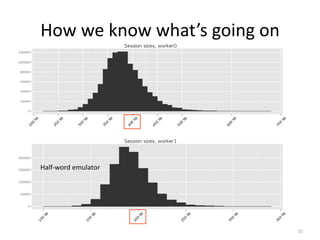
How we know what’s going on


Half‐word emulator


                              35
How we know what’s going on


                              36
How we know what’s going on


                              37
How we know what’s going on


                              38
How we know what’s going on


                              39
Conclusions
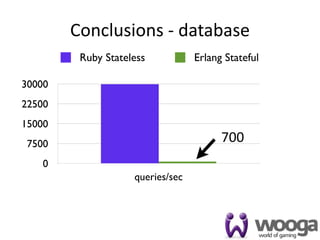
Conclusions ‐ database
         Ruby Stateless           Erlang Stateful

30000
22500
15000
 7500                                   700
    0
                    queries/sec


                                                    41
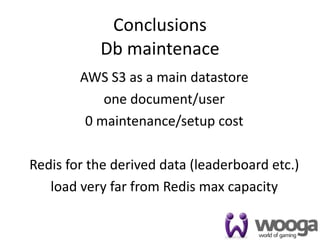
Conclusions
           Db maintenace
        AWS S3 as a main datastore
            one document/user
         0 maintenance/setup cost

Redis for the derived data (leaderboard etc.)
   load very far from Redis max capacity

                                            42
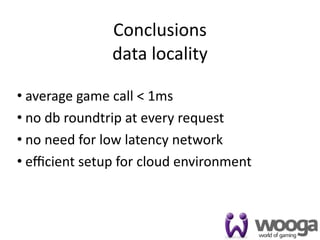
Conclusions
               data locality

• average game call < 1ms
• no db roundtrip at every request
• no need for low latency network
• efficient setup for cloud environment


                                        43
Conclusions
                 data locality

• finally CPU bound
• no CPU 4me for serializing/deserializing data 
  from db
• CPU only busy transforming data (minimum 
  possible ac4vity)


                                                   44
Conclusions
                 CPU usage

• 300K daily users
• 1000 h[p req/sec (game ac4ons)
• 4 m1.large AWS instances (dual core 8GB RAM)
• 2 instances (coordinators) 5% CPU load
• 2 instances (workers) 20% CPU load


                                                 45
Conclusions
     extra benefits

en4re user state in one process
               +
         immutability
               =
    Transac4onal behavior


                                  46
Conclusions
         extra benefits

One user session ‐> one erlang process
  The erlang VM is aware of processes
                  =>
the erlang VM is aware of user sessions


                                          47
Conclusions

      Thanks to VM process introspec4on
   process reduc4ons ‐> cost of a game ac4on
process used memory ‐> memory used by session

We gained a lot of knowledge about a fundamental 
                 ”business” en4ty

                                              48
Conclusions

• a radical change was made possible by a radically 
  different tool (erlang)


                                                   49
Conclusions

• a radical change was made possible by a radically 
  different tool (erlang)
• erlang can be good for data intensive/high 
  throughput applica4ons


                                                   49
Conclusions

• a radical change was made possible by a radically 
  different tool (erlang)
• erlang can be good for data intensive/high 
  throughput applica4ons
• stateful is not necessarily hard/dangerous/
  unmaintainable

                                                   49
Conclusions

• november 2010: 0 lines of erlang @wooga
• november 2011: 1 erlang game server live

...with more erlang coming, join us


                                             50
Q&A
  Knut Nesheim @knutin
 Paolo Negri @hungryblank


h[p://wooga.com/jobs

                            51

Getting real with erlang