

A Note on the General Numbering System
Used Nationally ( INDIA ) and internationally –
For Common & Business Purposes
By Himansu S M / 22- Apr 2017
Why Write About Numbers
 It is surprising to know that many people (Literate and
Qualified included) are not very clear about our
Numbering System and confuse very much while
converting our Indian System to the Western/
International System and vice versa.
 If asked “How much is a Million in Indian System”,
many people answer as “A Lakh”
 If asked “How much is a Billion in Indian System”,
many people answer as “A Crore”
2© Himansu S M / 22-Apr-2017
Why Write About Numbers
 Even a section of well educated people make such
mistakes.
 I was so disturbed by this, that I thought I must write
about the common / simple Numbering System.
 So here it is. I have tried my best to keep it simple, sort
and easy to understand.
3© Himansu S M / 22-Apr-2017
The Counting Numbers and Symbols
4© Himansu S M / 22-Apr-2017
Introduction
 As we all know that the NUMBERS are used for
expressing certain parameters or entities or money in
quantities –
 Numbers give a quantifiable representation which can
be used for simple Arithmetical Calculations or for
higher Mathematical Operations, as well as simple
estimate of the quantity.
 For this we use the best and mostly used “DECIMAL”
System
5© Himansu S M / 22-Apr-2017
Cardinal & Ordinal Numbers
 It is very important to know about these numbers in
this age of Business, Economics and Finance.
 CARDINAL Numbers are those which can be subjected
to Arithmetical & Mathematical Operations.
 Ex. If you have Rs. 200 and I have Rs. 100, together we
have Rs. 300 (addition)
 Ex. If a father wants to distribute Rs 600 among his 4
sons, each get Rs. 150 (division) – and so on
© Himansu S M / 22-Apr-2017 6
Cardinal & Ordinal Numbers
 ORDINAL Numbers are those which CANNOT be
subjected to Arithmetical & Mathematical Operations.
These are used for Naming, Identification, or
Sequential purpose.
 Ex. If your Apt no. is 3 and mine is 4, then it is
meaningless to say that the person living in Apt no. 7 is
You and Me taken together.
 Ex. Telephone No.s A/c No.s Road No.s, etc.
© Himansu S M / 22-Apr-2017 7
The Basic Numbers
 As we all know, we follow the “DECIMAL” numbering
System.
 This means, we use only 10 (TEN) Characters or Digits
to represent the quantity in Numbers.
 These Digits are: 0, 1, 2, 3, 4, 5, 6, 7, 8 and 9.
 Their names are Zero, One, Two, Three, Four, Five, Six,
Seven, Eight and Nine Respectively
8© Himansu S M / 22-Apr-2017
The Basic Numbers
 Each of these represent a distinct level of quantity,
like:
 “0” – Zero, represents “NIL”, not present or absent, or
when there are nothing.
 “1” to “9” – represent the respective values / levels /
quantities.
 What if the quantity exceeds “9” Nine?
 To represent the next higher number we use two digits
together, like 1 and 0 – i.e., 10 (Ten)
9© Himansu S M / 22-Apr-2017
The Basic Numbers
 And then the sequence goes on till “99”, when all the
digits are exhausted in two-digit number
 Then we repeat the same procedure to make it three-
digit number like 100, we call it Hundred.
 Like-wise the numbers increase to 1000, 10000, and so
on which can take care of representing higher and
higher numbers or quantity.
10© Himansu S M / 22-Apr-2017
The Counting Numbers
 In single digit numbers we have “0” to “9”
 In double digit numbers we have “10” to “99”
 In triple digit numbers we have “100” to “999”
 In 4-digit numbers we have “1000” to “9999”
 In 5-digit numbers we have “1000” to “99999”
 And so on and so forth till we can match our quantity
correctly.
 All these major steps have specific names:
11© Himansu S M / 22-Apr-2017
The Counting Numbers
 The Single Digit Numbers are Called “UNITS”
 The Double Digit Numbers are Called “TENS”
 The Triple Digit Numbers are Called “HUNDREDS”
 The 4-Digit Numbers are Called “THOUSANDS”
 Up to this Level, both Indian and International
Systems are the same, the Names being “Eka”, “Dasha”,
“Shata” and “Sahasra” respectively. Zero being called
“Shunya”
12© Himansu S M / 22-Apr-2017
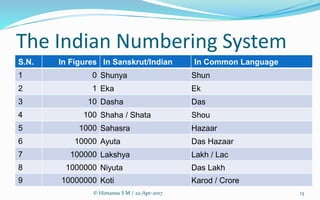
The Indian Numbering System
S.N. In Figures In Sanskrut/Indian In Common Language
1 0 Shunya Shun
2 1 Eka Ek
3 10 Dasha Das
4 100 Shaha / Shata Shou
5 1000 Sahasra Hazaar
6 10000 Ayuta Das Hazaar
7 100000 Lakshya Lakh / Lac
8 1000000 Niyuta Das Lakh
9 10000000 Koti Karod / Crore
© Himansu S M / 22-Apr-2017 13
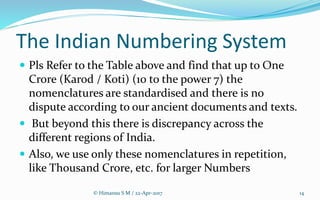
The Indian Numbering System
 Pls Refer to the Table above and find that up to One
Crore (Karod / Koti) (10 to the power 7) the
nomenclatures are standardised and there is no
dispute according to our ancient documents and texts.
 But beyond this there is discrepancy across the
different regions of India.
 Also, we use only these nomenclatures in repetition,
like Thousand Crore, etc. for larger Numbers
© Himansu S M / 22-Apr-2017 14
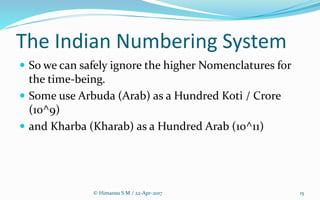
The Indian Numbering System
 So we can safely ignore the higher Nomenclatures for
the time-being.
 Some use Arbuda (Arab) as a Hundred Koti / Crore
(10^9)
 and Kharba (Kharab) as a Hundred Arab (10^11)
© Himansu S M / 22-Apr-2017 15
The International / Western
Numbering System
 As mentioned earlier, we have the same system in
International System of Numbers up to Thousand:
 0 = Zero 1 = Units
 10 = Tens 100= Hundreds
 1000 = Thousands
© Himansu S M / 22-Apr-2017 16
The International / Western
Numbering System
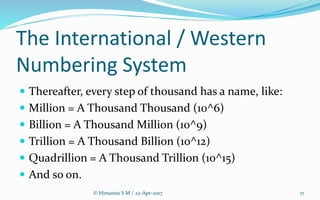
 Thereafter, every step of thousand has a name, like:
 Million = A Thousand Thousand (10^6)
 Billion = A Thousand Million (10^9)
 Trillion = A Thousand Billion (10^12)
 Quadrillion = A Thousand Trillion (10^15)
 And so on.
© Himansu S M / 22-Apr-2017 17
The International / Western
Numbering System
 There is no names in between –
 Like 10000 has no separate name – but is known as Ten
Thousand, 100000 as Hundred Thousand
 Similarly, Ten Million (10^7), Hundred Million (10^8)
 And Ten Billion (10^10), Hundred Billion (10^11)
© Himansu S M / 22-Apr-2017 18
How to Read & Write A Number
 For Small numbers with 4 to 5 digits, there is no
specific problem. We write 2356, 54186
 But for larger numbers involving 6 or more is a little
clumsy. Ex. 1234567 – takes time to figure out the no.
 So for readability, we use Commas as separators which
divides a long number into readable groups.
 For this we have two distinct systems: Indian &
Western / International
© Himansu S M / 22-Apr-2017 19
How to Read & Write A Number
 We call this as “Thousand Separator” – This segregates
the long number into multiples of thousand.
 Ex 123456789 as 123,456,789 – We have to read this
from right to left – Up-to-Thousand, then Thousand,
and then Million, and so on. So the number is 123
Million 456 Thousand Seven Hundred Eighty-Nine
 This is done to enhance readability.
© Himansu S M / 22-Apr-2017 20
How to Read & Write A Number
 The above is the Western System. In the Indian system
the first three digits from right (Up-to-Thousand)
remain the same. There after the grouping is made of 2
digits each.
 Ex. 1234567890 can be written as 1,23,45,67,890 – So
the No. is 1 Arab 23 Crore 45 Lakh 67 Thousand Eight
Hundred Ninety.
© Himansu S M / 22-Apr-2017 21
HOW TO CONVERT A NUMBER FROM ONE SYSTEM TO
THE OTHER
© Himansu S M / 22-Apr-2017 22
Converting The Number Formats
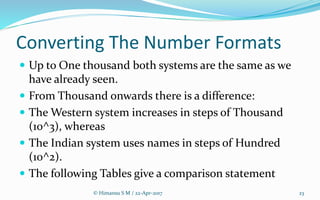
 Up to One thousand both systems are the same as we
have already seen.
 From Thousand onwards there is a difference:
 The Western system increases in steps of Thousand
(10^3), whereas
 The Indian system uses names in steps of Hundred
(10^2).
 The following Tables give a comparison statement
© Himansu S M / 22-Apr-2017 23
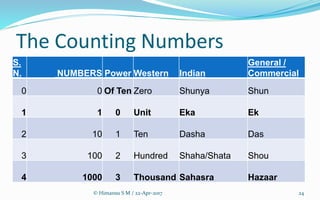
The Counting Numbers
S.
N. NUMBERS Power Western Indian
General /
Commercial
0 0 Of Ten Zero Shunya Shun
1 1 0 Unit Eka Ek
2 10 1 Ten Dasha Das
3 100 2 Hundred Shaha/Shata Shou
4 1000 3 Thousand Sahasra Hazaar
24© Himansu S M / 22-Apr-2017
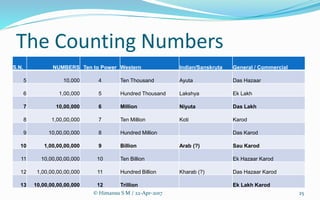
The Counting Numbers
S.N. NUMBERS Ten to Power Western Indian/Sanskruta General / Commercial
5 10,000 4 Ten Thousand Ayuta Das Hazaar
6 1,00,000 5 Hundred Thousand Lakshya Ek Lakh
7 10,00,000 6 Million Niyuta Das Lakh
8 1,00,00,000 7 Ten Million Koti Karod
9 10,00,00,000 8 Hundred Million Das Karod
10 1,00,00,00,000 9 Billion Arab (?) Sau Karod
11 10,00,00,00,000 10 Ten Billion Ek Hazaar Karod
12 1,00,00,00,00,000 11 Hundred Billion Kharab (?) Das Hazaar Karod
13 10,00,00,00,00,000 12 Trillion Ek Lakh Karod
25© Himansu S M / 22-Apr-2017
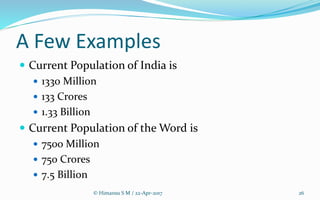
A Few Examples
 Current Population of India is
 1330 Million
 133 Crores
 1.33 Billion
 Current Population of the Word is
 7500 Million
 750 Crores
 7.5 Billion
© Himansu S M / 22-Apr-2017 26
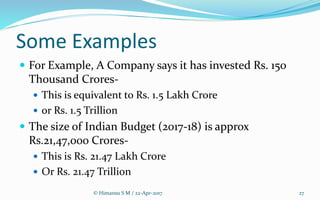
Some Examples
 For Example, A Company says it has invested Rs. 150
Thousand Crores-
 This is equivalent to Rs. 1.5 Lakh Crore
 or Rs. 1.5 Trillion
 The size of Indian Budget (2017-18) is approx
Rs.21,47,000 Crores-
 This is Rs. 21.47 Lakh Crore
 Or Rs. 21.47 Trillion
© Himansu S M / 22-Apr-2017 27
Things to Remember
© Himansu S M / 22-Apr-2017 28
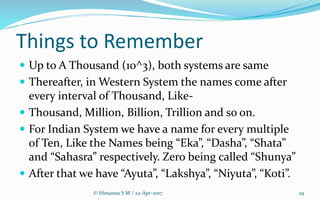
Things to Remember
 Up to A Thousand (10^3), both systems are same
 Thereafter, in Western System the names come after
every interval of Thousand, Like-
 Thousand, Million, Billion, Trillion and so on.
 For Indian System we have a name for every multiple
of Ten, Like the Names being “Eka”, “Dasha”, “Shata”
and “Sahasra” respectively. Zero being called “Shunya”
 After that we have “Ayuta”, “Lakshya”, “Niyuta”, “Koti”.
© Himansu S M / 22-Apr-2017 29
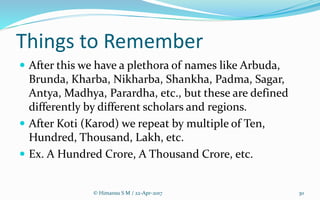
Things to Remember
 After this we have a plethora of names like Arbuda,
Brunda, Kharba, Nikharba, Shankha, Padma, Sagar,
Antya, Madhya, Parardha, etc., but these are defined
differently by different scholars and regions.
 After Koti (Karod) we repeat by multiple of Ten,
Hundred, Thousand, Lakh, etc.
 Ex. A Hundred Crore, A Thousand Crore, etc.
© Himansu S M / 22-Apr-2017 30
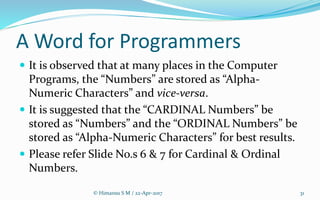
A Word for Programmers
 It is observed that at many places in the Computer
Programs, the “Numbers” are stored as “Alpha-
Numeric Characters” and vice-versa.
 It is suggested that the “CARDINAL Numbers” be
stored as “Numbers” and the “ORDINAL Numbers” be
stored as “Alpha-Numeric Characters” for best results.
 Please refer Slide No.s 6 & 7 for Cardinal & Ordinal
Numbers.
© Himansu S M / 22-Apr-2017 31
Thank You!
Hope I have clarified the Subject
© Himansu S M / 22-Apr-2017
© Himansu S M / 22-Apr-2017 32

The Number System

  • 1.
    A Note onthe General Numbering System Used Nationally ( INDIA ) and internationally – For Common & Business Purposes By Himansu S M / 22- Apr 2017
  • 2.
    Why Write AboutNumbers  It is surprising to know that many people (Literate and Qualified included) are not very clear about our Numbering System and confuse very much while converting our Indian System to the Western/ International System and vice versa.  If asked “How much is a Million in Indian System”, many people answer as “A Lakh”  If asked “How much is a Billion in Indian System”, many people answer as “A Crore” 2© Himansu S M / 22-Apr-2017
  • 3.
    Why Write AboutNumbers  Even a section of well educated people make such mistakes.  I was so disturbed by this, that I thought I must write about the common / simple Numbering System.  So here it is. I have tried my best to keep it simple, sort and easy to understand. 3© Himansu S M / 22-Apr-2017
  • 4.
    The Counting Numbersand Symbols 4© Himansu S M / 22-Apr-2017
  • 5.
    Introduction  As weall know that the NUMBERS are used for expressing certain parameters or entities or money in quantities –  Numbers give a quantifiable representation which can be used for simple Arithmetical Calculations or for higher Mathematical Operations, as well as simple estimate of the quantity.  For this we use the best and mostly used “DECIMAL” System 5© Himansu S M / 22-Apr-2017
  • 6.
    Cardinal & OrdinalNumbers  It is very important to know about these numbers in this age of Business, Economics and Finance.  CARDINAL Numbers are those which can be subjected to Arithmetical & Mathematical Operations.  Ex. If you have Rs. 200 and I have Rs. 100, together we have Rs. 300 (addition)  Ex. If a father wants to distribute Rs 600 among his 4 sons, each get Rs. 150 (division) – and so on © Himansu S M / 22-Apr-2017 6
  • 7.
    Cardinal & OrdinalNumbers  ORDINAL Numbers are those which CANNOT be subjected to Arithmetical & Mathematical Operations. These are used for Naming, Identification, or Sequential purpose.  Ex. If your Apt no. is 3 and mine is 4, then it is meaningless to say that the person living in Apt no. 7 is You and Me taken together.  Ex. Telephone No.s A/c No.s Road No.s, etc. © Himansu S M / 22-Apr-2017 7
  • 8.
    The Basic Numbers As we all know, we follow the “DECIMAL” numbering System.  This means, we use only 10 (TEN) Characters or Digits to represent the quantity in Numbers.  These Digits are: 0, 1, 2, 3, 4, 5, 6, 7, 8 and 9.  Their names are Zero, One, Two, Three, Four, Five, Six, Seven, Eight and Nine Respectively 8© Himansu S M / 22-Apr-2017
  • 9.
    The Basic Numbers Each of these represent a distinct level of quantity, like:  “0” – Zero, represents “NIL”, not present or absent, or when there are nothing.  “1” to “9” – represent the respective values / levels / quantities.  What if the quantity exceeds “9” Nine?  To represent the next higher number we use two digits together, like 1 and 0 – i.e., 10 (Ten) 9© Himansu S M / 22-Apr-2017
  • 10.
    The Basic Numbers And then the sequence goes on till “99”, when all the digits are exhausted in two-digit number  Then we repeat the same procedure to make it three- digit number like 100, we call it Hundred.  Like-wise the numbers increase to 1000, 10000, and so on which can take care of representing higher and higher numbers or quantity. 10© Himansu S M / 22-Apr-2017
  • 11.
    The Counting Numbers In single digit numbers we have “0” to “9”  In double digit numbers we have “10” to “99”  In triple digit numbers we have “100” to “999”  In 4-digit numbers we have “1000” to “9999”  In 5-digit numbers we have “1000” to “99999”  And so on and so forth till we can match our quantity correctly.  All these major steps have specific names: 11© Himansu S M / 22-Apr-2017
  • 12.
    The Counting Numbers The Single Digit Numbers are Called “UNITS”  The Double Digit Numbers are Called “TENS”  The Triple Digit Numbers are Called “HUNDREDS”  The 4-Digit Numbers are Called “THOUSANDS”  Up to this Level, both Indian and International Systems are the same, the Names being “Eka”, “Dasha”, “Shata” and “Sahasra” respectively. Zero being called “Shunya” 12© Himansu S M / 22-Apr-2017
  • 13.
    The Indian NumberingSystem S.N. In Figures In Sanskrut/Indian In Common Language 1 0 Shunya Shun 2 1 Eka Ek 3 10 Dasha Das 4 100 Shaha / Shata Shou 5 1000 Sahasra Hazaar 6 10000 Ayuta Das Hazaar 7 100000 Lakshya Lakh / Lac 8 1000000 Niyuta Das Lakh 9 10000000 Koti Karod / Crore © Himansu S M / 22-Apr-2017 13
  • 14.
    The Indian NumberingSystem  Pls Refer to the Table above and find that up to One Crore (Karod / Koti) (10 to the power 7) the nomenclatures are standardised and there is no dispute according to our ancient documents and texts.  But beyond this there is discrepancy across the different regions of India.  Also, we use only these nomenclatures in repetition, like Thousand Crore, etc. for larger Numbers © Himansu S M / 22-Apr-2017 14
  • 15.
    The Indian NumberingSystem  So we can safely ignore the higher Nomenclatures for the time-being.  Some use Arbuda (Arab) as a Hundred Koti / Crore (10^9)  and Kharba (Kharab) as a Hundred Arab (10^11) © Himansu S M / 22-Apr-2017 15
  • 16.
    The International /Western Numbering System  As mentioned earlier, we have the same system in International System of Numbers up to Thousand:  0 = Zero 1 = Units  10 = Tens 100= Hundreds  1000 = Thousands © Himansu S M / 22-Apr-2017 16
  • 17.
    The International /Western Numbering System  Thereafter, every step of thousand has a name, like:  Million = A Thousand Thousand (10^6)  Billion = A Thousand Million (10^9)  Trillion = A Thousand Billion (10^12)  Quadrillion = A Thousand Trillion (10^15)  And so on. © Himansu S M / 22-Apr-2017 17
  • 18.
    The International /Western Numbering System  There is no names in between –  Like 10000 has no separate name – but is known as Ten Thousand, 100000 as Hundred Thousand  Similarly, Ten Million (10^7), Hundred Million (10^8)  And Ten Billion (10^10), Hundred Billion (10^11) © Himansu S M / 22-Apr-2017 18
  • 19.
    How to Read& Write A Number  For Small numbers with 4 to 5 digits, there is no specific problem. We write 2356, 54186  But for larger numbers involving 6 or more is a little clumsy. Ex. 1234567 – takes time to figure out the no.  So for readability, we use Commas as separators which divides a long number into readable groups.  For this we have two distinct systems: Indian & Western / International © Himansu S M / 22-Apr-2017 19
  • 20.
    How to Read& Write A Number  We call this as “Thousand Separator” – This segregates the long number into multiples of thousand.  Ex 123456789 as 123,456,789 – We have to read this from right to left – Up-to-Thousand, then Thousand, and then Million, and so on. So the number is 123 Million 456 Thousand Seven Hundred Eighty-Nine  This is done to enhance readability. © Himansu S M / 22-Apr-2017 20
  • 21.
    How to Read& Write A Number  The above is the Western System. In the Indian system the first three digits from right (Up-to-Thousand) remain the same. There after the grouping is made of 2 digits each.  Ex. 1234567890 can be written as 1,23,45,67,890 – So the No. is 1 Arab 23 Crore 45 Lakh 67 Thousand Eight Hundred Ninety. © Himansu S M / 22-Apr-2017 21
  • 22.
    HOW TO CONVERTA NUMBER FROM ONE SYSTEM TO THE OTHER © Himansu S M / 22-Apr-2017 22
  • 23.
    Converting The NumberFormats  Up to One thousand both systems are the same as we have already seen.  From Thousand onwards there is a difference:  The Western system increases in steps of Thousand (10^3), whereas  The Indian system uses names in steps of Hundred (10^2).  The following Tables give a comparison statement © Himansu S M / 22-Apr-2017 23
  • 24.
    The Counting Numbers S. N.NUMBERS Power Western Indian General / Commercial 0 0 Of Ten Zero Shunya Shun 1 1 0 Unit Eka Ek 2 10 1 Ten Dasha Das 3 100 2 Hundred Shaha/Shata Shou 4 1000 3 Thousand Sahasra Hazaar 24© Himansu S M / 22-Apr-2017
  • 25.
    The Counting Numbers S.N.NUMBERS Ten to Power Western Indian/Sanskruta General / Commercial 5 10,000 4 Ten Thousand Ayuta Das Hazaar 6 1,00,000 5 Hundred Thousand Lakshya Ek Lakh 7 10,00,000 6 Million Niyuta Das Lakh 8 1,00,00,000 7 Ten Million Koti Karod 9 10,00,00,000 8 Hundred Million Das Karod 10 1,00,00,00,000 9 Billion Arab (?) Sau Karod 11 10,00,00,00,000 10 Ten Billion Ek Hazaar Karod 12 1,00,00,00,00,000 11 Hundred Billion Kharab (?) Das Hazaar Karod 13 10,00,00,00,00,000 12 Trillion Ek Lakh Karod 25© Himansu S M / 22-Apr-2017
  • 26.
    A Few Examples Current Population of India is  1330 Million  133 Crores  1.33 Billion  Current Population of the Word is  7500 Million  750 Crores  7.5 Billion © Himansu S M / 22-Apr-2017 26
  • 27.
    Some Examples  ForExample, A Company says it has invested Rs. 150 Thousand Crores-  This is equivalent to Rs. 1.5 Lakh Crore  or Rs. 1.5 Trillion  The size of Indian Budget (2017-18) is approx Rs.21,47,000 Crores-  This is Rs. 21.47 Lakh Crore  Or Rs. 21.47 Trillion © Himansu S M / 22-Apr-2017 27
  • 28.
    Things to Remember ©Himansu S M / 22-Apr-2017 28
  • 29.
    Things to Remember Up to A Thousand (10^3), both systems are same  Thereafter, in Western System the names come after every interval of Thousand, Like-  Thousand, Million, Billion, Trillion and so on.  For Indian System we have a name for every multiple of Ten, Like the Names being “Eka”, “Dasha”, “Shata” and “Sahasra” respectively. Zero being called “Shunya”  After that we have “Ayuta”, “Lakshya”, “Niyuta”, “Koti”. © Himansu S M / 22-Apr-2017 29
  • 30.
    Things to Remember After this we have a plethora of names like Arbuda, Brunda, Kharba, Nikharba, Shankha, Padma, Sagar, Antya, Madhya, Parardha, etc., but these are defined differently by different scholars and regions.  After Koti (Karod) we repeat by multiple of Ten, Hundred, Thousand, Lakh, etc.  Ex. A Hundred Crore, A Thousand Crore, etc. © Himansu S M / 22-Apr-2017 30
  • 31.
    A Word forProgrammers  It is observed that at many places in the Computer Programs, the “Numbers” are stored as “Alpha- Numeric Characters” and vice-versa.  It is suggested that the “CARDINAL Numbers” be stored as “Numbers” and the “ORDINAL Numbers” be stored as “Alpha-Numeric Characters” for best results.  Please refer Slide No.s 6 & 7 for Cardinal & Ordinal Numbers. © Himansu S M / 22-Apr-2017 31
  • 32.
    Thank You! Hope Ihave clarified the Subject © Himansu S M / 22-Apr-2017 © Himansu S M / 22-Apr-2017 32