APPLICATION ON DECIMALS
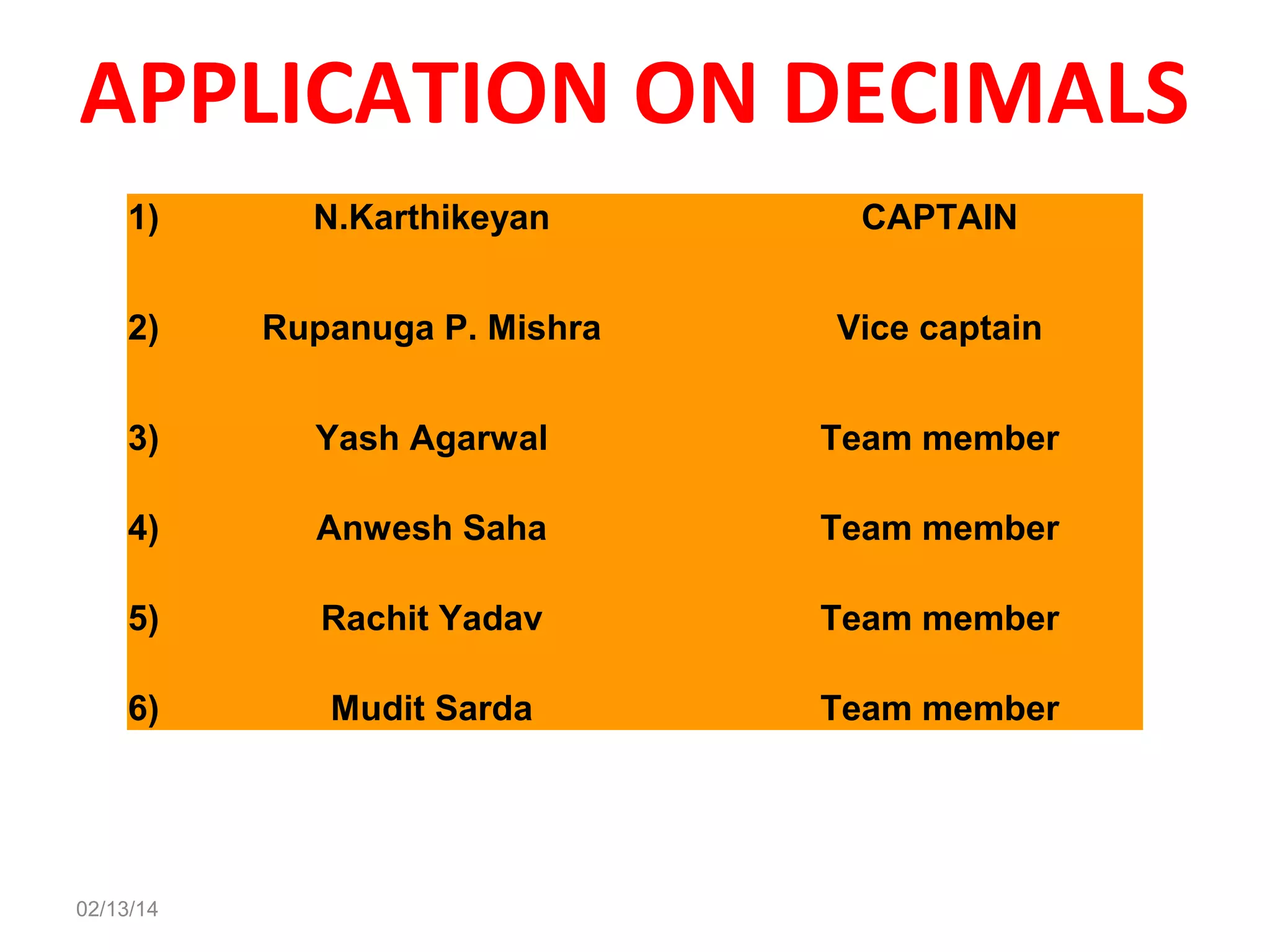
1)
 

N.Karthikeyan


CAPTAIN
 

2)

Rupanuga P. Mishra


Vice captain

 
3)
 
4)
 
5)
 
6)

 
Yash Agarwal
 
Anwesh Saha
 
Rachit Yadav
 
Mudit Sarda


Team member
 
Team member
 
Team member
 
Team member

02/13/14
Historical facts.

REFERENCE
http://education.ed.pacificu.edu/charlesm/courses/m
athsci/numsys/numsys.html
For the information
REFERENCE
http://bmisclass2011.wikispaces.com/Year7unit5TheN
umberZero
For the picture

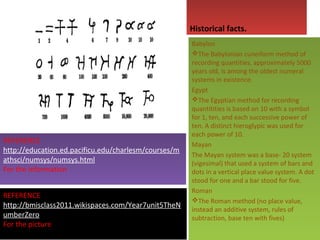
Babylon
The Babylonian cuneiform method of
recording quantities, approximately 5000
years old, is among the oldest numeral
systems in existence.
Egypt
The Egyptian method for recording
quantitities is based on 10 with a symbol
for 1, ten, and each successive power of
ten. A distinct hieroglypic was used for
each power of 10.
Mayan
The Mayan system was a base- 20 system
(vigesimal) that used a system of bars and
dots in a vertical place value system. A dot
stood for one and a bar stood for five.
Roman
The Roman method (no place value,
instead an additive system, rules of
subtraction, base ten with fives)
Who invented the modern
number system

Reference
http://en.wikipedia.org/wiki/File:Arabic_numerals-en.svg

For the picture

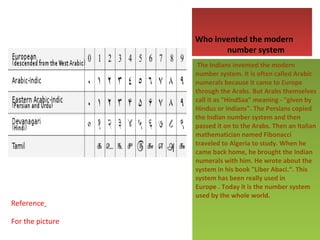
The Indians invented the modern
number system. It is often called Arabic
numerals because it came to Europe
through the Arabs. But Arabs themselves
call it as "HindSaa" meaning - "given by
Hindus or Indians". The Persians copied
the Indian number system and then
passed it on to the Arabs. Then an Italian
mathematician named Fibonacci
traveled to Algeria to study. When he
came back home, he brought the Indian
numerals with him. He wrote about the
system in his book "Liber Abaci.“. This
system has been really used in
Europe . Today it is the number system
used by the whole world.
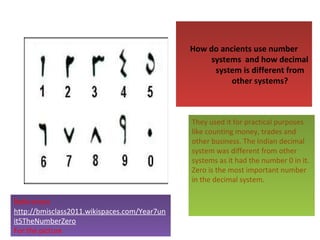
How do ancients use number
systems and how decimal
system is different from
other systems?

They used it for practical purposes
like counting money, trades and
other business. The Indian decimal
system was different from other
systems as it had the number 0 in it.
Zero is the most important number
in the decimal system.
References
http://bmisclass2011.wikispaces.com/Year7un
it5TheNumberZero
For the picture
INDIAN DECIMAL SYSTEM

Indian Decimal System uses the concept of Face Value and Place
Value as described below

PLACE VALUE

FACE VALUE

PLACE VALUE is relative, it
changes depending upon
the place where it is
situated. Place value
depends upon multiples of
10. Found only in decimal
system.

FACE VALUE is the exact value
of a number that cannot be
changed. Found in all
systems.
Use of Decimal System
•
•
•
•
•

Measurement.
Currency.
Weight.
Volume.
Nutrients in food.

• Conclusion: These help
us in daily life
Decimal System in measurement
• In measuring objects we use
the scale based on decimal
system. The most common
scale is metric scale.
• Metric scale consists of a
standard unit meter. All
other practical scales are
relative to it like
centimeter, millimeter and
kilometer.
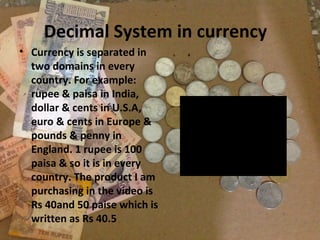
Decimal System in currency
• Currency is separated in
two domains in every
country. For example:
rupee & paisa in India,
dollar & cents in U.S.A,
euro & cents in Europe &
pounds & penny in
England. 1 rupee is 100
paisa & so it is in every
country. The product I am
purchasing in the video is
Rs 40and 50 paise which is
written as Rs 40.5
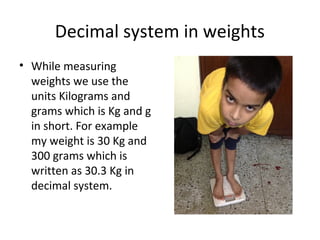
Decimal system in weights
• While measuring
weights we use the
units Kilograms and
grams which is Kg and g
in short. For example
my weight is 30 Kg and
300 grams which is
written as 30.3 Kg in
decimal system.
Decimal system in volume
• Volumes are measured
in litres and millilitres. 1
litre is equal to 1000
millilitres. If we make a
box of 10 cm x 10 cm x
10 cm then its volume is
1 litre. 1 millilitre is a
cube of 1cm x 1cm x
1cm.
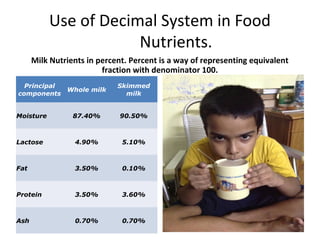
Use of Decimal System in Food
Nutrients.
Milk Nutrients in percent. Percent is a way of representing equivalent
fraction with denominator 100.
Principal
Whole milk
components

Skimmed
milk

Moisture

87.40%

90.50%

Lactose

4.90%

5.10%

Fat

3.50%

0.10%

Protein

3.50%

3.60%

Ash

0.70%

0.70%
From the PowerPoint I hope
you saw the use of decimal
systems.

nc
Co

ion
us
l

Application on decimals by Karthikeyan's team

  • 1.
  • 2.
    Historical facts. REFERENCE http://education.ed.pacificu.edu/charlesm/courses/m athsci/numsys/numsys.html For theinformation REFERENCE http://bmisclass2011.wikispaces.com/Year7unit5TheN umberZero For the picture Babylon The Babylonian cuneiform method of recording quantities, approximately 5000 years old, is among the oldest numeral systems in existence. Egypt The Egyptian method for recording quantitities is based on 10 with a symbol for 1, ten, and each successive power of ten. A distinct hieroglypic was used for each power of 10. Mayan The Mayan system was a base- 20 system (vigesimal) that used a system of bars and dots in a vertical place value system. A dot stood for one and a bar stood for five. Roman The Roman method (no place value, instead an additive system, rules of subtraction, base ten with fives)
  • 3.
    Who invented themodern number system Reference http://en.wikipedia.org/wiki/File:Arabic_numerals-en.svg For the picture The Indians invented the modern number system. It is often called Arabic numerals because it came to Europe through the Arabs. But Arabs themselves call it as "HindSaa" meaning - "given by Hindus or Indians". The Persians copied the Indian number system and then passed it on to the Arabs. Then an Italian mathematician named Fibonacci traveled to Algeria to study. When he came back home, he brought the Indian numerals with him. He wrote about the system in his book "Liber Abaci.“. This system has been really used in Europe . Today it is the number system used by the whole world.
  • 4.
    How do ancientsuse number systems and how decimal system is different from other systems? They used it for practical purposes like counting money, trades and other business. The Indian decimal system was different from other systems as it had the number 0 in it. Zero is the most important number in the decimal system. References http://bmisclass2011.wikispaces.com/Year7un it5TheNumberZero For the picture
  • 5.
    INDIAN DECIMAL SYSTEM IndianDecimal System uses the concept of Face Value and Place Value as described below PLACE VALUE FACE VALUE PLACE VALUE is relative, it changes depending upon the place where it is situated. Place value depends upon multiples of 10. Found only in decimal system. FACE VALUE is the exact value of a number that cannot be changed. Found in all systems.
  • 6.
    Use of DecimalSystem • • • • • Measurement. Currency. Weight. Volume. Nutrients in food. • Conclusion: These help us in daily life
  • 7.
    Decimal System inmeasurement • In measuring objects we use the scale based on decimal system. The most common scale is metric scale. • Metric scale consists of a standard unit meter. All other practical scales are relative to it like centimeter, millimeter and kilometer.
  • 8.
    Decimal System incurrency • Currency is separated in two domains in every country. For example: rupee & paisa in India, dollar & cents in U.S.A, euro & cents in Europe & pounds & penny in England. 1 rupee is 100 paisa & so it is in every country. The product I am purchasing in the video is Rs 40and 50 paise which is written as Rs 40.5
  • 9.
    Decimal system inweights • While measuring weights we use the units Kilograms and grams which is Kg and g in short. For example my weight is 30 Kg and 300 grams which is written as 30.3 Kg in decimal system.
  • 10.
    Decimal system involume • Volumes are measured in litres and millilitres. 1 litre is equal to 1000 millilitres. If we make a box of 10 cm x 10 cm x 10 cm then its volume is 1 litre. 1 millilitre is a cube of 1cm x 1cm x 1cm.
  • 11.
    Use of DecimalSystem in Food Nutrients. Milk Nutrients in percent. Percent is a way of representing equivalent fraction with denominator 100. Principal Whole milk components Skimmed milk Moisture 87.40% 90.50% Lactose 4.90% 5.10% Fat 3.50% 0.10% Protein 3.50% 3.60% Ash 0.70% 0.70%
  • 12.
    From the PowerPointI hope you saw the use of decimal systems. nc Co ion us l