Three Strategies to
Deliver Patient-Centered
Care in the Next Normal
HEALTH CATALYST EDITORS
© 2021 Health Catalyst
Proprietary. Feel free to share but we would appreciate a Health Catalyst citation.
Delivering Patient-Centered Care
In the COVID-19 era, decision makers face
a variety of new priorities, including scaling
virtual care solutions overnight, recovering
billions of dollars in lost revenue, over-
coming overcrowded ICUs, and managing
personnel safety with insufficient personal
protective equipment.
© 2021 Health Catalyst
Proprietary. Feel free to share but we would appreciate a Health Catalyst citation.
Delivering Patient-Centered Care
With so many pressing issues vying for
leadership’s attention, patient-centered care
can seem like a low-level priority.
However, treating a complex virus like
COVID-19 underscores the necessity to
keep patients at the center of care delivery.
© 2021 Health Catalyst
Proprietary. Feel free to share but we would appreciate a Health Catalyst citation.
Delivering Patient-Centered Care
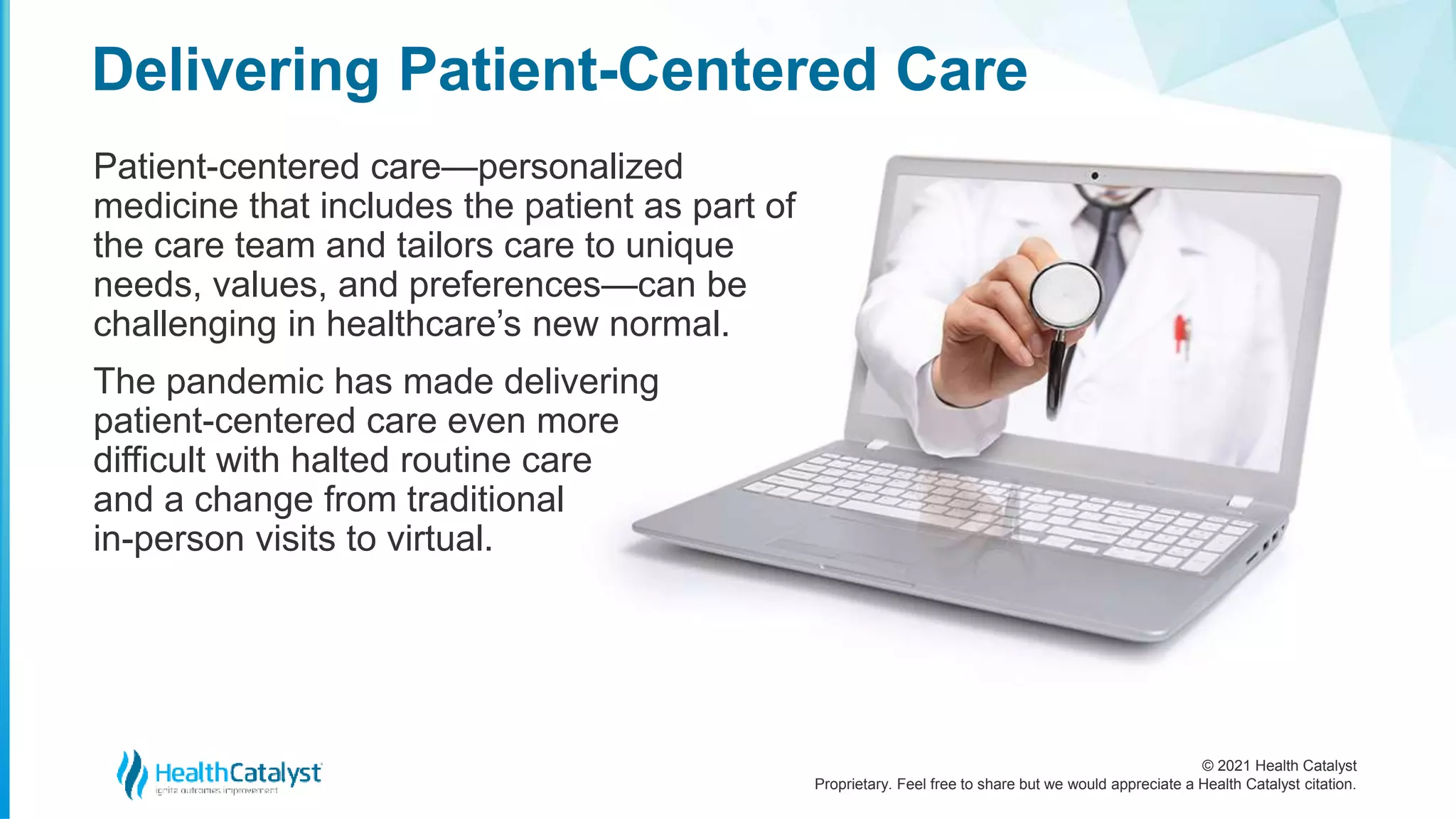
Patient-centered care—personalized
medicine that includes the patient as part of
the care team and tailors care to unique
needs, values, and preferences—can be
challenging in healthcare’s new normal.
The pandemic has made delivering
patient-centered care even more
difficult with halted routine care
and a change from traditional
in-person visits to virtual.
© 2021 Health Catalyst
Proprietary. Feel free to share but we would appreciate a Health Catalyst citation.
Delivering Patient-Centered Care
However, patient-centered care has never
been more critical; it requires providers and
care teams to adapt care plans and
interventions to the pandemic’s impact on
individual patients, especially those at
higher risk due to age or chronic diseases.
© 2021 Health Catalyst
Proprietary. Feel free to share but we would appreciate a Health Catalyst citation.
Three Strategies to Deliver
Patient-Centered Care
In spite of what has felt like overnight changes
to healthcare delivery with the onset of COVID-
19, hospitals, clinics, and other healthcare
organizations can focus patient-centered care
by applying three strategies:
1. Improve the Patient Experience
2. Implement the Meaningful Measures Initiative
3. Transition In-Person Visits to Virtual
© 2021 Health Catalyst
Proprietary. Feel free to share but we would appreciate a Health Catalyst citation.
Three Strategies to Deliver
Patient-Centered Care
#1: Improve the Patient Experience
Health systems recognize the increasing
importance of patient satisfaction as patients
become more involved in their care.
Health systems and other healthcare
organizations use patient satisfaction
scores as an indicator of the patient
experience and quality of care.
© 2021 Health Catalyst
Proprietary. Feel free to share but we would appreciate a Health Catalyst citation.
Three Strategies to Deliver
Patient-Centered Care
#1: Improve the Patient Experience
While the patient experience is important for
CMS reimbursements, it is also critical to
patient-centered care because the level of
satisfaction reveals a patient’s expectations
of care, how well the health system meets
those expectations, and the patient’s level
of engagement in their care.
© 2021 Health Catalyst
Proprietary. Feel free to share but we would appreciate a Health Catalyst citation.
Three Strategies to Deliver
Patient-Centered Care
#1: Improve the Patient Experience
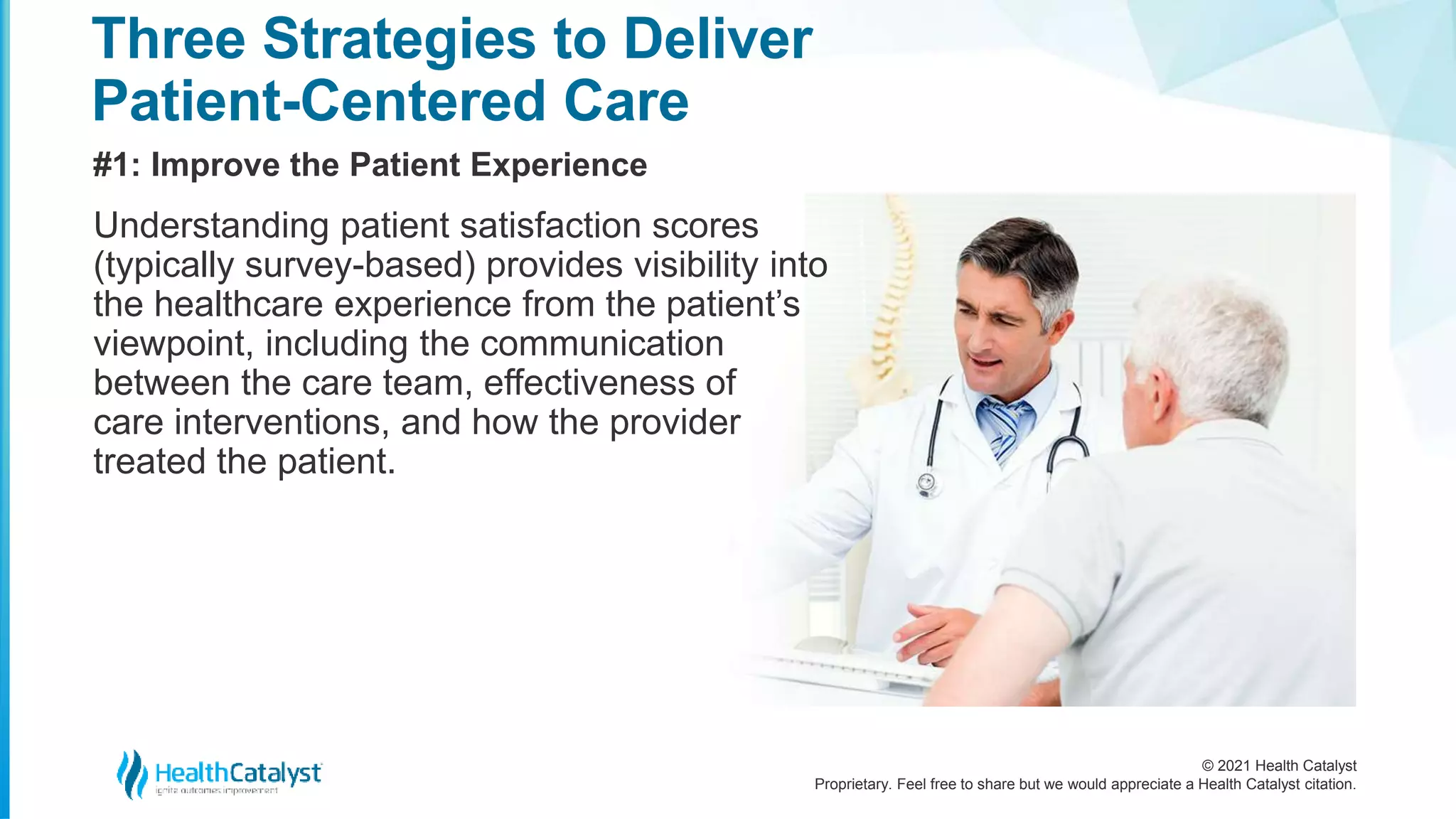
Understanding patient satisfaction scores
(typically survey-based) provides visibility into
the healthcare experience from the patient’s
viewpoint, including the communication
between the care team, effectiveness of
care interventions, and how the provider
treated the patient.
© 2021 Health Catalyst
Proprietary. Feel free to share but we would appreciate a Health Catalyst citation.
Three Strategies to Deliver
Patient-Centered Care
#1: Improve the Patient Experience
This information helps health systems target
and improve areas in which patients feel
less satisfied with their care, resulting in
elevated patient-centered care and higher
patient satisfaction scores that, in turn,
increase reimbursements.
© 2021 Health Catalyst
Proprietary. Feel free to share but we would appreciate a Health Catalyst citation.
Three Strategies to Deliver
Patient-Centered Care
#2: Implement the Meaningful Measures Initiative
To ensure that patients remain at the center
of care throughout the shift to value-based
care from fee for service, CMS enacted
clinical quality measures.
The CMS Meaningful Measures Initiative
(and Meaningful Measures 2.0 aimed at
focusing the entire healthcare ecosystem
around patients even more) serves as a
barometer for improving care delivery and
prioritizing patients throughout the entire
care process.
© 2021 Health Catalyst
Proprietary. Feel free to share but we would appreciate a Health Catalyst citation.
Three Strategies to Deliver
Patient-Centered Care
#2: Implement the Meaningful Measures Initiative
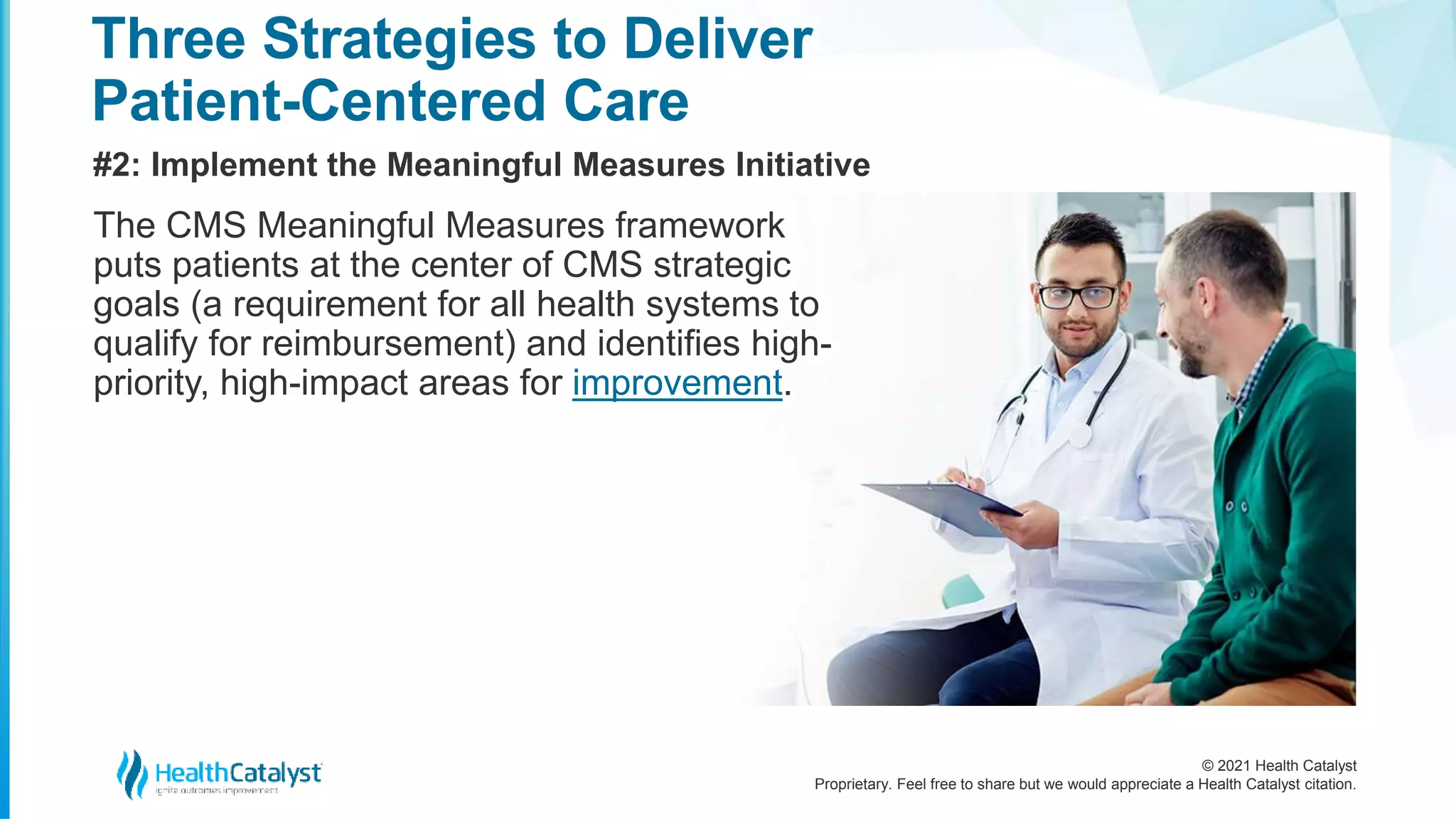
The CMS Meaningful Measures framework
puts patients at the center of CMS strategic
goals (a requirement for all health systems to
qualify for reimbursement) and identifies high-
priority, high-impact areas for improvement.
© 2021 Health Catalyst
Proprietary. Feel free to share but we would appreciate a Health Catalyst citation.
Three Strategies to Deliver
Patient-Centered Care
#2: Implement the Meaningful Measures Initiative
The Meaningful Measures Initiative further
keeps patients at the center of care by
decreasing the reporting burden on providers.
By streamlining the approach to regulatory
reporting and eliminating duplicate measures,
providers spend less time in the EHR and
more time with patients.
Patient data, combined with analytics tools,
also play a role in easing the reporting burden
so that providers can focus on patient needs.
© 2021 Health Catalyst
Proprietary. Feel free to share but we would appreciate a Health Catalyst citation.
Three Strategies to Deliver
Patient-Centered Care
#2: Implement the Meaningful Measures Initiative
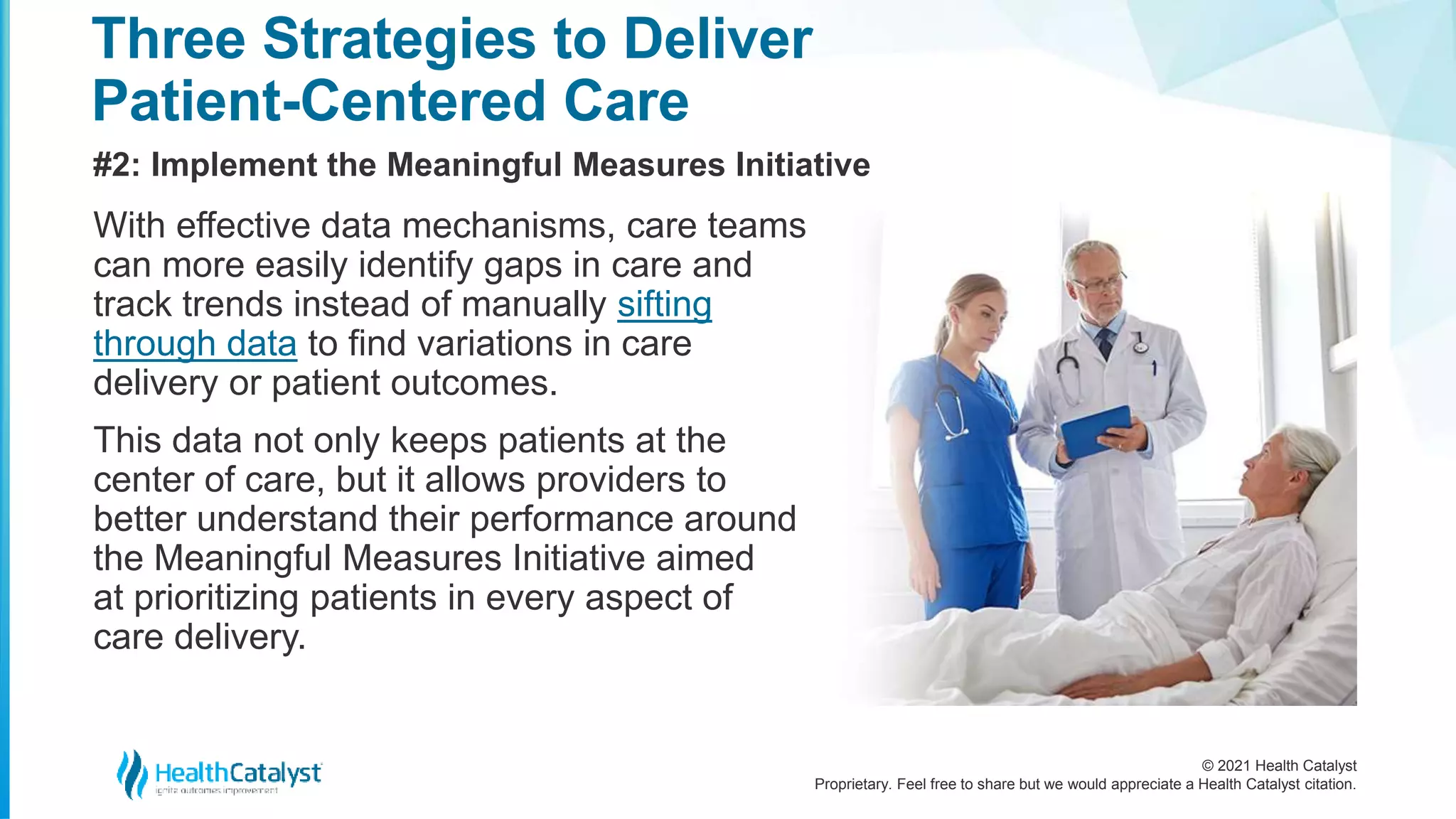
With effective data mechanisms, care teams
can more easily identify gaps in care and
track trends instead of manually sifting
through data to find variations in care
delivery or patient outcomes.
This data not only keeps patients at the
center of care, but it allows providers to
better understand their performance around
the Meaningful Measures Initiative aimed
at prioritizing patients in every aspect of
care delivery.
© 2021 Health Catalyst
Proprietary. Feel free to share but we would appreciate a Health Catalyst citation.
Three Strategies to Deliver
Patient-Centered Care
#3: Transition In-Person Visits to Virtual
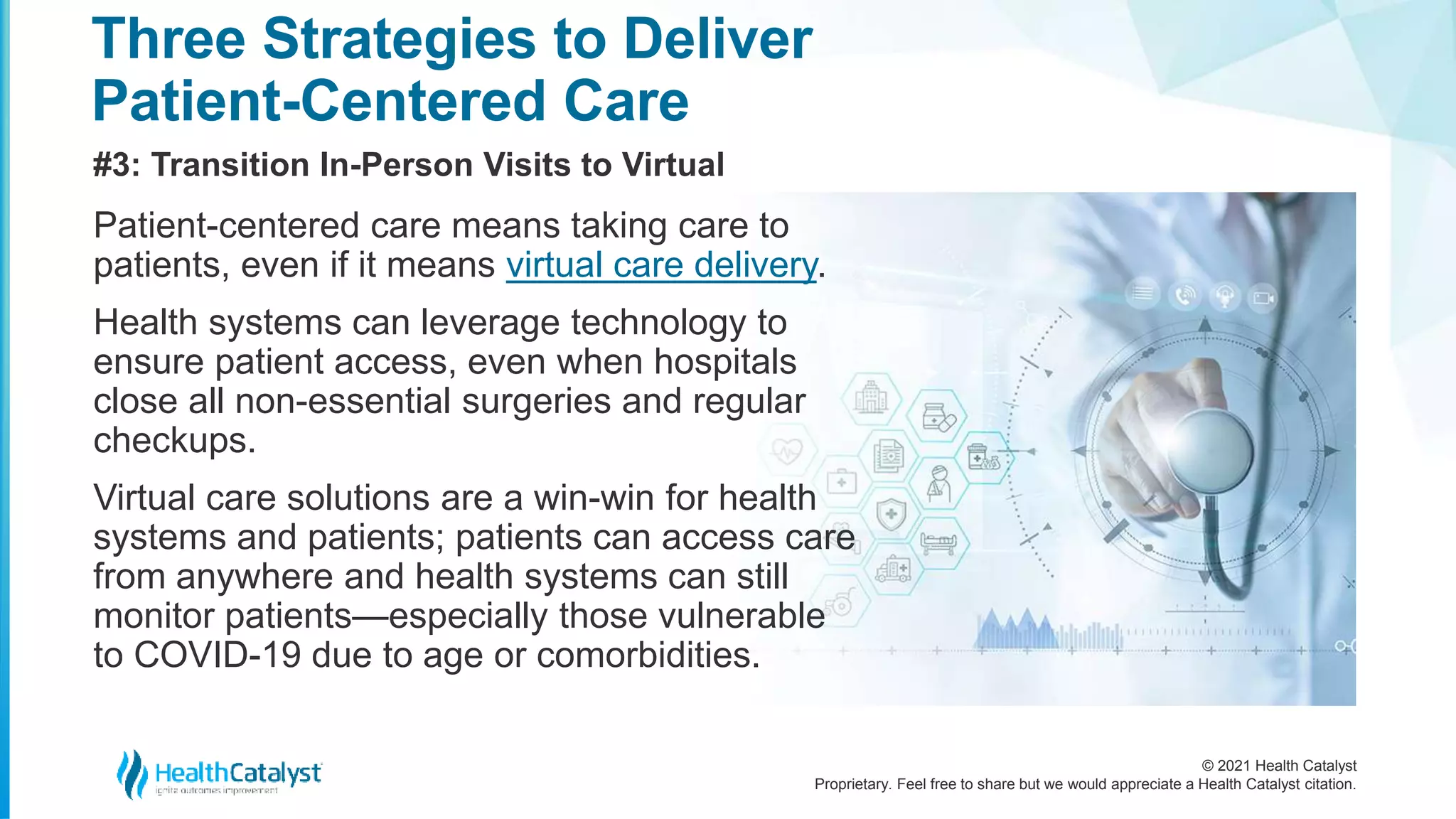
Patient-centered care means taking care to
patients, even if it means virtual care delivery.
Health systems can leverage technology to
ensure patient access, even when hospitals
close all non-essential surgeries and regular
checkups.
Virtual care solutions are a win-win for health
systems and patients; patients can access care
from anywhere and health systems can still
monitor patients—especially those vulnerable
to COVID-19 due to age or comorbidities.
© 2021 Health Catalyst
Proprietary. Feel free to share but we would appreciate a Health Catalyst citation.
Three Strategies to Deliver
Patient-Centered Care
#3: Transition In-Person Visits to Virtual
With the right tools, health systems can scale
virtual solutions in such a small window to
meet patients where they are, a critical aspect
of patient-centered care.
The Financial Impact Recovery Tool and
Patient Stratification Tool, for example, enable
healthcare organizations to overcome
obstacles to delivering telehealth (e.g.,
infrastructure, licensing, and provider buy-in),
a practical solution when routine care—a
principle of patient-centered care—is on hold.
© 2021 Health Catalyst
Proprietary. Feel free to share but we would appreciate a Health Catalyst citation.
Patient-Centered Care Is Possible in Any Setting
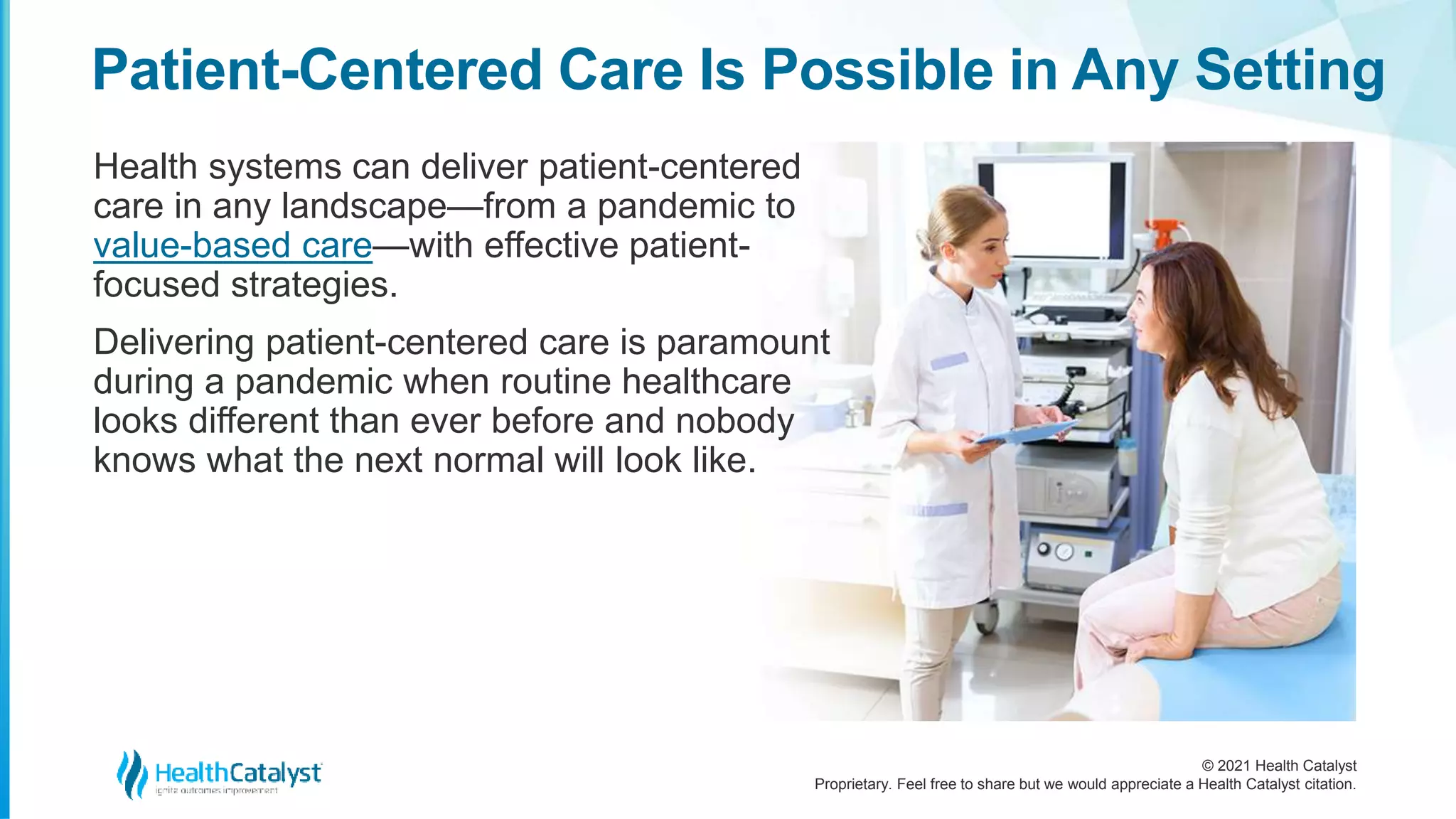
Health systems can deliver patient-centered
care in any landscape—from a pandemic to
value-based care—with effective patient-
focused strategies.
Delivering patient-centered care is paramount
during a pandemic when routine healthcare
looks different than ever before and nobody
knows what the next normal will look like.
© 2021 Health Catalyst
Proprietary. Feel free to share but we would appreciate a Health Catalyst citation.
Patient-Centered Care Is Possible in Any Setting
Identifying patient-centered tactics—improving
patient satisfaction, meeting CMS measures,
and delivering virtual care—health systems
can avoid becoming all-consumed with
competing priorities and keep patients at the
center of care.
Proactively prioritizing patients allows health
systems to tackle health problems before it’s
too late, ensuring every patient reaches, and
maintains, optimum health.
© 2021 Health Catalyst
Proprietary. Feel free to share but we would appreciate a Health Catalyst citation.
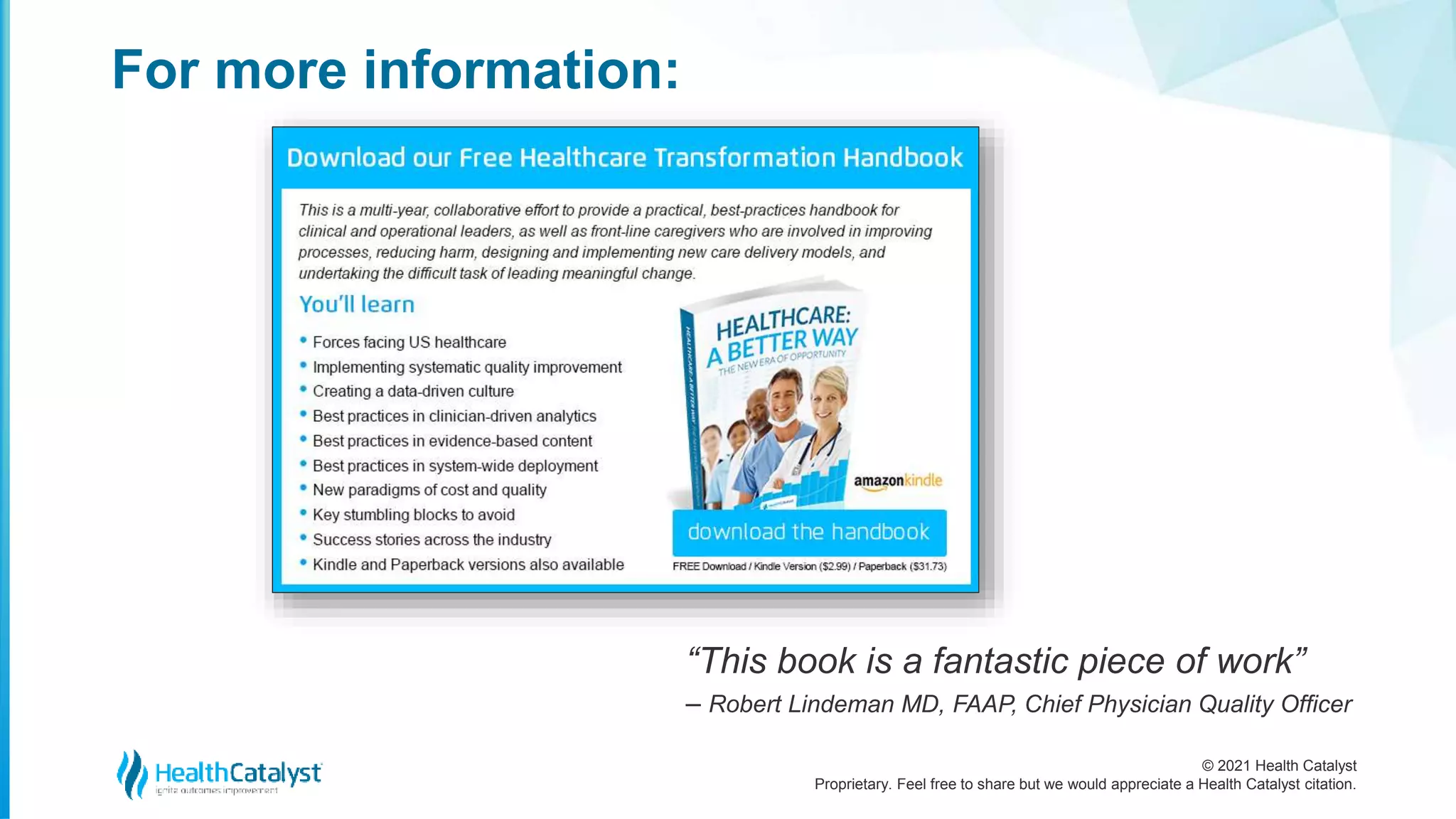
For more information:
“This book is a fantastic piece of work”
– Robert Lindeman MD, FAAP, Chief Physician Quality Officer
© 2021 Health Catalyst
Proprietary. Feel free to share but we would appreciate a Health Catalyst citation.
More about this topic
Link to original article for a more in-depth discussion.
Three Strategies to Deliver Patient-Centered Care in the Next Normal
Three Analytics Strategies to Drive Patient-Centered Care
Health Catalyst Editors
Shifting to Virtual Care in the COVID-19 Era: Analytics for Financial Success and an Optimized
Patient Experience - Health Catalyst Editors
Effective Patient Stratification: Four Solutions to Common Hurdles
Amy Flaster, MD, MBA, Senior VP, Population Health Management and Care Management
Six Ways Health Systems Use Analytics to Improve Patient Safety
Health Catalyst Editors
How to Scale Telehealth Solutions to Increase Patient Access During COVID-19
Ed Corbett, MD, Medical Officer
© 2021 Health Catalyst
Proprietary. Feel free to share but we would appreciate a Health Catalyst citation.
Other Clinical Quality Improvement Resources
Click to read additional information at www.healthcatalyst.com
Health Catalyst is a mission-driven data warehousing, analytics and outcomes-improvement
company that helps healthcare organizations of all sizes improve clinical, financial, and operational
outcomes needed to improve population health and accountable care. Our proven enterprise data
warehouse (EDW) and analytics platform helps improve quality, add efficiency and lower costs in
support of more than 65 million patients for organizations ranging from the largest US health system
to forward-thinking physician practices.
Health Catalyst was recently named as the leader in the enterprise healthcare BI market in
improvement by KLAS, and has received numerous best-place-to work awards including Modern
Healthcare in 2013, 2014, and 2015, as well as other recognitions such as “Best Place to work for
Millenials, and a “Best Perks for Women.”

Three Strategies to Deliver Patient-Centered Care in the Next Normal

  • 1.
    Three Strategies to DeliverPatient-Centered Care in the Next Normal HEALTH CATALYST EDITORS
  • 2.
    © 2021 HealthCatalyst Proprietary. Feel free to share but we would appreciate a Health Catalyst citation. Delivering Patient-Centered Care In the COVID-19 era, decision makers face a variety of new priorities, including scaling virtual care solutions overnight, recovering billions of dollars in lost revenue, over- coming overcrowded ICUs, and managing personnel safety with insufficient personal protective equipment.
  • 3.
    © 2021 HealthCatalyst Proprietary. Feel free to share but we would appreciate a Health Catalyst citation. Delivering Patient-Centered Care With so many pressing issues vying for leadership’s attention, patient-centered care can seem like a low-level priority. However, treating a complex virus like COVID-19 underscores the necessity to keep patients at the center of care delivery.
  • 4.
    © 2021 HealthCatalyst Proprietary. Feel free to share but we would appreciate a Health Catalyst citation. Delivering Patient-Centered Care Patient-centered care—personalized medicine that includes the patient as part of the care team and tailors care to unique needs, values, and preferences—can be challenging in healthcare’s new normal. The pandemic has made delivering patient-centered care even more difficult with halted routine care and a change from traditional in-person visits to virtual.
  • 5.
    © 2021 HealthCatalyst Proprietary. Feel free to share but we would appreciate a Health Catalyst citation. Delivering Patient-Centered Care However, patient-centered care has never been more critical; it requires providers and care teams to adapt care plans and interventions to the pandemic’s impact on individual patients, especially those at higher risk due to age or chronic diseases.
  • 6.
    © 2021 HealthCatalyst Proprietary. Feel free to share but we would appreciate a Health Catalyst citation. Three Strategies to Deliver Patient-Centered Care In spite of what has felt like overnight changes to healthcare delivery with the onset of COVID- 19, hospitals, clinics, and other healthcare organizations can focus patient-centered care by applying three strategies: 1. Improve the Patient Experience 2. Implement the Meaningful Measures Initiative 3. Transition In-Person Visits to Virtual
  • 7.
    © 2021 HealthCatalyst Proprietary. Feel free to share but we would appreciate a Health Catalyst citation. Three Strategies to Deliver Patient-Centered Care #1: Improve the Patient Experience Health systems recognize the increasing importance of patient satisfaction as patients become more involved in their care. Health systems and other healthcare organizations use patient satisfaction scores as an indicator of the patient experience and quality of care.
  • 8.
    © 2021 HealthCatalyst Proprietary. Feel free to share but we would appreciate a Health Catalyst citation. Three Strategies to Deliver Patient-Centered Care #1: Improve the Patient Experience While the patient experience is important for CMS reimbursements, it is also critical to patient-centered care because the level of satisfaction reveals a patient’s expectations of care, how well the health system meets those expectations, and the patient’s level of engagement in their care.
  • 9.
    © 2021 HealthCatalyst Proprietary. Feel free to share but we would appreciate a Health Catalyst citation. Three Strategies to Deliver Patient-Centered Care #1: Improve the Patient Experience Understanding patient satisfaction scores (typically survey-based) provides visibility into the healthcare experience from the patient’s viewpoint, including the communication between the care team, effectiveness of care interventions, and how the provider treated the patient.
  • 10.
    © 2021 HealthCatalyst Proprietary. Feel free to share but we would appreciate a Health Catalyst citation. Three Strategies to Deliver Patient-Centered Care #1: Improve the Patient Experience This information helps health systems target and improve areas in which patients feel less satisfied with their care, resulting in elevated patient-centered care and higher patient satisfaction scores that, in turn, increase reimbursements.
  • 11.
    © 2021 HealthCatalyst Proprietary. Feel free to share but we would appreciate a Health Catalyst citation. Three Strategies to Deliver Patient-Centered Care #2: Implement the Meaningful Measures Initiative To ensure that patients remain at the center of care throughout the shift to value-based care from fee for service, CMS enacted clinical quality measures. The CMS Meaningful Measures Initiative (and Meaningful Measures 2.0 aimed at focusing the entire healthcare ecosystem around patients even more) serves as a barometer for improving care delivery and prioritizing patients throughout the entire care process.
  • 12.
    © 2021 HealthCatalyst Proprietary. Feel free to share but we would appreciate a Health Catalyst citation. Three Strategies to Deliver Patient-Centered Care #2: Implement the Meaningful Measures Initiative The CMS Meaningful Measures framework puts patients at the center of CMS strategic goals (a requirement for all health systems to qualify for reimbursement) and identifies high- priority, high-impact areas for improvement.
  • 13.
    © 2021 HealthCatalyst Proprietary. Feel free to share but we would appreciate a Health Catalyst citation. Three Strategies to Deliver Patient-Centered Care #2: Implement the Meaningful Measures Initiative The Meaningful Measures Initiative further keeps patients at the center of care by decreasing the reporting burden on providers. By streamlining the approach to regulatory reporting and eliminating duplicate measures, providers spend less time in the EHR and more time with patients. Patient data, combined with analytics tools, also play a role in easing the reporting burden so that providers can focus on patient needs.
  • 14.
    © 2021 HealthCatalyst Proprietary. Feel free to share but we would appreciate a Health Catalyst citation. Three Strategies to Deliver Patient-Centered Care #2: Implement the Meaningful Measures Initiative With effective data mechanisms, care teams can more easily identify gaps in care and track trends instead of manually sifting through data to find variations in care delivery or patient outcomes. This data not only keeps patients at the center of care, but it allows providers to better understand their performance around the Meaningful Measures Initiative aimed at prioritizing patients in every aspect of care delivery.
  • 15.
    © 2021 HealthCatalyst Proprietary. Feel free to share but we would appreciate a Health Catalyst citation. Three Strategies to Deliver Patient-Centered Care #3: Transition In-Person Visits to Virtual Patient-centered care means taking care to patients, even if it means virtual care delivery. Health systems can leverage technology to ensure patient access, even when hospitals close all non-essential surgeries and regular checkups. Virtual care solutions are a win-win for health systems and patients; patients can access care from anywhere and health systems can still monitor patients—especially those vulnerable to COVID-19 due to age or comorbidities.
  • 16.
    © 2021 HealthCatalyst Proprietary. Feel free to share but we would appreciate a Health Catalyst citation. Three Strategies to Deliver Patient-Centered Care #3: Transition In-Person Visits to Virtual With the right tools, health systems can scale virtual solutions in such a small window to meet patients where they are, a critical aspect of patient-centered care. The Financial Impact Recovery Tool and Patient Stratification Tool, for example, enable healthcare organizations to overcome obstacles to delivering telehealth (e.g., infrastructure, licensing, and provider buy-in), a practical solution when routine care—a principle of patient-centered care—is on hold.
  • 17.
    © 2021 HealthCatalyst Proprietary. Feel free to share but we would appreciate a Health Catalyst citation. Patient-Centered Care Is Possible in Any Setting Health systems can deliver patient-centered care in any landscape—from a pandemic to value-based care—with effective patient- focused strategies. Delivering patient-centered care is paramount during a pandemic when routine healthcare looks different than ever before and nobody knows what the next normal will look like.
  • 18.
    © 2021 HealthCatalyst Proprietary. Feel free to share but we would appreciate a Health Catalyst citation. Patient-Centered Care Is Possible in Any Setting Identifying patient-centered tactics—improving patient satisfaction, meeting CMS measures, and delivering virtual care—health systems can avoid becoming all-consumed with competing priorities and keep patients at the center of care. Proactively prioritizing patients allows health systems to tackle health problems before it’s too late, ensuring every patient reaches, and maintains, optimum health.
  • 19.
    © 2021 HealthCatalyst Proprietary. Feel free to share but we would appreciate a Health Catalyst citation. For more information: “This book is a fantastic piece of work” – Robert Lindeman MD, FAAP, Chief Physician Quality Officer
  • 20.
    © 2021 HealthCatalyst Proprietary. Feel free to share but we would appreciate a Health Catalyst citation. More about this topic Link to original article for a more in-depth discussion. Three Strategies to Deliver Patient-Centered Care in the Next Normal Three Analytics Strategies to Drive Patient-Centered Care Health Catalyst Editors Shifting to Virtual Care in the COVID-19 Era: Analytics for Financial Success and an Optimized Patient Experience - Health Catalyst Editors Effective Patient Stratification: Four Solutions to Common Hurdles Amy Flaster, MD, MBA, Senior VP, Population Health Management and Care Management Six Ways Health Systems Use Analytics to Improve Patient Safety Health Catalyst Editors How to Scale Telehealth Solutions to Increase Patient Access During COVID-19 Ed Corbett, MD, Medical Officer
  • 21.
    © 2021 HealthCatalyst Proprietary. Feel free to share but we would appreciate a Health Catalyst citation. Other Clinical Quality Improvement Resources Click to read additional information at www.healthcatalyst.com Health Catalyst is a mission-driven data warehousing, analytics and outcomes-improvement company that helps healthcare organizations of all sizes improve clinical, financial, and operational outcomes needed to improve population health and accountable care. Our proven enterprise data warehouse (EDW) and analytics platform helps improve quality, add efficiency and lower costs in support of more than 65 million patients for organizations ranging from the largest US health system to forward-thinking physician practices. Health Catalyst was recently named as the leader in the enterprise healthcare BI market in improvement by KLAS, and has received numerous best-place-to work awards including Modern Healthcare in 2013, 2014, and 2015, as well as other recognitions such as “Best Place to work for Millenials, and a “Best Perks for Women.”