Social Determinants of Health:
Tools to Leverage Today’s Data Imperative
© 2018 Health Catalyst
Proprietary. Feel free to share but we would appreciate a Health Catalyst citation.
Social Determinants of Health
This report is based on a 2018 Healthcare Analytics Summit (HAS 18)
presentation given by Andrew Hamilton, RN, BSN, MS, Chief Informatics
Officer and Deputy Director of AllianceChicago, entitled, “Standardizing the
Collection of Social and Economic Risk Data.”
Andrew Hamilton, RN, BSN, MS
Chief Informatics Officer, Deputy Director
AllianceChicago
© 2018 Health Catalyst
Proprietary. Feel free to share but we would appreciate a Health Catalyst citation.
As value-based payment (VBP) puts more
pressure on health systems to reach quality
targets and lower the cost of care, healthcare
leaders are increasingly interested in
strategies to better understand health and
wellness in their populations.
Strategies that leverage social determinants
of health (SDOH) data are gaining attention
for their ability to paint a comprehensive
picture of health and address social and
economic risk by connecting patients in need
with the appropriated community services.
Healthcare Outcomes Improvement
© 2018 Health Catalyst
Proprietary. Feel free to share but we would appreciate a Health Catalyst citation.
The World Health Organization defines
SDOH as, “the conditions in which people
are born, live, work, and age.”
It adds that money, power, and resources at
the global, national, and local levels shape
these conditions and that SDOH significantly
impact health inequities.
This presentation outlines the importance of
SDOH in healthcare today and offers an
example of a protocol for health systems to
standardize SDOH in their workflows.
Social Determinants of Health
© 2018 Health Catalyst
Proprietary. Feel free to share but we would appreciate a Health Catalyst citation.
By capturing data on daily patient life,
socioeconomic and employment status,
environment, etc., SDOH data gives richer
insights into factors impacting health than
traditional healthcare encounters do.
This is an especially important
consideration with complex and
underserved populations.
Social Determinants of Health: A Requisite for
Delivery System and Payment Reform
© 2018 Health Catalyst
Proprietary. Feel free to share but we would appreciate a Health Catalyst citation.
Other data sources, such as genetics and
healthcare delivery, can shed some light on
quality and patient experience, but because
patient choices are the biggest driver of
health outcomes, true understanding
demands a broader view.
SDOH data captures patient choices
and genuine experiences at a level
traditional health data sources
(which exist primarily within the
four walls of healthcare) cannot.
Social Determinants of Health: A Requisite for
Delivery System and Payment Reform
© 2018 Health Catalyst
Proprietary. Feel free to share but we would appreciate a Health Catalyst citation.
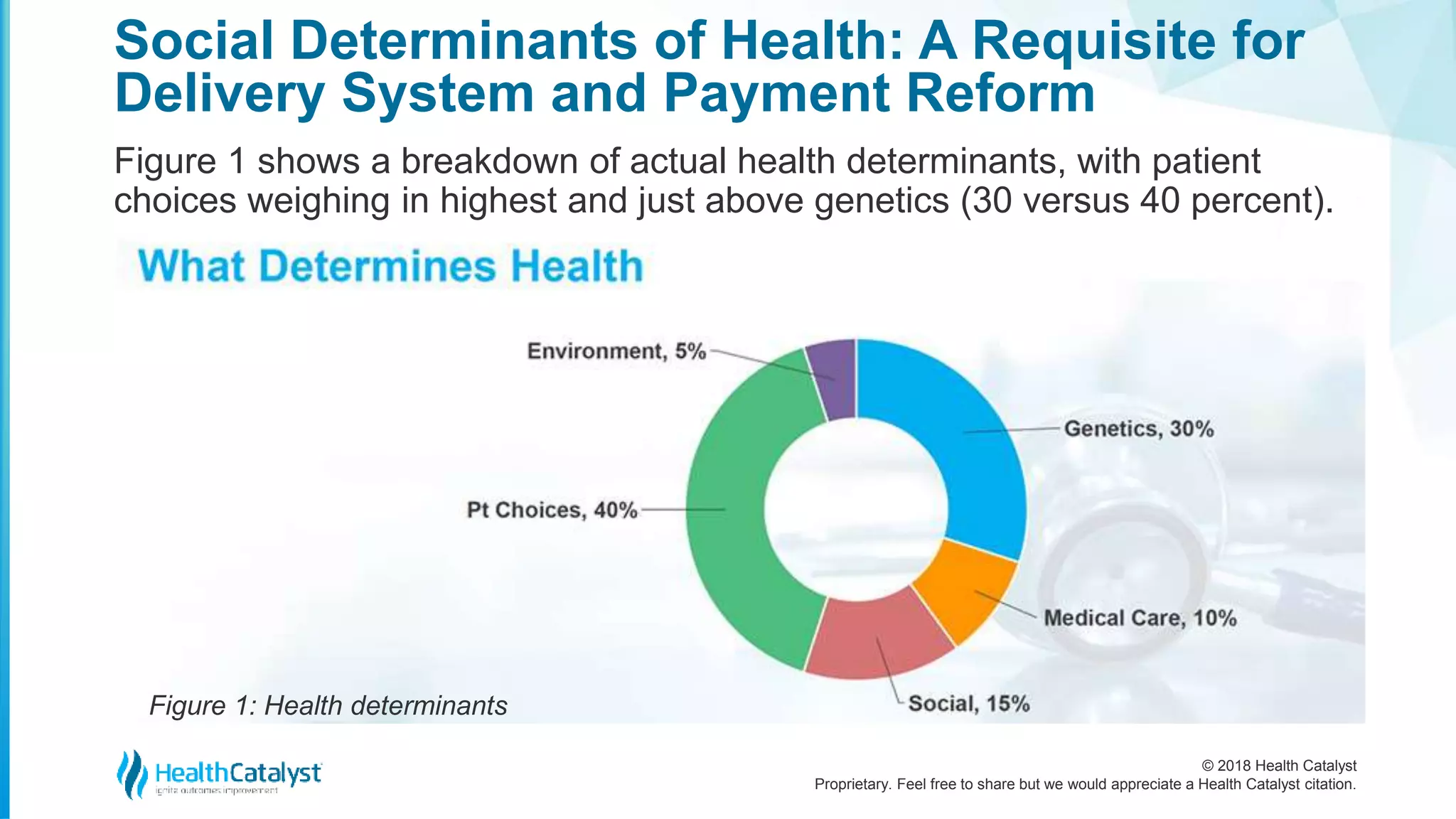
Figure 1 shows a breakdown of actual health determinants, with patient
choices weighing in highest and just above genetics (30 versus 40 percent).
Social Determinants of Health: A Requisite for
Delivery System and Payment Reform
Figure 1: Health determinants
© 2018 Health Catalyst
Proprietary. Feel free to share but we would appreciate a Health Catalyst citation.
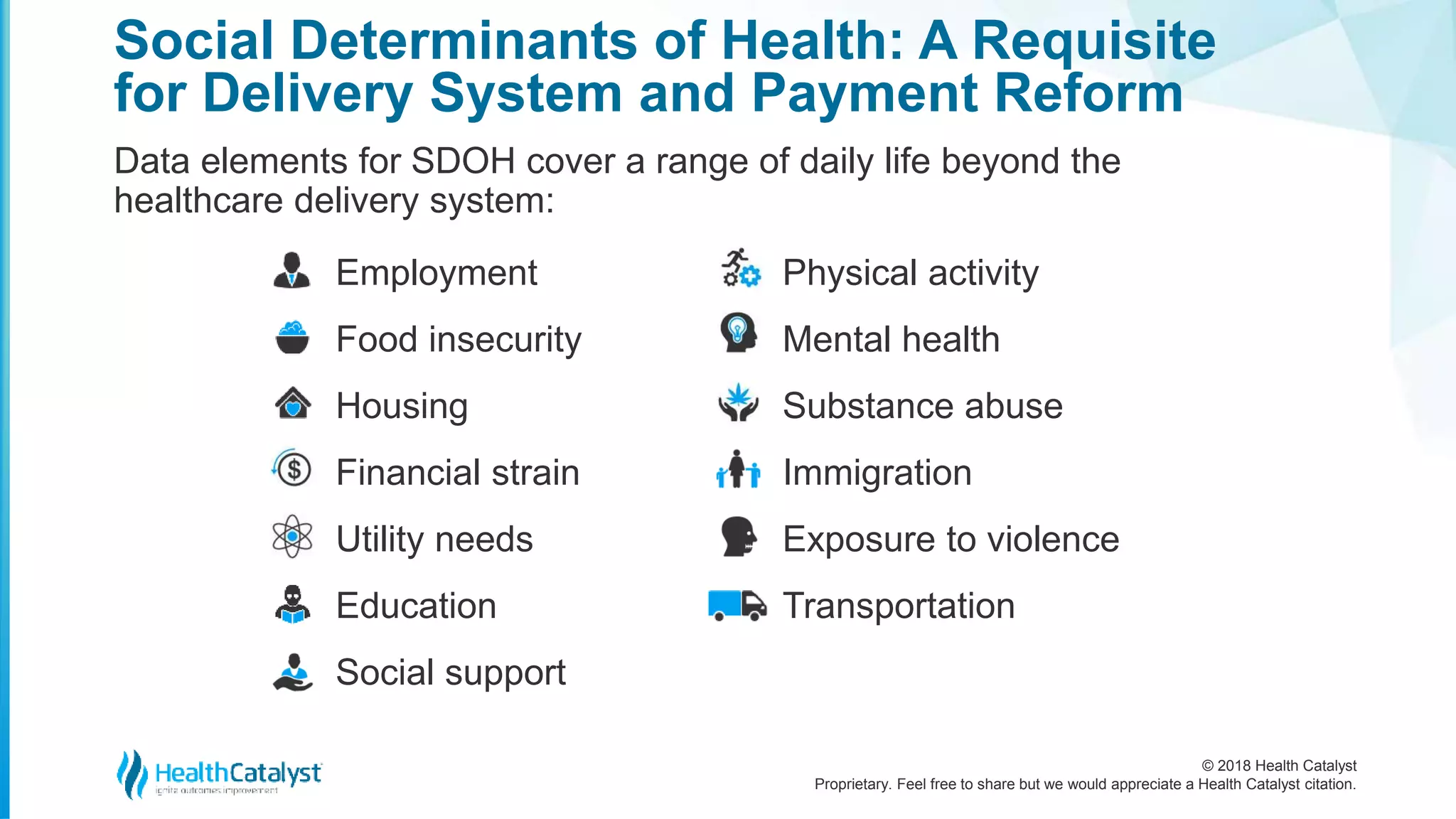
Data elements for SDOH cover a range of daily life beyond the
healthcare delivery system:
Social Determinants of Health: A Requisite
for Delivery System and Payment Reform
Employment
Food insecurity
Housing
Financial strain
Utility needs
Education
Social support
Physical activity
Mental health
Substance abuse
Immigration
Exposure to violence
Transportation
© 2018 Health Catalyst
Proprietary. Feel free to share but we would appreciate a Health Catalyst citation.
Figure 2 (next slide), a framework for health
equity, shows both the “upstream” SDOH,
or social-ecological, and the “downstream”
medical data models.
The goal of standardizing SDOH data is to
help health systems leverage both sides of
this diagram, ensuring incentivized and
sustainable services addressing SDOH as
well as integrated community partnerships.
Social Determinants of Health: A Requisite
for Delivery System and Payment Reform
© 2018 Health Catalyst
Proprietary. Feel free to share but we would appreciate a Health Catalyst citation.
Social Determinants of Health: A Requisite
for Delivery System and Payment Reform
Figure 2: A framework for health equity
© 2018 Health Catalyst
Proprietary. Feel free to share but we would appreciate a Health Catalyst citation.
Goals of Standardizing Data on Patient Social Risk
Health systems can achieve four central goals
by standardizing SDOH data within the EHR:
1. Improve health, lower cost, and advance health
equity (the overall goal).
2. Assess SDOH needs.
3. Link patients to community services.
4. Develop sustainable business models to
fund access to community services.
© 2018 Health Catalyst
Proprietary. Feel free to share but we would appreciate a Health Catalyst citation.
Goals of Standardizing Data on Patient Social Risk
To meet these goals, health systems need an
SDOH strategy that will leverage data for risk
stratification as well as connect patients with
appropriate community services.
Doing so requires data interoperability,
common sets of values, and the capability to
harness SDOH data for analytic purposes.
© 2018 Health Catalyst
Proprietary. Feel free to share but we would appreciate a Health Catalyst citation.
An Effective SDOH Protocol Prioritizes Patient
and Population Health
Healthcare organizations can benefit from following a
protocol for adopting SDOH into their workflows.
For example, the Protocol for Responding to
and Assessing Patients’ Assets, Risks and
Experiences (PRAPARE) is a standardized
patient risk assessment protocol that aims
to engage patients in assessing and
addressing SDOH.
© 2018 Health Catalyst
Proprietary. Feel free to share but we would appreciate a Health Catalyst citation.
An Effective SDOH Protocol Prioritizes Patient
and Population Health
As described by Hamilton during his HAS 18
presentation, PRAPARE is a national effort and
collaboration between multiple organizations to
help health systems and other providers collect
and apply the data they need to better
understand their patients’ social and economic
risks, with the goal to transform care to meet
patient and population needs.
© 2018 Health Catalyst
Proprietary. Feel free to share but we would appreciate a Health Catalyst citation.
An Effective SDOH Protocol Prioritizes Patient
and Population Health
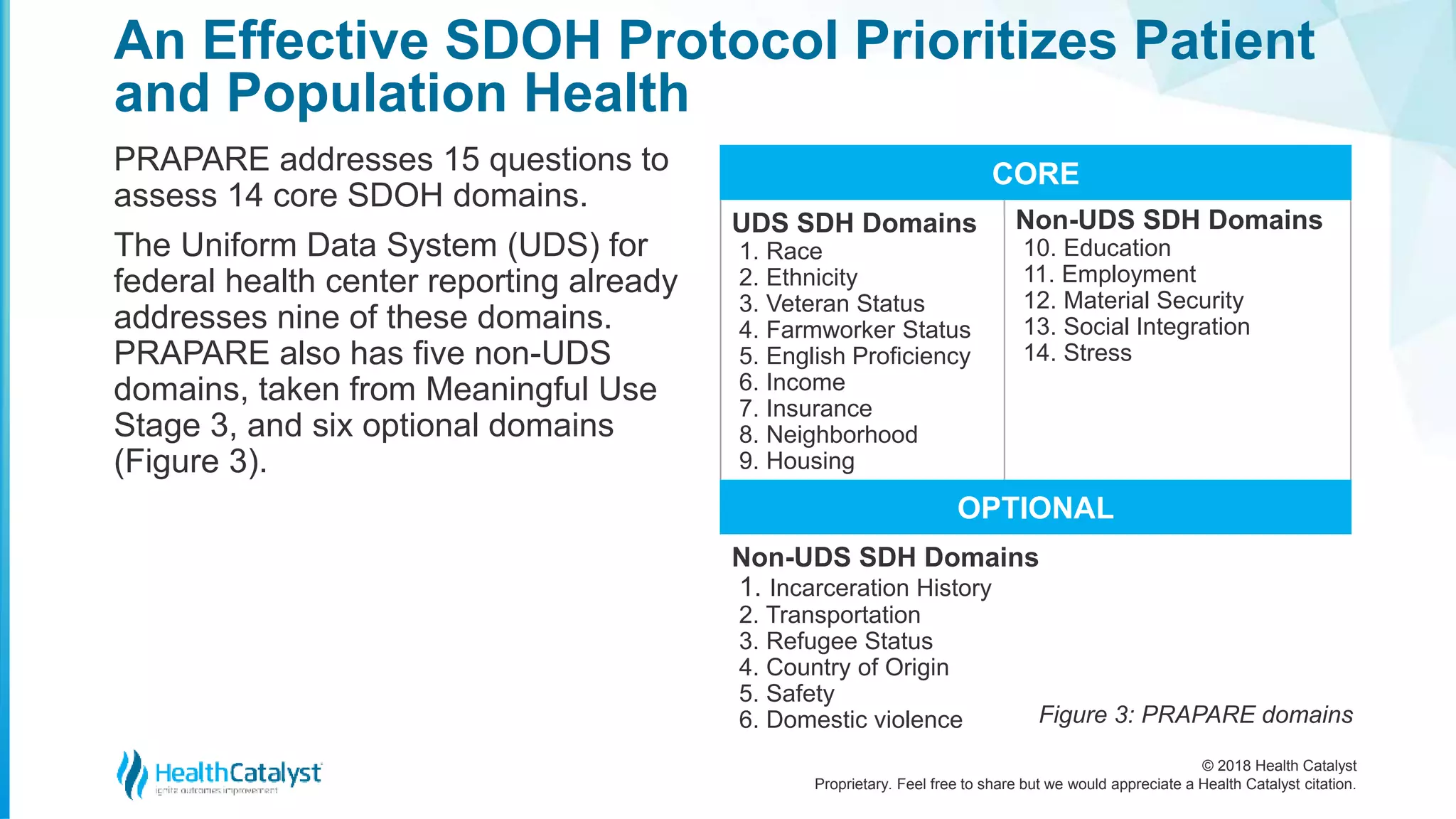
PRAPARE addresses 15 questions to
assess 14 core SDOH domains.
The Uniform Data System (UDS) for
federal health center reporting already
addresses nine of these domains.
PRAPARE also has five non-UDS
domains, taken from Meaningful Use
Stage 3, and six optional domains
(Figure 3).
CORE
UDS SDH Domains
1. Race
2. Ethnicity
3. Veteran Status
4. Farmworker Status
5. English Proficiency
6. Income
7. Insurance
8. Neighborhood
9. Housing
Non-UDS SDH Domains
10. Education
11. Employment
12. Material Security
13. Social Integration
14. Stress
OPTIONAL
Non-UDS SDH Domains
1. Incarceration History
2. Transportation
3. Refugee Status
4. Country of Origin
5. Safety
6. Domestic violence Figure 3: PRAPARE domains
© 2018 Health Catalyst
Proprietary. Feel free to share but we would appreciate a Health Catalyst citation.
An Effective SDOH Protocol Prioritizes Patient
and Population Health
An effective standardized patient risk
assessment protocols for SDOH must
collect data at an individual level and use
that data at a population health level to
inform care coordination efforts.
The data must be accessible to clinicians
at the point of care and at a national
level to inform local, state, and national
delivery redesign.
© 2018 Health Catalyst
Proprietary. Feel free to share but we would appreciate a Health Catalyst citation.
An Effective SDOH Protocol Prioritizes Patient
and Population Health
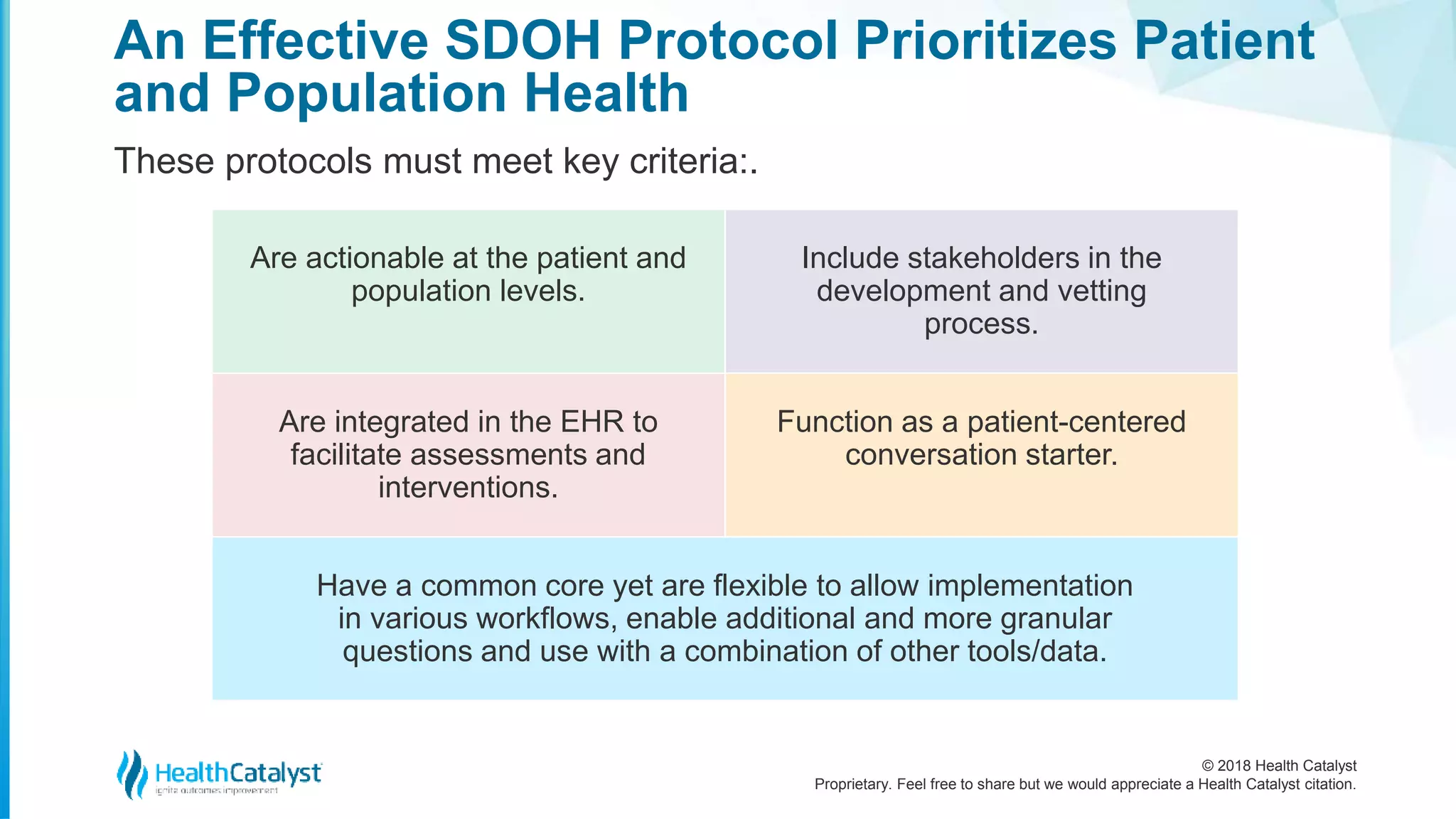
These protocols must meet key criteria:.
Are actionable at the patient and
population levels.
Include stakeholders in the
development and vetting
process.
Are integrated in the EHR to
facilitate assessments and
interventions.
Function as a patient-centered
conversation starter.
Have a common core yet are flexible to allow implementation
in various workflows, enable additional and more granular
questions and use with a combination of other tools/data.
© 2018 Health Catalyst
Proprietary. Feel free to share but we would appreciate a Health Catalyst citation.
An Effective SDOH Protocol Prioritizes Patient
and Population Health
Organizations looking for an effective standardized
patient risk assessment protocol for SDOH will
enjoy more effective outcomes if they choose a
protocol with an implementation and action toolkit.
© 2018 Health Catalyst
Proprietary. Feel free to share but we would appreciate a Health Catalyst citation.
An Effective SDOH Protocol Prioritizes Patient
and Population Health
The PRAPARE toolkit, for example, covers vital steps:
1. Understand the SDOH standardization project.
2. Engage key stakeholders.
3. Strategize the implementation process.
4. Carry out technical implementation with protocol-
provided EHR templates.
5. Develop workflow models.
6. Develop a data strategy.
7. Build capacity to respond to SDOH data.
8. Respond to SDOH data with interventions.
9. Track enabling services.
© 2018 Health Catalyst
Proprietary. Feel free to share but we would appreciate a Health Catalyst citation.
An Effective SDOH Protocol Prioritizes Patient
and Population Health
During two years of pilot studies (2015 and 2017), PRAPARE
has met important performance targets:
• Easy to administer.
• Allows for implementation with various workflows
and staffing models.
• Builds patient-clinician relationships.
• Identifies new needs.
• Leverages targeting messaging and staff support.
• Facilitates collaboration with community partners.
• Leads to positive change at the patient, health center,
and community/population levels.
© 2018 Health Catalyst
Proprietary. Feel free to share but we would appreciate a Health Catalyst citation.
Looking Ahead with SDOH Data
Standardization protocols for SDOH data are a necessary
place to start to integrate more patient social and
economic data into healthcare delivery.
As the industry moves toward greater health
equity, key questions remain about the role
of SDOH data moving forward.
© 2018 Health Catalyst
Proprietary. Feel free to share but we would appreciate a Health Catalyst citation.
Looking Ahead with SDOH Data
The next steps will need to identify the best ways
to capture SDOH data (particularly for patients
who have not engaged with the healthcare system)
and use the data to inform the patient’s care plan.
Additional understanding will include the
correlation between specific SDOH and health
outcomes and which business models will support
sustainable and effective programs around SDOH.
© 2018 Health Catalyst
Proprietary. Feel free to share but we would appreciate a Health Catalyst citation.
Looking Ahead with SDOH Data
Social and economic patient data will
continue to play a critical role in healthcare
as VBP further presses organizations to
raise quality and lower costs.
Health systems can best standardize SDOH
data in their workflows with a protocol that
includes relevant and comprehensive
domains, engages patients, enables
broader understanding of patient health,
integrates with organizational EHRs, and
is easy for clinicians to follow.
© 2018 Health Catalyst
Proprietary. Feel free to share but we would appreciate a Health Catalyst citation.
For more information:
“This book is a fantastic piece of work”
– Robert Lindeman MD, FAAP, Chief Physician Quality Officer
© 2018 Health Catalyst
Proprietary. Feel free to share but we would appreciate a Health Catalyst citation.
More about this topic
Link to original article for a more in-depth discussion.
Social Determinants of Health: Tools to Leverage Today’s Data Imperative
Population Health in Three Paragraphs
Dale Sanders, President of Technology
Integration of Community Health Workers Improves Care Management Effectiveness
Health Catalyst Success Stories
Health Equity: Why it Matters and How to Achieve it
Heather Schoonover, MN, ARNP-CNS, PHCNS-BC, Customer Success Director
Identifying Vulnerable Patients and Why They Matter
KimSu Marder, RN, CCM, Lead Care Manager
Cloud-Based Open-Platform Data Solutions: The Best Way to Meet Today’s Growing Health Data Demands
Jared Crapo, Sales, Sr. VP
Linda Simovic, Principal Program Manager, Azure for Health and Life Sciences
© 2018 Health Catalyst
Proprietary. Feel free to share but we would appreciate a Health Catalyst citation.
Other Clinical Quality Improvement Resources
Click to read additional information at www.healthcatalyst.com
Health Catalyst is a mission-driven data warehousing, analytics and outcomes-improvement company
that helps healthcare organizations of all sizes improve clinical, financial, and operational outcomes
needed to improve population health and accountable care. Our proven enterprise data warehouse
(EDW) and analytics platform helps improve quality, add efficiency and lower costs in support of more
than 65 million patients for organizations ranging from the largest US health system to forward-thinking
physician practices.
Health Catalyst was recently named as the leader in the enterprise healthcare BI market in
improvement by KLAS, and has received numerous best-place-to work awards including Modern
Healthcare in 2013, 2014, and 2015, as well as other recognitions such as “Best Place to work for
Millenials, and a “Best Perks for Women.”

Social Determinants of Health: Tools to Leverage Today's Data Imperative

  • 1.
    Social Determinants ofHealth: Tools to Leverage Today’s Data Imperative
  • 2.
    © 2018 HealthCatalyst Proprietary. Feel free to share but we would appreciate a Health Catalyst citation. Social Determinants of Health This report is based on a 2018 Healthcare Analytics Summit (HAS 18) presentation given by Andrew Hamilton, RN, BSN, MS, Chief Informatics Officer and Deputy Director of AllianceChicago, entitled, “Standardizing the Collection of Social and Economic Risk Data.” Andrew Hamilton, RN, BSN, MS Chief Informatics Officer, Deputy Director AllianceChicago
  • 3.
    © 2018 HealthCatalyst Proprietary. Feel free to share but we would appreciate a Health Catalyst citation. As value-based payment (VBP) puts more pressure on health systems to reach quality targets and lower the cost of care, healthcare leaders are increasingly interested in strategies to better understand health and wellness in their populations. Strategies that leverage social determinants of health (SDOH) data are gaining attention for their ability to paint a comprehensive picture of health and address social and economic risk by connecting patients in need with the appropriated community services. Healthcare Outcomes Improvement
  • 4.
    © 2018 HealthCatalyst Proprietary. Feel free to share but we would appreciate a Health Catalyst citation. The World Health Organization defines SDOH as, “the conditions in which people are born, live, work, and age.” It adds that money, power, and resources at the global, national, and local levels shape these conditions and that SDOH significantly impact health inequities. This presentation outlines the importance of SDOH in healthcare today and offers an example of a protocol for health systems to standardize SDOH in their workflows. Social Determinants of Health
  • 5.
    © 2018 HealthCatalyst Proprietary. Feel free to share but we would appreciate a Health Catalyst citation. By capturing data on daily patient life, socioeconomic and employment status, environment, etc., SDOH data gives richer insights into factors impacting health than traditional healthcare encounters do. This is an especially important consideration with complex and underserved populations. Social Determinants of Health: A Requisite for Delivery System and Payment Reform
  • 6.
    © 2018 HealthCatalyst Proprietary. Feel free to share but we would appreciate a Health Catalyst citation. Other data sources, such as genetics and healthcare delivery, can shed some light on quality and patient experience, but because patient choices are the biggest driver of health outcomes, true understanding demands a broader view. SDOH data captures patient choices and genuine experiences at a level traditional health data sources (which exist primarily within the four walls of healthcare) cannot. Social Determinants of Health: A Requisite for Delivery System and Payment Reform
  • 7.
    © 2018 HealthCatalyst Proprietary. Feel free to share but we would appreciate a Health Catalyst citation. Figure 1 shows a breakdown of actual health determinants, with patient choices weighing in highest and just above genetics (30 versus 40 percent). Social Determinants of Health: A Requisite for Delivery System and Payment Reform Figure 1: Health determinants
  • 8.
    © 2018 HealthCatalyst Proprietary. Feel free to share but we would appreciate a Health Catalyst citation. Data elements for SDOH cover a range of daily life beyond the healthcare delivery system: Social Determinants of Health: A Requisite for Delivery System and Payment Reform Employment Food insecurity Housing Financial strain Utility needs Education Social support Physical activity Mental health Substance abuse Immigration Exposure to violence Transportation
  • 9.
    © 2018 HealthCatalyst Proprietary. Feel free to share but we would appreciate a Health Catalyst citation. Figure 2 (next slide), a framework for health equity, shows both the “upstream” SDOH, or social-ecological, and the “downstream” medical data models. The goal of standardizing SDOH data is to help health systems leverage both sides of this diagram, ensuring incentivized and sustainable services addressing SDOH as well as integrated community partnerships. Social Determinants of Health: A Requisite for Delivery System and Payment Reform
  • 10.
    © 2018 HealthCatalyst Proprietary. Feel free to share but we would appreciate a Health Catalyst citation. Social Determinants of Health: A Requisite for Delivery System and Payment Reform Figure 2: A framework for health equity
  • 11.
    © 2018 HealthCatalyst Proprietary. Feel free to share but we would appreciate a Health Catalyst citation. Goals of Standardizing Data on Patient Social Risk Health systems can achieve four central goals by standardizing SDOH data within the EHR: 1. Improve health, lower cost, and advance health equity (the overall goal). 2. Assess SDOH needs. 3. Link patients to community services. 4. Develop sustainable business models to fund access to community services.
  • 12.
    © 2018 HealthCatalyst Proprietary. Feel free to share but we would appreciate a Health Catalyst citation. Goals of Standardizing Data on Patient Social Risk To meet these goals, health systems need an SDOH strategy that will leverage data for risk stratification as well as connect patients with appropriate community services. Doing so requires data interoperability, common sets of values, and the capability to harness SDOH data for analytic purposes.
  • 13.
    © 2018 HealthCatalyst Proprietary. Feel free to share but we would appreciate a Health Catalyst citation. An Effective SDOH Protocol Prioritizes Patient and Population Health Healthcare organizations can benefit from following a protocol for adopting SDOH into their workflows. For example, the Protocol for Responding to and Assessing Patients’ Assets, Risks and Experiences (PRAPARE) is a standardized patient risk assessment protocol that aims to engage patients in assessing and addressing SDOH.
  • 14.
    © 2018 HealthCatalyst Proprietary. Feel free to share but we would appreciate a Health Catalyst citation. An Effective SDOH Protocol Prioritizes Patient and Population Health As described by Hamilton during his HAS 18 presentation, PRAPARE is a national effort and collaboration between multiple organizations to help health systems and other providers collect and apply the data they need to better understand their patients’ social and economic risks, with the goal to transform care to meet patient and population needs.
  • 15.
    © 2018 HealthCatalyst Proprietary. Feel free to share but we would appreciate a Health Catalyst citation. An Effective SDOH Protocol Prioritizes Patient and Population Health PRAPARE addresses 15 questions to assess 14 core SDOH domains. The Uniform Data System (UDS) for federal health center reporting already addresses nine of these domains. PRAPARE also has five non-UDS domains, taken from Meaningful Use Stage 3, and six optional domains (Figure 3). CORE UDS SDH Domains 1. Race 2. Ethnicity 3. Veteran Status 4. Farmworker Status 5. English Proficiency 6. Income 7. Insurance 8. Neighborhood 9. Housing Non-UDS SDH Domains 10. Education 11. Employment 12. Material Security 13. Social Integration 14. Stress OPTIONAL Non-UDS SDH Domains 1. Incarceration History 2. Transportation 3. Refugee Status 4. Country of Origin 5. Safety 6. Domestic violence Figure 3: PRAPARE domains
  • 16.
    © 2018 HealthCatalyst Proprietary. Feel free to share but we would appreciate a Health Catalyst citation. An Effective SDOH Protocol Prioritizes Patient and Population Health An effective standardized patient risk assessment protocols for SDOH must collect data at an individual level and use that data at a population health level to inform care coordination efforts. The data must be accessible to clinicians at the point of care and at a national level to inform local, state, and national delivery redesign.
  • 17.
    © 2018 HealthCatalyst Proprietary. Feel free to share but we would appreciate a Health Catalyst citation. An Effective SDOH Protocol Prioritizes Patient and Population Health These protocols must meet key criteria:. Are actionable at the patient and population levels. Include stakeholders in the development and vetting process. Are integrated in the EHR to facilitate assessments and interventions. Function as a patient-centered conversation starter. Have a common core yet are flexible to allow implementation in various workflows, enable additional and more granular questions and use with a combination of other tools/data.
  • 18.
    © 2018 HealthCatalyst Proprietary. Feel free to share but we would appreciate a Health Catalyst citation. An Effective SDOH Protocol Prioritizes Patient and Population Health Organizations looking for an effective standardized patient risk assessment protocol for SDOH will enjoy more effective outcomes if they choose a protocol with an implementation and action toolkit.
  • 19.
    © 2018 HealthCatalyst Proprietary. Feel free to share but we would appreciate a Health Catalyst citation. An Effective SDOH Protocol Prioritizes Patient and Population Health The PRAPARE toolkit, for example, covers vital steps: 1. Understand the SDOH standardization project. 2. Engage key stakeholders. 3. Strategize the implementation process. 4. Carry out technical implementation with protocol- provided EHR templates. 5. Develop workflow models. 6. Develop a data strategy. 7. Build capacity to respond to SDOH data. 8. Respond to SDOH data with interventions. 9. Track enabling services.
  • 20.
    © 2018 HealthCatalyst Proprietary. Feel free to share but we would appreciate a Health Catalyst citation. An Effective SDOH Protocol Prioritizes Patient and Population Health During two years of pilot studies (2015 and 2017), PRAPARE has met important performance targets: • Easy to administer. • Allows for implementation with various workflows and staffing models. • Builds patient-clinician relationships. • Identifies new needs. • Leverages targeting messaging and staff support. • Facilitates collaboration with community partners. • Leads to positive change at the patient, health center, and community/population levels.
  • 21.
    © 2018 HealthCatalyst Proprietary. Feel free to share but we would appreciate a Health Catalyst citation. Looking Ahead with SDOH Data Standardization protocols for SDOH data are a necessary place to start to integrate more patient social and economic data into healthcare delivery. As the industry moves toward greater health equity, key questions remain about the role of SDOH data moving forward.
  • 22.
    © 2018 HealthCatalyst Proprietary. Feel free to share but we would appreciate a Health Catalyst citation. Looking Ahead with SDOH Data The next steps will need to identify the best ways to capture SDOH data (particularly for patients who have not engaged with the healthcare system) and use the data to inform the patient’s care plan. Additional understanding will include the correlation between specific SDOH and health outcomes and which business models will support sustainable and effective programs around SDOH.
  • 23.
    © 2018 HealthCatalyst Proprietary. Feel free to share but we would appreciate a Health Catalyst citation. Looking Ahead with SDOH Data Social and economic patient data will continue to play a critical role in healthcare as VBP further presses organizations to raise quality and lower costs. Health systems can best standardize SDOH data in their workflows with a protocol that includes relevant and comprehensive domains, engages patients, enables broader understanding of patient health, integrates with organizational EHRs, and is easy for clinicians to follow.
  • 24.
    © 2018 HealthCatalyst Proprietary. Feel free to share but we would appreciate a Health Catalyst citation. For more information: “This book is a fantastic piece of work” – Robert Lindeman MD, FAAP, Chief Physician Quality Officer
  • 25.
    © 2018 HealthCatalyst Proprietary. Feel free to share but we would appreciate a Health Catalyst citation. More about this topic Link to original article for a more in-depth discussion. Social Determinants of Health: Tools to Leverage Today’s Data Imperative Population Health in Three Paragraphs Dale Sanders, President of Technology Integration of Community Health Workers Improves Care Management Effectiveness Health Catalyst Success Stories Health Equity: Why it Matters and How to Achieve it Heather Schoonover, MN, ARNP-CNS, PHCNS-BC, Customer Success Director Identifying Vulnerable Patients and Why They Matter KimSu Marder, RN, CCM, Lead Care Manager Cloud-Based Open-Platform Data Solutions: The Best Way to Meet Today’s Growing Health Data Demands Jared Crapo, Sales, Sr. VP Linda Simovic, Principal Program Manager, Azure for Health and Life Sciences
  • 26.
    © 2018 HealthCatalyst Proprietary. Feel free to share but we would appreciate a Health Catalyst citation. Other Clinical Quality Improvement Resources Click to read additional information at www.healthcatalyst.com Health Catalyst is a mission-driven data warehousing, analytics and outcomes-improvement company that helps healthcare organizations of all sizes improve clinical, financial, and operational outcomes needed to improve population health and accountable care. Our proven enterprise data warehouse (EDW) and analytics platform helps improve quality, add efficiency and lower costs in support of more than 65 million patients for organizations ranging from the largest US health system to forward-thinking physician practices. Health Catalyst was recently named as the leader in the enterprise healthcare BI market in improvement by KLAS, and has received numerous best-place-to work awards including Modern Healthcare in 2013, 2014, and 2015, as well as other recognitions such as “Best Place to work for Millenials, and a “Best Perks for Women.”