Susang Kim(healess1@gmail.com)
Face Recognition
GroupFace: Learning Latent Groups and Constructing
Group-based Representations for Face Recognition
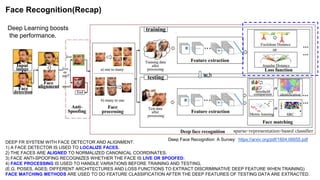
Face Recognition(Recap)
Deep Learning boosts
the performance.
sparse-representation-based classifier
DEEP FR SYSTEM WITH FACE DETECTOR AND ALIGNMENT.
1) A FACE DETECTOR IS USED TO LOCALIZE FACES.
2) THE FACES ARE ALIGNED TO NORMALIZED CANONICAL COORDINATES.
3) FACE ANTI-SPOOFING RECOGNIZES WHETHER THE FACE IS LIVE OR SPOOFED;
4) FACE PROCESSING IS USED TO HANDLE VARIATIONS BEFORE TRAINING AND TESTING,
(E.G. POSES, AGES; DIFFERENT ARCHITECTURES AND LOSS FUNCTIONS TO EXTRACT DISCRIMINATIVE DEEP FEATURE WHEN TRAINING)
FACE MATCHING METHODS ARE USED TO DO FEATURE CLASSIFICATION AFTER THE DEEP FEATURES OF TESTING DATA ARE EXTRACTED.
Deep Face Recognition: A Survey: https://arxiv.org/pdf/1804.06655.pdf
Deep Face Recognition: A Survey : https://arxiv.org/pdf/1804.06655.pdf
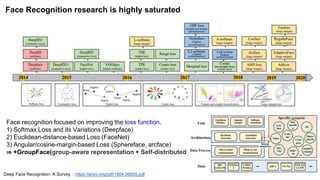
Face recognition focused on improving the loss function.
1) Softmax Loss and its Variations (Deepface)
2) Euclidean-distance-based Loss (FaceNet)
3) Angular/cosine-margin-based Loss (Sphereface, arcface)
⇒ +GroupFace(group-aware representation + Self-distributed
Face Recognition research is highly saturated
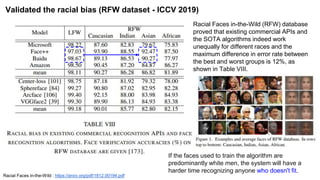
Racial Faces in-the-Wild (RFW) database
proved that existing commercial APIs and
the SOTA algorithms indeed work
unequally for different races and the
maximum difference in error rate between
the best and worst groups is 12%, as
shown in Table VIII.
Racial Faces in-the-Wild : https://arxiv.org/pdf/1812.00194.pdf
Validated the racial bias (RFW dataset - ICCV 2019)
If the faces used to train the algorithm are
predominantly white men, the system will have a
harder time recognizing anyone who doesn't fit.
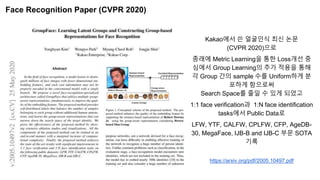
Kakao에서 쓴 얼굴인식 최신 논문
(CVPR 2020)으로
종래에 Metric Learning을 통한 Loss개선 중
심에서 Group Learning의 추가 적용을 통해
각 Group 간의 sample 수를 Uniform하게 분
포하게 함으로써
Search Space를 줄일 수 있게 되었고
1:1 face verification과 1:N face identification
tasks에서 Public Data로
LFW, YTF, CALFW, CPLFW, CFP, AgeDB-
30, MegaFace, IJB-B and IJB-C 부문 SOTA
기록
https://arxiv.org/pdf/2005.10497.pdf
Face Recognition Paper (CVPR 2020)
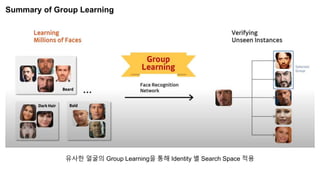
유사한 얼굴의 Group Learning을 통해 Identity 별 Search Space 적용
Summary of Group Learning
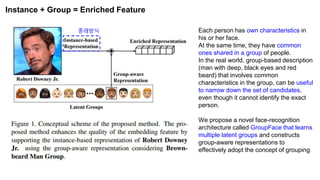
Each person has own characteristics in
his or her face.
At the same time, they have common
ones shared in a group of people.
In the real world, group-based description
(man with deep, black eyes and red
beard) that involves common
characteristics in the group, can be useful
to narrow down the set of candidates,
even though it cannot identify the exact
person.
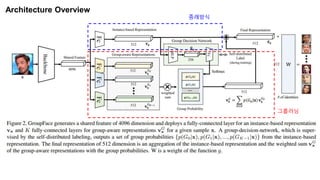
We propose a novel face-recognition
architecture called GroupFace that learns
multiple latent groups and constructs
group-aware representations to
effectively adopt the concept of grouping
Instance + Group = Enriched Feature
종래방식
Architecture Overview
종래방식
그룹러닝
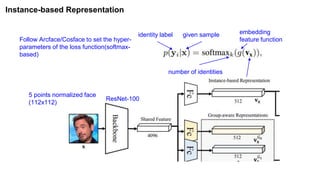
ResNet-100
5 points normalized face
(112x112)
Follow Arcface/Cosface to set the hyper-
parameters of the loss function(softmax-
based)
identity label given sample embedding
feature function
number of identities
Instance-based Representation
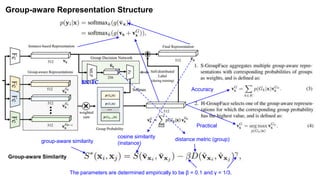
Accuracy
Practical
BN+FC
Group-aware Representation Structure
group-aware similarity
cosine similarity
(instance)
distance metric (group)
The parameters are determined empirically to be β = 0.1 and γ = 1/3.
Group-aware Similarity
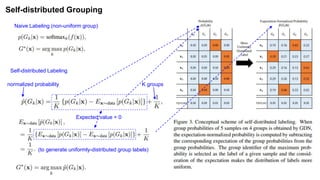
Naive Labeling (non-uniform group)
Self-distributed Labeling
Self-distributed Grouping
normalized probability K groups
Expected value = 0
(to generate uniformly-distributed group labels)
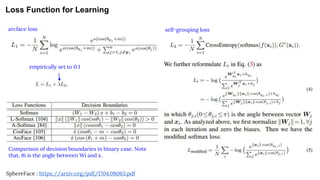
arcface loss self-grouping loss
empirically set to 0.1
SphereFace : https://arxiv.org/pdf/1704.08063.pdf
Comparison of decision boundaries in binary case. Note
that, θi is the angle between Wi and x.
Loss Function for Learning
Train Data : MSCeleb-1M (10M images for 100K identities / refined version (3.8M images for
85k identities)
Test Data : nine commonly used datasets (LFW, YTF, CALFW, CPLFW, CFP, AgeDB-30,
MegaFace, IJB-B and IJB-C)
Metrics : TAR@FAR = 1e-6 / TAR@FAR=1e-5 (Compare a True Accept Rate at a certain
False Accept Rate)
Baseline Model : ArcFace(ResNet-100) GDN(two blocks of MLP[BN-FC] and a FC for group
classification)
Learning : 8 synchronized GPUs and a mini-batch involving 128 images per GPU
learning rate : 0.005 for the first 50k, 0.0005 for the 20k, and 0.00005 for 10k with a weight
decay of 0.0005 and a momentum of 0.9 with stochastic gradient descent (SGD)
Pre-trained network : only the softmax-based loss(Arcface).(To stable the group-probability)
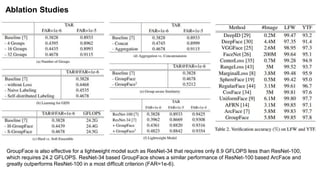
Experiments
GroupFace is also effective for a lightweight model such as ResNet-34 that requires only 8.9 GFLOPS less than ResNet-100,
which requires 24.2 GFLOPS. ResNet-34 based GroupFace shows a similar performance of ResNet-100 based ArcFace and
greatly outperforms ResNet-100 in a most difficult criterion (FAR=1e-6).
Ablation Studies
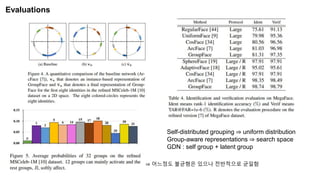
Self-distributed grouping ⇒ uniform distribution
Group-aware representations ⇒ search space
GDN : self group + latent group
⇒ 어느정도 불균형은 있으나 전반적으로 균일함
Evaluations
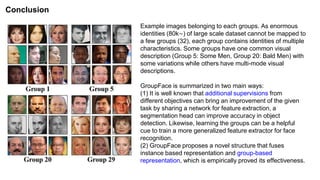
Example images belonging to each groups. As enormous
identities (80k∼) of large scale dataset cannot be mapped to
a few groups (32), each group contains identities of multiple
characteristics. Some groups have one common visual
description (Group 5: Some Men, Group 20: Bald Men) with
some variations while others have multi-mode visual
descriptions.
GroupFace is summarized in two main ways:
(1) It is well known that additional supervisions from
different objectives can bring an improvement of the given
task by sharing a network for feature extraction, a
segmentation head can improve accuracy in object
detection. Likewise, learning the groups can be a helpful
cue to train a more generalized feature extractor for face
recognition.
(2) GroupFace proposes a novel structure that fuses
instance based representation and group-based
representation, which is empirically proved its effectiveness.
Conclusion
Thanks
Any Questions?
You can send mail to
Susang Kim(healess1@gmail.com)

GroupFace (Face Recognition)

  • 1.
    Susang Kim(healess1@gmail.com) Face Recognition GroupFace:Learning Latent Groups and Constructing Group-based Representations for Face Recognition
  • 2.
    Face Recognition(Recap) Deep Learningboosts the performance. sparse-representation-based classifier DEEP FR SYSTEM WITH FACE DETECTOR AND ALIGNMENT. 1) A FACE DETECTOR IS USED TO LOCALIZE FACES. 2) THE FACES ARE ALIGNED TO NORMALIZED CANONICAL COORDINATES. 3) FACE ANTI-SPOOFING RECOGNIZES WHETHER THE FACE IS LIVE OR SPOOFED; 4) FACE PROCESSING IS USED TO HANDLE VARIATIONS BEFORE TRAINING AND TESTING, (E.G. POSES, AGES; DIFFERENT ARCHITECTURES AND LOSS FUNCTIONS TO EXTRACT DISCRIMINATIVE DEEP FEATURE WHEN TRAINING) FACE MATCHING METHODS ARE USED TO DO FEATURE CLASSIFICATION AFTER THE DEEP FEATURES OF TESTING DATA ARE EXTRACTED. Deep Face Recognition: A Survey: https://arxiv.org/pdf/1804.06655.pdf
  • 3.
    Deep Face Recognition:A Survey : https://arxiv.org/pdf/1804.06655.pdf Face recognition focused on improving the loss function. 1) Softmax Loss and its Variations (Deepface) 2) Euclidean-distance-based Loss (FaceNet) 3) Angular/cosine-margin-based Loss (Sphereface, arcface) ⇒ +GroupFace(group-aware representation + Self-distributed Face Recognition research is highly saturated
  • 4.
    Racial Faces in-the-Wild(RFW) database proved that existing commercial APIs and the SOTA algorithms indeed work unequally for different races and the maximum difference in error rate between the best and worst groups is 12%, as shown in Table VIII. Racial Faces in-the-Wild : https://arxiv.org/pdf/1812.00194.pdf Validated the racial bias (RFW dataset - ICCV 2019) If the faces used to train the algorithm are predominantly white men, the system will have a harder time recognizing anyone who doesn't fit.
  • 5.
    Kakao에서 쓴 얼굴인식최신 논문 (CVPR 2020)으로 종래에 Metric Learning을 통한 Loss개선 중 심에서 Group Learning의 추가 적용을 통해 각 Group 간의 sample 수를 Uniform하게 분 포하게 함으로써 Search Space를 줄일 수 있게 되었고 1:1 face verification과 1:N face identification tasks에서 Public Data로 LFW, YTF, CALFW, CPLFW, CFP, AgeDB- 30, MegaFace, IJB-B and IJB-C 부문 SOTA 기록 https://arxiv.org/pdf/2005.10497.pdf Face Recognition Paper (CVPR 2020)
  • 6.
    유사한 얼굴의 GroupLearning을 통해 Identity 별 Search Space 적용 Summary of Group Learning
  • 7.
    Each person hasown characteristics in his or her face. At the same time, they have common ones shared in a group of people. In the real world, group-based description (man with deep, black eyes and red beard) that involves common characteristics in the group, can be useful to narrow down the set of candidates, even though it cannot identify the exact person. We propose a novel face-recognition architecture called GroupFace that learns multiple latent groups and constructs group-aware representations to effectively adopt the concept of grouping Instance + Group = Enriched Feature 종래방식
  • 8.
  • 9.
    ResNet-100 5 points normalizedface (112x112) Follow Arcface/Cosface to set the hyper- parameters of the loss function(softmax- based) identity label given sample embedding feature function number of identities Instance-based Representation
  • 10.
    Accuracy Practical BN+FC Group-aware Representation Structure group-awaresimilarity cosine similarity (instance) distance metric (group) The parameters are determined empirically to be β = 0.1 and γ = 1/3. Group-aware Similarity
  • 11.
    Naive Labeling (non-uniformgroup) Self-distributed Labeling Self-distributed Grouping normalized probability K groups Expected value = 0 (to generate uniformly-distributed group labels)
  • 12.
    arcface loss self-groupingloss empirically set to 0.1 SphereFace : https://arxiv.org/pdf/1704.08063.pdf Comparison of decision boundaries in binary case. Note that, θi is the angle between Wi and x. Loss Function for Learning
  • 13.
    Train Data :MSCeleb-1M (10M images for 100K identities / refined version (3.8M images for 85k identities) Test Data : nine commonly used datasets (LFW, YTF, CALFW, CPLFW, CFP, AgeDB-30, MegaFace, IJB-B and IJB-C) Metrics : TAR@FAR = 1e-6 / TAR@FAR=1e-5 (Compare a True Accept Rate at a certain False Accept Rate) Baseline Model : ArcFace(ResNet-100) GDN(two blocks of MLP[BN-FC] and a FC for group classification) Learning : 8 synchronized GPUs and a mini-batch involving 128 images per GPU learning rate : 0.005 for the first 50k, 0.0005 for the 20k, and 0.00005 for 10k with a weight decay of 0.0005 and a momentum of 0.9 with stochastic gradient descent (SGD) Pre-trained network : only the softmax-based loss(Arcface).(To stable the group-probability) Experiments
  • 14.
    GroupFace is alsoeffective for a lightweight model such as ResNet-34 that requires only 8.9 GFLOPS less than ResNet-100, which requires 24.2 GFLOPS. ResNet-34 based GroupFace shows a similar performance of ResNet-100 based ArcFace and greatly outperforms ResNet-100 in a most difficult criterion (FAR=1e-6). Ablation Studies
  • 15.
    Self-distributed grouping ⇒uniform distribution Group-aware representations ⇒ search space GDN : self group + latent group ⇒ 어느정도 불균형은 있으나 전반적으로 균일함 Evaluations
  • 16.
    Example images belongingto each groups. As enormous identities (80k∼) of large scale dataset cannot be mapped to a few groups (32), each group contains identities of multiple characteristics. Some groups have one common visual description (Group 5: Some Men, Group 20: Bald Men) with some variations while others have multi-mode visual descriptions. GroupFace is summarized in two main ways: (1) It is well known that additional supervisions from different objectives can bring an improvement of the given task by sharing a network for feature extraction, a segmentation head can improve accuracy in object detection. Likewise, learning the groups can be a helpful cue to train a more generalized feature extractor for face recognition. (2) GroupFace proposes a novel structure that fuses instance based representation and group-based representation, which is empirically proved its effectiveness. Conclusion
  • 17.
    Thanks Any Questions? You cansend mail to Susang Kim(healess1@gmail.com)