Lifts
Building Material and
Construction Technology
Efforts by:
Harshita Singh
B.Arch 7A
Amity School of Architecture &
Planning
Lifts
• A vertical transport equipment that efficiently moves people between floors (levels,
deck) of a building, vessel or other structure.
• Generally powered by electric motor that drive by traction cable and counterweight
systems like a hoist or hydraulic pump.
• Rapid development : buildings design nowadays built vertically /higher because
of high land cost.
• Basic needs : to bring building user from one level to higher level in building
• Comfort needs : working efficiency for office building or large organization.
• UBBL : building with more than 6 storey must provide lifts system.
• Fire requirements : provide fire lift to be used during fire.
Importance of Lifts
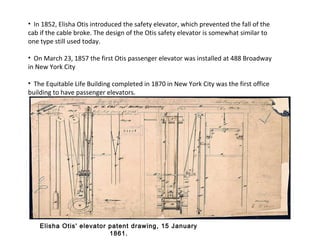
• In 1852, Elisha Otis introduced the safety elevator, which prevented the fall of the
cab if the cable broke. The design of the Otis safety elevator is somewhat similar to
one type still used today.
• On March 23, 1857 the first Otis passenger elevator was installed at 488 Broadway
in New York City
• The Equitable Life Building completed in 1870 in New York City was the first office
building to have passenger elevators.
Elisha Otis' elevator patent drawing, 15 January
1861.
Types
Elevators
– traction
• gearless  medium-high speed passenger
• geared  low speed passenger
– hydraulic
• plunger
• hole-less
• roped
Performance Criteria
Ideal Performance:
– minimum waiting time
– comfortable acceleration
– rapid transportation
– smooth/rapid slowing
– accurate leveling
– rapid loading/unloading
– quick/quiet door operation
– good visual travel direction/floor indicators
– easily operated controls
– comfortable lighting
– reliable emergency equipment
– smooth/safe operation of mechanical equipment
Lift Categories According to the
Function
• Trade Lift
- Crucial to the good performance to clients of the
building.
- Between 6 – 23 people.
- Speed of elevator 200 – 2000 ft/ min.
- Examples : offices, shopping mall and hotels
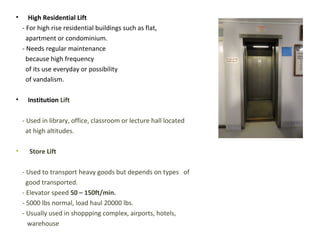
• Hospital Lift
- Used in hospital & treatment center
- Designed for transporting large carts or furniture.
- Speed of elevator 100 – 350 ft/ min.
- Two sides of front and back doors for loading and
unloading facilities.
- Door width between 900 – 1100mm
• High Residential Lift
- For high rise residential buildings such as flat,
apartment or condominium.
- Needs regular maintenance
because high frequency
of its use everyday or possibility
of vandalism.
• Institution Lift
- Used in library, office, classroom or lecture hall located
at high altitudes.
• Store Lift
- Used to transport heavy goods but depends on types of
good transported.
- Elevator speed 50 – 150ft/min.
- 5000 lbs normal, load haul 20000 lbs.
- Usually used in shoppping complex, airports, hotels,
warehouse
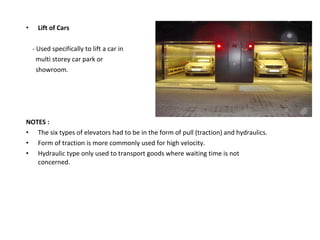
• Lift of Cars
- Used specifically to lift a car in
multi storey car park or
showroom.
NOTES :
• The six types of elevators had to be in the form of pull (traction) and hydraulics.
• Form of traction is more commonly used for high velocity.
• Hydraulic type only used to transport goods where waiting time is not
concerned.
Characteristic of Lifts
1. Lift needed for the building more than 6 storey.
2. Installation must be in accordance with the regulation in UBBL.
3. Suitable speed 100 – 150ft/min. Too fast will result in a nervous breakdown
to the user. If too slow will cause lack of function.
USER REQUIREMENTS :
• Good System – quiet equipment, smooth journey, good condition and safe at
every moment.
• Waiting time – minimum waiting time at any level.
• Aesthetics – Button panel clear and easily reached at appropriate level.
Complete instruction. Decorative lighting and comfortable.
• Movement of door – door movement is quiet and fast.
Components & Installation of
Lifts
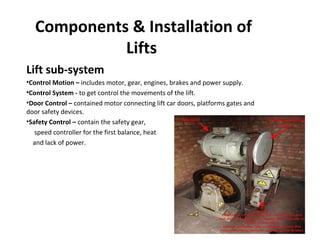
Lift sub-system
•Control Motion – includes motor, gear, engines, brakes and power supply.
•Control System - to get control the movements of the lift.
•Door Control – contained motor connecting lift car doors, platforms gates and
door safety devices.
•Safety Control – contain the safety gear,
speed controller for the first balance, heat
and lack of power.
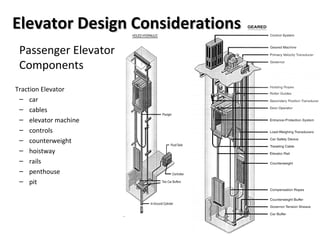
Passenger Elevator
Components
Traction Elevator
– car
– cables
– elevator machine
– controls
– counterweight
– hoistway
– rails
– penthouse
– pit
Elevator Design ConsiderationsElevator Design Considerations
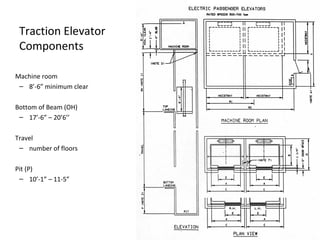
Traction Elevator
Components
Machine room
– 8’-6” minimum clear
Bottom of Beam (OH)
– 17’-6” – 20’6’’
Travel
– number of floors
Pit (P)
– 10’-1” – 11-5”
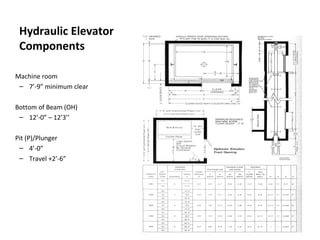
Hydraulic Elevator
Components
Machine room
– 7’-9” minimum clear
Bottom of Beam (OH)
– 12’-0” – 12’3’’
Pit (P)/Plunger
– 4’-0”
– Travel +2’-6”
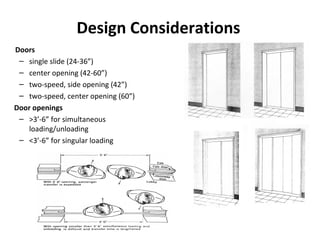
Design Considerations
Doors
– single slide (24-36”)
– center opening (42-60”)
– two-speed, side opening (42”)
– two-speed, center opening (60”)
Door openings
– >3’-6” for simultaneous
loading/unloading
– <3’-6” for singular loading
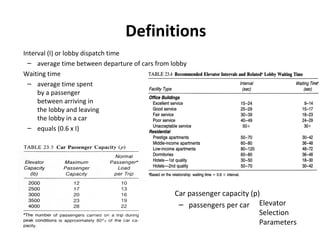
Definitions
Interval (I) or lobby dispatch time
– average time between departure of cars from lobby
Waiting time
– average time spent
by a passenger
between arriving in
the lobby and leaving
the lobby in a car
– equals (0.6 x I)
Elevator
Selection
Parameters
Car passenger capacity (p)
– passengers per car
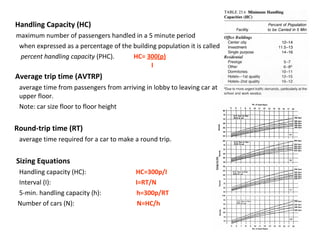
Handling Capacity (HC)
maximum number of passengers handled in a 5 minute period
when expressed as a percentage of the building population it is called
percent handling capacity (PHC). HC= 300(p)
I
Average trip time (AVTRP)
average time from passengers from arriving in lobby to leaving car at
upper floor.
Note: car size floor to floor height
Round-trip time (RT)
average time required for a car to make a round trip.
Sizing Equations
Handling capacity (HC): HC=300p/I
Interval (I): I=RT/N
5-min. handling capacity (h): h=300p/RT
Number of cars (N): N=HC/h
Parameters
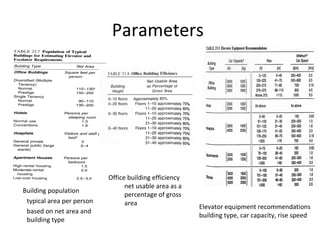
Building population
typical area per person
based on net area and
building type
Office building efficiency
net usable area as a
percentage of gross
area
Elevator equipment recommendations
building type, car capacity, rise speed
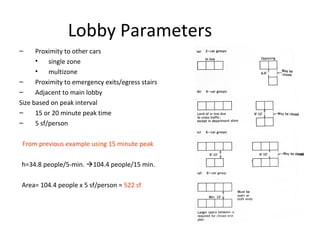
Lobby Parameters
– Proximity to other cars
• single zone
• multizone
– Proximity to emergency exits/egress stairs
– Adjacent to main lobby
Size based on peak interval
– 15 or 20 minute peak time
– 5 sf/person
From previous example using 15 minute peak
h=34.8 people/5-min. 104.4 people/15 min.
Area= 104.4 people x 5 sf/person = 522 sf

Lifts

  • 1.
    Lifts Building Material and ConstructionTechnology Efforts by: Harshita Singh B.Arch 7A Amity School of Architecture & Planning
  • 2.
    Lifts • A verticaltransport equipment that efficiently moves people between floors (levels, deck) of a building, vessel or other structure. • Generally powered by electric motor that drive by traction cable and counterweight systems like a hoist or hydraulic pump. • Rapid development : buildings design nowadays built vertically /higher because of high land cost. • Basic needs : to bring building user from one level to higher level in building • Comfort needs : working efficiency for office building or large organization. • UBBL : building with more than 6 storey must provide lifts system. • Fire requirements : provide fire lift to be used during fire. Importance of Lifts
  • 3.
    • In 1852,Elisha Otis introduced the safety elevator, which prevented the fall of the cab if the cable broke. The design of the Otis safety elevator is somewhat similar to one type still used today. • On March 23, 1857 the first Otis passenger elevator was installed at 488 Broadway in New York City • The Equitable Life Building completed in 1870 in New York City was the first office building to have passenger elevators. Elisha Otis' elevator patent drawing, 15 January 1861.
  • 4.
    Types Elevators – traction • gearless medium-high speed passenger • geared  low speed passenger – hydraulic • plunger • hole-less • roped
  • 5.
    Performance Criteria Ideal Performance: –minimum waiting time – comfortable acceleration – rapid transportation – smooth/rapid slowing – accurate leveling – rapid loading/unloading – quick/quiet door operation – good visual travel direction/floor indicators – easily operated controls – comfortable lighting – reliable emergency equipment – smooth/safe operation of mechanical equipment
  • 6.
    Lift Categories Accordingto the Function • Trade Lift - Crucial to the good performance to clients of the building. - Between 6 – 23 people. - Speed of elevator 200 – 2000 ft/ min. - Examples : offices, shopping mall and hotels • Hospital Lift - Used in hospital & treatment center - Designed for transporting large carts or furniture. - Speed of elevator 100 – 350 ft/ min. - Two sides of front and back doors for loading and unloading facilities. - Door width between 900 – 1100mm
  • 7.
    • High ResidentialLift - For high rise residential buildings such as flat, apartment or condominium. - Needs regular maintenance because high frequency of its use everyday or possibility of vandalism. • Institution Lift - Used in library, office, classroom or lecture hall located at high altitudes. • Store Lift - Used to transport heavy goods but depends on types of good transported. - Elevator speed 50 – 150ft/min. - 5000 lbs normal, load haul 20000 lbs. - Usually used in shoppping complex, airports, hotels, warehouse
  • 8.
    • Lift ofCars - Used specifically to lift a car in multi storey car park or showroom. NOTES : • The six types of elevators had to be in the form of pull (traction) and hydraulics. • Form of traction is more commonly used for high velocity. • Hydraulic type only used to transport goods where waiting time is not concerned.
  • 9.
    Characteristic of Lifts 1.Lift needed for the building more than 6 storey. 2. Installation must be in accordance with the regulation in UBBL. 3. Suitable speed 100 – 150ft/min. Too fast will result in a nervous breakdown to the user. If too slow will cause lack of function. USER REQUIREMENTS : • Good System – quiet equipment, smooth journey, good condition and safe at every moment. • Waiting time – minimum waiting time at any level. • Aesthetics – Button panel clear and easily reached at appropriate level. Complete instruction. Decorative lighting and comfortable. • Movement of door – door movement is quiet and fast.
  • 10.
    Components & Installationof Lifts Lift sub-system •Control Motion – includes motor, gear, engines, brakes and power supply. •Control System - to get control the movements of the lift. •Door Control – contained motor connecting lift car doors, platforms gates and door safety devices. •Safety Control – contain the safety gear, speed controller for the first balance, heat and lack of power.
  • 11.
    Passenger Elevator Components Traction Elevator –car – cables – elevator machine – controls – counterweight – hoistway – rails – penthouse – pit Elevator Design ConsiderationsElevator Design Considerations
  • 12.
    Traction Elevator Components Machine room –8’-6” minimum clear Bottom of Beam (OH) – 17’-6” – 20’6’’ Travel – number of floors Pit (P) – 10’-1” – 11-5”
  • 13.
    Hydraulic Elevator Components Machine room –7’-9” minimum clear Bottom of Beam (OH) – 12’-0” – 12’3’’ Pit (P)/Plunger – 4’-0” – Travel +2’-6”
  • 14.
    Design Considerations Doors – singleslide (24-36”) – center opening (42-60”) – two-speed, side opening (42”) – two-speed, center opening (60”) Door openings – >3’-6” for simultaneous loading/unloading – <3’-6” for singular loading
  • 15.
    Definitions Interval (I) orlobby dispatch time – average time between departure of cars from lobby Waiting time – average time spent by a passenger between arriving in the lobby and leaving the lobby in a car – equals (0.6 x I) Elevator Selection Parameters Car passenger capacity (p) – passengers per car
  • 16.
    Handling Capacity (HC) maximumnumber of passengers handled in a 5 minute period when expressed as a percentage of the building population it is called percent handling capacity (PHC). HC= 300(p) I Average trip time (AVTRP) average time from passengers from arriving in lobby to leaving car at upper floor. Note: car size floor to floor height Round-trip time (RT) average time required for a car to make a round trip. Sizing Equations Handling capacity (HC): HC=300p/I Interval (I): I=RT/N 5-min. handling capacity (h): h=300p/RT Number of cars (N): N=HC/h
  • 17.
    Parameters Building population typical areaper person based on net area and building type Office building efficiency net usable area as a percentage of gross area Elevator equipment recommendations building type, car capacity, rise speed
  • 18.
    Lobby Parameters – Proximityto other cars • single zone • multizone – Proximity to emergency exits/egress stairs – Adjacent to main lobby Size based on peak interval – 15 or 20 minute peak time – 5 sf/person From previous example using 15 minute peak h=34.8 people/5-min. 104.4 people/15 min. Area= 104.4 people x 5 sf/person = 522 sf