MAP
By
S. Harish
Contents
What is MAP
Novel MAP gases
Testing of MAP applications
High Oxygen MAP
 Modified Atmosphere Packaging (MAP) is a long established and continuously
increasing technique for extending the shelf-life of fresh food products.
 MAP requires specialized machinery to flush out air from the packaging and replace
it with a different gas or gas mixture.
 The MAP packaging aims to provide longer shelf-life, maintain sensory attributes
like color or appearance and achieve the food safety of the product.
 The normal composition of air is 21% oxygen, 78% nitrogen and less than 0.1%
carbon dioxide. Modification of the atmosphere within the package by reducing the
oxygen content while increasing the levels of carbon dioxide and/or nitrogen has
been shown to significantly extend the shelf-life of perishable foods at chill
temperatures.
What is MAP ?
History
 MAP was first recorded in 1927 as an extension of the shelf-life of apples by
storing them in atmospheres with reduced oxygen and increased carbon
dioxide concentrations.
 In the 1930s it was used to transport fruit in the holds of ships and increasing
the carbon dioxide concentration surrounding beef carcasses transported long
distances was shown to increase shelf-life by up to 100% (Davies, 1995).
 In the UK, Marks and Spencer introduced MAP meat in 1979; the success of
this product led, two years later, to the introduction of MAP bacon, fish (both
fresh and cured), sliced cooked meats.
Gases used in MAP
 Carbon dioxide (CO2) inhibits the increase of most aerobic bacteria. It is the
most important gas in the packaging of food under modified atmospheres. In
general one can say the higher the CO2 concentration the longer the durability of
the perishable food.
 Nitrogen (N2) is an inert gas that is used to expel air especially Oxygen out of the
packaging. It is also used as a filling gas that equalizes the effect of CO2
absorption by the perishable food.
 Oxygen (O2) is generally useful for the growth of microorganisms and it should
be excluded from MAP gases but in some cases a level of it can bring positive
results in food preservation.
It keeps the natural color of the perishable food (effect of freshness).
It makes possible respiration, especially for fruits or vegetables.
Novel MAP gases
 The novel gases that are used in the MAP process are High Oxygen MAP, Argon
and Nitrous oxide MAP.
 High Oxygen MAP was found to be particularly inhibiting the enzymic
discolorations, preventing anaerobic fermentation reactions and inhibiting
microbial growth.
 Argon and Nitrous oxide are classified as miscellaneous additives are used in
food products in EU.
 Research on testing these both gases revealed that Argon can more effectively
inhibit enzymatic activities, microbial growth and degradative chemical reaction
in some perishable foods.
 Further research revealed that these gases increase the shelf life by reducing the
fungal growth.
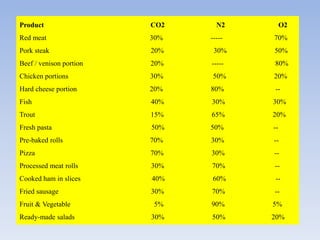
Product CO2 N2 O2
Red meat 30% ----- 70%
Pork steak 20% 30% 50%
Beef / venison portion 20% ----- 80%
Chicken portions 30% 50% 20%
Hard cheese portion 20% 80% --
Fish 40% 30% 30%
Trout 15% 65% 20%
Fresh pasta 50% 50% --
Pre-baked rolls 70% 30% --
Pizza 70% 30% --
Processed meat rolls 30% 70% --
Cooked ham in slices 40% 60% --
Fried sausage 30% 70% --
Fruit & Vegetable 5% 90% 5%
Ready-made salads 30% 50% 20%
Machine Systems For MAP
Gas Flush Technique
 The gas flush technique is normally accomplished on a form fill-seal machine.
 The replacement of air inside a package is performed by a continuous gas stream.
 This gas stream dilutes the air in the atmosphere surrounding the food product.
 The great advantage of the gas flush technique is the speed of the machine.
 Since the action is continuous, the product rate can be very high.
Compensated Vacuum
 The compensated vacuum technique removes the air inside by absorbing the vacuum in
the atmosphere inside the package and then breaking the vacuum with the desired gas
mixtures.
 Since the replacement of the air is accomplished in a two-step process, the speed of
operation of the equipment is slower than the gas flush technique.
 When considering the Oxygen sensitive food items compensated vacuum is the best
choice.
Machines used in MAP
 Thermo-forming packaging machines
 Vacuum chamber machines
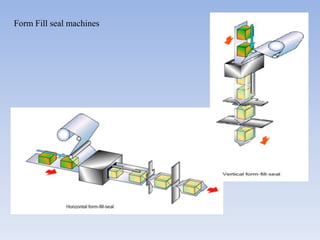
 Form fill seal machines; which is again divided into horizontal form fill seal and
vertical form fill seal.
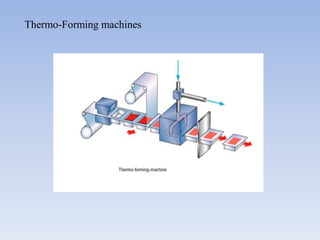
Thermo-Forming machines
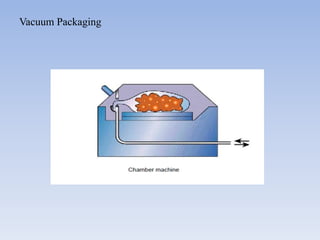
Vacuum Packaging
Form Fill seal machines
Advantages of MAP
 Longer durability of perishable food / Decrease of spoilage
 Reduces the growth of germs
 The product retains its form and texture.
 The product retains its vitamin content, taste and fat content.
 The natural color of the product is preserved.
 The need to use preserving agents is reduced.
 The longer the shelf life of the products:
The more economical the use of staff and machines as goods can be held in stock.
Extended distribution.
Extended variety of delicate fresh products.
Disadvantages of MAP
 Capital cost of gas packaging machinery.
 Cost of gases and packaging materials.
 Cost of analytical equipment to ensure that correct gas mixtures are being used.
 Cost of quality assurance systems to prevent the distribution of leakers, etc.
 Increased pack volume which will adversely affect transport costs and retail
display space.
 Potential growth of food-borne pathogens due to temperature abuse by retailers
and consumers.
 Benefits of MAP are lost once the pack is opened or leaks.
Testing novel MAPApplications
 Enzymatic discolorations of prepared non-sulfite dipped potatoes and apples were
generally more effectively inhibited by the usage of gas mixtures which are
nitrogen, argon and carbon dioxide than using high Oxygen MAP.
 By comparison High Oxygen and Argon MAP were not found to affect the cell
permeability, tissue exudate or pH of prepared carrots.
 Extracts from High Oxygen MAP prepared lettuce and onions did not have any
cytotoxic effects on human colon cells.
 Respiration rates of selected prepared produce items were not found to be
significantly affected by high Oxygen MAP and Argon, but were substantially
reduced by the addition of 10% CO2.
 Argon and Nitrous Oxide containing MAP treatments were found to have
negligible effect on the sensory quality of the prepared food items in comparison
with equivalent Nitrogen containing MAP treatments.
 High Oxygen MAP increased the membrane damage of the apple slices
whereas the high Argon MAP decreased the damage of the membrane.
 High Oxygen MAP increased the peroxidase activity of Botrytis cinerea, but
the addition of 10% CO2 substantially reduced the activity.
High Oxygen MAP
 The application of High Oxygen Atmospheres (HOA) (i.e. > 70% O2) for
packaging ready-to-eat vegetables was evaluated as an alternative technique
for low O2 Equilibrium Modified Atmosphere (EMA) packaging (3% O2-
5% CO2-balance N2) for respiring products.
 High O2 atmospheres were found to be particularly effective in inhibiting
enzymatic browning of the tested vegetables. Also, the microbial quality was
better as a reduction in yeast growth was observed.
 For most prepared items High Oxygen MAP was found to be beneficiary
related to the sensory quality in comparison with other gas mixtures and low
Oxygen MAP.
 High Oxygen MAP was found to inhibit the growth of several generic
groups of bacteria, yeasts and moulds and also a range of food pathogenic
organisms.
MAP

MAP

  • 1.
  • 2.
    Contents What is MAP NovelMAP gases Testing of MAP applications High Oxygen MAP
  • 3.
     Modified AtmospherePackaging (MAP) is a long established and continuously increasing technique for extending the shelf-life of fresh food products.  MAP requires specialized machinery to flush out air from the packaging and replace it with a different gas or gas mixture.  The MAP packaging aims to provide longer shelf-life, maintain sensory attributes like color or appearance and achieve the food safety of the product.  The normal composition of air is 21% oxygen, 78% nitrogen and less than 0.1% carbon dioxide. Modification of the atmosphere within the package by reducing the oxygen content while increasing the levels of carbon dioxide and/or nitrogen has been shown to significantly extend the shelf-life of perishable foods at chill temperatures. What is MAP ?
  • 4.
    History  MAP wasfirst recorded in 1927 as an extension of the shelf-life of apples by storing them in atmospheres with reduced oxygen and increased carbon dioxide concentrations.  In the 1930s it was used to transport fruit in the holds of ships and increasing the carbon dioxide concentration surrounding beef carcasses transported long distances was shown to increase shelf-life by up to 100% (Davies, 1995).  In the UK, Marks and Spencer introduced MAP meat in 1979; the success of this product led, two years later, to the introduction of MAP bacon, fish (both fresh and cured), sliced cooked meats.
  • 5.
    Gases used inMAP  Carbon dioxide (CO2) inhibits the increase of most aerobic bacteria. It is the most important gas in the packaging of food under modified atmospheres. In general one can say the higher the CO2 concentration the longer the durability of the perishable food.  Nitrogen (N2) is an inert gas that is used to expel air especially Oxygen out of the packaging. It is also used as a filling gas that equalizes the effect of CO2 absorption by the perishable food.  Oxygen (O2) is generally useful for the growth of microorganisms and it should be excluded from MAP gases but in some cases a level of it can bring positive results in food preservation. It keeps the natural color of the perishable food (effect of freshness). It makes possible respiration, especially for fruits or vegetables.
  • 6.
    Novel MAP gases The novel gases that are used in the MAP process are High Oxygen MAP, Argon and Nitrous oxide MAP.  High Oxygen MAP was found to be particularly inhibiting the enzymic discolorations, preventing anaerobic fermentation reactions and inhibiting microbial growth.  Argon and Nitrous oxide are classified as miscellaneous additives are used in food products in EU.  Research on testing these both gases revealed that Argon can more effectively inhibit enzymatic activities, microbial growth and degradative chemical reaction in some perishable foods.  Further research revealed that these gases increase the shelf life by reducing the fungal growth.
  • 7.
    Product CO2 N2O2 Red meat 30% ----- 70% Pork steak 20% 30% 50% Beef / venison portion 20% ----- 80% Chicken portions 30% 50% 20% Hard cheese portion 20% 80% -- Fish 40% 30% 30% Trout 15% 65% 20% Fresh pasta 50% 50% -- Pre-baked rolls 70% 30% -- Pizza 70% 30% -- Processed meat rolls 30% 70% -- Cooked ham in slices 40% 60% -- Fried sausage 30% 70% -- Fruit & Vegetable 5% 90% 5% Ready-made salads 30% 50% 20%
  • 8.
    Machine Systems ForMAP Gas Flush Technique  The gas flush technique is normally accomplished on a form fill-seal machine.  The replacement of air inside a package is performed by a continuous gas stream.  This gas stream dilutes the air in the atmosphere surrounding the food product.  The great advantage of the gas flush technique is the speed of the machine.  Since the action is continuous, the product rate can be very high.
  • 9.
    Compensated Vacuum  Thecompensated vacuum technique removes the air inside by absorbing the vacuum in the atmosphere inside the package and then breaking the vacuum with the desired gas mixtures.  Since the replacement of the air is accomplished in a two-step process, the speed of operation of the equipment is slower than the gas flush technique.  When considering the Oxygen sensitive food items compensated vacuum is the best choice.
  • 10.
    Machines used inMAP  Thermo-forming packaging machines  Vacuum chamber machines  Form fill seal machines; which is again divided into horizontal form fill seal and vertical form fill seal.
  • 11.
  • 12.
  • 13.
  • 14.
    Advantages of MAP Longer durability of perishable food / Decrease of spoilage  Reduces the growth of germs  The product retains its form and texture.  The product retains its vitamin content, taste and fat content.  The natural color of the product is preserved.  The need to use preserving agents is reduced.  The longer the shelf life of the products: The more economical the use of staff and machines as goods can be held in stock. Extended distribution. Extended variety of delicate fresh products.
  • 15.
    Disadvantages of MAP Capital cost of gas packaging machinery.  Cost of gases and packaging materials.  Cost of analytical equipment to ensure that correct gas mixtures are being used.  Cost of quality assurance systems to prevent the distribution of leakers, etc.  Increased pack volume which will adversely affect transport costs and retail display space.  Potential growth of food-borne pathogens due to temperature abuse by retailers and consumers.  Benefits of MAP are lost once the pack is opened or leaks.
  • 16.
    Testing novel MAPApplications Enzymatic discolorations of prepared non-sulfite dipped potatoes and apples were generally more effectively inhibited by the usage of gas mixtures which are nitrogen, argon and carbon dioxide than using high Oxygen MAP.  By comparison High Oxygen and Argon MAP were not found to affect the cell permeability, tissue exudate or pH of prepared carrots.  Extracts from High Oxygen MAP prepared lettuce and onions did not have any cytotoxic effects on human colon cells.  Respiration rates of selected prepared produce items were not found to be significantly affected by high Oxygen MAP and Argon, but were substantially reduced by the addition of 10% CO2.  Argon and Nitrous Oxide containing MAP treatments were found to have negligible effect on the sensory quality of the prepared food items in comparison with equivalent Nitrogen containing MAP treatments.
  • 17.
     High OxygenMAP increased the membrane damage of the apple slices whereas the high Argon MAP decreased the damage of the membrane.  High Oxygen MAP increased the peroxidase activity of Botrytis cinerea, but the addition of 10% CO2 substantially reduced the activity.
  • 18.
    High Oxygen MAP The application of High Oxygen Atmospheres (HOA) (i.e. > 70% O2) for packaging ready-to-eat vegetables was evaluated as an alternative technique for low O2 Equilibrium Modified Atmosphere (EMA) packaging (3% O2- 5% CO2-balance N2) for respiring products.  High O2 atmospheres were found to be particularly effective in inhibiting enzymatic browning of the tested vegetables. Also, the microbial quality was better as a reduction in yeast growth was observed.  For most prepared items High Oxygen MAP was found to be beneficiary related to the sensory quality in comparison with other gas mixtures and low Oxygen MAP.  High Oxygen MAP was found to inhibit the growth of several generic groups of bacteria, yeasts and moulds and also a range of food pathogenic organisms.

Editor's Notes

  • #12 Film is heat-formed into a tray on a lower conveyor belt and the product is then added. Air is extracted, gas injected and the loaded package is sealed by welding on a film from an upper conveyor belt. This machine is suitable for meat, fish and prepared food.
  • #13 The product is inserted into prefabricated bags or trays. The packages are placed in a chamber from which the air is extracted and the pressure equalised with gas. The packages are then sealed by welding. This machine type is suitable for small production volumes at a relatively low cost.
  • #14 A film is formed into a tube which is pinched together at one end, the other end being sealed over an injection pipe. Product is portioned out into the tube, which is then sealed at the other end and cut off. Gas is continually fed through the tube to purge the air. This type of machine is mostly used for powdered and bulk products such as coffee and peanuts as well as diced foodstuffs. Gas flushing may sometimes be necessary before packing.