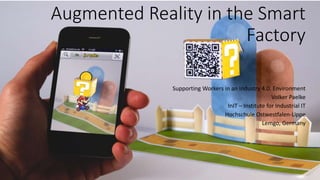
Augmented Reality in the Smart
Factory
Supporting Workers in an Industry 4.0. Environment
Volker Paelke
InIT – Institute for Industrial IT
Hochschule Ostwestfalen-Lippe
Lemgo, Germany
1
INTRODUCTION
• AR applications have high potential to improve the user experience
of applications in which users must access and interact with
information that has a direct spatial relation to their immediate
environment.
• using augmented reality to support workers in the increasingly
flexible and data rich environment of future smart factories and
discuss initial findings on the impact of an AR interface on the user
experience.
2
Motivation and State of the Art
• most common user interface paradigm today is the graphical user
interface (GUI), also called the WIMP (windows, icons, menu, pointer)
• advantage of graphical user interfaces is that users can directly interact with
visual representations of objects and commands on the screen and receive
immediate visual feedback, alleviating the need to remember complex
commands.
• in applications that rely on spatial information related to a real world
environment traditional GUIs are less than ideal, because the
information displayed in the interface is removed from its real world
context and interaction is effected indirectly through the interface
• virtual and augmented reality are ideal for interpretation of
information in a spatial context
3
Requirements
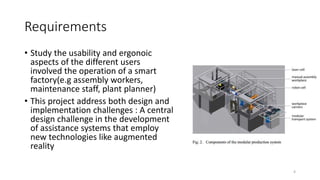
• Study the usability and ergonoic
aspects of the different users
involved the operation of a smart
factory(e.g assembly workers,
maintenance staff, plant planner)
• This project address both design and
implementation challenges : A central
design challenge in the development
of assistance systems that employ
new technologies like augmented
reality
4
Visualization Concepts
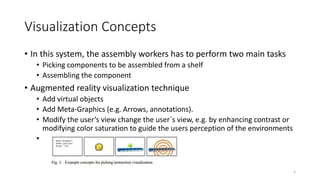
• In this system, the assembly workers has to perform two main tasks
• Picking components to be assembled from a shelf
• Assembling the component
• Augmented reality visualization technique
• Add virtual objects
• Add Meta-Graphics (e.g. Arrows, annotations).
• Modify the user’s view change the user´s view, e.g. by enhancing contrast or
modifying color saturation to guide the users perception of the environments
•
5
Visualization Concepts Implementation
• https://www.youtube.com/watch?v=Gr1OuND5iUc
6
Implementation
• Video see-through : A camera captures the environment and augmented
information is overlaid on this video in a real time.
• Optical see through: User wears a special display in which the
augmentation information is optically combined with the with the view of
real world.
• Projection: the augmentation information is projected directly on the real
world objects.
• Tools used to implement:
• Vuzix Star 1200
• Built with metaio SDK
• Logitech c920 HD camera
7
Conclusion
• This paper presented experiences on using augmented reality in
assistance system within smart factory environment.
• Augmented Reality is very promising user interface concept in this
application domain.
8
Future Work
• Establish a collection of proven user interface elements for common
tasks in industria application environment that will help to make the
factor of the future more user friendly for a large variety of user.
• This powerpoint is edited by
• Hanas Subakti
• hanaskuliah@gmail.com
9

Augmented reality in the smart factory

  • 1.
    Augmented Reality inthe Smart Factory Supporting Workers in an Industry 4.0. Environment Volker Paelke InIT – Institute for Industrial IT Hochschule Ostwestfalen-Lippe Lemgo, Germany 1
  • 2.
    INTRODUCTION • AR applicationshave high potential to improve the user experience of applications in which users must access and interact with information that has a direct spatial relation to their immediate environment. • using augmented reality to support workers in the increasingly flexible and data rich environment of future smart factories and discuss initial findings on the impact of an AR interface on the user experience. 2
  • 3.
    Motivation and Stateof the Art • most common user interface paradigm today is the graphical user interface (GUI), also called the WIMP (windows, icons, menu, pointer) • advantage of graphical user interfaces is that users can directly interact with visual representations of objects and commands on the screen and receive immediate visual feedback, alleviating the need to remember complex commands. • in applications that rely on spatial information related to a real world environment traditional GUIs are less than ideal, because the information displayed in the interface is removed from its real world context and interaction is effected indirectly through the interface • virtual and augmented reality are ideal for interpretation of information in a spatial context 3
  • 4.
    Requirements • Study theusability and ergonoic aspects of the different users involved the operation of a smart factory(e.g assembly workers, maintenance staff, plant planner) • This project address both design and implementation challenges : A central design challenge in the development of assistance systems that employ new technologies like augmented reality 4
  • 5.
    Visualization Concepts • Inthis system, the assembly workers has to perform two main tasks • Picking components to be assembled from a shelf • Assembling the component • Augmented reality visualization technique • Add virtual objects • Add Meta-Graphics (e.g. Arrows, annotations). • Modify the user’s view change the user´s view, e.g. by enhancing contrast or modifying color saturation to guide the users perception of the environments • 5
  • 6.
    Visualization Concepts Implementation •https://www.youtube.com/watch?v=Gr1OuND5iUc 6
  • 7.
    Implementation • Video see-through: A camera captures the environment and augmented information is overlaid on this video in a real time. • Optical see through: User wears a special display in which the augmentation information is optically combined with the with the view of real world. • Projection: the augmentation information is projected directly on the real world objects. • Tools used to implement: • Vuzix Star 1200 • Built with metaio SDK • Logitech c920 HD camera 7
  • 8.
    Conclusion • This paperpresented experiences on using augmented reality in assistance system within smart factory environment. • Augmented Reality is very promising user interface concept in this application domain. 8
  • 9.
    Future Work • Establisha collection of proven user interface elements for common tasks in industria application environment that will help to make the factor of the future more user friendly for a large variety of user. • This powerpoint is edited by • Hanas Subakti • hanaskuliah@gmail.com 9