Startup Lessons Learned Drew Houston @drewhouston
Background Cofounder & CEO, Dropbox Earlier: MIT comp sci (‘05), started online SAT prep co, engineer @ startups  Easiest way to share files across computers & with other people Founded in ‘07, launched Sep ’08 Sequoia & Accel-backed startup in SF Millions of users, rapidly growing
Some context 100,000    many millions of users in 18 months since launch No advertising spend Hostile environment: lots of competitors, software download Mostly done by engineers w/ some guidance but no prior marketing experience
How we applied lean startup  principles at Dropbox (sometimes on purpose, sometimes by accident)
Paul Graham: Early and often Joel Spolsky:  When it doesn’t completely suck (avoid “Marimba Phenomenon”) When to Launch?
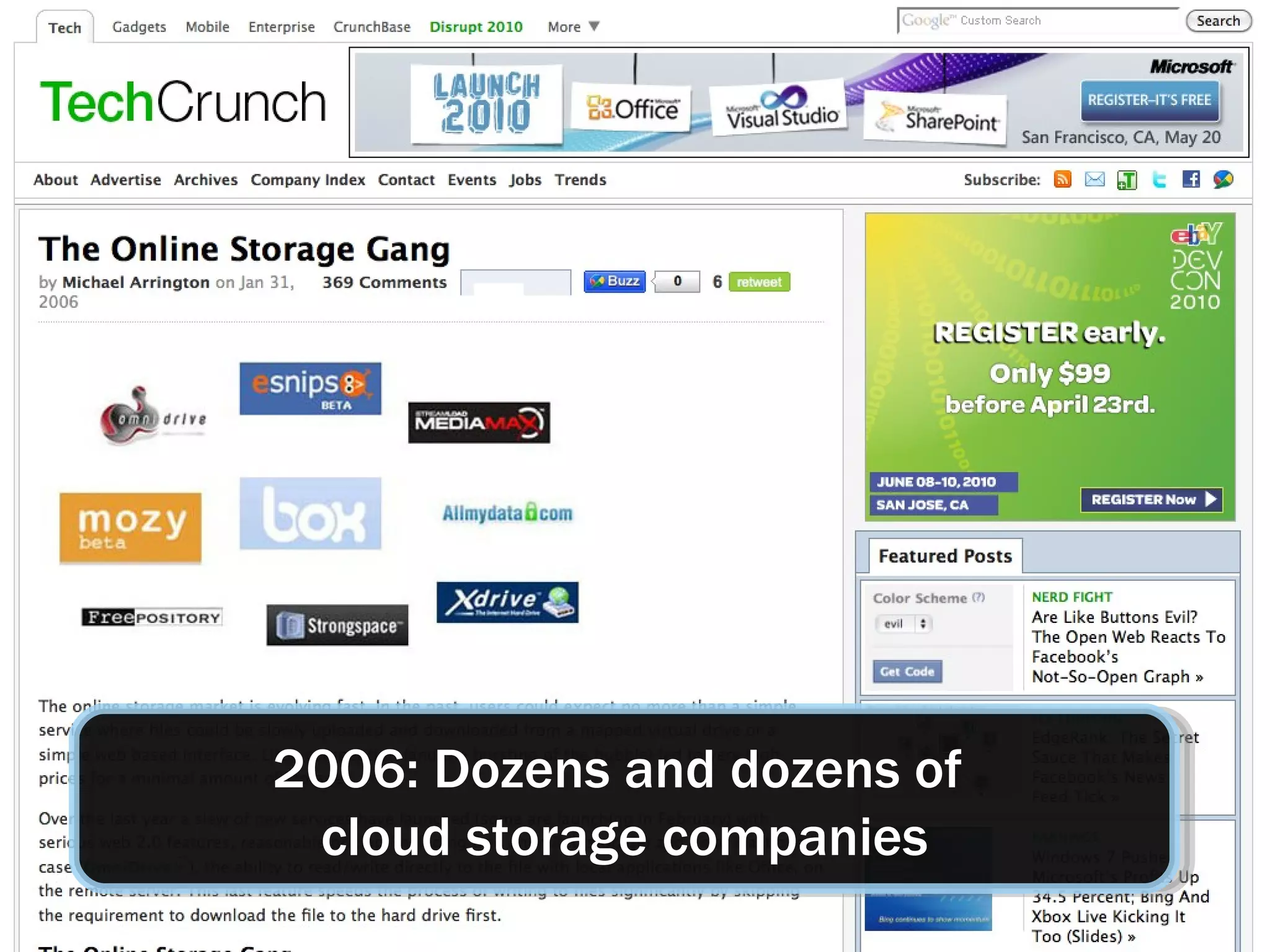
2006: Dozens and dozens of  cloud storage companies
VC: “There are a million  cloud storage startups!” Drew: “Do you use any of them?” VC: “No” Drew: “…”
Building a bulletproof, scalable, cross-platform cloud storage architecture is  hard
"[product] ended up turning all my Word docs and half my Excel Spreadsheets into 0 byte files. Needless to say, I am not happy." From competitor’s support forum:
Learn early, learn often
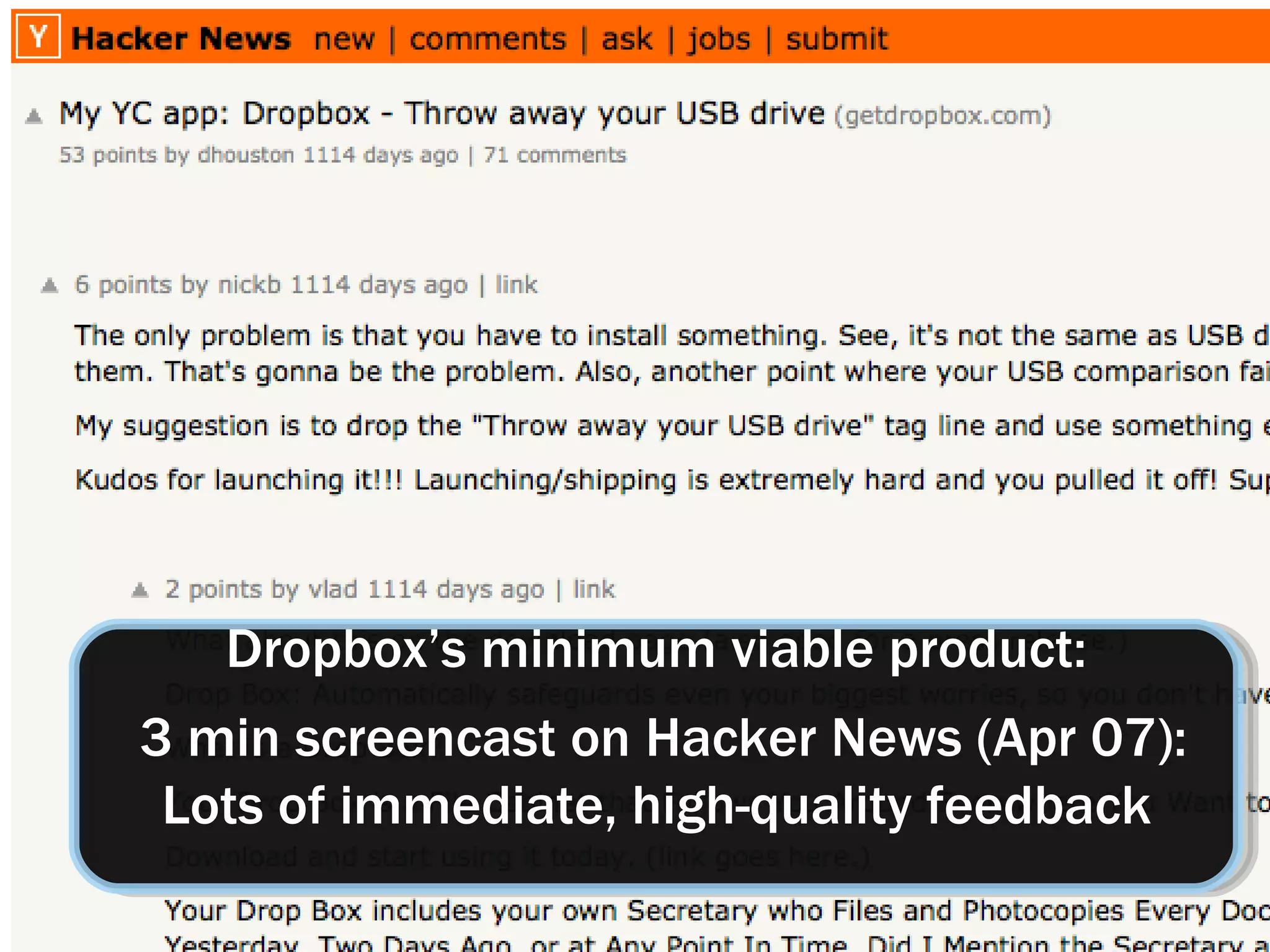
Dropbox’s minimum viable product: 3 min screencast on Hacker News (Apr 07): Lots of immediate, high-quality feedback
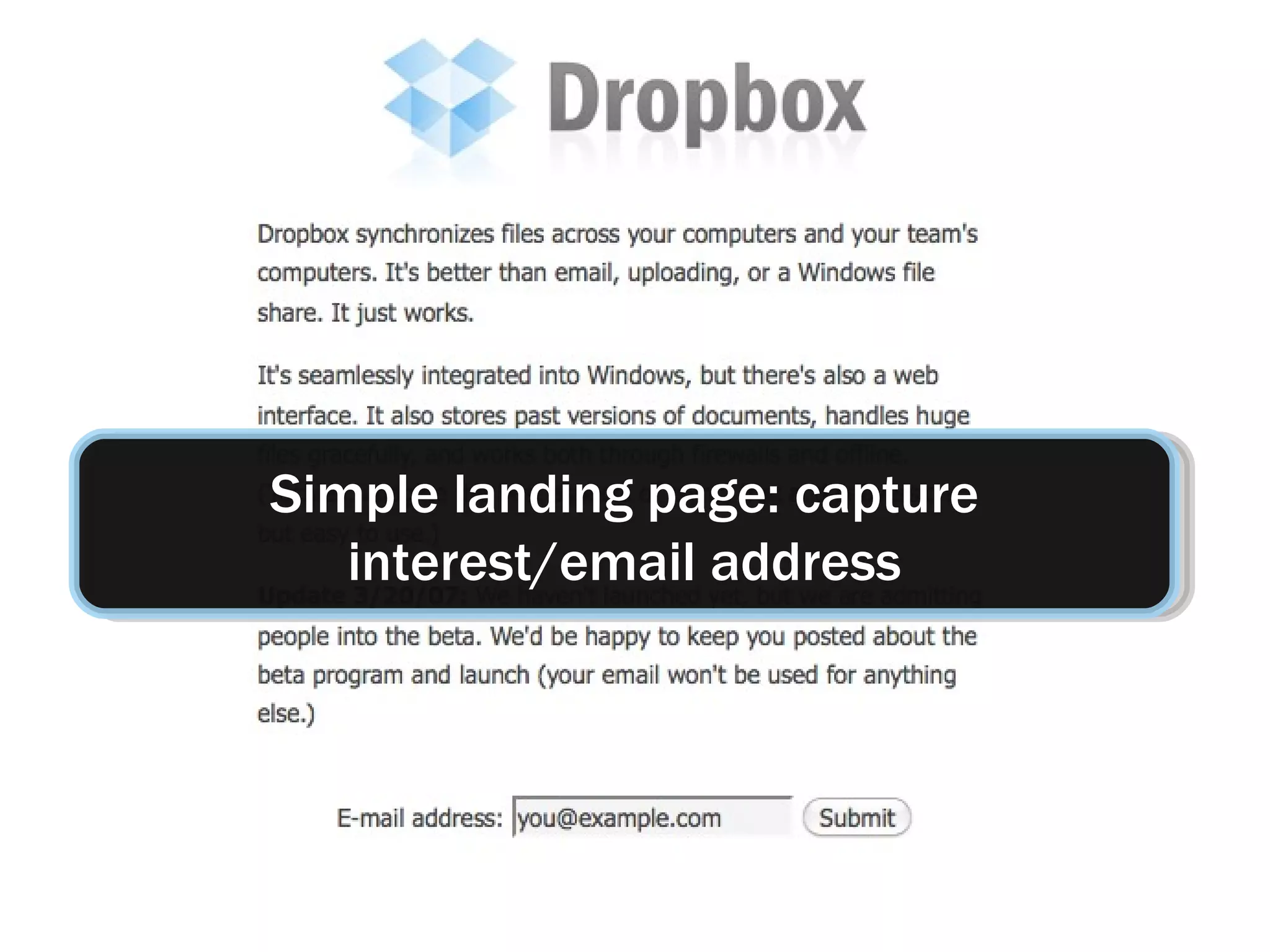
Simple landing page: capture interest/email address
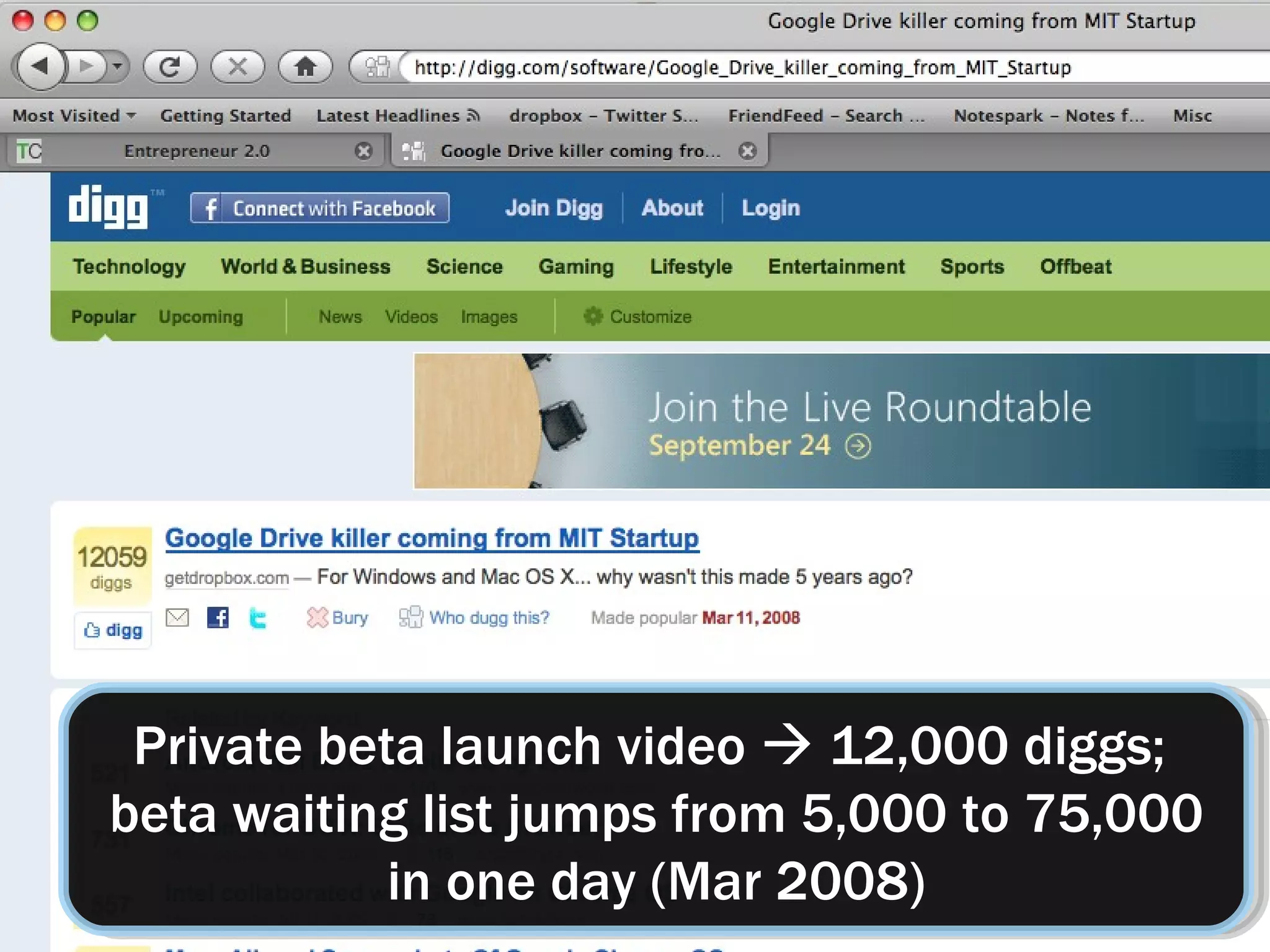
Private beta launch video    12,000 diggs;  beta waiting list jumps from 5,000 to 75,000 in one day (Mar 2008)
What we learned Biggest risk: making something no one wants Not launching    painful, but not learning    fatal Put something in users hands (doesn’t have to be code) and get real feedback ASAP Know where your target audience hangs out & speak to them in an authentic way
When “best practices” aren’t best
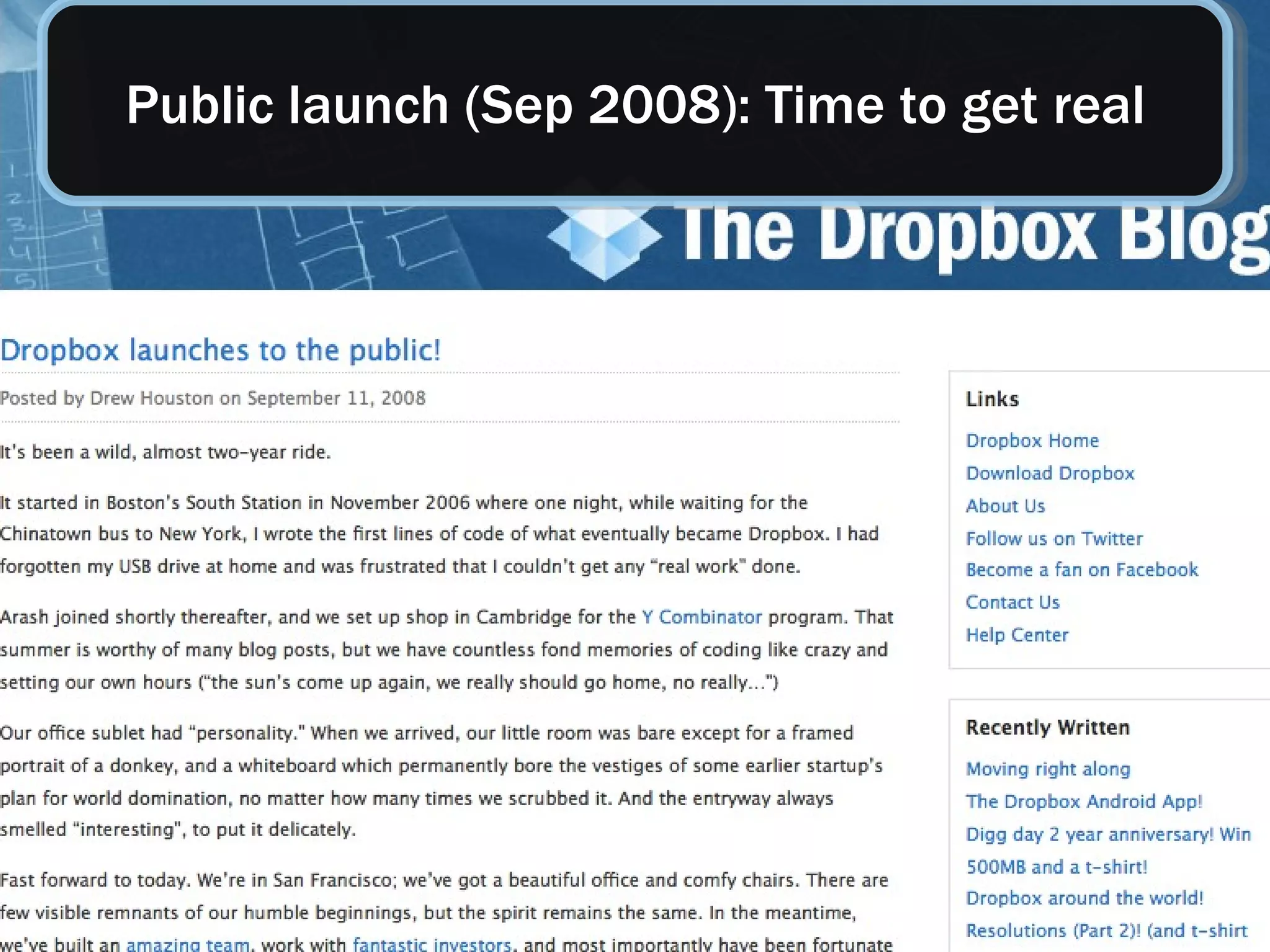
Public launch (Sep 2008): Time to get real
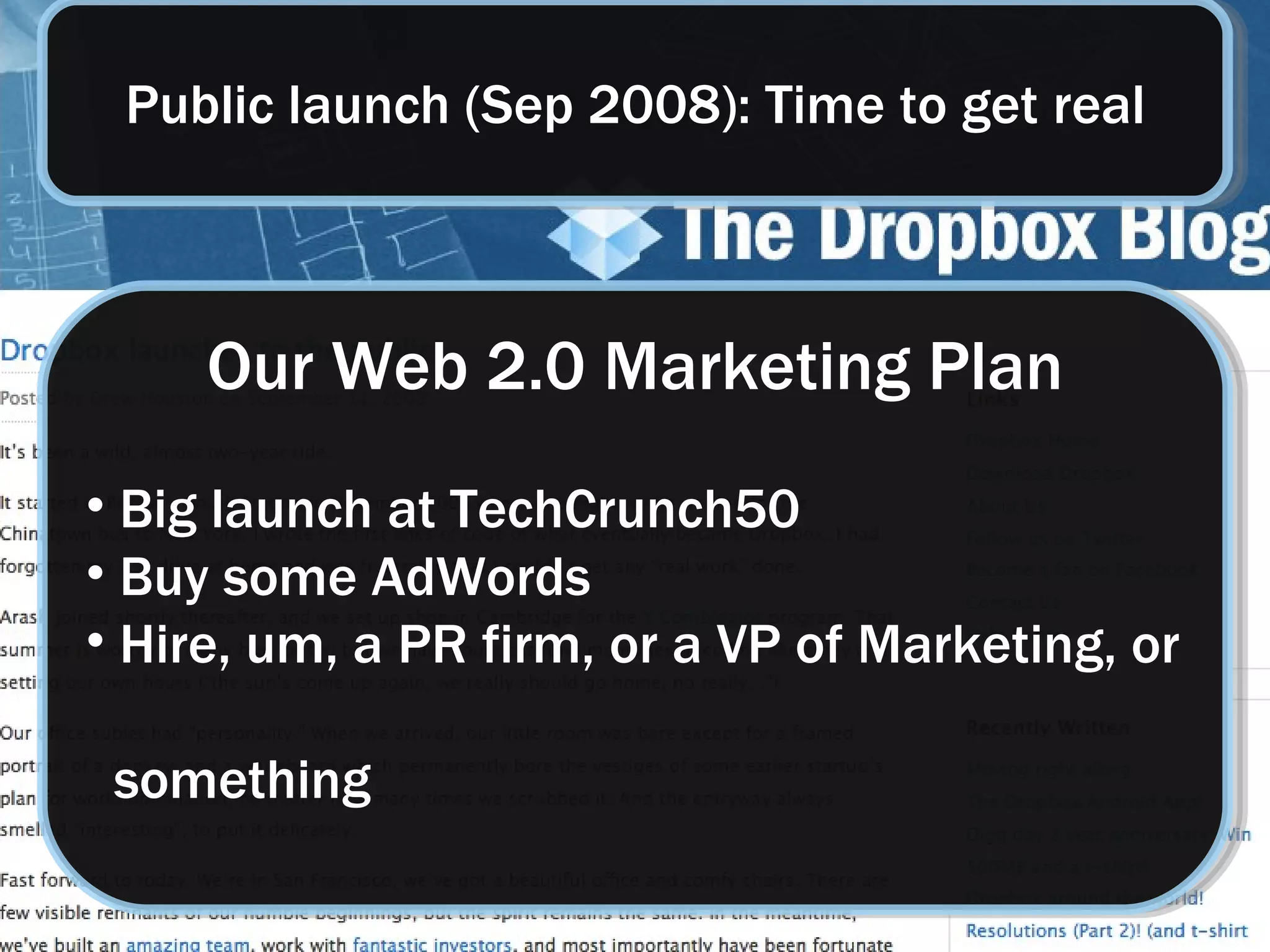
Public launch (Sep 2008): Time to get real Our Web 2.0 Marketing Plan Big launch at TechCrunch50 Buy some AdWords Hire, um, a PR firm, or a VP of Marketing, or    something
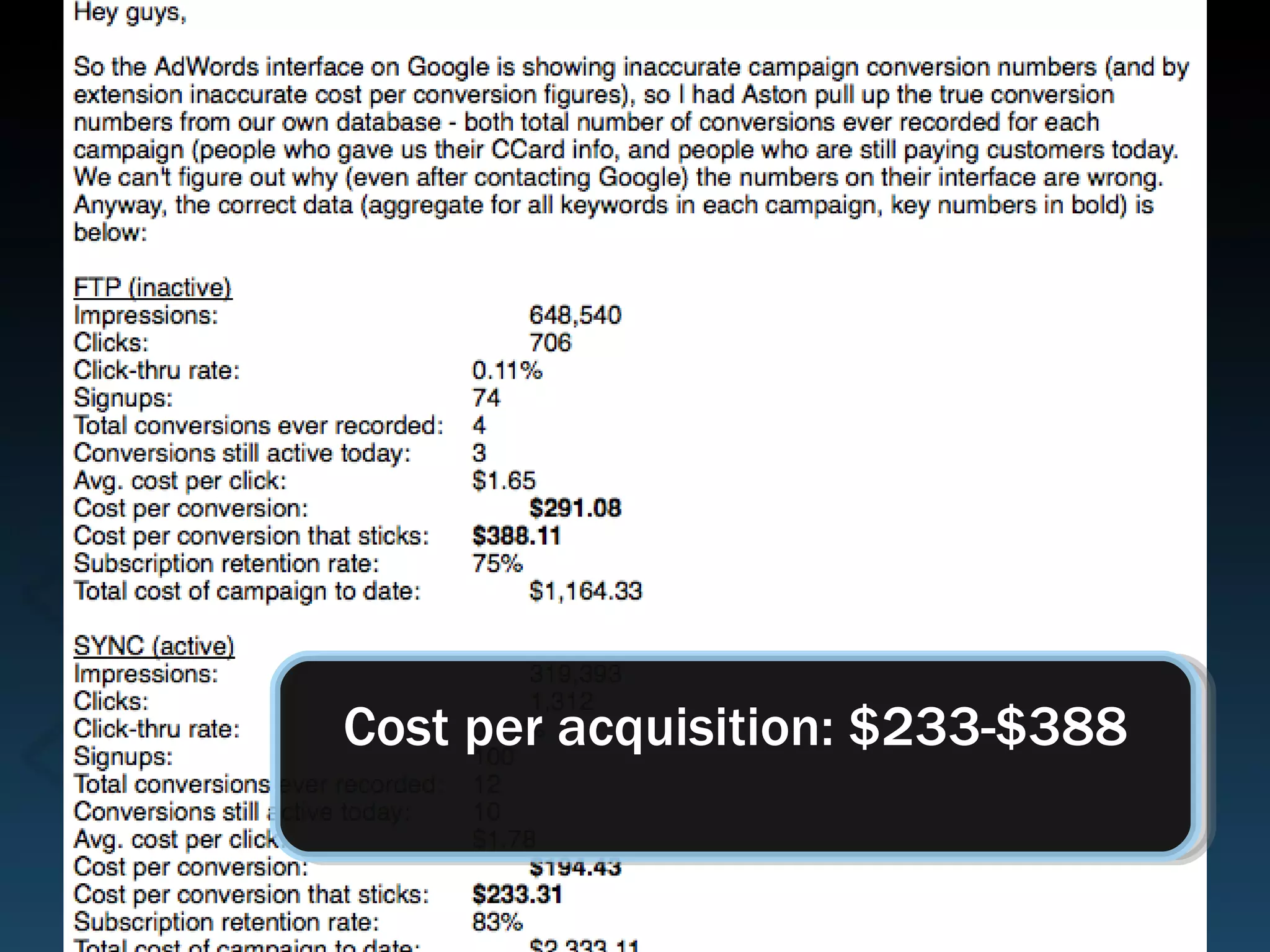
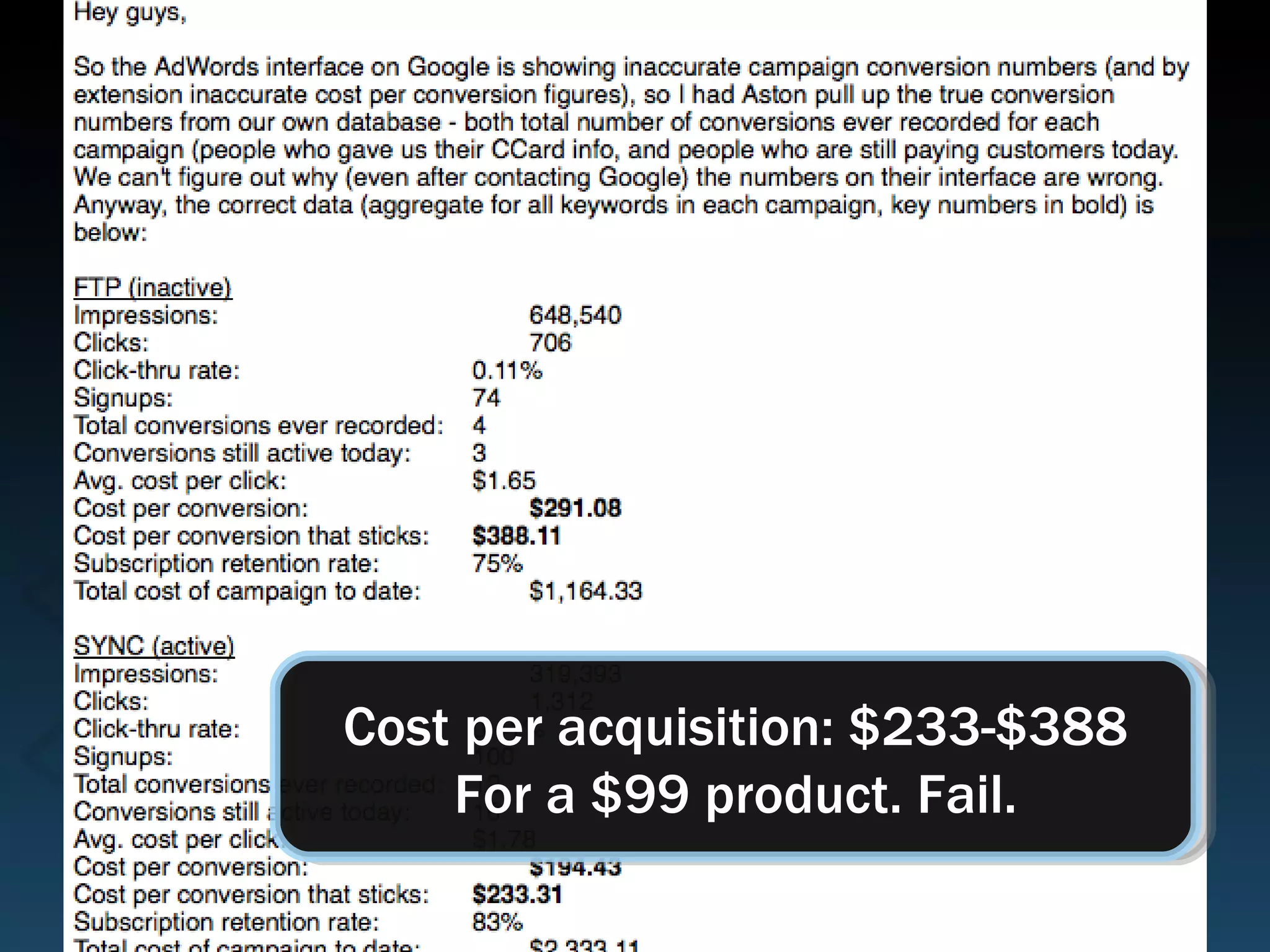
Experiment: Paid search Hired experienced SEM & affiliate marketing guy ($$) Picked out keywords, made landing pages Hid the free account option for people arriving via paid search, replace with free time-limited trial Went live in early 2009
Cost per acquisition: $233-$388
Cost per acquisition: $233-$388 For a $99 product. Fail.
Experiments failing left and right Problem: Most obvious keywords bidded  way up Probably by other venture-backed startups Problem: Long tail had little volume Problem: Hiding free option was shady, confusing, buggy Affiliate program, display ads, etc sucked too Economics totally broken
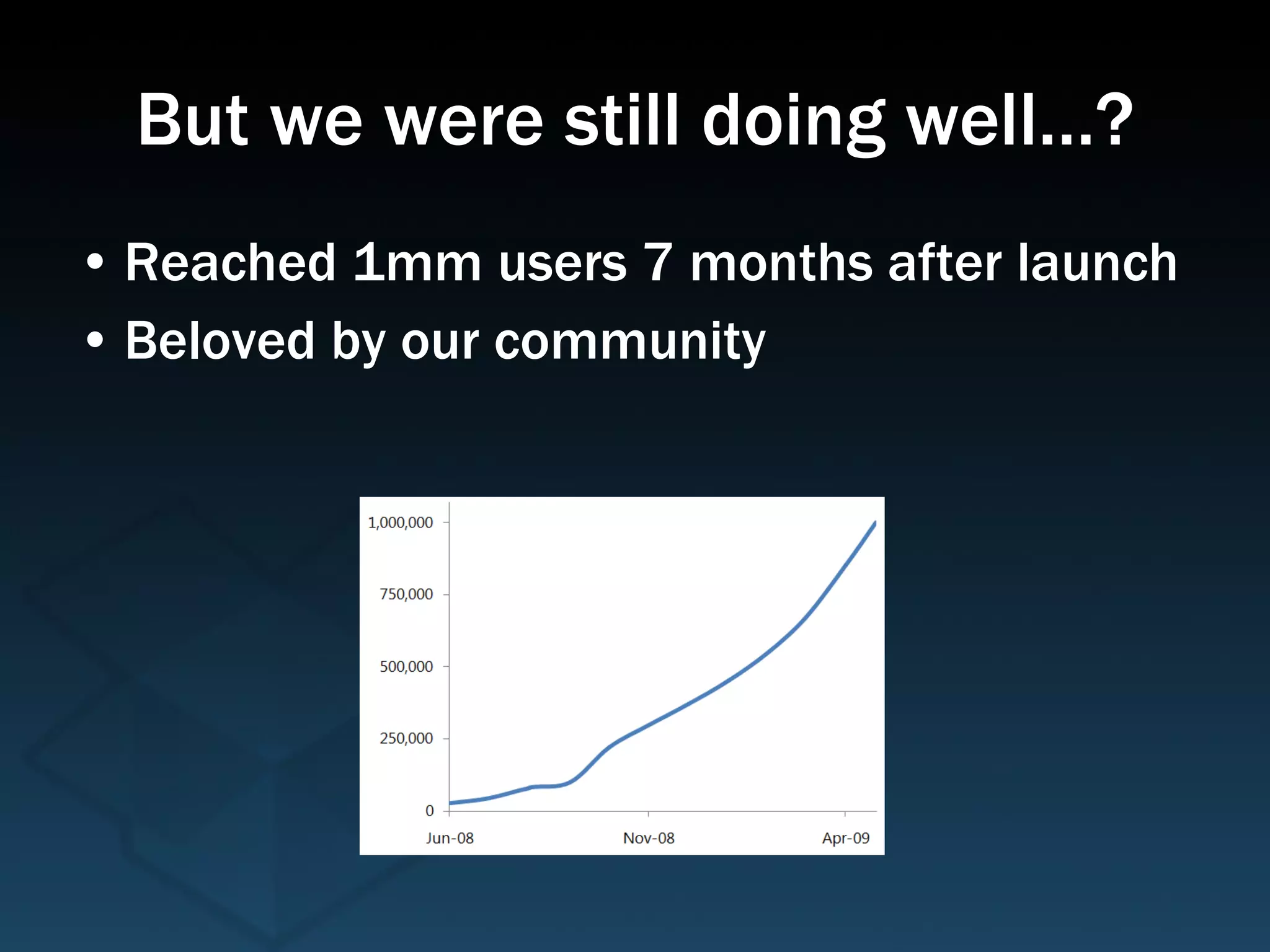
But we were still doing well…? Reached 1mm users 7 months after launch Beloved by our community
What we learned Lots of pressure (or guilt) to do things the traditional way. But think first principles Fortunately, we spent almost all our effort on making an elegant, simple product that “just works” and making users happy And we worked our asses off And hired the smartest people we knew “Keep the main thing the main thing”
What we learned Mostly ignored (or woefully mishandled):  hiring non-engineers mainstream PR traditional messaging/positioning deadlines, process, “best practices” having a “real” website partnerships/bizdev having lots of features Product-market fit cures many sins of management
Fourteen Months to the Epiphany
Why were conventional techniques failing,  yet we were still succeeding?
AdWords wasn’t the problem Nobody wakes up in the morning wishing they didn’t have to carry a USB drive, email themselves, etc. Similar things existed, but people weren’t actively looking for what we were making Display ads, landing pages ineffective Search is a way to  harvest  demand,  not  create  it
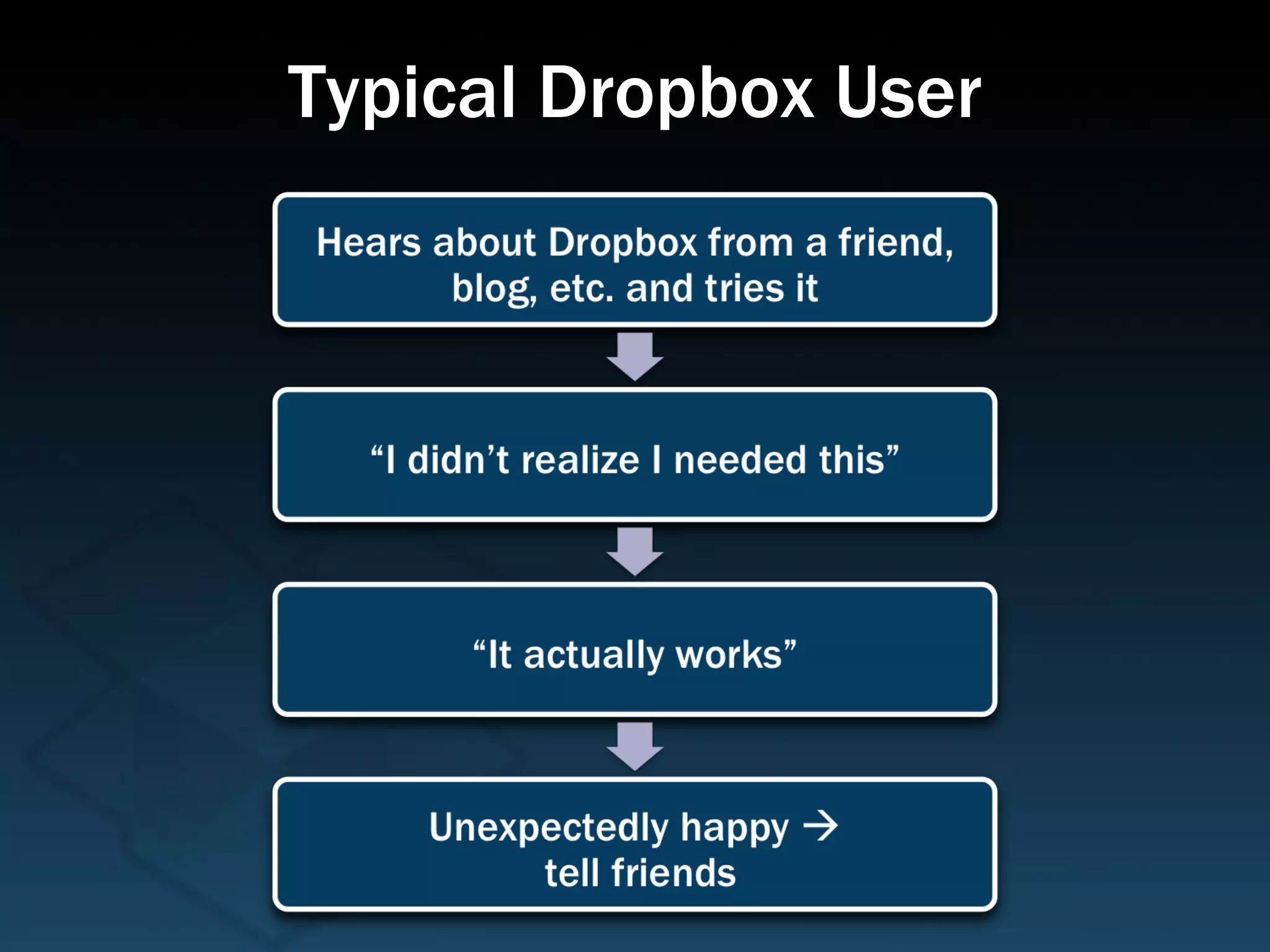
Typical Dropbox User
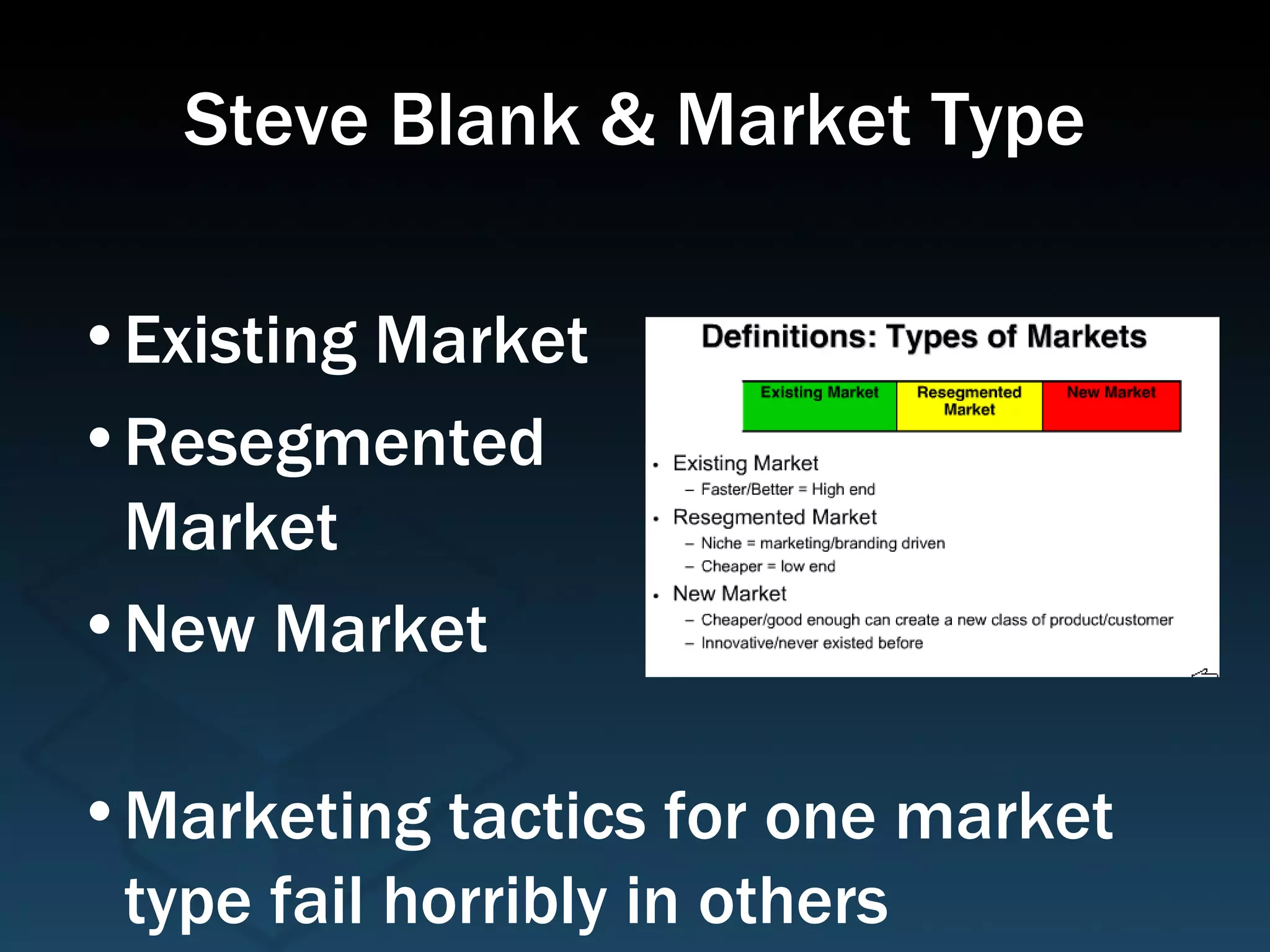
Steve Blank & Market Type Existing Market Resegmented Market New Market Marketing tactics for one market type fail horribly in others
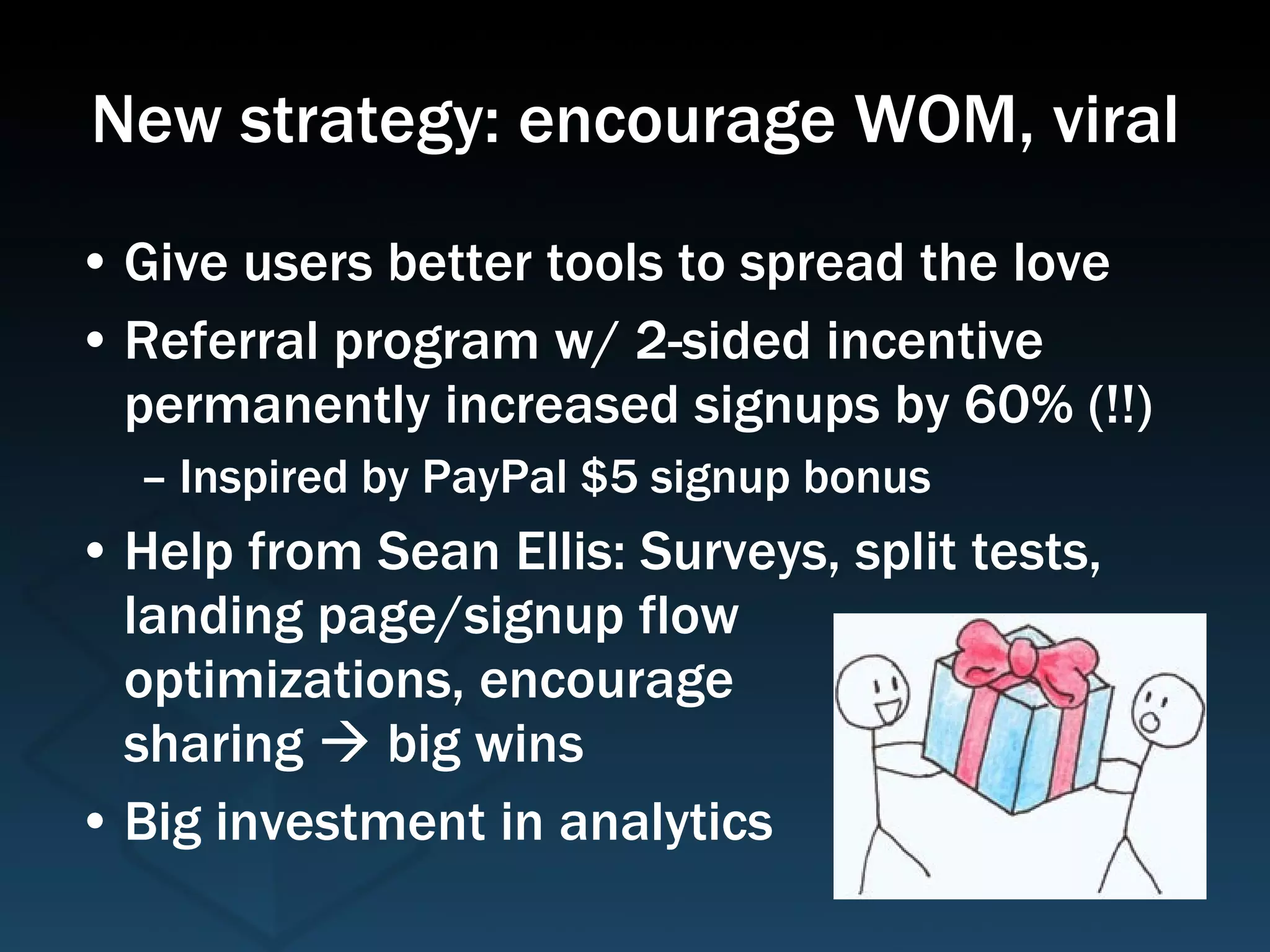
New strategy: encourage WOM, viral Give users better tools to spread the love Referral program w/ 2-sided incentive permanently increased signups by 60% (!!) Inspired by PayPal $5 signup bonus Help from Sean Ellis: Surveys, split tests, landing page/signup flow  optimizations, encourage sharing    big wins Big investment in analytics
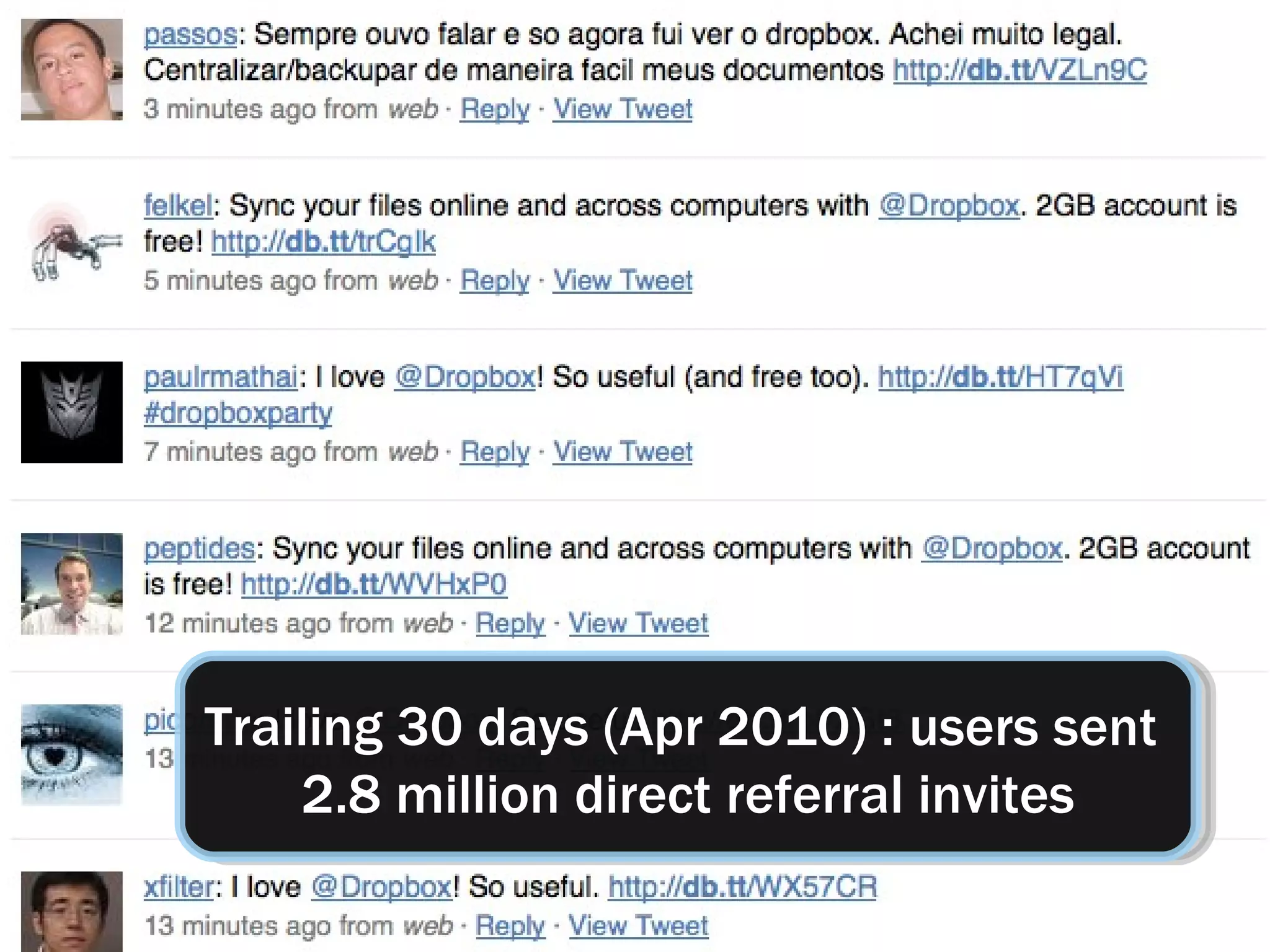
Trailing 30 days (Apr 2010) : users sent  2.8 million direct referral invites
Results September 2008: 100,000 registered users January 2010 (15 mos later): 4,000,000 Mostly from word-of-mouth and viral: 35% of daily signups from referral program 20% from shared folders, other viral features Sustained 15-20%+ month-over-month growth since launch
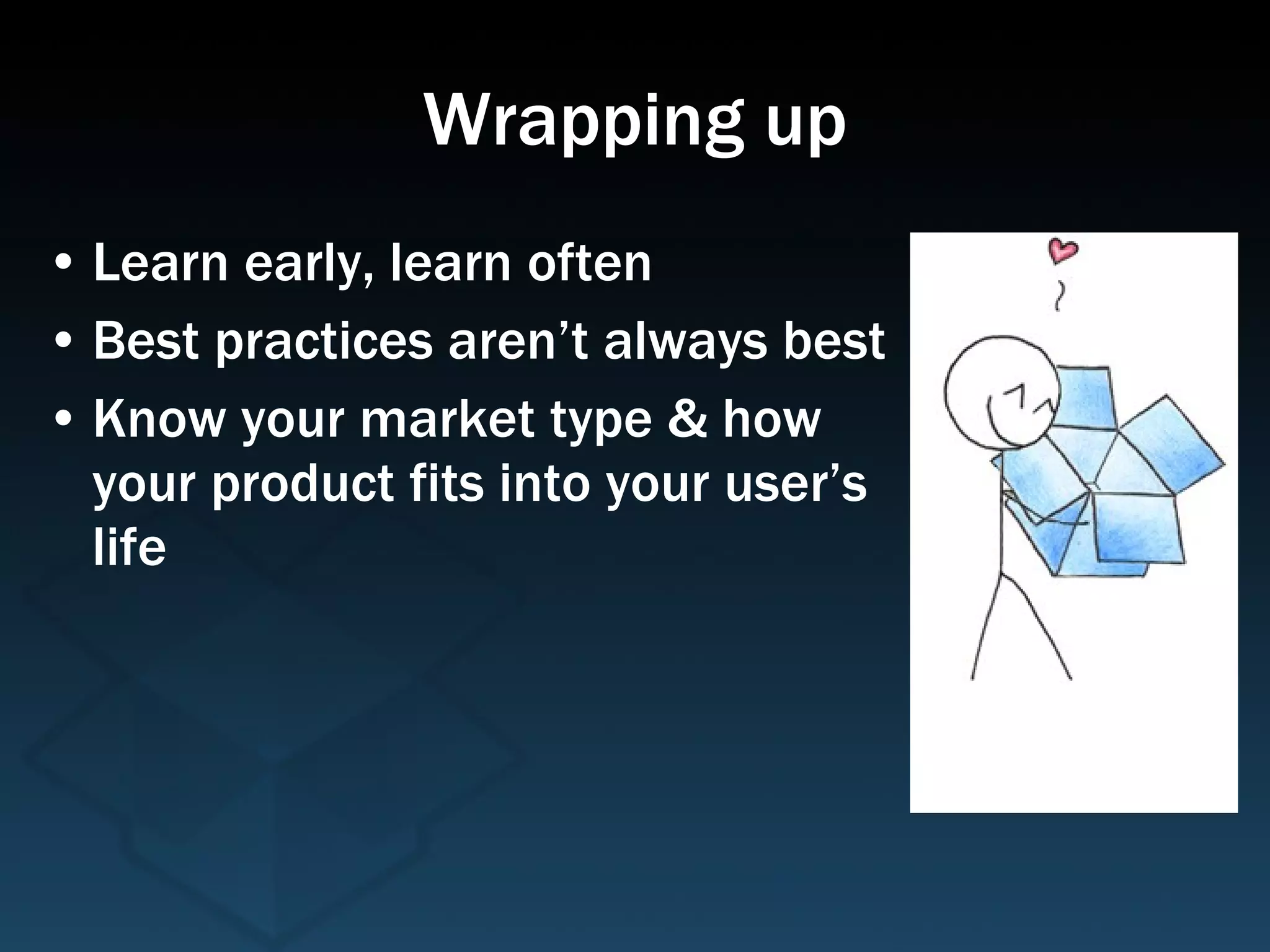
Wrapping up Learn early, learn often Best practices aren’t always best Know your market type & how  your product fits into your user’s  life
Thank you! Questions? @drewhouston

Dropbox Startup Lessons Learned

  • 1.
    Startup Lessons LearnedDrew Houston @drewhouston
  • 2.
    Background Cofounder &CEO, Dropbox Earlier: MIT comp sci (‘05), started online SAT prep co, engineer @ startups Easiest way to share files across computers & with other people Founded in ‘07, launched Sep ’08 Sequoia & Accel-backed startup in SF Millions of users, rapidly growing
  • 3.
    Some context 100,000  many millions of users in 18 months since launch No advertising spend Hostile environment: lots of competitors, software download Mostly done by engineers w/ some guidance but no prior marketing experience
  • 4.
    How we appliedlean startup principles at Dropbox (sometimes on purpose, sometimes by accident)
  • 5.
    Paul Graham: Earlyand often Joel Spolsky: When it doesn’t completely suck (avoid “Marimba Phenomenon”) When to Launch?
  • 6.
    2006: Dozens anddozens of cloud storage companies
  • 7.
    VC: “There area million cloud storage startups!” Drew: “Do you use any of them?” VC: “No” Drew: “…”
  • 8.
    Building a bulletproof,scalable, cross-platform cloud storage architecture is hard
  • 9.
    "[product] ended upturning all my Word docs and half my Excel Spreadsheets into 0 byte files. Needless to say, I am not happy." From competitor’s support forum:
  • 10.
  • 11.
    Dropbox’s minimum viableproduct: 3 min screencast on Hacker News (Apr 07): Lots of immediate, high-quality feedback
  • 12.
    Simple landing page:capture interest/email address
  • 13.
    Private beta launchvideo  12,000 diggs; beta waiting list jumps from 5,000 to 75,000 in one day (Mar 2008)
  • 14.
    What we learnedBiggest risk: making something no one wants Not launching  painful, but not learning  fatal Put something in users hands (doesn’t have to be code) and get real feedback ASAP Know where your target audience hangs out & speak to them in an authentic way
  • 15.
  • 16.
    Public launch (Sep2008): Time to get real
  • 17.
    Public launch (Sep2008): Time to get real Our Web 2.0 Marketing Plan Big launch at TechCrunch50 Buy some AdWords Hire, um, a PR firm, or a VP of Marketing, or something
  • 18.
    Experiment: Paid searchHired experienced SEM & affiliate marketing guy ($$) Picked out keywords, made landing pages Hid the free account option for people arriving via paid search, replace with free time-limited trial Went live in early 2009
  • 19.
  • 20.
    Cost per acquisition:$233-$388 For a $99 product. Fail.
  • 21.
    Experiments failing leftand right Problem: Most obvious keywords bidded way up Probably by other venture-backed startups Problem: Long tail had little volume Problem: Hiding free option was shady, confusing, buggy Affiliate program, display ads, etc sucked too Economics totally broken
  • 22.
    But we werestill doing well…? Reached 1mm users 7 months after launch Beloved by our community
  • 23.
    What we learnedLots of pressure (or guilt) to do things the traditional way. But think first principles Fortunately, we spent almost all our effort on making an elegant, simple product that “just works” and making users happy And we worked our asses off And hired the smartest people we knew “Keep the main thing the main thing”
  • 24.
    What we learnedMostly ignored (or woefully mishandled): hiring non-engineers mainstream PR traditional messaging/positioning deadlines, process, “best practices” having a “real” website partnerships/bizdev having lots of features Product-market fit cures many sins of management
  • 25.
    Fourteen Months tothe Epiphany
  • 26.
    Why were conventionaltechniques failing, yet we were still succeeding?
  • 27.
    AdWords wasn’t theproblem Nobody wakes up in the morning wishing they didn’t have to carry a USB drive, email themselves, etc. Similar things existed, but people weren’t actively looking for what we were making Display ads, landing pages ineffective Search is a way to harvest demand, not create it
  • 28.
  • 29.
    Steve Blank &Market Type Existing Market Resegmented Market New Market Marketing tactics for one market type fail horribly in others
  • 30.
    New strategy: encourageWOM, viral Give users better tools to spread the love Referral program w/ 2-sided incentive permanently increased signups by 60% (!!) Inspired by PayPal $5 signup bonus Help from Sean Ellis: Surveys, split tests, landing page/signup flow optimizations, encourage sharing  big wins Big investment in analytics
  • 31.
    Trailing 30 days(Apr 2010) : users sent 2.8 million direct referral invites
  • 32.
    Results September 2008:100,000 registered users January 2010 (15 mos later): 4,000,000 Mostly from word-of-mouth and viral: 35% of daily signups from referral program 20% from shared folders, other viral features Sustained 15-20%+ month-over-month growth since launch
  • 33.
    Wrapping up Learnearly, learn often Best practices aren’t always best Know your market type & how your product fits into your user’s life
  • 34.

Editor's Notes

  • #4 Unusual aspects
  • #5 A few examples/stories
  • #6 As a founder lots of questions
  • #7 Back in 2006 the cloud storage market was insane
  • #8 Investor meetings had an interesting pattern
  • #9 (as I spent the bulk of my 20s discovering) This is not your typical rails app that you can bang out in a weekend.
  • #10 One thing I ran into over and over again was products that half worked. I promise you, if they did, I wouldn’t be here, I would be using that instead. But these were the guys who launched early. And now most of them are dead, not because of Dropbox but largely by self inflicted wounds.
  • #11 So, launching early and joining the pigpile of halfassed storage products was not terribly appealing
  • #12 So shipping code was out of the question YC app – ship in 8 wks vs 18 mos Prototype worked; video could show product in best light; get much of the same feedback as if we shipped working code
  • #15 YC’s motto
  • #18 As engineers
  • #19 We ran a bunch of experiments; adwords example -- everybody else is doing it
  • #24 - SEM is an example, but others – guilt to do what everyone else is doing -- to hire a product person, or a VP of whatever, or make an analytics dashboard, or a PR firm, etc. Often these are great things to do but that’s not a license to blindly do them
  • #25 To do something well in general you’ll be doing something else poorly