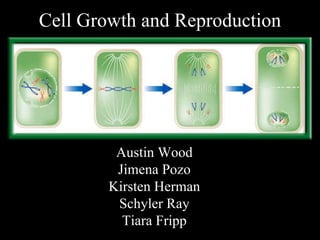
Cell Growth and Reproduction Austin Wood Jimena Pozo Kirsten Herman Schyler Ray Tiara Fripp
Cell Growth and Reproduction Cell Theory:  All cells come from pre-existing cells Cell Division: Cells produced from one cell (parent cell) Result is two or more identical cells Repairs worn-out tissue (ex: skin)  Allows organisms to grow and change  Ivy to wrap around a trellis
Cell Growth and Reproduction Chromatin:  long strands of DNA wrapped around proteins Chromosomes exist as chromatin for most of cell’s lifetime Spaghetti noodles Chromosomes carry genetic information that is copied and passed on to new cells Like wound spaghetti
Cell Growth and Reproduction Chromosome Chromatin
Cell Growth and Reproduction Before cell division, chromosome is in spaghetti-like CHROMATIN state As cell division begins, chromosomes take on a new tightly packed shape
Cell Growth and Reproduction Cell Cycle:  Sequence of growth and division of the cell. Majority of cell’s life is spent during INTERPHASE or the cell’s growth period
Cell Growth and Reproduction INTERPHASE: Longest phase:  Growth Phase Cell grows in size Carries on metabolism Chromosomes are duplicated to prepare for division 3 Stages:
Cell Growth and Reproduction INTERPHASE: 3 Stages:  Cell grows, protein production is high Cell copies its chromosomes Centrioles replicate and cell prepares for division
Cell Growth and Reproduction After INTERPHASE, cell enters period of division, also called MITOSIS Mitosis:  period of cell division Forms two daughter cells with complete set of chromosomes Mitosis
Cell Growth and Reproduction MITOSIS: As cell gets to the maximum size, it begins to undergo MITOSIS (cell division) FOUR PHASES: Prophase Metaphase Anaphase Telophase
Cell Growth and Reproduction 1 st  Phase of Mitosis:  PROPHASE Long stringy chromatin coils up into visible chromosomes Spindle fibers Disappearing nuclear envelope Doubled chromosome
Cell Growth and Reproduction 1 st  Phase of Mitosis:  PROPHASE Each duplicated chromosome is made of two halves called SISTER CHROMATIDS Sister chromatids
Cell Growth and Reproduction 1 st  Phase of Mitosis:  PROPHASE Towards end of Prophase, nucleus begins to disappear as nuclear envelope and nucleolus disintegrate Centrioles begin to migrate to opposite ends of cells
Cell Growth and Reproduction 1 st  Phase of Mitosis:  PROPHASE Sister chromatids held together by CENTROMERE Located just outside of nucleus Plays role in chromatid separation Centromere
Cell Growth and Reproduction 1 st  Phase of Mitosis:  PROPHASE As pairs of CENTRIOLES move to opposite ends of cell, the SPINDLE forms between them SPINDLE:  football-shaped, cage-like structure Separates sister chromatids during Mitosis Spindle
Cell Growth and Reproduction PROPHASE:  Let’s break it down Chromosomes coil up Sister Chromatids form Nucleolus and Nuclear Envelope disintegrates Centrioles migrate to opposite ends Spindles form between Centrioles
Cell Growth and Reproduction 2 nd  Phase of Mitosis:  METAPHASE Doubled chromosomes attach to spindle fibers by centromeres Chromosomes pulled up by spindle fibers and begin to line up on equator of spindles
Cell Growth and Reproduction 2 nd  Phase of Mitosis:  METAPHASE One sister chromatid’s spindle fiber extends to one pole while other spindle fiber extends to opposite pole
Cell Growth and Reproduction 2 nd  Phase of Mitosis:  METAPHASE What is the importance? This arrangement of the chromatids ensures that each new cell receives identical and complete set of chromosomes (DNA)
Cell Growth and Reproduction 3 rd  Phase of Mitosis:  ANAPHASE Beginning of sister chromatid separation Centromeres split Chromosomes separate from each other Shortening of spindle fibers pull apart chromatids to opposite poles
Cell Growth and Reproduction 4 th  Phase of Mitosis:  TELOPHASE Begins once chromatids reach opposite poles Chromosomes begin to to unwind Spindle breaks down
Cell Growth and Reproduction 4 th  Phase of Mitosis:  TELOPHASE Nucleolus and nuclear envelope reappears around new set of chromosomes Double membrane forms between two new nuclei Two daughter cells formed
Cell Growth and Reproduction Cytokinesis: After Telophase, cell’s cytoplasm divides Animal Cells: At end of Telophase, plasma membrane pinches off forming two separate cells. Plant Cells:  Cell plate laid across cell’s equator—there is no pinching off.  Cell membrane forms around each cell and new cell walls form on each side of cell plate
Cell Growth and Reproduction Cytokinesis:
Cell Growth and Reproduction What are the results of Mitosis? Single Cell organism remains a single cell but has replicated itself Multicellular organisms have grown or created another cell that will work together as tissue to perform a certain function

cell+reproduction

  • 1.
    Cell Growth andReproduction Austin Wood Jimena Pozo Kirsten Herman Schyler Ray Tiara Fripp
  • 2.
    Cell Growth andReproduction Cell Theory: All cells come from pre-existing cells Cell Division: Cells produced from one cell (parent cell) Result is two or more identical cells Repairs worn-out tissue (ex: skin) Allows organisms to grow and change Ivy to wrap around a trellis
  • 3.
    Cell Growth andReproduction Chromatin: long strands of DNA wrapped around proteins Chromosomes exist as chromatin for most of cell’s lifetime Spaghetti noodles Chromosomes carry genetic information that is copied and passed on to new cells Like wound spaghetti
  • 4.
    Cell Growth andReproduction Chromosome Chromatin
  • 5.
    Cell Growth andReproduction Before cell division, chromosome is in spaghetti-like CHROMATIN state As cell division begins, chromosomes take on a new tightly packed shape
  • 6.
    Cell Growth andReproduction Cell Cycle: Sequence of growth and division of the cell. Majority of cell’s life is spent during INTERPHASE or the cell’s growth period
  • 7.
    Cell Growth andReproduction INTERPHASE: Longest phase: Growth Phase Cell grows in size Carries on metabolism Chromosomes are duplicated to prepare for division 3 Stages:
  • 8.
    Cell Growth andReproduction INTERPHASE: 3 Stages: Cell grows, protein production is high Cell copies its chromosomes Centrioles replicate and cell prepares for division
  • 9.
    Cell Growth andReproduction After INTERPHASE, cell enters period of division, also called MITOSIS Mitosis: period of cell division Forms two daughter cells with complete set of chromosomes Mitosis
  • 10.
    Cell Growth andReproduction MITOSIS: As cell gets to the maximum size, it begins to undergo MITOSIS (cell division) FOUR PHASES: Prophase Metaphase Anaphase Telophase
  • 11.
    Cell Growth andReproduction 1 st Phase of Mitosis: PROPHASE Long stringy chromatin coils up into visible chromosomes Spindle fibers Disappearing nuclear envelope Doubled chromosome
  • 12.
    Cell Growth andReproduction 1 st Phase of Mitosis: PROPHASE Each duplicated chromosome is made of two halves called SISTER CHROMATIDS Sister chromatids
  • 13.
    Cell Growth andReproduction 1 st Phase of Mitosis: PROPHASE Towards end of Prophase, nucleus begins to disappear as nuclear envelope and nucleolus disintegrate Centrioles begin to migrate to opposite ends of cells
  • 14.
    Cell Growth andReproduction 1 st Phase of Mitosis: PROPHASE Sister chromatids held together by CENTROMERE Located just outside of nucleus Plays role in chromatid separation Centromere
  • 15.
    Cell Growth andReproduction 1 st Phase of Mitosis: PROPHASE As pairs of CENTRIOLES move to opposite ends of cell, the SPINDLE forms between them SPINDLE: football-shaped, cage-like structure Separates sister chromatids during Mitosis Spindle
  • 16.
    Cell Growth andReproduction PROPHASE: Let’s break it down Chromosomes coil up Sister Chromatids form Nucleolus and Nuclear Envelope disintegrates Centrioles migrate to opposite ends Spindles form between Centrioles
  • 17.
    Cell Growth andReproduction 2 nd Phase of Mitosis: METAPHASE Doubled chromosomes attach to spindle fibers by centromeres Chromosomes pulled up by spindle fibers and begin to line up on equator of spindles
  • 18.
    Cell Growth andReproduction 2 nd Phase of Mitosis: METAPHASE One sister chromatid’s spindle fiber extends to one pole while other spindle fiber extends to opposite pole
  • 19.
    Cell Growth andReproduction 2 nd Phase of Mitosis: METAPHASE What is the importance? This arrangement of the chromatids ensures that each new cell receives identical and complete set of chromosomes (DNA)
  • 20.
    Cell Growth andReproduction 3 rd Phase of Mitosis: ANAPHASE Beginning of sister chromatid separation Centromeres split Chromosomes separate from each other Shortening of spindle fibers pull apart chromatids to opposite poles
  • 21.
    Cell Growth andReproduction 4 th Phase of Mitosis: TELOPHASE Begins once chromatids reach opposite poles Chromosomes begin to to unwind Spindle breaks down
  • 22.
    Cell Growth andReproduction 4 th Phase of Mitosis: TELOPHASE Nucleolus and nuclear envelope reappears around new set of chromosomes Double membrane forms between two new nuclei Two daughter cells formed
  • 23.
    Cell Growth andReproduction Cytokinesis: After Telophase, cell’s cytoplasm divides Animal Cells: At end of Telophase, plasma membrane pinches off forming two separate cells. Plant Cells: Cell plate laid across cell’s equator—there is no pinching off. Cell membrane forms around each cell and new cell walls form on each side of cell plate
  • 24.
    Cell Growth andReproduction Cytokinesis:
  • 25.
    Cell Growth andReproduction What are the results of Mitosis? Single Cell organism remains a single cell but has replicated itself Multicellular organisms have grown or created another cell that will work together as tissue to perform a certain function