The Competence-Innovation
Loop
Glenn Martin
The College
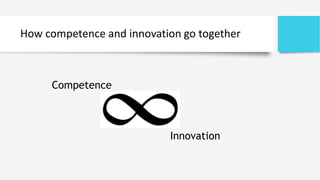
How competence and innovation go together
Competence
Innovation
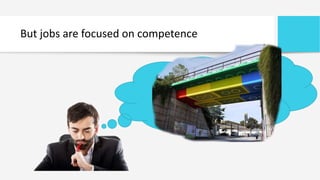
But jobs are focused on competence
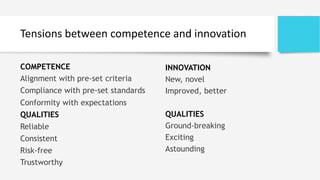
Tensions between competence and innovation
COMPETENCE
Alignment with pre-set criteria
Compliance with pre-set standards
Conformity with expectations
QUALITIES
Reliable
Consistent
Risk-free
Trustworthy
INNOVATION
New, novel
Improved, better
QUALITIES
Ground-breaking
Exciting
Astounding
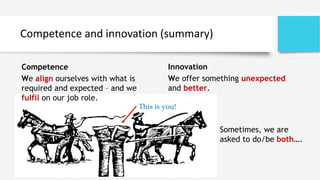
Competence and innovation (summary)
Innovation
We offer something unexpected
and better.
Competence
We align ourselves with what is
required and expected – and we
fulfil on our job role.
This is you!
Sometimes, we are
asked to do/be both….
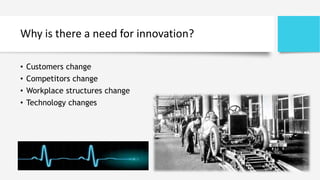
Why is there a need for innovation?
• Customers change
• Competitors change
• Workplace structures change
• Technology changes
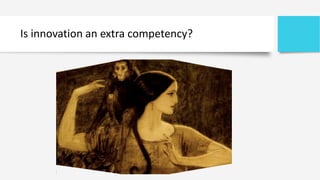
Is innovation an extra competency?
Innovation as a competence
“To build innovation muscle, companies must
include innovation in their competency models.”
1. Creativity
2. Enterprising
3. Integrating perspectives
4. Forecasting
5. Managing change
(Drew Boyd)
Where does innovation get into the picture?
Norwest skytrain construction at Memorial Avenue, Kellyville, 2016
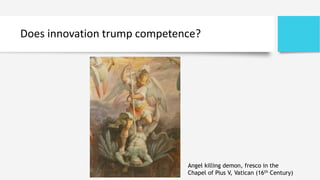
Does innovation trump competence?
Angel killing demon, fresco in the
Chapel of Pius V, Vatican (16th Century)
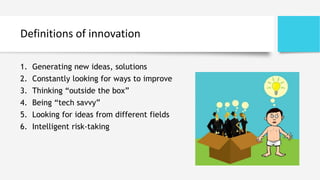
Definitions of innovation
1. Generating new ideas, solutions
2. Constantly looking for ways to improve
3. Thinking “outside the box”
4. Being “tech savvy”
5. Looking for ideas from different fields
6. Intelligent risk-taking
Simple definition of innovation
People implementing
new ideas
that create value.
- Hattori & Wycoff (Innovation training, 2004)
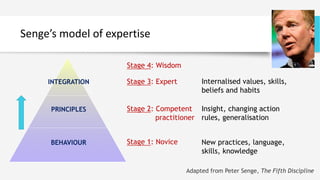
Senge’s model of expertise
Stage 1: Novice
Stage 2: Competent
practitioner
Stage 3: Expert
BEHAVIOUR
PRINCIPLES
INTEGRATION
Adapted from Peter Senge, The Fifth Discipline
Stage 4: Wisdom
New practices, language,
skills, knowledge
Insight, changing action
rules, generalisation
Internalised values, skills,
beliefs and habits
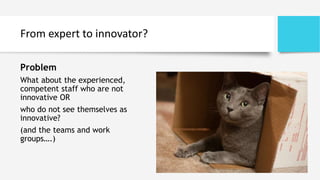
From expert to innovator?
Problem
What about the experienced,
competent staff who are not
innovative OR
who do not see themselves as
innovative?
(and the teams and work
groups….)
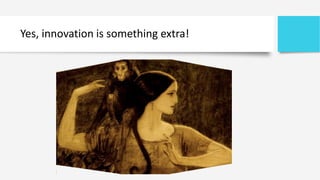
Yes, innovation is something extra!
Reconciling expertise and innovation
Focus on expertise
Novice: Language and basic
practices
Competent practitioner:
Insights, principles, generalise
across contexts
Expert: Internalised skills,
values, beliefs, habits
Focus on innovation
Creating what is new, novel,
better, improved, enhanced,
exciting….?
How??!
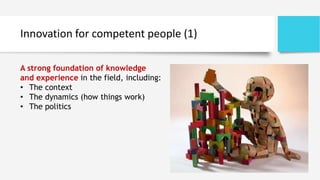
Innovation for competent people (1)
A strong foundation of knowledge
and experience in the field, including:
• The context
• The dynamics (how things work)
• The politics
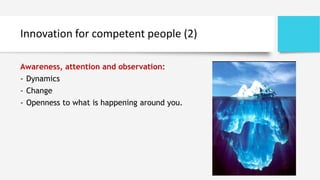
Innovation for competent people (2)
Awareness, attention and observation:
- Dynamics
- Change
- Openness to what is happening around you.
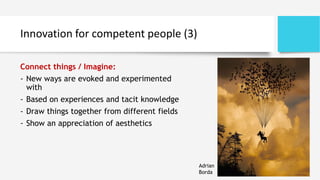
Innovation for competent people (3)
Connect things / Imagine:
- New ways are evoked and experimented
with
- Based on experiences and tacit knowledge
- Draw things together from different fields
- Show an appreciation of aesthetics
Adrian
Borda
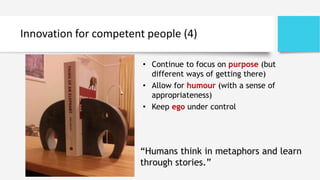
Innovation for competent people (4)
“Humans think in metaphors and learn
through stories.”
• Continue to focus on purpose (but
different ways of getting there)
• Allow for humour (with a sense of
appropriateness)
• Keep ego under control
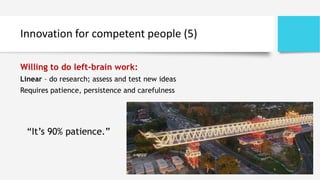
Innovation for competent people (5)
Willing to do left-brain work:
Linear – do research; assess and test new ideas
Requires patience, persistence and carefulness
“It’s 90% patience.”
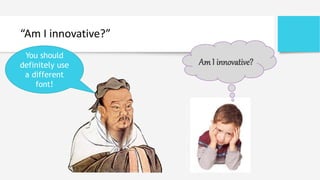
“Am I innovative?”
AmI innovative?
You should
definitely use
a different
font!
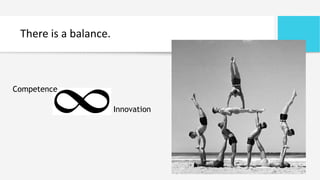
There is a balance.
Competence
Innovation
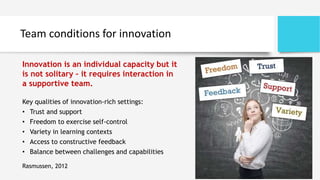
Team conditions for innovation
Key qualities of innovation-rich settings:
• Trust and support
• Freedom to exercise self-control
• Variety in learning contexts
• Access to constructive feedback
• Balance between challenges and capabilities
Rasmussen, 2012
Innovation is an individual capacity but it
is not solitary – it requires interaction in
a supportive team.
The College Blended Learning Team
Glenn Martin
Stacey Figueira
David White
Carole Stanford
John O’Connor
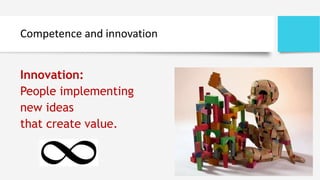
Competence and innovation
Innovation:
People implementing
new ideas
that create value.
Sources and resources
Boyd, Drew and Goldenberg, Jacob, 2014, Inside the Box: A Proven System
of Creativity for Breakthrough. See post by Drew Boyd
Greene, Robert, 2012, Mastery, Penguin, New York.
Hudson, Ken, 2008, The idea accelerator, Allen & Unwin, Sydney.
Klein, Gary 1999, Sources of power: How people make decisions, MIT
Press, Cambridge MA.
Rasmussen, Palle 2012, Creative and innovative competence as a task for
adult education, ELM Magazine, Issue 4.
Senge Peter, 1992, The fifth discipline, Random House, Sydney.
Slides: See www.slideshare.net (Search for Glenn Martin; beware the
impostors)

The Competence innovation Loop

  • 1.
  • 2.
    How competence andinnovation go together Competence Innovation
  • 3.
    But jobs arefocused on competence
  • 4.
    Tensions between competenceand innovation COMPETENCE Alignment with pre-set criteria Compliance with pre-set standards Conformity with expectations QUALITIES Reliable Consistent Risk-free Trustworthy INNOVATION New, novel Improved, better QUALITIES Ground-breaking Exciting Astounding
  • 5.
    Competence and innovation(summary) Innovation We offer something unexpected and better. Competence We align ourselves with what is required and expected – and we fulfil on our job role. This is you! Sometimes, we are asked to do/be both….
  • 6.
    Why is therea need for innovation? • Customers change • Competitors change • Workplace structures change • Technology changes
  • 7.
    Is innovation anextra competency?
  • 8.
    Innovation as acompetence “To build innovation muscle, companies must include innovation in their competency models.” 1. Creativity 2. Enterprising 3. Integrating perspectives 4. Forecasting 5. Managing change (Drew Boyd)
  • 9.
    Where does innovationget into the picture? Norwest skytrain construction at Memorial Avenue, Kellyville, 2016
  • 10.
    Does innovation trumpcompetence? Angel killing demon, fresco in the Chapel of Pius V, Vatican (16th Century)
  • 11.
    Definitions of innovation 1.Generating new ideas, solutions 2. Constantly looking for ways to improve 3. Thinking “outside the box” 4. Being “tech savvy” 5. Looking for ideas from different fields 6. Intelligent risk-taking
  • 12.
    Simple definition ofinnovation People implementing new ideas that create value. - Hattori & Wycoff (Innovation training, 2004)
  • 13.
    Senge’s model ofexpertise Stage 1: Novice Stage 2: Competent practitioner Stage 3: Expert BEHAVIOUR PRINCIPLES INTEGRATION Adapted from Peter Senge, The Fifth Discipline Stage 4: Wisdom New practices, language, skills, knowledge Insight, changing action rules, generalisation Internalised values, skills, beliefs and habits
  • 14.
    From expert toinnovator? Problem What about the experienced, competent staff who are not innovative OR who do not see themselves as innovative? (and the teams and work groups….)
  • 15.
    Yes, innovation issomething extra!
  • 16.
    Reconciling expertise andinnovation Focus on expertise Novice: Language and basic practices Competent practitioner: Insights, principles, generalise across contexts Expert: Internalised skills, values, beliefs, habits Focus on innovation Creating what is new, novel, better, improved, enhanced, exciting….? How??!
  • 17.
    Innovation for competentpeople (1) A strong foundation of knowledge and experience in the field, including: • The context • The dynamics (how things work) • The politics
  • 18.
    Innovation for competentpeople (2) Awareness, attention and observation: - Dynamics - Change - Openness to what is happening around you.
  • 19.
    Innovation for competentpeople (3) Connect things / Imagine: - New ways are evoked and experimented with - Based on experiences and tacit knowledge - Draw things together from different fields - Show an appreciation of aesthetics Adrian Borda
  • 20.
    Innovation for competentpeople (4) “Humans think in metaphors and learn through stories.” • Continue to focus on purpose (but different ways of getting there) • Allow for humour (with a sense of appropriateness) • Keep ego under control
  • 21.
    Innovation for competentpeople (5) Willing to do left-brain work: Linear – do research; assess and test new ideas Requires patience, persistence and carefulness “It’s 90% patience.”
  • 22.
    “Am I innovative?” AmIinnovative? You should definitely use a different font!
  • 23.
    There is abalance. Competence Innovation
  • 24.
    Team conditions forinnovation Key qualities of innovation-rich settings: • Trust and support • Freedom to exercise self-control • Variety in learning contexts • Access to constructive feedback • Balance between challenges and capabilities Rasmussen, 2012 Innovation is an individual capacity but it is not solitary – it requires interaction in a supportive team.
  • 25.
    The College BlendedLearning Team Glenn Martin Stacey Figueira David White Carole Stanford John O’Connor
  • 26.
    Competence and innovation Innovation: Peopleimplementing new ideas that create value.
  • 27.
    Sources and resources Boyd,Drew and Goldenberg, Jacob, 2014, Inside the Box: A Proven System of Creativity for Breakthrough. See post by Drew Boyd Greene, Robert, 2012, Mastery, Penguin, New York. Hudson, Ken, 2008, The idea accelerator, Allen & Unwin, Sydney. Klein, Gary 1999, Sources of power: How people make decisions, MIT Press, Cambridge MA. Rasmussen, Palle 2012, Creative and innovative competence as a task for adult education, ELM Magazine, Issue 4. Senge Peter, 1992, The fifth discipline, Random House, Sydney. Slides: See www.slideshare.net (Search for Glenn Martin; beware the impostors)