Blockchains:
What and Why
Dr. Gavin Wood
co-founder, ethereum project
founder, ethcore limited
@gavofyork
Take a step back
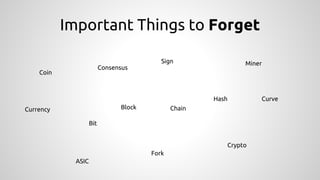
Important Things to Forget
Coin
Crypto
Currency
Bit
ChainBlock
Hash
Consensus
Fork
MinerSign
ASIC
Curve
What is the Blockchain?
A Blockchain is...
A Byzantine-Fault-Tolerant decentralised
singleton fixed-function state-transition
system
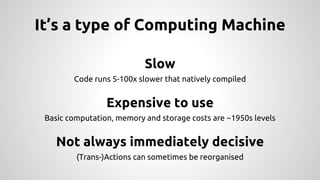
It’s a type of Computing Machine
Slow
Code runs 5-100x slower that natively compiled
Expensive to use
Basic computation, memory and storage costs are ~1950s levels
Not always immediately decisive
(Trans-)Actions can sometimes be reorganised
Sounds. Awesome.
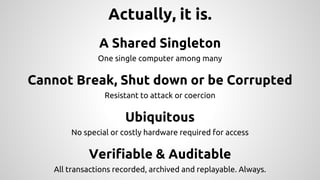
Actually, it is.
A Shared Singleton
One single computer among many
Cannot Break, Shut down or be Corrupted
Resistant to attack or coercion
Ubiquitous
No special or costly hardware required for access
Verifiable & Auditable
All transactions recorded, archived and replayable. Always.
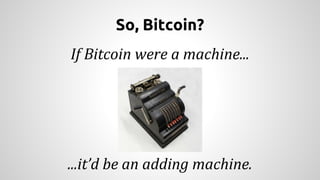
So, Bitcoin?
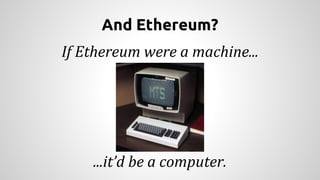
And Ethereum?
Natively Multi-User
Has as many accounts as is needed
Natively Object-Oriented
Encapsulation enforced in “virtual silicon”
Accessible
Wherever there’s Javascript, there’s Ethereum
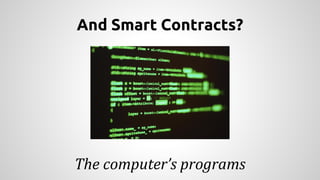
And Smart Contracts?
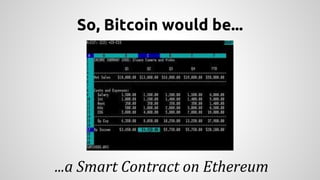
So, Bitcoin would be...
Guarantees for Smart Contracts
Atomicity
Entire operation runs or nothing does
Synchrony
No two operations can interfere with each other
Provenance
All messages (method calls) can be inspected to determine caller address
Guarantees
Permanence
Object’s data are permanent
Immortality
Object can never be externally deleted - can only voluntarily commit suicide
Immutability
Object’s code can never be changed
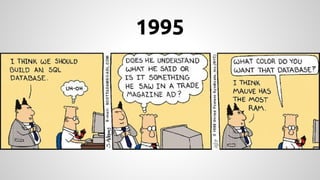
1995
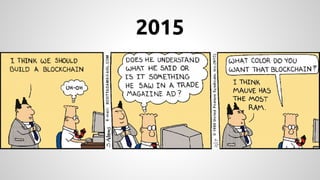
2015
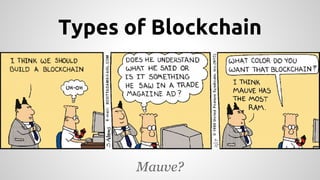
Mauve?
Types of Blockchain
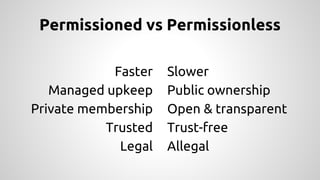
Permissioned vs Permissionless
Faster
Managed upkeep
Private membership
Trusted
Legal
Slower
Public ownership
Open & transparent
Trust-free
Allegal
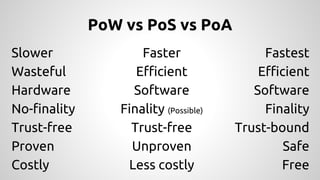
PoW vs PoS vs PoA
Slower
Wasteful
Hardware
No-finality
Trust-free
Proven
Costly
Fastest
Efficient
Software
Finality
Trust-bound
Safe
Free
Faster
Efficient
Software
Finality (Possible)
Trust-free
Unproven
Less costly
Why?
Compared to connection-poor siloes
Innovation Turbocharger
Walled Gardens
Interoperability Difficult
Reliability, standards, trust, security collude to make it a nightmare
Increased Barriers
For integrating multi-party, multi-domain systems
Cumbersome
Servers are expensive to set up and maintain;
Blockchain always-on, always ready
Not to mention Security
Auditability
All results are readily auditable from their inputs
Security
Fewer servers and databases to hack
Authenticity
All interactions are cryptographically signed:
Unauthorised Interactions are Impossible
A bridge across trust boundaries
Diffuses the Trust
Problem
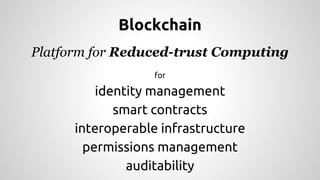
Blockchain
Platform for Reduced-trust Computing
for
identity management
smart contracts
interoperable infrastructure
permissions management
auditability
Why Not?
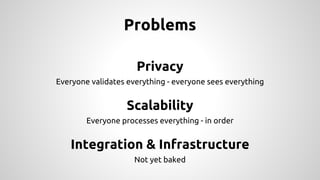
Problems
Privacy
Everyone validates everything - everyone sees everything
Scalability
Everyone processes everything - in order
Integration & Infrastructure
Not yet baked
Blockchain:
What and Why
Dr. Gavin Wood
@gavofyork
Questions?

Blockchain what and why-

  • 1.
    Blockchains: What and Why Dr.Gavin Wood co-founder, ethereum project founder, ethcore limited @gavofyork
  • 2.
  • 3.
    Important Things toForget Coin Crypto Currency Bit ChainBlock Hash Consensus Fork MinerSign ASIC Curve
  • 4.
    What is theBlockchain?
  • 5.
    A Blockchain is... AByzantine-Fault-Tolerant decentralised singleton fixed-function state-transition system
  • 7.
    It’s a typeof Computing Machine Slow Code runs 5-100x slower that natively compiled Expensive to use Basic computation, memory and storage costs are ~1950s levels Not always immediately decisive (Trans-)Actions can sometimes be reorganised
  • 8.
  • 9.
    Actually, it is. AShared Singleton One single computer among many Cannot Break, Shut down or be Corrupted Resistant to attack or coercion Ubiquitous No special or costly hardware required for access Verifiable & Auditable All transactions recorded, archived and replayable. Always.
  • 10.
  • 11.
  • 12.
    Natively Multi-User Has asmany accounts as is needed Natively Object-Oriented Encapsulation enforced in “virtual silicon” Accessible Wherever there’s Javascript, there’s Ethereum
  • 13.
  • 14.
  • 15.
    Guarantees for SmartContracts Atomicity Entire operation runs or nothing does Synchrony No two operations can interfere with each other Provenance All messages (method calls) can be inspected to determine caller address
  • 16.
    Guarantees Permanence Object’s data arepermanent Immortality Object can never be externally deleted - can only voluntarily commit suicide Immutability Object’s code can never be changed
  • 17.
  • 18.
  • 19.
  • 20.
    Permissioned vs Permissionless Faster Managedupkeep Private membership Trusted Legal Slower Public ownership Open & transparent Trust-free Allegal
  • 21.
    PoW vs PoSvs PoA Slower Wasteful Hardware No-finality Trust-free Proven Costly Fastest Efficient Software Finality Trust-bound Safe Free Faster Efficient Software Finality (Possible) Trust-free Unproven Less costly
  • 22.
  • 23.
    Compared to connection-poorsiloes Innovation Turbocharger
  • 24.
    Walled Gardens Interoperability Difficult Reliability,standards, trust, security collude to make it a nightmare Increased Barriers For integrating multi-party, multi-domain systems Cumbersome Servers are expensive to set up and maintain; Blockchain always-on, always ready
  • 25.
    Not to mentionSecurity Auditability All results are readily auditable from their inputs Security Fewer servers and databases to hack Authenticity All interactions are cryptographically signed: Unauthorised Interactions are Impossible
  • 26.
    A bridge acrosstrust boundaries Diffuses the Trust Problem
  • 27.
    Blockchain Platform for Reduced-trustComputing for identity management smart contracts interoperable infrastructure permissions management auditability
  • 28.
  • 29.
    Problems Privacy Everyone validates everything- everyone sees everything Scalability Everyone processes everything - in order Integration & Infrastructure Not yet baked
  • 30.
    Blockchain: What and Why Dr.Gavin Wood @gavofyork Questions?