
Block chains and
Consensus Algorithms
BY JERRY D CHAN
WALLSTREETTECHNOLOGIST.COM
BITTOKU.CO.JP
Public Block chain (Bitcoin,Ethereum)
Block chain, not Blockchain!
A collection of transactions
Time-stamped grouping in blocks
Proof of Work to decide sequencing
Token to incentivize validators (block writers) to remain in consensus
Public, permission-less, censorship-resistant, pseudo-anonymous
Private Block chains (Consensus Ledgers)
aka distributed ledgers, aka private block chains
Shared multi writer database
Control and participation in the network is private/permissioned
Ownership of the assets represented is public
Use of cryptographic keys to restrict asset ownership changes into the ledger
If no PoW, why blocks?
Private Block chains vs multi-writer Dbs
Better immutability guarantees with simplified audit trail
No super-user roles
Ownership of the data / Ownership of the Db
No central 3rd party acting as a gatekeeper for controlling the modification of that data
Token vs Token-less
◦ PBFT + Merkel Root + PGP + P2P + TRUST == Private Block chain
◦ PBFT + Merkel Root + PGP + P2P + TOKEN == Permissioned Block chain
Are they secure?
Benefits of Private Block Chains
Allows a group of companies to pool resources and reduce costs in a trust reduced way
Local money corporate money
Real time settlement between counterparties (for certain markets)
Potentially replace SWIFT, but only if money is taken off banks and put into settlement chain
Potentially replace 3rd party settlement business, trade aggregators/netting services
Benefits of Public Block Chains
Global permission-less
Trust minimized
Censorship resistant
Commodity like deflationary money which is not based on debt
IoT, DAOs, DACs
Internet vs AOL, Napster (mp3), Telecoms (skype), Personal Banking (?)
Potential Issues
Flash crash (liquidity) risk
Increased attack risk
Systematic risk
Legal risk
Operational risk vs Systematic risk
About me
Blog: wallstreettechnologist.com
twitter: @digitsu
jerry.d.chan@bittoku.co.jp
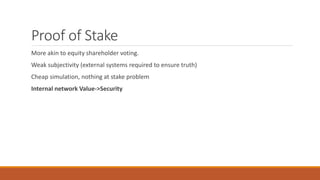
Proof of Stake
More akin to equity shareholder voting.
Weak subjectivity (external systems required to ensure truth)
Cheap simulation, nothing at stake problem
Internal network Value->Security
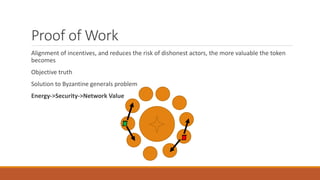
Proof of Work
Alignment of incentives, and reduces the risk of dishonest actors, the more valuable the token
becomes
Objective truth
Solution to Byzantine generals problem
Energy->Security->Network Value

Block Chains and Consensus Algos

  • 1.
    Block chains and ConsensusAlgorithms BY JERRY D CHAN WALLSTREETTECHNOLOGIST.COM BITTOKU.CO.JP
  • 2.
    Public Block chain(Bitcoin,Ethereum) Block chain, not Blockchain! A collection of transactions Time-stamped grouping in blocks Proof of Work to decide sequencing Token to incentivize validators (block writers) to remain in consensus Public, permission-less, censorship-resistant, pseudo-anonymous
  • 3.
    Private Block chains(Consensus Ledgers) aka distributed ledgers, aka private block chains Shared multi writer database Control and participation in the network is private/permissioned Ownership of the assets represented is public Use of cryptographic keys to restrict asset ownership changes into the ledger If no PoW, why blocks?
  • 4.
    Private Block chainsvs multi-writer Dbs Better immutability guarantees with simplified audit trail No super-user roles Ownership of the data / Ownership of the Db No central 3rd party acting as a gatekeeper for controlling the modification of that data Token vs Token-less ◦ PBFT + Merkel Root + PGP + P2P + TRUST == Private Block chain ◦ PBFT + Merkel Root + PGP + P2P + TOKEN == Permissioned Block chain Are they secure?
  • 5.
    Benefits of PrivateBlock Chains Allows a group of companies to pool resources and reduce costs in a trust reduced way Local money corporate money Real time settlement between counterparties (for certain markets) Potentially replace SWIFT, but only if money is taken off banks and put into settlement chain Potentially replace 3rd party settlement business, trade aggregators/netting services
  • 6.
    Benefits of PublicBlock Chains Global permission-less Trust minimized Censorship resistant Commodity like deflationary money which is not based on debt IoT, DAOs, DACs Internet vs AOL, Napster (mp3), Telecoms (skype), Personal Banking (?)
  • 7.
    Potential Issues Flash crash(liquidity) risk Increased attack risk Systematic risk Legal risk Operational risk vs Systematic risk
  • 9.
    About me Blog: wallstreettechnologist.com twitter:@digitsu jerry.d.chan@bittoku.co.jp
  • 10.
    Proof of Stake Moreakin to equity shareholder voting. Weak subjectivity (external systems required to ensure truth) Cheap simulation, nothing at stake problem Internal network Value->Security
  • 11.
    Proof of Work Alignmentof incentives, and reduces the risk of dishonest actors, the more valuable the token becomes Objective truth Solution to Byzantine generals problem Energy->Security->Network Value

Editor's Notes

  • #2 Blockchain is not one word. it was never one word. It was 2.
  • #3 token value ensures that the price of defrauding the network is less that being honest changing any block will invalidate the children of that block – tamper evident pow is required for someone to write a block
  • #4 blocks because of the need to make atomic changes in batches
  • #5 If no token, then how is security provided? token block chains use PoW or PoS to secure it. Ripple case of txn header malleation
  • #6 Not that much more efficient than current model with standards for asset representation (like FIX protocol) everyone stores a copy of the same db, instead of everyone keeping their own records and reconciling daily. Elimination of batch reconciliation means that trading can happen 24/7 and reconciliation can happen in real time. Unfortunately, interfacting with the outside world means falling back to a batch process, so the gains are somewhat limited. Not everything can be made real time. For instance CVA and VAR calculations are expensive and must be done in batch, so it is not practical to have them done in realtime. It increases volatility in the system, small short term errors or disturbances can cascade through the systems and do damage, where as daily batches act as natural circuit breakers. (like how phones used to act as them) Trade aggregators only if legal liability issue can be solved.
  • #7 permissionless use, guarantees censorship free. You need a money if you are going to pay for drones to deliver your amazon packages. Much less trust required that a private block chain
  • #8 more value on chain incentivizes more attacks if an insecure chain is used then more dangerous than 3rd party risk. Who is legally culpable?
  • #9 News on Japan payment method legalized Bitcoin Financial firms may need to register with FSA Public Block chains Coinbase, Circle, Blockchain.info, Bitpay, Abra, Blockstream, Steam Private Block chains R3CEV, Eris, DAH, Ripple, Ascribe, IBM
  • #11 most private blockchains use something like PoS. The richer you are (in network coin terms), the more influence you have There are some potential solutions to nothing at stake problem, but nothing that I have seen to work at scale as yet. No energy means no external value need to be injected into the system, stakeholders are only stay for speculative reasons, value can exit the network as quickly as it enters. Network value is assumed and grown via self bootstrapping with newcomers paying for the exit of early joiners. (ponzi like)
  • #12 Energy is used as a medium of conversion of value from external system to internal system. Energy use insures that value can only enter the system but harder to exit. Network value is ‘grown’ is bootstrapped by utility, a intrinsic value