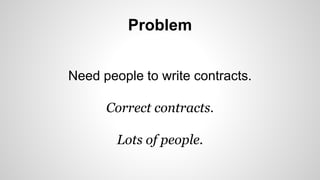
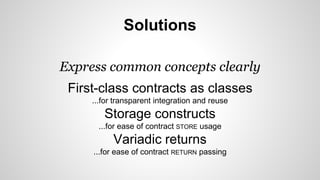
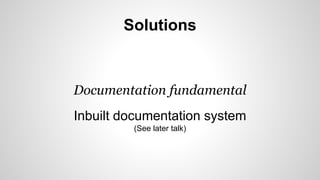
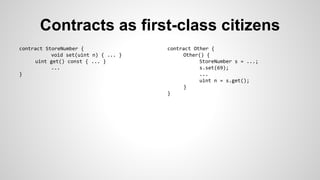
Solidity is a programming language for writing smart contracts on the Ethereum blockchain. It aims to make writing correct contracts easier by having syntax similar to JavaScript to leverage existing developer skills, expressing concepts clearly through classes for reuse, and making testing and formal proofing of contracts simpler. Solidity also includes features like an inbuilt documentation system and storage constructs to facilitate contract development and ensure contracts behave as intended.



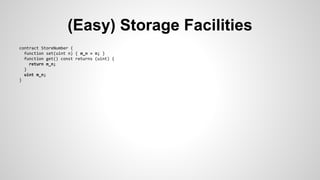
![(Easy) Storage Facilities
struct Endpoint {
uint32 ipv4;
uint16 port;
}
contract Endpoints {
function set(uint32 _ipv4, uint16 _port) {
var end = new Endpoint({ipv4: _ipv4, port:
_port});
m_ends[msg.caller] = end;
}
function kill() { delete m_ends[msg.caller]; }
mapping { address => Endpoint } m_ends;
}](https://image.slidesharecdn.com/ylwiqa0ltkmvk8tj6zfd-signature-51056598ff1416d4f7908ba9b552c0dd5efedd50717a73ea99fc30f360a97619-poli-141130115011-conversion-gate01/85/Solidity-9-320.jpg)
![Variadic Returns
contract Endpoints {
function set(uint32 _ipv4, uint16 _port) {
var end = new Endpoint({ipv4: _ipv4, port:
_port});
m_ends[msg.caller] = end;
}
function kill() { delete m_ends[msg.caller]; }
function get(address _a) const
returns (uint32, uint16) {
return m_ends[_a];
}
mapping { address => Endpoint } m_ends;
}](https://image.slidesharecdn.com/ylwiqa0ltkmvk8tj6zfd-signature-51056598ff1416d4f7908ba9b552c0dd5efedd50717a73ea99fc30f360a97619-poli-141130115011-conversion-gate01/85/Solidity-10-320.jpg)
![Formal Proofing
contract Cash {
function give(address _a, uint32 _amount) {
if (m_balances[msg.caller] >= _amount) {
m_balances[msg.caller] -= _amount;
m_balances[_a] += _amount;
}
}
function balance(address _a) const returns (uint32)
{
return m_balances[_a];
}
mapping { address => uint64 } m_balances;
construction:
m_balances[msg.caller] = 1000000000;
invariant:
reduce(+, map(valueOf, m_balances)) == 1000000000;
}](https://image.slidesharecdn.com/ylwiqa0ltkmvk8tj6zfd-signature-51056598ff1416d4f7908ba9b552c0dd5efedd50717a73ea99fc30f360a97619-poli-141130115011-conversion-gate01/85/Solidity-11-320.jpg)
![Inbuilt Docs (NatSpec)
contract Cash {
/// Transfers `_amount` cash from your account
/// `msg.caller` to the account controlled by `_a`.
function give(address _a, uint32 _amount) {
if (m_balances[msg.caller] >= _amount) {
m_balances[msg.caller] -= _amount;
m_balances[_a] += _amount;
}
}
/// Returns the amount of cash controlled by account
/// `_a`.
function balance(address _a) const returns (uint32)
{
return m_balances[_a];
}
mapping { address => uint64 } m_balances;
construction:
/// Creator of contract is endowed with balance of
/// 1000000000.
m_balances[msg.caller] = 1000000000;
invariant:
/// Total cash in system is always 1000000000.
reduce(+, map(valueOf, m_balances)) == 1000000000;
}](https://image.slidesharecdn.com/ylwiqa0ltkmvk8tj6zfd-signature-51056598ff1416d4f7908ba9b552c0dd5efedd50717a73ea99fc30f360a97619-poli-141130115011-conversion-gate01/85/Solidity-12-320.jpg)