


Blockchain, smart contracts
introduction
© Lukasz Jarmulowicz 2016
TL; DR
- History, background
- Solved problems
- How it works (wallets, transactions, mining)
- Ethereum, Smart contracts
- Profit
Why bitcoin?
Ledger
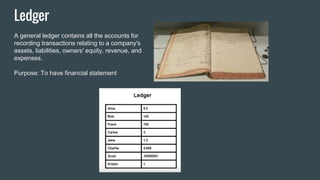
A general ledger contains all the accounts for
recording transactions relating to a company's
assets, liabilities, owners' equity, revenue, and
expenses.
Purpose: To have financial statement
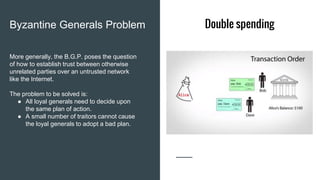
Double spendingByzantine Generals Problem
More generally, the B.G.P. poses the question
of how to establish trust between otherwise
unrelated parties over an untrusted network
like the Internet.
The problem to be solved is:
● All loyal generals need to decide upon
the same plan of action.
● A small number of traitors cannot cause
the loyal generals to adopt a bad plan.
Bitcoin
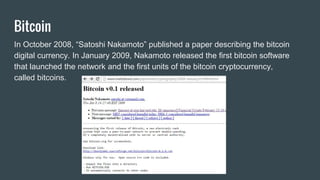
In October 2008, “Satoshi Nakamoto” published a paper describing the bitcoin
digital currency. In January 2009, Nakamoto released the first bitcoin software
that launched the network and the first units of the bitcoin cryptocurrency,
called bitcoins.
Distributed ledger - Blockchain
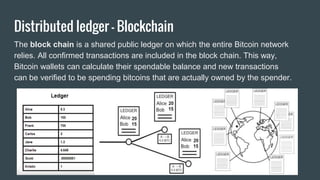
The block chain is a shared public ledger on which the entire Bitcoin network
relies. All confirmed transactions are included in the block chain. This way,
Bitcoin wallets can calculate their spendable balance and new transactions
can be verified to be spending bitcoins that are actually owned by the spender.
A mysterious new technology emerges, seemingly out of nowhere, but actually the
result of two decades of intense research and development by nearly anonymous
researchers.
...
Eventually mainstream products, companies and industries emerge to commercialize
it; its effects become profound; and later, many people wonder why its powerful
promise wasn’t more obvious from the start.
...
What technology am I talking about? Personal computers in 1975, the Internet in 1993,
and – I believe – Bitcoin in 2014
Marc Andreesen, creator of Netscape Navigator
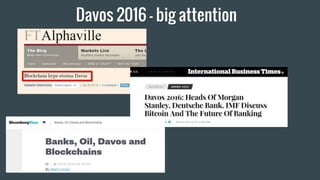
Davos 2016 - big attention
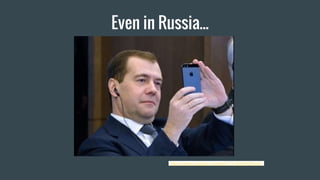
Even in Russia...
https://www.youtube.com/watch?v=BXlAH2fhyoU
Ok, ok.. but how it works ?
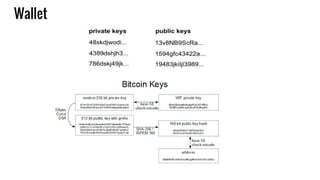
Wallet
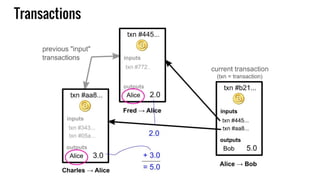
Transactions
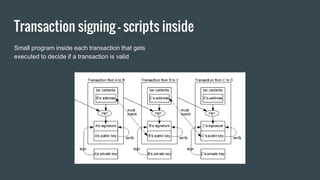
Transaction signing - scripts inside
Small program inside each transaction that gets
executed to decide if a transaction is valid
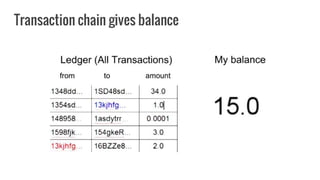
Transaction chain gives balance
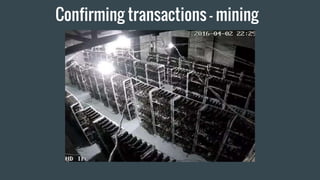
Confirming transactions - mining
Mining - blocks
Bitcoin mining is the process that puts
transactions into a block, to make sure everyone
has a consistent view of the transaction log.
Mining is also the mechanism for new bitcoins to
enter the system. When a block is successfully
mined, new bitcoins are generated in the block
and paid to the miner.
This mining bounty is large - currently 25
bitcoins per block (~ $14,000).
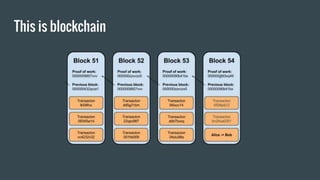
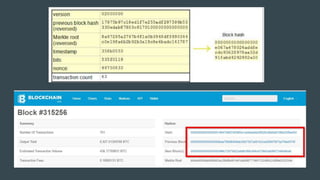
This is blockchain
Recap
Wallets
Transactions
Transaction chain > balance
Mining > creating linked blocks
Example?
Ethereum, smart contracts
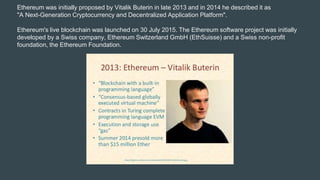
Ethereum was initially proposed by Vitalik Buterin in late 2013 and in 2014 he described it as
"A Next-Generation Cryptocurrency and Decentralized Application Platform".
Ethereum's live blockchain was launched on 30 July 2015. The Ethereum software project was initially
developed by a Swiss company, Ethereum Switzerland GmbH (EthSuisse) and a Swiss non-profit
foundation, the Ethereum Foundation.
Ethereum Virtual Machine
Programmable blockchain - Rather than give
users a set of pre-defined operations (e.g.
bitcoin transactions), Ethereum allows users to
create their own operations of any complexity
they wish.
Bitcoin blockchain was purely a list of
transactions, Ethereum’s basic unit is the
account. The Ethereum blockchain tracks the
state of every account, and all state transitions
on the Ethereum blockchain are transfers of
value and information between accounts.
Platform for many different types of
decentralized blockchain applications, including
but not limited to cryptocurrencies.
Smart contracts
● Contracts lives on the Ethereum blockchain
● Have own Ethereum address and balance
● Can send and receive transactions
● “Activated” when you send a transaction to it
Smart contracts
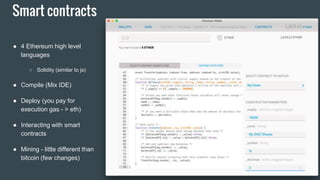
● 4 Ethereum high level
languages
○ Solidity (similar to js)
● Compile (Mix IDE)
● Deploy (you pay for
execution gas - > eth)
● Interacting with smart
contracts
● Mining - little different than
bitcoin (few changes)
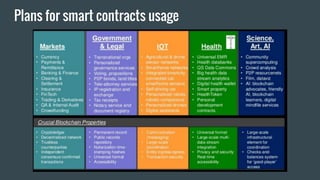
Plans for smart contracts usage
ETHEREUM AS A ‘WORLD
COMPUTER’
Computation on Ethereum is slow
and expensive.
(currently similar to smartphone?!)
For computation, there are better,
cheaper and faster alternatives that
don’t require blockchains and all
that.
Ethereum can create
various forms of economic
alignment, shared purpose
and coordination between
thousands of anonymous
people, at a fraction of a
cost compared to
alternatives (legal
frameworks).
Sharing economy (ex. uber,
airbnb) will be everywhere.
Decentralized autonomous organizations (“DAO”)
● Best comparable to a digital company, but without an attached legal entity
● The Owner (kind of admin) can add (or remove) voting members to the organization
● Any member can make a proposal (by sending transaction or execute contract)
● People vote on proposals
● Allows people to participate in risks & rewards of digital ventures
Cons
Scalability
Confidentiality
Valuations
No Buyer Protection - real time
Thank you.
Questions?
© Lukasz Jarmulowicz 2016

Blockchain, smart contracts - introduction

  • 1.
  • 2.
    TL; DR - History,background - Solved problems - How it works (wallets, transactions, mining) - Ethereum, Smart contracts - Profit
  • 3.
  • 4.
    Ledger A general ledgercontains all the accounts for recording transactions relating to a company's assets, liabilities, owners' equity, revenue, and expenses. Purpose: To have financial statement
  • 5.
    Double spendingByzantine GeneralsProblem More generally, the B.G.P. poses the question of how to establish trust between otherwise unrelated parties over an untrusted network like the Internet. The problem to be solved is: ● All loyal generals need to decide upon the same plan of action. ● A small number of traitors cannot cause the loyal generals to adopt a bad plan.
  • 6.
    Bitcoin In October 2008,“Satoshi Nakamoto” published a paper describing the bitcoin digital currency. In January 2009, Nakamoto released the first bitcoin software that launched the network and the first units of the bitcoin cryptocurrency, called bitcoins.
  • 7.
    Distributed ledger -Blockchain The block chain is a shared public ledger on which the entire Bitcoin network relies. All confirmed transactions are included in the block chain. This way, Bitcoin wallets can calculate their spendable balance and new transactions can be verified to be spending bitcoins that are actually owned by the spender.
  • 8.
    A mysterious newtechnology emerges, seemingly out of nowhere, but actually the result of two decades of intense research and development by nearly anonymous researchers. ... Eventually mainstream products, companies and industries emerge to commercialize it; its effects become profound; and later, many people wonder why its powerful promise wasn’t more obvious from the start. ... What technology am I talking about? Personal computers in 1975, the Internet in 1993, and – I believe – Bitcoin in 2014 Marc Andreesen, creator of Netscape Navigator
  • 10.
    Davos 2016 -big attention
  • 11.
  • 12.
    Ok, ok.. buthow it works ?
  • 13.
  • 14.
  • 15.
    Transaction signing -scripts inside Small program inside each transaction that gets executed to decide if a transaction is valid
  • 16.
  • 17.
  • 18.
    Mining - blocks Bitcoinmining is the process that puts transactions into a block, to make sure everyone has a consistent view of the transaction log. Mining is also the mechanism for new bitcoins to enter the system. When a block is successfully mined, new bitcoins are generated in the block and paid to the miner. This mining bounty is large - currently 25 bitcoins per block (~ $14,000).
  • 19.
  • 21.
    Recap Wallets Transactions Transaction chain >balance Mining > creating linked blocks Example?
  • 22.
  • 23.
    Ethereum was initiallyproposed by Vitalik Buterin in late 2013 and in 2014 he described it as "A Next-Generation Cryptocurrency and Decentralized Application Platform". Ethereum's live blockchain was launched on 30 July 2015. The Ethereum software project was initially developed by a Swiss company, Ethereum Switzerland GmbH (EthSuisse) and a Swiss non-profit foundation, the Ethereum Foundation.
  • 24.
    Ethereum Virtual Machine Programmableblockchain - Rather than give users a set of pre-defined operations (e.g. bitcoin transactions), Ethereum allows users to create their own operations of any complexity they wish. Bitcoin blockchain was purely a list of transactions, Ethereum’s basic unit is the account. The Ethereum blockchain tracks the state of every account, and all state transitions on the Ethereum blockchain are transfers of value and information between accounts. Platform for many different types of decentralized blockchain applications, including but not limited to cryptocurrencies.
  • 25.
    Smart contracts ● Contractslives on the Ethereum blockchain ● Have own Ethereum address and balance ● Can send and receive transactions ● “Activated” when you send a transaction to it
  • 26.
    Smart contracts ● 4Ethereum high level languages ○ Solidity (similar to js) ● Compile (Mix IDE) ● Deploy (you pay for execution gas - > eth) ● Interacting with smart contracts ● Mining - little different than bitcoin (few changes)
  • 27.
    Plans for smartcontracts usage
  • 28.
    ETHEREUM AS A‘WORLD COMPUTER’ Computation on Ethereum is slow and expensive. (currently similar to smartphone?!) For computation, there are better, cheaper and faster alternatives that don’t require blockchains and all that. Ethereum can create various forms of economic alignment, shared purpose and coordination between thousands of anonymous people, at a fraction of a cost compared to alternatives (legal frameworks). Sharing economy (ex. uber, airbnb) will be everywhere.
  • 29.
    Decentralized autonomous organizations(“DAO”) ● Best comparable to a digital company, but without an attached legal entity ● The Owner (kind of admin) can add (or remove) voting members to the organization ● Any member can make a proposal (by sending transaction or execute contract) ● People vote on proposals ● Allows people to participate in risks & rewards of digital ventures
  • 30.
  • 32.

Editor's Notes

  • #5 Fra Luca Bartolomeo de Pacioli - XV wiek - wspolpracownik LEO matematyk, uważany za "ojca rachunkowości“ Sprawozdanie finansowe – uporządkowane przedstawienie sytuacji finansowej i finansowych wyników działalności podmiotu gospodarczego Ask Aleksander if it’s important
  • #6 The problem was originally framed in terms of a group of generals camped around an enemy city. - Plan (atak, ucieczka, kiedy atak) but can't ever meet in person. The only means of communication is by messenger sent by foot from one camp to another. Further complicating matters, not every general can be trusted to be loyal to the cause. Jest uogólnieniem problemu dwóch armii[3] albo problemu dwóch generałów.
  • #15 A Bitcoin transaction moves bitcoins between one or more inputs and outputs. Each input is a transaction and address supplying bitcoins. Each output is an address receiving bitcoin, along with the amount of bitcoins going to that address.
  • #22 IBM Blockchain? https://youtu.be/IgNfoQQ5Reg?t=4s