Progress Report
Parity
Parity
What is Parity?
Parity Ethereum Client is software made by Parity Technologies
● Acts as a “full” node on the Ethereum network
● Keeps a synchronised block chain to audit other nodes
● Manages secret keys; signs and publishes transactions
● Written in Rust for correctness, performance and footprint
● Portable - works on Windows, Mac OS and Linux/Unix
● Modular actor-based architecture for reliability
Parity
What is Parity?
Advanced Ethereum client:
● State-trie pruning keeps database size to a minimum
● Auto-upgrading keeps node up to date via smart-contract
● Light-client operation for minimal-resource/embedded clients
● Chain-specification files for multi-chain interoperability
● Consensus-abstraction for pluggable consensus algorithms
Parity
PAR
● Fully syncs in around 60s
● Serves & shares:
○ Compressed, condensed,
aggregated state-trie data
○ Cryptographic manifests
● Multi-level security
● Downloads receipts &
transactions to ensure full
compatibility
Parity wire protocol for
Warp-sync
Parity
PIP
● Builds on Foundation’s LES
protocol
● Request pipelining to
minimize round-trips
● Responses fully provable:
sybil attack resistant
Parity light client Protocol
Parity
Vaults
Keep your addresses to
yourself
● Geth-dialect of wallet files
include address in plaintext
● Vaults encrypt address and
other metadata of key files
● One path = one password
● Enter path’s password to
see addresses of key files
Parity
Deep Tracing
Figure out what really
happened
● New trace_ API
● Allows for:
○ state deltas
○ VM trace
○ deep transaction trace
● Used for:
○ preview transactions
○ re-run transactions
Parity
Tendermint
Proof-of-Authority /
Proof-of-Stake pluggable
consensus algorithm
● High-performance
PBFT-based consensus
algorithm
● Authorities controlled via
smart-contract
● Proof-of-Stake variant
Parity
Stratum
Support for Stratum
notification
● High-performance mining
hardware can get TCP
notifications of new work
Parity
Scheduled
transactions
Transactions can be
published only on certain
conditions
● Avoid publishing
transactions until a
specified:
○ Block number
○ Block timestamp
● “Alarm clock”
● Scheduled transactions
persist between runs
Parity
Auto-updating
Parity will stay in sync with
the network. Always.
● Multiple functions:
○ Always
○ Never
○ Track versus minor-version
○ Critical only
○ Download only
● Controlled by
smart-contract
● Smart-contract has
partially-automated,
multi-phase multi-key
system
Parity
Parity Infrastructure
Smart contracts and services
● Registry hierarchical name registry
● TokenReg, DappReg, BadgeReg network-maintained indexes
● GithubHint/URLHint hash to URL hint system
● Operations Client version & consensus algorithm database/DAO
● SMSVerification SMS-based identity verification system
● EmailVerification e-Mail-based identity verification system
Parity
Operations
The right information to
keep network operations
going.
● Multi-stakeholder smart
contract
● Multi-client, multi-track,
multi-release,
multi-binary
● Tracks consensus protocol
● Implements much of
“Yellow Paper council”
● Forks require teams signoff
● Chronicles which releases
support which forks
Parity
SMS-Certifier
First tool to fight Sybil
● Centralised service :(
● Accounts get certified that
they have unique phone
associated
● Low cost (12 Finney)
● No data released on chain
● Only hash stored on server
Parity
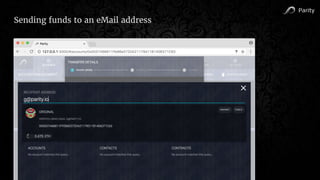
Email-Certifier
Send Ether to an e-mail
address
● Centralised service :(
● Accounts get certified that
they correspond to an email
address
● Free
● Email hash placed on chain
● ETH address resolvable
Parity
What is Parity Wallet?
Primary user interface for the Parity Ethereum client
● Account/identity management
● Wallet management
● Contract development, deployment, management
● Secure authorisation & signing
● Transaction tracing and node management
● (Decentralised) Application publishing and management
● Chrome Browser Extension support
Parity
Account & Identity Management
● Name display: local and Registry
● Name input: local, Registry and e-Mail certified
● Displays Ether and Standard Tokens via Token Registry
● Displays certifications via Badge Registry
● Bestow and filter by tags
● Standard recovery phrase key generator
Parity
Accounts management
Parity
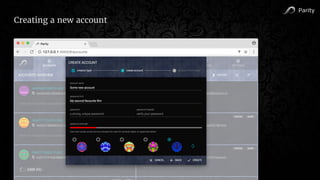
Creating a new account
Parity
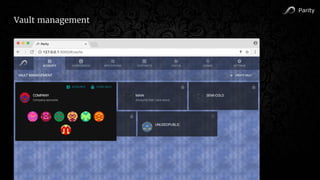
Vault management
Parity
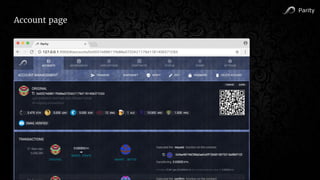
Account page
Parity
Sending funds to an eMail address
Parity
Wallet Management
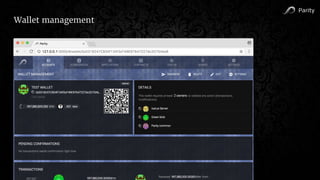
● Seamless multi-signature wallet support
● Similar to accounts: taggable, badges, tokens
● One-click transaction approval
● Efficient transaction history
● Coming-soon: Wallet support for approving DApp transactions
Parity
Wallet management
Parity
Contract Development/Deployment/Management
● Solidity editor and compiler
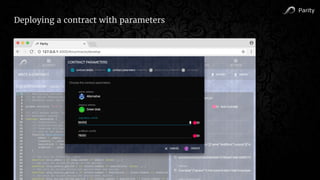
● Streamlined deployment
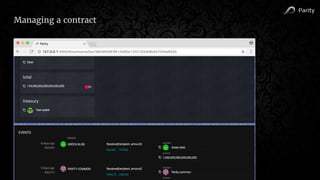
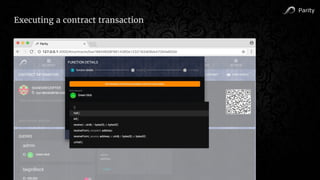
● Management interface for:
○ viewing public properties
○ calling into contract
○ executing transactions
○ inspecting events from contracts
Parity
Contract editor
Parity
Deploying a contract with parameters
Parity
Managing a contract
Parity
Executing a contract transaction
Parity
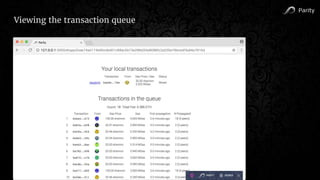
Secure Approval/Signing
● Multi-layer security approach:
○ Only isolated high-security Parity module for storing/using secrets
○ Only high-security API allows signing to be approved by supplying password
○ Only JS signer code served by Parity has access by default
● In-Application overlay (“Signer Snippet”)
○ Secure background pattern to ensure DApp isn’t sniffing password
○ Allows primary/default account selection
○ Identifies Application responsible for request
○ Works on Parity-hosted “DApplications” and Ethereum-enabled websites
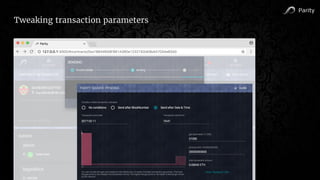
○ Allows tweaking of parameters (gas, gasPrice and conditional publishing)
Parity
Signer with pending transaction
Parity
Tweaking transaction parameters
Parity
Application Publication & Management
● DApp manifest allows for metadata display
● (Decentralised) Applications visible on main Applications page
● Three sections:
○ Local (those found in your parity/dapps directory)
○ Built-in (those that come bundled with Parity Wallet)
○ Network (those found published to the DApps Registry)
● Parity hosts all allowing for ease of development
● Coming soon: DApp permissions to allow certain DApps to access
greater portion of the API
Parity
Applications management
Parity
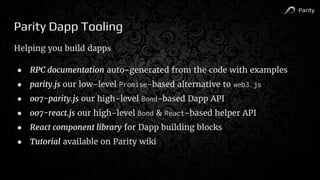
Node management & Transaction tracing
● View node information (consensus/chain/logging)
● Alter node operation (syncing & network)
● Published transactions can be traced
● View transaction queue to see nodes to which propagated
● May be resubmitted with altered gas/gasPrice
Parity
Viewing the transaction queue
Parity
Parity Dapp Tooling
Helping you build dapps
● RPC documentation auto-generated from the code with examples
● parity.js our low-level Promise-based alternative to web3.js
● oo7-parity.js our high-level Bond-based Dapp API
● oo7-react.js our high-level Bond & React-based helper API
● React component library for Dapp building blocks
● Tutorial available on Parity wiki
Parity
RPC Docs
Autogenerated RPC
documentation
● All Parity RPCs now have
markdown documentation
auto-generated from code
Parity
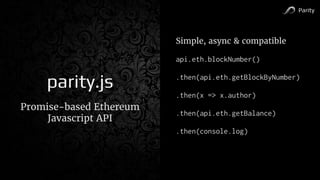
parity.js
Promise-based Ethereum
Javascript API
Simple, async & compatible
api.eth.blockNumber()
.then(api.eth.getBlockByNumber)
.then(x => x.author)
.then(api.eth.getBalance)
.then(console.log)
Parity
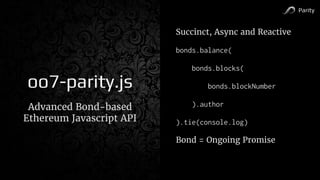
oo7-parity.js
Advanced Bond-based
Ethereum Javascript API
Succinct, Async and Reactive
bonds.balance(
bonds.blocks(
bonds.blockNumber
).author
).tie(console.log)
Bond = Ongoing Promise
Parity
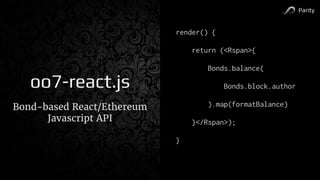
oo7-react.js
Bond-based React/Ethereum
Javascript API
render() {
return (<Rspan>{
Bonds.balance(
Bonds.block.author
).map(formatBalance)
}</Rspan>);
}
Parity
Works well with contracts
class App extends React.Component {
constructor() {
super();
this.coin = bonds.makeContract(
api.abi.erc20token,
bonds.registry.getAddress(‘gavcoin’, ‘A’)
);
}
render() {
return (<div>You have <Rspan>{
this.coin.balanceOf(bonds.accounts[0])
}</Rspan> GAV and <Rspan>{
bonds.balance(bonds.accounts[0])
.map(formatBalance)
}</Rspan>.</div>);
}
}
● Fully reactive
● Easy to extend
● Composable
● Simple API
● Promise-friendly
Parity
Create new Bonded React Components
class Account extends ReactiveComponent {
constructor() { super([‘address’]); }
render() {
return (<span>{self.state.address}
(<Balance value={
bonds.balance(self.state.address)
}/>)
</span>);
}
}
class Balance extends ReactiveComponent {
constructor() { super([‘value’]); }
render() {
return (<span>{
formatBalance(self.state.value)
}</span>);
}
}
● Fully reactive
● Easy to extend
● Composable
● Simple API
● Promise-friendly
What is Polkadot?
What does it provide?
Pooled security
all constituent chains of our community guaranteed
Trust-free transactions
constituent chains can send transactions to each other
Entirely general
free-form messages: no set semantics; same guarantees
as contract-calling in ethereum
How does it work?
Relay-chain
the top-level which coordinates consensus and
transaction delivery between constituents
Parachains
constituent chains which gather and process
transactions
Basics of the Relay-chain
No functionality
no external transactions, no smart contracts
Governance built-in
token ownership gives voting privileges
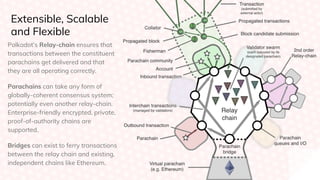
Polkadot’s Relay-chain ensures that
transactions between the constituent
parachains get delivered and that
they are all operating correctly.
Parachains can take any form of
globally-coherent consensus system;
potentially even another relay-chain.
Enterprise-friendly encrypted, private,
proof-of-authority chains are
supported.
Bridges can exist to ferry transactions
between the relay chain and existing,
independent chains like Ethereum.
Extensible, Scalable
and Flexible
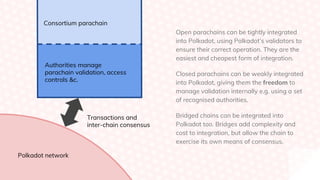
Open parachains can be tightly integrated
into Polkadot, using Polkadot’s validators to
ensure their correct operation. They are the
easiest and cheapest form of integration.
Closed parachains can be weakly integrated
into Polkadot, giving them the freedom to
manage validation internally e.g. using a set
of recognised authorities.
Bridged chains can be integrated into
Polkadot too. Bridges add complexity and
cost to integration, but allow the chain to
exercise its own means of consensus.
Polkadot network
Consortium parachain
Authorities manage
parachain validation, access
controls &c.
Transactions and
inter-chain consensus
Polkadot
Join the dots
@gavofyork @polkadotproject @polkadotnetwork
github.com/polkadot-io gitter.im/polkadot-io/Lobby

Parity Progress Report

  • 1.
  • 2.
    Parity What is Parity? ParityEthereum Client is software made by Parity Technologies ● Acts as a “full” node on the Ethereum network ● Keeps a synchronised block chain to audit other nodes ● Manages secret keys; signs and publishes transactions ● Written in Rust for correctness, performance and footprint ● Portable - works on Windows, Mac OS and Linux/Unix ● Modular actor-based architecture for reliability
  • 3.
    Parity What is Parity? AdvancedEthereum client: ● State-trie pruning keeps database size to a minimum ● Auto-upgrading keeps node up to date via smart-contract ● Light-client operation for minimal-resource/embedded clients ● Chain-specification files for multi-chain interoperability ● Consensus-abstraction for pluggable consensus algorithms
  • 4.
    Parity PAR ● Fully syncsin around 60s ● Serves & shares: ○ Compressed, condensed, aggregated state-trie data ○ Cryptographic manifests ● Multi-level security ● Downloads receipts & transactions to ensure full compatibility Parity wire protocol for Warp-sync
  • 5.
    Parity PIP ● Builds onFoundation’s LES protocol ● Request pipelining to minimize round-trips ● Responses fully provable: sybil attack resistant Parity light client Protocol
  • 6.
    Parity Vaults Keep your addressesto yourself ● Geth-dialect of wallet files include address in plaintext ● Vaults encrypt address and other metadata of key files ● One path = one password ● Enter path’s password to see addresses of key files
  • 7.
    Parity Deep Tracing Figure outwhat really happened ● New trace_ API ● Allows for: ○ state deltas ○ VM trace ○ deep transaction trace ● Used for: ○ preview transactions ○ re-run transactions
  • 8.
    Parity Tendermint Proof-of-Authority / Proof-of-Stake pluggable consensusalgorithm ● High-performance PBFT-based consensus algorithm ● Authorities controlled via smart-contract ● Proof-of-Stake variant
  • 9.
    Parity Stratum Support for Stratum notification ●High-performance mining hardware can get TCP notifications of new work
  • 10.
    Parity Scheduled transactions Transactions can be publishedonly on certain conditions ● Avoid publishing transactions until a specified: ○ Block number ○ Block timestamp ● “Alarm clock” ● Scheduled transactions persist between runs
  • 11.
    Parity Auto-updating Parity will stayin sync with the network. Always. ● Multiple functions: ○ Always ○ Never ○ Track versus minor-version ○ Critical only ○ Download only ● Controlled by smart-contract ● Smart-contract has partially-automated, multi-phase multi-key system

  • 12.
    Parity Parity Infrastructure Smart contractsand services ● Registry hierarchical name registry ● TokenReg, DappReg, BadgeReg network-maintained indexes ● GithubHint/URLHint hash to URL hint system ● Operations Client version & consensus algorithm database/DAO ● SMSVerification SMS-based identity verification system ● EmailVerification e-Mail-based identity verification system
  • 13.
    Parity Operations The right informationto keep network operations going. ● Multi-stakeholder smart contract ● Multi-client, multi-track, multi-release, multi-binary ● Tracks consensus protocol ● Implements much of “Yellow Paper council” ● Forks require teams signoff ● Chronicles which releases support which forks
  • 14.
    Parity SMS-Certifier First tool tofight Sybil ● Centralised service :( ● Accounts get certified that they have unique phone associated ● Low cost (12 Finney) ● No data released on chain ● Only hash stored on server
  • 15.
    Parity Email-Certifier Send Ether toan e-mail address ● Centralised service :( ● Accounts get certified that they correspond to an email address ● Free ● Email hash placed on chain ● ETH address resolvable
  • 16.
    Parity What is ParityWallet? Primary user interface for the Parity Ethereum client ● Account/identity management ● Wallet management ● Contract development, deployment, management ● Secure authorisation & signing ● Transaction tracing and node management ● (Decentralised) Application publishing and management ● Chrome Browser Extension support
  • 17.
    Parity Account & IdentityManagement ● Name display: local and Registry ● Name input: local, Registry and e-Mail certified ● Displays Ether and Standard Tokens via Token Registry ● Displays certifications via Badge Registry ● Bestow and filter by tags ● Standard recovery phrase key generator
  • 18.
  • 19.
  • 20.
  • 21.
  • 22.
    Parity Sending funds toan eMail address
  • 23.
    Parity Wallet Management ● Seamlessmulti-signature wallet support ● Similar to accounts: taggable, badges, tokens ● One-click transaction approval ● Efficient transaction history ● Coming-soon: Wallet support for approving DApp transactions
  • 24.
  • 25.
    Parity Contract Development/Deployment/Management ● Solidityeditor and compiler ● Streamlined deployment ● Management interface for: ○ viewing public properties ○ calling into contract ○ executing transactions ○ inspecting events from contracts
  • 26.
  • 27.
  • 28.
  • 29.
  • 30.
    Parity Secure Approval/Signing ● Multi-layersecurity approach: ○ Only isolated high-security Parity module for storing/using secrets ○ Only high-security API allows signing to be approved by supplying password ○ Only JS signer code served by Parity has access by default ● In-Application overlay (“Signer Snippet”) ○ Secure background pattern to ensure DApp isn’t sniffing password ○ Allows primary/default account selection ○ Identifies Application responsible for request ○ Works on Parity-hosted “DApplications” and Ethereum-enabled websites ○ Allows tweaking of parameters (gas, gasPrice and conditional publishing)
  • 31.
  • 32.
  • 33.
    Parity Application Publication &Management ● DApp manifest allows for metadata display ● (Decentralised) Applications visible on main Applications page ● Three sections: ○ Local (those found in your parity/dapps directory) ○ Built-in (those that come bundled with Parity Wallet) ○ Network (those found published to the DApps Registry) ● Parity hosts all allowing for ease of development ● Coming soon: DApp permissions to allow certain DApps to access greater portion of the API
  • 34.
  • 35.
    Parity Node management &Transaction tracing ● View node information (consensus/chain/logging) ● Alter node operation (syncing & network) ● Published transactions can be traced ● View transaction queue to see nodes to which propagated ● May be resubmitted with altered gas/gasPrice

  • 36.
  • 37.
    Parity Parity Dapp Tooling Helpingyou build dapps ● RPC documentation auto-generated from the code with examples ● parity.js our low-level Promise-based alternative to web3.js ● oo7-parity.js our high-level Bond-based Dapp API ● oo7-react.js our high-level Bond & React-based helper API ● React component library for Dapp building blocks ● Tutorial available on Parity wiki
  • 38.
    Parity RPC Docs Autogenerated RPC documentation ●All Parity RPCs now have markdown documentation auto-generated from code
  • 39.
    Parity parity.js Promise-based Ethereum Javascript API Simple,async & compatible api.eth.blockNumber() .then(api.eth.getBlockByNumber) .then(x => x.author) .then(api.eth.getBalance) .then(console.log)
  • 40.
    Parity oo7-parity.js Advanced Bond-based Ethereum JavascriptAPI Succinct, Async and Reactive bonds.balance( bonds.blocks( bonds.blockNumber ).author ).tie(console.log) Bond = Ongoing Promise
  • 41.
    Parity oo7-react.js Bond-based React/Ethereum Javascript API render(){ return (<Rspan>{ Bonds.balance( Bonds.block.author ).map(formatBalance) }</Rspan>); }
  • 42.
    Parity Works well withcontracts class App extends React.Component { constructor() { super(); this.coin = bonds.makeContract( api.abi.erc20token, bonds.registry.getAddress(‘gavcoin’, ‘A’) ); } render() { return (<div>You have <Rspan>{ this.coin.balanceOf(bonds.accounts[0]) }</Rspan> GAV and <Rspan>{ bonds.balance(bonds.accounts[0]) .map(formatBalance) }</Rspan>.</div>); } } ● Fully reactive ● Easy to extend ● Composable ● Simple API ● Promise-friendly
  • 43.
    Parity Create new BondedReact Components class Account extends ReactiveComponent { constructor() { super([‘address’]); } render() { return (<span>{self.state.address} (<Balance value={ bonds.balance(self.state.address) }/>) </span>); } } class Balance extends ReactiveComponent { constructor() { super([‘value’]); } render() { return (<span>{ formatBalance(self.state.value) }</span>); } } ● Fully reactive ● Easy to extend ● Composable ● Simple API ● Promise-friendly
  • 44.
  • 45.
    What does itprovide? Pooled security all constituent chains of our community guaranteed Trust-free transactions constituent chains can send transactions to each other Entirely general free-form messages: no set semantics; same guarantees as contract-calling in ethereum
  • 46.
    How does itwork? Relay-chain the top-level which coordinates consensus and transaction delivery between constituents Parachains constituent chains which gather and process transactions
  • 47.
    Basics of theRelay-chain No functionality no external transactions, no smart contracts Governance built-in token ownership gives voting privileges
  • 48.
    Polkadot’s Relay-chain ensuresthat transactions between the constituent parachains get delivered and that they are all operating correctly. Parachains can take any form of globally-coherent consensus system; potentially even another relay-chain. Enterprise-friendly encrypted, private, proof-of-authority chains are supported. Bridges can exist to ferry transactions between the relay chain and existing, independent chains like Ethereum. Extensible, Scalable and Flexible
  • 49.
    Open parachains canbe tightly integrated into Polkadot, using Polkadot’s validators to ensure their correct operation. They are the easiest and cheapest form of integration. Closed parachains can be weakly integrated into Polkadot, giving them the freedom to manage validation internally e.g. using a set of recognised authorities. Bridged chains can be integrated into Polkadot too. Bridges add complexity and cost to integration, but allow the chain to exercise its own means of consensus. Polkadot network Consortium parachain Authorities manage parachain validation, access controls &c. Transactions and inter-chain consensus
  • 50.
    Polkadot Join the dots @gavofyork@polkadotproject @polkadotnetwork github.com/polkadot-io gitter.im/polkadot-io/Lobby