Polkadot
Connected consensus
What is Polkadot?
What does it provide?
Pooled security
all constituent chains of our community guaranteed
Trust-free transactions
constituent chains can send transactions to each other
How does it work?
Relay-chain
the top-level which coordinates consensus and
transaction delivery between constituents
Parachains
constituent chains which gather and process
transactions
Basics of the Relay-chain
No functionality
no external transactions, no smart contracts
Fees levied
fees paid for voting/movement of tokens between
parachains
Governance of the Relay-chain
TBD
no big decisions made yet, but likely to take much from
present political structures; bi-cameral, multi-role
governance
Stakeholders hold final say
referendum mechanism built-in
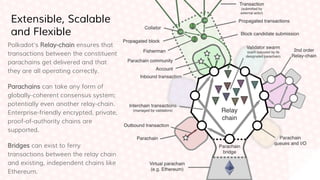
Polkadot’s Relay-chain ensures that
transactions between the constituent
parachains get delivered and that
they are all operating correctly.
Parachains can take any form of
globally-coherent consensus system;
potentially even another relay-chain.
Enterprise-friendly encrypted, private,
proof-of-authority chains are
supported.
Bridges can exist to ferry
transactions between the relay chain
and existing, independent chains like
Ethereum.
Extensible, Scalable
and Flexible
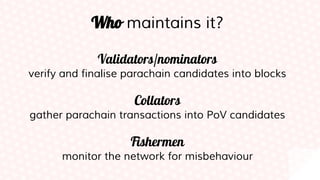
Who maintains it?
Validators/nominators
verify and finalise parachain candidates into blocks
Collators
gather parachain transactions into PoV candidates
Fishermen
monitor the network for misbehaviour
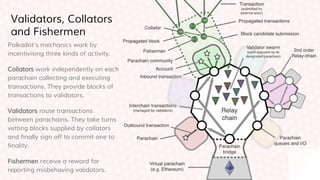
Polkadot’s mechanics work by
incentivising three kinds of activity.
Collators work independently on each
parachain collecting and executing
transactions. They provide blocks of
transactions to validators.
Validators route transactions
between parachains. They take turns
vetting blocks supplied by collators
and finally sign off to commit one to
finality.
Fishermen receive a reward for
reporting misbehaving validators.
Validators, Collators
and Fishermen
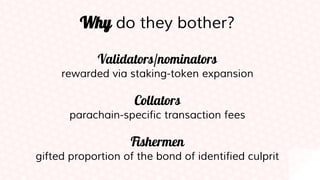
Why do they bother?
Validators/nominators
rewarded via staking-token expansion
Collators
parachain-specific transaction fees
Fishermen
gifted proportion of the bond of identified culprit
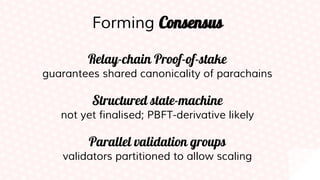
Forming Consensus
Relay-chain Proof-of-stake
guarantees shared canonicality of parachains
Structured state-machine
not yet finalised; PBFT-derivative likely
Parallel validation groups
validators partitioned to allow scaling
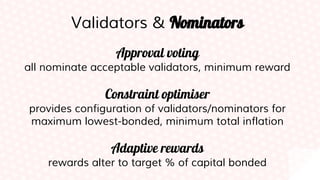
Validators & Nominators
Approval voting
all nominate acceptable validators, minimum reward
Constraint optimiser
provides configuration of validators/nominators for
maximum lowest-bonded, minimum total inflation
Adaptive rewards
rewards alter to target % of capital bonded
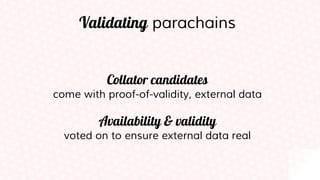
Validating parachains
Collator candidates
come with proof-of-validity, external data
Availability & validity
voted on to ensure external data real
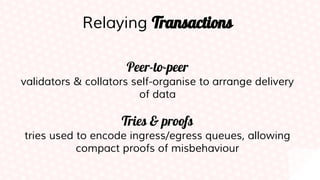
Relaying Transactions
Peer-to-peer
validators & collators self-organise to arrange delivery
of data
Tries & proofs
tries used to encode ingress/egress queues, allowing
compact proofs of misbehaviour
Ensuring Availability
Validators
consensus includes giving availability guarantees
Proof-of-Collator
registered collators can challenge data availability
Mild punishment
validators given slight reward reductions on complaints
Ensuring Fairness
important that collator set contains some good guys
Golden ticket
randomly selected address
Mild reward
for validators backing blocks whose collator’s address
is close to ticket
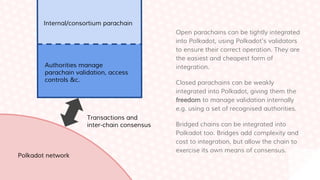
Open parachains can be tightly integrated
into Polkadot, using Polkadot’s validators
to ensure their correct operation. They are
the easiest and cheapest form of
integration.
Closed parachains can be weakly
integrated into Polkadot, giving them the
freedom to manage validation internally
e.g. using a set of recognised authorities.
Bridged chains can be integrated into
Polkadot too. Bridges add complexity and
cost to integration, but allow the chain to
exercise its own means of consensus.
Polkadot network
Internal/consortium parachain
Authorities manage
parachain validation, access
controls &c.
Transactions and
inter-chain consensus
Polkadot
Connected consensus
@gavofyork @polkadotproject @polkadotnetwork
github.com/polkadot-io gitter.im/polkadot-io/Lobby

Polkadot prezo

  • 1.
  • 2.
  • 3.
    What does itprovide? Pooled security all constituent chains of our community guaranteed Trust-free transactions constituent chains can send transactions to each other
  • 4.
    How does itwork? Relay-chain the top-level which coordinates consensus and transaction delivery between constituents Parachains constituent chains which gather and process transactions
  • 5.
    Basics of theRelay-chain No functionality no external transactions, no smart contracts Fees levied fees paid for voting/movement of tokens between parachains
  • 6.
    Governance of theRelay-chain TBD no big decisions made yet, but likely to take much from present political structures; bi-cameral, multi-role governance Stakeholders hold final say referendum mechanism built-in
  • 7.
    Polkadot’s Relay-chain ensuresthat transactions between the constituent parachains get delivered and that they are all operating correctly. Parachains can take any form of globally-coherent consensus system; potentially even another relay-chain. Enterprise-friendly encrypted, private, proof-of-authority chains are supported. Bridges can exist to ferry transactions between the relay chain and existing, independent chains like Ethereum. Extensible, Scalable and Flexible
  • 8.
    Who maintains it? Validators/nominators verifyand finalise parachain candidates into blocks Collators gather parachain transactions into PoV candidates Fishermen monitor the network for misbehaviour
  • 9.
    Polkadot’s mechanics workby incentivising three kinds of activity. Collators work independently on each parachain collecting and executing transactions. They provide blocks of transactions to validators. Validators route transactions between parachains. They take turns vetting blocks supplied by collators and finally sign off to commit one to finality. Fishermen receive a reward for reporting misbehaving validators. Validators, Collators and Fishermen
  • 10.
    Why do theybother? Validators/nominators rewarded via staking-token expansion Collators parachain-specific transaction fees Fishermen gifted proportion of the bond of identified culprit
  • 11.
    Forming Consensus Relay-chain Proof-of-stake guaranteesshared canonicality of parachains Structured state-machine not yet finalised; PBFT-derivative likely Parallel validation groups validators partitioned to allow scaling
  • 12.
    Validators & Nominators Approvalvoting all nominate acceptable validators, minimum reward Constraint optimiser provides configuration of validators/nominators for maximum lowest-bonded, minimum total inflation Adaptive rewards rewards alter to target % of capital bonded
  • 13.
    Validating parachains Collator candidates comewith proof-of-validity, external data Availability & validity voted on to ensure external data real
  • 14.
    Relaying Transactions Peer-to-peer validators &collators self-organise to arrange delivery of data Tries & proofs tries used to encode ingress/egress queues, allowing compact proofs of misbehaviour
  • 15.
    Ensuring Availability Validators consensus includesgiving availability guarantees Proof-of-Collator registered collators can challenge data availability Mild punishment validators given slight reward reductions on complaints
  • 16.
    Ensuring Fairness important thatcollator set contains some good guys Golden ticket randomly selected address Mild reward for validators backing blocks whose collator’s address is close to ticket
  • 17.
    Open parachains canbe tightly integrated into Polkadot, using Polkadot’s validators to ensure their correct operation. They are the easiest and cheapest form of integration. Closed parachains can be weakly integrated into Polkadot, giving them the freedom to manage validation internally e.g. using a set of recognised authorities. Bridged chains can be integrated into Polkadot too. Bridges add complexity and cost to integration, but allow the chain to exercise its own means of consensus. Polkadot network Internal/consortium parachain Authorities manage parachain validation, access controls &c. Transactions and inter-chain consensus
  • 18.
    Polkadot Connected consensus @gavofyork @polkadotproject@polkadotnetwork github.com/polkadot-io gitter.im/polkadot-io/Lobby