
Organizational Behavior
Presented by,
Ganesha Pandian N
1
Unit 1: Focus and Purpose
References: Organizational Behavior – Stephen P. Robbins; Ninth edition; Prentice hall
Publication
MSM-MBA I Semester 2020
Content
• Definition
• Need and Importance of OB
• Nature and Scope
• Framework
• Organization behavior models
2MSM-MBA I Semester 2020
Definitions you need to know in
Management
• Managers – individuals who achieve goals
through other people (subordinates)
• Organization – a consciously coordinated
social unit – to achieve common goals –
followed by hierarchy
3MSM-MBA I Semester 2020
• Planning – defining goals, establishing
strategies and plans to coordinate
activities
• Organizing – Determining  when need
to be done; how to be done; who will do
it; where it is executed; decision making
authority
4MSM-MBA I Semester 2020
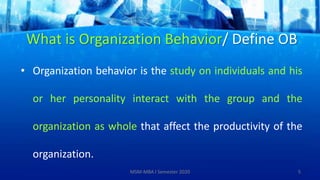
What is Organization Behavior/ Define OB
• Organization behavior is the study on individuals and his
or her personality interact with the group and the
organization as whole that affect the productivity of the
organization.
5MSM-MBA I Semester 2020
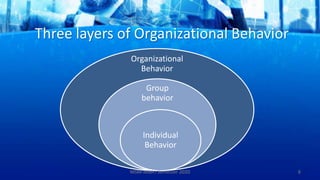
Three layers of Organizational Behavior
6
Organizational
Behavior
Group
behavior
Individual
Behavior
MSM-MBA I Semester 2020
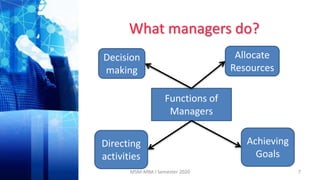
What managers do?
7
Functions of
Managers
Decision
making
Allocate
Resources
Achieving
Goals
Directing
activities
MSM-MBA I Semester 2020
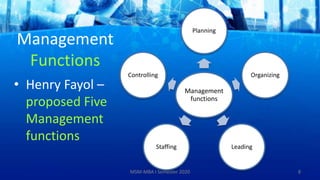
Management
Functions
8
• Henry Fayol –
proposed Five
Management
functions
Management
functions
Planning
Organizing
LeadingStaffing
Controlling
MSM-MBA I Semester 2020
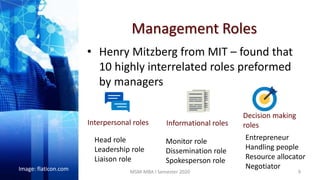
Management Roles
• Henry Mitzberg from MIT – found that
10 highly interrelated roles preformed
by managers
9
Interpersonal roles Informational roles
Decision making
roles
Head role
Leadership role
Liaison role
Monitor role
Dissemination role
Spokesperson role
Entrepreneur
Handling people
Resource allocator
NegotiatorImage: flaticon.com MSM-MBA I Semester 2020
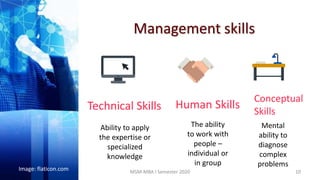
Management skills
10
Technical Skills
Ability to apply
the expertise or
specialized
knowledge
Human Skills
Conceptual
Skills
Image: flaticon.com
The ability
to work with
people –
individual or
in group
Mental
ability to
diagnose
complex
problems
MSM-MBA I Semester 2020
Effective Vs Successful Managerial
Activities
• Effectiveness – achieve the goals and making
performance
• Success – Getting promotion and moving fast in
career ladder.
• The successful mangers are having social and
political skills than the effective managers – proves
the Human factor
11MSM-MBA I Semester 2020
What is OB?
• It is about study of people what they do in the
organization.
• It emphasize behavior related to work
• Ob includes the core topics – Motivation leader
behavior and power, interpersonal communication,
group structure and processes, learning, attitude
development and perception and so on
12MSM-MBA I Semester 2020
Intuition into systematic study
• OB is an abstract concept
• Intuition: One’s feeling that is not
supported by research studies.
• Systematic study: Relationship between
one factor with another – cause and effect
13MSM-MBA I Semester 2020
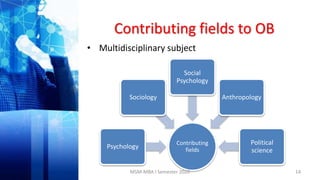
Contributing fields to OB
• Multidisciplinary subject
14
Contributing
fields
Psychology
Sociology
Social
Psychology
Anthropology
Political
science
MSM-MBA I Semester 2020
Problems in OB
• Science can be applied in all situation and are
contingent
• OB is complex study and are not generalized.
Since Human beings are complex in nature.
• Same person behave differently in different
situations.
15
Image: flaticon.com MSM-MBA I Semester 2020
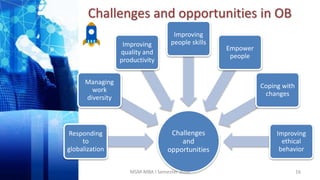
Challenges and opportunities in OB
16
Challenges
and
opportunities
Responding
to
globalization
Managing
work
diversity
Improving
quality and
productivity
Improving
people skills
Empower
people
Coping with
changes
Improving
ethical
behavior
MSM-MBA I Semester 2020
Developing OB model
• Model – an abstract of reality
• The dependent variables – Independent
variables
• Contingency OB model
17MSM-MBA I Semester 2020
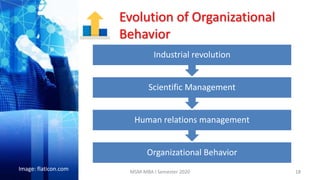
Evolution of Organizational
Behavior
18
Organizational Behavior
Human relations management
Scientific Management
Industrial revolution
Image: flaticon.com MSM-MBA I Semester 2020
Industrial Revolution
• Robert Owen – Father of personnel
Management
• Andrew Ure – published book on “The
philosophy of Manufacturers” in 1835
• Pension funds started in 1886 and the
compensation for accidents for 1895
19MSM-MBA I Semester 2020
Scientific Management
• Fredrick Taylor – Father of Scientific Management
1. Converted intuition to scientific approach
2. Emphasis on group action
3. Cooperation between different levels in organization
4. Maximizing the production
5. Selection and training through scientific techniques
20MSM-MBA I Semester 2020
Human Relations Movement
1. Great depression (1929) in US
2. Labor movement – French revolution and
Russian revolution
3. Hawthorne Studies – Elton Mayo (Father
of Human relations movement)
21MSM-MBA I Semester 2020
Hawthorne light illumination
experiment
• To find the impact of light on productivity
• Two group of employees chosen – Test group and
control group
• When conducting the research, the light does not
have significant impact
• Some external factor called “Human factor”
interfere the results
22
Image: flaticon.com MSM-MBA I Semester 2020
Nature of people
• Uniqueness – individual differences
• Perception – differs for different people in different
situations
• Motivation factor – boasts the productivity
• Causal Behavior – source of the behavior
• Desire for involvement – work consciousness
• Human dignity - Ego of an individual
23MSM-MBA I Semester 2020
Theoretical framework of OB
• Cognitive framework – Edward Tolman
• Behavioral framework – Ivan Pavlov and
John B Watson
• Social learning approaches – integrates
both the Cognitive framework and
Behavioral framework
24
Image: flaticon.com MSM-MBA I Semester 2020
25MSM-MBA I Semester 2020

Organizational behavior - Unit 1 : Focus and Purpose

  • 1.
    Organizational Behavior Presented by, GaneshaPandian N 1 Unit 1: Focus and Purpose References: Organizational Behavior – Stephen P. Robbins; Ninth edition; Prentice hall Publication MSM-MBA I Semester 2020
  • 2.
    Content • Definition • Needand Importance of OB • Nature and Scope • Framework • Organization behavior models 2MSM-MBA I Semester 2020
  • 3.
    Definitions you needto know in Management • Managers – individuals who achieve goals through other people (subordinates) • Organization – a consciously coordinated social unit – to achieve common goals – followed by hierarchy 3MSM-MBA I Semester 2020
  • 4.
    • Planning –defining goals, establishing strategies and plans to coordinate activities • Organizing – Determining  when need to be done; how to be done; who will do it; where it is executed; decision making authority 4MSM-MBA I Semester 2020
  • 5.
    What is OrganizationBehavior/ Define OB • Organization behavior is the study on individuals and his or her personality interact with the group and the organization as whole that affect the productivity of the organization. 5MSM-MBA I Semester 2020
  • 6.
    Three layers ofOrganizational Behavior 6 Organizational Behavior Group behavior Individual Behavior MSM-MBA I Semester 2020
  • 7.
    What managers do? 7 Functionsof Managers Decision making Allocate Resources Achieving Goals Directing activities MSM-MBA I Semester 2020
  • 8.
    Management Functions 8 • Henry Fayol– proposed Five Management functions Management functions Planning Organizing LeadingStaffing Controlling MSM-MBA I Semester 2020
  • 9.
    Management Roles • HenryMitzberg from MIT – found that 10 highly interrelated roles preformed by managers 9 Interpersonal roles Informational roles Decision making roles Head role Leadership role Liaison role Monitor role Dissemination role Spokesperson role Entrepreneur Handling people Resource allocator NegotiatorImage: flaticon.com MSM-MBA I Semester 2020
  • 10.
    Management skills 10 Technical Skills Abilityto apply the expertise or specialized knowledge Human Skills Conceptual Skills Image: flaticon.com The ability to work with people – individual or in group Mental ability to diagnose complex problems MSM-MBA I Semester 2020
  • 11.
    Effective Vs SuccessfulManagerial Activities • Effectiveness – achieve the goals and making performance • Success – Getting promotion and moving fast in career ladder. • The successful mangers are having social and political skills than the effective managers – proves the Human factor 11MSM-MBA I Semester 2020
  • 12.
    What is OB? •It is about study of people what they do in the organization. • It emphasize behavior related to work • Ob includes the core topics – Motivation leader behavior and power, interpersonal communication, group structure and processes, learning, attitude development and perception and so on 12MSM-MBA I Semester 2020
  • 13.
    Intuition into systematicstudy • OB is an abstract concept • Intuition: One’s feeling that is not supported by research studies. • Systematic study: Relationship between one factor with another – cause and effect 13MSM-MBA I Semester 2020
  • 14.
    Contributing fields toOB • Multidisciplinary subject 14 Contributing fields Psychology Sociology Social Psychology Anthropology Political science MSM-MBA I Semester 2020
  • 15.
    Problems in OB •Science can be applied in all situation and are contingent • OB is complex study and are not generalized. Since Human beings are complex in nature. • Same person behave differently in different situations. 15 Image: flaticon.com MSM-MBA I Semester 2020
  • 16.
    Challenges and opportunitiesin OB 16 Challenges and opportunities Responding to globalization Managing work diversity Improving quality and productivity Improving people skills Empower people Coping with changes Improving ethical behavior MSM-MBA I Semester 2020
  • 17.
    Developing OB model •Model – an abstract of reality • The dependent variables – Independent variables • Contingency OB model 17MSM-MBA I Semester 2020
  • 18.
    Evolution of Organizational Behavior 18 OrganizationalBehavior Human relations management Scientific Management Industrial revolution Image: flaticon.com MSM-MBA I Semester 2020
  • 19.
    Industrial Revolution • RobertOwen – Father of personnel Management • Andrew Ure – published book on “The philosophy of Manufacturers” in 1835 • Pension funds started in 1886 and the compensation for accidents for 1895 19MSM-MBA I Semester 2020
  • 20.
    Scientific Management • FredrickTaylor – Father of Scientific Management 1. Converted intuition to scientific approach 2. Emphasis on group action 3. Cooperation between different levels in organization 4. Maximizing the production 5. Selection and training through scientific techniques 20MSM-MBA I Semester 2020
  • 21.
    Human Relations Movement 1.Great depression (1929) in US 2. Labor movement – French revolution and Russian revolution 3. Hawthorne Studies – Elton Mayo (Father of Human relations movement) 21MSM-MBA I Semester 2020
  • 22.
    Hawthorne light illumination experiment •To find the impact of light on productivity • Two group of employees chosen – Test group and control group • When conducting the research, the light does not have significant impact • Some external factor called “Human factor” interfere the results 22 Image: flaticon.com MSM-MBA I Semester 2020
  • 23.
    Nature of people •Uniqueness – individual differences • Perception – differs for different people in different situations • Motivation factor – boasts the productivity • Causal Behavior – source of the behavior • Desire for involvement – work consciousness • Human dignity - Ego of an individual 23MSM-MBA I Semester 2020
  • 24.
    Theoretical framework ofOB • Cognitive framework – Edward Tolman • Behavioral framework – Ivan Pavlov and John B Watson • Social learning approaches – integrates both the Cognitive framework and Behavioral framework 24 Image: flaticon.com MSM-MBA I Semester 2020
  • 25.