INTRODUCTION
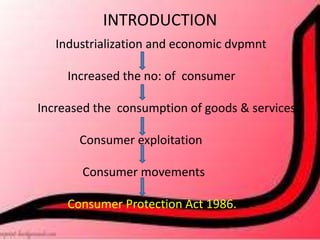
Industrialization and economic dvpmnt
Increased the no: of consumer
Increased the consumption of goods & services.
Consumer exploitation
Consumer movements
Consumer Protection Act 1986.
OBJECTIVES OF
THE ACT
Promoting and protecting
the consumer rights.
Providing for the
establishment of consumer
council and other
authorities.
Providing speedy and
simple redressal machinery
at district state and central
level for settling consumer
disputes and related
matters.
CONSUMER
A person who buys/avails
any goods/service for a
consideration which has
been paid/ promised/ partly
paid and partly promised or
under scheme of deferred
payment and includes other
user of such goods/service
with the approval of the
buyer.
Note
• Consumer does not include a
person who obtains goods or
avails services for commercial
purpose or re-sale, or given
free of charge
Service
Sec2(1)(0) of the act defines the
word service. It means service of
any description which is made
available to potential users
includes the facilities in
connection with
banking, financing, insurance, tr
ansport, processing, supply of
electrical or other
energy, boarding or both house
construction, entertainment, am
usement or other
information,but it does not
include the rendering of service
free of chargeor under a
contract of free of service.
• Instances of
commercial purpose
not treated as
consumers
• Purchase of vehicle for
running it as taxi
• Purchase of goods for
resale
• Purchase of
photocopier for
commercial purpose
• Instances of commercial
purpose treated as
consumers
• A railway passenger is a
consumer
• An employee who is a
member of EPF
• A person using electricity
for commercial purpose
• Nominee under a policy
of life insurance.
•The r/s of teacher and student in an educatnal institution is not
a service
•Service rendered by the govt servants under the central govt
health insurance scheme are not covered by the term service
Consumer RightsSafety
Education
Choose Information
Redressal
Heard
Objectives of CPA, 1986
UNFAIR TRADE
PRACTICE
• Unfair method or deceptive
practice adopted for
promoting the sale, use or
supply of any goods or for
the provision of any
services.
1. Misleading Advertisements
and False representation
2. Bargain sale
3. Offering gifts or prizes with the
intention of not providing it.
4. Non compliance of prescribed
standards
5. Hoarding/destruction of goods
Consumer
protection council
• The COPRA 1986 provides
the constitution of
consumer protection
council at the
• central
• state and
• district levels.
CENTRAL CONSUMER PROTECTION
COUNCIL
• 150 members
• Headed by minister in charge of consumer affiars
Also includes:
• Minister/Deputy minister of state for food&civil
supplies.
• Members of parliament
• Consumer of SC and ST
• Representatives of consumer org.
• The term of council is for 3 yrs.
• It shall have the jurisdiction to entertain
complaints where the value of the goods or
services and compensation the claim exceeds Rs.
1 Crore
State consumer protection council
• Established by state govt
• Includes
• Minister in charge of the consumer affairs in the state govt
- chairman
• Members nominated by the state and central govt.
• It shall have the jurisdiction to entertain complaints
where the value of the goods or services and
compensation, if any, claimed exceeds Rs. 20 Lakhs
but does not exceed Rs.1 Crore
OBJECTS OF THE COUNCIL:
• To promote and protect within the state the rights of the
consumer.
District consumer protection council
• Established by state govt
• Includes:
• District collector-chairman
• Official and non official members nominated by the state
govt
• It shall have jurisdiction to entertain complaints
where the value of the goods or services and the
compensation, if any, claimed does not exceed
Rs.20 Lakhs
• OBJECTS:
• To promote and protect the rights of the consumer within
the district
Content of Consumer Complaint
• Details of the complainant.
• Details of the opposite party or parties.
• The facts relating to complaint and when and where it arose.
• Documents, if any, in support of the allegations contained in the complaint.
• Relief which the complainant is seeking.
• Complaint should be addressed to the president of the forum.
• Within 21 days a copy is sent to the opposite party to give his version of the case.
• In case of failure the district forum will proceed in the manner under sec13(c )(g)of
COPRA.
• In case of alleged goods require analysis it will be sent to laboratory for testing by
district forum.The copy of the result will be sent to the opposite party.
• If the allegations made is found true by the district forum the following are the
remedies:
Remedies Under COPRA
• To remove the defects pointed out by the appropriate laboratory
from goods in question
• To withdraw the hazardous goods from being offered for sale
• To cease from manufacturing of hazardous goods
• Not to offer the hazardous goods for sale.
• Issue of corrective advertisement
• Provision of adequate costs to parties
• To replace the goods with new goods of similar description
which shall be free from any defect
• To return to the complainant the price, or, as the case may be, the
charges paid by the complainant.
• To remove the defects or deficiencies in the services in question
• To discontinue the unfair trade practice or the restrictive trade
practice or not to repeat them.
Copra 1986
Copra 1986

Copra 1986

  • 2.
    INTRODUCTION Industrialization and economicdvpmnt Increased the no: of consumer Increased the consumption of goods & services. Consumer exploitation Consumer movements Consumer Protection Act 1986.
  • 3.
    OBJECTIVES OF THE ACT Promotingand protecting the consumer rights. Providing for the establishment of consumer council and other authorities. Providing speedy and simple redressal machinery at district state and central level for settling consumer disputes and related matters.
  • 4.
    CONSUMER A person whobuys/avails any goods/service for a consideration which has been paid/ promised/ partly paid and partly promised or under scheme of deferred payment and includes other user of such goods/service with the approval of the buyer. Note • Consumer does not include a person who obtains goods or avails services for commercial purpose or re-sale, or given free of charge
  • 5.
    Service Sec2(1)(0) of theact defines the word service. It means service of any description which is made available to potential users includes the facilities in connection with banking, financing, insurance, tr ansport, processing, supply of electrical or other energy, boarding or both house construction, entertainment, am usement or other information,but it does not include the rendering of service free of chargeor under a contract of free of service.
  • 6.
    • Instances of commercialpurpose not treated as consumers • Purchase of vehicle for running it as taxi • Purchase of goods for resale • Purchase of photocopier for commercial purpose • Instances of commercial purpose treated as consumers • A railway passenger is a consumer • An employee who is a member of EPF • A person using electricity for commercial purpose • Nominee under a policy of life insurance. •The r/s of teacher and student in an educatnal institution is not a service •Service rendered by the govt servants under the central govt health insurance scheme are not covered by the term service
  • 7.
  • 8.
    UNFAIR TRADE PRACTICE • Unfairmethod or deceptive practice adopted for promoting the sale, use or supply of any goods or for the provision of any services. 1. Misleading Advertisements and False representation 2. Bargain sale 3. Offering gifts or prizes with the intention of not providing it. 4. Non compliance of prescribed standards 5. Hoarding/destruction of goods
  • 10.
    Consumer protection council • TheCOPRA 1986 provides the constitution of consumer protection council at the • central • state and • district levels.
  • 11.
    CENTRAL CONSUMER PROTECTION COUNCIL •150 members • Headed by minister in charge of consumer affiars Also includes: • Minister/Deputy minister of state for food&civil supplies. • Members of parliament • Consumer of SC and ST • Representatives of consumer org. • The term of council is for 3 yrs. • It shall have the jurisdiction to entertain complaints where the value of the goods or services and compensation the claim exceeds Rs. 1 Crore
  • 12.
    State consumer protectioncouncil • Established by state govt • Includes • Minister in charge of the consumer affairs in the state govt - chairman • Members nominated by the state and central govt. • It shall have the jurisdiction to entertain complaints where the value of the goods or services and compensation, if any, claimed exceeds Rs. 20 Lakhs but does not exceed Rs.1 Crore OBJECTS OF THE COUNCIL: • To promote and protect within the state the rights of the consumer.
  • 13.
    District consumer protectioncouncil • Established by state govt • Includes: • District collector-chairman • Official and non official members nominated by the state govt • It shall have jurisdiction to entertain complaints where the value of the goods or services and the compensation, if any, claimed does not exceed Rs.20 Lakhs • OBJECTS: • To promote and protect the rights of the consumer within the district
  • 14.
    Content of ConsumerComplaint • Details of the complainant. • Details of the opposite party or parties. • The facts relating to complaint and when and where it arose. • Documents, if any, in support of the allegations contained in the complaint. • Relief which the complainant is seeking. • Complaint should be addressed to the president of the forum. • Within 21 days a copy is sent to the opposite party to give his version of the case. • In case of failure the district forum will proceed in the manner under sec13(c )(g)of COPRA. • In case of alleged goods require analysis it will be sent to laboratory for testing by district forum.The copy of the result will be sent to the opposite party. • If the allegations made is found true by the district forum the following are the remedies:
  • 15.
    Remedies Under COPRA •To remove the defects pointed out by the appropriate laboratory from goods in question • To withdraw the hazardous goods from being offered for sale • To cease from manufacturing of hazardous goods • Not to offer the hazardous goods for sale. • Issue of corrective advertisement • Provision of adequate costs to parties • To replace the goods with new goods of similar description which shall be free from any defect • To return to the complainant the price, or, as the case may be, the charges paid by the complainant. • To remove the defects or deficiencies in the services in question • To discontinue the unfair trade practice or the restrictive trade practice or not to repeat them.