Bitcoin
A Peer-to-Peer
Electronic Cash System
Author: Satoshi Nakamoto
Presenter:
Course:
Professors:

Flavio Vit
UNICAMP –IA368
Christian Esteve Rothenberg,
Mauricio Ferreira Magalhães
November 20, 2013
Agenda
 Introduction
 Key Concepts
 BTC Transactions
 BTC Mining
 Bitcoins
 Proof of Work
 Digital Wallet
 Security

 Legal Considerations
 Conclusion
Introduction
What is Bitcoin?

 First decentralized digital / virtual currency
 Crypto Peer to Peer currency
 Electronic payment system based on cryptographic proof instead
of trust

 Developed by a person or group under the pseudonym of
Satoshi Nakamoto in 2008 / Operational since early 2009

 No financial institutions is managing
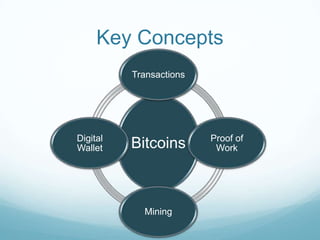
Key Concepts
Transactions

Digital
Wallet

Bitcoins

Mining

Proof of
Work
BTC Transactions
 Straight between the owner and the receiver
 Broadcasted through the P2P network
 All are public but anonymous
 Mining nodes collects the transactions into Blocks
BTC Transactions
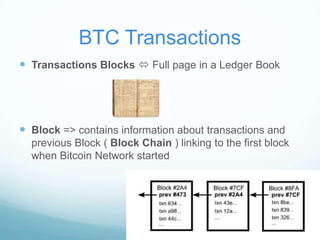
 Transactions Blocks  Full page in a Ledger Book

 Block => contains information about transactions and
previous Block ( Block Chain ) linking to the first block
when Bitcoin Network started
BTC Transactions
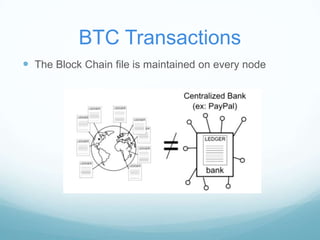
 The Block Chain file is maintained on every node
BTC Transactions
 Each Block carries a Proof of Work

 BTC are generated for the machine which solved the
Proof of Work

 New block is started and linked to the block chain

 First transaction in a block = Special transaction = new
coins owned by the creator of the block

 New block chain status is broadcasted to the network
BTC Transactions
Fighting Transactions Hackers

 Transaction history cannot be changed unless redoing
all Proof of Work of all blocks in the chain

 Redoing the proof of work since the very first
transaction block =>
power

Enormous computational

 Double spending problem => solved using a P2P
distributed timestamp server to generate computational
proof of the chronological order of transactions
BTC Mining
• No centralized entity for generating BTC
• Mining Process => Solve the Proof of Work from a
Transaction Block

• Confirms transactions and increase security
• User can be miners and are rewarded by:
• Transactions fees for the transactions they confirm
• New block created / proof of work solved? => 25 BTC today

• Mining is a competitive market $$$$$$
• More miners => More secure network
BTC Mining
 September 2013 => 11,5 Million Bitcoins

 Bitcoins are generated in blocks
 Currently 25 Bitcoins are mined per block
 A New Block are generated every 10 minutes
 The mined BTC are kept with the PC which solved the
proof of work
BTC Mining
 BTC are generated in a steady rate

 In Jan 2009, 1 Transaction Block solved = 50 BTC
 After 210.000 transaction blocks, the reward drops by
50%

 BTC generation => to stop by 2140
 21 Million Bitcoins will be generated

 After 2140 the incentive will be only the transaction
fee
BTC Mining
Mining nodes

 Initially, CPU power to solve the Proof of Work for
Transaction Blocks

 Graphic cards solve faster the Proof of Work

 New dedicated chips for performing mining
 Miners are crucial BTC network by ensuring:
•
•
•

Impartial
Stable
Secure
Bitcoins
 BTC are entries in the transactions blocks / in the
ledger book

 Someone receives a BTC => transaction logged in the
transaction block chain (unconfirmed until Proof of
Work is solved)

 BTC ownership and transfer are ensured by digital
signatures (crypto private and public keys)
Proof of Work
 Protocol challenging the mining nodes

 Tough to be solved X Easy to be verified
 Every 2 weeks, BTC generation rate is auto adjusted.
 Increasing / decreasing the difficulty of the Proof of
Work => targeting 10 minutes block generation

 Solving the puzzle => Winning a lottery
Proof of Work
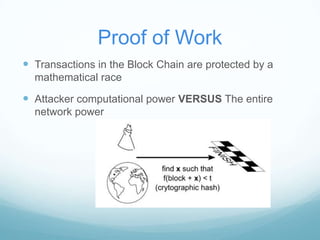
 Transactions in the Block Chain are protected by a
mathematical race

 Attacker computational power VERSUS The entire
network power
Proof of Work
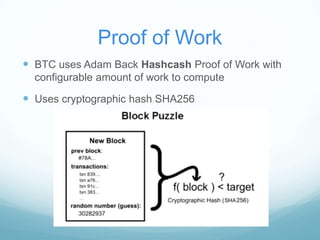
 BTC uses Adam Back Hashcash Proof of Work with
configurable amount of work to compute

 Uses cryptographic hash SHA256
Proof of Work
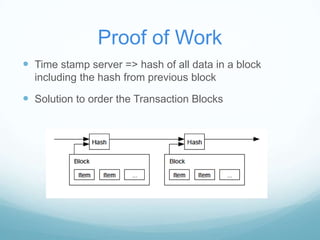
 Time stamp server => hash of all data in a block
including the hash from previous block

 Solution to order the Transaction Blocks
Proof of Work
 Typical PC may take several years to solve it

 Solved in 10 minutes using the BTC network
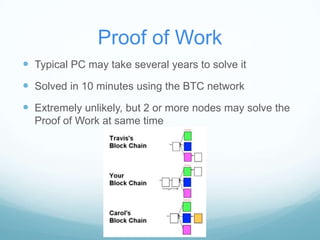
 Extremely unlikely, but 2 or more nodes may solve the
Proof of Work at same time
Proof of Work
 Branches in the block chain are created in this case

 Tie!!! => to be broken when someone solves the next
block

 Nodes will switch to the longest branch

 Blocks will be discarded and respective transactions
will be handled by the wining branch

 The block chain stabilizes and nodes agree with the
chain sequence
Digital Wallet
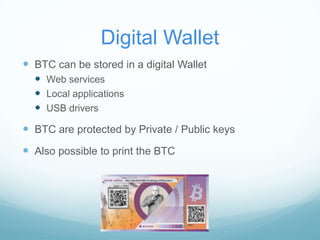
 BTC can be stored in a digital Wallet
 Web services
 Local applications
 USB drivers

 BTC are protected by Private / Public keys
 Also possible to print the BTC
Digital Wallet
 No one can lock or freeze your money like a bank
account

 Bitcoins fraction => the smallest fraction:
1 Satoshi  0.00000001 BTC

 Losing your private key => losing yours BTCs
…Forever gone from BTC economy

 BTC is deflationary!
Security
 No one can change the BTC software without the
majority of the entire network of users accepting the
change

 While the majority of the nodes are honest, attackers
cannot harm the system

 End of Block Chain Insecurity => Branches => Double
Spending attack => Protected by the Hashcash / Time
Stamp Server

 The attacker would need astronomical computer power
to corrupt the block chain
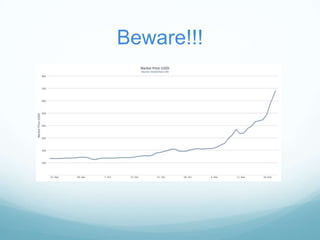
Beware!!!
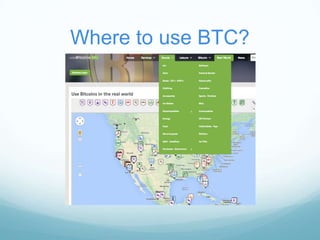
Where to use BTC?
Legal Considerations
 Money laundry – practically impossible to track BTC
transactions

• FBI x Silk Road – Bitcoin used for trading drugs among
other illicit products.
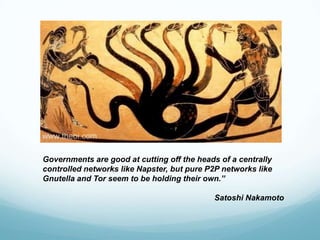
Governments are good at cutting off the heads of a centrally
controlled networks like Napster, but pure P2P networks like
Gnutella and Tor seem to be holding their own.”

Satoshi Nakamoto
Conclusions
 BTC: P2P digital currency with mathematic protection
 No centralized control / No evil Central Bank
 The exchange rates may oscillate drastically
“…we don’t really understand how that worked, as
economists.” - Lawrence White, economics professor
at George Mason University / IEEE Spectrum
interview
Conclusions
 No government can print more money

 Anonymity
 Lower global transaction costs
 A new bubble may emerge
 Oct 2013 = 150 USD
 Nov 2013 > 500 USD

 March 28th 2013: BTC passed the 1 Billion USD (11
million Bitcoins in circulation)
References
1. Satoshi Nakamoto. Bitcoin: A Peer-to-Peer Electronic Cash System.
http://bitcoin.org/bitcoin.pdf

2. Khan Academy.http://www.youtube.com/user/khanacademy
3. Scott Driscoll. How Bitcoin Works Under the Hood.
4. http://www.imponderablethings.com/2013/07/how-bitcoin-works-underhood.html

5. Adam Back. Hashcash. http://www.hashcash.org/

Bitcoin A Peer-to-Peer Electronic Cash System

  • 1.
    Bitcoin A Peer-to-Peer Electronic CashSystem Author: Satoshi Nakamoto Presenter: Course: Professors: Flavio Vit UNICAMP –IA368 Christian Esteve Rothenberg, Mauricio Ferreira Magalhães November 20, 2013
  • 2.
    Agenda  Introduction  KeyConcepts  BTC Transactions  BTC Mining  Bitcoins  Proof of Work  Digital Wallet  Security  Legal Considerations  Conclusion
  • 3.
    Introduction What is Bitcoin? First decentralized digital / virtual currency  Crypto Peer to Peer currency  Electronic payment system based on cryptographic proof instead of trust  Developed by a person or group under the pseudonym of Satoshi Nakamoto in 2008 / Operational since early 2009  No financial institutions is managing
  • 4.
  • 5.
    BTC Transactions  Straightbetween the owner and the receiver  Broadcasted through the P2P network  All are public but anonymous  Mining nodes collects the transactions into Blocks
  • 6.
    BTC Transactions  TransactionsBlocks  Full page in a Ledger Book  Block => contains information about transactions and previous Block ( Block Chain ) linking to the first block when Bitcoin Network started
  • 7.
    BTC Transactions  TheBlock Chain file is maintained on every node
  • 8.
    BTC Transactions  EachBlock carries a Proof of Work  BTC are generated for the machine which solved the Proof of Work  New block is started and linked to the block chain  First transaction in a block = Special transaction = new coins owned by the creator of the block  New block chain status is broadcasted to the network
  • 9.
    BTC Transactions Fighting TransactionsHackers  Transaction history cannot be changed unless redoing all Proof of Work of all blocks in the chain  Redoing the proof of work since the very first transaction block => power Enormous computational  Double spending problem => solved using a P2P distributed timestamp server to generate computational proof of the chronological order of transactions
  • 10.
    BTC Mining • Nocentralized entity for generating BTC • Mining Process => Solve the Proof of Work from a Transaction Block • Confirms transactions and increase security • User can be miners and are rewarded by: • Transactions fees for the transactions they confirm • New block created / proof of work solved? => 25 BTC today • Mining is a competitive market $$$$$$ • More miners => More secure network
  • 11.
    BTC Mining  September2013 => 11,5 Million Bitcoins  Bitcoins are generated in blocks  Currently 25 Bitcoins are mined per block  A New Block are generated every 10 minutes  The mined BTC are kept with the PC which solved the proof of work
  • 12.
    BTC Mining  BTCare generated in a steady rate  In Jan 2009, 1 Transaction Block solved = 50 BTC  After 210.000 transaction blocks, the reward drops by 50%  BTC generation => to stop by 2140  21 Million Bitcoins will be generated  After 2140 the incentive will be only the transaction fee
  • 13.
    BTC Mining Mining nodes Initially, CPU power to solve the Proof of Work for Transaction Blocks  Graphic cards solve faster the Proof of Work  New dedicated chips for performing mining  Miners are crucial BTC network by ensuring: • • • Impartial Stable Secure
  • 14.
    Bitcoins  BTC areentries in the transactions blocks / in the ledger book  Someone receives a BTC => transaction logged in the transaction block chain (unconfirmed until Proof of Work is solved)  BTC ownership and transfer are ensured by digital signatures (crypto private and public keys)
  • 15.
    Proof of Work Protocol challenging the mining nodes  Tough to be solved X Easy to be verified  Every 2 weeks, BTC generation rate is auto adjusted.  Increasing / decreasing the difficulty of the Proof of Work => targeting 10 minutes block generation  Solving the puzzle => Winning a lottery
  • 16.
    Proof of Work Transactions in the Block Chain are protected by a mathematical race  Attacker computational power VERSUS The entire network power
  • 17.
    Proof of Work BTC uses Adam Back Hashcash Proof of Work with configurable amount of work to compute  Uses cryptographic hash SHA256
  • 18.
    Proof of Work Time stamp server => hash of all data in a block including the hash from previous block  Solution to order the Transaction Blocks
  • 19.
    Proof of Work Typical PC may take several years to solve it  Solved in 10 minutes using the BTC network  Extremely unlikely, but 2 or more nodes may solve the Proof of Work at same time
  • 20.
    Proof of Work Branches in the block chain are created in this case  Tie!!! => to be broken when someone solves the next block  Nodes will switch to the longest branch  Blocks will be discarded and respective transactions will be handled by the wining branch  The block chain stabilizes and nodes agree with the chain sequence
  • 21.
    Digital Wallet  BTCcan be stored in a digital Wallet  Web services  Local applications  USB drivers  BTC are protected by Private / Public keys  Also possible to print the BTC
  • 22.
    Digital Wallet  Noone can lock or freeze your money like a bank account  Bitcoins fraction => the smallest fraction: 1 Satoshi  0.00000001 BTC  Losing your private key => losing yours BTCs …Forever gone from BTC economy  BTC is deflationary!
  • 23.
    Security  No onecan change the BTC software without the majority of the entire network of users accepting the change  While the majority of the nodes are honest, attackers cannot harm the system  End of Block Chain Insecurity => Branches => Double Spending attack => Protected by the Hashcash / Time Stamp Server  The attacker would need astronomical computer power to corrupt the block chain
  • 24.
  • 25.
  • 26.
    Legal Considerations  Moneylaundry – practically impossible to track BTC transactions • FBI x Silk Road – Bitcoin used for trading drugs among other illicit products.
  • 27.
    Governments are goodat cutting off the heads of a centrally controlled networks like Napster, but pure P2P networks like Gnutella and Tor seem to be holding their own.” Satoshi Nakamoto
  • 28.
    Conclusions  BTC: P2Pdigital currency with mathematic protection  No centralized control / No evil Central Bank  The exchange rates may oscillate drastically “…we don’t really understand how that worked, as economists.” - Lawrence White, economics professor at George Mason University / IEEE Spectrum interview
  • 29.
    Conclusions  No governmentcan print more money  Anonymity  Lower global transaction costs  A new bubble may emerge  Oct 2013 = 150 USD  Nov 2013 > 500 USD  March 28th 2013: BTC passed the 1 Billion USD (11 million Bitcoins in circulation)
  • 30.
    References 1. Satoshi Nakamoto.Bitcoin: A Peer-to-Peer Electronic Cash System. http://bitcoin.org/bitcoin.pdf 2. Khan Academy.http://www.youtube.com/user/khanacademy 3. Scott Driscoll. How Bitcoin Works Under the Hood. 4. http://www.imponderablethings.com/2013/07/how-bitcoin-works-underhood.html 5. Adam Back. Hashcash. http://www.hashcash.org/