Mike Wright and Enrico Vanino
E: mike.wright@imperial.ac.uk
Project 12: Accessing and
using alternative finance
Introduction
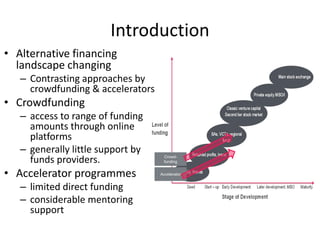
• Alternative financing
landscape changing
– Contrasting approaches by
crowdfunding & accelerators
• Crowdfunding
– access to range of funding
amounts through online
platforms
– generally little support by
funds providers.
• Accelerator programmes
– limited direct funding
– considerable mentoring
support
Accelerator
Crowd-
funding
Three Questions
1. To what extent are entrepreneurs using
crowdfunding as an alternative source of
finance?
2. What is the impact of alternative funding
sources on ventures receiving this funding?
3. What is the role and nature of social
networks in a successful alternative finance
campaign?
• To what extent are entrepreneurs using
crowdfunding as an alternative source of
finance?
– UK SME Finance Monitor Data
– Share of companies using crowdfunding, and
share of total funding it represents
– Analyse characteristics of firms using
crowdfunding compared with those that do not.
• What is the impact of alternative funding
sources on ventures receiving this funding?
– UK SME Finance Monitor data
– Relationship between the use of crowdfunding
and firm outcomes (controlling for other sources
of funding)
• Growth, exporting, profitability, productivity
– Linkages between crowdfunding, business angels
and VCs.
• What is the role and nature of social networks in a successful
alternative finance campaign?
• Crowdfunding
– 1/3 of funding on Kickstarter raised by serial crowdfunders
– Entrepreneurs develop “internal” social capital comprising links with
others on platform.
– Rise in serial crowdfunders.
• entrepreneurs carve out from the crowd a community of support for
subsequent crowdfunding campaigns to ensure campaign success.
– How effective?
• If already possess sufficient social capital within a crowdfunding platform
through backing others’ campaigns, is additional effect of the social capital
originating from previous successful campaigns weak?
• If backers have many alternative funding opportunities, does social capital
needs to be maintained by launching new campaigns, otherwise becomes
obsolete over time?
• To what extent and how do community members engage with entrepreneur
after investment through posting? How do these contribute to venture
development and obtaining further funding?
– We explore these issues using Kickstarter data.
• What is the role and nature of social networks in
a successful alternative finance campaign?
• Accelerators
– Provide bridge to follow-on funding from more
traditional providers
– Many accelerators now facing choices of raising
further funds, closing, merging or changing their
strategies.
• (1) the extent to which accelerator programs have
succeeded in providing follow-on finance for cohort firms?
• (2) the longevity and adaptation of accelerators?
– Nesta data downloadable from the BEIS website
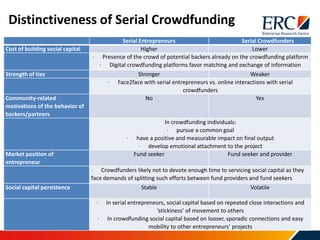
Serial Entrepreneurs Serial Crowdfunders
Cost of building social capital Higher Lower
· Presence of the crowd of potential backers already on the crowdfunding platform
· Digital crowdfunding platforms favor matching and exchange of information
Strength of ties Stronger Weaker
· Face2face with serial entrepreneurs vs. online interactions with serial
crowdfunders
Community-related
motivations of the behavior of
backers/partners
No Yes
In crowdfunding individuals:
· pursue a common goal
· have a positive and measurable impact on final output
· develop emotional attachment to the project
Market position of
entrepreneur
Fund seeker Fund seeker and provider
· Crowdfunders likely not to devote enough time to servicing social capital as they
face demands of splitting such efforts between fund providers and fund seekers
Social capital persistence Stable Volatile
· In serial entrepreneurs, social capital based on repeated close interactions and
‘stickiness’ of movement to others
· In crowdfunding social capital based on looser, sporadic connections and easy
mobility to other entrepreneurs’ projects
Distinctiveness of Serial Crowdfunding
Some preliminary findings
• 31,389 Kickstarter campaigns
• Serial crowdfunders’ campaign success mainly related to
“internal” social capital in links with backers of previous
successful campaigns.
– launching several successful crowdfunding campaigns over time
gives entrepreneurs opportunity to interact with backers of
their projects
– This social capital substitutes for that developed by serial
crowdfunders within the platform from backing others’
campaigns
• Social capital from previously successful campaigns
depreciates over time
– no effect on success likelihood of subsequent campaigns if time
elapsed since last campaign is high.
Preliminary implications
• Serial crowdfunders
– maintain social capital by posting new funding campaigns over time.
– as social capital from earlier campaigns substitutes for other forms of social
capital, entrepreneurs with “internal” (platform) social capital from previous
successful campaigns should avoid backing other projects as a strategy to
develop internal social capital.
• Platform managers
– to build an active community with numerous members design solutions to
keep project proponents and backers on their platforms
• introducing forums to allow backers and proponents to interact
• implement effective updating system to bring backers frequently to the platform
• Policy
– support for serial entrepreneurs/crowdfunders needs to recognize that
benefits of serials may only be temporary
• Consider timing of last previous venture
THANK YOU – QUESTIONS and COMMENTS?
If you would like any more information about this research please contact us:
Mike Wright: mike.wright@imperial.ac.uk
Enrico Vanino: e.vanino@aston.ac.uk

Project 12 presentation. Research Showcase. june 2017

  • 1.
    Mike Wright andEnrico Vanino E: mike.wright@imperial.ac.uk Project 12: Accessing and using alternative finance
  • 2.
    Introduction • Alternative financing landscapechanging – Contrasting approaches by crowdfunding & accelerators • Crowdfunding – access to range of funding amounts through online platforms – generally little support by funds providers. • Accelerator programmes – limited direct funding – considerable mentoring support Accelerator Crowd- funding
  • 3.
    Three Questions 1. Towhat extent are entrepreneurs using crowdfunding as an alternative source of finance? 2. What is the impact of alternative funding sources on ventures receiving this funding? 3. What is the role and nature of social networks in a successful alternative finance campaign?
  • 4.
    • To whatextent are entrepreneurs using crowdfunding as an alternative source of finance? – UK SME Finance Monitor Data – Share of companies using crowdfunding, and share of total funding it represents – Analyse characteristics of firms using crowdfunding compared with those that do not.
  • 5.
    • What isthe impact of alternative funding sources on ventures receiving this funding? – UK SME Finance Monitor data – Relationship between the use of crowdfunding and firm outcomes (controlling for other sources of funding) • Growth, exporting, profitability, productivity – Linkages between crowdfunding, business angels and VCs.
  • 6.
    • What isthe role and nature of social networks in a successful alternative finance campaign? • Crowdfunding – 1/3 of funding on Kickstarter raised by serial crowdfunders – Entrepreneurs develop “internal” social capital comprising links with others on platform. – Rise in serial crowdfunders. • entrepreneurs carve out from the crowd a community of support for subsequent crowdfunding campaigns to ensure campaign success. – How effective? • If already possess sufficient social capital within a crowdfunding platform through backing others’ campaigns, is additional effect of the social capital originating from previous successful campaigns weak? • If backers have many alternative funding opportunities, does social capital needs to be maintained by launching new campaigns, otherwise becomes obsolete over time? • To what extent and how do community members engage with entrepreneur after investment through posting? How do these contribute to venture development and obtaining further funding? – We explore these issues using Kickstarter data.
  • 7.
    • What isthe role and nature of social networks in a successful alternative finance campaign? • Accelerators – Provide bridge to follow-on funding from more traditional providers – Many accelerators now facing choices of raising further funds, closing, merging or changing their strategies. • (1) the extent to which accelerator programs have succeeded in providing follow-on finance for cohort firms? • (2) the longevity and adaptation of accelerators? – Nesta data downloadable from the BEIS website
  • 8.
    Serial Entrepreneurs SerialCrowdfunders Cost of building social capital Higher Lower · Presence of the crowd of potential backers already on the crowdfunding platform · Digital crowdfunding platforms favor matching and exchange of information Strength of ties Stronger Weaker · Face2face with serial entrepreneurs vs. online interactions with serial crowdfunders Community-related motivations of the behavior of backers/partners No Yes In crowdfunding individuals: · pursue a common goal · have a positive and measurable impact on final output · develop emotional attachment to the project Market position of entrepreneur Fund seeker Fund seeker and provider · Crowdfunders likely not to devote enough time to servicing social capital as they face demands of splitting such efforts between fund providers and fund seekers Social capital persistence Stable Volatile · In serial entrepreneurs, social capital based on repeated close interactions and ‘stickiness’ of movement to others · In crowdfunding social capital based on looser, sporadic connections and easy mobility to other entrepreneurs’ projects Distinctiveness of Serial Crowdfunding
  • 9.
    Some preliminary findings •31,389 Kickstarter campaigns • Serial crowdfunders’ campaign success mainly related to “internal” social capital in links with backers of previous successful campaigns. – launching several successful crowdfunding campaigns over time gives entrepreneurs opportunity to interact with backers of their projects – This social capital substitutes for that developed by serial crowdfunders within the platform from backing others’ campaigns • Social capital from previously successful campaigns depreciates over time – no effect on success likelihood of subsequent campaigns if time elapsed since last campaign is high.
  • 10.
    Preliminary implications • Serialcrowdfunders – maintain social capital by posting new funding campaigns over time. – as social capital from earlier campaigns substitutes for other forms of social capital, entrepreneurs with “internal” (platform) social capital from previous successful campaigns should avoid backing other projects as a strategy to develop internal social capital. • Platform managers – to build an active community with numerous members design solutions to keep project proponents and backers on their platforms • introducing forums to allow backers and proponents to interact • implement effective updating system to bring backers frequently to the platform • Policy – support for serial entrepreneurs/crowdfunders needs to recognize that benefits of serials may only be temporary • Consider timing of last previous venture
  • 11.
    THANK YOU –QUESTIONS and COMMENTS? If you would like any more information about this research please contact us: Mike Wright: mike.wright@imperial.ac.uk Enrico Vanino: e.vanino@aston.ac.uk