By : Hardik Patel


                    1
 Also known as the crowd financing, equity crowd
    funding, or hyper funding.
   It is a method of funding that allows individuals to
    utilize their personal networks to raise capital and
    support their cause or business.
   Campaign organizers create an online profile to
    explain their fundraise goals and share their project
    with friends, family, social networks, etc.
   It can be for profitable or non profitable purposes.
   It has its origins in the concept of crowd sourcing.

                                                            2
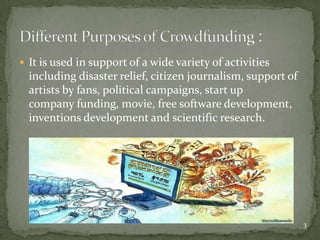
 It is used in support of a wide variety of activities
  including disaster relief, citizen journalism, support of
  artists by fans, political campaigns, start up
  company funding, movie, free software development,
  inventions development and scientific research.


                                                              3
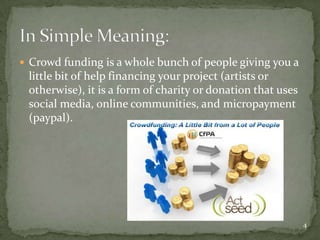
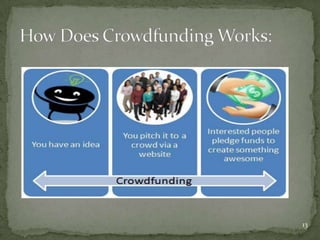
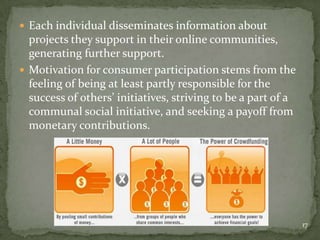
 Crowd funding is a whole bunch of people giving you a
 little bit of help financing your project (artists or
 otherwise), it is a form of charity or donation that uses
 social media, online communities, and micropayment
 (paypal).


                                                             4
 Crowdfunding has a long and rich history with roots
    going back to the 1700's.
   1997- The Inception of Modern Day Crowdfunding
   2009- Crowdfunding Emerges as a Major Funding
    Source
   2011- Crowdfunding Gains Washington's Support
   2012- Fundable Launches the First Business
    Crowdfunding Platform


                                                        5
 Crowdfunding is a rapidly growing industry
 Average successful crowdfunding campaign is around
    $7,000 and lasts around 9 weeks.
   Campaigns that can gain 30% of their goal within the first
    week are more likely to succeed.
   Social Media is a critical factor in crowdfunding success: for
    every order of magnitude increase in Facebook friends (10,
    100, 1000), the probability of success increases drastically
    (from 9%-, 20%, to 40%).
   Individuals ages 24-35 and mostly men are much more
    likely to participate in crowdfunding campaign.
   Those earning over $100,000 per year are the most likely to
    invest in startups through crowdfunding.
                                                                     6
 Crowdfunding platforms serve as a “network
  orchestrators”. They create the necessary
  organizational systems and conditions for resource
  integration among other players to take place.
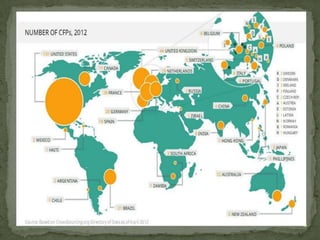
 The emergence of CFPs around the globe is
  accelerating. By the end of 2012 there are expected to
  be more than 530 platforms, up 60% since last year.
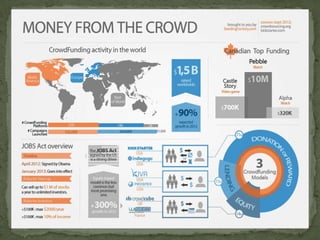
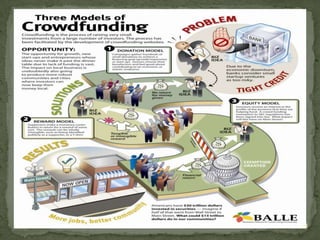
 Crowdsourcing.org breaks these down into four
  categories: Donation-Based, Reward-Based
  (accounting for the majority), Lending-Based and
  Equity-Based.
                                                           7
8
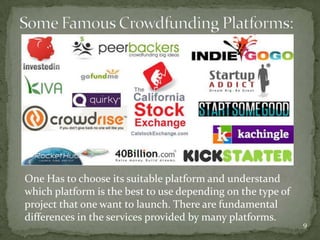
One Has to choose its suitable platform and understand
which platform is the best to use depending on the type of
project that one want to launch. There are fundamental
differences in the services provided by many platforms.
                                                             9
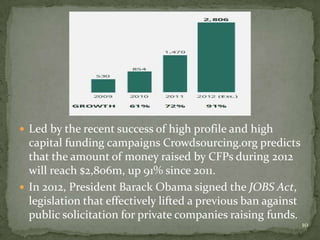
 Led by the recent success of high profile and high
  capital funding campaigns Crowdsourcing.org predicts
  that the amount of money raised by CFPs during 2012
  will reach $2,806m, up 91% since 2011.
 In 2012, President Barack Obama signed the JOBS Act,
  legislation that effectively lifted a previous ban against
  public solicitation for private companies raising funds.
                                                               10
11
 Though funding is often the main goal of a campaign,
  it can also a fantastic way to gain visibility and grow
  your customer base.
 Some additional ancillary benefits of a great fundraise
  are:
   Traction
   Social proof
   Press coverage
   Marketing
   Potential investor interest.


                                                            12
13
14
15
 The inputs of the individuals in the crowd trigger to
  crowdfunding process and influence the ultimate
  value of the offerings or outcomes of the process.
 Each individual acts as an agent of the offering,
  selecting and promoting the projects in which they
  believe.
 The will sometimes play a donor role oriented towards
  providing help on social projects. In some cases they
  will become shareholders and contribute to the
  development and growth of the offering.

                                                          16
 Each individual disseminates information about
  projects they support in their online communities,
  generating further support.
 Motivation for consumer participation stems from the
  feeling of being at least partly responsible for the
  success of others’ initiatives, striving to be a part of a
  communal social initiative, and seeking a payoff from
  monetary contributions.


                                                               17
 Social entrepreneurs of all varieties are turning to
  crowdfunding to launch or expand their social efforts;
  Here below are some examples of Social entrepreneurs
  who raised funds for their venture by using
  crowdfunding platforms.


                                                           18
 Rebecca Pontius led the effort for an organization
 called the Do Good Bus to raise $100,000 on
 StartSomeGood to show people how to volunteer by
 taking them on a bus to volunteer all around the
 country.

 Martha Griffin raised $31,763 on Kickstarter to publish
 a children’s book called Sam’s Birthmark.


                                                            19
 Jennifer Windrum raised $35,000 on StartSomeGood
 for SMAC—Sock Monkeys Against Cancer.

 Kristopher Young, head of PROViDE, which provides
 care for people in Haiti, raised over $2,000 on
 StartSomeGood for a dry composting toilet.

 Brad Hurvitz, founder of Trek to Teach, raised $2,910
 on StartSomeGood.


                                                          20
http://www.youtube.com/watch?fe
ature=player_embedded&v=qZQla
Zvzf78


                                  21
 Richards, L. (2012, June 15). Crowdfunding in numbers:
      stats. Retrieved from
      http://econsultancy.com/ca/blog/10074-
      crowdfunding-in-numbers-stats
 Thorpe, D. (2013, January 01). Crowdfunding success
      stories include $35,000 for sock monkeys and
      $2,000 for a dry composting toilet. Retrieved from
      http://www.forbes.com/sites/devinthorpe/2013/01
      /30/crowdfunding-success-stories-include-35000-
      for-sock-monkeys-and-2000-for-a-dry-
      composting-toilet/
                                                           22
 Gofundme. (2012, May 12). http://www.gofundme.com.
      Retrieved from
      http://www.gofundme.com/crowdfunding-
      websites/
 Wikipedia contributors. (n.d.). Wikipedia, the free
      encyclopedia. In Wikipedia, The Free
      Encyclopedia. Retrieved from
      http://en.wikipedia.org/wiki/Crowd_funding
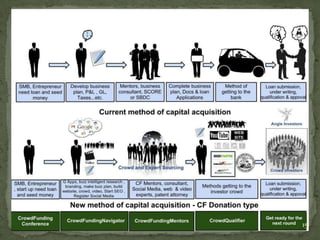
 Khorram, D. (Producer). (2012). Current method of capital
      acquisition vs new method of capital acquisition - cf
      donation type. Retrieved from
      http://www.crowdfundingplanning.com/blog-
      crowdfunding_planning-Conference-
      cloud_based_business_planning-
      crowdfunding_softwarecrowdfunding-
      crowdfunding_exchange/traditionalcapitalacquisition
      vscrowdfunding
                                                              23

Crowd funding

  • 1.
    By : HardikPatel 1
  • 2.
     Also knownas the crowd financing, equity crowd funding, or hyper funding.  It is a method of funding that allows individuals to utilize their personal networks to raise capital and support their cause or business.  Campaign organizers create an online profile to explain their fundraise goals and share their project with friends, family, social networks, etc.  It can be for profitable or non profitable purposes.  It has its origins in the concept of crowd sourcing. 2
  • 3.
     It isused in support of a wide variety of activities including disaster relief, citizen journalism, support of artists by fans, political campaigns, start up company funding, movie, free software development, inventions development and scientific research. 3
  • 4.
     Crowd fundingis a whole bunch of people giving you a little bit of help financing your project (artists or otherwise), it is a form of charity or donation that uses social media, online communities, and micropayment (paypal). 4
  • 5.
     Crowdfunding hasa long and rich history with roots going back to the 1700's.  1997- The Inception of Modern Day Crowdfunding  2009- Crowdfunding Emerges as a Major Funding Source  2011- Crowdfunding Gains Washington's Support  2012- Fundable Launches the First Business Crowdfunding Platform 5
  • 6.
     Crowdfunding isa rapidly growing industry  Average successful crowdfunding campaign is around $7,000 and lasts around 9 weeks.  Campaigns that can gain 30% of their goal within the first week are more likely to succeed.  Social Media is a critical factor in crowdfunding success: for every order of magnitude increase in Facebook friends (10, 100, 1000), the probability of success increases drastically (from 9%-, 20%, to 40%).  Individuals ages 24-35 and mostly men are much more likely to participate in crowdfunding campaign.  Those earning over $100,000 per year are the most likely to invest in startups through crowdfunding. 6
  • 7.
     Crowdfunding platformsserve as a “network orchestrators”. They create the necessary organizational systems and conditions for resource integration among other players to take place.  The emergence of CFPs around the globe is accelerating. By the end of 2012 there are expected to be more than 530 platforms, up 60% since last year.  Crowdsourcing.org breaks these down into four categories: Donation-Based, Reward-Based (accounting for the majority), Lending-Based and Equity-Based. 7
  • 8.
  • 9.
    One Has tochoose its suitable platform and understand which platform is the best to use depending on the type of project that one want to launch. There are fundamental differences in the services provided by many platforms. 9
  • 10.
     Led bythe recent success of high profile and high capital funding campaigns Crowdsourcing.org predicts that the amount of money raised by CFPs during 2012 will reach $2,806m, up 91% since 2011.  In 2012, President Barack Obama signed the JOBS Act, legislation that effectively lifted a previous ban against public solicitation for private companies raising funds. 10
  • 11.
  • 12.
     Though fundingis often the main goal of a campaign, it can also a fantastic way to gain visibility and grow your customer base.  Some additional ancillary benefits of a great fundraise are:  Traction  Social proof  Press coverage  Marketing  Potential investor interest. 12
  • 13.
  • 14.
  • 15.
  • 16.
     The inputsof the individuals in the crowd trigger to crowdfunding process and influence the ultimate value of the offerings or outcomes of the process.  Each individual acts as an agent of the offering, selecting and promoting the projects in which they believe.  The will sometimes play a donor role oriented towards providing help on social projects. In some cases they will become shareholders and contribute to the development and growth of the offering. 16
  • 17.
     Each individualdisseminates information about projects they support in their online communities, generating further support.  Motivation for consumer participation stems from the feeling of being at least partly responsible for the success of others’ initiatives, striving to be a part of a communal social initiative, and seeking a payoff from monetary contributions. 17
  • 18.
     Social entrepreneursof all varieties are turning to crowdfunding to launch or expand their social efforts; Here below are some examples of Social entrepreneurs who raised funds for their venture by using crowdfunding platforms. 18
  • 19.
     Rebecca Pontiusled the effort for an organization called the Do Good Bus to raise $100,000 on StartSomeGood to show people how to volunteer by taking them on a bus to volunteer all around the country.  Martha Griffin raised $31,763 on Kickstarter to publish a children’s book called Sam’s Birthmark. 19
  • 20.
     Jennifer Windrumraised $35,000 on StartSomeGood for SMAC—Sock Monkeys Against Cancer.  Kristopher Young, head of PROViDE, which provides care for people in Haiti, raised over $2,000 on StartSomeGood for a dry composting toilet.  Brad Hurvitz, founder of Trek to Teach, raised $2,910 on StartSomeGood. 20
  • 21.
  • 22.
     Richards, L.(2012, June 15). Crowdfunding in numbers: stats. Retrieved from http://econsultancy.com/ca/blog/10074- crowdfunding-in-numbers-stats  Thorpe, D. (2013, January 01). Crowdfunding success stories include $35,000 for sock monkeys and $2,000 for a dry composting toilet. Retrieved from http://www.forbes.com/sites/devinthorpe/2013/01 /30/crowdfunding-success-stories-include-35000- for-sock-monkeys-and-2000-for-a-dry- composting-toilet/ 22
  • 23.
     Gofundme. (2012,May 12). http://www.gofundme.com. Retrieved from http://www.gofundme.com/crowdfunding- websites/  Wikipedia contributors. (n.d.). Wikipedia, the free encyclopedia. In Wikipedia, The Free Encyclopedia. Retrieved from http://en.wikipedia.org/wiki/Crowd_funding  Khorram, D. (Producer). (2012). Current method of capital acquisition vs new method of capital acquisition - cf donation type. Retrieved from http://www.crowdfundingplanning.com/blog- crowdfunding_planning-Conference- cloud_based_business_planning- crowdfunding_softwarecrowdfunding- crowdfunding_exchange/traditionalcapitalacquisition vscrowdfunding 23